8D               Summary Sheets
             Habitats and environments
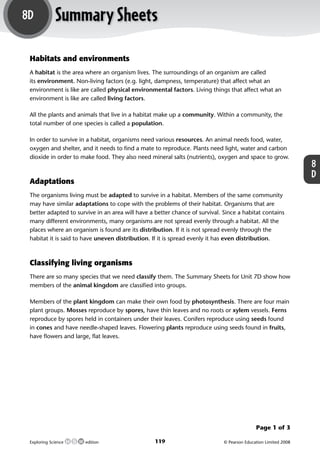
             A habitat is the area where an organism lives. The surroundings of an organism are called
             its environment. Non-living factors (e.g. light, dampness, temperature) that affect what an
             environment is like are called physical environmental factors. Living things that affect what an
             environment is like are called living factors.

             All the plants and animals that live in a habitat make up a community. Within a community, the
             total number of one species is called a population.

             In order to survive in a habitat, organisms need various resources. An animal needs food, water,
             oxygen and shelter, and it needs to find a mate to reproduce. Plants need light, water and carbon
             dioxide in order to make food. They also need mineral salts (nutrients), oxygen and space to grow.
                                                                                                                                     8
                                                                                                                                     D
             Adaptations
             The organisms living must be adapted to survive in a habitat. Members of the same community
             may have similar adaptations to cope with the problems of their habitat. Organisms that are
             better adapted to survive in an area will have a better chance of survival. Since a habitat contains
             many different environments, many organisms are not spread evenly through a habitat. All the
             places where an organism is found are its distribution. If it is not spread evenly through the
             habitat it is said to have uneven distribution. If it is spread evenly it has even distribution.


             Classifying living organisms
             There are so many species that we need classify them. The Summary Sheets for Unit 7D show how
             members of the animal kingdom are classified into groups.

             Members of the plant kingdom can make their own food by photosynthesis. There are four main
             plant groups. Mosses reproduce by spores, have thin leaves and no roots or xylem vessels. Ferns
             reproduce by spores held in containers under their leaves. Conifers reproduce using seeds found
             in cones and have needle-shaped leaves. Flowering plants reproduce using seeds found in fruits,
             have flowers and large, flat leaves.


                                                                                                        Page 1 of 3

             Exploring Science    edition                     119                        © Pearson Education Limited 2008


M04_ES_AB_Y8_5415_U8D.indd 119                                                                                          8/12/09 3:51:54 PM
8D               Summary Sheets (continued)

             Sampling methods
             Ecologists are scientists who study habitats. They catch organisms using various sampling
             methods, then use keys and field guides to identify them.

             Ecologists often need to know the size of a population. It would be impossible to count all the
             organisms in a habitat, so they take samples and then estimate the total population.

             A quadrat is a sampling square used to estimate plant populations. It is placed randomly on the
             ground and the number of plants inside it is counted each time. The more samples that are taken,
             the more reliable an estimate will be.

             Ecologists measure physical environmental factors, like how warm it is and how much oxygen is
8            dissolved in pond water, using sensors and data loggers. They see if there are any relationships
D            (links) between the factors, such as the warmer the water, the lower the oxygen level is.


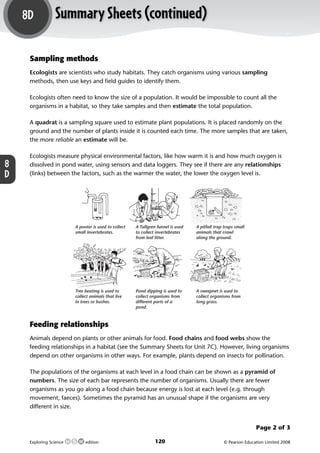
                                 A pooter is used to collect   A Tullgren funnel is used   A pitfall trap traps small
                                 small invertebrates.          to collect invertebrates    animals that crawl
                                                               from leaf litter.           along the ground.


                                 Tree beating is used to       Pond dipping is used to     A sweepnet is used to
                                 collect animals that live     collect organisms from      collect organisms from
                                 in trees or bushes.           different parts of a        long grass.
                                                               pond.


             Feeding relationships
             Animals depend on plants or other animals for food. Food chains and food webs show the
             feeding relationships in a habitat (see the Summary Sheets for Unit 7C). However, living organisms
             depend on other organisms in other ways. For example, plants depend on insects for pollination.

             The populations of the organisms at each level in a food chain can be shown as a pyramid of
             numbers. The size of each bar represents the number of organisms. Usually there are fewer
             organisms as you go along a food chain because energy is lost at each level (e.g. through
             movement, faeces). Sometimes the pyramid has an unusual shape if the organisms are very
             different in size.


                                                                                                                         Page 2 of 3

             Exploring Science        edition                            120                              © Pearson Education Limited 2008


M04_ES_AB_Y8_5415_U8D.indd 120                                                                                                           8/12/09 3:51:56 PM
8D               Summary Sheets (continued)

             Populations
             The size of a population is affected by several factors.

               • Animals compete with each other for resources such as food, water and shelter.
               • Plants compete for light, water, nutrients (mineral salts) and space.
               • Competition for resources may cause populations of some organisms to decrease.
               • Disease can kill organisms.
               • Poisons may kill organisms, or kill the organisms that they depend on. Poisons can build up in
                 the animals as you go along a food chain.
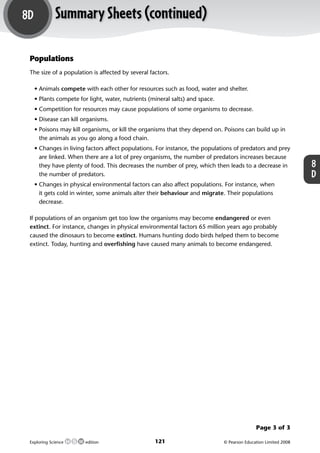
               • Changes in living factors affect populations. For instance, the populations of predators and prey
                 are linked. When there are a lot of prey organisms, the number of predators increases because
                 they have plenty of food. This decreases the number of prey, which then leads to a decrease in                      8
                 the number of predators.                                                                                            D
               • Changes in physical environmental factors can also affect populations. For instance, when
                 it gets cold in winter, some animals alter their behaviour and migrate. Their populations
                 decrease.

             If populations of an organism get too low the organisms may become endangered or even
             extinct. For instance, changes in physical environmental factors 65 million years ago probably
             caused the dinosaurs to become extinct. Humans hunting dodo birds helped them to become
             extinct. Today, hunting and overfishing have caused many animals to become endangered.


                                                                                                        Page 3 of 3

             Exploring Science     edition                     121                       © Pearson Education Limited 2008


M04_ES_AB_Y8_5415_U8D.indd 121                                                                                          8/12/09 3:51:56 PM

Ecological relationships

  • 1.
    8D Summary Sheets Habitats and environments A habitat is the area where an organism lives. The surroundings of an organism are called its environment. Non-living factors (e.g. light, dampness, temperature) that affect what an environment is like are called physical environmental factors. Living things that affect what an environment is like are called living factors. All the plants and animals that live in a habitat make up a community. Within a community, the total number of one species is called a population. In order to survive in a habitat, organisms need various resources. An animal needs food, water, oxygen and shelter, and it needs to find a mate to reproduce. Plants need light, water and carbon dioxide in order to make food. They also need mineral salts (nutrients), oxygen and space to grow. 8 D Adaptations The organisms living must be adapted to survive in a habitat. Members of the same community may have similar adaptations to cope with the problems of their habitat. Organisms that are better adapted to survive in an area will have a better chance of survival. Since a habitat contains many different environments, many organisms are not spread evenly through a habitat. All the places where an organism is found are its distribution. If it is not spread evenly through the habitat it is said to have uneven distribution. If it is spread evenly it has even distribution. Classifying living organisms There are so many species that we need classify them. The Summary Sheets for Unit 7D show how members of the animal kingdom are classified into groups. Members of the plant kingdom can make their own food by photosynthesis. There are four main plant groups. Mosses reproduce by spores, have thin leaves and no roots or xylem vessels. Ferns reproduce by spores held in containers under their leaves. Conifers reproduce using seeds found in cones and have needle-shaped leaves. Flowering plants reproduce using seeds found in fruits, have flowers and large, flat leaves. Page 1 of 3 Exploring Science edition 119 © Pearson Education Limited 2008 M04_ES_AB_Y8_5415_U8D.indd 119 8/12/09 3:51:54 PM
  • 2.
    8D Summary Sheets (continued) Sampling methods Ecologists are scientists who study habitats. They catch organisms using various sampling methods, then use keys and field guides to identify them. Ecologists often need to know the size of a population. It would be impossible to count all the organisms in a habitat, so they take samples and then estimate the total population. A quadrat is a sampling square used to estimate plant populations. It is placed randomly on the ground and the number of plants inside it is counted each time. The more samples that are taken, the more reliable an estimate will be. Ecologists measure physical environmental factors, like how warm it is and how much oxygen is 8 dissolved in pond water, using sensors and data loggers. They see if there are any relationships D (links) between the factors, such as the warmer the water, the lower the oxygen level is. A pooter is used to collect A Tullgren funnel is used A pitfall trap traps small small invertebrates. to collect invertebrates animals that crawl from leaf litter. along the ground. Tree beating is used to Pond dipping is used to A sweepnet is used to collect animals that live collect organisms from collect organisms from in trees or bushes. different parts of a long grass. pond. Feeding relationships Animals depend on plants or other animals for food. Food chains and food webs show the feeding relationships in a habitat (see the Summary Sheets for Unit 7C). However, living organisms depend on other organisms in other ways. For example, plants depend on insects for pollination. The populations of the organisms at each level in a food chain can be shown as a pyramid of numbers. The size of each bar represents the number of organisms. Usually there are fewer organisms as you go along a food chain because energy is lost at each level (e.g. through movement, faeces). Sometimes the pyramid has an unusual shape if the organisms are very different in size. Page 2 of 3 Exploring Science edition 120 © Pearson Education Limited 2008 M04_ES_AB_Y8_5415_U8D.indd 120 8/12/09 3:51:56 PM
  • 3.
    8D Summary Sheets (continued) Populations The size of a population is affected by several factors. • Animals compete with each other for resources such as food, water and shelter. • Plants compete for light, water, nutrients (mineral salts) and space. • Competition for resources may cause populations of some organisms to decrease. • Disease can kill organisms. • Poisons may kill organisms, or kill the organisms that they depend on. Poisons can build up in the animals as you go along a food chain. • Changes in living factors affect populations. For instance, the populations of predators and prey are linked. When there are a lot of prey organisms, the number of predators increases because they have plenty of food. This decreases the number of prey, which then leads to a decrease in 8 the number of predators. D • Changes in physical environmental factors can also affect populations. For instance, when it gets cold in winter, some animals alter their behaviour and migrate. Their populations decrease. If populations of an organism get too low the organisms may become endangered or even extinct. For instance, changes in physical environmental factors 65 million years ago probably caused the dinosaurs to become extinct. Humans hunting dodo birds helped them to become extinct. Today, hunting and overfishing have caused many animals to become endangered. Page 3 of 3 Exploring Science edition 121 © Pearson Education Limited 2008 M04_ES_AB_Y8_5415_U8D.indd 121 8/12/09 3:51:56 PM