Ecology 
Basic Needs of Living things 
Organisms and Their Environment
Ecology 
• The study of the relations ships between 
organisms and between organisms and their 
environment.
What do you mean environment? 
The environment is made up of two things 
1. Abiotic Factors: Non-living (never was living) 
Examples: rocks, water, air, weather, sunlight, 
sand, temperature… 
2. Biotic Factors: Living ,once living things or 
part of a living organism. Examples: Leaves, 
trees, poop, whales, flowers, mushrooms.
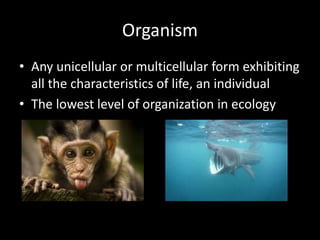
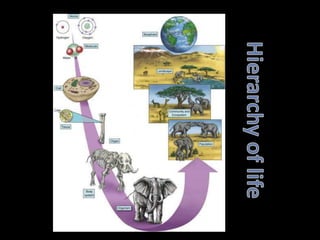
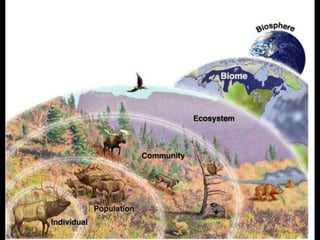
Organism 
• Any unicellular or multicellular form exhibiting 
all the characteristics of life, an individual 
• The lowest level of organization in ecology
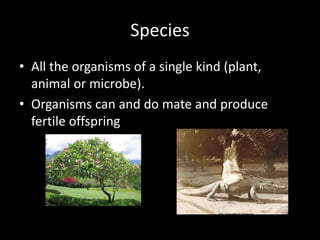
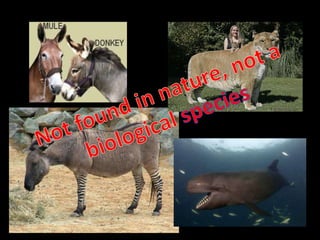
Species 
• All the organisms of a single kind (plant, 
animal or microbe). 
• Organisms can and do mate and produce 
fertile offspring
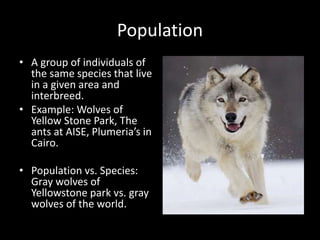
Population 
• A group of individuals of 
the same species that live 
in a given area and 
interbreed. 
• Example: Wolves of 
Yellow Stone Park, The 
ants at AISE, Plumeria’s in 
Cairo. 
• Population vs. Species: 
Gray wolves of 
Yellowstone park vs. gray 
wolves of the world.
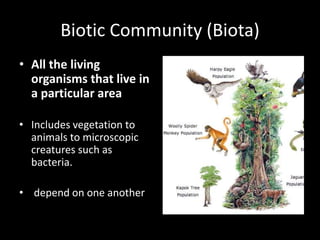
Biotic Community (Biota) 
• All the living 
organisms that live in 
a particular area 
• Includes vegetation to 
animals to microscopic 
creatures such as 
bacteria. 
• depend on one another
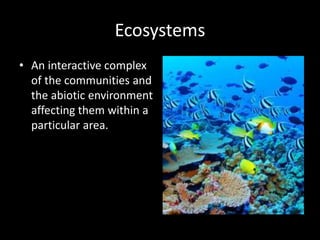
Ecosystems 
• An interactive complex 
of the communities and 
the abiotic environment 
affecting them within a 
particular area.
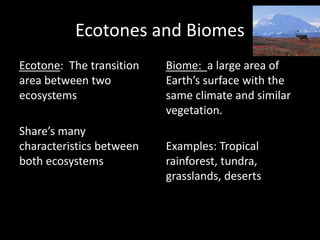
Ecotones and Biomes 
Ecotone: The transition 
area between two 
ecosystems 
Share’s many 
characteristics between 
both ecosystems 
Biome: a large area of 
Earth’s surface with the 
same climate and similar 
vegetation. 
Examples: Tropical 
rainforest, tundra, 
grasslands, deserts
Organisms and their environment

Organisms and their environment

  • 1.
    Ecology Basic Needsof Living things Organisms and Their Environment
  • 2.
    Ecology • Thestudy of the relations ships between organisms and between organisms and their environment.
  • 3.
    What do youmean environment? The environment is made up of two things 1. Abiotic Factors: Non-living (never was living) Examples: rocks, water, air, weather, sunlight, sand, temperature… 2. Biotic Factors: Living ,once living things or part of a living organism. Examples: Leaves, trees, poop, whales, flowers, mushrooms.
  • 4.
    Organism • Anyunicellular or multicellular form exhibiting all the characteristics of life, an individual • The lowest level of organization in ecology
  • 5.
    Species • Allthe organisms of a single kind (plant, animal or microbe). • Organisms can and do mate and produce fertile offspring
  • 7.
    Population • Agroup of individuals of the same species that live in a given area and interbreed. • Example: Wolves of Yellow Stone Park, The ants at AISE, Plumeria’s in Cairo. • Population vs. Species: Gray wolves of Yellowstone park vs. gray wolves of the world.
  • 8.
    Biotic Community (Biota) • All the living organisms that live in a particular area • Includes vegetation to animals to microscopic creatures such as bacteria. • depend on one another
  • 9.
    Ecosystems • Aninteractive complex of the communities and the abiotic environment affecting them within a particular area.
  • 10.
    Ecotones and Biomes Ecotone: The transition area between two ecosystems Share’s many characteristics between both ecosystems Biome: a large area of Earth’s surface with the same climate and similar vegetation. Examples: Tropical rainforest, tundra, grasslands, deserts