> What are some of the branches                         of biology?          biology                            reproduction                             All living things on Earth are
     > What are seven characteristics                       that all              cell                               heredity                                 tied together by common
                                                                                                                                                              traits and rely on one another
        living things share?                                                      homeostasis                        evolution
                                                                                                                                                              for their common survival.
                                                                                  metabolism
                                                                                                                                                      .~__________________                       .~A
                                                                                                                                                                                                       !
         ~------------.-~-----.---------                                                     _,   __   co ••   _..     -   .---_   --~-.       ---


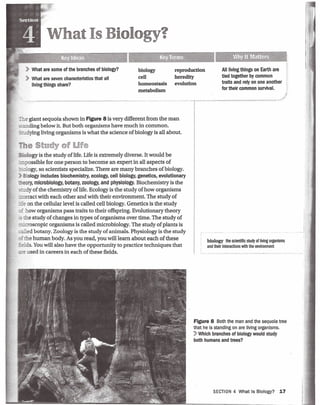
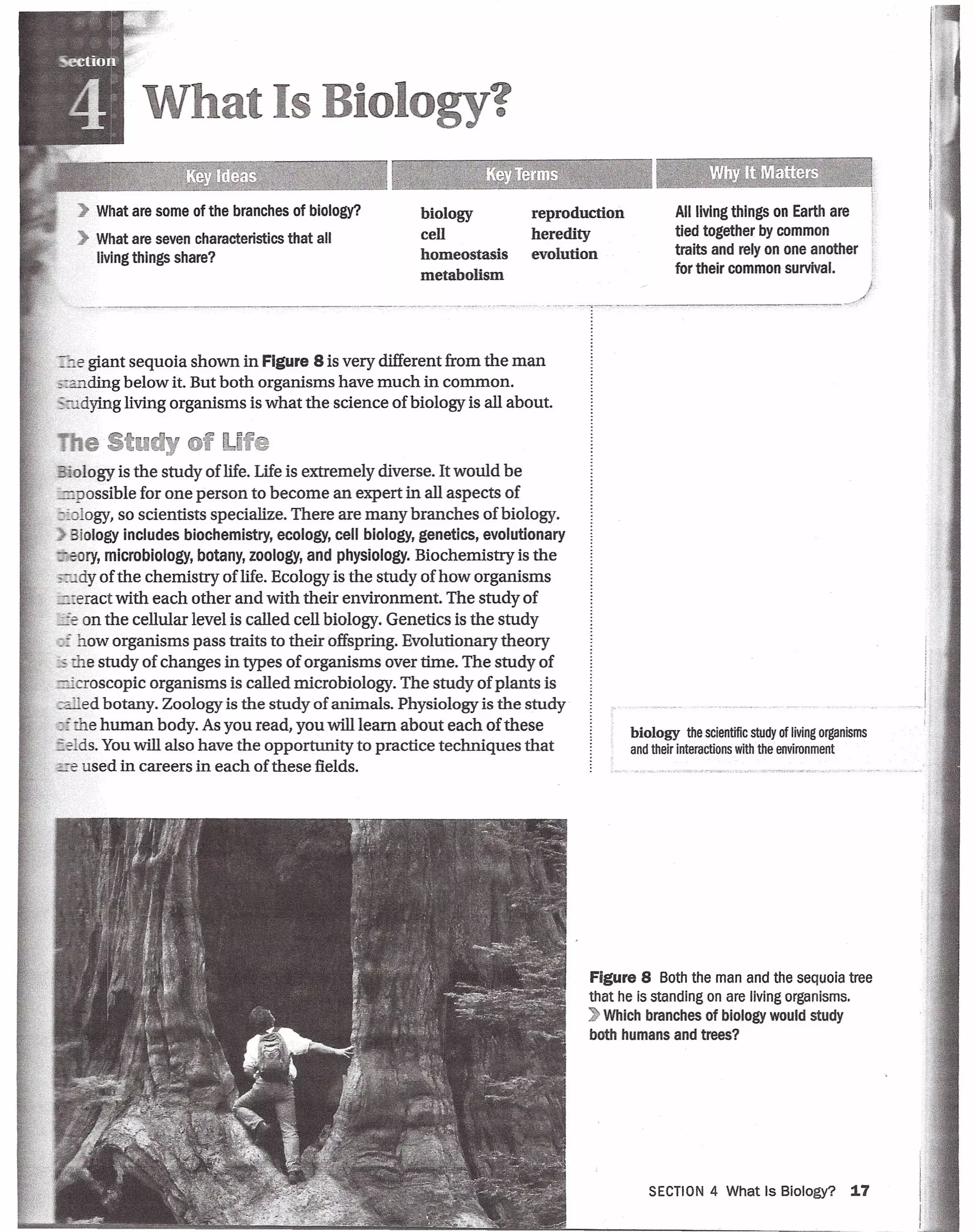
7_e giant sequoia shown in Figure 8 is very different from the man
szanding below it. But both organisms have much in common.
'-mdying living organisms is what the science of biology is all about.

The      s·~vj                             @f ll,"fe
  .ology is the study of life. Life is extremely diverse. It would be
_possible    for one person to become an expert in all aspects of
-=-:ology,so scientists specialize. There are many branches of biology.
}- Biology includes                        biochemistry,   ecology, cell biology, genetics, evolutionary
C"aory, microbiology, botany, zoology, and physiology. Biochemistry is the
~~ dy of the chemistry of life. Ecology is the study of how organisms
b-eract with each other and with their environment. The study of
=e-   on the cellular level is called cell biology. Genetics is the study
 :: how organisms pass traits to their offspring. Evolutionary theory
=-  the study of changes in types of organisms over time. The study of
.:::<icroscopic organisms is called microbiology. The study of plants is
 ~ ed botany. Zoology is the study of animals. Physiology is the study
:: me   human body. As you read, you will learn about each of these                                                                                  biology the scientific study of living organisms
::clds. You will also have the opportunity to practice techniques that                                                                               and their interactions with the environment
 zre used in careers in each of these fields.


                                                                                                                                           Figure 8 Both the man and the sequoia tree
                                                                                                                                           that he is standing on are living organisms.
                                                                                                                                              Which branches of biology would study
                                                                                                                                           both humans and trees?


                                                                                                                                                        SECTION 4 What Is Biology?               17
r@perties            L'"fe
                                               All living organisms share certain properties. ~ The seven properties
                                               of life are cellular organization, homeostasis, metabolism, responsiveness,
                                               reproduction, heredity, and growth. Life is characterized by the presence
                                               of all seven properties at some stage in an organism's life.
                                               Cellular Organi:!:ati@1i'iI A cell is the smallest unit capable of all life
                                               functions. A cell is a highly organized, tiny structure that is enclosed
                                               in a thin covering called a membrane. The basic structure of cells is
                                               the same in all organisms.


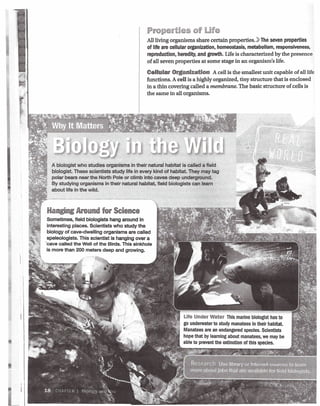
  anging Around for Science
 Sometimes, field biologists hang around in
 interesting places. Scientists who study the
 biology of cave-dwelling organisms are called
 speleologists. This scientist is hanging over a
'cave called the Well of the Birds. This sinkhole
 is more than 200 meters deep and growing.


                                                               Life Under Water This marine biologist has to
                                                               go underwaterto study manatees in their habitat.
                                                               Manatees are an endangeredspecies. Scientists
                                                               hope that by learning about manatees,we may be
                                                               able to prevent the extinction of this species.
Homeostasis       All living organisms must maintain a stable
        internal environment in order to function properly. The
        maintenance of stable internal conditions in spite of changes
        in the external environment is called homeostasis.
        Metali»@lism Living things carry out many chemical reac-
        tions in order to obtain energy. Metabolism is the sum of all
        of the chemical reactions carried out in an organism. Almost
        ell of the energy used by living things originally comes from
        sunlight. Plants, algae, and some bacteria capture this energy
        and use it to make molecules. These molecules serve as the
        source of energy, or food, for other organisms.
        RespOi'!l!!hf$U'ieSS    In addition to maintaining a stable
        internal environment, living organisms also respond to
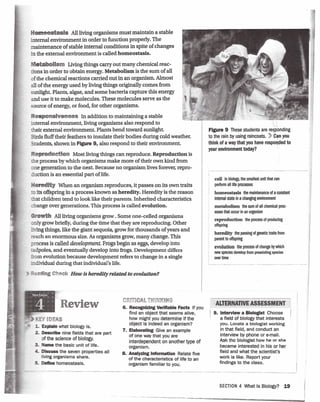
        their external environment. Plants bend toward sunlight.                           Figure 9 These students are re$:ponding
        Birds fluff their feathers to insulate their bodies during cold weather.           to the rain by using raincoats.  ~~n you
        Students, shown in Figure 9, also respond to their environment.                    think of a way that you have respoq~ed to
                                                                                           your environment today?            .
        Reprcductnon Most living things can reproduce. Reproduction is
        me process by which organisms make more of their own kind from                                                                                                 j
        one generation to the next. Because no organism lives forever, repro-              •   _._    ~~~.<'~~'~_~-T~   __ ~~~~~-.    .'_~~~        ~   •• '~_~        .1
         uction is an essential part of life.
                                                                                                     cell in biology,
                                                                                                                    thesmallest nitthat can
                                                                                                                              u
        Heredity When an organism reproduces, it passes on its own traits                            perform lifeprocesses
                                                                                                            all
         a its offspring in a process known as heredity. Heredity is the reason                      homeostasis themaintenancef a constant
                                                                                                                                      o
        that children tend to look like their parents. Inherited characteristics                     internalstatein a changing nvironment
                                                                                                                              e
        change over generations. This process is called evolution.                                   metabolism thesumof all chemical roc-
                                                                                                                                    p
                                                                                                     esses occurin anorganism
                                                                                                         that
        Growth All living organisms grow. Some one-celled organisms
                                                                                                     reproduction       theprocess f producing
                                                                                                                                 o
        only grow briefly, during the time that they are reproducing. Other                          offspring
        living things, like the giant sequoia, grow for thousands of years and
                                                                                                     heredity thepassingofgenetic
                                                                                                                                traitsfrom
        reach an enormous size. As organisms grow, many change. This                       ,         parentto offspring
        _rocess is called development. Frogs begin as eggs, develop into
                                                                                                     evolution theprocess f change which
                                                                                                                        o         by
        tadpoles, and eventually develop into frogs. Development differs                             newspecies
                                                                                                              develop
                                                                                                                    frompreexistingpecies
                                                                                                                                  s
        Horn evolution because development refers to change in a single                              overtime
        fudividual during that individual's life.
,< ;)   Reading Ci1ercf{ How is heredity related to evolution?


                                                 C ITiCAt HiNKDNG
                     Review                      6. Recognizing Verifiable Facts If you
                                                                                                     ALTERNATIVE ASSESSMENT
                                                    find an object that seems alive,           i 9.       Interview a Biologist Choose
          KEYmEA~                                   how might you determine if the             ;          a field of biology that interests
                                                    object is indeed an organism?                        you. Locate a biologist working
         1. Explain what biology is.
                                                 7. Elaborating Give an example                           in that field, and conduct an
         2. Describe nine fields that are part                                                            interview by phone or e-mall,
                                                    of one way that you are
            of the science of biology.                                                                   Ask the biologist how he or she
                                                    interdependent on another type of
         3. Name the basic unit of life.            organism.                                            became interested in his or her
         4. Discuss the seven properties all     S. Analyzing Information Relate five                    field and what the scientist's
            living organisms share.                 of the characteristics of life to an                 work is like. Report your
         5. Define homeostasis.                     organism familiar to xou .                           findings to the class.
             ..   _---------

                                                                                                         SECTION 4 What Is Biology?            19                 {
                                                                                                                                                                   /
                                                                                                                                                                  .I

Chapter 1 properties of life

  • 1.
    > What aresome of the branches of biology? biology reproduction All living things on Earth are > What are seven characteristics that all cell heredity tied together by common traits and rely on one another living things share? homeostasis evolution for their common survival. metabolism .~__________________ .~A ! ~------------.-~-----.--------- _, __ co •• _.. - .---_ --~-. --- 7_e giant sequoia shown in Figure 8 is very different from the man szanding below it. But both organisms have much in common. '-mdying living organisms is what the science of biology is all about. The s·~vj @f ll,"fe .ology is the study of life. Life is extremely diverse. It would be _possible for one person to become an expert in all aspects of -=-:ology,so scientists specialize. There are many branches of biology. }- Biology includes biochemistry, ecology, cell biology, genetics, evolutionary C"aory, microbiology, botany, zoology, and physiology. Biochemistry is the ~~ dy of the chemistry of life. Ecology is the study of how organisms b-eract with each other and with their environment. The study of =e- on the cellular level is called cell biology. Genetics is the study :: how organisms pass traits to their offspring. Evolutionary theory =- the study of changes in types of organisms over time. The study of .:::<icroscopic organisms is called microbiology. The study of plants is ~ ed botany. Zoology is the study of animals. Physiology is the study :: me human body. As you read, you will learn about each of these biology the scientific study of living organisms ::clds. You will also have the opportunity to practice techniques that and their interactions with the environment zre used in careers in each of these fields. Figure 8 Both the man and the sequoia tree that he is standing on are living organisms. Which branches of biology would study both humans and trees? SECTION 4 What Is Biology? 17
  • 2.
    r@perties L'"fe All living organisms share certain properties. ~ The seven properties of life are cellular organization, homeostasis, metabolism, responsiveness, reproduction, heredity, and growth. Life is characterized by the presence of all seven properties at some stage in an organism's life. Cellular Organi:!:ati@1i'iI A cell is the smallest unit capable of all life functions. A cell is a highly organized, tiny structure that is enclosed in a thin covering called a membrane. The basic structure of cells is the same in all organisms. anging Around for Science Sometimes, field biologists hang around in interesting places. Scientists who study the biology of cave-dwelling organisms are called speleologists. This scientist is hanging over a 'cave called the Well of the Birds. This sinkhole is more than 200 meters deep and growing. Life Under Water This marine biologist has to go underwaterto study manatees in their habitat. Manatees are an endangeredspecies. Scientists hope that by learning about manatees,we may be able to prevent the extinction of this species.
  • 3.
    Homeostasis All living organisms must maintain a stable internal environment in order to function properly. The maintenance of stable internal conditions in spite of changes in the external environment is called homeostasis. Metali»@lism Living things carry out many chemical reac- tions in order to obtain energy. Metabolism is the sum of all of the chemical reactions carried out in an organism. Almost ell of the energy used by living things originally comes from sunlight. Plants, algae, and some bacteria capture this energy and use it to make molecules. These molecules serve as the source of energy, or food, for other organisms. RespOi'!l!!hf$U'ieSS In addition to maintaining a stable internal environment, living organisms also respond to their external environment. Plants bend toward sunlight. Figure 9 These students are re$:ponding Birds fluff their feathers to insulate their bodies during cold weather. to the rain by using raincoats. ~~n you Students, shown in Figure 9, also respond to their environment. think of a way that you have respoq~ed to your environment today? . Reprcductnon Most living things can reproduce. Reproduction is me process by which organisms make more of their own kind from j one generation to the next. Because no organism lives forever, repro- • _._ ~~~.<'~~'~_~-T~ __ ~~~~~-. .'_~~~ ~ •• '~_~ .1 uction is an essential part of life. cell in biology, thesmallest nitthat can u Heredity When an organism reproduces, it passes on its own traits perform lifeprocesses all a its offspring in a process known as heredity. Heredity is the reason homeostasis themaintenancef a constant o that children tend to look like their parents. Inherited characteristics internalstatein a changing nvironment e change over generations. This process is called evolution. metabolism thesumof all chemical roc- p esses occurin anorganism that Growth All living organisms grow. Some one-celled organisms reproduction theprocess f producing o only grow briefly, during the time that they are reproducing. Other offspring living things, like the giant sequoia, grow for thousands of years and heredity thepassingofgenetic traitsfrom reach an enormous size. As organisms grow, many change. This , parentto offspring _rocess is called development. Frogs begin as eggs, develop into evolution theprocess f change which o by tadpoles, and eventually develop into frogs. Development differs newspecies develop frompreexistingpecies s Horn evolution because development refers to change in a single overtime fudividual during that individual's life. ,< ;) Reading Ci1ercf{ How is heredity related to evolution? C ITiCAt HiNKDNG Review 6. Recognizing Verifiable Facts If you ALTERNATIVE ASSESSMENT find an object that seems alive, i 9. Interview a Biologist Choose KEYmEA~ how might you determine if the ; a field of biology that interests object is indeed an organism? you. Locate a biologist working 1. Explain what biology is. 7. Elaborating Give an example in that field, and conduct an 2. Describe nine fields that are part interview by phone or e-mall, of one way that you are of the science of biology. Ask the biologist how he or she interdependent on another type of 3. Name the basic unit of life. organism. became interested in his or her 4. Discuss the seven properties all S. Analyzing Information Relate five field and what the scientist's living organisms share. of the characteristics of life to an work is like. Report your 5. Define homeostasis. organism familiar to xou . findings to the class. .. _--------- SECTION 4 What Is Biology? 19 { / .I