1
Phylum Echinodermata
“The spiny skinned animals”
2
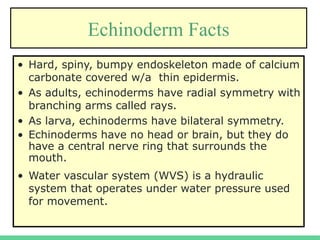
Echinoderm Facts
• Hard, spiny, bumpy endoskeleton made of calcium
carbonate covered w/a thin epidermis.
• As adults, echinoderms have radial symmetry with
branching arms called rays.
• As larva, echinoderms have bilateral symmetry.
• Echinoderms have no head or brain, but they do
have a central nerve ring that surrounds the
mouth.
• Water vascular system (WVS) is a hydraulic
system that operates under water pressure used
for movement.
3
Echinoderm facts
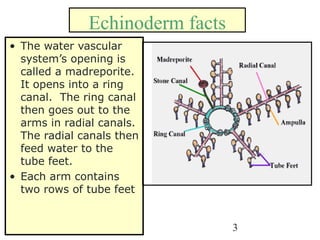
• The water vascular
system’s opening is
called a madreporite.
It opens into a ring
canal. The ring canal
then goes out to the
arms in radial canals.
The radial canals then
feed water to the
tube feet.
• Each arm contains
two rows of tube feet
4
Echinoderm facts
• Tube feet are used in movement, gas exchange and
excretion; nitrogen waste excreted as ammonia exits the
anus.
• At the top of each tube foot is the ampulla which acts like
a bulb on a medicine dropper.
• Echinoderms are considered to carnivores, herbivores and
detritus feeders.
• Simple nervous system for most echinoderms – Starfish
have up to 200 light sensitive cells clustered in eyespots
of each arm. No actual eyes.
• Pedicellariae are pincher-like appendages used for
protection and for cleaning the surface of the body.
• For balance & hearing, statocysts or tiny stones pass over
hairs to tell the starfish up from down and sense motion
or sound by vibrations in the water.
5
Echinoderm Reproduction
• Echinoderms can reproduce sexually or asexually.
• Reproduction – echinoderms are either male or
female. Sperm and eggs produced in the testes or
ovaries is released into the water to become
fertilized. This is sexual reproduction.
• Reproduction – ask a Fisherman and he will tell you
that tearing starfish into chunks is a great way to
increase their population. Each chunk will undergo
regeneration (asexual reproduction) and form new
starfish. So, ripping them up is not a great way to
reduce predation on shellfish, which bring in a
pretty-penny.
6
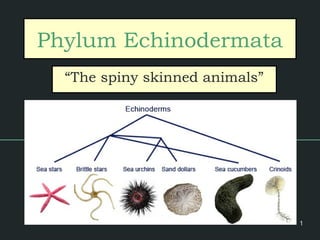
Echinoderms
• The spiny skinned animals include these Classes:
1.Class Asteroidea - starfish (sea stars)
2.Class Crinoidea - the crinoids or “feather stars”
3.Class Ophiuroidea - brittle stars, basket star
4.Class Echinodermata - sea urchin, sand dollar
5.Class Holothuroidea - sea cucumbers
6.Class Concentricycloidea – sea daises
7
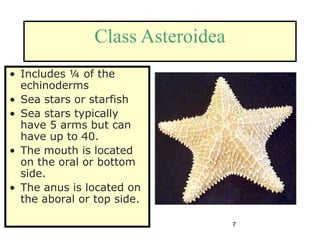
Class Asteroidea
• Includes ¼ of the
echinoderms
• Sea stars or starfish
• Sea stars typically
have 5 arms but can
have up to 40.
• The mouth is located
on the oral or bottom
side.
• The anus is located on
the aboral or top side.
8
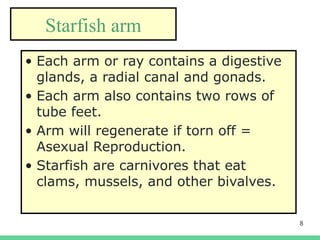
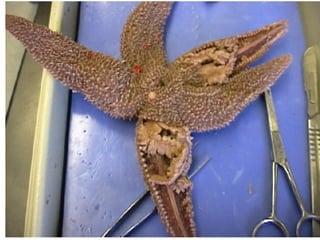
Starfish arm
• Each arm or ray contains a digestive
glands, a radial canal and gonads.
• Each arm also contains two rows of
tube feet.
• Arm will regenerate if torn off =
Asexual Reproduction.
• Starfish are carnivores that eat
clams, mussels, and other bivalves.
9
10
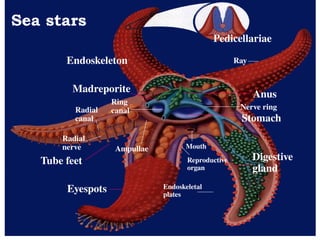
Endoskeleton
Madreporite
Tube feet
Pedicellariae
Anus
Stomach
Digestive
gland
Eyespots
Ray
Nerve ring
Mouth
Reproductive
organ
Endoskeletal
plates
Radial
nerve Ampullae
Radial
canal
Ring
canal
Sea stars
11
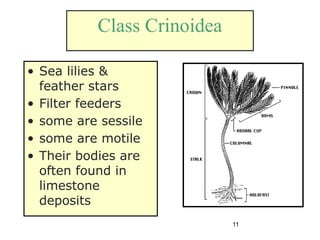
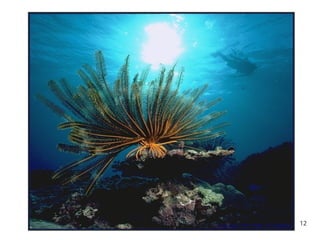
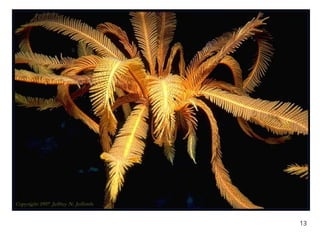
Class Crinoidea
• Sea lilies &
feather stars
• Filter feeders
• some are sessile
• some are motile
• Their bodies are
often found in
limestone
deposits
12
13
14
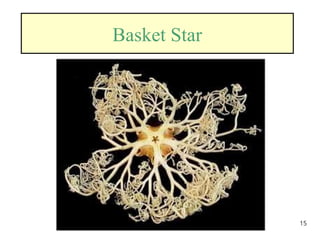
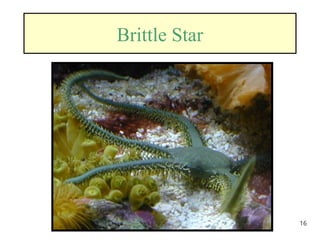
Class Ophiuroidea
• Brittle stars & Basket Stars
• These are perhaps the fastest of the
echinoderms. Do not use tube feet for
movement.
• Most of them are filter feeders or
detritus eaters
• Flexible arms, and may be offered as
food to get away from predators
15
Basket Star
16
Brittle Star
17
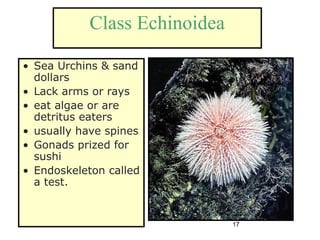
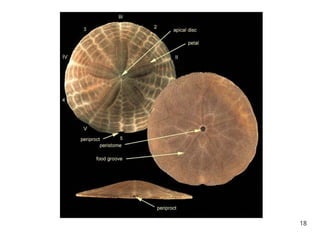
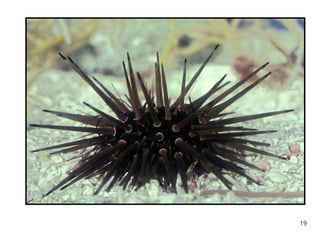
Class Echinoidea
• Sea Urchins & sand
dollars
• Lack arms or rays
• eat algae or are
detritus eaters
• usually have spines
• Gonads prized for
sushi
• Endoskeleton called
a test.
18
19
20
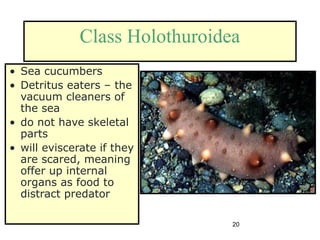
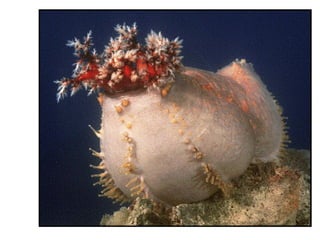
Class Holothuroidea
• Sea cucumbers
• Detritus eaters – the
vacuum cleaners of
the sea
• do not have skeletal
parts
• will eviscerate if they
are scared, meaning
offer up internal
organs as food to
distract predator
21
22
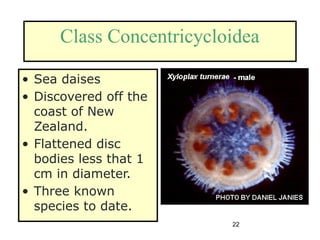
Class Concentricycloidea
• Sea daises
• Discovered off the
coast of New
Zealand.
• Flattened disc
bodies less that 1
cm in diameter.
• Three known
species to date.
23
Phylum Chordata
• Three subphyla
–Phylum Urochordata - tunicates
–Phylum Cephalochordata -
lancelets
–Phylum Vertebrata - vertebrates
24
Invertebrate Chordates
• This group belongs to the Phylum
Chordata because they contain a stiff but
flexible rod called a notochord.
• Characteristics
–dorsal nerve chord - hollow tube
–pharyngeal pouches - out pockets in
pharynx
–postanal tail - used for propulsion
25
Subphylum Cephalochordata
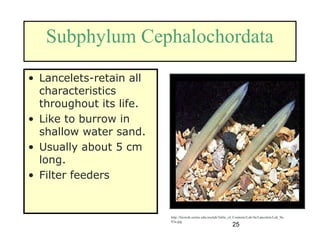
• Lancelets-retain all
characteristics
throughout its life.
• Like to burrow in
shallow water sand.
• Usually about 5 cm
long.
• Filter feeders
http://bioweb.uwlax.edu/zoolab/Table_of_Contents/Lab-9a/Lancelets/Lab_9a-
03a.jpg
26
Subphylum Urochordata
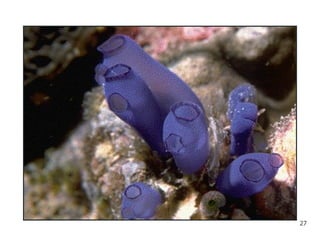
• Tunicates - AKA “Sea squirts” because
their bodies are covered with a tough
covering like tunic.
• Filter feeds as adults w/incurrent
siphons
• External fertilization - hermaphrodites
that release sperm through excurrent
siphons.
27
http://www.ucmp.berkeley.edu/chordata/
urochordata.gif

Echinoderms_and_Invertebrate_Chordates_29_.ppt.pptx

  • 1.
  • 2.
    2 Echinoderm Facts • Hard,spiny, bumpy endoskeleton made of calcium carbonate covered w/a thin epidermis. • As adults, echinoderms have radial symmetry with branching arms called rays. • As larva, echinoderms have bilateral symmetry. • Echinoderms have no head or brain, but they do have a central nerve ring that surrounds the mouth. • Water vascular system (WVS) is a hydraulic system that operates under water pressure used for movement.
  • 3.
    3 Echinoderm facts • Thewater vascular system’s opening is called a madreporite. It opens into a ring canal. The ring canal then goes out to the arms in radial canals. The radial canals then feed water to the tube feet. • Each arm contains two rows of tube feet
  • 4.
    4 Echinoderm facts • Tubefeet are used in movement, gas exchange and excretion; nitrogen waste excreted as ammonia exits the anus. • At the top of each tube foot is the ampulla which acts like a bulb on a medicine dropper. • Echinoderms are considered to carnivores, herbivores and detritus feeders. • Simple nervous system for most echinoderms – Starfish have up to 200 light sensitive cells clustered in eyespots of each arm. No actual eyes. • Pedicellariae are pincher-like appendages used for protection and for cleaning the surface of the body. • For balance & hearing, statocysts or tiny stones pass over hairs to tell the starfish up from down and sense motion or sound by vibrations in the water.
  • 5.
    5 Echinoderm Reproduction • Echinodermscan reproduce sexually or asexually. • Reproduction – echinoderms are either male or female. Sperm and eggs produced in the testes or ovaries is released into the water to become fertilized. This is sexual reproduction. • Reproduction – ask a Fisherman and he will tell you that tearing starfish into chunks is a great way to increase their population. Each chunk will undergo regeneration (asexual reproduction) and form new starfish. So, ripping them up is not a great way to reduce predation on shellfish, which bring in a pretty-penny.
  • 6.
    6 Echinoderms • The spinyskinned animals include these Classes: 1.Class Asteroidea - starfish (sea stars) 2.Class Crinoidea - the crinoids or “feather stars” 3.Class Ophiuroidea - brittle stars, basket star 4.Class Echinodermata - sea urchin, sand dollar 5.Class Holothuroidea - sea cucumbers 6.Class Concentricycloidea – sea daises
  • 7.
    7 Class Asteroidea • Includes¼ of the echinoderms • Sea stars or starfish • Sea stars typically have 5 arms but can have up to 40. • The mouth is located on the oral or bottom side. • The anus is located on the aboral or top side.
  • 8.
    8 Starfish arm • Eacharm or ray contains a digestive glands, a radial canal and gonads. • Each arm also contains two rows of tube feet. • Arm will regenerate if torn off = Asexual Reproduction. • Starfish are carnivores that eat clams, mussels, and other bivalves.
  • 9.
  • 10.
  • 11.
    11 Class Crinoidea • Sealilies & feather stars • Filter feeders • some are sessile • some are motile • Their bodies are often found in limestone deposits
  • 12.
  • 13.
  • 14.
    14 Class Ophiuroidea • Brittlestars & Basket Stars • These are perhaps the fastest of the echinoderms. Do not use tube feet for movement. • Most of them are filter feeders or detritus eaters • Flexible arms, and may be offered as food to get away from predators
  • 15.
  • 16.
  • 17.
    17 Class Echinoidea • SeaUrchins & sand dollars • Lack arms or rays • eat algae or are detritus eaters • usually have spines • Gonads prized for sushi • Endoskeleton called a test.
  • 18.
  • 19.
  • 20.
    20 Class Holothuroidea • Seacucumbers • Detritus eaters – the vacuum cleaners of the sea • do not have skeletal parts • will eviscerate if they are scared, meaning offer up internal organs as food to distract predator
  • 21.
  • 22.
    22 Class Concentricycloidea • Seadaises • Discovered off the coast of New Zealand. • Flattened disc bodies less that 1 cm in diameter. • Three known species to date.
  • 23.
    23 Phylum Chordata • Threesubphyla –Phylum Urochordata - tunicates –Phylum Cephalochordata - lancelets –Phylum Vertebrata - vertebrates
  • 24.
    24 Invertebrate Chordates • Thisgroup belongs to the Phylum Chordata because they contain a stiff but flexible rod called a notochord. • Characteristics –dorsal nerve chord - hollow tube –pharyngeal pouches - out pockets in pharynx –postanal tail - used for propulsion
  • 25.
    25 Subphylum Cephalochordata • Lancelets-retainall characteristics throughout its life. • Like to burrow in shallow water sand. • Usually about 5 cm long. • Filter feeders http://bioweb.uwlax.edu/zoolab/Table_of_Contents/Lab-9a/Lancelets/Lab_9a- 03a.jpg
  • 26.
    26 Subphylum Urochordata • Tunicates- AKA “Sea squirts” because their bodies are covered with a tough covering like tunic. • Filter feeds as adults w/incurrent siphons • External fertilization - hermaphrodites that release sperm through excurrent siphons.
  • 27.