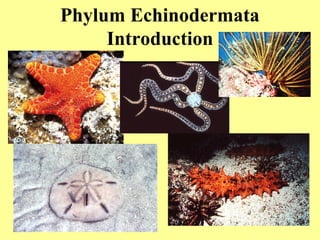
Phylum Echinodermata
Introduction
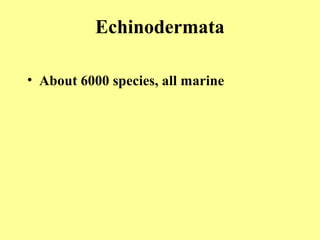
• About 6000 species, all marine
Echinodermata
• secondary
pentamerous radial
symmetry
internal skeleton
• water vascular
system
Echinodermata
Major characteristics
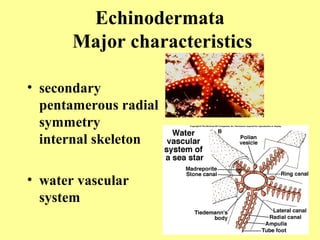
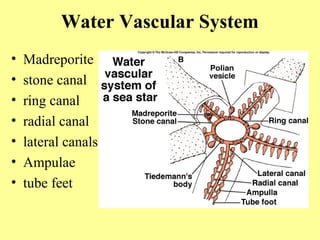
Water Vascular System
• Madreporite
• stone canal
• ring canal
• radial canal
• lateral canals
• Ampulae
• tube feet
CLASSIFICATION OF
ECHINODERMATA
• Class Asteroidea
• Class Ophiuroidea
• Class Echinoidea
• Class Holothuroidea
• Class Crinoidea
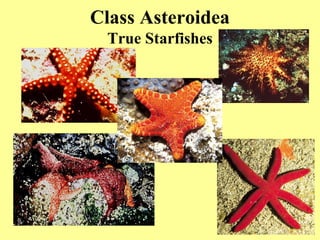
Class Asteroidea
True Starfishes
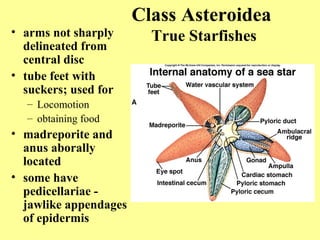
Class Asteroidea
True Starfishes• arms not sharply
delineated from
central disc
• tube feet with
suckers; used for
– Locomotion
– obtaining food
• madreporite and
anus aborally
located
• some have
pedicellariae -
jawlike appendages
of epidermis
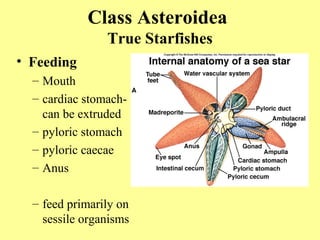
• Feeding
– Mouth
– cardiac stomach-
can be extruded
– pyloric stomach
– pyloric caecae
– Anus
– feed primarily on
sessile organisms
Class Asteroidea
True Starfishes
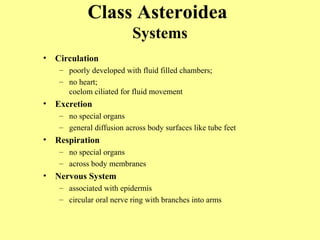
• Circulation
– poorly developed with fluid filled chambers;
– no heart;
coelom ciliated for fluid movement
• Excretion
– no special organs
– general diffusion across body surfaces like tube feet
• Respiration
– no special organs
– across body membranes
• Nervous System
– associated with epidermis
– circular oral nerve ring with branches into arms
Class Asteroidea
Systems
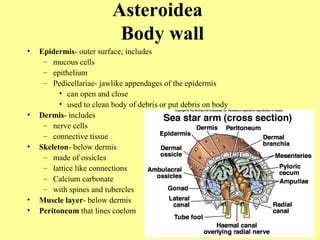
• Epidermis- outer surface; includes
– mucous cells
– epithelium
– Pedicellariae- jawlike appendages of the epidermis
• can open and close
• used to clean body of debris or put debris on body
• Dermis- includes
– nerve cells
– connective tissue
• Skeleton- below dermis
– made of ossicles
– lattice like connections
– Calcium carbonate
– with spines and tubercles
• Muscle layer- below dermis
• Peritoneum that lines coelom
Asteroidea
Body wall
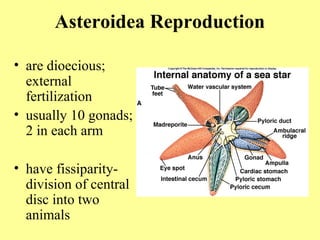
• are dioecious;
external
fertilization
• usually 10 gonads;
2 in each arm
• have fissiparity-
division of central
disc into two
animals
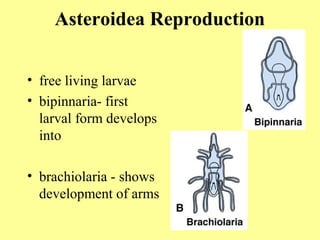
Asteroidea Reproduction
• free living larvae
• bipinnaria- first
larval form develops
into
• brachiolaria - shows
development of arms
Asteroidea Reproduction
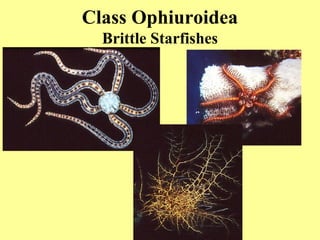
Class Ophiuroidea
Brittle Starfishes
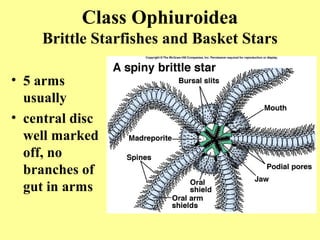
• 5 arms
usually
• central disc
well marked
off, no
branches of
gut in arms
Class Ophiuroidea
Brittle Starfishes and Basket Stars
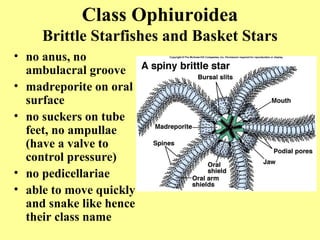
• no anus, no
ambulacral groove
• madreporite on oral
surface
• no suckers on tube
feet, no ampullae
(have a valve to
control pressure)
• no pedicellariae
• able to move quickly
and snake like hence
their class name
Class Ophiuroidea
Brittle Starfishes and Basket Stars
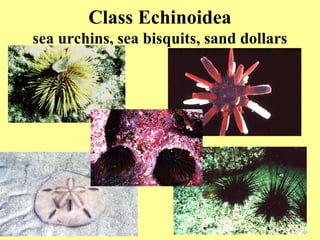
Class Echinoidea
sea urchins, sea bisquits, sand dollars
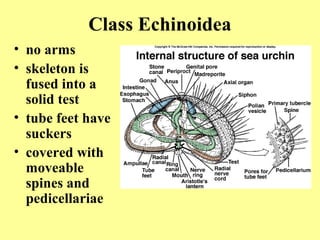
• no arms
• skeleton is
fused into a
solid test
• tube feet have
suckers
• covered with
moveable
spines and
pedicellariae
Class Echinoidea
Class Echinoidea
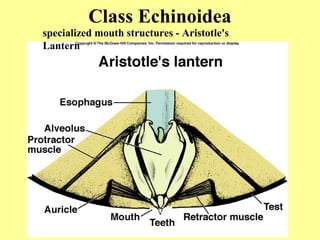
specialized mouth structures - Aristotle's
Lantern
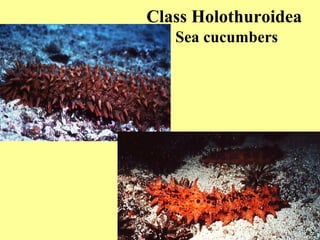
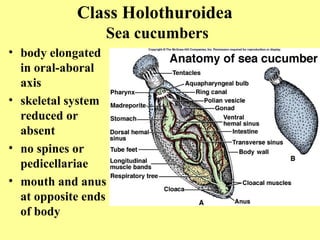
Class Holothuroidea
Sea cucumbers
• body elongated
in oral-aboral
axis
• skeletal system
reduced or
absent
• no spines or
pedicellariae
• mouth and anus
at opposite ends
of body
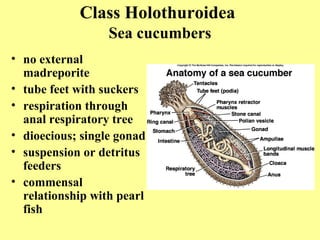
Class Holothuroidea
Sea cucumbers
• no external
madreporite
• tube feet with suckers
• respiration through
anal respiratory tree
• dioecious; single gonad
• suspension or detritus
feeders
• commensal
relationship with pearl
fish
Class Holothuroidea
Sea cucumbers
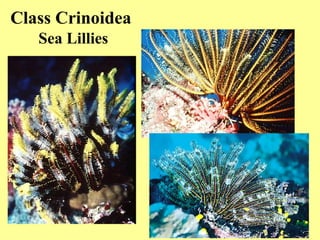
Class Crinoidea
Sea Lillies
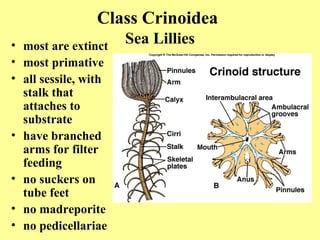
• most are extinct
• most primative
• all sessile, with
stalk that
attaches to
substrate
• have branched
arms for filter
feeding
• no suckers on
tube feet
• no madreporite
• no pedicellariae
Class Crinoidea
Sea Lillies

Echinoderms

  • 1.
  • 2.
    • About 6000species, all marine Echinodermata
  • 3.
    • secondary pentamerous radial symmetry internalskeleton • water vascular system Echinodermata Major characteristics
  • 4.
    Water Vascular System •Madreporite • stone canal • ring canal • radial canal • lateral canals • Ampulae • tube feet
  • 5.
    CLASSIFICATION OF ECHINODERMATA • ClassAsteroidea • Class Ophiuroidea • Class Echinoidea • Class Holothuroidea • Class Crinoidea
  • 6.
  • 7.
    Class Asteroidea True Starfishes•arms not sharply delineated from central disc • tube feet with suckers; used for – Locomotion – obtaining food • madreporite and anus aborally located • some have pedicellariae - jawlike appendages of epidermis
  • 8.
    • Feeding – Mouth –cardiac stomach- can be extruded – pyloric stomach – pyloric caecae – Anus – feed primarily on sessile organisms Class Asteroidea True Starfishes
  • 9.
    • Circulation – poorlydeveloped with fluid filled chambers; – no heart; coelom ciliated for fluid movement • Excretion – no special organs – general diffusion across body surfaces like tube feet • Respiration – no special organs – across body membranes • Nervous System – associated with epidermis – circular oral nerve ring with branches into arms Class Asteroidea Systems
  • 10.
    • Epidermis- outersurface; includes – mucous cells – epithelium – Pedicellariae- jawlike appendages of the epidermis • can open and close • used to clean body of debris or put debris on body • Dermis- includes – nerve cells – connective tissue • Skeleton- below dermis – made of ossicles – lattice like connections – Calcium carbonate – with spines and tubercles • Muscle layer- below dermis • Peritoneum that lines coelom Asteroidea Body wall
  • 11.
    • are dioecious; external fertilization •usually 10 gonads; 2 in each arm • have fissiparity- division of central disc into two animals Asteroidea Reproduction
  • 12.
    • free livinglarvae • bipinnaria- first larval form develops into • brachiolaria - shows development of arms Asteroidea Reproduction
  • 13.
  • 14.
    • 5 arms usually •central disc well marked off, no branches of gut in arms Class Ophiuroidea Brittle Starfishes and Basket Stars
  • 15.
    • no anus,no ambulacral groove • madreporite on oral surface • no suckers on tube feet, no ampullae (have a valve to control pressure) • no pedicellariae • able to move quickly and snake like hence their class name Class Ophiuroidea Brittle Starfishes and Basket Stars
  • 16.
    Class Echinoidea sea urchins,sea bisquits, sand dollars
  • 17.
    • no arms •skeleton is fused into a solid test • tube feet have suckers • covered with moveable spines and pedicellariae Class Echinoidea
  • 18.
    Class Echinoidea specialized mouthstructures - Aristotle's Lantern
  • 19.
  • 20.
    • body elongated inoral-aboral axis • skeletal system reduced or absent • no spines or pedicellariae • mouth and anus at opposite ends of body Class Holothuroidea Sea cucumbers
  • 21.
    • no external madreporite •tube feet with suckers • respiration through anal respiratory tree • dioecious; single gonad • suspension or detritus feeders • commensal relationship with pearl fish Class Holothuroidea Sea cucumbers
  • 22.
  • 23.
    • most areextinct • most primative • all sessile, with stalk that attaches to substrate • have branched arms for filter feeding • no suckers on tube feet • no madreporite • no pedicellariae Class Crinoidea Sea Lillies