Echinoderms
What is an Echinoderm?Echinoderms are characterized by spiny skin, an internal skeleton, a water vascular system, and suction-cuplike structures called Tube FeetMost echinoderms exhibit a five-part radial symmetry
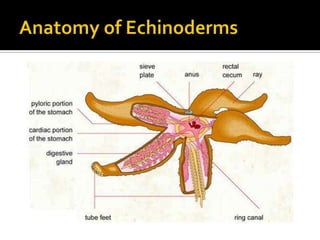
Anatomy of Echinoderms
The Water Vascular System
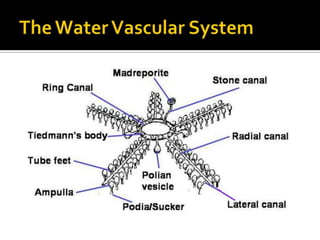
The Water Vascular System (continued)The water Vascular System, which is filled with fluid, carries out many essential body functions in echinodermsAmong these functions are respiration, circulation, and movementThe Madreporite is the opening to the outside
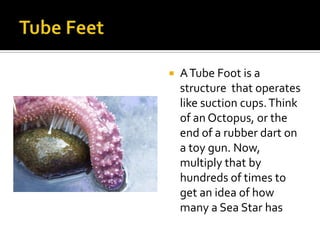
Tube FeetA Tube Foot is a structure  that operates like suction cups. Think of an Octopus, or the end of a rubber dart on a toy gun. Now, multiply that by hundreds of times to get an idea of how many a Sea Star has
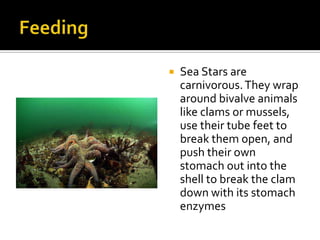
FeedingSea Stars are carnivorous. They wrap around bivalve animals like clams or mussels, use their tube feet to break them open, and push their own stomach out into the shell to break the clam down with its stomach enzymes
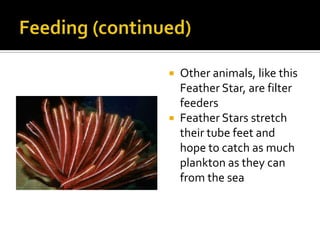
Feeding (continued)Other animals, like this Feather Star, are filter feedersFeather Stars stretch their tube feet and hope to catch as much plankton as they can from the sea
Feeding (continued)Sea Cucumbers act like the vacuum cleaners of the sea. They crawl around and eat all the algae and debris from the ocean floorSea Urchins scrape rocks and the sea floor with their needles and eat all the algae they can find
Respiration and CirculationOxygen, food processing, and waste are carried out by the Water Vascular SystemSea Stars also use their Tube Feet to excrete gas and oxygen while other species use skin gills to breathe
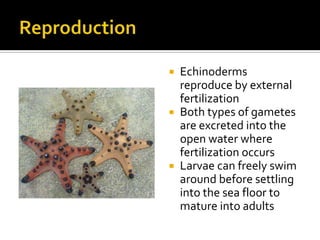
ReproductionEchinoderms reproduce by external fertilizationBoth types of gametes are excreted into the open water where fertilization occursLarvae can freely swim around before settling into the sea floor to mature into adults
Nervous SystemEchinoderms lack a complex Nervous SystemEchinoderms lack a brain, but they make up for it in a simple system of scattered nerve cells around their body which can sense light, gravity, and chemicals released by potential prey
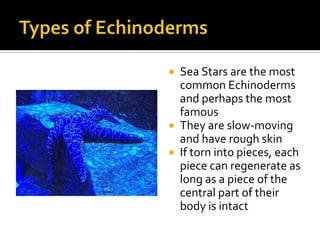
Types of EchinodermsSea Stars are the most common Echinoderms and perhaps the most famousThey are slow-moving and have rough skinIf torn into pieces, each piece can regenerate as long as a piece of the central part of their body is intact
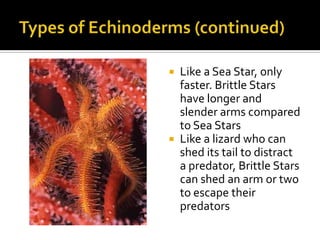
Types of Echinoderms (continued)Like a Sea Star, only faster. Brittle Stars have longer and slender arms compared to Sea StarsLike a lizard who can shed its tail to distract a predator, Brittle Stars can shed an arm or two to escape their predators
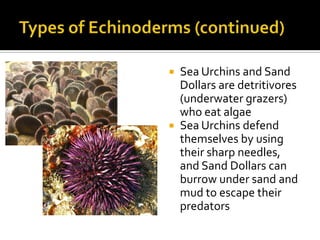
Types of Echinoderms (continued)Sea Urchins and Sand Dollars are detritivores (underwater grazers) who eat algaeSea Urchins defend themselves by using their sharp needles, and Sand Dollars can burrow under sand and mud to escape their predators
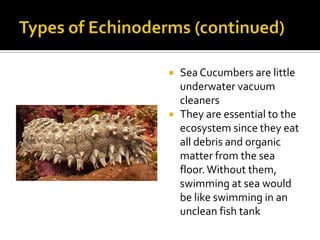
Types of Echinoderms (continued)Sea Cucumbers are little underwater vacuum cleanersThey are essential to the ecosystem since they eat all debris andorganic matter from the sea floor. Without them, swimming at sea would be like swimming in an unclean fish tank
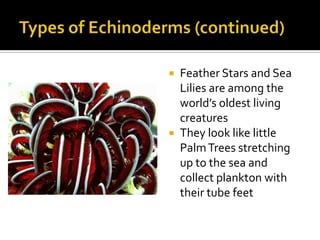
Types of Echinoderms (continued)Feather Stars and Sea Lilies are among the world’s oldest living creaturesThey look like little Palm Trees stretching up to the sea and collect plankton with their tube feet
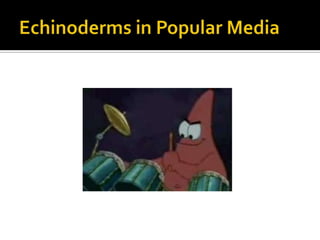
Echinoderms in Popular Media

Echinoderms

  • 1.
  • 2.
    What is anEchinoderm?Echinoderms are characterized by spiny skin, an internal skeleton, a water vascular system, and suction-cuplike structures called Tube FeetMost echinoderms exhibit a five-part radial symmetry
  • 3.
  • 4.
  • 5.
    The Water VascularSystem (continued)The water Vascular System, which is filled with fluid, carries out many essential body functions in echinodermsAmong these functions are respiration, circulation, and movementThe Madreporite is the opening to the outside
  • 6.
    Tube FeetA TubeFoot is a structure that operates like suction cups. Think of an Octopus, or the end of a rubber dart on a toy gun. Now, multiply that by hundreds of times to get an idea of how many a Sea Star has
  • 7.
    FeedingSea Stars arecarnivorous. They wrap around bivalve animals like clams or mussels, use their tube feet to break them open, and push their own stomach out into the shell to break the clam down with its stomach enzymes
  • 8.
    Feeding (continued)Other animals,like this Feather Star, are filter feedersFeather Stars stretch their tube feet and hope to catch as much plankton as they can from the sea
  • 9.
    Feeding (continued)Sea Cucumbersact like the vacuum cleaners of the sea. They crawl around and eat all the algae and debris from the ocean floorSea Urchins scrape rocks and the sea floor with their needles and eat all the algae they can find
  • 10.
    Respiration and CirculationOxygen,food processing, and waste are carried out by the Water Vascular SystemSea Stars also use their Tube Feet to excrete gas and oxygen while other species use skin gills to breathe
  • 11.
    ReproductionEchinoderms reproduce byexternal fertilizationBoth types of gametes are excreted into the open water where fertilization occursLarvae can freely swim around before settling into the sea floor to mature into adults
  • 12.
    Nervous SystemEchinoderms lacka complex Nervous SystemEchinoderms lack a brain, but they make up for it in a simple system of scattered nerve cells around their body which can sense light, gravity, and chemicals released by potential prey
  • 13.
    Types of EchinodermsSeaStars are the most common Echinoderms and perhaps the most famousThey are slow-moving and have rough skinIf torn into pieces, each piece can regenerate as long as a piece of the central part of their body is intact
  • 14.
    Types of Echinoderms(continued)Like a Sea Star, only faster. Brittle Stars have longer and slender arms compared to Sea StarsLike a lizard who can shed its tail to distract a predator, Brittle Stars can shed an arm or two to escape their predators
  • 15.
    Types of Echinoderms(continued)Sea Urchins and Sand Dollars are detritivores (underwater grazers) who eat algaeSea Urchins defend themselves by using their sharp needles, and Sand Dollars can burrow under sand and mud to escape their predators
  • 16.
    Types of Echinoderms(continued)Sea Cucumbers are little underwater vacuum cleanersThey are essential to the ecosystem since they eat all debris andorganic matter from the sea floor. Without them, swimming at sea would be like swimming in an unclean fish tank
  • 17.
    Types of Echinoderms(continued)Feather Stars and Sea Lilies are among the world’s oldest living creaturesThey look like little Palm Trees stretching up to the sea and collect plankton with their tube feet
  • 18.