MBBS, FCPS, MD, FACC, FESC, FRCP, FSCAI,
FCCP,FAPSC, FAPSIC, FAHA,FACP,FASE
Professor and Head of Cardiology
Colonel Malek Medical College , Manikganj.
For under-graduates
drtoufiq19711@yahoo.com21/11/2019
Under graduate version 2019
drtoufiq1971@gmail.com
28.11.2019 CMMC-02 ECG Lecture 09
Q wave
Professor Dr Md Toufiqur Rahman
The Q Wave
â€ĸ A Q wave is any negative deflection
that precedes an R wave
â€ĸ The Q wave represents the normal left-
to-right depolarisation of the
interventricular septum
â€ĸ Small ‘septal’ Q waves are typically seen
in the left-sided leads (I, aVL, V5 and V6)
drtoufiq1971@gmail.com
28.11.2019 CMMC-02 ECG Lecture 08
Q wave
Professor Dr Md Toufiqur Rahman
drtoufiq1971@gmail.com
28.11.2019 CMMC-02 ECG Lecture 08
Q wave
Professor Dr Md Toufiqur Rahman
Q waves in different leads
â€ĸ Small Q waves are normal in most
leads
â€ĸ Deeper Q waves (>2 mm) may be seen
in leads III and aVR as a normal variant
â€ĸ Under normal circumstances, Q
waves are not seen in the right-sided
leads (V1-3)
drtoufiq1971@gmail.com
28.11.2019 CMMC-02 ECG Lecture 08
Q wave
Professor Dr Md Toufiqur Rahman
Pathological Q Waves
Q waves are considered pathological if:
> 40 ms (1 mm) wide
> 2 mm deep
> 25% of depth of QRS complex
Seen in leads V1-3
Pathological Q waves usually indicate
current or prior myocardial infarction.
drtoufiq1971@gmail.com
21.11.2019 CMMC-02 ECG Lecture 07
Q wave
Professor Dr Md Toufiqur Rahman
Differential Diagnosis/ Causes of Q waves
â€ĸ Myocardial infarction
â€ĸ Cardiomyopathies —
Hypertrophic (HCM), infiltrative myocardial
disease
â€ĸ Rotation of the heart — Extreme clockwise
or counter-clockwise rotation
â€ĸ Lead placement errors — e.g. upper limb
leads placed on lower limbs
drtoufiq1971@gmail.com
21.11.2019 CMMC-02 ECG Lecture 07
Q wave
Professor Dr Md Toufiqur Rahman
Loss of normal Q waves
â€ĸ The absence of small septal Q
waves in leads V5-6 should be
considered abnormal.
â€ĸ Absent Q waves in V5-6 is most
commonly due to LBBB.
drtoufiq1971@gmail.com
21.11.2019 CMMC-02 ECG Lecture 07
Q wave
Professor Dr Md Toufiqur Rahman
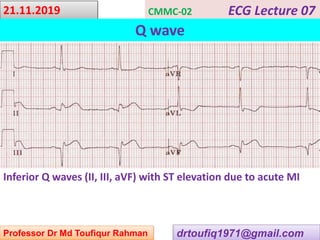
Inferior Q waves (II, III, aVF) with ST elevation due to acute MI
drtoufiq1971@gmail.com
21.11.2019 CMMC-02 ECG Lecture 07
Q wave
Professor Dr Md Toufiqur Rahman
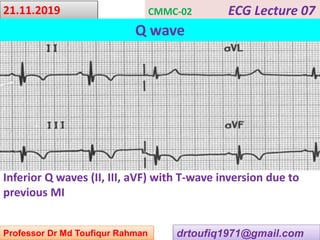
Inferior Q waves (II, III, aVF) with T-wave inversion due to
previous MI
drtoufiq1971@gmail.com
21.11.2019 CMMC-02 ECG Lecture 07
Q wave
Professor Dr Md Toufiqur Rahman
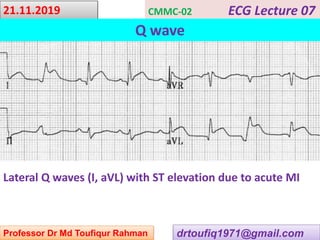
Lateral Q waves (I, aVL) with ST elevation due to acute MI
drtoufiq1971@gmail.com
21.11.2019 CMMC-02 ECG Lecture 07
Q wave
Professor Dr Md Toufiqur Rahman
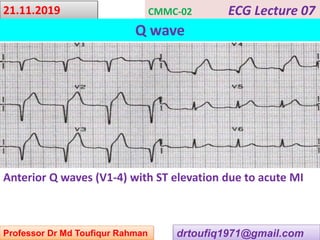
Anterior Q waves (V1-4) with ST elevation due to acute MI
drtoufiq1971@gmail.com
21.11.2019 CMMC-02 ECG Lecture 07
Q wave
Professor Dr Md Toufiqur Rahman
Anterior Q waves (V1-4) with T-wave inversion due to recent MI

ECG-Q wave

  • 1.
    MBBS, FCPS, MD,FACC, FESC, FRCP, FSCAI, FCCP,FAPSC, FAPSIC, FAHA,FACP,FASE Professor and Head of Cardiology Colonel Malek Medical College , Manikganj. For under-graduates drtoufiq19711@yahoo.com21/11/2019 Under graduate version 2019
  • 2.
    drtoufiq1971@gmail.com 28.11.2019 CMMC-02 ECGLecture 09 Q wave Professor Dr Md Toufiqur Rahman The Q Wave â€ĸ A Q wave is any negative deflection that precedes an R wave â€ĸ The Q wave represents the normal left- to-right depolarisation of the interventricular septum â€ĸ Small ‘septal’ Q waves are typically seen in the left-sided leads (I, aVL, V5 and V6)
  • 3.
    drtoufiq1971@gmail.com 28.11.2019 CMMC-02 ECGLecture 08 Q wave Professor Dr Md Toufiqur Rahman
  • 4.
    drtoufiq1971@gmail.com 28.11.2019 CMMC-02 ECGLecture 08 Q wave Professor Dr Md Toufiqur Rahman Q waves in different leads â€ĸ Small Q waves are normal in most leads â€ĸ Deeper Q waves (>2 mm) may be seen in leads III and aVR as a normal variant â€ĸ Under normal circumstances, Q waves are not seen in the right-sided leads (V1-3)
  • 5.
    drtoufiq1971@gmail.com 28.11.2019 CMMC-02 ECGLecture 08 Q wave Professor Dr Md Toufiqur Rahman Pathological Q Waves Q waves are considered pathological if: > 40 ms (1 mm) wide > 2 mm deep > 25% of depth of QRS complex Seen in leads V1-3 Pathological Q waves usually indicate current or prior myocardial infarction.
  • 6.
    drtoufiq1971@gmail.com 21.11.2019 CMMC-02 ECGLecture 07 Q wave Professor Dr Md Toufiqur Rahman Differential Diagnosis/ Causes of Q waves â€ĸ Myocardial infarction â€ĸ Cardiomyopathies — Hypertrophic (HCM), infiltrative myocardial disease â€ĸ Rotation of the heart — Extreme clockwise or counter-clockwise rotation â€ĸ Lead placement errors — e.g. upper limb leads placed on lower limbs
  • 7.
    drtoufiq1971@gmail.com 21.11.2019 CMMC-02 ECGLecture 07 Q wave Professor Dr Md Toufiqur Rahman Loss of normal Q waves â€ĸ The absence of small septal Q waves in leads V5-6 should be considered abnormal. â€ĸ Absent Q waves in V5-6 is most commonly due to LBBB.
  • 8.
    drtoufiq1971@gmail.com 21.11.2019 CMMC-02 ECGLecture 07 Q wave Professor Dr Md Toufiqur Rahman Inferior Q waves (II, III, aVF) with ST elevation due to acute MI
  • 9.
    drtoufiq1971@gmail.com 21.11.2019 CMMC-02 ECGLecture 07 Q wave Professor Dr Md Toufiqur Rahman Inferior Q waves (II, III, aVF) with T-wave inversion due to previous MI
  • 10.
    drtoufiq1971@gmail.com 21.11.2019 CMMC-02 ECGLecture 07 Q wave Professor Dr Md Toufiqur Rahman Lateral Q waves (I, aVL) with ST elevation due to acute MI
  • 11.
    drtoufiq1971@gmail.com 21.11.2019 CMMC-02 ECGLecture 07 Q wave Professor Dr Md Toufiqur Rahman Anterior Q waves (V1-4) with ST elevation due to acute MI
  • 12.
    drtoufiq1971@gmail.com 21.11.2019 CMMC-02 ECGLecture 07 Q wave Professor Dr Md Toufiqur Rahman Anterior Q waves (V1-4) with T-wave inversion due to recent MI