NORMAL ECG
AIIMS,BHUBANESWAR,CARDIOLOGY
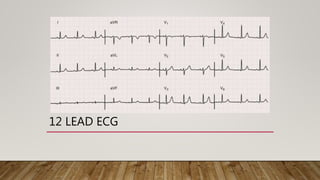
12 LEAD ECG
HISTORY OF ELECTROCARDIOGRAGHY
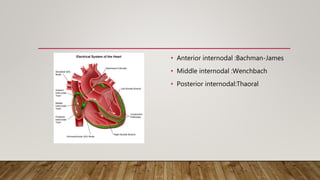
• Anterior internodal :Bachman-James
• Middle internodal :Wenchbach
• Posterior internodal:Thaoral
DEPOLARISATION
SEQUENCE
ELECTRICAL DIPOLE
• A dipole is created when one
part of the muscle strip becomes
electrically negative relative to
the rest of the muscle strip.
Movement of the dipole from
negative to positive (arrow)
creates an electrical field.
FILTERING
• An electrocardiogram (ECG) is obtained analog
and, in current machines, is converted into a digital
signal, where it is filtered to block out some of the
“noise” while keeping relevant parts of the “signal.”
Low frequency signals such as respiration are
eliminated using a high pass filter. High frequency
signals such as noncardiac muscle potentials are
attenuated using a low pass filter. Specific “notch”
filters that eliminate electromagnetic interference
at 50 to 60 Hz may also be used.
A TOTAL OF 12 LEADS
THREE ARM BIPOLAR LEADS
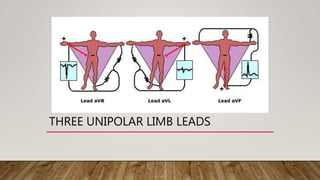
THREE UNIPOLAR LIMB LEADS
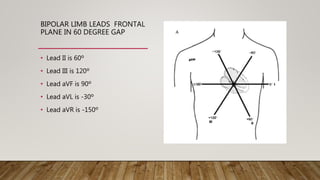
BIPOLAR LIMB LEADS FRONTAL
PLANE IN 60 DEGREE GAP
• Lead II is 60º
• Lead III is 120º
• Lead aVF is 90º
• Lead aVL is -30º
• Lead aVR is -150º
UNIPOLAR IN 30
DEGREE GAP
BIPOLAR IN 60
DEGREE GAP
WILSON’S PRECORDIAL LEADS
• V1 – Fourth intercostal space to the right of the sternum
• V2 – Fourth intercostal space to the left of the sternum
• V3 – Midway between V2 and V4
• V4 – Fifth intercostal space at the midclavicular line
• V5 – Anterior axillary line at the level of V4, or halfway between V4 and V6 if the
anterior axillary line is unclear.
• V6 – Midaxillary line at the level of V4
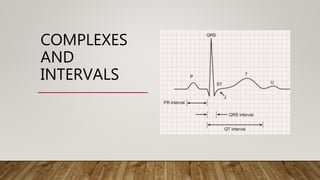
COMPLEXES
AND
INTERVALS
P WAVE
• The P wave represents atrial depolarization
• From the right to left atrium
• Positive in most leads
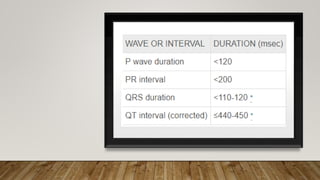
• The duration is generally <0.12 sec (three small boxes)
• Amplitude <0.25 mv (2.5 small boxes)
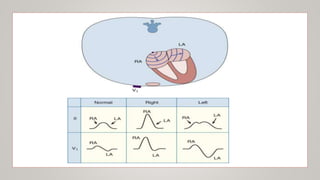
• Right atrial depolarization precedes that of the left atrium
• the P wave is often notched in the limb leads and usually biphasic in lead V1
PR INTERVAL
• The PR interval =P wave+ PR segment
• From the beginning of the P wave to the first part of the QRS complex
• Time for atrial depolarization (the P wave) and conduction through the AV node and
the His-Purkinje system (which constitute the PR segment)
• PR interval : 0.12 to 0.20 sec (three to five small boxes)
• Shorter at faster heart rates due to sympathetically mediated enhancement of
atrioventricular (AV) nodal conduction
• Longer when the rate is slowed as a consequence of slower AV nodal conduction
resulting from withdrawal of sympathetic tone or an increase in vagal inputs.
QRS COMPLEX
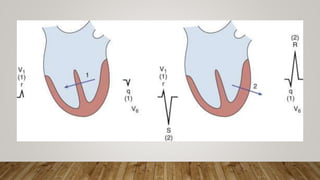
• If the initial deflection is negative, it is termed a Q wave
• Small Q waves are often seen in leads I, aVL, and V4-V6 as a result of initial septal
depolarization and are considered normal.
• The first positive deflection of the QRS complex is called the R wave=
depolarization of the LV myocardium
• RV depolarization is obscured because the LV myocardial mass is much greater
than that of the right ventricle
• The small R wave in lead V1 represents initial septal depolarization.
QRS COMPLEX
• The negative deflection following the R wave is the S wave, which represents
terminal depolarization of the high lateral wall
• If there is a second positive deflection, it is known as an R'.
• Lower case letters (q, r, or s) are used for relatively small amplitude waves of less
than 0.5 mV (less than 5 mm with standard calibration)
• An entirely negative QRS complex is called a QS wave
• QRS duration = 0.06 to 0.10 seconds (1½ to 2½ small boxes) and is not
influenced by heart rate.
• The R wave should progress in size across the precordial leads V1-V6
• Normally there is a small R wave in lead V1 with a deep S wave
• R wave amplitude should increase in size until V4-V6 while the S wave becomes
less deep. This is termed R wave progression across the precordium
ST SEGMENT
• The ST segment occurs after ventricular depolarization has ended and before
repolarization has begun
• The time of electrocardiographic silence
• The intersection of the end of the QRS complex and the initial part of the ST
segment is termed the J point
• The ST segment is usually isoelectric
T WAVE
• T wave =Period of ventricular repolarization
• the rate of repolarization is slower than depolarization, the T wave is broad, has a slow upstroke,
and rapidly returns to the isoelectric line following its peak (ie, slow upstroke, rapid downstroke)
• T wave is asymmetric and the amplitude is variable
• T wave is usually smooth up and down
• depolarization begins at the endocardial surface and spreads to the epicardium, while
repolarization begins at the epicardial surface and spreads to the endocardium, the direction of
ventricular depolarization is opposite to that of ventricular repolarization
• T wave vector on the ECG normally is in the same direction as the major deflection of the QRS
• he QRS and T wave axes are concordant
QT INTERVAL —
• QT interval = QRS complex+ ST segment+ T wave
• QT interval is primarily a measure of ventricular repolarization
• JT interval= ventricular repolarization since it does not include ventricular
depolarization, but in most clinical situations, the QT interval is used
• QRS complex duration is increased, this will lead to an increase in QT interval but
does not reflect a change in ventricular repolarization. A widened QRS, therefore,
must be considered if a prolonged QT interval is being evaluated.
QT INTERVAL
• QT (or JT) interval is dependent upon the heart rate
• it is shorter at faster heart rates and longer when the rate is slower
• QT interval that is corrected for heart rate (QTc) is often calculated as follows
(based on Bazett's formula):
• QTc = QT interval ÷ square root of the RR interval (in sec)
QT INTERVAL
• QTc in men is ≤0.44 sec
• QTc in women is ≤0.45 to 0.46 sec
• . QTc values, however, are on a bell curve
•
U WAVE
• Seen in V2 to V4
• May be from late repolarization of the mid-myocardial M cells
• The amplitude of the U wave is typically less than 0.2 Mv
• Clearly separate from the T wave
• Hypokalemia and bradycardia
• U merge with T wave when the QT interval is prolonged (a QT-U wave)
• Very obvious when the QT or JT interval is shortened [ digoxin or hypercalcemia]
APPROACH TO ECG INTERPRETATION
• Step-1:Standardisation
• Step 2: Rate
• Step 3:rhythm
• Step 4:AXIS
• STEP 5:INTERVAL
• STEP 6:P WAVE
• STEP 7:QRS COMPEX
• STEP 8: ST segment-T wave
• STEP 9:Overall interpretation
GRID LINES AND STANDARDIZATION OF THE ECG
HEART RATE
• The division of 300 by the number of large boxes = heart rate
• The division of 1500 by the number of small boxes = heart rate
• If the rhythm is irregular,
• Number of complexes on the ECG x6
• Normal= 60 to 100
• < 60 is bradycardia
• > 100 is tachycardia
BRADYCARDIA
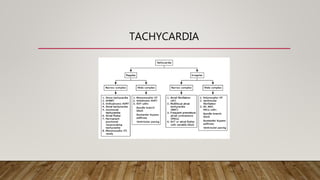
TACHYCARDIA
BRADYCARDIA
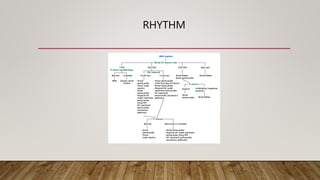
RHYTHM
RHYTHM ANALYSIS
FRONTAL PLANE QRS AXIS
QRS AXIS
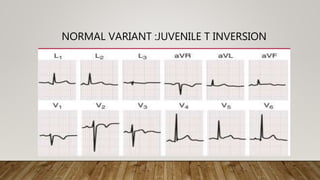
NORMAL VARIANT :JUVENILE T INVERSION
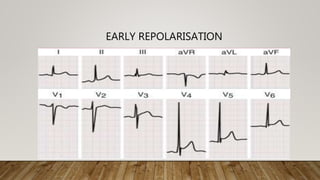
EARLY REPOLARISATION
ACUTE ST ELEVATION MI
FLAVOR WON'T LAST
IT'S THE QUALITY
WORK
MUST WORK IN DAY
ALSO, IN THE DARK

12 LEAD NORMAL ELECTROCARDIOGRAM

  • 1.
  • 2.
  • 3.
  • 4.
    • Anterior internodal:Bachman-James • Middle internodal :Wenchbach • Posterior internodal:Thaoral
  • 5.
  • 6.
    ELECTRICAL DIPOLE • Adipole is created when one part of the muscle strip becomes electrically negative relative to the rest of the muscle strip. Movement of the dipole from negative to positive (arrow) creates an electrical field.
  • 7.
    FILTERING • An electrocardiogram(ECG) is obtained analog and, in current machines, is converted into a digital signal, where it is filtered to block out some of the “noise” while keeping relevant parts of the “signal.” Low frequency signals such as respiration are eliminated using a high pass filter. High frequency signals such as noncardiac muscle potentials are attenuated using a low pass filter. Specific “notch” filters that eliminate electromagnetic interference at 50 to 60 Hz may also be used.
  • 8.
    A TOTAL OF12 LEADS THREE ARM BIPOLAR LEADS
  • 9.
  • 10.
    BIPOLAR LIMB LEADSFRONTAL PLANE IN 60 DEGREE GAP • Lead II is 60º • Lead III is 120º • Lead aVF is 90º • Lead aVL is -30º • Lead aVR is -150º
  • 11.
    UNIPOLAR IN 30 DEGREEGAP BIPOLAR IN 60 DEGREE GAP
  • 12.
  • 13.
    • V1 –Fourth intercostal space to the right of the sternum • V2 – Fourth intercostal space to the left of the sternum • V3 – Midway between V2 and V4 • V4 – Fifth intercostal space at the midclavicular line • V5 – Anterior axillary line at the level of V4, or halfway between V4 and V6 if the anterior axillary line is unclear. • V6 – Midaxillary line at the level of V4
  • 14.
  • 15.
    P WAVE • TheP wave represents atrial depolarization • From the right to left atrium • Positive in most leads • The duration is generally <0.12 sec (three small boxes) • Amplitude <0.25 mv (2.5 small boxes) • Right atrial depolarization precedes that of the left atrium • the P wave is often notched in the limb leads and usually biphasic in lead V1
  • 17.
    PR INTERVAL • ThePR interval =P wave+ PR segment • From the beginning of the P wave to the first part of the QRS complex • Time for atrial depolarization (the P wave) and conduction through the AV node and the His-Purkinje system (which constitute the PR segment) • PR interval : 0.12 to 0.20 sec (three to five small boxes) • Shorter at faster heart rates due to sympathetically mediated enhancement of atrioventricular (AV) nodal conduction • Longer when the rate is slowed as a consequence of slower AV nodal conduction resulting from withdrawal of sympathetic tone or an increase in vagal inputs.
  • 18.
    QRS COMPLEX • Ifthe initial deflection is negative, it is termed a Q wave • Small Q waves are often seen in leads I, aVL, and V4-V6 as a result of initial septal depolarization and are considered normal. • The first positive deflection of the QRS complex is called the R wave= depolarization of the LV myocardium • RV depolarization is obscured because the LV myocardial mass is much greater than that of the right ventricle • The small R wave in lead V1 represents initial septal depolarization.
  • 19.
    QRS COMPLEX • Thenegative deflection following the R wave is the S wave, which represents terminal depolarization of the high lateral wall • If there is a second positive deflection, it is known as an R'. • Lower case letters (q, r, or s) are used for relatively small amplitude waves of less than 0.5 mV (less than 5 mm with standard calibration) • An entirely negative QRS complex is called a QS wave
  • 20.
    • QRS duration= 0.06 to 0.10 seconds (1½ to 2½ small boxes) and is not influenced by heart rate. • The R wave should progress in size across the precordial leads V1-V6 • Normally there is a small R wave in lead V1 with a deep S wave • R wave amplitude should increase in size until V4-V6 while the S wave becomes less deep. This is termed R wave progression across the precordium
  • 22.
    ST SEGMENT • TheST segment occurs after ventricular depolarization has ended and before repolarization has begun • The time of electrocardiographic silence • The intersection of the end of the QRS complex and the initial part of the ST segment is termed the J point • The ST segment is usually isoelectric
  • 23.
    T WAVE • Twave =Period of ventricular repolarization • the rate of repolarization is slower than depolarization, the T wave is broad, has a slow upstroke, and rapidly returns to the isoelectric line following its peak (ie, slow upstroke, rapid downstroke) • T wave is asymmetric and the amplitude is variable • T wave is usually smooth up and down • depolarization begins at the endocardial surface and spreads to the epicardium, while repolarization begins at the epicardial surface and spreads to the endocardium, the direction of ventricular depolarization is opposite to that of ventricular repolarization • T wave vector on the ECG normally is in the same direction as the major deflection of the QRS • he QRS and T wave axes are concordant
  • 24.
    QT INTERVAL — •QT interval = QRS complex+ ST segment+ T wave • QT interval is primarily a measure of ventricular repolarization • JT interval= ventricular repolarization since it does not include ventricular depolarization, but in most clinical situations, the QT interval is used • QRS complex duration is increased, this will lead to an increase in QT interval but does not reflect a change in ventricular repolarization. A widened QRS, therefore, must be considered if a prolonged QT interval is being evaluated.
  • 25.
    QT INTERVAL • QT(or JT) interval is dependent upon the heart rate • it is shorter at faster heart rates and longer when the rate is slower • QT interval that is corrected for heart rate (QTc) is often calculated as follows (based on Bazett's formula): • QTc = QT interval ÷ square root of the RR interval (in sec)
  • 26.
    QT INTERVAL • QTcin men is ≤0.44 sec • QTc in women is ≤0.45 to 0.46 sec • . QTc values, however, are on a bell curve •
  • 27.
    U WAVE • Seenin V2 to V4 • May be from late repolarization of the mid-myocardial M cells • The amplitude of the U wave is typically less than 0.2 Mv • Clearly separate from the T wave • Hypokalemia and bradycardia • U merge with T wave when the QT interval is prolonged (a QT-U wave) • Very obvious when the QT or JT interval is shortened [ digoxin or hypercalcemia]
  • 28.
    APPROACH TO ECGINTERPRETATION • Step-1:Standardisation • Step 2: Rate • Step 3:rhythm • Step 4:AXIS • STEP 5:INTERVAL • STEP 6:P WAVE • STEP 7:QRS COMPEX • STEP 8: ST segment-T wave • STEP 9:Overall interpretation
  • 30.
    GRID LINES ANDSTANDARDIZATION OF THE ECG
  • 31.
    HEART RATE • Thedivision of 300 by the number of large boxes = heart rate • The division of 1500 by the number of small boxes = heart rate • If the rhythm is irregular, • Number of complexes on the ECG x6 • Normal= 60 to 100 • < 60 is bradycardia • > 100 is tachycardia
  • 32.
  • 33.
  • 34.
  • 35.
  • 36.
  • 37.
  • 38.
  • 39.
  • 40.
  • 41.
  • 42.
    FLAVOR WON'T LAST IT'STHE QUALITY WORK MUST WORK IN DAY ALSO, IN THE DARK