Cardiology
Topics
• Electrocardiographic Monitoring
• Dysrhythmias
Cardiac Physiology
• Cardiac Conductive System
• Properties
• Excitability
• Conductivity
• Automaticity
• Contractility
Conduction System
Conduction System
• Each component of the conductive
system has its own intrinsic rate of self-
excitation.
• SA node = 60–100 beats per minute
• AV node = 40–60 beats per minute
• Purkinje system = 15–40 beats per minute
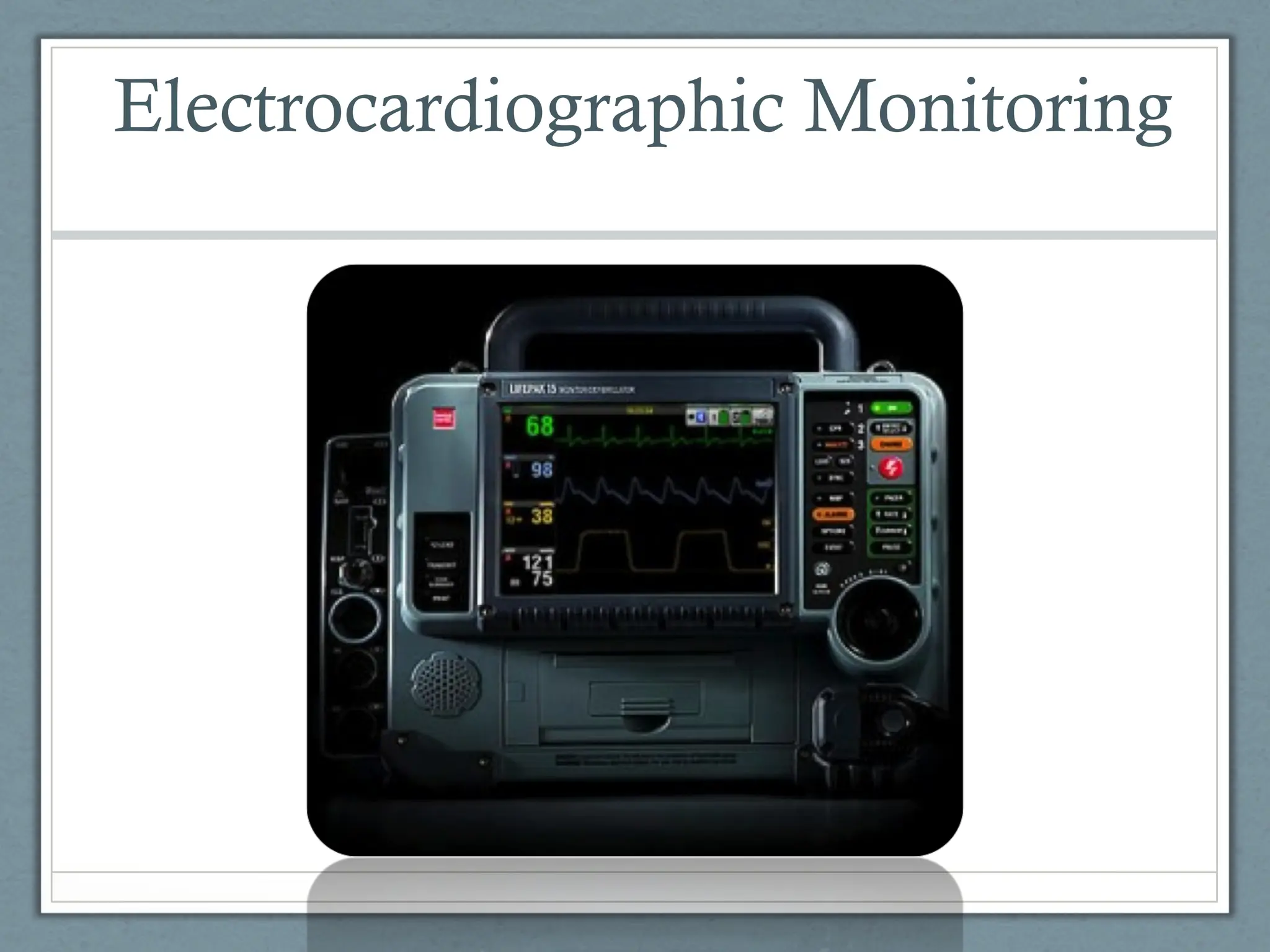
Electrocardiographic Monitoring
Electrocardiographic
Monitoring
• Electrocardiogram (ECG) is a graphic record of
the heart’s electrical activity.
• Tells you nothing about the heart’s pumping ability,
which you must evaluate by pulse and blood pressure.
• The body acts as a giant conductor of
electricity.
• The heart is its largest generator
• Electrodes on the skin can detect the total
electrical activity within the heart.
Electrocardiographic
Monitoring
• Electrical Impulses
• Positive impulses
• Deflect upward
• Negative impulses
• Deflect downward
• The isoelectric line
• Absence of deflection
• Artifact
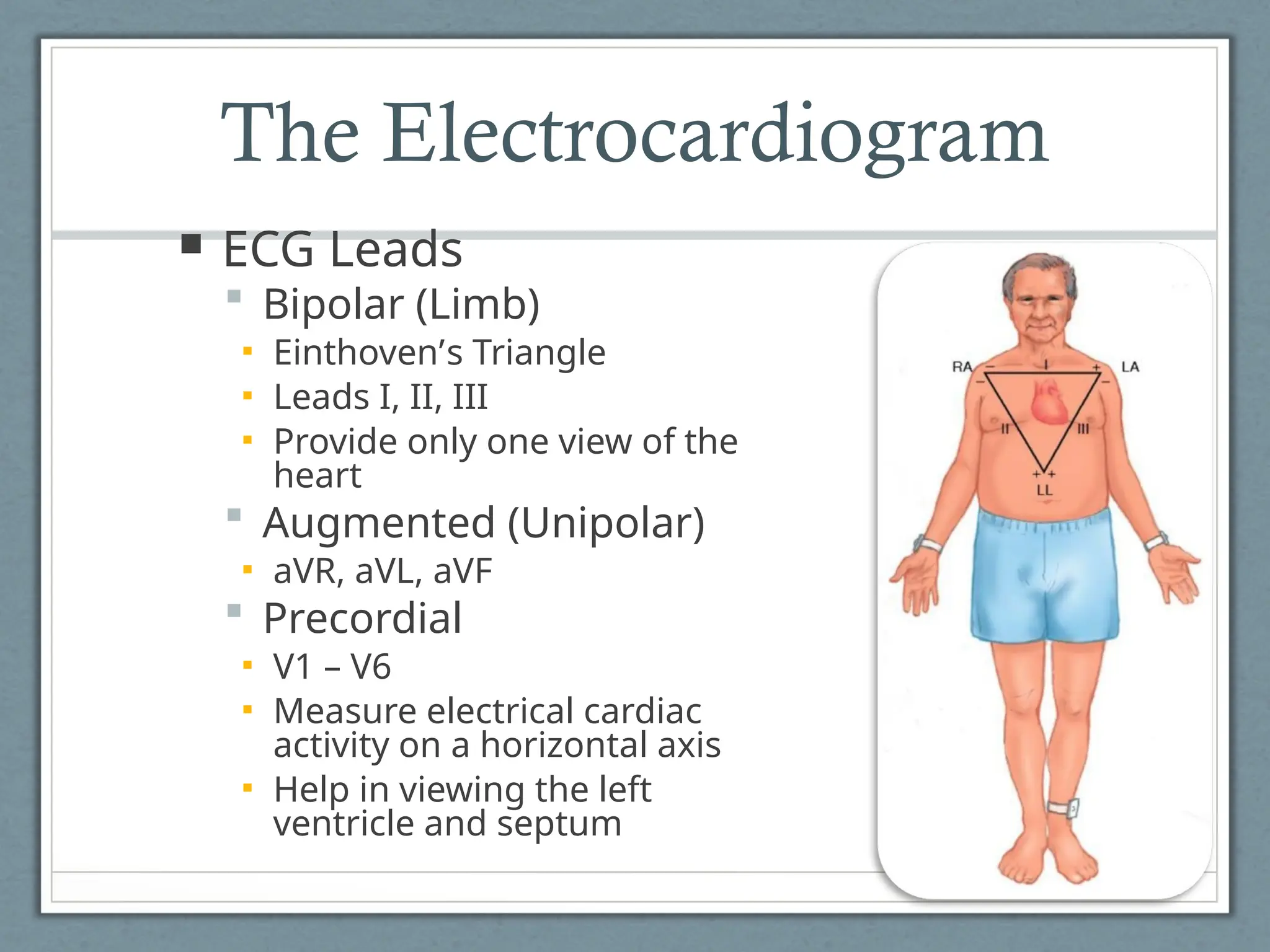
The Electrocardiogram
 ECG Leads
 Bipolar (Limb)
▪ Einthoven’s Triangle
▪ Leads I, II, III
▪ Provide only one view of the
heart
 Augmented (Unipolar)
▪ aVR, aVL, aVF
 Precordial
▪ V1 – V6
▪ Measure electrical cardiac
activity on a horizontal axis
▪ Help in viewing the left
ventricle and septum
The Electrocardiogram
• Routine Monitoring
• Routine ECG monitoring generally uses only one
lead
• Most common monitoring leads are either lead II
or the modified chest lead 1 (MCL1)
• Einthoven’s triangle offers a basis for placing the
leads
• Place the electrodes on the chest wall
• Lead placement
Single Lead Monitoring
• Information from a
single lead shows:
• Rate
• Regularity
• Time to conduct an
impulse
• Single lead cannot show:
• Presence of an infarct
• Axis deviation or chamber
enlargement
• Right-to-left differences in
conduction
• Quality or presence of
pumping action
The Electrocardiogram
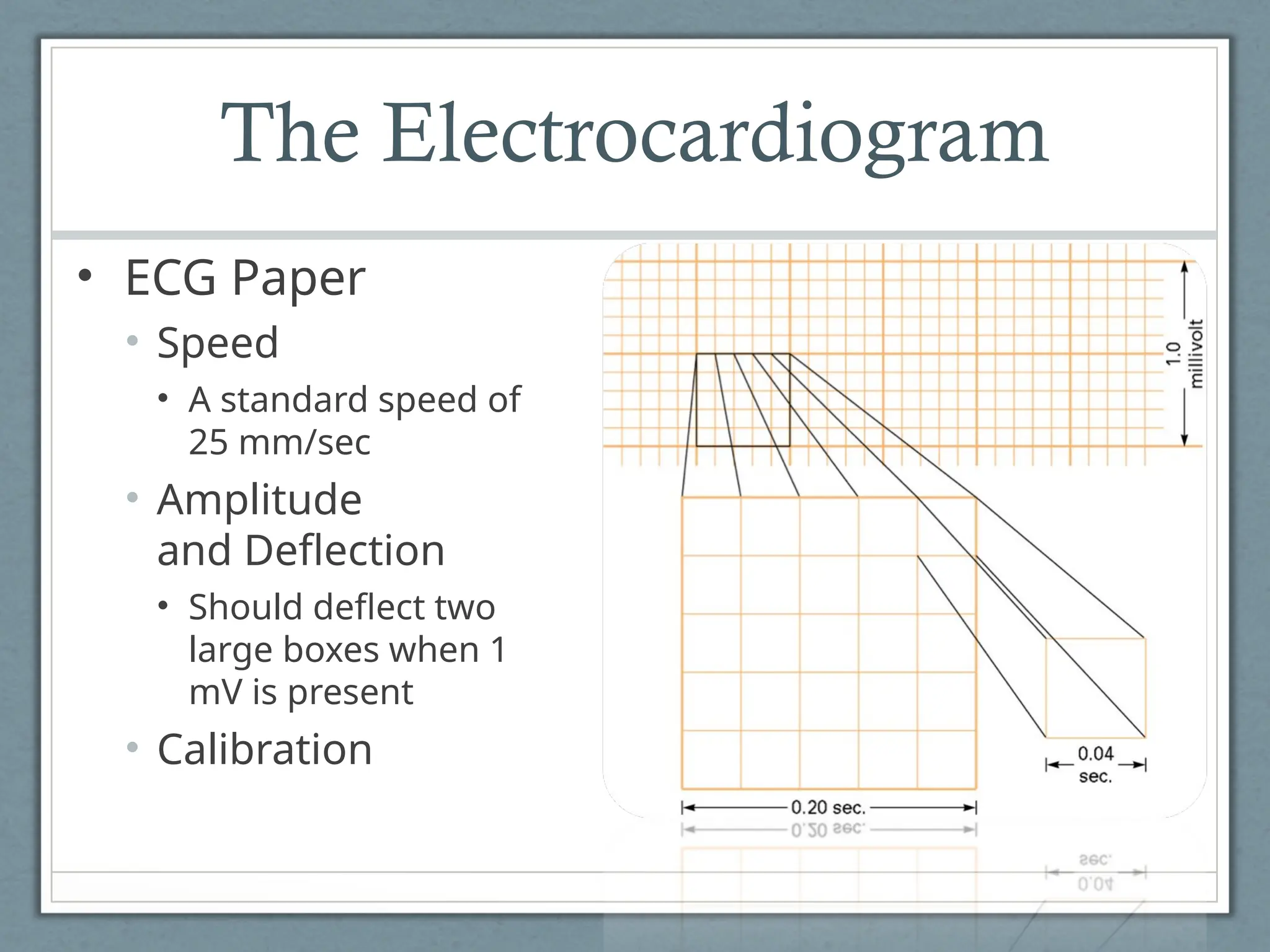
• ECG Paper
• Speed
• A standard speed of
25 mm/sec
• Amplitude
and Deflection
• Should deflect two
large boxes when 1
mV is present
• Calibration
The Electrocardiogram
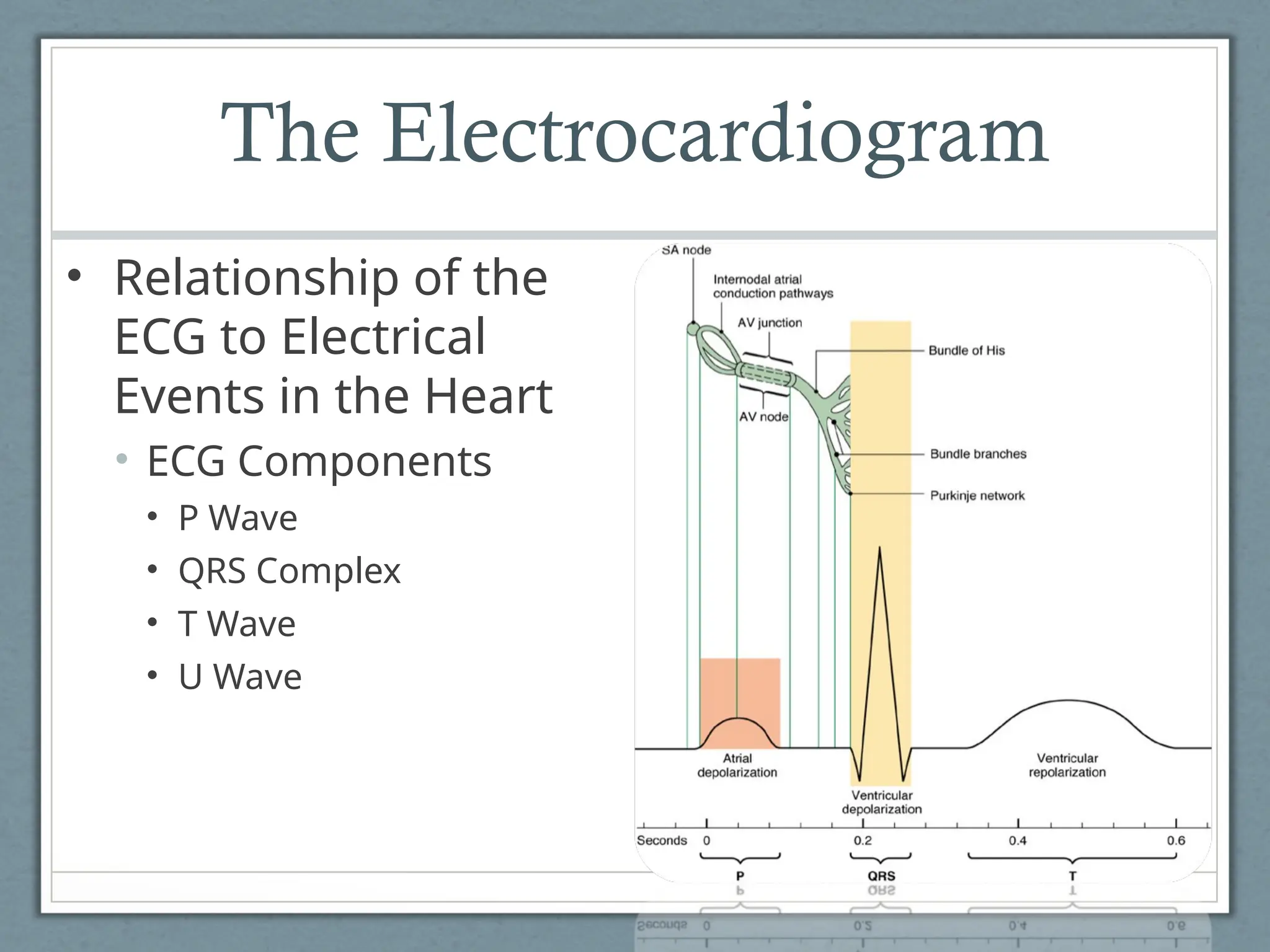
• Relationship of the
ECG to Electrical
Events in the Heart
• ECG Components
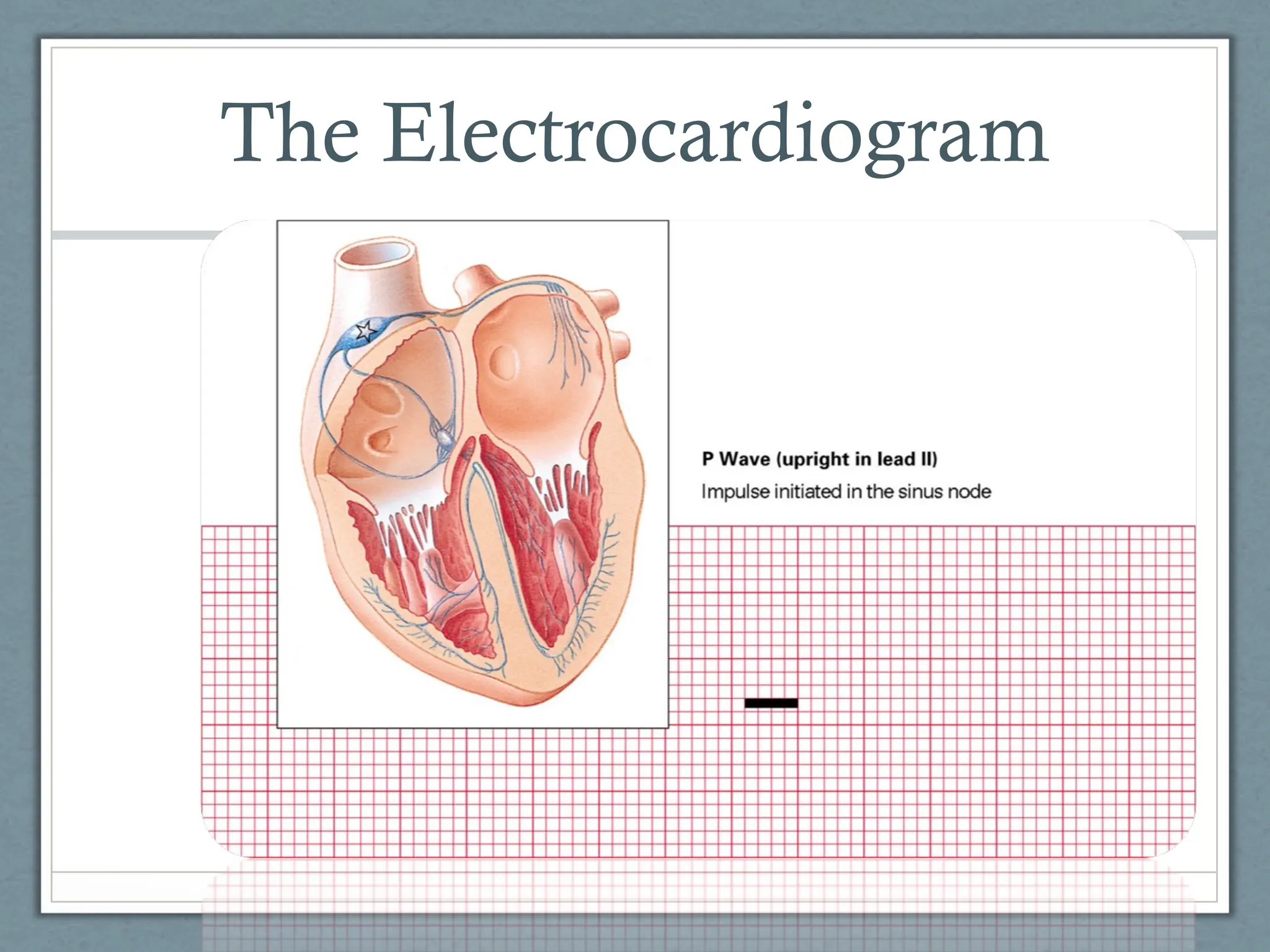
• P Wave
• QRS Complex
• T Wave
• U Wave
The Electrocardiogram
• Time Intervals
• PR Interval (PRI) or
PQ Interval (PQI)
• 0.12–0.20 seconds
• QRS Interval
• 0.08–0.12 seconds
• ST Segment
• QT Interval
• 0.33–0.42 seconds
The Electrocardiogram
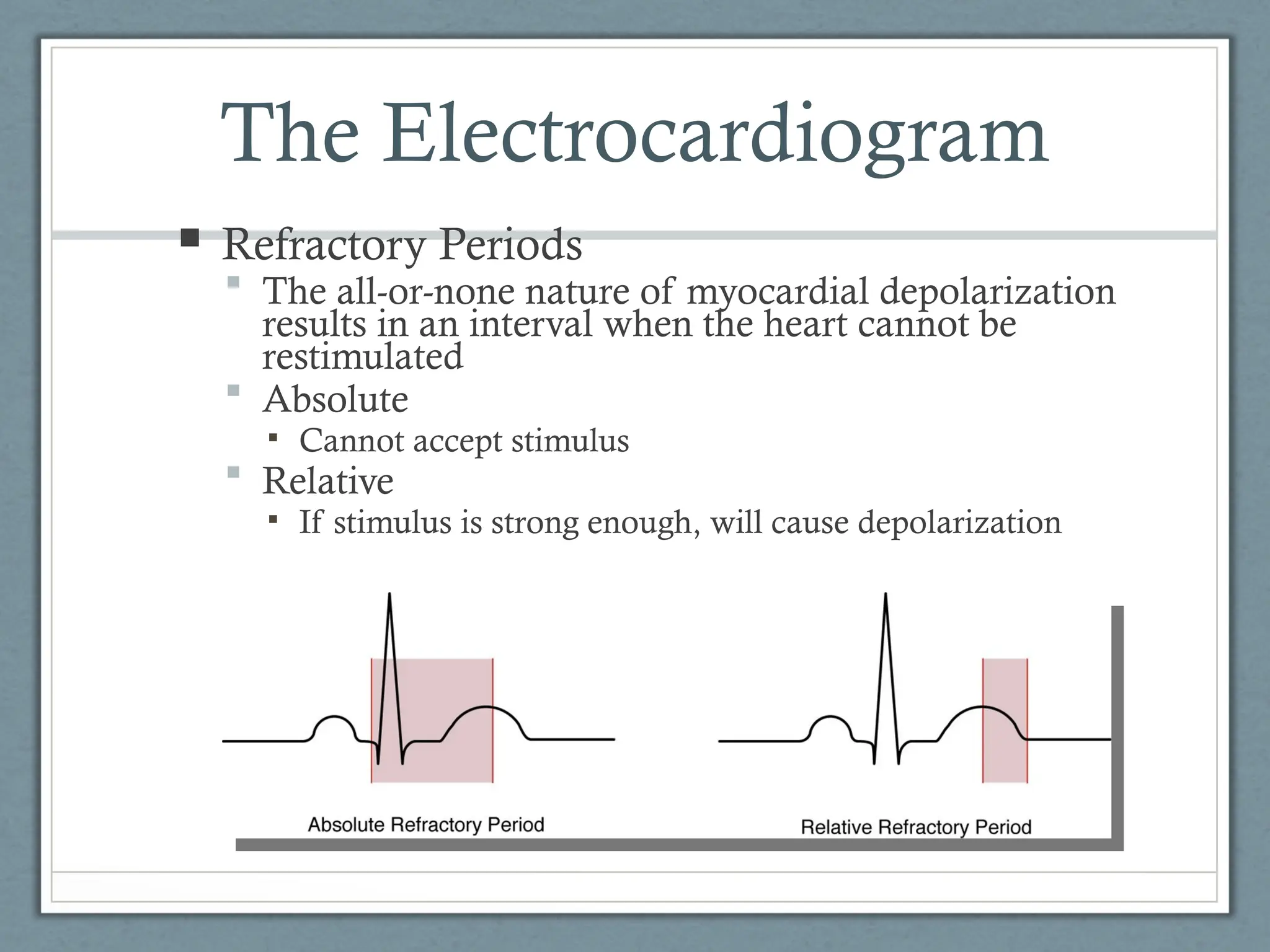
 Refractory Periods
 The all-or-none nature of myocardial depolarization
results in an interval when the heart cannot be
restimulated
 Absolute
▪ Cannot accept stimulus
 Relative
▪ If stimulus is strong enough, will cause depolarization
The Electrocardiogram
• ST Segment Changes
• The ST segment is usually an isoelectric line
• Ischemia causes deflections
• Infarctions usually follow this sequence:
• Ischemia
• ST segment depression or an inverted T wave
• Injury
• Elevates the ST segment
• Necrosis
• Significant Q wave presents
The Electrocardiogram
• Interpretation of Rhythm Strips
• Basic Criteria
• Always be consistent and analytical
• Memorize the rules for each dysrhythmia
• Analyze a given rhythm strip according to a specific
format
• Compare your analysis to the rules for each
dysrhythmia
• Identify the dysrhythmia by its similarity to
established rules
The Electrocardiogram
• Five-Step Procedure
• Analyze the rate
• Analyze the rhythm
• Analyze the P waves
• Analyze the PR interval
• Analyze the QRS complex
The Electrocardiogram
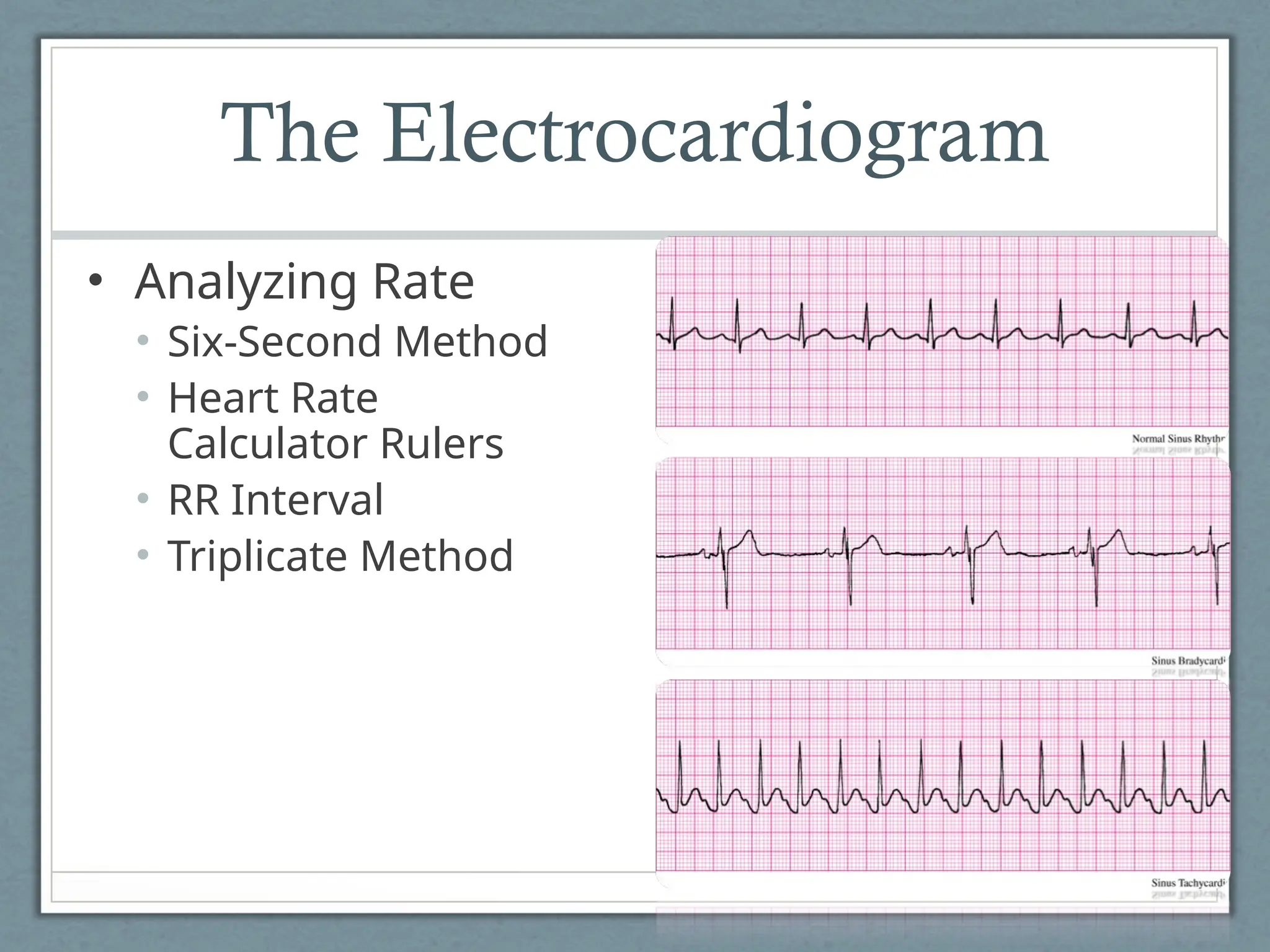
• Analyzing Rate
• Six-Second Method
• Heart Rate
Calculator Rulers
• RR Interval
• Triplicate Method
The Electrocardiogram
• Analyzing Rate
• Six-Second Method
The Electrocardiogram
• Analyzing Rate
• RR Interval
• Count the number
of large boxes from
R-R, and divide
number of boxes
into 300
The Electrocardiogram
• Analyzing Rate
• Triplicate Method
• Count the large
boxes from R to R
• 300, 150, 100, 75,
60, 50
The Electrocardiogram
• Analyzing Rhythm
• Regular
• Occasionally
Irregular
• Regularly Irregular
• Irregularly Irregular
The Electrocardiogram
• Analyzing P Waves
• Are P waves present?
• Are the P waves regular?
• Is there one P wave for each QRS complex?
• Are the P waves upright or inverted?
• Do all the P waves look alike?
• Analyzing the PR Interval
• Normal PR interval is 0.12–0.20 sec
• Analyzing the QRS Complex
• Do all the QRS complexes look alike?
• What is the QRS duration?
• Usually 0.04–0.12 sec
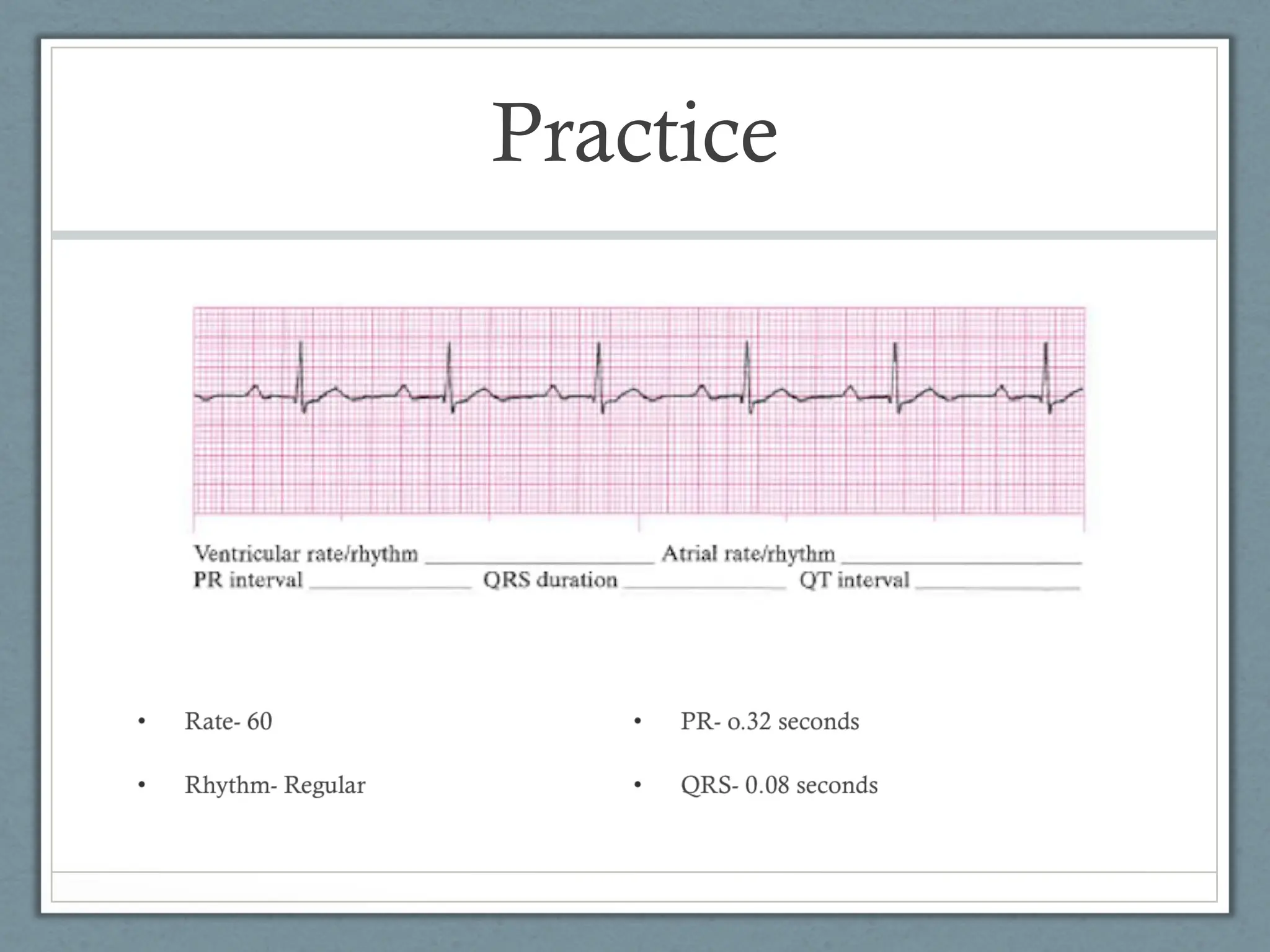
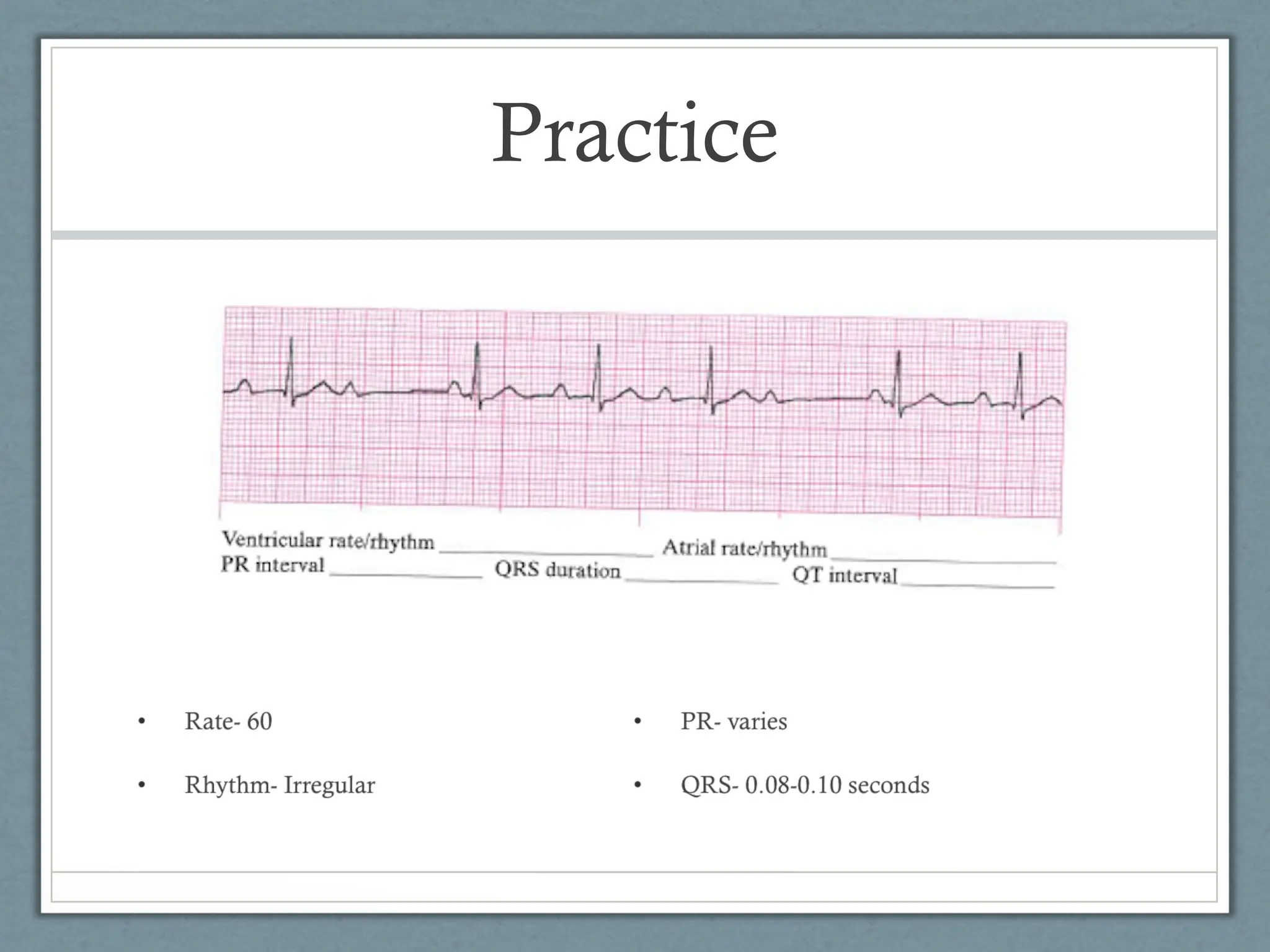
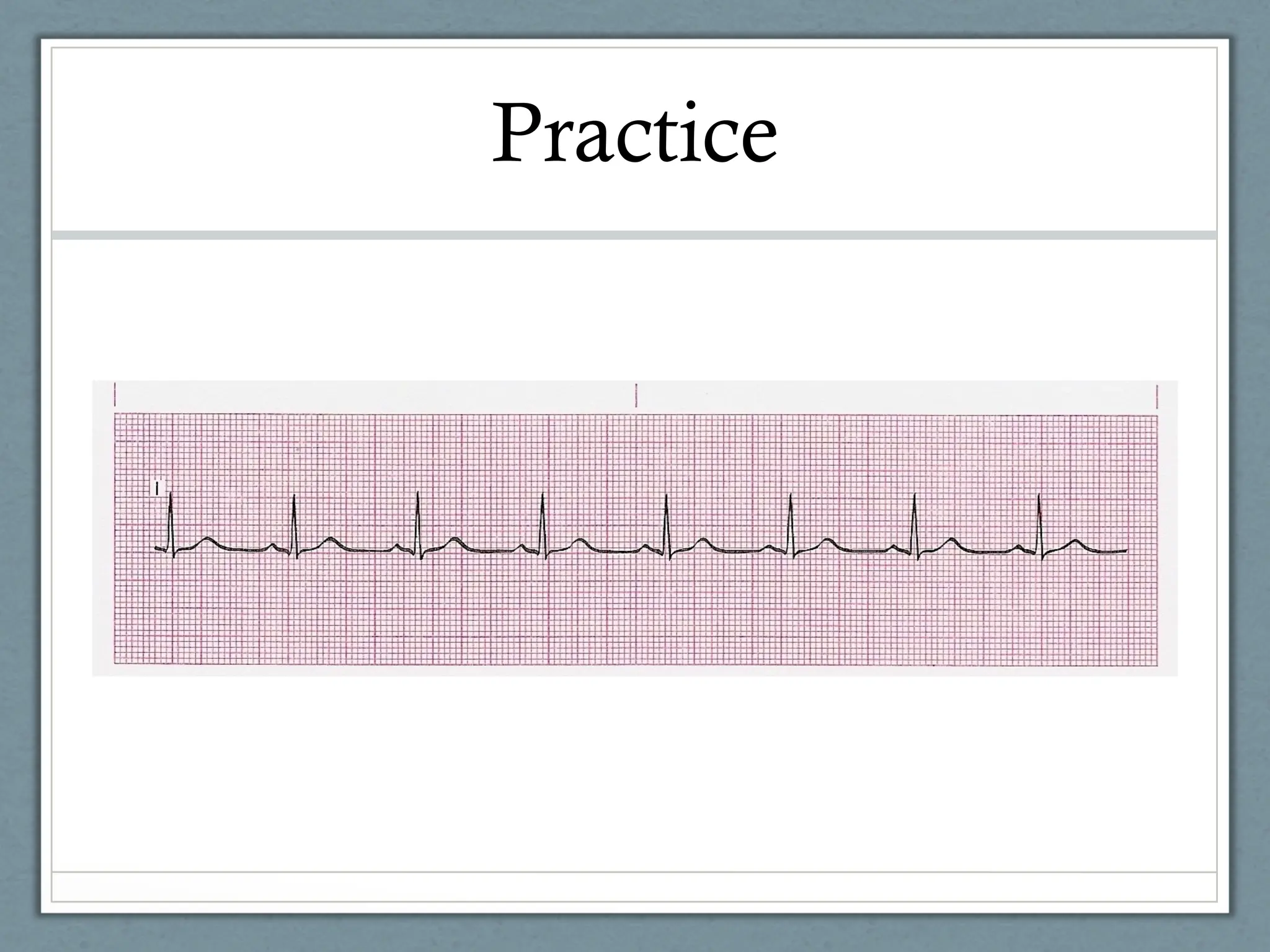
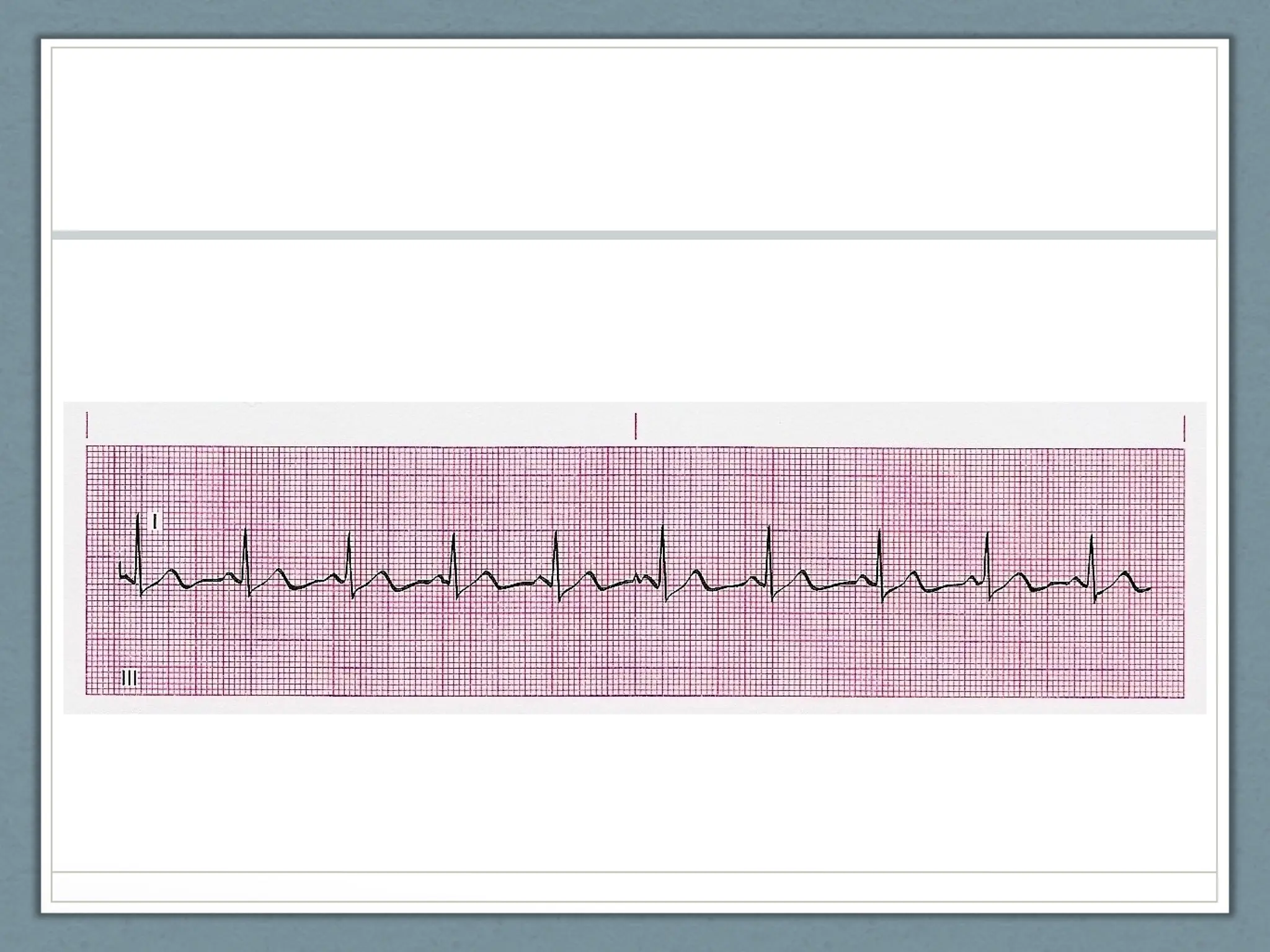
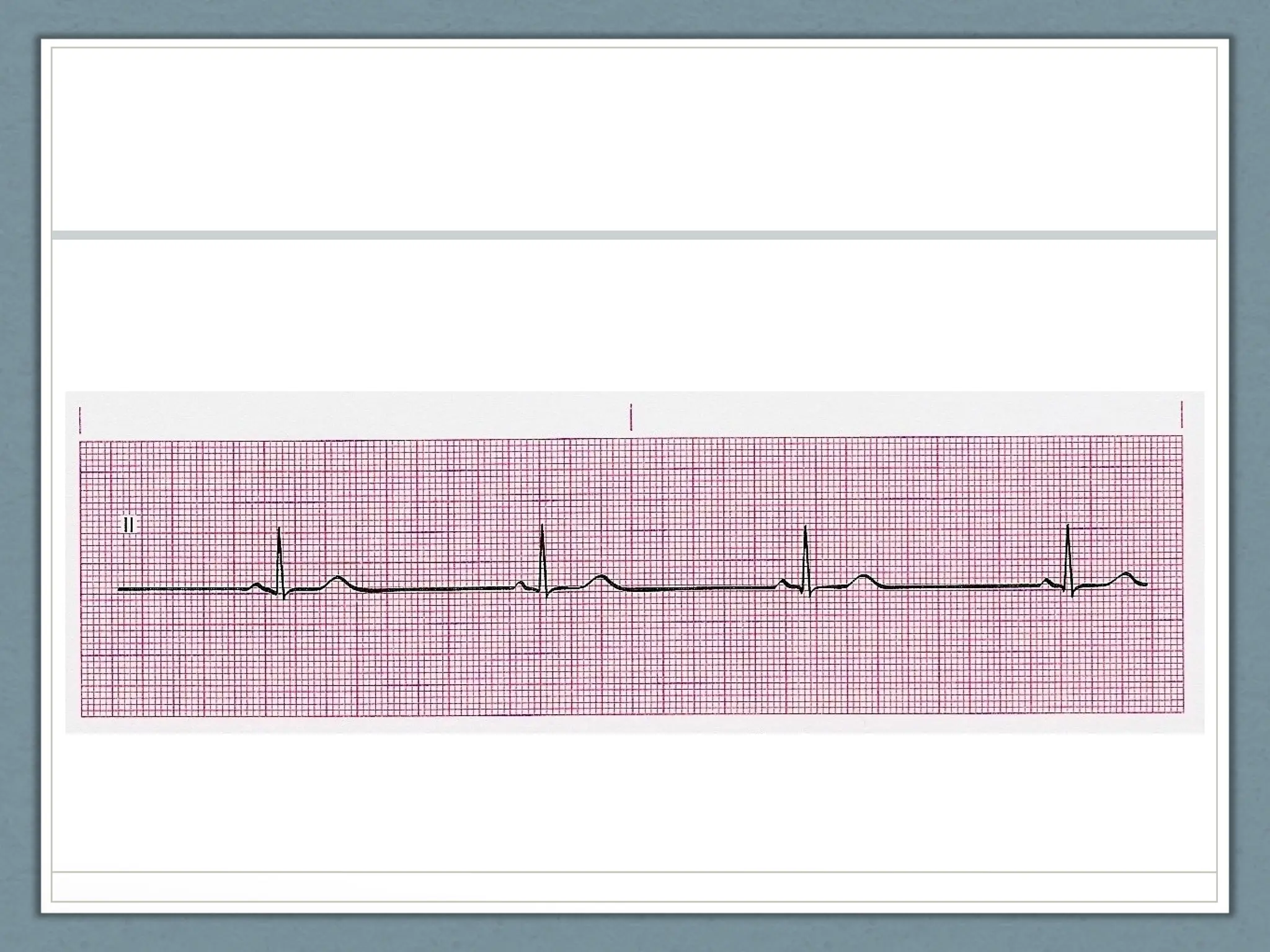
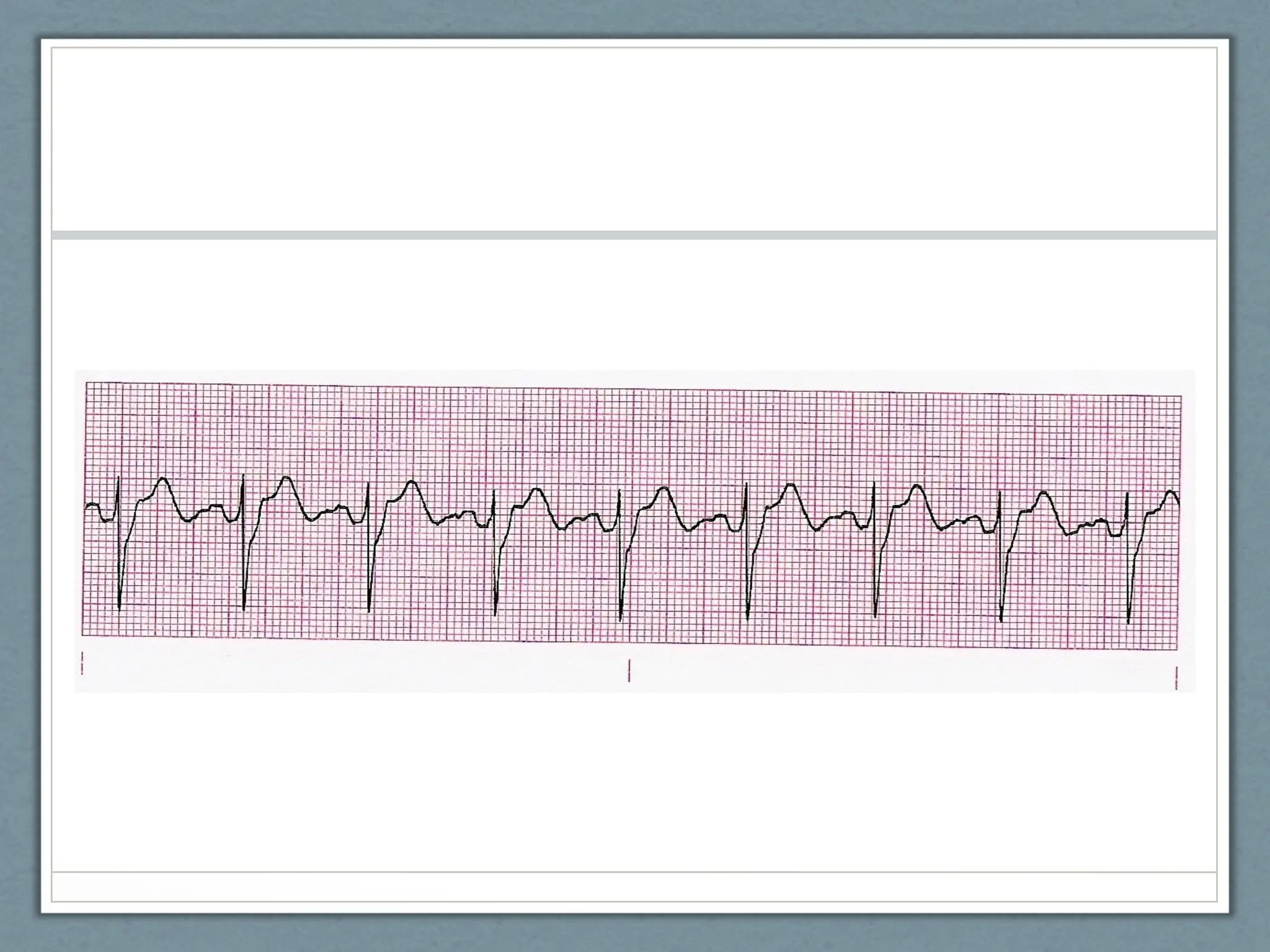
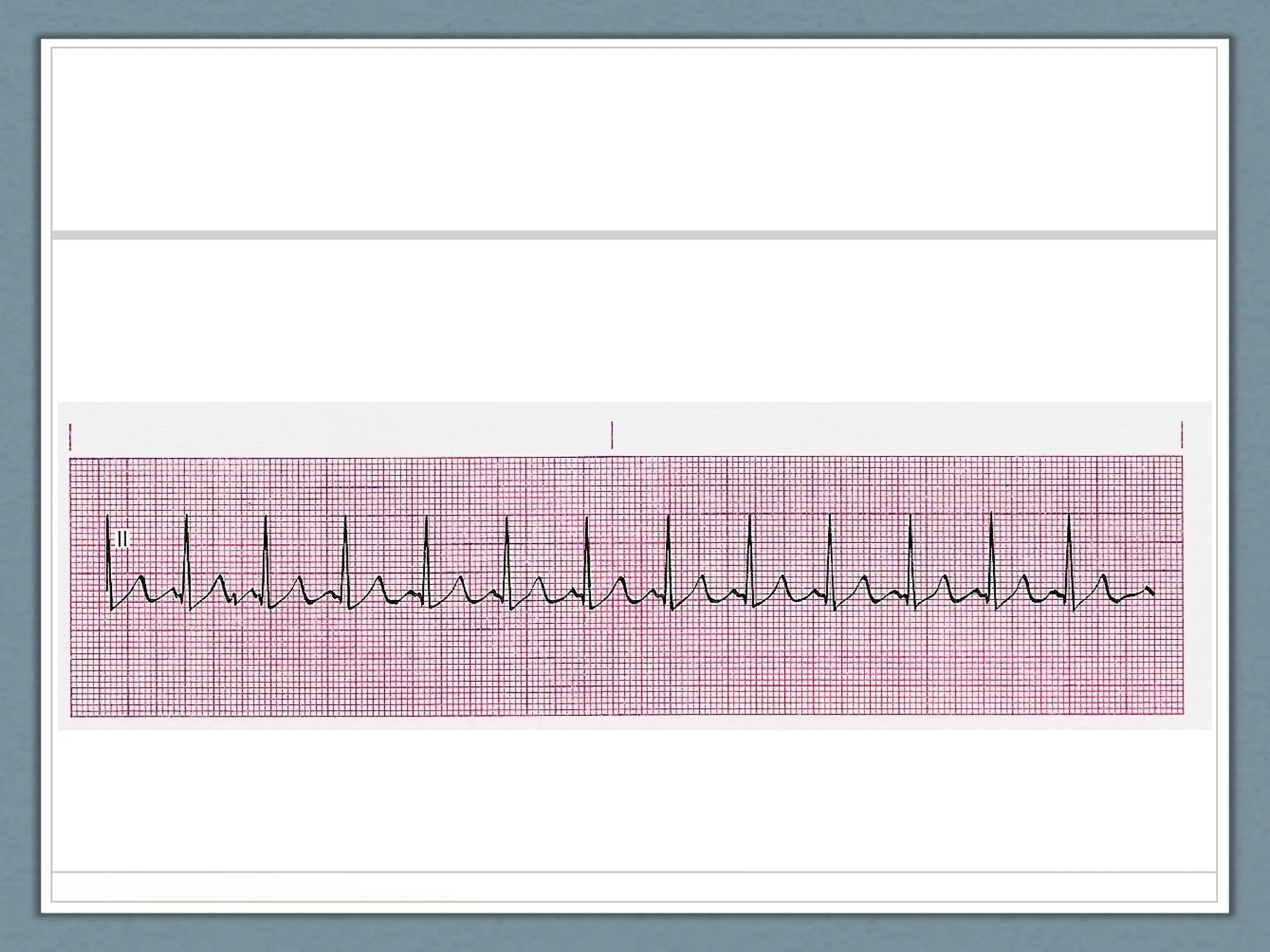
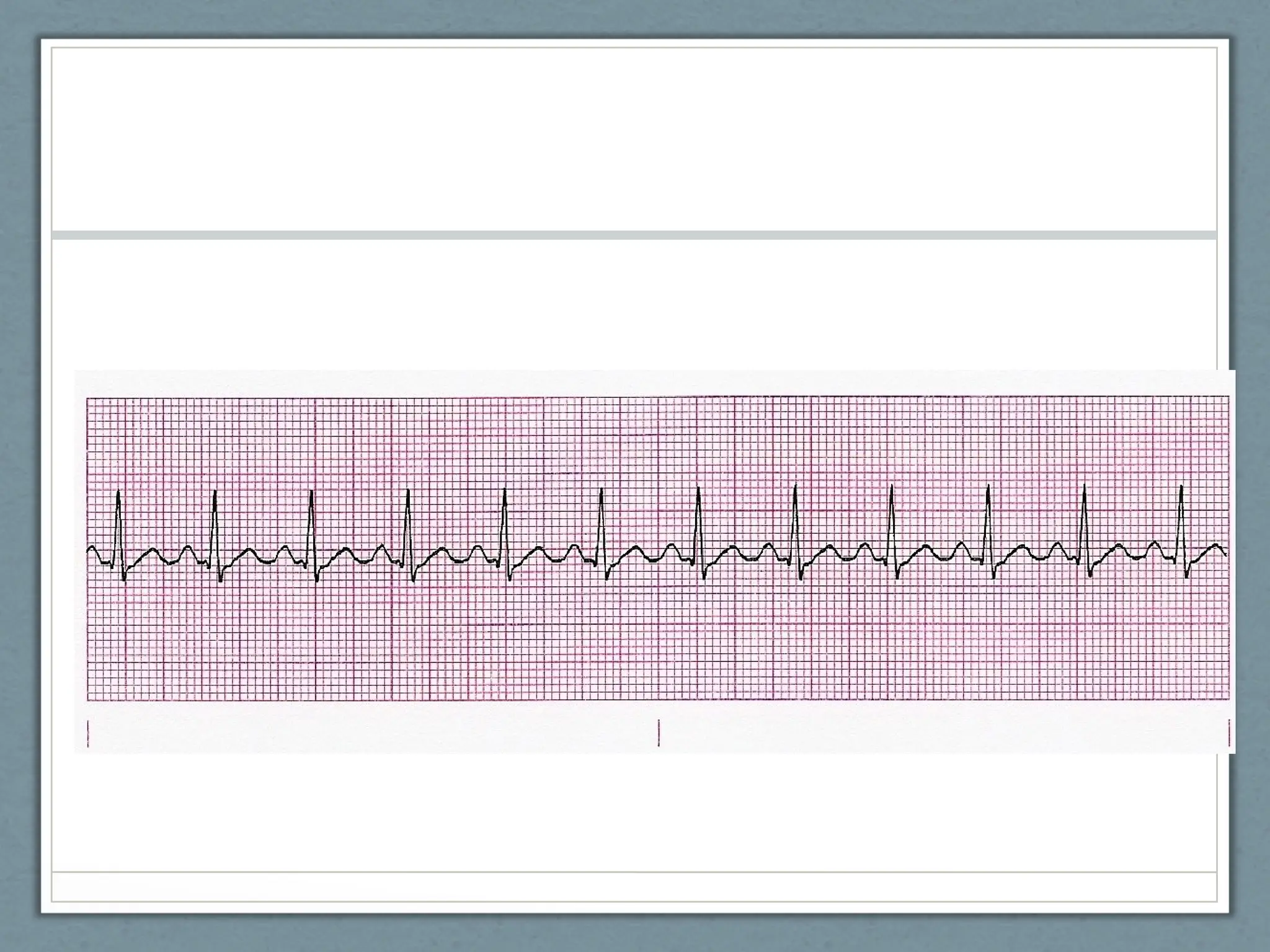
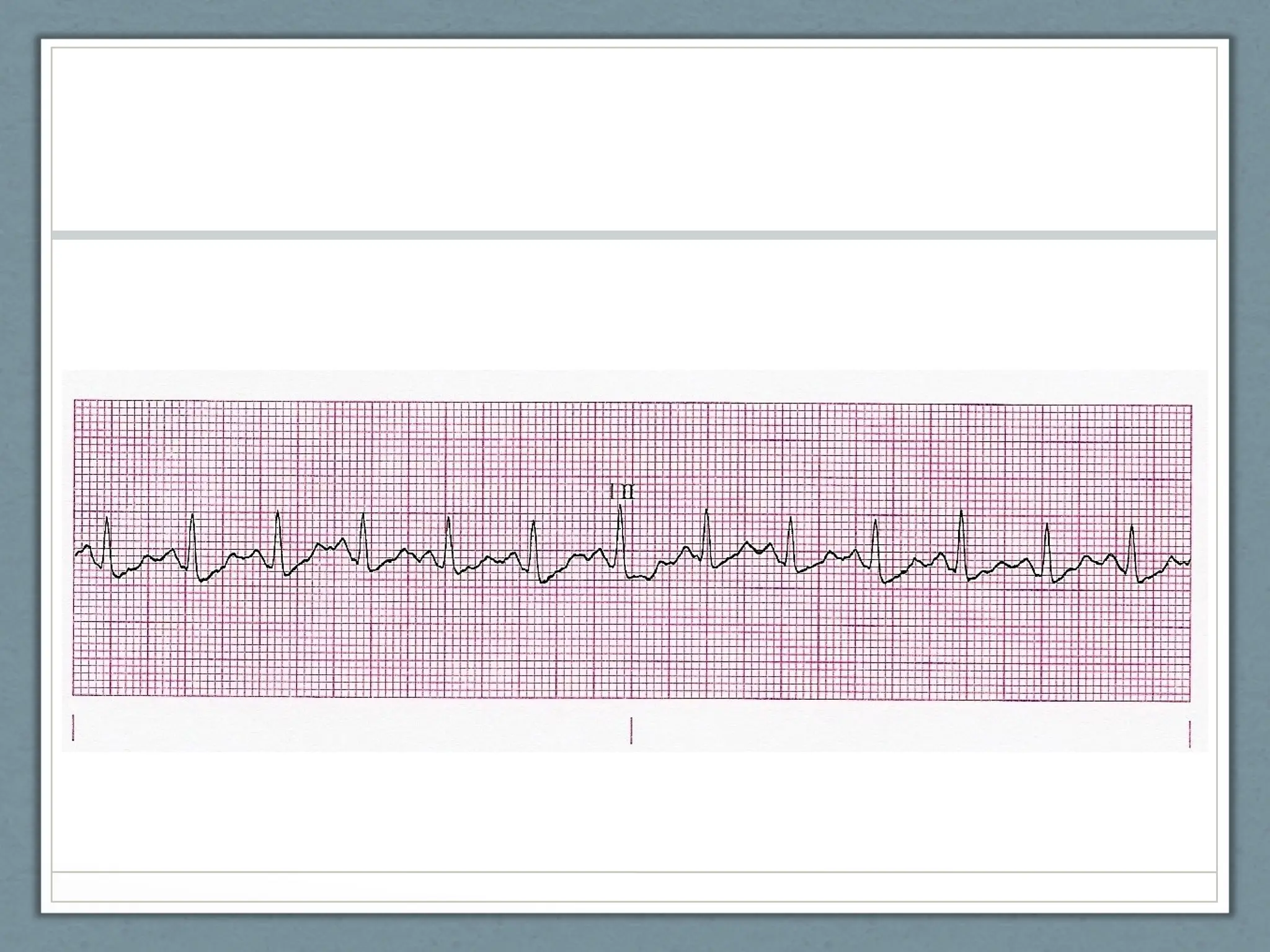
Practice
Practice
Practice
Practice
Practice
Practice
Cardiac Rhythms
• Normal Sinus Rhythm
• Rate
• 60–100
• Rhythm
• Regular
• P waves
• Normal, upright, only before each QRS complex
• PR Interval
• 0.12–0.20 seconds
• QRS Complex
• Normal, duration of <0.12 seconds
Normal Sinus Rhythm
Dysrhythmias
Dysrhythmias
• Dysrhythmia
• Any deviation from the heart’s normal
electrical rhythm
Causes of Dysrhythmias
• Myocardial Ischemia, Necrosis, or Infarction
• Autonomic Nervous System Imbalance
• Distention of the Chambers of the Heart
• Blood Gas Abnormalities
• Electrolyte Imbalances
Causes of Dysrhythmias
• Trauma to the Myocardium
• Drug Effects and Drug Toxicity
• Electrocution
• Hypothermia
• CNS Damage
• Idiopathic Events
• Normal Occurrences
Dysrhythmias
• Mechanism of Impulse Formation
• Ectopic Foci
• Result of enhanced automaticity
• Cells other than the pacemaker cells automatically
depolarize
• PVC’s, PAC’s, and PJC’s
• Reentry
• Ischemia or another disease process alters two
branches of a conduction pathway
• Can result in rapid rhythms such as paroxysmal
supraventricular tachycardia or atrial fibrillation
Dysrhythmias
• Classification of Dysrhythmias
• Nature of Origin
• Magnitude
• Severity
• Site of Origin
Dysrhythmias
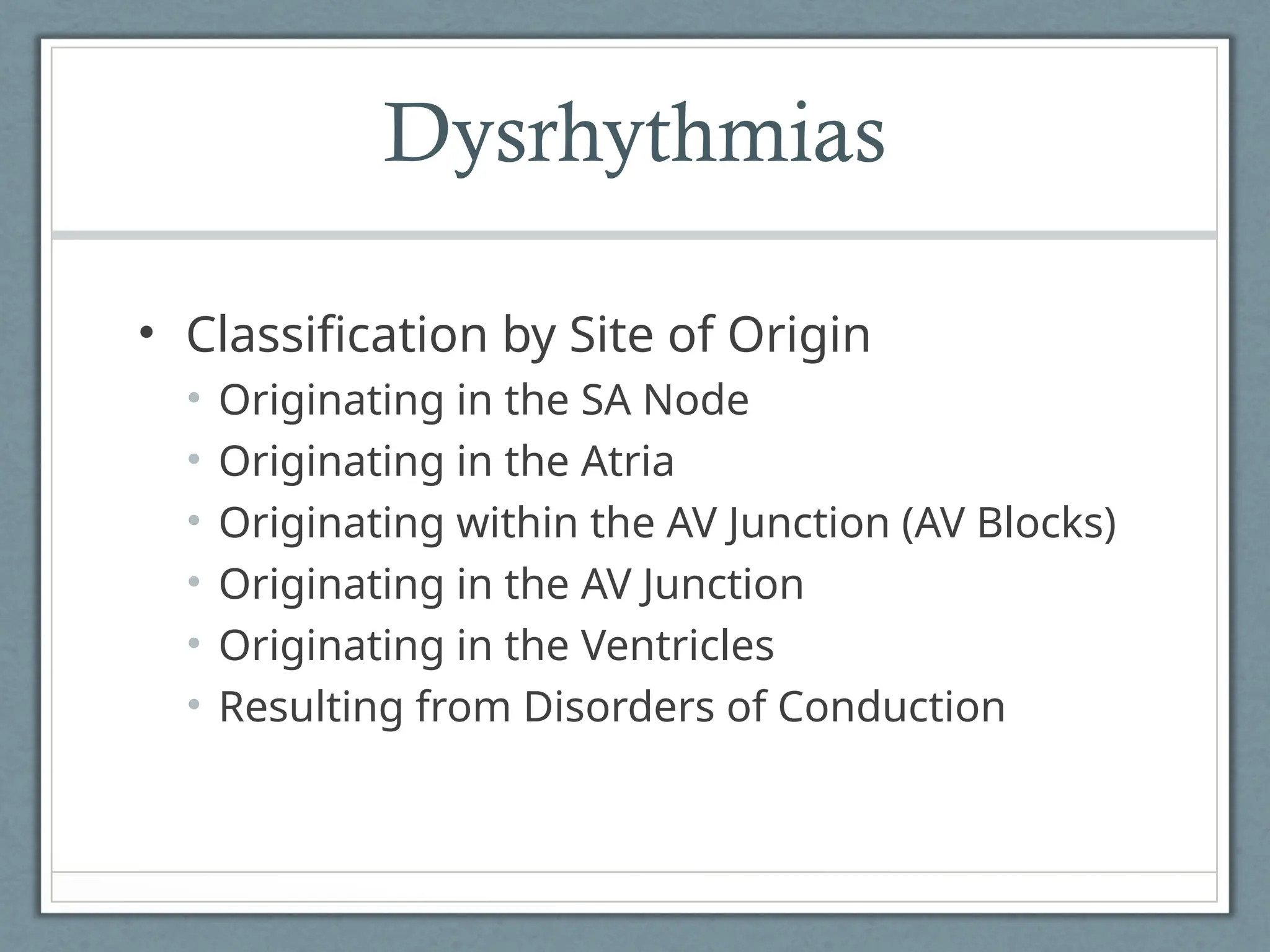
• Classification by Site of Origin
• Originating in the SA Node
• Originating in the Atria
• Originating within the AV Junction (AV Blocks)
• Originating in the AV Junction
• Originating in the Ventricles
• Resulting from Disorders of Conduction
Dysrhythmias Originating
in the SA Node
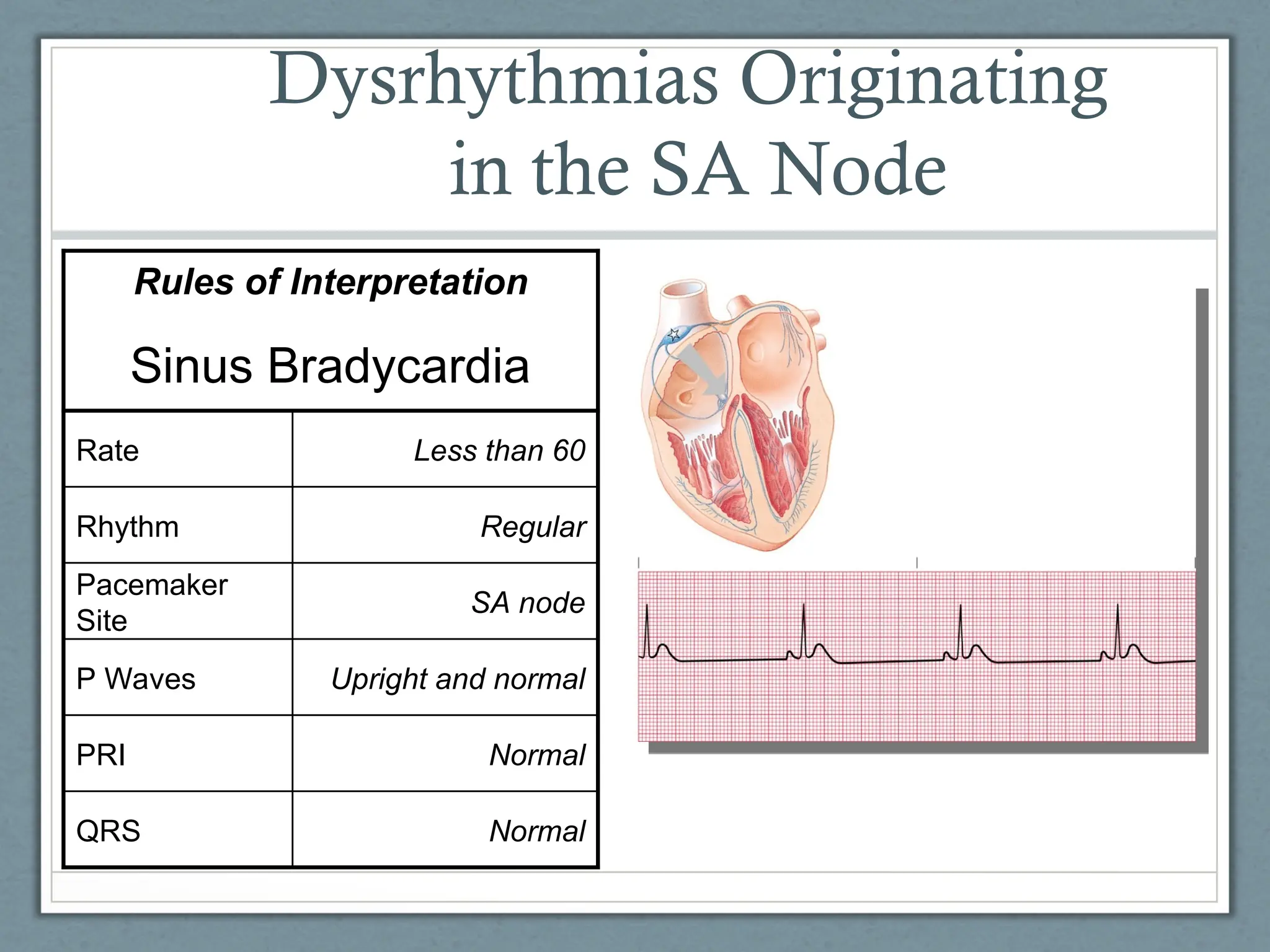
• Sinus Bradycardia
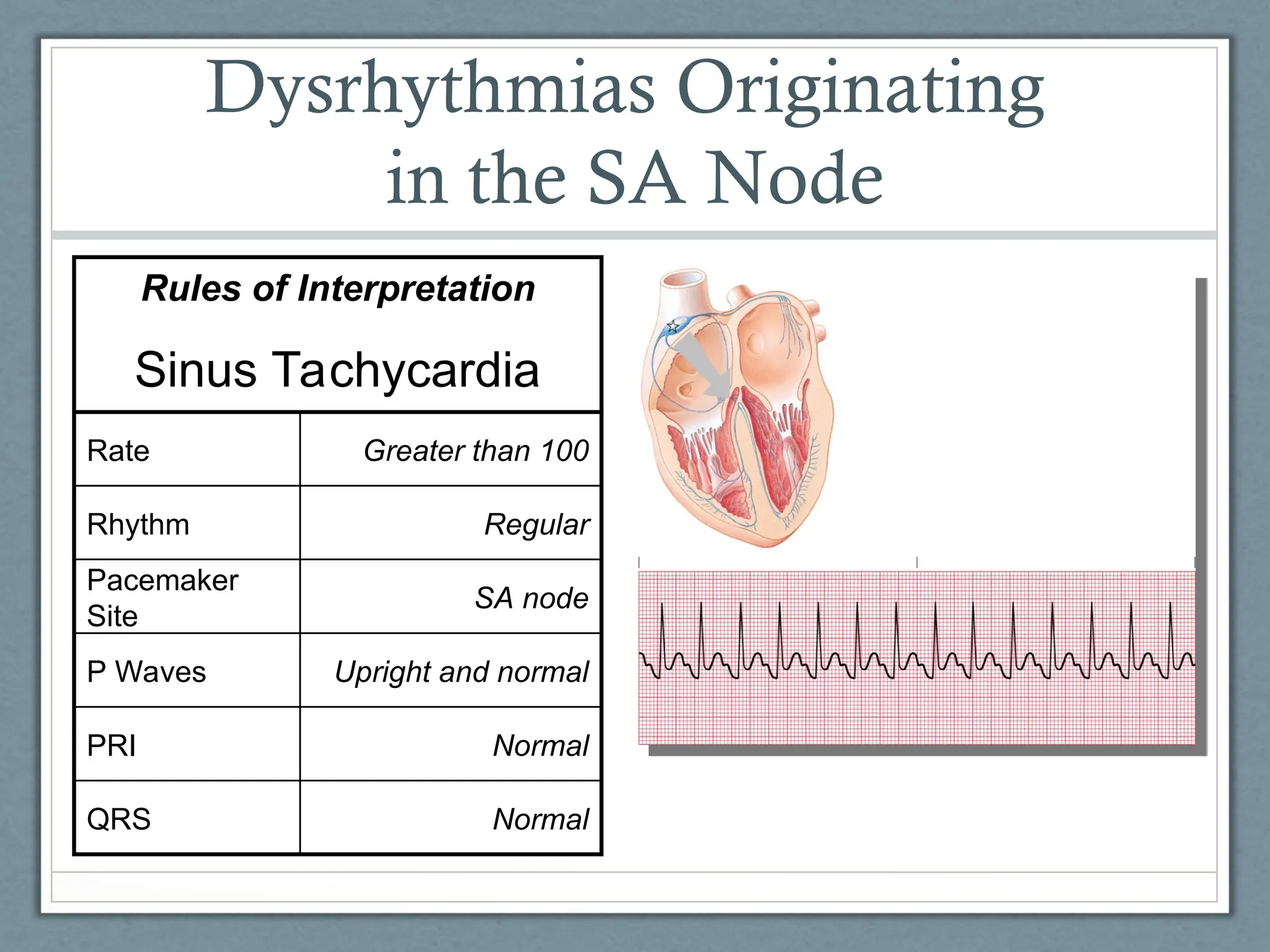
• Sinus Tachycardia
Dysrhythmias Originating
in the SA Node
Normal
QRS
Normal
PRI
Upright and normal
P Waves
SA node
Pacemaker
Site
Regular
Rhythm
Less than 60
Rate
Sinus Bradycardia
Rules of Interpretation
Normal
QRS
Normal
PRI
Upright and normal
P Waves
SA node
Pacemaker
Site
Regular
Rhythm
Greater than 100
Rate
Sinus Tachycardia
Rules of Interpretation
Dysrhythmias Originating
in the SA Node
Practice
EKG POWERPOINT NC emergency care in the streets

EKG POWERPOINT NC emergency care in the streets

  • 1.
  • 2.
  • 3.
    Cardiac Physiology • CardiacConductive System • Properties • Excitability • Conductivity • Automaticity • Contractility
  • 4.
  • 5.
    Conduction System • Eachcomponent of the conductive system has its own intrinsic rate of self- excitation. • SA node = 60–100 beats per minute • AV node = 40–60 beats per minute • Purkinje system = 15–40 beats per minute
  • 6.
  • 7.
    Electrocardiographic Monitoring • Electrocardiogram (ECG)is a graphic record of the heart’s electrical activity. • Tells you nothing about the heart’s pumping ability, which you must evaluate by pulse and blood pressure. • The body acts as a giant conductor of electricity. • The heart is its largest generator • Electrodes on the skin can detect the total electrical activity within the heart.
  • 8.
    Electrocardiographic Monitoring • Electrical Impulses •Positive impulses • Deflect upward • Negative impulses • Deflect downward • The isoelectric line • Absence of deflection • Artifact
  • 9.
    The Electrocardiogram  ECGLeads  Bipolar (Limb) ▪ Einthoven’s Triangle ▪ Leads I, II, III ▪ Provide only one view of the heart  Augmented (Unipolar) ▪ aVR, aVL, aVF  Precordial ▪ V1 – V6 ▪ Measure electrical cardiac activity on a horizontal axis ▪ Help in viewing the left ventricle and septum
  • 10.
    The Electrocardiogram • RoutineMonitoring • Routine ECG monitoring generally uses only one lead • Most common monitoring leads are either lead II or the modified chest lead 1 (MCL1) • Einthoven’s triangle offers a basis for placing the leads • Place the electrodes on the chest wall • Lead placement
  • 11.
    Single Lead Monitoring •Information from a single lead shows: • Rate • Regularity • Time to conduct an impulse • Single lead cannot show: • Presence of an infarct • Axis deviation or chamber enlargement • Right-to-left differences in conduction • Quality or presence of pumping action
  • 12.
    The Electrocardiogram • ECGPaper • Speed • A standard speed of 25 mm/sec • Amplitude and Deflection • Should deflect two large boxes when 1 mV is present • Calibration
  • 13.
    The Electrocardiogram • Relationshipof the ECG to Electrical Events in the Heart • ECG Components • P Wave • QRS Complex • T Wave • U Wave
  • 14.
  • 15.
  • 16.
  • 17.
  • 18.
  • 19.
  • 20.
  • 21.
    The Electrocardiogram • TimeIntervals • PR Interval (PRI) or PQ Interval (PQI) • 0.12–0.20 seconds • QRS Interval • 0.08–0.12 seconds • ST Segment • QT Interval • 0.33–0.42 seconds
  • 22.
    The Electrocardiogram  RefractoryPeriods  The all-or-none nature of myocardial depolarization results in an interval when the heart cannot be restimulated  Absolute ▪ Cannot accept stimulus  Relative ▪ If stimulus is strong enough, will cause depolarization
  • 23.
    The Electrocardiogram • STSegment Changes • The ST segment is usually an isoelectric line • Ischemia causes deflections • Infarctions usually follow this sequence: • Ischemia • ST segment depression or an inverted T wave • Injury • Elevates the ST segment • Necrosis • Significant Q wave presents
  • 24.
    The Electrocardiogram • Interpretationof Rhythm Strips • Basic Criteria • Always be consistent and analytical • Memorize the rules for each dysrhythmia • Analyze a given rhythm strip according to a specific format • Compare your analysis to the rules for each dysrhythmia • Identify the dysrhythmia by its similarity to established rules
  • 25.
    The Electrocardiogram • Five-StepProcedure • Analyze the rate • Analyze the rhythm • Analyze the P waves • Analyze the PR interval • Analyze the QRS complex
  • 26.
    The Electrocardiogram • AnalyzingRate • Six-Second Method • Heart Rate Calculator Rulers • RR Interval • Triplicate Method
  • 27.
    The Electrocardiogram • AnalyzingRate • Six-Second Method
  • 28.
    The Electrocardiogram • AnalyzingRate • RR Interval • Count the number of large boxes from R-R, and divide number of boxes into 300
  • 29.
    The Electrocardiogram • AnalyzingRate • Triplicate Method • Count the large boxes from R to R • 300, 150, 100, 75, 60, 50
  • 30.
    The Electrocardiogram • AnalyzingRhythm • Regular • Occasionally Irregular • Regularly Irregular • Irregularly Irregular
  • 31.
    The Electrocardiogram • AnalyzingP Waves • Are P waves present? • Are the P waves regular? • Is there one P wave for each QRS complex? • Are the P waves upright or inverted? • Do all the P waves look alike? • Analyzing the PR Interval • Normal PR interval is 0.12–0.20 sec • Analyzing the QRS Complex • Do all the QRS complexes look alike? • What is the QRS duration? • Usually 0.04–0.12 sec
  • 32.
  • 33.
  • 34.
  • 35.
  • 36.
  • 37.
  • 38.
    Cardiac Rhythms • NormalSinus Rhythm • Rate • 60–100 • Rhythm • Regular • P waves • Normal, upright, only before each QRS complex • PR Interval • 0.12–0.20 seconds • QRS Complex • Normal, duration of <0.12 seconds
  • 39.
  • 40.
  • 41.
    Dysrhythmias • Dysrhythmia • Anydeviation from the heart’s normal electrical rhythm
  • 42.
    Causes of Dysrhythmias •Myocardial Ischemia, Necrosis, or Infarction • Autonomic Nervous System Imbalance • Distention of the Chambers of the Heart • Blood Gas Abnormalities • Electrolyte Imbalances
  • 43.
    Causes of Dysrhythmias •Trauma to the Myocardium • Drug Effects and Drug Toxicity • Electrocution • Hypothermia • CNS Damage • Idiopathic Events • Normal Occurrences
  • 44.
    Dysrhythmias • Mechanism ofImpulse Formation • Ectopic Foci • Result of enhanced automaticity • Cells other than the pacemaker cells automatically depolarize • PVC’s, PAC’s, and PJC’s • Reentry • Ischemia or another disease process alters two branches of a conduction pathway • Can result in rapid rhythms such as paroxysmal supraventricular tachycardia or atrial fibrillation
  • 45.
    Dysrhythmias • Classification ofDysrhythmias • Nature of Origin • Magnitude • Severity • Site of Origin
  • 46.
    Dysrhythmias • Classification bySite of Origin • Originating in the SA Node • Originating in the Atria • Originating within the AV Junction (AV Blocks) • Originating in the AV Junction • Originating in the Ventricles • Resulting from Disorders of Conduction
  • 47.
    Dysrhythmias Originating in theSA Node • Sinus Bradycardia • Sinus Tachycardia
  • 48.
    Dysrhythmias Originating in theSA Node Normal QRS Normal PRI Upright and normal P Waves SA node Pacemaker Site Regular Rhythm Less than 60 Rate Sinus Bradycardia Rules of Interpretation
  • 49.
    Normal QRS Normal PRI Upright and normal PWaves SA node Pacemaker Site Regular Rhythm Greater than 100 Rate Sinus Tachycardia Rules of Interpretation Dysrhythmias Originating in the SA Node
  • 50.