Presented by: Dave Jay S. Manriquez RN.
ECG leads placement
Sinus tachycardia
Sinus bradycardia
Atrial fibrillation
Atrial flutter
Ventricular tachycardia
Ventricular fibrillation
asystole
P wave
The P wave represents the wave of depolarization that spreads from the SA
node throughout the atria, and is usually 0.08 to 0.1 seconds (80-100 ms) in
duration. The brief isoelectric (zero voltage) period after the P wave
represents the time in which the impulse is traveling within the AV node
(where the conduction velocity is greatly retarded) and the bundle of
His. Atrial rate can be calculated by determining the time interval between P
waves. Click here to see how atrial rate is calculated.
The period of time from the onset of the P wave to the beginning of the QRS
complex is termed the P-R interval, which normally ranges from 0.12 to 0.20
seconds in duration. This interval represents the time between the onset of
atrial depolarization and the onset of ventricular depolarization. If the P-R
interval is >0.2 sec, there is an AV conduction block, which is also termed a
first-degree heart block if the impulse is still able to be conducted into the
ventricles.
QRS complex
The QRS complex represents ventricular depolarization. Ventricular rate can
be calculated by determining the time interval between QRS complexes. Click
here to see how ventricular rate is calculated.
The duration of the QRS complex is normally 0.06 to 0.1 seconds. This
relatively short duration indicates that ventricular depolarization normally
occurs very rapidly. If the QRS complex is prolonged (> 0.1 sec), conduction
is impaired within the ventricles. This can occur with bundle branch blocks or
whenever a ventricular foci (abnormal pacemaker site) becomes the
pacemaker driving the ventricle. Such an ectopic foci nearly always results in
impulses being conducted over slower pathways within the heart, thereby
increasing the time for depolarization and the duration of the QRS complex.
The shape of the QRS complex in the above figure is idealized. In fact, the
shape changes depending on which recording electrodes are being used. The
shape will also change when there is abnormal conduction of electrical
impulses within the ventricles. The figure to the right summarizes the
nomenclature used to define the different components of the QRS complex.
ST segment
The isoelectric period (ST segment) following the QRS is the time at which the
entire ventricle is depolarized and roughly corresponds to the plateau phase
of the ventricular action potential. The ST segment is important in the
diagnosis of ventricular ischemia or hypoxia because under those conditions,
the ST segment can become either depressed or elevated.
T wave
The T wave represents ventricular repolarization and is longer in duration than
depolarization (i.e., conduction of the repolarization wave is slower than the
wave of depolarization). Sometimes a small positive U wave may be seen
following the T wave (not shown in figure at top of page). This wave
represents the last remnants of ventricular repolarization. Inverted or
prominent U waves indicates underlying pathology or conditions affecting
repolarization.
Q-T interval
The Q-T interval represents the time for both ventricular depolarization and
repolarization to occur, and therefore roughly estimates the duration of an
average ventricular action potential. This interval can range from 0.2 to 0.4
seconds depending upon heart rate. At high heart rates, ventricular action
potentials shorten in duration, which decreases the Q-T interval. Because
prolonged Q-T intervals can be diagnostic for susceptibility to certain types of
tachyarrhythmias, it is important to determine if a given Q-T interval is
excessively long. In practice, the Q-T interval is expressed as a "corrected Q-
T (QTc)" by taking the Q-T interval and dividing it by the square root of the R-
R interval (interval between ventricular depolarizations). This allows an
assessment of the Q-T interval that is independent of heart rate. Normal
corrected Q-Tc intervals are less than 0.44 seconds.
There is no distinctly visible wave representing atrial repolarization in the ECG
because it occurs during ventricular depolarization. Because the wave of
atrial repolarization is relatively small in amplitude (i.e., has low voltage), it is
masked by the much larger ventricular-generated QRS complex
2
Introduction to ECG Interpretation
Rate
Rate is cycles or beats per minute.
Normal rate for the SA node 60-100.
<60
bradycardia
>100
tachycardia
SA node is the usual pacemaker, other potential pacemakers (if SA node
fails) are atrial pacemakers with inherent rates of 60-80, AV node (rate 40-60),
or ventricular pacer (rate 20-40). In certain pathologic conditions ectopic (out
of place) pacemakers can go much faster at rates 150-250 cycles/minute.
There are three methods of calculating rate:
1. Most Common Method:
(Most rates can be calculated this way). Find an R wave on a heavy
line (large box) count off "300, 150, 100, 75, 60, 50" for each large box
you land on until you reach the next R wave. Estimate the rate if the
second R wave doesn't fall on a heavy black line.
Rate calculation
Memorize the number sequence:
300, 150, 100, 75, 60, 50
2. Figure 4: Common Method.
3. Mathematical method:
Use this method if there is a regular bradycardia, i.e. - rate < 50. If the
distance between the two R waves is too long to use the common
method, use the approach: 300/[# large boxes between two R waves].
Figure 5: Count number of large boxes between first and second R
waves=7.5. 300/7.5 large boxes = rate 40.
4. Six-second method:
Count off 30 large boxes = 6 seconds (remember 1 large box = 0.2
seconds, so 30 large boxes = 6 seconds). Then, count the number of
R-R intervals in six seconds and multiply by 10. This is the number of
beats per minute. This is most useful if you have an irregular rhythm
(like atrial fibrillation) when you want to know an average rate.
3
Figure 6: Count 30 large boxes, starting from the first R wave. There are 8 R-
R intervals within 30 boxes. Multiply 8 x 10 = Rate 80.
Rhythm (to include intervals)
We will focus on the basic "core" of rhythms and measured "intervals" (PR,
QRS, QT). Rhythms are often the most challenging aspect of ECG's. You will
see most rhythms several times over the next few years of your training, and
you will eventually recognize them at a glance.
Now for some basics - "arrhythmia" means abnormal rhythm.
The normal conduction pathway is: SA node --> AV node --> Bundle of HIS
--> Bundle Branches.
Arrhythmia can be understood by realizing the existence of ectopic (out of
place) foci (pacemakers) and understanding the normal conduction pathway
of the heart. Very simply put, if the beat originates in the atria or AV node
(supraventricular) the QRS is usually narrow (normal), because it comes from
above along the normal pathway.
Figure 6a: QRS is narrow (normal).
If the beat is ventricular in origin, the QRS is wide and bizarre because it
doesn't come down the normal pathway.
Figure 6b: QRS is wide.
Aberrancy is an exception to this rule - here it does actually follow the normal
pathway (atria - AV node - ventricle) but for some reason the pathway is
refractory to the beat and you get a wide QRS.
A reasonable way to group arrhythmias is in four general groups. Let us
briefly review these four groups, then we will develop some common sense
principles for evaluating rhythm (to include intervals).
Axis
Direction of depolarization (vector) of the QRS complex.
1. The left ventricle is thicker so the mean QRS vector is down and to the
left. (The origin of the vector is the AV node with the left ventricle being
down and to the left of this).
2. The vector will point toward hypertrophy (thickened wall) and away
from the infarct (electrically dead area).
4
Figure 28: Axis nomenclature.
Normal axis -30 to +90 degrees
Left axis deviation -30 to -90 degrees
Right axis deviation +90 to +/-180
degrees
Indeterminate (extreme) axis
deviation
-90 to +/-180
degrees
Since lead I and aVF are perpendicular to each other, you can use those two
leads to quickly determine axis.
Lead I runs from right to left across a patient's body, positive at the left hand:
(See figure 28).
If the QRS in lead I is positive (mainly above the baseline), the direction of
depolarization will be in the positive half (right half) of the circle above. You
can make a diagram and shade in the positive half of the circle.
Lead aVF runs from top to bottom across a patient's body, positive at the feet:
(See figure 28).
If the QRS in lead aVF is positive (mainly above the baseline), the direction of
depolarization will be in the positive half (lower half) of the circle above. You
can make a diagram and shade in the positive half of the circle:
To find the axis overlap the two circles. The common shaded area is the
quadrant in which the axis lies. In this example, the axis lies in the normal
quadrant, which on a patient, points down and to the left.
You can repeat this process for any two leads, but I and aVF are the classic
places to look. If you realize that there are two leads to consider and a
positive (+) or (-) orientation for each lead, there would be four possible
combinations. Memorize the following axis guidelines.
Lead I Lead
aVF
1. Normal axis (0 to +90 degrees) Positive Positive
2. Left axis deviation (-30 to -90) Also check
lead II. To be true left axis deviation, it should
also be down in lead II. If the QRS is upright
in II, the axis is still normal (0 to -30).
Positive Negative
3. Right axis deviation (+90 to +180) Negative Positive
4. Indeterminate axis (-90 to -180) Negative Negative
5
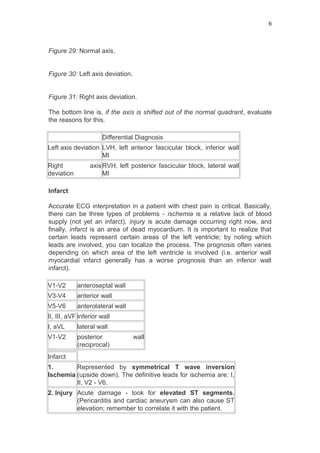
Figure 29: Normal axis.
Figure 30: Left axis deviation.
Figure 31: Right axis deviation.
The bottom line is, if the axis is shifted out of the normal quadrant, evaluate
the reasons for this.
Differential Diagnosis
Left axis deviation LVH, left anterior fascicular block, inferior wall
MI
Right axis
deviation
RVH, left posterior fascicular block, lateral wall
MI
Infarct
Accurate ECG interpretation in a patient with chest pain is critical. Basically,
there can be three types of problems - ischemia is a relative lack of blood
supply (not yet an infarct), injury is acute damage occurring right now, and
finally, infarct is an area of dead myocardium. It is important to realize that
certain leads represent certain areas of the left ventricle; by noting which
leads are involved, you can localize the process. The prognosis often varies
depending on which area of the left ventricle is involved (i.e. anterior wall
myocardial infarct generally has a worse prognosis than an inferior wall
infarct).
V1-V2 anteroseptal wall
V3-V4 anterior wall
V5-V6 anterolateral wall
II, III, aVF inferior wall
I, aVL lateral wall
V1-V2 posterior wall
(reciprocal)
Infarct
1.
Ischemia
Represented by symmetrical T wave inversion
(upside down). The definitive leads for ischemia are: I,
II, V2 - V6.
2. Injury Acute damage - look for elevated ST segments.
(Pericarditis and cardiac aneurysm can also cause ST
elevation; remember to correlate it with the patient.
6
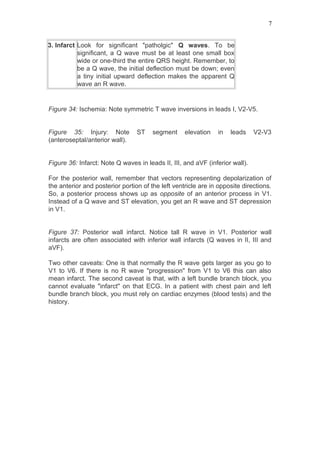
3. Infarct Look for significant "patholgic" Q waves. To be
significant, a Q wave must be at least one small box
wide or one-third the entire QRS height. Remember, to
be a Q wave, the initial deflection must be down; even
a tiny initial upward deflection makes the apparent Q
wave an R wave.
Figure 34: Ischemia: Note symmetric T wave inversions in leads I, V2-V5.
Figure 35: Injury: Note ST segment elevation in leads V2-V3
(anteroseptal/anterior wall).
Figure 36: Infarct: Note Q waves in leads II, III, and aVF (inferior wall).
For the posterior wall, remember that vectors representing depolarization of
the anterior and posterior portion of the left ventricle are in opposite directions.
So, a posterior process shows up as opposite of an anterior process in V1.
Instead of a Q wave and ST elevation, you get an R wave and ST depression
in V1.
Figure 37: Posterior wall infarct. Notice tall R wave in V1. Posterior wall
infarcts are often associated with inferior wall infarcts (Q waves in II, III and
aVF).
Two other caveats: One is that normally the R wave gets larger as you go to
V1 to V6. If there is no R wave "progression" from V1 to V6 this can also
mean infarct. The second caveat is that, with a left bundle branch block, you
cannot evaluate "infarct" on that ECG. In a patient with chest pain and left
bundle branch block, you must rely on cardiac enzymes (blood tests) and the
history.
7

Ecg, ELECTROCARDIOGRAM

  • 1.
    Presented by: DaveJay S. Manriquez RN. ECG leads placement Sinus tachycardia Sinus bradycardia Atrial fibrillation Atrial flutter Ventricular tachycardia Ventricular fibrillation asystole P wave The P wave represents the wave of depolarization that spreads from the SA node throughout the atria, and is usually 0.08 to 0.1 seconds (80-100 ms) in duration. The brief isoelectric (zero voltage) period after the P wave represents the time in which the impulse is traveling within the AV node (where the conduction velocity is greatly retarded) and the bundle of His. Atrial rate can be calculated by determining the time interval between P waves. Click here to see how atrial rate is calculated. The period of time from the onset of the P wave to the beginning of the QRS complex is termed the P-R interval, which normally ranges from 0.12 to 0.20 seconds in duration. This interval represents the time between the onset of atrial depolarization and the onset of ventricular depolarization. If the P-R interval is >0.2 sec, there is an AV conduction block, which is also termed a first-degree heart block if the impulse is still able to be conducted into the ventricles. QRS complex The QRS complex represents ventricular depolarization. Ventricular rate can be calculated by determining the time interval between QRS complexes. Click here to see how ventricular rate is calculated. The duration of the QRS complex is normally 0.06 to 0.1 seconds. This relatively short duration indicates that ventricular depolarization normally occurs very rapidly. If the QRS complex is prolonged (> 0.1 sec), conduction is impaired within the ventricles. This can occur with bundle branch blocks or whenever a ventricular foci (abnormal pacemaker site) becomes the pacemaker driving the ventricle. Such an ectopic foci nearly always results in
  • 2.
    impulses being conductedover slower pathways within the heart, thereby increasing the time for depolarization and the duration of the QRS complex. The shape of the QRS complex in the above figure is idealized. In fact, the shape changes depending on which recording electrodes are being used. The shape will also change when there is abnormal conduction of electrical impulses within the ventricles. The figure to the right summarizes the nomenclature used to define the different components of the QRS complex. ST segment The isoelectric period (ST segment) following the QRS is the time at which the entire ventricle is depolarized and roughly corresponds to the plateau phase of the ventricular action potential. The ST segment is important in the diagnosis of ventricular ischemia or hypoxia because under those conditions, the ST segment can become either depressed or elevated. T wave The T wave represents ventricular repolarization and is longer in duration than depolarization (i.e., conduction of the repolarization wave is slower than the wave of depolarization). Sometimes a small positive U wave may be seen following the T wave (not shown in figure at top of page). This wave represents the last remnants of ventricular repolarization. Inverted or prominent U waves indicates underlying pathology or conditions affecting repolarization. Q-T interval The Q-T interval represents the time for both ventricular depolarization and repolarization to occur, and therefore roughly estimates the duration of an average ventricular action potential. This interval can range from 0.2 to 0.4 seconds depending upon heart rate. At high heart rates, ventricular action potentials shorten in duration, which decreases the Q-T interval. Because prolonged Q-T intervals can be diagnostic for susceptibility to certain types of tachyarrhythmias, it is important to determine if a given Q-T interval is excessively long. In practice, the Q-T interval is expressed as a "corrected Q- T (QTc)" by taking the Q-T interval and dividing it by the square root of the R- R interval (interval between ventricular depolarizations). This allows an assessment of the Q-T interval that is independent of heart rate. Normal corrected Q-Tc intervals are less than 0.44 seconds. There is no distinctly visible wave representing atrial repolarization in the ECG because it occurs during ventricular depolarization. Because the wave of atrial repolarization is relatively small in amplitude (i.e., has low voltage), it is masked by the much larger ventricular-generated QRS complex 2
  • 3.
    Introduction to ECGInterpretation Rate Rate is cycles or beats per minute. Normal rate for the SA node 60-100. <60 bradycardia >100 tachycardia SA node is the usual pacemaker, other potential pacemakers (if SA node fails) are atrial pacemakers with inherent rates of 60-80, AV node (rate 40-60), or ventricular pacer (rate 20-40). In certain pathologic conditions ectopic (out of place) pacemakers can go much faster at rates 150-250 cycles/minute. There are three methods of calculating rate: 1. Most Common Method: (Most rates can be calculated this way). Find an R wave on a heavy line (large box) count off "300, 150, 100, 75, 60, 50" for each large box you land on until you reach the next R wave. Estimate the rate if the second R wave doesn't fall on a heavy black line. Rate calculation Memorize the number sequence: 300, 150, 100, 75, 60, 50 2. Figure 4: Common Method. 3. Mathematical method: Use this method if there is a regular bradycardia, i.e. - rate < 50. If the distance between the two R waves is too long to use the common method, use the approach: 300/[# large boxes between two R waves]. Figure 5: Count number of large boxes between first and second R waves=7.5. 300/7.5 large boxes = rate 40. 4. Six-second method: Count off 30 large boxes = 6 seconds (remember 1 large box = 0.2 seconds, so 30 large boxes = 6 seconds). Then, count the number of R-R intervals in six seconds and multiply by 10. This is the number of beats per minute. This is most useful if you have an irregular rhythm (like atrial fibrillation) when you want to know an average rate. 3
  • 4.
    Figure 6: Count30 large boxes, starting from the first R wave. There are 8 R- R intervals within 30 boxes. Multiply 8 x 10 = Rate 80. Rhythm (to include intervals) We will focus on the basic "core" of rhythms and measured "intervals" (PR, QRS, QT). Rhythms are often the most challenging aspect of ECG's. You will see most rhythms several times over the next few years of your training, and you will eventually recognize them at a glance. Now for some basics - "arrhythmia" means abnormal rhythm. The normal conduction pathway is: SA node --> AV node --> Bundle of HIS --> Bundle Branches. Arrhythmia can be understood by realizing the existence of ectopic (out of place) foci (pacemakers) and understanding the normal conduction pathway of the heart. Very simply put, if the beat originates in the atria or AV node (supraventricular) the QRS is usually narrow (normal), because it comes from above along the normal pathway. Figure 6a: QRS is narrow (normal). If the beat is ventricular in origin, the QRS is wide and bizarre because it doesn't come down the normal pathway. Figure 6b: QRS is wide. Aberrancy is an exception to this rule - here it does actually follow the normal pathway (atria - AV node - ventricle) but for some reason the pathway is refractory to the beat and you get a wide QRS. A reasonable way to group arrhythmias is in four general groups. Let us briefly review these four groups, then we will develop some common sense principles for evaluating rhythm (to include intervals). Axis Direction of depolarization (vector) of the QRS complex. 1. The left ventricle is thicker so the mean QRS vector is down and to the left. (The origin of the vector is the AV node with the left ventricle being down and to the left of this). 2. The vector will point toward hypertrophy (thickened wall) and away from the infarct (electrically dead area). 4
  • 5.
    Figure 28: Axisnomenclature. Normal axis -30 to +90 degrees Left axis deviation -30 to -90 degrees Right axis deviation +90 to +/-180 degrees Indeterminate (extreme) axis deviation -90 to +/-180 degrees Since lead I and aVF are perpendicular to each other, you can use those two leads to quickly determine axis. Lead I runs from right to left across a patient's body, positive at the left hand: (See figure 28). If the QRS in lead I is positive (mainly above the baseline), the direction of depolarization will be in the positive half (right half) of the circle above. You can make a diagram and shade in the positive half of the circle. Lead aVF runs from top to bottom across a patient's body, positive at the feet: (See figure 28). If the QRS in lead aVF is positive (mainly above the baseline), the direction of depolarization will be in the positive half (lower half) of the circle above. You can make a diagram and shade in the positive half of the circle: To find the axis overlap the two circles. The common shaded area is the quadrant in which the axis lies. In this example, the axis lies in the normal quadrant, which on a patient, points down and to the left. You can repeat this process for any two leads, but I and aVF are the classic places to look. If you realize that there are two leads to consider and a positive (+) or (-) orientation for each lead, there would be four possible combinations. Memorize the following axis guidelines. Lead I Lead aVF 1. Normal axis (0 to +90 degrees) Positive Positive 2. Left axis deviation (-30 to -90) Also check lead II. To be true left axis deviation, it should also be down in lead II. If the QRS is upright in II, the axis is still normal (0 to -30). Positive Negative 3. Right axis deviation (+90 to +180) Negative Positive 4. Indeterminate axis (-90 to -180) Negative Negative 5
  • 6.
    Figure 29: Normalaxis. Figure 30: Left axis deviation. Figure 31: Right axis deviation. The bottom line is, if the axis is shifted out of the normal quadrant, evaluate the reasons for this. Differential Diagnosis Left axis deviation LVH, left anterior fascicular block, inferior wall MI Right axis deviation RVH, left posterior fascicular block, lateral wall MI Infarct Accurate ECG interpretation in a patient with chest pain is critical. Basically, there can be three types of problems - ischemia is a relative lack of blood supply (not yet an infarct), injury is acute damage occurring right now, and finally, infarct is an area of dead myocardium. It is important to realize that certain leads represent certain areas of the left ventricle; by noting which leads are involved, you can localize the process. The prognosis often varies depending on which area of the left ventricle is involved (i.e. anterior wall myocardial infarct generally has a worse prognosis than an inferior wall infarct). V1-V2 anteroseptal wall V3-V4 anterior wall V5-V6 anterolateral wall II, III, aVF inferior wall I, aVL lateral wall V1-V2 posterior wall (reciprocal) Infarct 1. Ischemia Represented by symmetrical T wave inversion (upside down). The definitive leads for ischemia are: I, II, V2 - V6. 2. Injury Acute damage - look for elevated ST segments. (Pericarditis and cardiac aneurysm can also cause ST elevation; remember to correlate it with the patient. 6
  • 7.
    3. Infarct Lookfor significant "patholgic" Q waves. To be significant, a Q wave must be at least one small box wide or one-third the entire QRS height. Remember, to be a Q wave, the initial deflection must be down; even a tiny initial upward deflection makes the apparent Q wave an R wave. Figure 34: Ischemia: Note symmetric T wave inversions in leads I, V2-V5. Figure 35: Injury: Note ST segment elevation in leads V2-V3 (anteroseptal/anterior wall). Figure 36: Infarct: Note Q waves in leads II, III, and aVF (inferior wall). For the posterior wall, remember that vectors representing depolarization of the anterior and posterior portion of the left ventricle are in opposite directions. So, a posterior process shows up as opposite of an anterior process in V1. Instead of a Q wave and ST elevation, you get an R wave and ST depression in V1. Figure 37: Posterior wall infarct. Notice tall R wave in V1. Posterior wall infarcts are often associated with inferior wall infarcts (Q waves in II, III and aVF). Two other caveats: One is that normally the R wave gets larger as you go to V1 to V6. If there is no R wave "progression" from V1 to V6 this can also mean infarct. The second caveat is that, with a left bundle branch block, you cannot evaluate "infarct" on that ECG. In a patient with chest pain and left bundle branch block, you must rely on cardiac enzymes (blood tests) and the history. 7