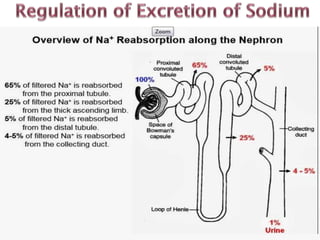
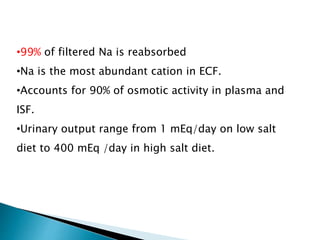
•99% of filtered Na is reabsorbed
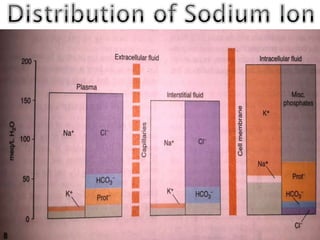
•Na is the most abundant cation in ECF.
•Accounts for 90% of osmotic activity in plasma and
ISF.
•Urinary output range from 1 mEq/day on low salt
diet to 400 mEq /day in high salt diet.
Sodium - < 130 meq/l
Mild : 130 to 138
Moderate : 120 to 130
Severe :<120
Severe
Acute : <100 meq/l
Chronic : <115meq/l
Types
I
•Acute:
•Chronic
II
•Hypervolaemic hyponatremia
•Hypovolemic hyponatremia
•Normovolemic hyponatremia
•Pseudo hyponatremia
Hypervolaemic hyponatremia:
•Absorption of fluid into intravascular compartment.
•Severe : S Na< 100 mmol/l
•Urine sodium will be , 15 mmol /l
Corrected with hypertonic saline.
Slow correction: 2meq/hr
Q4hrly serum sodium measurement
Hypovolemic hyponatremia:
Due to:
Diarrhoea & vomiting – urine sodium < 20mmoles/l
Renal causes - urine sodium > 20 mmoles/L
Shock
Correction with isotonic normal saline.
Normovolemic Hyponatraemia
Renal failure
SIADH
Treatment:
Fluid restriction.
Demeclocycline – vasopressin anagonist
Pseudohyponatremia
Due to increase in other solutes like glucose,lipids,plasma
protien,urea.
Causes of hyponatraemia:
•Intestinal obstruction
•Intestinal fistulas
•Gastric outlet obstruction with vomiting
•Severe diarrhoea
•SIADH
•Immediately after surgery or trauma
•Stroke
•Cerebral salt-wasting syndrome (CSWS) is
a rare endocrine condition featuring a low serum Na
concentration and dehydration in response to
trauma/injury.
Clinical features of hyponatraemia:
•Dry coated tongue
•Sunken eyes
•Dry wrinkled skin
•Hypotension
•Dark scanty urine
•Irritability, disorientation.
•Convulsions
Chronic hyponatraemia :
Hypothermia, reduced tendon reflex, pseudo bulbar
palsy.
Serum electrolyte. Urine sodium.
Sodium deficit : (125 – present S.sodium) x body
weight(kg) x 0.6
Management:
Acute : Rate 2meq/L/hr
Not more than 10meq /Day
Chronic : Rate < 1 meq/L/hr
Not more than 10 meq/L/day
Serum sodium : > 150 meq/L.
Causes:
Normal saline overload
Renal dysfunction
Cardiac failure
Drug induced: NSAIDS,Corticosteroids
Clinical features
Pitting oedema
Puffiness of face
Increased urination
Dilated jugular veins
Pulmonary oedema features.
Types of Hypernatraemia
Euvolemic :
Failure of water intake – in comatous patient,bedridden ,postoperative,high
fever patient.
Diabetes insipidus
Chronic renal failure.
Hypovolemic:
•More water loss than sodium
•Vomiting
•Diarrhoea
•Undue sweating
•Osmotic diuresis – glucose/mannitol.
Hypervolemic:
•Salt intake
•Hypertonic saline infusion.
Restriction of sodium.
Slow correction:
• Dextrose 5%
Fast correction can cause cerebral oedema
Oral / NG administration of water.
•5 percent dextrose in water, intravenously, at a rate of 3 to
6 mL/kg per hour.
•The serum sodium and blood glucose should be monitored
every one to two hours until the serum sodium is lowered
below 145 meq/L.
•Once the serum sodium concentration has reached
145 meq/L, the rate of infusion is reduced to
1 mL/kg/hour and continued until normonatremia
(140 meq/L) is restored.
•The goal of this regimen is to lower the serum sodium by
1 to 2 meq/L per hour and to restore normonatremia in less
than 24 hours.
•Free water deficit correction.
Sodium correction

Sodium correction

  • 5.
    •99% of filteredNa is reabsorbed •Na is the most abundant cation in ECF. •Accounts for 90% of osmotic activity in plasma and ISF. •Urinary output range from 1 mEq/day on low salt diet to 400 mEq /day in high salt diet.
  • 6.
    Sodium - <130 meq/l Mild : 130 to 138 Moderate : 120 to 130 Severe :<120 Severe Acute : <100 meq/l Chronic : <115meq/l Types I •Acute: •Chronic II •Hypervolaemic hyponatremia •Hypovolemic hyponatremia •Normovolemic hyponatremia •Pseudo hyponatremia
  • 7.
    Hypervolaemic hyponatremia: •Absorption offluid into intravascular compartment. •Severe : S Na< 100 mmol/l •Urine sodium will be , 15 mmol /l Corrected with hypertonic saline. Slow correction: 2meq/hr Q4hrly serum sodium measurement
  • 8.
    Hypovolemic hyponatremia: Due to: Diarrhoea& vomiting – urine sodium < 20mmoles/l Renal causes - urine sodium > 20 mmoles/L Shock Correction with isotonic normal saline.
  • 9.
    Normovolemic Hyponatraemia Renal failure SIADH Treatment: Fluidrestriction. Demeclocycline – vasopressin anagonist Pseudohyponatremia Due to increase in other solutes like glucose,lipids,plasma protien,urea.
  • 10.
    Causes of hyponatraemia: •Intestinalobstruction •Intestinal fistulas •Gastric outlet obstruction with vomiting •Severe diarrhoea •SIADH •Immediately after surgery or trauma •Stroke •Cerebral salt-wasting syndrome (CSWS) is a rare endocrine condition featuring a low serum Na concentration and dehydration in response to trauma/injury.
  • 11.
    Clinical features ofhyponatraemia: •Dry coated tongue •Sunken eyes •Dry wrinkled skin •Hypotension •Dark scanty urine •Irritability, disorientation. •Convulsions Chronic hyponatraemia : Hypothermia, reduced tendon reflex, pseudo bulbar palsy.
  • 12.
    Serum electrolyte. Urinesodium. Sodium deficit : (125 – present S.sodium) x body weight(kg) x 0.6 Management: Acute : Rate 2meq/L/hr Not more than 10meq /Day Chronic : Rate < 1 meq/L/hr Not more than 10 meq/L/day
  • 13.
    Serum sodium :> 150 meq/L. Causes: Normal saline overload Renal dysfunction Cardiac failure Drug induced: NSAIDS,Corticosteroids
  • 14.
    Clinical features Pitting oedema Puffinessof face Increased urination Dilated jugular veins Pulmonary oedema features.
  • 15.
    Types of Hypernatraemia Euvolemic: Failure of water intake – in comatous patient,bedridden ,postoperative,high fever patient. Diabetes insipidus Chronic renal failure. Hypovolemic: •More water loss than sodium •Vomiting •Diarrhoea •Undue sweating •Osmotic diuresis – glucose/mannitol. Hypervolemic: •Salt intake •Hypertonic saline infusion.
  • 16.
    Restriction of sodium. Slowcorrection: • Dextrose 5% Fast correction can cause cerebral oedema Oral / NG administration of water.
  • 17.
    •5 percent dextrosein water, intravenously, at a rate of 3 to 6 mL/kg per hour. •The serum sodium and blood glucose should be monitored every one to two hours until the serum sodium is lowered below 145 meq/L. •Once the serum sodium concentration has reached 145 meq/L, the rate of infusion is reduced to 1 mL/kg/hour and continued until normonatremia (140 meq/L) is restored. •The goal of this regimen is to lower the serum sodium by 1 to 2 meq/L per hour and to restore normonatremia in less than 24 hours. •Free water deficit correction.