Case based discussion -Snake
Envenomation
Dr. Zaheen Zehra
Dept of Paediatrics.
• 7 yr old boy brought with alleged h/o unknown
bite on 11/03/17 at 10:30 am at home.
• Site of bite- dorsum of left foot
• C/o Excrutiating pain and swelling on the left leg.
• After 1 hr child sustained localised swelling,H/o
progression of swelling upwards till left knee
associated with pain.
• No h/o bleeding from the site, LOC, Seizures, Ptosis
• No respiratory distress
• Past History:
No significant past history
• Family History: Nil significant
• Antenatal and perinatal history: Nil significant
• Immunisation History: Upto date
• Growth and development: Normal
Treatment History:
• Child was immediately taken to Kallukurichi
GH, diagnosed as snake bite with cellulitis of
left leg.
• Treated with IV fluids, Inj.Tramadol, Inj.Rantac,
Inj.Taxim, Inj.Metrogyl, ASV.
• Dose of ASV not mentioned. Not given
premedications
• Referred that day for ASV allergy.
ON EXAMINATION
Initial assessment: Stable
Primary assessment : Normal - (Urgent)
Active,febrile
GCS-15/15
Vitals:
Temperature-100 F
PR-130/min
RR-24/min
CFT-<3 sec
BP-130/90mmHg
Breath holding time – adequate
No bleeding sites
SYSTEMIC EXAMINATION:
• Respiratory System:
B/L AE equal, NVBS Heard.
• CNS:Sensorium-normal;No ptosis
• CVS:
S1,S2 heard; Tachycardia present
• P/A:
Soft, non tender, no organomegaly, no renal angle
tenderness
LOCAL EXAMINATION:
• Warmth,swelling and tenderness till distal one
third of the lower limb(Below knee)
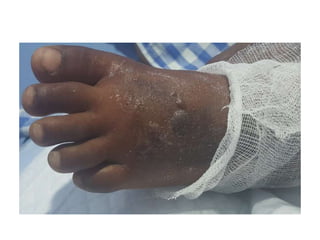
• Fang mark on the dorsum of the left foot
• Blebs and discolouration present
• Peripheral pulses felt, no evidence of
compartment syndrome
• Left inguinal lymphadenopathy present- Tender+
• Provisional diagnosis of Left leg cellulitis-
secondary to ?snake bite envenomation was
made and child was shifted to PICU
• Whole blood clotting time done- less than 20mins
• CBC showed TLC 12,000 with plt of 2.18lakhs
• RFT was normal
• Child empirically started on iv ceftriaxone and
metronidazole
• Monitored for urine output, increase in
swelling,compartment syndrome.
• On day 3 of hospitalization - pus c/s was sent
from the bleb.
• Pediatric surgery opinion taken on day 3 of
hospitalization- Opined as Necrotizing fascitis
of leg.(Evolving)
• Iv antibiotics was changed to ampiclox and
amikacin and metronidazole was continued.
• Wound debridement with fasciotomy was
done on day 5 of hospitalisation. Tissue
culture was sent.
• Pus c/s (aerobic & tissue culture showed
evidence of klebsiella pneumoniae sensitive to
the ciprofloxacin, ceftriaxone, amikacin,
magnex, meropenem
• Anaerobic culture : sterile
• Taken over by paediatric surgery. Daily wound
dressing done.
• Planned to do skin grafting after 2 weeks.
Snake Envenomation
• Highest Mortality in the world.
• Deaths of 30,000 per annum. (WHO 2009)
• 236 species of snakes in India
• 15 varieties are poisonous.
• Cobra, Russell's viper, saw- scaled,vipers and
krait are the most common.
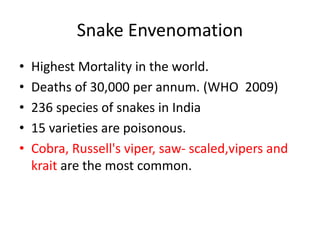
Cobra
Naga Pambu or Nalla
pambu
நாகப் பாம்பு/நல்ல பாம்பு
Naja naja
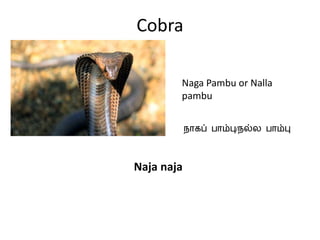
Common Krait
Bungarus caeruleus
Kattu viriyan/ Thani
Paambu
கட்டு விரியன்
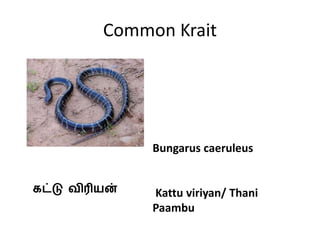
Saw scaled snake
Echis carinatus.
Surutai pambu
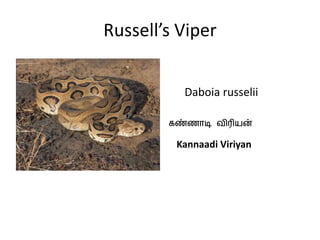
Russell’s Viper
Daboia russelii
கண்ணாடி விரியன்
Kannaadi Viriyan
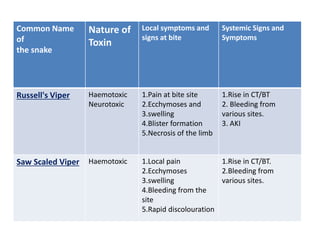
Common Name
of
the snake
Nature of
Toxin
Local symptoms and
signs at bite
Systemic Signs and
Symptoms
Russell's Viper Haemotoxic
Neurotoxic
1.Pain at bite site
2.Ecchymoses and
3.swelling
4.Blister formation
5.Necrosis of the limb
1.Rise in CT/BT
2. Bleeding from
various sites.
3. AKI
Saw Scaled Viper Haemotoxic 1.Local pain
2.Ecchymoses
3.swelling
4.Bleeding from the
site
5.Rapid discolouration
1.Rise in CT/BT.
2.Bleeding from
various sites.
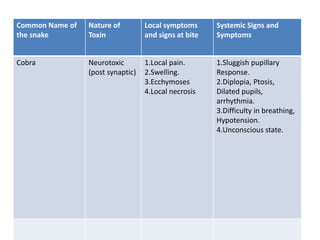
Common Name of
the snake
Nature of
Toxin
Local symptoms
and signs at bite
Systemic Signs and
Symptoms
Cobra Neurotoxic
(post synaptic)
1.Local pain.
2.Swelling.
3.Ecchymoses
4.Local necrosis
1.Sluggish pupillary
Response.
2.Diplopia, Ptosis,
Dilated pupils,
arrhythmia.
3.Difficulty in breathing,
Hypotension.
4.Unconscious state.
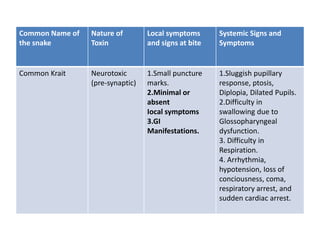
Common Name of
the snake
Nature of
Toxin
Local symptoms
and signs at bite
Systemic Signs and
Symptoms
Common Krait Neurotoxic
(pre-synaptic)
1.Small puncture
marks.
2.Minimal or
absent
Iocal symptoms
3.GI
Manifestations.
1.Sluggish pupillary
response, ptosis,
Diplopia, Dilated Pupils.
2.Difficulty in
swallowing due to
Glossopharyngeal
dysfunction.
3. Difficulty in
Respiration.
4. Arrhythmia,
hypotension, Ioss of
conciousness, coma,
respiratory arrest, and
sudden cardiac arrest.
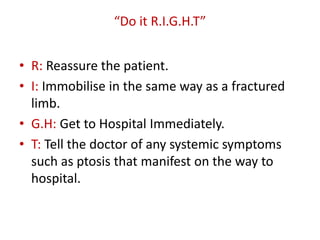
“Do it R.I.G.H.T”
• R: Reassure the patient.
• I: Immobilise in the same way as a fractured
limb.
• G.H: Get to Hospital Immediately.
• T: Tell the doctor of any systemic symptoms
such as ptosis that manifest on the way to
hospital.
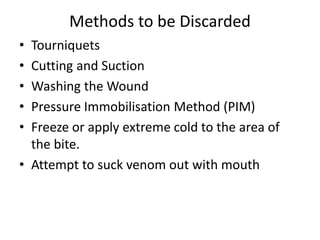
Methods to be Discarded
• Tourniquets
• Cutting and Suction
• Washing the Wound
• Pressure Immobilisation Method (PIM)
• Freeze or apply extreme cold to the area of
the bite.
• Attempt to suck venom out with mouth
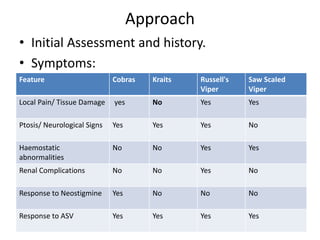
Approach
• Initial Assessment and history.
• Symptoms:
Feature Cobras Kraits Russell's
Viper
Saw ScaIed
Viper
Local Pain/ Tissue Damage yes No Yes Yes
Ptosis/ Neurological Signs Yes Yes Yes No
Haemostatic
abnormalities
No No Yes Yes
Renal Complications No No Yes No
Response to Neostigmine Yes No No No
Response to ASV Yes Yes Yes Yes
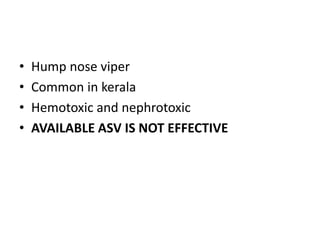
• Hump nose viper
• Common in kerala
• Hemotoxic and nephrotoxic
• AVAILABLE ASV IS NOT EFFECTIVE
Investigations
• 20 minutes whole blood clotting test
• Haemoglobin/ Pcv/ Platelet count/ PT/ APTT/
FDP/ D-Dimer
• A Peripheral Smear
• Urine for for Proteinuria/ RBC/
haemoglobinuria/ myoglobinuria
• Sr.creatinine/urea/Potassium
TREATMENT
• Managing pain:
This can be treated with painkillers such as
Paracetamol.
• Handling Tourniquets:
Before removal of the touniquet, check for the
presence of pulse distal to the tourniquet.
Anti Snake Venom (ASV)
• INDICATION:
Evidence of systemic envenomation
Evidence of coagulopathy: Primarily detected by
2OWBCT or visible spontaneous systemic
bleeding etc.
Evidence of neurotoxicity: Ptosis, external
ophthalmoplegia, muscle paralysis,inability to
lift the head etc
Severe Local envenomation
• Premedication :
Hydrocortisone 2-5 mg/Kg
Chlorpheniramine 0.1-0.3 mg/kg
Ranitidine 2 mg /kg
Dosage: 10 vials
Russell's viper injects 63mg (Range 5mg - 147
mg; SD 7 mg) of venom- each vial contains
6mg of ASV
• Route of administration- Intravenous infusion
10 vials of ASV is diluted in 10-20ml/kg of
isotonic saline and given over one hour
• Child is monitored closely for ASV related
reactions.
Locally instilling ASV on bite site to be avoided
ASV Reactions
In cases of anaphyllaxis
• Discontinue ASV infusion
• 0.01mg/kg adrenaline 1 :1000 given IM
• Second or third dose may be repeated if
symptoms not reversed
• If anaphyllactic shock – start adrenaline
infusion
• Once recovered, ASV can be restarted slowly
Recovery Signs
• Spontaneous systemic bleeding such as gum
bleeding usually stops within 15 – 30 minutes.
• Blood coagulability is usually restored in 6 hours.
Principal test is 2OWBCT.
• Post synaptic neurotoxic envenoming such as in
Cobra bites, may begin to improve as early as 30
minutes after antivenom, but can take several
hours.
• Active haemolysis and rhabdomyolysis may
cease within a few hours and the urine returns to
its normal colour.
• In patients with Shock, blood pressure may
increase after 30 minutes
When and how much repeat dose
• Hemotoxic snake bite:
Maximum 25 vials
After 6 hours
• Neurotoxic snake bite:
Maximum 20 vials
After 1-2 hours
• Why ASV not effective after delayed
presentation or persistent local swelling?
ASV acts in the circulation to prevent binding
of unbound venom
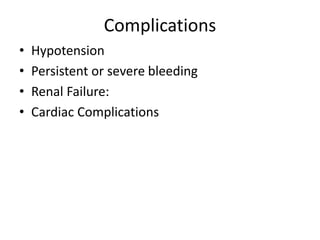
Complications
• Hypotension
• Persistent or severe bleeding
• Renal Failure:
• Cardiac Complications
Surgical Complications
• Ulcer following snakebite
• Necrosis of the skin and underlying tissues
• Gangrene of the toes and fingers
• Debridement of necrotic tissues
• Compartment syndrome.
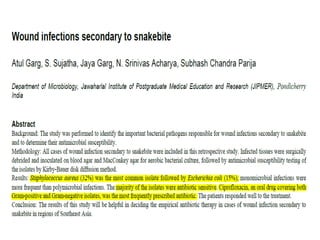
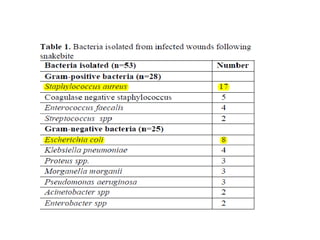
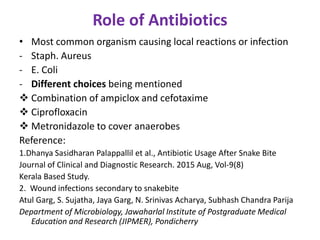
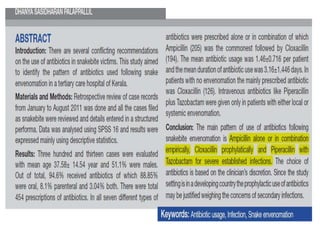
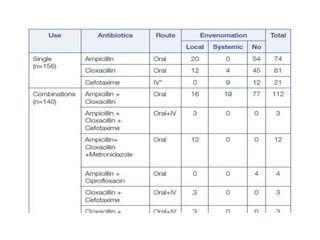
Role of Antibiotics
• Most common organism causing local reactions or infection
- Staph. Aureus
- E. Coli
- Different choices being mentioned
 Combination of ampiclox and cefotaxime
 Ciprofloxacin
 Metronidazole to cover anaerobes
Reference:
1.Dhanya Sasidharan Palappallil et al., Antibiotic Usage After Snake Bite
Journal of Clinical and Diagnostic Research. 2015 Aug, Vol-9(8)
Kerala Based Study.
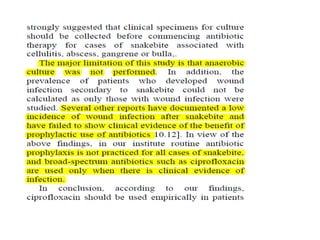
2. Wound infections secondary to snakebite
Atul Garg, S. Sujatha, Jaya Garg, N. Srinivas Acharya, Subhash Chandra Parija
Department of Microbiology, Jawaharlal Institute of Postgraduate Medical
Education and Research (JIPMER), Pondicherry
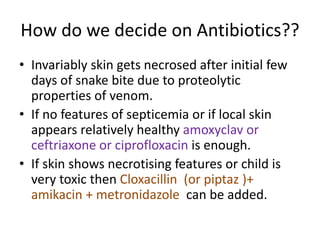
How do we decide on Antibiotics??
• Invariably skin gets necrosed after initial few
days of snake bite due to proteolytic
properties of venom.
• If no features of septicemia or if local skin
appears relatively healthy amoxyclav or
ceftriaxone or ciprofloxacin is enough.
• If skin shows necrotising features or child is
very toxic then Cloxacillin (or piptaz )+
amikacin + metronidazole can be added.
• THANK YOU

Snake envenomation

  • 1.
    Case based discussion-Snake Envenomation Dr. Zaheen Zehra Dept of Paediatrics.
  • 2.
    • 7 yrold boy brought with alleged h/o unknown bite on 11/03/17 at 10:30 am at home. • Site of bite- dorsum of left foot • C/o Excrutiating pain and swelling on the left leg. • After 1 hr child sustained localised swelling,H/o progression of swelling upwards till left knee associated with pain. • No h/o bleeding from the site, LOC, Seizures, Ptosis • No respiratory distress
  • 3.
    • Past History: Nosignificant past history • Family History: Nil significant • Antenatal and perinatal history: Nil significant • Immunisation History: Upto date • Growth and development: Normal
  • 4.
    Treatment History: • Childwas immediately taken to Kallukurichi GH, diagnosed as snake bite with cellulitis of left leg. • Treated with IV fluids, Inj.Tramadol, Inj.Rantac, Inj.Taxim, Inj.Metrogyl, ASV. • Dose of ASV not mentioned. Not given premedications • Referred that day for ASV allergy.
  • 5.
    ON EXAMINATION Initial assessment:Stable Primary assessment : Normal - (Urgent) Active,febrile GCS-15/15 Vitals: Temperature-100 F PR-130/min RR-24/min CFT-<3 sec BP-130/90mmHg Breath holding time – adequate No bleeding sites
  • 6.
    SYSTEMIC EXAMINATION: • RespiratorySystem: B/L AE equal, NVBS Heard. • CNS:Sensorium-normal;No ptosis • CVS: S1,S2 heard; Tachycardia present • P/A: Soft, non tender, no organomegaly, no renal angle tenderness
  • 7.
    LOCAL EXAMINATION: • Warmth,swellingand tenderness till distal one third of the lower limb(Below knee) • Fang mark on the dorsum of the left foot • Blebs and discolouration present • Peripheral pulses felt, no evidence of compartment syndrome • Left inguinal lymphadenopathy present- Tender+
  • 9.
    • Provisional diagnosisof Left leg cellulitis- secondary to ?snake bite envenomation was made and child was shifted to PICU • Whole blood clotting time done- less than 20mins • CBC showed TLC 12,000 with plt of 2.18lakhs • RFT was normal • Child empirically started on iv ceftriaxone and metronidazole • Monitored for urine output, increase in swelling,compartment syndrome.
  • 10.
    • On day3 of hospitalization - pus c/s was sent from the bleb. • Pediatric surgery opinion taken on day 3 of hospitalization- Opined as Necrotizing fascitis of leg.(Evolving) • Iv antibiotics was changed to ampiclox and amikacin and metronidazole was continued. • Wound debridement with fasciotomy was done on day 5 of hospitalisation. Tissue culture was sent.
  • 11.
    • Pus c/s(aerobic & tissue culture showed evidence of klebsiella pneumoniae sensitive to the ciprofloxacin, ceftriaxone, amikacin, magnex, meropenem • Anaerobic culture : sterile
  • 12.
    • Taken overby paediatric surgery. Daily wound dressing done. • Planned to do skin grafting after 2 weeks.
  • 13.
    Snake Envenomation • HighestMortality in the world. • Deaths of 30,000 per annum. (WHO 2009) • 236 species of snakes in India • 15 varieties are poisonous. • Cobra, Russell's viper, saw- scaled,vipers and krait are the most common.
  • 14.
    Cobra Naga Pambu orNalla pambu நாகப் பாம்பு/நல்ல பாம்பு Naja naja
  • 15.
    Common Krait Bungarus caeruleus Kattuviriyan/ Thani Paambu கட்டு விரியன்
  • 16.
    Saw scaled snake Echiscarinatus. Surutai pambu
  • 17.
    Russell’s Viper Daboia russelii கண்ணாடிவிரியன் Kannaadi Viriyan
  • 18.
    Common Name of the snake Natureof Toxin Local symptoms and signs at bite Systemic Signs and Symptoms Russell's Viper Haemotoxic Neurotoxic 1.Pain at bite site 2.Ecchymoses and 3.swelling 4.Blister formation 5.Necrosis of the limb 1.Rise in CT/BT 2. Bleeding from various sites. 3. AKI Saw Scaled Viper Haemotoxic 1.Local pain 2.Ecchymoses 3.swelling 4.Bleeding from the site 5.Rapid discolouration 1.Rise in CT/BT. 2.Bleeding from various sites.
  • 19.
    Common Name of thesnake Nature of Toxin Local symptoms and signs at bite Systemic Signs and Symptoms Cobra Neurotoxic (post synaptic) 1.Local pain. 2.Swelling. 3.Ecchymoses 4.Local necrosis 1.Sluggish pupillary Response. 2.Diplopia, Ptosis, Dilated pupils, arrhythmia. 3.Difficulty in breathing, Hypotension. 4.Unconscious state.
  • 20.
    Common Name of thesnake Nature of Toxin Local symptoms and signs at bite Systemic Signs and Symptoms Common Krait Neurotoxic (pre-synaptic) 1.Small puncture marks. 2.Minimal or absent Iocal symptoms 3.GI Manifestations. 1.Sluggish pupillary response, ptosis, Diplopia, Dilated Pupils. 2.Difficulty in swallowing due to Glossopharyngeal dysfunction. 3. Difficulty in Respiration. 4. Arrhythmia, hypotension, Ioss of conciousness, coma, respiratory arrest, and sudden cardiac arrest.
  • 21.
    “Do it R.I.G.H.T” •R: Reassure the patient. • I: Immobilise in the same way as a fractured limb. • G.H: Get to Hospital Immediately. • T: Tell the doctor of any systemic symptoms such as ptosis that manifest on the way to hospital.
  • 22.
    Methods to beDiscarded • Tourniquets • Cutting and Suction • Washing the Wound • Pressure Immobilisation Method (PIM) • Freeze or apply extreme cold to the area of the bite. • Attempt to suck venom out with mouth
  • 23.
    Approach • Initial Assessmentand history. • Symptoms: Feature Cobras Kraits Russell's Viper Saw ScaIed Viper Local Pain/ Tissue Damage yes No Yes Yes Ptosis/ Neurological Signs Yes Yes Yes No Haemostatic abnormalities No No Yes Yes Renal Complications No No Yes No Response to Neostigmine Yes No No No Response to ASV Yes Yes Yes Yes
  • 24.
    • Hump noseviper • Common in kerala • Hemotoxic and nephrotoxic • AVAILABLE ASV IS NOT EFFECTIVE
  • 25.
    Investigations • 20 minuteswhole blood clotting test • Haemoglobin/ Pcv/ Platelet count/ PT/ APTT/ FDP/ D-Dimer • A Peripheral Smear • Urine for for Proteinuria/ RBC/ haemoglobinuria/ myoglobinuria • Sr.creatinine/urea/Potassium
  • 26.
    TREATMENT • Managing pain: Thiscan be treated with painkillers such as Paracetamol. • Handling Tourniquets: Before removal of the touniquet, check for the presence of pulse distal to the tourniquet.
  • 27.
    Anti Snake Venom(ASV) • INDICATION: Evidence of systemic envenomation Evidence of coagulopathy: Primarily detected by 2OWBCT or visible spontaneous systemic bleeding etc. Evidence of neurotoxicity: Ptosis, external ophthalmoplegia, muscle paralysis,inability to lift the head etc Severe Local envenomation
  • 28.
    • Premedication : Hydrocortisone2-5 mg/Kg Chlorpheniramine 0.1-0.3 mg/kg Ranitidine 2 mg /kg Dosage: 10 vials Russell's viper injects 63mg (Range 5mg - 147 mg; SD 7 mg) of venom- each vial contains 6mg of ASV
  • 29.
    • Route ofadministration- Intravenous infusion 10 vials of ASV is diluted in 10-20ml/kg of isotonic saline and given over one hour • Child is monitored closely for ASV related reactions. Locally instilling ASV on bite site to be avoided
  • 30.
    ASV Reactions In casesof anaphyllaxis • Discontinue ASV infusion • 0.01mg/kg adrenaline 1 :1000 given IM • Second or third dose may be repeated if symptoms not reversed • If anaphyllactic shock – start adrenaline infusion • Once recovered, ASV can be restarted slowly
  • 31.
    Recovery Signs • Spontaneoussystemic bleeding such as gum bleeding usually stops within 15 – 30 minutes. • Blood coagulability is usually restored in 6 hours. Principal test is 2OWBCT. • Post synaptic neurotoxic envenoming such as in Cobra bites, may begin to improve as early as 30 minutes after antivenom, but can take several hours. • Active haemolysis and rhabdomyolysis may cease within a few hours and the urine returns to its normal colour. • In patients with Shock, blood pressure may increase after 30 minutes
  • 32.
    When and howmuch repeat dose • Hemotoxic snake bite: Maximum 25 vials After 6 hours • Neurotoxic snake bite: Maximum 20 vials After 1-2 hours
  • 33.
    • Why ASVnot effective after delayed presentation or persistent local swelling? ASV acts in the circulation to prevent binding of unbound venom
  • 34.
    Complications • Hypotension • Persistentor severe bleeding • Renal Failure: • Cardiac Complications
  • 35.
    Surgical Complications • Ulcerfollowing snakebite • Necrosis of the skin and underlying tissues • Gangrene of the toes and fingers • Debridement of necrotic tissues • Compartment syndrome.
  • 36.
    Role of Antibiotics •Most common organism causing local reactions or infection - Staph. Aureus - E. Coli - Different choices being mentioned  Combination of ampiclox and cefotaxime  Ciprofloxacin  Metronidazole to cover anaerobes Reference: 1.Dhanya Sasidharan Palappallil et al., Antibiotic Usage After Snake Bite Journal of Clinical and Diagnostic Research. 2015 Aug, Vol-9(8) Kerala Based Study. 2. Wound infections secondary to snakebite Atul Garg, S. Sujatha, Jaya Garg, N. Srinivas Acharya, Subhash Chandra Parija Department of Microbiology, Jawaharlal Institute of Postgraduate Medical Education and Research (JIPMER), Pondicherry
  • 42.
    How do wedecide on Antibiotics?? • Invariably skin gets necrosed after initial few days of snake bite due to proteolytic properties of venom. • If no features of septicemia or if local skin appears relatively healthy amoxyclav or ceftriaxone or ciprofloxacin is enough. • If skin shows necrotising features or child is very toxic then Cloxacillin (or piptaz )+ amikacin + metronidazole can be added.
  • 43.