1 
Chapter 2 
Fundamental Properties 
of Antennas 
ECE 5318/6352 
Antenna Engineering 
Dr. Stuart Long
2 
 
IEEE Standards 
 
Definition of Terms for Antennas 
 
IEEE Standard 145-1983 
 
IEEE Transactions on Antennas and 
Propagation Vol. AP-31, No. 6, Part II, Nov. 1983
3 
 
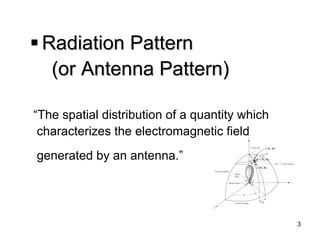
Radiation Pattern 
(or Antenna Pattern) 
“The spatial distribution of a quantity which 
characterizes the electromagnetic field 
generated by an antenna.”
4 
 
Distribution can be a 
 
Mathematical function 
 
Graphical representation 
 
Collection of experimental data points
5 
 
Quantity plotted can be a 
 
Power flux density W[W/m²] 
 
Radiation intensity U [W/sr] 
 
Field strength E [V/m] 
 
Directivity D
6 
 Graph can be 
 
Polar or rectangular
7 
 Graph can be 
 
Amplitude field |E| or power |E|² patterns 
(in linear scale) (in dB)
8 
 
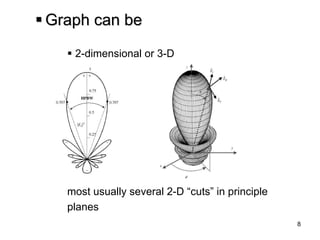
Graph can be 
 
2-dimensional or 3-D 
most usually several 2-D “cuts” in principle 
planes
9 
 
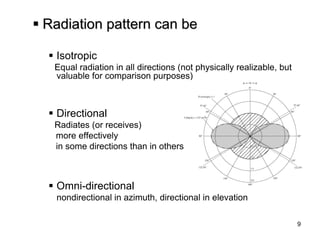
Radiation pattern can be 
 
Isotropic 
Equal radiation in all directions (not physically realizable, but valuable for comparison purposes) 
 
Directional 
Radiates (or receives) 
more effectively 
in some directions than in others 
 
Omni-directional 
nondirectional in azimuth, directional in elevation
10 
 
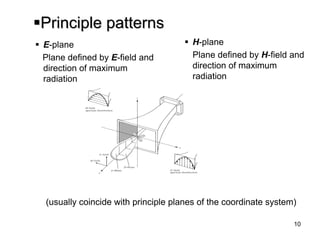
Principle patterns 
 
E-plane 
Plane defined by E-field and direction of maximum radiation 
 
H-plane 
Plane defined by H-field and direction of maximum radiation 
(usually coincide with principle planes of the coordinate system)
11 
Coordinate System 
Fig. 2.1 Coordinate system for antenna analysis.
12 
 
Radiation pattern lobes 
 
Major lobe (main beam) in direction of maximum radiation (may be more than one) 
 
Minor lobe - any lobe but a major one 
 
Side lobe - lobe adjacent to major one 
 
Back lobe – minor lobe in direction exactly opposite to major one
13 
 
Side lobe level or ratio (SLR) 
 
(side lobe magnitude / major lobe magnitude) 
 
- 20 dB typical 
 
< -50 dB very difficult 
Plot routine included on CD for rectangular and polar graphs
14 
Polar Pattern 
Fig. 2.3(a) Radiation lobes and 
beamwidths of an antenna pattern
15 
Linear Pattern 
Fig. 2.3(b) Linear plot of power pattern and 
its associated lobes and beamwidths
16 
 
Field Regions 
 
Reactive near field 
energy stored not radiated 
λ= wavelength 
D= largest dimension of the antenna 
 362.0DR
17 
 
Field Regions 
 
Radiating near field (Fresnel) 
radiating fields predominate 
pattern still depend on R 
radial component may still be appreciable 
λ= wavelength 
D= largest dimension of the antenna  23262.0DRD
18 
 
Field Regions 
 
Far field ( 
Fraunhofer Fraunhofer) 
field distribution independent of R 
field components are essentially transverse  22DR
19 
 
Radian 
Fig. 2.10(a) Geometrical arrangements for defining a radian 
r 
2 radians in full circle 
arc length of circle
20 
 
Steradian 
one steradian subtends an area of 
4π steradians in entire sphere 
ddrdAsin2 
Fig. 2.10(b) Geometrical arrangements 
for defining a steradian. 
ddrdAdsin2 2rA
21 
 Radiation power density 
HEW   
 
Instantaneous Poynting vector 
 
Time average Poynting vector 
[ W/m ² ] 
 
Total instantaneous 
Power 
 
Average radiated 
Power 
[ W/m ² ] 
 ssWP d 
[ W ] 
HEW  Re21avg  savgraddPsW 
[ W ] 
[2-8] 
[2-9] 
[2-4] 
[2-3]
22 
 Radiation intensity 
“Power radiated per unit solid angle” 
avgWrU2 
far zone fields without 1/r factor 
22),,( 2),(  rrUE  222),,(),,( 2   rErEr 
[W/unit solid angle] 
[2-12a] 
22oo1(,)(,) 2EE   
Note: This final equation does not have an r in it. The “zero” superscript means that the 1/r term is removed.
23 
 
Directive Gain 
Ratio of radiation intensity in a given direction to the radiation intensity averaged over all directions 
radogPUUUD4 
 
Directivity Gain 
(Dg) -- directivity in a given direction 
[2-16] 
04radPU   
(This is the radiation intensity if the antenna radiated its power equally in all directions.) 
201,sin4SUUdd   
Note:
24 
 
Directivity 
radmaxomaxoPUUUD4 
Do (isotropic) = 1.0 
ogDD0 
 
Directivity 
-- Do 
value of directive gain in direction of maximum radiation intensity
25 
 
Beamwidth 
 
Half power beamwidth 
Angle between adjacent points where field strength is 0.707 times the maximum, or the power is 0.5 times the maximum 
(-3dB below maximum) 
 
First null beamwidth 
Angle between nulls in pattern 
Fig. 2.11(b) 2-D power patterns (in linear scale) 
of U()=cos²()cos³()
26 
 
Approximate directivity for 
omnidirectional patterns 
 
McDonald 
2HPBW0027.0HPBW 101  oD 
   π 
   π 
 
Pozar 
(HPBW in degrees) 
Results shown with exact values in Fig. 2.18 
HPBW1818.01914.172oD nUsin 
Better if no minor lobes [2-33b] 
[2-32] 
[2-33a] 
For example
27 
 
Approximate directivity for directional patterns 
 
Kraus 
1212441,253orrddD   
   π/2 
   π 
 
Tai & Pereira 
Antennas with only one narrow main lobe and very negligible minor lobes 
22212221815,7218.22ddrroD     nUcos 
[2-30b] 
[2-31] 
[2-27] 
For example 
( ) HPBW in two perpendicular planes in radians or  in degrees) 
12,rr12,dd 
Note: According to Elliott, a better number to use in the Kraus formula is 32,400 (Eq. 2-271 in Balanis). In fact, the 41,253 is really wrong (it is derived assuming a rectangular beam footprint instead of the correct elliptical one).
28 
 
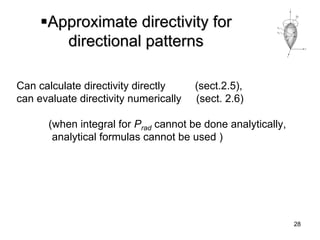
Approximate directivity for 
directional patterns 
Can calculate directivity directly (sect.2.5), 
can evaluate directivity numerically (sect. 2.6) 
(when integral for Prad cannot be done analytically, 
analytical formulas cannot be used )
29 
 
Gain 
Like directivity but also takes into account efficiency of antenna 
(includes reflection, conductor, and dielectric losses) 
 oinoinZZZZ   ;12 
eo : overall eff. 
er : reflection eff. 
ec : conduction eff. 
ed : dielectric eff. 
Efficiency source) isotropic(lossless,PUPUeDeGinmaxradmaxooooabs 44 dcroeeee dccdeee 
[2-49c] 
radcdinPeP radoincPeP 
30 
 
Gain 
By IEEE definition “gain does not include losses arising from impedance 
mismatches (reflection losses) and polarization mismatches (losses)” source) isotropic(lossless,PUDeGinmaxocdo 4 
[2-49a]
31 
 
Bandwidth 
“frequency range over which some characteristic conforms to a standard” 
 
Pattern bandwidth 
 
Beamwidth, side lobe level, gain, polarization, beam direction 
 
polarization bandwidth example: circular polarization with axial ratio < 3 dB 
 
Impedance bandwidth 
 
usually based on reflection coefficient 
 
under 2 to 1 VSWR typical
32 
 
Bandwidth 
 
Broadband antennas 
usually use ratio (e.g. 10:1) 
 
Narrow band antennas 
usually use percentage (e.g. 5%)
33 
 
Polarization 
 
Linear 
 
Circular 
 
Elliptical 
Right or left handed 
rotation in time
34 
 
Polarization 
 
Polarization loss factor 
 
p is angle between wave and antenna polarization 
22 ˆˆcoswapPLF 
[2-71]
35 
 
Input impedance 
“Ratio of voltage to current at terminals of antenna” 
ZA = RA + jXA 
RA = Rr + RL 
Rr = radiation resistance 
RL = loss resistance 
ZA = antenna impedance at terminals a-b
36 
 
Input impedance 
 
Antenna radiation efficiency 
 2221211() 22grrcdrLgrgLIRPowerRadiatedbyAntennaPePowerDeliveredtoAntennaPPIRIR   
[2-90] 
LrrcdRRRe   
Note: this works well for those antennas that are modeled as a series RLC circuit – like wire antennas. For those that are modeled as parallel RLC circuit (like a microstrip antenna), we would use G values instead of R values.
37 
 
Friis Transmission Equation 
Fig. 2.31 Geometrical orientation of transmitting and receiving antennas for Friis transmission equation
38 
 
Friis Transmission Equation 
et = efficiency of transmitting antenna 
er = efficiency of receiving antenna 
Dt= directive gain of transmitting antenna 
Dr = directive gain of receiving antenna 
= wavelength 
R = distance between antennas 
assuming impedance and 
polarization matches 
224),(),( RDDeePPrrrtttrttr    
[2-117]
39 
 
Radar Range Equation 
Fig. 2.32 Geometrical arrangement of 
transmitter, target, and receiver for 
radar range equation22144),(),(      RRDDeePPrrrttttrcdrcdt     
[2-123]
40 
 
Radar Cross Section 
RCS 
 
Usually given symbol  
 
Far field characteristic 
 
Units in [m²] 
4rincUW  incident power density on body from transmit directionincW scattered power intensity in receive directionrU 
Physical interpretation: The radar cross section is the area of an equivalent ideal “black body” absorber that absorbs all incident power that then radiates it equally in all directions.
41 
 
Radar Cross Section ( 
RCS) 
 
Function of 
 
Polarization of the wave 
 
Angle of incidence 
 
Angle of observation 
 
Geometry of target 
 
Electrical properties of target 
 
Frequency
42 
 
Radar Cross Section ( 
RCS)

Ece5318 ch2

  • 1.
    1 Chapter 2 Fundamental Properties of Antennas ECE 5318/6352 Antenna Engineering Dr. Stuart Long
  • 2.
    2  IEEEStandards  Definition of Terms for Antennas  IEEE Standard 145-1983  IEEE Transactions on Antennas and Propagation Vol. AP-31, No. 6, Part II, Nov. 1983
  • 3.
    3  RadiationPattern (or Antenna Pattern) “The spatial distribution of a quantity which characterizes the electromagnetic field generated by an antenna.”
  • 4.
    4  Distributioncan be a  Mathematical function  Graphical representation  Collection of experimental data points
  • 5.
    5  Quantityplotted can be a  Power flux density W[W/m²]  Radiation intensity U [W/sr]  Field strength E [V/m]  Directivity D
  • 6.
    6  Graphcan be  Polar or rectangular
  • 7.
    7  Graphcan be  Amplitude field |E| or power |E|² patterns (in linear scale) (in dB)
  • 8.
    8  Graphcan be  2-dimensional or 3-D most usually several 2-D “cuts” in principle planes
  • 9.
    9  Radiationpattern can be  Isotropic Equal radiation in all directions (not physically realizable, but valuable for comparison purposes)  Directional Radiates (or receives) more effectively in some directions than in others  Omni-directional nondirectional in azimuth, directional in elevation
  • 10.
    10  Principlepatterns  E-plane Plane defined by E-field and direction of maximum radiation  H-plane Plane defined by H-field and direction of maximum radiation (usually coincide with principle planes of the coordinate system)
  • 11.
    11 Coordinate System Fig. 2.1 Coordinate system for antenna analysis.
  • 12.
    12  Radiationpattern lobes  Major lobe (main beam) in direction of maximum radiation (may be more than one)  Minor lobe - any lobe but a major one  Side lobe - lobe adjacent to major one  Back lobe – minor lobe in direction exactly opposite to major one
  • 13.
    13  Sidelobe level or ratio (SLR)  (side lobe magnitude / major lobe magnitude)  - 20 dB typical  < -50 dB very difficult Plot routine included on CD for rectangular and polar graphs
  • 14.
    14 Polar Pattern Fig. 2.3(a) Radiation lobes and beamwidths of an antenna pattern
  • 15.
    15 Linear Pattern Fig. 2.3(b) Linear plot of power pattern and its associated lobes and beamwidths
  • 16.
    16  FieldRegions  Reactive near field energy stored not radiated λ= wavelength D= largest dimension of the antenna  362.0DR
  • 17.
    17  FieldRegions  Radiating near field (Fresnel) radiating fields predominate pattern still depend on R radial component may still be appreciable λ= wavelength D= largest dimension of the antenna  23262.0DRD
  • 18.
    18  FieldRegions  Far field ( Fraunhofer Fraunhofer) field distribution independent of R field components are essentially transverse  22DR
  • 19.
    19  Radian Fig. 2.10(a) Geometrical arrangements for defining a radian r 2 radians in full circle arc length of circle
  • 20.
    20  Steradian one steradian subtends an area of 4π steradians in entire sphere ddrdAsin2 Fig. 2.10(b) Geometrical arrangements for defining a steradian. ddrdAdsin2 2rA
  • 21.
    21  Radiationpower density HEW    Instantaneous Poynting vector  Time average Poynting vector [ W/m ² ]  Total instantaneous Power  Average radiated Power [ W/m ² ]  ssWP d [ W ] HEW  Re21avg  savgraddPsW [ W ] [2-8] [2-9] [2-4] [2-3]
  • 22.
    22  Radiationintensity “Power radiated per unit solid angle” avgWrU2 far zone fields without 1/r factor 22),,( 2),(  rrUE  222),,(),,( 2   rErEr [W/unit solid angle] [2-12a] 22oo1(,)(,) 2EE   Note: This final equation does not have an r in it. The “zero” superscript means that the 1/r term is removed.
  • 23.
    23  DirectiveGain Ratio of radiation intensity in a given direction to the radiation intensity averaged over all directions radogPUUUD4  Directivity Gain (Dg) -- directivity in a given direction [2-16] 04radPU   (This is the radiation intensity if the antenna radiated its power equally in all directions.) 201,sin4SUUdd   Note:
  • 24.
    24  Directivity radmaxomaxoPUUUD4 Do (isotropic) = 1.0 ogDD0  Directivity -- Do value of directive gain in direction of maximum radiation intensity
  • 25.
    25  Beamwidth  Half power beamwidth Angle between adjacent points where field strength is 0.707 times the maximum, or the power is 0.5 times the maximum (-3dB below maximum)  First null beamwidth Angle between nulls in pattern Fig. 2.11(b) 2-D power patterns (in linear scale) of U()=cos²()cos³()
  • 26.
    26  Approximatedirectivity for omnidirectional patterns  McDonald 2HPBW0027.0HPBW 101  oD    π    π  Pozar (HPBW in degrees) Results shown with exact values in Fig. 2.18 HPBW1818.01914.172oD nUsin Better if no minor lobes [2-33b] [2-32] [2-33a] For example
  • 27.
    27  Approximatedirectivity for directional patterns  Kraus 1212441,253orrddD      π/2    π  Tai & Pereira Antennas with only one narrow main lobe and very negligible minor lobes 22212221815,7218.22ddrroD     nUcos [2-30b] [2-31] [2-27] For example ( ) HPBW in two perpendicular planes in radians or  in degrees) 12,rr12,dd Note: According to Elliott, a better number to use in the Kraus formula is 32,400 (Eq. 2-271 in Balanis). In fact, the 41,253 is really wrong (it is derived assuming a rectangular beam footprint instead of the correct elliptical one).
  • 28.
    28  Approximatedirectivity for directional patterns Can calculate directivity directly (sect.2.5), can evaluate directivity numerically (sect. 2.6) (when integral for Prad cannot be done analytically, analytical formulas cannot be used )
  • 29.
    29  Gain Like directivity but also takes into account efficiency of antenna (includes reflection, conductor, and dielectric losses)  oinoinZZZZ   ;12 eo : overall eff. er : reflection eff. ec : conduction eff. ed : dielectric eff. Efficiency source) isotropic(lossless,PUPUeDeGinmaxradmaxooooabs 44 dcroeeee dccdeee [2-49c] radcdinPeP radoincPeP 
  • 30.
    30  Gain By IEEE definition “gain does not include losses arising from impedance mismatches (reflection losses) and polarization mismatches (losses)” source) isotropic(lossless,PUDeGinmaxocdo 4 [2-49a]
  • 31.
    31  Bandwidth “frequency range over which some characteristic conforms to a standard”  Pattern bandwidth  Beamwidth, side lobe level, gain, polarization, beam direction  polarization bandwidth example: circular polarization with axial ratio < 3 dB  Impedance bandwidth  usually based on reflection coefficient  under 2 to 1 VSWR typical
  • 32.
    32  Bandwidth  Broadband antennas usually use ratio (e.g. 10:1)  Narrow band antennas usually use percentage (e.g. 5%)
  • 33.
    33  Polarization  Linear  Circular  Elliptical Right or left handed rotation in time
  • 34.
    34  Polarization  Polarization loss factor  p is angle between wave and antenna polarization 22 ˆˆcoswapPLF [2-71]
  • 35.
    35  Inputimpedance “Ratio of voltage to current at terminals of antenna” ZA = RA + jXA RA = Rr + RL Rr = radiation resistance RL = loss resistance ZA = antenna impedance at terminals a-b
  • 36.
    36  Inputimpedance  Antenna radiation efficiency  2221211() 22grrcdrLgrgLIRPowerRadiatedbyAntennaPePowerDeliveredtoAntennaPPIRIR   [2-90] LrrcdRRRe   Note: this works well for those antennas that are modeled as a series RLC circuit – like wire antennas. For those that are modeled as parallel RLC circuit (like a microstrip antenna), we would use G values instead of R values.
  • 37.
    37  FriisTransmission Equation Fig. 2.31 Geometrical orientation of transmitting and receiving antennas for Friis transmission equation
  • 38.
    38  FriisTransmission Equation et = efficiency of transmitting antenna er = efficiency of receiving antenna Dt= directive gain of transmitting antenna Dr = directive gain of receiving antenna = wavelength R = distance between antennas assuming impedance and polarization matches 224),(),( RDDeePPrrrtttrttr    [2-117]
  • 39.
    39  RadarRange Equation Fig. 2.32 Geometrical arrangement of transmitter, target, and receiver for radar range equation22144),(),(      RRDDeePPrrrttttrcdrcdt     [2-123]
  • 40.
    40  RadarCross Section RCS  Usually given symbol   Far field characteristic  Units in [m²] 4rincUW  incident power density on body from transmit directionincW scattered power intensity in receive directionrU Physical interpretation: The radar cross section is the area of an equivalent ideal “black body” absorber that absorbs all incident power that then radiates it equally in all directions.
  • 41.
    41  RadarCross Section ( RCS)  Function of  Polarization of the wave  Angle of incidence  Angle of observation  Geometry of target  Electrical properties of target  Frequency
  • 42.
    42  RadarCross Section ( RCS)