Wireless Communication
Channels: Large-Scale Pathloss
Diffraction
3
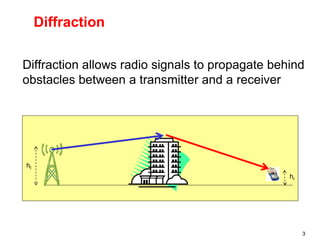
Diffraction
Diffraction allows radio signals to propagate behind
obstacles between a transmitter and a receiver
ht
hr
4
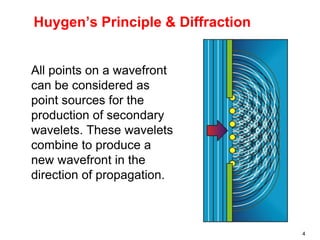
Huygen’s Principle & Diffraction
All points on a wavefront
can be considered as
point sources for the
production of secondary
wavelets. These wavelets
combine to produce a
new wavefront in the
direction of propagation.
5
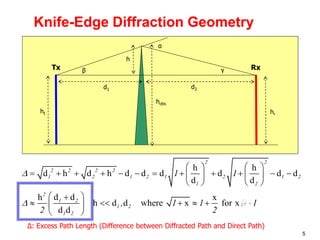
Knife-Edge Diffraction Geometry
ht hr
d1 d2
hobs
h
Tx Rx
α
β γ
Δ: Excess Path Length (Difference between Diffracted Path and Direct Path)
h h
d h d h d d d d d d
d d
d d
h x
h d d where x for x
d d
2 2
2 2 2 2
1 2 1 2 1 2 1 2
1 2
2
1 2
1 2
1 2
1 1
, 1 1 1
2 2


   
           
   
   
 

    
 
 
<
<
6
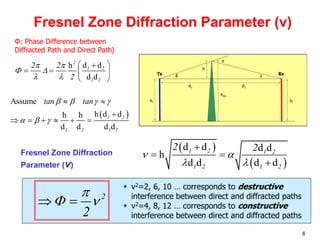
Ф: Phase Difference between
Diffracted Path and Direct Path)
d d
h
d d
2
1 2
1 2
2 2
2
 
 
 
 

   
 
 
Assume
h d d
h h
d d d d
1 2
1 2 1 2
tan tan
   
  
 

     
 
 
d d d d
h
d d d d
1 2 1 2
1 2 1 2
2 2
 
 

 

Fresnel Zone Diffraction
Parameter (ν)
Fresnel Zone Diffraction Parameter (ν)
2
2

 
 
 ν2=2, 6, 10 … corresponds to destructive
interference between direct and diffracted paths
 ν2=4, 8, 12 … corresponds to constructive
interference between direct and diffracted paths
7
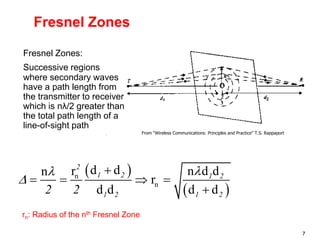
Fresnel Zones
From “Wireless Communications: Principles and Practice” T.S. Rappaport
Fresnel Zones:
Successive regions
where secondary waves
have a path length from
the transmitter to receiver
which is nλ/2 greater than
the total path length of a
line-of-sight path
 
 
n
n
d d
r n d d
n
r
d d d d
2
1 2 1 2
1 2 1 2
2 2




   

rn: Radius of the nth Fresnel Zone
8
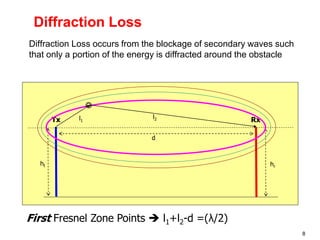
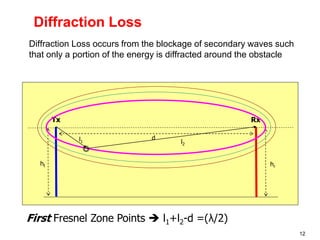
Diffraction Loss
Diffraction Loss occurs from the blockage of secondary waves such
that only a portion of the energy is diffracted around the obstacle
ht hr
Tx Rx
l1
l2
d
First Fresnel Zone Points  l1+l2-d =(λ/2)
9
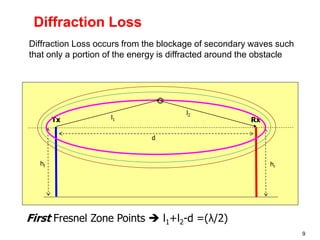
Diffraction Loss
Diffraction Loss occurs from the blockage of secondary waves such
that only a portion of the energy is diffracted around the obstacle
ht hr
Tx Rx
l1
l2
d
First Fresnel Zone Points  l1+l2-d =(λ/2)
10
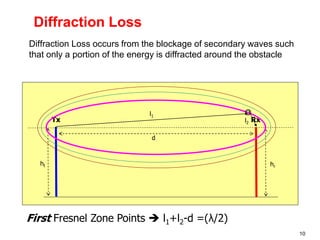
Diffraction Loss
Diffraction Loss occurs from the blockage of secondary waves such
that only a portion of the energy is diffracted around the obstacle
ht hr
Tx Rx
l1
l2
d
First Fresnel Zone Points  l1+l2-d =(λ/2)
11
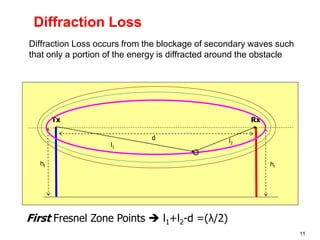
Diffraction Loss
Diffraction Loss occurs from the blockage of secondary waves such
that only a portion of the energy is diffracted around the obstacle
ht hr
Tx Rx
l1
l2
d
First Fresnel Zone Points  l1+l2-d =(λ/2)
12
Diffraction Loss
Diffraction Loss occurs from the blockage of secondary waves such
that only a portion of the energy is diffracted around the obstacle
ht hr
Tx Rx
l1 l2
d
First Fresnel Zone Points  l1+l2-d =(λ/2)
13
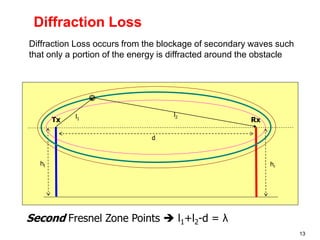
Diffraction Loss
Diffraction Loss occurs from the blockage of secondary waves such
that only a portion of the energy is diffracted around the obstacle
ht hr
Tx Rx
l1
l2
d
Second Fresnel Zone Points  l1+l2-d = λ
14
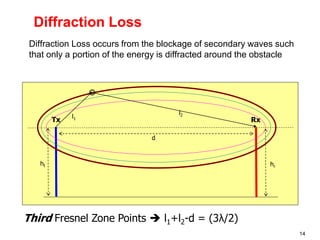
Diffraction Loss
Diffraction Loss occurs from the blockage of secondary waves such
that only a portion of the energy is diffracted around the obstacle
ht hr
Tx Rx
l1
l2
d
Third Fresnel Zone Points  l1+l2-d = (3λ/2)
15
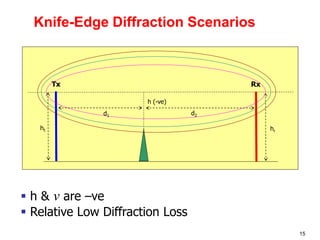
Knife-Edge Diffraction Scenarios
ht hr
Tx Rx
d1 d2
h (-ve)
 h & ν are –ve
 Relative Low Diffraction Loss
16
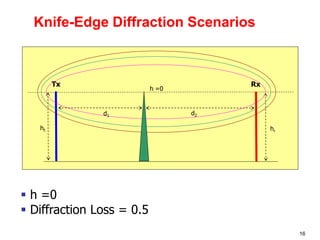
ht hr
Tx Rx
d1 d2
h =0
Knife-Edge Diffraction Scenarios
 h =0
 Diffraction Loss = 0.5
17
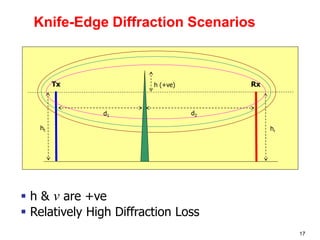
Knife-Edge Diffraction Scenarios
ht hr
Tx Rx
d1 d2
h (+ve)
 h & ν are +ve
 Relatively High Diffraction Loss
18
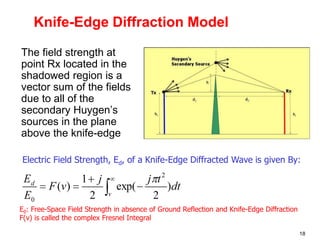
Knife-Edge Diffraction Model
The field strength at
point Rx located in the
shadowed region is a
vector sum of the fields
due to all of the
secondary Huygen’s
sources in the plane
above the knife-edge
Electric Field Strength, Ed, of a Knife-Edge Diffracted Wave is given By:
E0: Free-Space Field Strength in absence of Ground Reflection and Knife-Edge Diffraction
F(ν) is called the complex Fresnel Integral
19
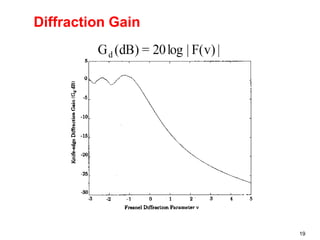
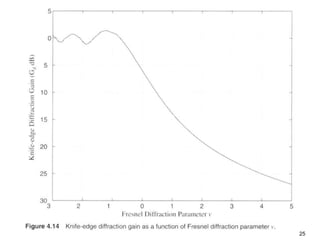
Diffraction Gain
20
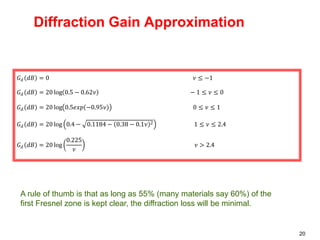
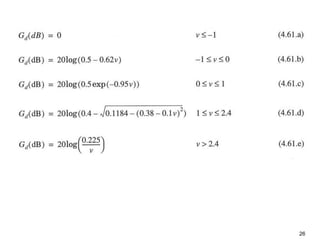
Diffraction Gain Approximation
𝐺𝑑 𝑑𝐵 = 0 𝜈 ≤ −1
𝐺𝑑 𝑑𝐵 = 20 log 0.5 − 0.62𝜈 − 1 ≤ 𝜈 ≤ 0
𝐺𝑑 𝑑𝐵 = 20 log 0.5𝑒𝑥𝑝 −0.95𝜈 0 ≤ 𝜈 ≤ 1
𝐺𝑑 𝑑𝐵 = 20 log 0.4 − 0.1184 − 0.38 − 0.1𝜈 2 1 ≤ 𝜈 ≤ 2.4
𝐺𝑑 𝑑𝐵 = 20 log
0.225
𝜈
𝜈 > 2.4
A rule of thumb is that as long as 55% (many materials say 60%) of the
first Fresnel zone is kept clear, the diffraction loss will be minimal.
21
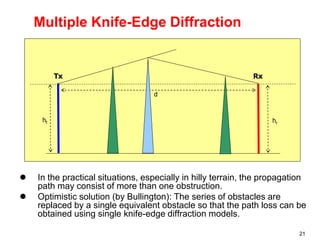
Multiple Knife-Edge Diffraction
ht hr
Tx Rx
d
 In the practical situations, especially in hilly terrain, the propagation
path may consist of more than one obstruction.
 Optimistic solution (by Bullington): The series of obstacles are
replaced by a single equivalent obstacle so that the path loss can be
obtained using single knife-edge diffraction models.
22
23
24
25
26

Diffraction.ppt

  • 1.
  • 2.
  • 3.
    3 Diffraction Diffraction allows radiosignals to propagate behind obstacles between a transmitter and a receiver ht hr
  • 4.
    4 Huygen’s Principle &Diffraction All points on a wavefront can be considered as point sources for the production of secondary wavelets. These wavelets combine to produce a new wavefront in the direction of propagation.
  • 5.
    5 Knife-Edge Diffraction Geometry hthr d1 d2 hobs h Tx Rx α β γ Δ: Excess Path Length (Difference between Diffracted Path and Direct Path) h h d h d h d d d d d d d d d d h x h d d where x for x d d 2 2 2 2 2 2 1 2 1 2 1 2 1 2 1 2 2 1 2 1 2 1 2 1 1 , 1 1 1 2 2                                       < <
  • 6.
    6 Ф: Phase Differencebetween Diffracted Path and Direct Path) d d h d d 2 1 2 1 2 2 2 2                  Assume h d d h h d d d d 1 2 1 2 1 2 tan tan                     d d d d h d d d d 1 2 1 2 1 2 1 2 2 2         Fresnel Zone Diffraction Parameter (ν) Fresnel Zone Diffraction Parameter (ν) 2 2       ν2=2, 6, 10 … corresponds to destructive interference between direct and diffracted paths  ν2=4, 8, 12 … corresponds to constructive interference between direct and diffracted paths
  • 7.
    7 Fresnel Zones From “WirelessCommunications: Principles and Practice” T.S. Rappaport Fresnel Zones: Successive regions where secondary waves have a path length from the transmitter to receiver which is nλ/2 greater than the total path length of a line-of-sight path     n n d d r n d d n r d d d d 2 1 2 1 2 1 2 1 2 2 2          rn: Radius of the nth Fresnel Zone
  • 8.
    8 Diffraction Loss Diffraction Lossoccurs from the blockage of secondary waves such that only a portion of the energy is diffracted around the obstacle ht hr Tx Rx l1 l2 d First Fresnel Zone Points  l1+l2-d =(λ/2)
  • 9.
    9 Diffraction Loss Diffraction Lossoccurs from the blockage of secondary waves such that only a portion of the energy is diffracted around the obstacle ht hr Tx Rx l1 l2 d First Fresnel Zone Points  l1+l2-d =(λ/2)
  • 10.
    10 Diffraction Loss Diffraction Lossoccurs from the blockage of secondary waves such that only a portion of the energy is diffracted around the obstacle ht hr Tx Rx l1 l2 d First Fresnel Zone Points  l1+l2-d =(λ/2)
  • 11.
    11 Diffraction Loss Diffraction Lossoccurs from the blockage of secondary waves such that only a portion of the energy is diffracted around the obstacle ht hr Tx Rx l1 l2 d First Fresnel Zone Points  l1+l2-d =(λ/2)
  • 12.
    12 Diffraction Loss Diffraction Lossoccurs from the blockage of secondary waves such that only a portion of the energy is diffracted around the obstacle ht hr Tx Rx l1 l2 d First Fresnel Zone Points  l1+l2-d =(λ/2)
  • 13.
    13 Diffraction Loss Diffraction Lossoccurs from the blockage of secondary waves such that only a portion of the energy is diffracted around the obstacle ht hr Tx Rx l1 l2 d Second Fresnel Zone Points  l1+l2-d = λ
  • 14.
    14 Diffraction Loss Diffraction Lossoccurs from the blockage of secondary waves such that only a portion of the energy is diffracted around the obstacle ht hr Tx Rx l1 l2 d Third Fresnel Zone Points  l1+l2-d = (3λ/2)
  • 15.
    15 Knife-Edge Diffraction Scenarios hthr Tx Rx d1 d2 h (-ve)  h & ν are –ve  Relative Low Diffraction Loss
  • 16.
    16 ht hr Tx Rx d1d2 h =0 Knife-Edge Diffraction Scenarios  h =0  Diffraction Loss = 0.5
  • 17.
    17 Knife-Edge Diffraction Scenarios hthr Tx Rx d1 d2 h (+ve)  h & ν are +ve  Relatively High Diffraction Loss
  • 18.
    18 Knife-Edge Diffraction Model Thefield strength at point Rx located in the shadowed region is a vector sum of the fields due to all of the secondary Huygen’s sources in the plane above the knife-edge Electric Field Strength, Ed, of a Knife-Edge Diffracted Wave is given By: E0: Free-Space Field Strength in absence of Ground Reflection and Knife-Edge Diffraction F(ν) is called the complex Fresnel Integral
  • 19.
  • 20.
    20 Diffraction Gain Approximation 𝐺𝑑𝑑𝐵 = 0 𝜈 ≤ −1 𝐺𝑑 𝑑𝐵 = 20 log 0.5 − 0.62𝜈 − 1 ≤ 𝜈 ≤ 0 𝐺𝑑 𝑑𝐵 = 20 log 0.5𝑒𝑥𝑝 −0.95𝜈 0 ≤ 𝜈 ≤ 1 𝐺𝑑 𝑑𝐵 = 20 log 0.4 − 0.1184 − 0.38 − 0.1𝜈 2 1 ≤ 𝜈 ≤ 2.4 𝐺𝑑 𝑑𝐵 = 20 log 0.225 𝜈 𝜈 > 2.4 A rule of thumb is that as long as 55% (many materials say 60%) of the first Fresnel zone is kept clear, the diffraction loss will be minimal.
  • 21.
    21 Multiple Knife-Edge Diffraction hthr Tx Rx d  In the practical situations, especially in hilly terrain, the propagation path may consist of more than one obstruction.  Optimistic solution (by Bullington): The series of obstacles are replaced by a single equivalent obstacle so that the path loss can be obtained using single knife-edge diffraction models.
  • 22.
  • 23.
  • 24.
  • 25.
  • 26.