a. BASICS OF ANTENNA
MODULE 3
INTRODUCTION
 An antenna is used to radiate electromagnetic energy
efficiently and in desired directions.
 Antennas act as matching systems between sources
of electromagnetic energy and space.
 Antenna is a source or radiator of Electromagnetic
waves or a sensor of Electromagnetic waves.
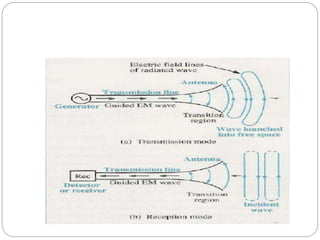
 It is a transition device or transducer between a
guided wave and a free space wave or vice versa.
 It is also an electrical conductor or system of
conductors that radiates EM energy into or collects
EM energy from free space.
 Antennas function by transmitting or receiving
electromagnetic (EM) waves.
BASIC ANTENNA
PARAMETERS
 A radio antenna may be defined as the structure
associated with the region of transition between a
guided wave and a free space wave or vice
versa.
 The basic principle of radiation is produced by
accelerated charge.
 The basic equation of radiation is I L = Q V (Ams-
1)
where, I = Time changing current in Amps/sec
L = Length of the current element in meters
Q = Charge in Coulombs
V = Time changing velocity
PATTERNS
 The radiation pattern or antenna pattern is the
graphical representation of the radiation properties of
the antenna as a function of space. That is, the
antenna's pattern describes how the antenna radiates
energy out into space (or how it receives energy).
 It is important to state that an antenna can radiate
energy in all directions, so the antenna pattern is
actually three-dimensional.
 It is common, however, to describe this 3D pattern
with two planar patterns, called the principal plane
patterns.
 These principal plane patterns can be obtained by
making two slices through the 3D pattern, through the
maximum value of the pattern.
 It is these principal plane patterns that are commonly
referred to as the antenna patterns.
 Radiation pattern or Antenna pattern is defined as
the spatial distribution of a ‘quantity’ that
characterizes the EM field generated by an
antenna.
 The ‘quantity’ may be Power, Radiation Intensity,
Field amplitude, Relative Phase etc
 Always the radiation has Main lobe through which
radiation is maximum in the z direction and Minor lobe
(side and back lobes) in the x and y direction.
 Any field pattern is presented by 3D spherical
coordinates or by plane cuts through main lobe axis.
Two plane cuts as right angles are called as principal
plane pattern.
 To specify the radiation pattern with respect to field
intensity and polarization requires three patterns:
i. The θ component of the electric field as a function of the
angles θ and Φ or Eθ(θ,Φ) in Vm-1.
ii. The Φ component of the electric field as a function of
the angles θ and Φ or EΦ(θ,Φ) in Vm-1.
iii. The phases of these fields as a function of the angles
θ and Φ or δθ(θ,Φ) and δΦ(θ,Φ) in radian or degree.
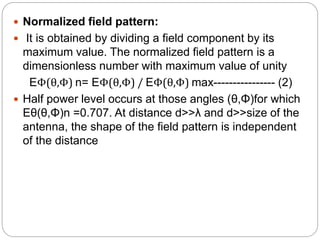
 Normalized field pattern:
 It is obtained by dividing a field component by its
maximum value. The normalized field pattern is a
dimensionless number with maximum value of unity
EΦ(θ,Φ) n= EΦ(θ,Φ) / EΦ(θ,Φ) max---------------- (2)
 Half power level occurs at those angles (θ,Φ)for which
Eθ(θ,Φ)n =0.707. At distance d>>λ and d>>size of the
antenna, the shape of the field pattern is independent
of the distance
Normalized power pattern:
 Pattern expressed in terms of power per unit area is
called power pattern. Normalizing the power with
respect to maximum value yields normalized power
patterns as a function of angle which is dimensionless
and maximum value is unity.
Pn(θ,Φ)n = S(θ,Φ)/ S(θ,Φ)max---------------- (3)
Where, S(θ,Φ) is the Poynting vector = [ Eθ^2(θ,Φ) +
EΦ^2(θ,Φ) ] / Z0 Wm-2
 S(θ,Φ)max is the maximum value of S(θ,Φ), Wm-2
 Z0 is the intrinsic impedance of free space = 376.7Ω.
 Decibel level is given by dB = 10 log10 Pn(θ,Φ)
 Half power levels occurs at those angles (θ,Φ) for
which P(θ,Φ)n =0.5.
Pattern Lobes and
Beamwidths:
 The radiation pattern characteristics involve three
dimensional vector fields for full representation,
 but the scalar quantities can be used. They are:
 1. Half power beam-width HPBW
 2. Beam Area, ΩA
 3. Bema Efficiency, εM
 4. Directivity D, Gain G
 5. Effective Aperture, Ae
 6. Radiation Intensity
 Beamwidth is associated with the lobes in the
antenna pattern.
 It is defined as the angular separation between
two identical points on the opposite sides of the
main lobe.
 The most common type of beamwidth is the half-
power (3 dB) beamwidth (HPBW). To find HPBW,
in the equation, defining the radiation pattern, we
set power equal to 0.5 and solve it for angles.
 Another frequently used measure of beamwidth is
the first-null beamwidth (FNBW), which is the
angular separation between the first nulls on
either sides of the main lobe.
 Beamwidth:
Antenna Beam-width is the measure of directivity of an
antenna. The antenna beamwidth is the angular width
expressed in degrees which is measured on the major
lobe of the radiation pattern of an antenna.
 HPBW:
The angular width on the major lobe of radiation pattern
between two points where the power is half of the
maximum radiated power is called Half Power Beam-
width. Here the power decreases to half of its maximum
value.
 FNBW:
When the angular width is measured between the first
nulls or first side lobes it is called First Null Beam Width.
The factors affecting beam width are:
1. Shape of the radiation pattern.
2. Dimensions of antenna.
 Beam width defines the resolution capability of the
antenna, i.e., the ability of the system to separate two
adjacent targets.
 The beam solid angle of an antenna is given by the integral
of the normalized power pattern over a sphere (4π
steradians).
 Beam area ΩA is the solid angle through which all of the
power radiated by antenna would stream if P(θ, Φ)
maintained its maximum value over ΩA and was zero.
 Total power radiated = P(θ, Φ) ΩA watts
 Beam area is the solid angle ΩA is often approximated in
terms of the angles subtended by the Half Power points of
the main lobe in the two principal planes(Minor lobes are
neglected)
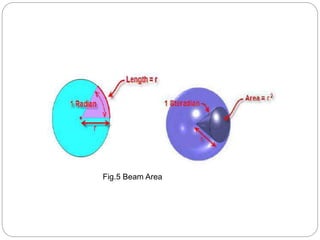
 Radian and Steredian: Radian is plane angle
with its vertex at the center of a circle of
radius r and is subtended by an arc whose
length is equal to r. Circumference of the circle is
2πr Therefore total angle of the circle is 2π
radians.
 Steredian is solid angle with its vertex at the
center of a sphere of radius r, which is
subtended by a spherical surface area equal to
the area of a square with side length r, Area of the
sphere is 4πr2.
 Therefore, the total solid angle of the sphere is
4π steredians
Fig.5 Beam Area
 1steradian = (1radian)2
= (180 / π)2
= 3282.8064 square degrees
4π steradians = 3282.8064 x 4π
= 41,253 square degree
 The infinitesimal area ds on a surface of a sphere of
radius r in spherical co-ordinates (with θ as vertical
angle and Φ as azimuth angle) is
ds = r2 sinθ dθ dΦ
 By definition of solid angle: ds = r2 dΩ
Hence,
dΩ = sinθ dθ dΦ
Radiation Intensity
 Definition: The power radiated from an Antenna
per unit solid angle is called the Radiation
Intensity.
 “U” Units: Watts/steradians or Watts/ square
degree Poynting vector or power density is
dependent on distance from the antenna while
Radiation intensity is independent of the distance
from the antenna.
 The normalized power pattern can also be
expressed as the ratio of radiation intensity as a
function of angle to its maximum value.
 Beam Efficiency Pn(θ,Φ)n = S(θ,Φ)/ S(θ,Φ)max
Beam Efficiency
 The total beam area ΩA consists of the main
beam area ΩM plus the minor lobe area Ωm .
ΩA = ΩM + Ωm
 The ratio of main beam area to the total beam
area is called the beam efficiency εM
εM = ΩM / ΩA
 The ratio of minor lobe area to the total beam
area is called stray factor εm
εm = Ωm / ΩA
Directivity D and Gain G
 From the field point of view, the most important quantitative
information on the antenna is the directivity, which is a
measure of the concentration of radiated power in a
particular direction.
 It is defined as the ratio of the radiation intensity in a given
direction from the antenna to the radiation intensity
averaged over all directions.
 The average radiation intensity is equal to the total
radiated power divided by 4π.
 If the direction is not specified, the direction of maximum
radiation is implied.
 Mathematically, the directivity (dimensionless) can be
written as
D=U (θ ,φ)max/ U (θ ,φ)avg
The directivity is a dimensionless quantity. The maximum
directivity is always ≥ 1.
Directivity and Beam area
 Directivity is the ratio of total solid angle of the
sphere to beam solid angle. For antennas with
rotationally symmetric lobes, the directivity D can
be approximated as:
D = 4π / θ Φ
 Directivity of isotropic antenna is equal to unity,
for an isotropic antenna Beam area ΩA=4π
 Directivity indicates how well an antenna radiates
in a particular direction in comparison with an
isotropic antenna radiating same amount of
power Smaller the beam area, larger is the
directivity
Gain
 Any physical Antenna has losses associated with it.
Depending on structure both ohmic and dielectric
losses can be present. Input power Pin is the sum of
the Radiated power Prad and losses Ploss .
Pin=Prad + Ploss
 The Gain G of an Antenna is an actual or realized
quantity which is less than Directivity D due to ohmic
losses in the antenna.
 The ratio of Gain to Directivity is the Antenna
efficiency factor k (dimensionless)
𝐺 = 𝐾𝐷, 𝑤ℎ𝑒𝑟𝑒 0 ≤ 𝐾 ≤1
 Directivity and Gain: Directivity and Gain of an
antenna represent the ability to focus it’s beam in a
particular direction. Directivity is a parameter
dependent only on the shape of radiation pattern
Effective Aperture
 Aperture Concept: Aperture of an Antenna is the
area through which the power is radiated or
received. Concept of Apertures is most simply
introduced by considering a Receiving Antenna.
 Let receiving antenna be a rectangular Horn
immersed in the field of uniform plane wave as
shown
 Let the Poynting vector or power density of the plane
wave be S watts/sq –m and let the area or physical
aperture be Ap sq-m.
 But the Field response of Horn is not uniform across
Ap because E at sidewalls must equal zero. Thus
effective Aperture Ae of the Horn is less than Ap.
 Aperture Efficiency is as follows: εap=Ae/Ap
 Effective Aperture and Beam area: Consider an
Antenna with an effective Aperture Ae which radiates
all of it’s power in a conical pattern of beam area ΩA,
assuming uniform field Ea over the aperture, power
radiated is
Fig: Effective Aperture
 Assuming a uniform field Er in far field at a
distance r. Power radiated is also given by
P=Er^2/Z0 r2 ΩA
 Equating the two and noting that Er = Ea Ae/r λ
we get Aperture Beam Area relation
Λ2 = Ae ΩA
 At a Given wavelength if effective aperture is
known, Beam Area can be determined or vice
versa
Effective height
 The effective height is another parameter related
to the apertures. Multiplying the effective
height,he(meters), times the magnitude of the
incident electric field E (V/m) yields the voltage V
induced.
 Thus V=he E or he= V/ E (m). Effective height
provides an indication as to how much of the
antenna is involved in radiating (or receiving. To
demonstrate this, consider the current
distributions a dipole antenna for two different
lengths.
For an antenna of radiation resistance Rr matched to it’d load ,
power delivered to load is
𝑃 = 𝑉^2/4𝑟 and
voltage is given by V=heE
Therefore, P=(heE)2/(4Rr)
In terms of Effective aperture the same power is given by
P=SAe= (E^2/z0 )Ae
 Equating the two,
Bandwidth or frequency bandwidth:
Antenna characteristics, which should conform to certain
requirements, might be: input impedance, radiation pattern,
beamwidth, polarization, side-lobe level, gain, beam direction and
width, radiation efficiency. Separate bandwidths may be introduced:
impedance bandwidth, pattern bandwidth, etc.
 The FBW of broadband antennas is expressed as the
ratio of the upper to the lower frequencies, where the
antenna performance is acceptable. Based on
Bandwidth antennas can be classified as
1. Broad band antennas-BW expressed as ratio of
upper to lower frequencies of acceptable operation
 eg: 10:1 BW means fH is 10 times greater than fL
2. Narrow band antennas-BW is expressed as
percentage of frequency difference over center
frequency eg:5% means (fH –fL) /fo is .05. Bandwidth
can be considered to be the range of frequencies on
either sides of a center frequency (usually resonant
freq. for a dipole)
 The FBW of broadband antennas is expressed as
the ratio of the upper to the lower frequencies,
where the antenna performance is acceptable
𝐹𝐵𝑊 =𝑓𝑚𝑎𝑥/𝑓𝑚𝑖𝑛
Radiation Efficiency
 Total antenna resistance is the sum of 5
components
Rr+Rg+Ri+Rc+Rw
Where, Rr is Radiation resistance
Rg is ground resistance
Ri is equivalent insulation loss
Rc is resistance of tuning inductance
Rw is resistance equivalent of conductor loss
Radiation efficiency=Rr/( Rr+Rg+Ri+Rc+Rw). It is
the ratio of power radiated from the antenna to
the total power supplied to the antenna
Antenna temperature
 The antenna noise can be divided into two types
according to its physical source:
- noise due to the loss resistance of the antenna
itself; and
- noise, which the antenna picks up from the
surrounding environment The noise power per
unit bandwidth is proportional to the object’s
temperature and is given by Nyquist’s relation
 where
 TP is the physical temperature of the object in K
(Kelvin degrees); and k is
 Boltzmann’s constant (1.38x10⁻²³ J/K
 A resistor is a thermal noise source. The noise
voltage (rms value) generated by a resistor R,
kept at a temperature T, is given by
 The receiver also has a temperature TR
associated with it and the total system noise
temperature (i.e., Antenna +Receiver) has
combined temperature given b
And total noise power in the system is
THE RADIO COMMUNICATION
LINK
 The usefulness of the aperture concept is well
illustrated by using it to derive the important Friis
transmission formula published in 1946 by Harald
T. Friis (1) of the Bell Telephone Laboratory.
Fig: Radio communication link
 the formula gives the power received over a radio
communi- cation link.
 Assuming lossless, matched antennas, let the
transmitter feed a power Pt to a transmitting
antenna of effective aperture Aet . At a distance r
a receiving antenna of effective aperture Aer
intercepts
 some of the power radiated by the transmitting
antenna and delivers it to the receiver R.
Assuming for the moment that the transmitting
antenna is isotropic, the power per unit area
available at the receiving antenna is
𝑆𝑟 =𝑃𝑡/4𝜋𝑟2
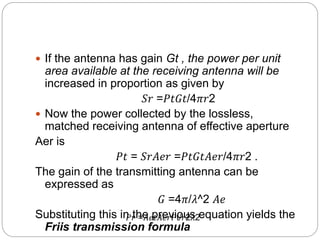
 If the antenna has gain Gt , the power per unit
area available at the receiving antenna will be
increased in proportion as given by
𝑆𝑟 =𝑃𝑡𝐺𝑡/4𝜋𝑟2
 Now the power collected by the lossless,
matched receiving antenna of effective aperture
Aer is
𝑃𝑡 = 𝑆𝑟𝐴𝑒𝑟 =𝑃𝑡𝐺𝑡𝐴𝑒𝑟/4𝜋𝑟2 .
The gain of the transmitting antenna can be
expressed as
𝐺 =4𝜋/𝜆^2 𝐴𝑒
Substituting this in the previous equation yields the
Friis transmission formula
𝑃𝑟 =𝐴𝑒𝑡𝐴𝑒𝑟𝑃t/𝑟2𝜆2
ANTENNA FIELD ZONES
 The fields around an antenna may be divided into
two principal regions, one near the antenna called
the near field or Fresnel zone and one at a large
distance called the far field or Fraunhofer zone.
Referring to, the boundary between the two may
be arbitrarily taken to be at a radius
 R=2L^2/λ
L = maximum dimension of the antenna, m
λ = wavelength, m
 In the far or Fraunhofer region, the measurable
field components are transverse to the ra- dial
direction from the antenna and all power flow is
directed radially outward.
 In the far field the shape of the field pattern is
independent of the distance.
 In the near or Fresnel region, the longitudinal
component of the electric field may be significant
and power flow is not entirely radial.
 In the near field, the shape of the field pattern
depends, in general, on the distance.
Fig 9. Antenna field
zones
 Enclosing the antenna in an imaginary boundary
sphere as in Fig. 9 it is as though the region near the
poles of the sphere acts as a reflector.
 On the other hand, the waves expanding
perpendicular to the dipole in the equatorial region of
the sphere result in power leakage through the sphere
as if partially transparent in this region.
 This results in reciprocating (oscillating) energy flow
near the antenna accompanied by outward flow in the
equatorial region.
 The outflow accounts for the power radiated from the
antenna, while the reciprocating energy represents
reactive power that is trapped near the antenna like in
a resonator
 The term power flow is sometimes used, it is
actually energy which flows, power being the time
rate of energy flow. A similar loose usage occurs
when we say we pay a power bill, when, in fact, we
are actually paying for electric energy.
 Near Field (Fresnel’s Region)
Power flow is not entirely radiated.
Shape of field pattern is dependent of radial
distance.
There is an energy reciprocating b/n antenna and
space.
Reactive energy.
 Far field (Fraunhofer’s region)
Real power flow is directed radially outwork.
Shape of the field pattern is independent of
distance.

MODULE 3.pptx

  • 1.
    a. BASICS OFANTENNA MODULE 3
  • 2.
    INTRODUCTION  An antennais used to radiate electromagnetic energy efficiently and in desired directions.  Antennas act as matching systems between sources of electromagnetic energy and space.  Antenna is a source or radiator of Electromagnetic waves or a sensor of Electromagnetic waves.  It is a transition device or transducer between a guided wave and a free space wave or vice versa.  It is also an electrical conductor or system of conductors that radiates EM energy into or collects EM energy from free space.  Antennas function by transmitting or receiving electromagnetic (EM) waves.
  • 3.
    BASIC ANTENNA PARAMETERS  Aradio antenna may be defined as the structure associated with the region of transition between a guided wave and a free space wave or vice versa.  The basic principle of radiation is produced by accelerated charge.  The basic equation of radiation is I L = Q V (Ams- 1) where, I = Time changing current in Amps/sec L = Length of the current element in meters Q = Charge in Coulombs V = Time changing velocity
  • 5.
    PATTERNS  The radiationpattern or antenna pattern is the graphical representation of the radiation properties of the antenna as a function of space. That is, the antenna's pattern describes how the antenna radiates energy out into space (or how it receives energy).  It is important to state that an antenna can radiate energy in all directions, so the antenna pattern is actually three-dimensional.  It is common, however, to describe this 3D pattern with two planar patterns, called the principal plane patterns.  These principal plane patterns can be obtained by making two slices through the 3D pattern, through the maximum value of the pattern.  It is these principal plane patterns that are commonly referred to as the antenna patterns.
  • 6.
     Radiation patternor Antenna pattern is defined as the spatial distribution of a ‘quantity’ that characterizes the EM field generated by an antenna.  The ‘quantity’ may be Power, Radiation Intensity, Field amplitude, Relative Phase etc
  • 7.
     Always theradiation has Main lobe through which radiation is maximum in the z direction and Minor lobe (side and back lobes) in the x and y direction.  Any field pattern is presented by 3D spherical coordinates or by plane cuts through main lobe axis. Two plane cuts as right angles are called as principal plane pattern.  To specify the radiation pattern with respect to field intensity and polarization requires three patterns: i. The θ component of the electric field as a function of the angles θ and Φ or Eθ(θ,Φ) in Vm-1. ii. The Φ component of the electric field as a function of the angles θ and Φ or EΦ(θ,Φ) in Vm-1. iii. The phases of these fields as a function of the angles θ and Φ or δθ(θ,Φ) and δΦ(θ,Φ) in radian or degree.
  • 8.
     Normalized fieldpattern:  It is obtained by dividing a field component by its maximum value. The normalized field pattern is a dimensionless number with maximum value of unity EΦ(θ,Φ) n= EΦ(θ,Φ) / EΦ(θ,Φ) max---------------- (2)  Half power level occurs at those angles (θ,Φ)for which Eθ(θ,Φ)n =0.707. At distance d>>λ and d>>size of the antenna, the shape of the field pattern is independent of the distance
  • 9.
    Normalized power pattern: Pattern expressed in terms of power per unit area is called power pattern. Normalizing the power with respect to maximum value yields normalized power patterns as a function of angle which is dimensionless and maximum value is unity. Pn(θ,Φ)n = S(θ,Φ)/ S(θ,Φ)max---------------- (3) Where, S(θ,Φ) is the Poynting vector = [ Eθ^2(θ,Φ) + EΦ^2(θ,Φ) ] / Z0 Wm-2  S(θ,Φ)max is the maximum value of S(θ,Φ), Wm-2  Z0 is the intrinsic impedance of free space = 376.7Ω.  Decibel level is given by dB = 10 log10 Pn(θ,Φ)  Half power levels occurs at those angles (θ,Φ) for which P(θ,Φ)n =0.5.
  • 10.
    Pattern Lobes and Beamwidths: The radiation pattern characteristics involve three dimensional vector fields for full representation,  but the scalar quantities can be used. They are:  1. Half power beam-width HPBW  2. Beam Area, ΩA  3. Bema Efficiency, εM  4. Directivity D, Gain G  5. Effective Aperture, Ae  6. Radiation Intensity
  • 12.
     Beamwidth isassociated with the lobes in the antenna pattern.  It is defined as the angular separation between two identical points on the opposite sides of the main lobe.  The most common type of beamwidth is the half- power (3 dB) beamwidth (HPBW). To find HPBW, in the equation, defining the radiation pattern, we set power equal to 0.5 and solve it for angles.  Another frequently used measure of beamwidth is the first-null beamwidth (FNBW), which is the angular separation between the first nulls on either sides of the main lobe.
  • 14.
     Beamwidth: Antenna Beam-widthis the measure of directivity of an antenna. The antenna beamwidth is the angular width expressed in degrees which is measured on the major lobe of the radiation pattern of an antenna.  HPBW: The angular width on the major lobe of radiation pattern between two points where the power is half of the maximum radiated power is called Half Power Beam- width. Here the power decreases to half of its maximum value.  FNBW: When the angular width is measured between the first nulls or first side lobes it is called First Null Beam Width. The factors affecting beam width are: 1. Shape of the radiation pattern. 2. Dimensions of antenna.
  • 15.
     Beam widthdefines the resolution capability of the antenna, i.e., the ability of the system to separate two adjacent targets.  The beam solid angle of an antenna is given by the integral of the normalized power pattern over a sphere (4π steradians).  Beam area ΩA is the solid angle through which all of the power radiated by antenna would stream if P(θ, Φ) maintained its maximum value over ΩA and was zero.  Total power radiated = P(θ, Φ) ΩA watts  Beam area is the solid angle ΩA is often approximated in terms of the angles subtended by the Half Power points of the main lobe in the two principal planes(Minor lobes are neglected)
  • 16.
     Radian andSteredian: Radian is plane angle with its vertex at the center of a circle of radius r and is subtended by an arc whose length is equal to r. Circumference of the circle is 2πr Therefore total angle of the circle is 2π radians.  Steredian is solid angle with its vertex at the center of a sphere of radius r, which is subtended by a spherical surface area equal to the area of a square with side length r, Area of the sphere is 4πr2.  Therefore, the total solid angle of the sphere is 4π steredians
  • 17.
  • 18.
     1steradian =(1radian)2 = (180 / π)2 = 3282.8064 square degrees 4π steradians = 3282.8064 x 4π = 41,253 square degree  The infinitesimal area ds on a surface of a sphere of radius r in spherical co-ordinates (with θ as vertical angle and Φ as azimuth angle) is ds = r2 sinθ dθ dΦ  By definition of solid angle: ds = r2 dΩ Hence, dΩ = sinθ dθ dΦ
  • 19.
    Radiation Intensity  Definition:The power radiated from an Antenna per unit solid angle is called the Radiation Intensity.  “U” Units: Watts/steradians or Watts/ square degree Poynting vector or power density is dependent on distance from the antenna while Radiation intensity is independent of the distance from the antenna.  The normalized power pattern can also be expressed as the ratio of radiation intensity as a function of angle to its maximum value.  Beam Efficiency Pn(θ,Φ)n = S(θ,Φ)/ S(θ,Φ)max
  • 20.
    Beam Efficiency  Thetotal beam area ΩA consists of the main beam area ΩM plus the minor lobe area Ωm . ΩA = ΩM + Ωm  The ratio of main beam area to the total beam area is called the beam efficiency εM εM = ΩM / ΩA  The ratio of minor lobe area to the total beam area is called stray factor εm εm = Ωm / ΩA
  • 21.
    Directivity D andGain G  From the field point of view, the most important quantitative information on the antenna is the directivity, which is a measure of the concentration of radiated power in a particular direction.  It is defined as the ratio of the radiation intensity in a given direction from the antenna to the radiation intensity averaged over all directions.  The average radiation intensity is equal to the total radiated power divided by 4π.  If the direction is not specified, the direction of maximum radiation is implied.  Mathematically, the directivity (dimensionless) can be written as D=U (θ ,φ)max/ U (θ ,φ)avg The directivity is a dimensionless quantity. The maximum directivity is always ≥ 1.
  • 22.
  • 23.
     Directivity isthe ratio of total solid angle of the sphere to beam solid angle. For antennas with rotationally symmetric lobes, the directivity D can be approximated as: D = 4π / θ Φ  Directivity of isotropic antenna is equal to unity, for an isotropic antenna Beam area ΩA=4π  Directivity indicates how well an antenna radiates in a particular direction in comparison with an isotropic antenna radiating same amount of power Smaller the beam area, larger is the directivity
  • 24.
    Gain  Any physicalAntenna has losses associated with it. Depending on structure both ohmic and dielectric losses can be present. Input power Pin is the sum of the Radiated power Prad and losses Ploss . Pin=Prad + Ploss  The Gain G of an Antenna is an actual or realized quantity which is less than Directivity D due to ohmic losses in the antenna.  The ratio of Gain to Directivity is the Antenna efficiency factor k (dimensionless) 𝐺 = 𝐾𝐷, 𝑤ℎ𝑒𝑟𝑒 0 ≤ 𝐾 ≤1  Directivity and Gain: Directivity and Gain of an antenna represent the ability to focus it’s beam in a particular direction. Directivity is a parameter dependent only on the shape of radiation pattern
  • 25.
    Effective Aperture  ApertureConcept: Aperture of an Antenna is the area through which the power is radiated or received. Concept of Apertures is most simply introduced by considering a Receiving Antenna.  Let receiving antenna be a rectangular Horn immersed in the field of uniform plane wave as shown
  • 26.
     Let thePoynting vector or power density of the plane wave be S watts/sq –m and let the area or physical aperture be Ap sq-m.  But the Field response of Horn is not uniform across Ap because E at sidewalls must equal zero. Thus effective Aperture Ae of the Horn is less than Ap.  Aperture Efficiency is as follows: εap=Ae/Ap  Effective Aperture and Beam area: Consider an Antenna with an effective Aperture Ae which radiates all of it’s power in a conical pattern of beam area ΩA, assuming uniform field Ea over the aperture, power radiated is
  • 27.
  • 28.
     Assuming auniform field Er in far field at a distance r. Power radiated is also given by P=Er^2/Z0 r2 ΩA  Equating the two and noting that Er = Ea Ae/r λ we get Aperture Beam Area relation Λ2 = Ae ΩA  At a Given wavelength if effective aperture is known, Beam Area can be determined or vice versa
  • 29.
    Effective height  Theeffective height is another parameter related to the apertures. Multiplying the effective height,he(meters), times the magnitude of the incident electric field E (V/m) yields the voltage V induced.  Thus V=he E or he= V/ E (m). Effective height provides an indication as to how much of the antenna is involved in radiating (or receiving. To demonstrate this, consider the current distributions a dipole antenna for two different lengths.
  • 30.
    For an antennaof radiation resistance Rr matched to it’d load , power delivered to load is 𝑃 = 𝑉^2/4𝑟 and voltage is given by V=heE Therefore, P=(heE)2/(4Rr) In terms of Effective aperture the same power is given by P=SAe= (E^2/z0 )Ae
  • 31.
     Equating thetwo, Bandwidth or frequency bandwidth: Antenna characteristics, which should conform to certain requirements, might be: input impedance, radiation pattern, beamwidth, polarization, side-lobe level, gain, beam direction and width, radiation efficiency. Separate bandwidths may be introduced: impedance bandwidth, pattern bandwidth, etc.
  • 32.
     The FBWof broadband antennas is expressed as the ratio of the upper to the lower frequencies, where the antenna performance is acceptable. Based on Bandwidth antennas can be classified as 1. Broad band antennas-BW expressed as ratio of upper to lower frequencies of acceptable operation  eg: 10:1 BW means fH is 10 times greater than fL 2. Narrow band antennas-BW is expressed as percentage of frequency difference over center frequency eg:5% means (fH –fL) /fo is .05. Bandwidth can be considered to be the range of frequencies on either sides of a center frequency (usually resonant freq. for a dipole)
  • 33.
     The FBWof broadband antennas is expressed as the ratio of the upper to the lower frequencies, where the antenna performance is acceptable 𝐹𝐵𝑊 =𝑓𝑚𝑎𝑥/𝑓𝑚𝑖𝑛
  • 34.
    Radiation Efficiency  Totalantenna resistance is the sum of 5 components Rr+Rg+Ri+Rc+Rw Where, Rr is Radiation resistance Rg is ground resistance Ri is equivalent insulation loss Rc is resistance of tuning inductance Rw is resistance equivalent of conductor loss Radiation efficiency=Rr/( Rr+Rg+Ri+Rc+Rw). It is the ratio of power radiated from the antenna to the total power supplied to the antenna
  • 35.
    Antenna temperature  Theantenna noise can be divided into two types according to its physical source: - noise due to the loss resistance of the antenna itself; and - noise, which the antenna picks up from the surrounding environment The noise power per unit bandwidth is proportional to the object’s temperature and is given by Nyquist’s relation
  • 36.
     where  TPis the physical temperature of the object in K (Kelvin degrees); and k is  Boltzmann’s constant (1.38x10⁻²³ J/K  A resistor is a thermal noise source. The noise voltage (rms value) generated by a resistor R, kept at a temperature T, is given by
  • 38.
     The receiveralso has a temperature TR associated with it and the total system noise temperature (i.e., Antenna +Receiver) has combined temperature given b And total noise power in the system is
  • 39.
    THE RADIO COMMUNICATION LINK The usefulness of the aperture concept is well illustrated by using it to derive the important Friis transmission formula published in 1946 by Harald T. Friis (1) of the Bell Telephone Laboratory. Fig: Radio communication link
  • 40.
     the formulagives the power received over a radio communi- cation link.  Assuming lossless, matched antennas, let the transmitter feed a power Pt to a transmitting antenna of effective aperture Aet . At a distance r a receiving antenna of effective aperture Aer intercepts  some of the power radiated by the transmitting antenna and delivers it to the receiver R. Assuming for the moment that the transmitting antenna is isotropic, the power per unit area available at the receiving antenna is 𝑆𝑟 =𝑃𝑡/4𝜋𝑟2
  • 41.
     If theantenna has gain Gt , the power per unit area available at the receiving antenna will be increased in proportion as given by 𝑆𝑟 =𝑃𝑡𝐺𝑡/4𝜋𝑟2  Now the power collected by the lossless, matched receiving antenna of effective aperture Aer is 𝑃𝑡 = 𝑆𝑟𝐴𝑒𝑟 =𝑃𝑡𝐺𝑡𝐴𝑒𝑟/4𝜋𝑟2 . The gain of the transmitting antenna can be expressed as 𝐺 =4𝜋/𝜆^2 𝐴𝑒 Substituting this in the previous equation yields the Friis transmission formula 𝑃𝑟 =𝐴𝑒𝑡𝐴𝑒𝑟𝑃t/𝑟2𝜆2
  • 42.
    ANTENNA FIELD ZONES The fields around an antenna may be divided into two principal regions, one near the antenna called the near field or Fresnel zone and one at a large distance called the far field or Fraunhofer zone. Referring to, the boundary between the two may be arbitrarily taken to be at a radius  R=2L^2/λ L = maximum dimension of the antenna, m λ = wavelength, m
  • 43.
     In thefar or Fraunhofer region, the measurable field components are transverse to the ra- dial direction from the antenna and all power flow is directed radially outward.  In the far field the shape of the field pattern is independent of the distance.  In the near or Fresnel region, the longitudinal component of the electric field may be significant and power flow is not entirely radial.  In the near field, the shape of the field pattern depends, in general, on the distance.
  • 44.
    Fig 9. Antennafield zones
  • 45.
     Enclosing theantenna in an imaginary boundary sphere as in Fig. 9 it is as though the region near the poles of the sphere acts as a reflector.  On the other hand, the waves expanding perpendicular to the dipole in the equatorial region of the sphere result in power leakage through the sphere as if partially transparent in this region.  This results in reciprocating (oscillating) energy flow near the antenna accompanied by outward flow in the equatorial region.  The outflow accounts for the power radiated from the antenna, while the reciprocating energy represents reactive power that is trapped near the antenna like in a resonator
  • 46.
     The termpower flow is sometimes used, it is actually energy which flows, power being the time rate of energy flow. A similar loose usage occurs when we say we pay a power bill, when, in fact, we are actually paying for electric energy.  Near Field (Fresnel’s Region) Power flow is not entirely radiated. Shape of field pattern is dependent of radial distance. There is an energy reciprocating b/n antenna and space. Reactive energy.  Far field (Fraunhofer’s region) Real power flow is directed radially outwork. Shape of the field pattern is independent of distance.