ANTENNAS AND WAVE PROPAGATION
ANTENNA:
 An antenna is a specialized transducer that
converts radio-frequency (RF) fields into
alternating current (AC) or vice-versa.
 An antenna is a device for sending or
receiving electromagnetic waves
Antenna parameters:
• Radiation pattern
• Efficiency
• Bandwidth
• Directivity
• Gain
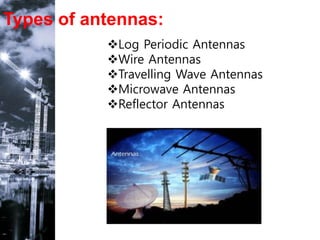
Types of antennas:
Log Periodic Antennas
Wire Antennas
Travelling Wave Antennas
Microwave Antennas
Reflector Antennas
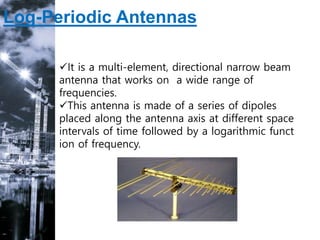
Log-Periodic Antennas
It is a multi-element, directional narrow beam
antenna that works on a wide range of
frequencies.
This antenna is made of a series of dipoles
placed along the antenna axis at different space
intervals of time followed by a logarithmic funct
ion of frequency.
Types of log period antennas
Bow-Tie Antennas
Log-Periodic Dipole Array
Bow-Tie Antennas
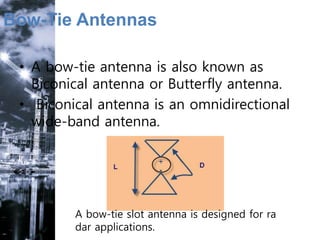
• A bow-tie antenna is also known as
Biconical antenna or Butterfly antenna.
• Biconical antenna is an omnidirectional
wide-band antenna.
A bow-tie slot antenna is designed for ra
dar applications.
Log-Periodic Dipole Array
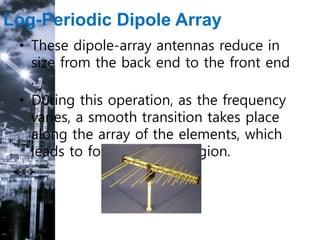
• These dipole-array antennas reduce in
size from the back end to the front end
.
• During this operation, as the frequency
varies, a smooth transition takes place
along the array of the elements, which
leads to form an active region.
2. Wire Antennas
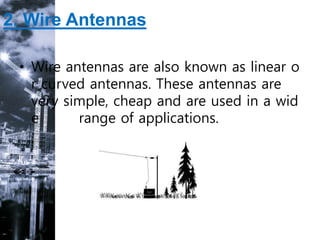
• Wire antennas are also known as linear o
r curved antennas. These antennas are
very simple, cheap and are used in a wid
e range of applications.
• These antennas are
further subdivided into four types
Short Dipole Antenna
Dipole Antenna
Monopole Antenna
Loop Antenna
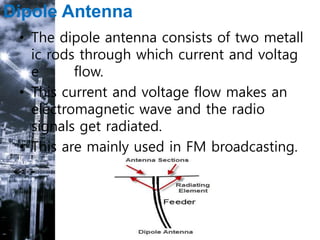
Dipole Antenna
• The dipole antenna consists of two metall
ic rods through which current and voltag
e flow.
• This current and voltage flow makes an
electromagnetic wave and the radio
signals get radiated.
• This are mainly used in FM broadcasting.
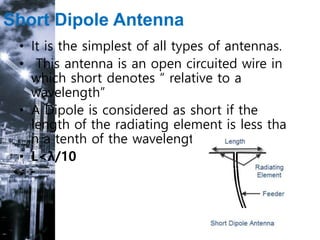
Short Dipole Antenna
• It is the simplest of all types of antennas.
• This antenna is an open circuited wire in
which short denotes “ relative to a
wavelength”
• A Dipole is considered as short if the
length of the radiating element is less tha
n a tenth of the wavelength.
• L<λ/10
•
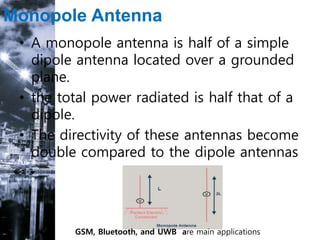
Monopole Antenna
• A monopole antenna is half of a simple
dipole antenna located over a grounded
plane.
• the total power radiated is half that of a
dipole.
• The directivity of these antennas become
double compared to the dipole antennas
.
GSM, Bluetooth, and UWB are main applications
Loop Antenna
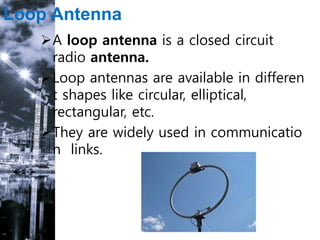
A loop antenna is a closed circuit
radio antenna.
Loop antennas are available in differen
t shapes like circular, elliptical,
rectangular, etc.
They are widely used in communicatio
n links.
3. Travelling Wave Antennas
• The antenna in which the standing wave
does not exist along the length of the
antenna is called traveling wave antenna.
• These antennas are of two types
1. Helical Antennas
2. Yagi-Uda Antennas
Helical Antennas
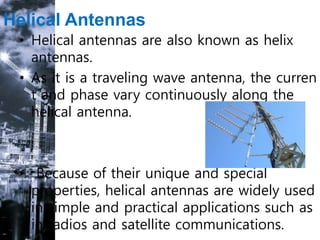
• Helical antennas are also known as helix
antennas.
• As it is a traveling wave antenna, the curren
t and phase vary continuously along the
helical antenna.
• Because of their unique and special
properties, helical antennas are widely used
in simple and practical applications such as
in radios and satellite communications.
Yagi-Uda Antennas
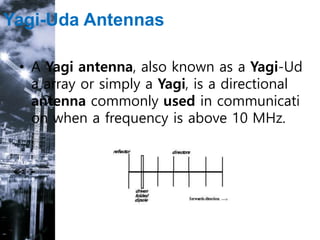
• A Yagi antenna, also known as a Yagi-Ud
a array or simply a Yagi, is a directional
antenna commonly used in communicati
on when a frequency is above 10 MHz.
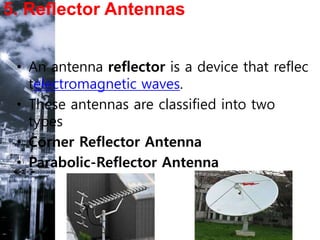
4. Microwave Antennas
• The antennas operating at microwave
frequencies are known as microwave
antennas.
• These antennas are used in a wide range
of applications.
• These antennas are classified into two
types
• Rectangular Micro strip Antennas
• Planar Inverted-F Antennas
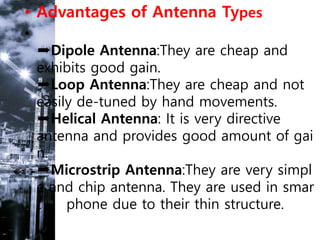
5. Reflector Antennas
• An antenna reflector is a device that reflec
telectromagnetic waves.
• These antennas are classified into two
types
• Corner Reflector Antenna
• Parabolic-Reflector Antenna
• Advantages of Antenna Types
•
➨Dipole Antenna:They are cheap and
exhibits good gain.
➨Loop Antenna:They are cheap and not
easily de-tuned by hand movements.
➨Helical Antenna: It is very directive
antenna and provides good amount of gai
n.
➨Microstrip Antenna:They are very simpl
e and chip antenna. They are used in smar
t phone due to their thin structure.
ANTENNA APPLICATIONS
• They are used in Radio Astronomy.
• antenna is used to cure breast cancer.
• Antennas can be extremely small. iPhone
has several antennas all built into that
small case.
• Mobile satellite communication
• Used in GPS tracking
• Antennas are also used in Remote
sensing and in defense radar.
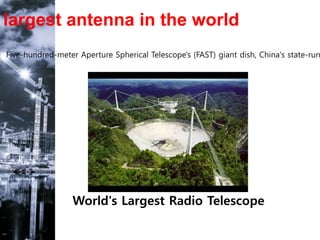
largest antenna in the world
World's Largest Radio Telescope
Five-hundred-meter Aperture Spherical Telescope's (FAST) giant dish, China's state-run
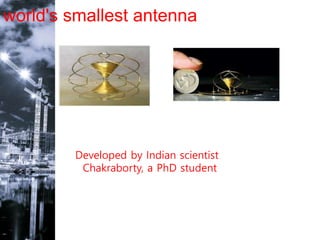
world's smallest antenna
Developed by Indian scientist
Chakraborty, a PhD student
Antennas and their types

Antennas and their types

  • 1.
    ANTENNAS AND WAVEPROPAGATION
  • 2.
    ANTENNA:  An antennais a specialized transducer that converts radio-frequency (RF) fields into alternating current (AC) or vice-versa.  An antenna is a device for sending or receiving electromagnetic waves
  • 3.
    Antenna parameters: • Radiationpattern • Efficiency • Bandwidth • Directivity • Gain
  • 4.
    Types of antennas: LogPeriodic Antennas Wire Antennas Travelling Wave Antennas Microwave Antennas Reflector Antennas
  • 5.
    Log-Periodic Antennas It isa multi-element, directional narrow beam antenna that works on a wide range of frequencies. This antenna is made of a series of dipoles placed along the antenna axis at different space intervals of time followed by a logarithmic funct ion of frequency.
  • 6.
    Types of logperiod antennas Bow-Tie Antennas Log-Periodic Dipole Array
  • 7.
    Bow-Tie Antennas • Abow-tie antenna is also known as Biconical antenna or Butterfly antenna. • Biconical antenna is an omnidirectional wide-band antenna. A bow-tie slot antenna is designed for ra dar applications.
  • 8.
    Log-Periodic Dipole Array •These dipole-array antennas reduce in size from the back end to the front end . • During this operation, as the frequency varies, a smooth transition takes place along the array of the elements, which leads to form an active region.
  • 9.
    2. Wire Antennas •Wire antennas are also known as linear o r curved antennas. These antennas are very simple, cheap and are used in a wid e range of applications.
  • 10.
    • These antennasare further subdivided into four types Short Dipole Antenna Dipole Antenna Monopole Antenna Loop Antenna
  • 11.
    Dipole Antenna • Thedipole antenna consists of two metall ic rods through which current and voltag e flow. • This current and voltage flow makes an electromagnetic wave and the radio signals get radiated. • This are mainly used in FM broadcasting.
  • 12.
    Short Dipole Antenna •It is the simplest of all types of antennas. • This antenna is an open circuited wire in which short denotes “ relative to a wavelength” • A Dipole is considered as short if the length of the radiating element is less tha n a tenth of the wavelength. • L<λ/10 •
  • 13.
    Monopole Antenna • Amonopole antenna is half of a simple dipole antenna located over a grounded plane. • the total power radiated is half that of a dipole. • The directivity of these antennas become double compared to the dipole antennas . GSM, Bluetooth, and UWB are main applications
  • 14.
    Loop Antenna A loopantenna is a closed circuit radio antenna. Loop antennas are available in differen t shapes like circular, elliptical, rectangular, etc. They are widely used in communicatio n links.
  • 15.
    3. Travelling WaveAntennas • The antenna in which the standing wave does not exist along the length of the antenna is called traveling wave antenna. • These antennas are of two types 1. Helical Antennas 2. Yagi-Uda Antennas
  • 16.
    Helical Antennas • Helicalantennas are also known as helix antennas. • As it is a traveling wave antenna, the curren t and phase vary continuously along the helical antenna. • Because of their unique and special properties, helical antennas are widely used in simple and practical applications such as in radios and satellite communications.
  • 17.
    Yagi-Uda Antennas • AYagi antenna, also known as a Yagi-Ud a array or simply a Yagi, is a directional antenna commonly used in communicati on when a frequency is above 10 MHz.
  • 18.
    4. Microwave Antennas •The antennas operating at microwave frequencies are known as microwave antennas. • These antennas are used in a wide range of applications. • These antennas are classified into two types • Rectangular Micro strip Antennas • Planar Inverted-F Antennas
  • 19.
    5. Reflector Antennas •An antenna reflector is a device that reflec telectromagnetic waves. • These antennas are classified into two types • Corner Reflector Antenna • Parabolic-Reflector Antenna
  • 20.
    • Advantages ofAntenna Types • ➨Dipole Antenna:They are cheap and exhibits good gain. ➨Loop Antenna:They are cheap and not easily de-tuned by hand movements. ➨Helical Antenna: It is very directive antenna and provides good amount of gai n. ➨Microstrip Antenna:They are very simpl e and chip antenna. They are used in smar t phone due to their thin structure.
  • 21.
    ANTENNA APPLICATIONS • Theyare used in Radio Astronomy. • antenna is used to cure breast cancer. • Antennas can be extremely small. iPhone has several antennas all built into that small case. • Mobile satellite communication • Used in GPS tracking • Antennas are also used in Remote sensing and in defense radar.
  • 22.
    largest antenna inthe world World's Largest Radio Telescope Five-hundred-meter Aperture Spherical Telescope's (FAST) giant dish, China's state-run
  • 23.
    world's smallest antenna Developedby Indian scientist Chakraborty, a PhD student

Editor's Notes