CHAPTER 5
MICROWAVE ANTENNA
MICROWAVE ANTENNA
Definition
A conductor or group of conductors used either for
radiating electromagnetic energy into space or
for collecting it from space.
or
Is a structure which may be described as a metallic
object, often a wire or a collection of wires
through specific design capable of converting high
frequency current into EM wave and transmit it
into free space at light velocity with high power
(kW) besides receiving EM wave from free space
and convert it into high frequency current at much
lower power (mW).
Basic operation of transmit and
receive antennas
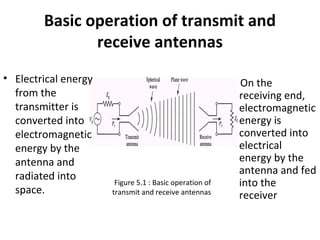
• Electrical energy
from the
transmitter is
converted into
electromagnetic
energy by the
antenna and
radiated into
space.

Figure 5.1 : Basic operation of
transmit and receive antennas

On the
receiving end,
electromagnetic
energy is
converted into
electrical
energy by the
antenna and fed
into the
receiver
Basic operation of transmit and
receive antennas (cont)
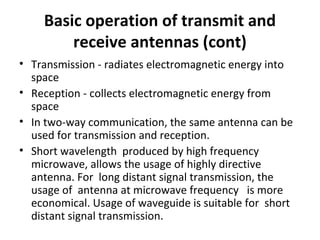
• Transmission - radiates electromagnetic energy into
space
• Reception - collects electromagnetic energy from
space
• In two-way communication, the same antenna can be
used for transmission and reception.
• Short wavelength produced by high frequency
microwave, allows the usage of highly directive
antenna. For long distant signal transmission, the
usage of antenna at microwave frequency is more
economical. Usage of waveguide is suitable for short
distant signal transmission.
FUNCTION OF ANTENNA
•
•
•

•
•

•

Transmit energy with high efficiency .
Receive energy as low as mW.
Provide matching between transmitter and free space and between
free space and receiver, thus maximum power transfer is achieve
besides preventing the occurrence of reflection.
Directs radiation toward and suppresses radiation
Two common features exist at the antenna Tx and Rx antenna is the
radiation pattern and impedance, but it is different in terms of
transmission power and reception power.
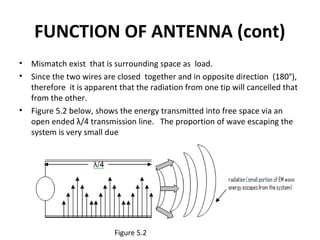
Figure 5.2 below, shows the energy transmitted into free space via an
open ended λ/4 transmission line. The proportion of wave escaping
the system is very small due
FUNCTION OF ANTENNA (cont)
•
•

•

Mismatch exist that is surrounding space as load.
Since the two wires are closed together and in opposite direction (180°),
therefore it is apparent that the radiation from one tip will cancelled that
from the other.
Figure 5.2 below, shows the energy transmitted into free space via an
open ended λ/4 transmission line. The proportion of wave escaping the
system is very small due

Figure 5.2
TYPES OF MICROWAVE ANTENNA
A.
B.
C.
D.
E.
F.
G.

Horn / aperture antenna
Parabolic / dish antenna
Dipole antenna
Slotted (leaky-wave) antenna
Dielectric lens antenna
Printed (patch or microstrip) antenna
Phase Array antenna
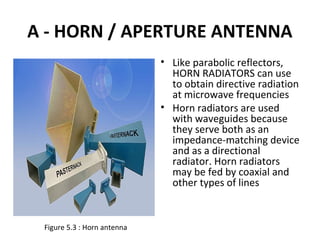
A - HORN / APERTURE ANTENNA
• Like parabolic reflectors,
HORN RADIATORS can use
to obtain directive radiation
at microwave frequencies
• Horn radiators are used
with waveguides because
they serve both as an
impedance-matching device
and as a directional
radiator. Horn radiators
may be fed by coaxial and
other types of lines

Figure 5.3 : Horn antenna
Horn Antenna
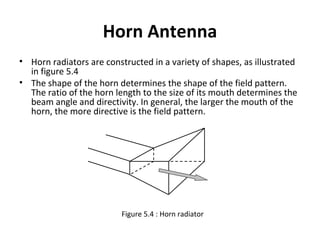
• Horn radiators are constructed in a variety of shapes, as illustrated
in figure 5.4
• The shape of the horn determines the shape of the field pattern.
The ratio of the horn length to the size of its mouth determines the
beam angle and directivity. In general, the larger the mouth of the
horn, the more directive is the field pattern.

Figure 5.4 : Horn radiator
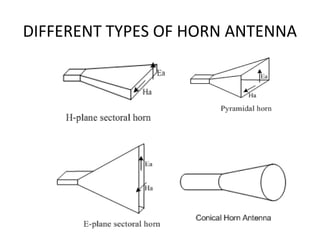
DIFFERENT TYPES OF HORN ANTENNA
THREE TYPES OF HORN ANTENNA
• Horn antenna tapered / flared in one
dimension only i.e in E-plane or H-plane
(known as sectoral horn).
• Horn antenna tapered / flared in two
dimension i.e in E-plane and H-plane (known
as pyramidal horn).
• Conical taper / flares uniformly in all direction
i.e in circular form.
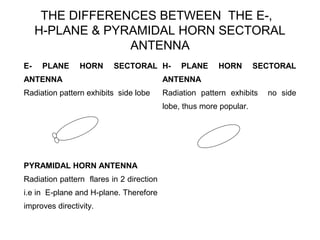
THE DIFFERENCES BETWEEN THE E-,
H-PLANE & PYRAMIDAL HORN SECTORAL
ANTENNA
E-

PLANE

HORN

SECTORAL H-

PLANE

HORN

SECTORAL

ANTENNA

ANTENNA

Radiation pattern exhibits side lobe

Radiation pattern exhibits
lobe, thus more popular.

PYRAMIDAL HORN ANTENNA
Radiation pattern flares in 2 direction
i.e in E-plane and H-plane. Therefore
improves directivity.

no side
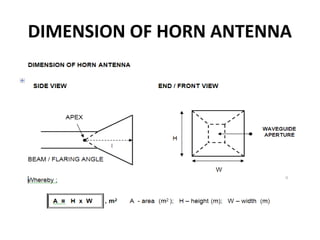
DIMENSION OF HORN ANTENNA
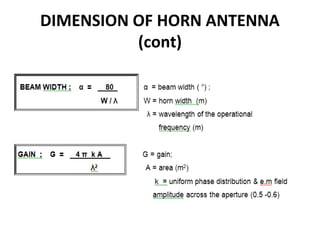
(cont)
B- PARABOLIC (REFLECTOR / DISH)
ANTENNA
• Is a big dish like structure made from metal or
wire mesh / grid.
• Mesh hole ≤ λ / 12.
• Widely used in microwave propagation via free
space.
• Also known as secondary antenna since it
depends on primary antenna which acts as a
feeder at the focal point (horn antenna or dipole
antenna) to enhance the performance quality of
the transmitter and the receiver
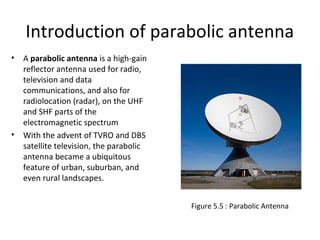
Introduction of parabolic antenna
•

•

A parabolic antenna is a high-gain
reflector antenna used for radio,
television and data
communications, and also for
radiolocation (radar), on the UHF
and SHF parts of the
electromagnetic spectrum
With the advent of TVRO and DBS
satellite television, the parabolic
antenna became a ubiquitous
feature of urban, suburban, and
even rural landscapes.
Figure 5.5 : Parabolic Antenna
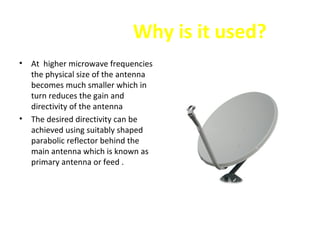
Why is it used?
•

•

At higher microwave frequencies
the physical size of the antenna
becomes much smaller which in
turn reduces the gain and
directivity of the antenna
The desired directivity can be
achieved using suitably shaped
parabolic reflector behind the
main antenna which is known as
primary antenna or feed .
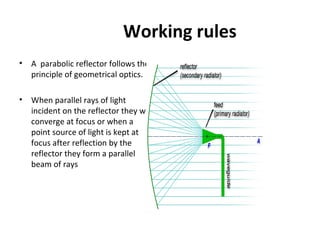
Working rules
•

A parabolic reflector follows the
principle of geometrical optics.

•

When parallel rays of light
incident on the reflector they will
converge at focus or when a
point source of light is kept at
focus after reflection by the
reflector they form a parallel
beam of rays
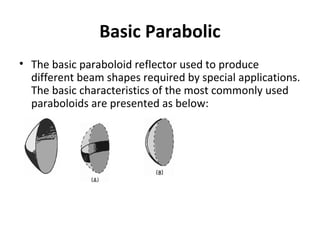
Basic Parabolic
• The basic paraboloid reflector used to produce
different beam shapes required by special applications.
The basic characteristics of the most commonly used
paraboloids are presented as below:
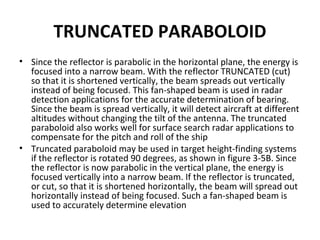
TRUNCATED PARABOLOID
• Since the reflector is parabolic in the horizontal plane, the energy is
focused into a narrow beam. With the reflector TRUNCATED (cut)
so that it is shortened vertically, the beam spreads out vertically
instead of being focused. This fan-shaped beam is used in radar
detection applications for the accurate determination of bearing.
Since the beam is spread vertically, it will detect aircraft at different
altitudes without changing the tilt of the antenna. The truncated
paraboloid also works well for surface search radar applications to
compensate for the pitch and roll of the ship
• Truncated paraboloid may be used in target height-finding systems
if the reflector is rotated 90 degrees, as shown in figure 3-5B. Since
the reflector is now parabolic in the vertical plane, the energy is
focused vertically into a narrow beam. If the reflector is truncated,
or cut, so that it is shortened horizontally, the beam will spread out
horizontally instead of being focused. Such a fan-shaped beam is
used to accurately determine elevation
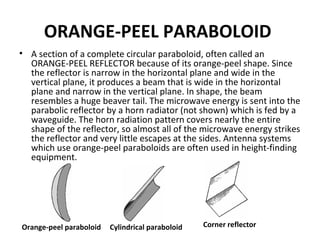
ORANGE-PEEL PARABOLOID
• A section of a complete circular paraboloid, often called an
ORANGE-PEEL REFLECTOR because of its orange-peel shape. Since
the reflector is narrow in the horizontal plane and wide in the
vertical plane, it produces a beam that is wide in the horizontal
plane and narrow in the vertical plane. In shape, the beam
resembles a huge beaver tail. The microwave energy is sent into the
parabolic reflector by a horn radiator (not shown) which is fed by a
waveguide. The horn radiation pattern covers nearly the entire
shape of the reflector, so almost all of the microwave energy strikes
the reflector and very little escapes at the sides. Antenna systems
which use orange-peel paraboloids are often used in height-finding
equipment.

Orange-peel paraboloid

Cylindrical paraboloid

Corner reflector
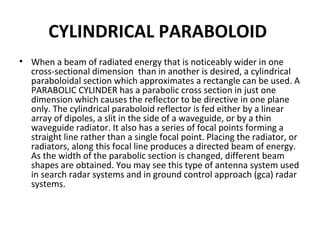
CYLINDRICAL PARABOLOID
• When a beam of radiated energy that is noticeably wider in one
cross-sectional dimension than in another is desired, a cylindrical
paraboloidal section which approximates a rectangle can be used. A
PARABOLIC CYLINDER has a parabolic cross section in just one
dimension which causes the reflector to be directive in one plane
only. The cylindrical paraboloid reflector is fed either by a linear
array of dipoles, a slit in the side of a waveguide, or by a thin
waveguide radiator. It also has a series of focal points forming a
straight line rather than a single focal point. Placing the radiator, or
radiators, along this focal line produces a directed beam of energy.
As the width of the parabolic section is changed, different beam
shapes are obtained. You may see this type of antenna system used
in search radar systems and in ground control approach (gca) radar
systems.
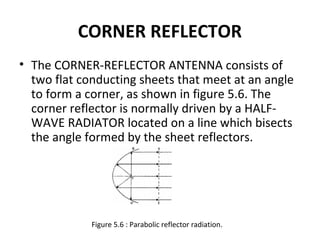
CORNER REFLECTOR
• The CORNER-REFLECTOR ANTENNA consists of
two flat conducting sheets that meet at an angle
to form a corner, as shown in figure 5.6. The
corner reflector is normally driven by a HALFWAVE RADIATOR located on a line which bisects
the angle formed by the sheet reflectors.

Figure 5.6 : Parabolic reflector radiation.
CORNER REFLECTOR (cont)

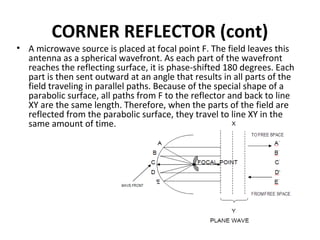
• A microwave source is placed at focal point F. The field leaves this
antenna as a spherical wavefront. As each part of the wavefront
reaches the reflecting surface, it is phase-shifted 180 degrees. Each
part is then sent outward at an angle that results in all parts of the
field traveling in parallel paths. Because of the special shape of a
parabolic surface, all paths from F to the reflector and back to line
XY are the same length. Therefore, when the parts of the field are
reflected from the parabolic surface, they travel to line XY in the
same amount of time.
CORNER REFLECTOR (cont)
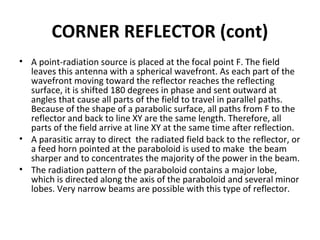
• A point-radiation source is placed at the focal point F. The field
leaves this antenna with a spherical wavefront. As each part of the
wavefront moving toward the reflector reaches the reflecting
surface, it is shifted 180 degrees in phase and sent outward at
angles that cause all parts of the field to travel in parallel paths.
Because of the shape of a parabolic surface, all paths from F to the
reflector and back to line XY are the same length. Therefore, all
parts of the field arrive at line XY at the same time after reflection.
• A parasitic array to direct the radiated field back to the reflector, or
a feed horn pointed at the paraboloid is used to make the beam
sharper and to concentrates the majority of the power in the beam.
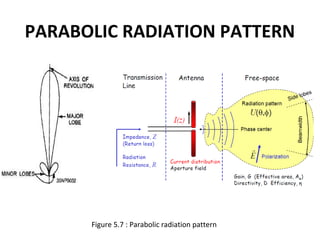
• The radiation pattern of the paraboloid contains a major lobe,
which is directed along the axis of the paraboloid and several minor
lobes. Very narrow beams are possible with this type of reflector.
PARABOLIC RADIATION PATTERN

Figure 5.7 : Parabolic radiation pattern
PARABOLIC (REFLECTOR / DISH)
ANTENNA as TRANSMITTER
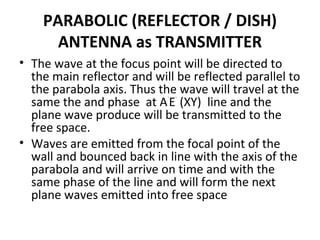
• The wave at the focus point will be directed to
the main reflector and will be reflected parallel to
the parabola axis. Thus the wave will travel at the
same the and phase at A`E` (XY) line and the
plane wave produce will be transmitted to the
free space.
• Waves are emitted from the focal point of the
wall and bounced back in line with the axis of the
parabola and will arrive on time and with the
same phase of the line and will form the next
plane waves emitted into free space
PARABOLIC (REFLECTOR / DISH)
ANTENNA as RECEIVER
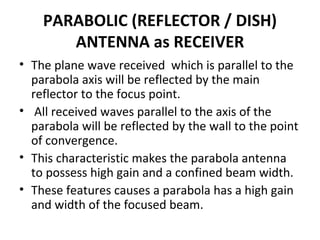
• The plane wave received which is parallel to the
parabola axis will be reflected by the main
reflector to the focus point.
• All received waves parallel to the axis of the
parabola will be reflected by the wall to the point
of convergence.
• This characteristic makes the parabola antenna
to possess high gain and a confined beam width.
• These features causes a parabola has a high gain
and width of the focused beam.
C- SLOTTED (LEAKY-WAVE) ANTENNA

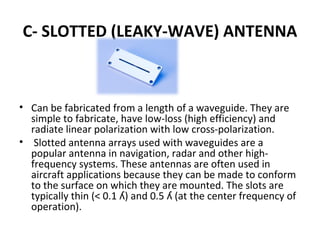
• Can be fabricated from a length of a waveguide. They are
simple to fabricate, have low-loss (high efficiency) and
radiate linear polarization with low cross-polarization.
• Slotted antenna arrays used with waveguides are a
popular antenna in navigation, radar and other highfrequency systems. These antennas are often used in
aircraft applications because they can be made to conform
to the surface on which they are mounted. The slots are
typically thin (< 0.1 ʎ) and 0.5 ʎ (at the center frequency of
operation).
SLOT ANTENNA
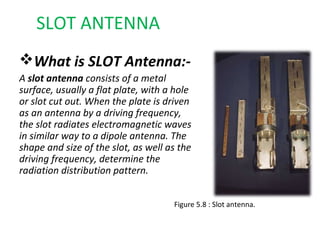
What is SLOT Antenna:A slot antenna consists of a metal
surface, usually a flat plate, with a hole
or slot cut out. When the plate is driven
as an antenna by a driving frequency,
the slot radiates electromagnetic waves
in similar way to a dipole antenna. The
shape and size of the slot, as well as the
driving frequency, determine the
radiation distribution pattern.
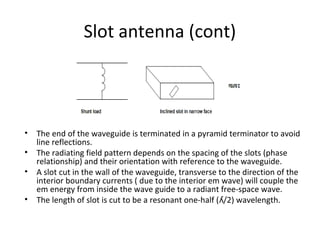
Figure 5.8 : Slot antenna.
SLOTTED (LEAKY-WAVE) ANTENNA
(CONT)
• The slots on the waveguide will assumed to have a narrow
width. Increasing the width increases the bandwidth (recall
that a fatter antenna often has an increased bandwidth);
the expense of a larger width is a higher degree of crosspolarization. The Fractional Bandwidth for thin slots can be
as low as 3-5%; wide slots can have a FBW on the order of
75%.
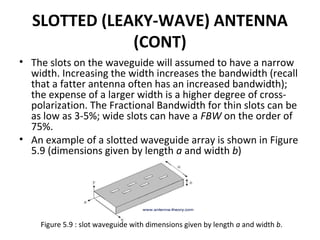
• An example of a slotted waveguide array is shown in Figure
5.9 (dimensions given by length a and width b)

Figure 5.9 : slot waveguide with dimensions given by length a and width b.
SLOTTED (LEAKY-WAVE) ANTENNA
(CONT)
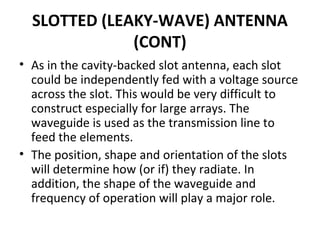
• As in the cavity-backed slot antenna, each slot
could be independently fed with a voltage source
across the slot. This would be very difficult to
construct especially for large arrays. The
waveguide is used as the transmission line to
feed the elements.
• The position, shape and orientation of the slots
will determine how (or if) they radiate. In
addition, the shape of the waveguide and
frequency of operation will play a major role.
Slot antenna (cont)
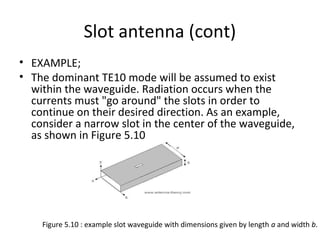
• EXAMPLE;
• The dominant TE10 mode will be assumed to exist
within the waveguide. Radiation occurs when the
currents must "go around" the slots in order to
continue on their desired direction. As an example,
consider a narrow slot in the center of the waveguide,
as shown in Figure 5.10

Figure 5.10 : example slot waveguide with dimensions given by length a and width b.
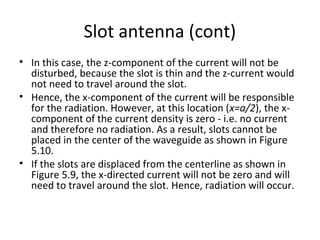
Slot antenna (cont)
• In this case, the z-component of the current will not be
disturbed, because the slot is thin and the z-current would
not need to travel around the slot.
• Hence, the x-component of the current will be responsible
for the radiation. However, at this location (x=a/2), the xcomponent of the current density is zero - i.e. no current
and therefore no radiation. As a result, slots cannot be
placed in the center of the waveguide as shown in Figure
5.10.
• If the slots are displaced from the centerline as shown in
Figure 5.9, the x-directed current will not be zero and will
need to travel around the slot. Hence, radiation will occur.
Slot antenna (cont)
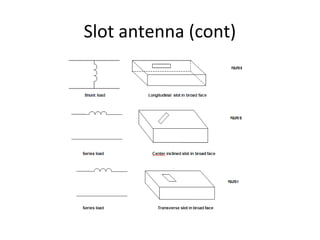
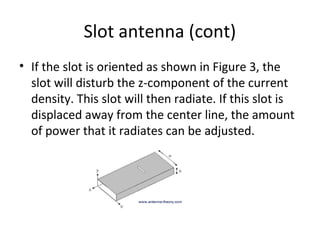
• If the slot is oriented as shown in Figure 3, the
slot will disturb the z-component of the current
density. This slot will then radiate. If this slot is
displaced away from the center line, the amount
of power that it radiates can be adjusted.
Slot antenna (cont)
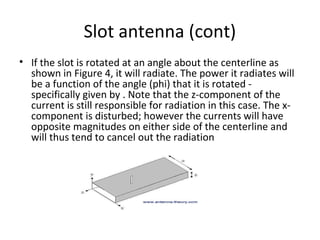
• If the slot is rotated at an angle about the centerline as
shown in Figure 4, it will radiate. The power it radiates will
be a function of the angle (phi) that it is rotated specifically given by . Note that the z-component of the
current is still responsible for radiation in this case. The xcomponent is disturbed; however the currents will have
opposite magnitudes on either side of the centerline and
will thus tend to cancel out the radiation
Slot antenna (cont)
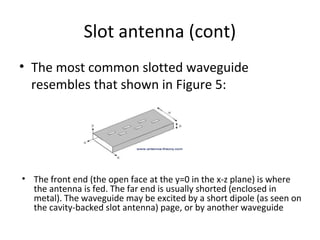
• The most common slotted waveguide
resembles that shown in Figure 5:

• The front end (the open face at the y=0 in the x-z plane) is where
the antenna is fed. The far end is usually shorted (enclosed in
metal). The waveguide may be excited by a short dipole (as seen on
the cavity-backed slot antenna) page, or by another waveguide
Slot antenna (cont)
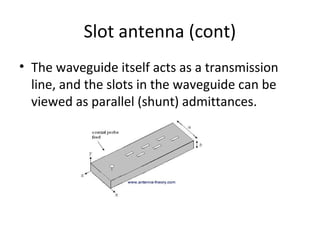
• The waveguide itself acts as a transmission
line, and the slots in the waveguide can be
viewed as parallel (shunt) admittances.
Slot antenna (cont)
Slot antenna (cont)
Slot antenna (cont)

•
•
•
•

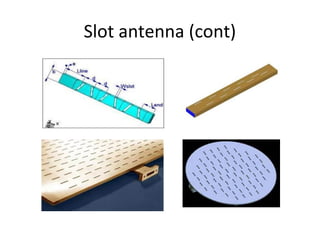
The end of the waveguide is terminated in a pyramid terminator to avoid
line reflections.
The radiating field pattern depends on the spacing of the slots (phase
relationship) and their orientation with reference to the waveguide.
A slot cut in the wall of the waveguide, transverse to the direction of the
interior boundary currents ( due to the interior em wave) will couple the
em energy from inside the wave guide to a radiant free-space wave.
The length of slot is cut to be a resonant one-half ( ʎ/2) wavelength.
D) DIPOLE ANTENNAS
TWO TYPES OF DIPOLE ANTENNAS:
•Half-wave (ʎ/2) dipole antenna (or Hertz antenna)
•Quarter-wave (ʎ /4) vertical antenna (or Marconi
antenna)
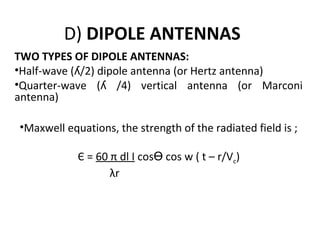
•Maxwell equations, the strength of the radiated field is ;
Є = 60 π dl I cosӨ cos w ( t – r/Vc)
λr
D) DIPOLE ANTENNAS Cont.
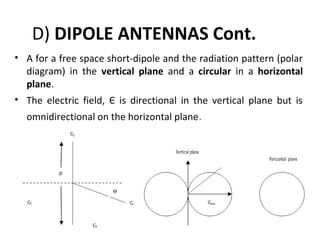
• A for a free space short-dipole and the radiation pattern (polar
diagram) in the vertical plane and a circular in a horizontal
plane.
• The electric field, Є is directional in the vertical plane but is
omnidirectional on the horizontal plane.
D) DIPOLE ANTENNAS Cont.
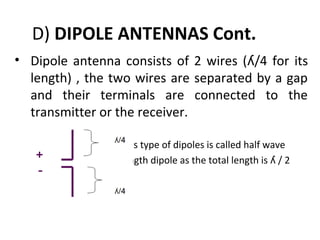
• Dipole antenna consists of 2 wires (ʎ/4 for its
length) , the two wires are separated by a gap
and their terminals are connected to the
transmitter or the receiver.
This type of dipoles is called half wave
length dipole as the total length is ʎ / 2
D) DIPOLE ANTENNAS Cont.

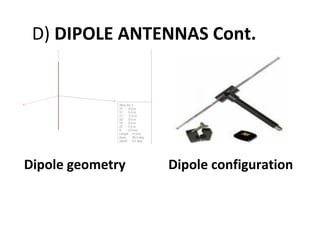
Dipole geometry

Dipole configuration
D) DIPOLE ANTENNAS Cont.
RADIATION PATTERN
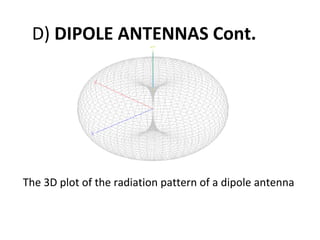
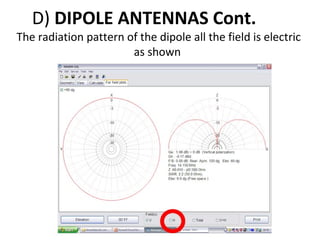
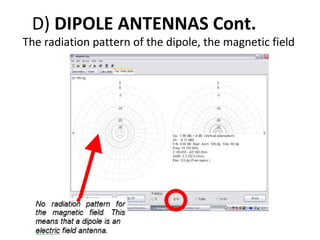
•The dipole is an electric field antenna, means
that the magnetic field is zero at the near field.
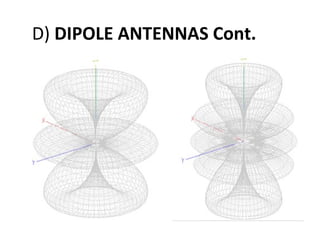
•The radiation pattern is like a donut cake with
the maximum perpendicular to the dipole, and a
null along it.
•The polarization is along the dipole.
D) DIPOLE ANTENNAS Cont.

The 3D plot of the radiation pattern of a dipole antenna
D) DIPOLE ANTENNAS Cont.
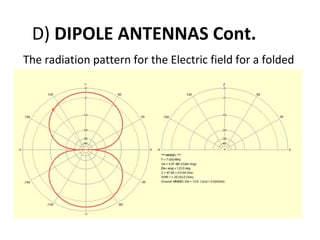
The radiation pattern for the Electric field for a folded
dipole antenna
D) DIPOLE ANTENNAS Cont.

The radiation pattern of the dipole all the field is electric
as shown
D) DIPOLE ANTENNAS Cont.

The radiation pattern of the dipole, the magnetic field
equals zero
D) DIPOLE ANTENNAS Cont.
• When the length of the dipole exceeds lambda
the radiation pattern takes a new shape due
to the appearance of the grating lobes where
the major lobes divides into multiple lobes .
D) DIPOLE ANTENNAS Cont.
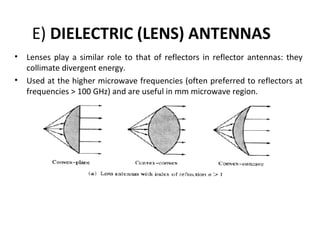
E) DIELECTRIC (LENS) ANTENNAS
•
•

Lenses play a similar role to that of reflectors in reflector antennas: they
collimate divergent energy.
Used at the higher microwave frequencies (often preferred to reflectors at
frequencies > 100 GHz) and are useful in mm microwave region.
E) DIELECTRIC (LENS) ANTENNAS cont.
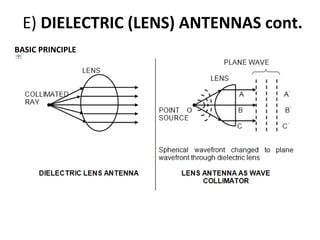
BASIC PRINCIPLE
E) DIELECTRIC (LENS) ANTENNAS cont.
• The velocity of em wave through a dielectric materal is
less than that in free space.
• The section of spherical em wave that travels through
the center (the greatest thickness) of the dielectric
material will travel most slowly compared to both end.
• The velocities of the spherical wave entering the lens
will be controlled and the curved wavefront will
become a plane wavefront with constant phase in
front of the dielectric antenna (refraction based on
Snell’s law).
E) DIELECTRIC (LENS) ANTENNAS cont.
• Are contructed from polistyrene, teflon or any denser
dielectric material to produce
large diffraction
(belauan) although its size and weight is small. The
material use will cause the wave to attenuate greatly
(losses and absortion of signal - greatest attenuation
at center – thickest lens).
• To avoid this situation, zoned and stepped dielectric
antennas are used so that the optical path can be
divided into paths differing by integral multiples of a
wavelength from one zone to another.
E) DIELECTRIC (LENS) ANTENNAS Cont.
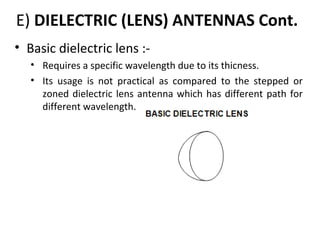
• Basic dielectric lens :• Requires a specific wavelength due to its thicness.
• Its usage is not practical as compared to the stepped or
zoned dielectric lens antenna which has different path for
different wavelength.
E) DIELECTRIC (LENS) ANTENNAS Cont.
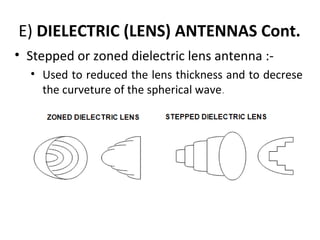
• Stepped or zoned dielectric lens antenna :• Used to reduced the lens thickness and to decrese
the curveture of the spherical wave.
•
•

•
•

F) PRINTED (MICROSTRIP OR PATCH)
ANTENNA

A patch antenna is a narrowband, wide-beam antenna.
Fabricated by etching the antenna element pattern in metal
trace bonded to an insulating dielectric substrate, such as a
printed circuit board, with a continuous metal layer bonded to
the opposite side of the substrate which forms a ground plane.
Microstrip antenna shapes :- ex : square, rectangular, circular
and elliptical
Some patch antennas do not use a dielectric substrate and
instead made of a metal patch mounted above a ground plane
using dielectric spacers; the resulting structure is less rugged
but has a wider bandwidth.
F) PRINTED (MICROSTRIP OR PATCH)
ANTENNA Cont.
•

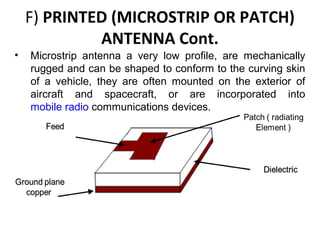
Microstrip antenna a very low profile, are mechanically
rugged and can be shaped to conform to the curving skin
of a vehicle, they are often mounted on the exterior of
aircraft and spacecraft, or are incorporated into
mobile radio communications devices.
F) PRINTED (MICROSTRIP OR PATCH)
ANTENNA Cont.
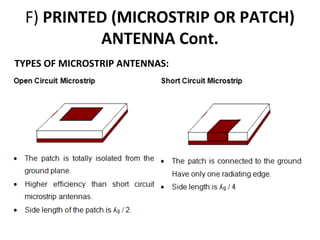
TYPES OF MICROSTRIP ANTENNAS:
F) PRINTED (MICROSTRIP OR PATCH)
ANTENNA Cont.
ADVANTAGES
•High accuracy in manufacturing , the design is executed by Photo
etching.
•Easy to integrate with other devices.
•An array of microstrip antennas can be used to form a pattern that
is difficult to synthesize using a single element.
•We can obtain high directivity using microstrip arrays.
•Have a main radiating edge , this makes it useful for mobile Phones
to avoid radiation inside the device .
•Small sized applicable for handheld portable communication.
•Smart antennas when combined with phase shifters .
F) PRINTED (MICROSTRIP OR PATCH)
ANTENNA Cont.
DISADVANTAGES
•Narrow band width ( 1% ) , while mobiles need ( 8% ).
•Low efficiency , especially for short circuited microstrip
antenna.
•Some feeding techniques like aperture and proximity coupling
are difficult to fabricate.
•An array suffers presence of feed network decreasing
efficiency , also microstrip antennas are relatively expensive.
F) PRINTED (MICROSTRIP OR PATCH)
ANTENNA Cont.
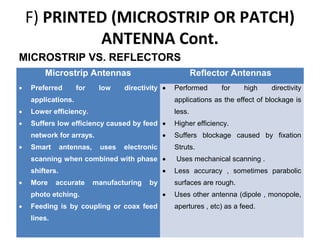
MICROSTRIP VS. REFLECTORS
Microstrip Antennas
•

Preferred

for

low

Reflector Antennas

directivity •

Performed

for

high

directivity

applications.

applications as the effect of blockage is

•

Lower efficiency.

less.

•

Suffers low efficiency caused by feed •

Higher efficiency.

•

network for arrays.
•

Smart

antennas,

uses

electronic

Struts.

scanning when combined with phase •
•

shifters.
•

More

accurate

manufacturing

by

photo etching.
•

Feeding is by coupling or coax feed
lines.

Suffers blockage caused by fixation
Uses mechanical scanning .
Less accuracy , sometimes parabolic
surfaces are rough.

•

Uses other antenna (dipole , monopole,
apertures , etc) as a feed.
G- PHASED ARRAY ANTENNA
• Is an array of antennas in which the relative phases of the
respective signals feeding the antennas are varied in such a
way that the effective radiation pattern of the array is
reinforced in a desired direction and suppressed in
undesired directions.
• Phased array transmission is use to enhance transmission
of radio waves in one direction.
• A phased array antenna is composed of lots of radiating
elements each with a phase shifter. Beams are formed by
shifting the phase of the signal emitted from each radiating
element, to provide constructive/destructive interference
so as to steer the beams in the desired direction
Phased Array Antenna (Cont)
• Areas of the antenna matrix can act as separate
antennas. This allows many antenna beam
patterns to be individually controlled at the same
time. A large,phase-steered antenna system
could be used to control the positions of many
aircraft as at larger airport.
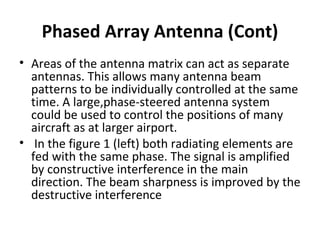
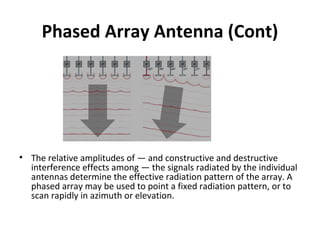
• In the figure 1 (left) both radiating elements are
fed with the same phase. The signal is amplified
by constructive interference in the main
direction. The beam sharpness is improved by the
destructive interference
Phased Array Antenna (Cont)

•

•

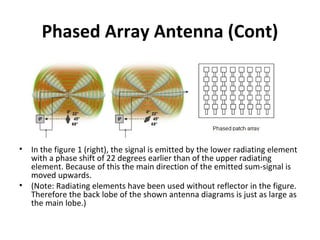
In the figure 1 (right), the signal is emitted by the lower radiating element
with a phase shift of 22 degrees earlier than of the upper radiating
element. Because of this the main direction of the emitted sum-signal is
moved upwards.
(Note: Radiating elements have been used without reflector in the figure.
Therefore the back lobe of the shown antenna diagrams is just as large as
the main lobe.)
Phased Array Antenna (Cont)
• The main beam always points in the direction of the
increasing phase shift.
• If the signal to be radiated is delivered through an
electronic phase shifter giving a continuous phase
shift, the beam direction will be electronically
adjustable. However, this cannot be extended
unlimitedly.
• The highest value, which can be achieved for the Field
of View (FOV) of a phased array antenna is 120° (60°
left and 60° right). With the sine theorem the
necessary phase moving can be calculated
Phased Array Antenna (Cont)
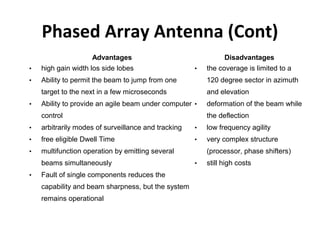
Advantages

Disadvantages

•

high gain width los side lobes

•

Ability to permit the beam to jump from one

120 degree sector in azimuth

target to the next in a few microseconds

and elevation

•

Ability to provide an agile beam under computer

•

•

control

the coverage is limited to a

deformation of the beam while
the deflection

•

arbitrarily modes of surveillance and tracking

•

low frequency agility

•

free eligible Dwell Time

•

very complex structure

•

multifunction operation by emitting several
beams simultaneously

•

Fault of single components reduces the
capability and beam sharpness, but the system
remains operational

(processor, phase shifters)
•

still high costs
Phased Array Antenna (Cont)
• CONCLUSION:
• Beamforming antenna systems improve wireless network
performance
• increase system capacity
• improve signal quality
• suppress interference and noise
• save power
• Beamforming antennas improve infrastructure networks
performance. They may improve ad hoc networks performance.
New MAC protocol standards are needed.
• Vector antennas may replace spatial arrays to further improve
beamforming performance
Phased Array Antenna (Cont)

• The relative amplitudes of — and constructive and destructive
interference effects among — the signals radiated by the individual
antennas determine the effective radiation pattern of the array. A
phased array may be used to point a fixed radiation pattern, or to
scan rapidly in azimuth or elevation.
DIFFERENT TYPES OF PHASED ARRAYS
•
•
•
•

There are two main types of beamformers:
time domain beamformers
frequency domain beamformers
A graduated attenuation window is
sometimes applied across the face of the
array to improve side-lobe suppression
performance, in addition to the phase shift.
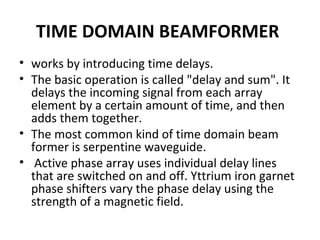
TIME DOMAIN BEAMFORMER
• works by introducing time delays.
• The basic operation is called "delay and sum". It
delays the incoming signal from each array
element by a certain amount of time, and then
adds them together.
• The most common kind of time domain beam
former is serpentine waveguide.
• Active phase array uses individual delay lines
that are switched on and off. Yttrium iron garnet
phase shifters vary the phase delay using the
strength of a magnetic field.
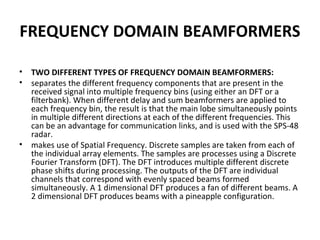
FREQUENCY DOMAIN BEAMFORMERS
•
•

•

TWO DIFFERENT TYPES OF FREQUENCY DOMAIN BEAMFORMERS:
separates the different frequency components that are present in the
received signal into multiple frequency bins (using either an DFT or a
filterbank). When different delay and sum beamformers are applied to
each frequency bin, the result is that the main lobe simultaneously points
in multiple different directions at each of the different frequencies. This
can be an advantage for communication links, and is used with the SPS-48
radar.
makes use of Spatial Frequency. Discrete samples are taken from each of
the individual array elements. The samples are processes using a Discrete
Fourier Transform (DFT). The DFT introduces multiple different discrete
phase shifts during processing. The outputs of the DFT are individual
channels that correspond with evenly spaced beams formed
simultaneously. A 1 dimensional DFT produces a fan of different beams. A
2 dimensional DFT produces beams with a pineapple configuration.
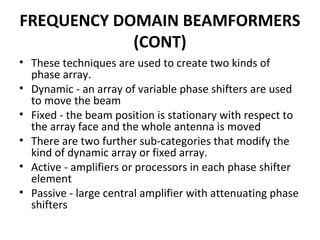
FREQUENCY DOMAIN BEAMFORMERS
(CONT)
• These techniques are used to create two kinds of
phase array.
• Dynamic - an array of variable phase shifters are used
to move the beam
• Fixed - the beam position is stationary with respect to
the array face and the whole antenna is moved
• There are two further sub-categories that modify the
kind of dynamic array or fixed array.
• Active - amplifiers or processors in each phase shifter
element
• Passive - large central amplifier with attenuating phase
shifters
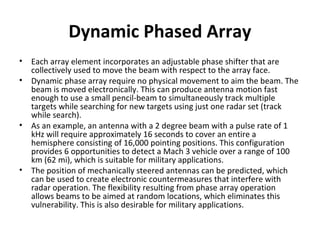
Dynamic Phased Array
•
•

•

•

Each array element incorporates an adjustable phase shifter that are
collectively used to move the beam with respect to the array face.
Dynamic phase array require no physical movement to aim the beam. The
beam is moved electronically. This can produce antenna motion fast
enough to use a small pencil-beam to simultaneously track multiple
targets while searching for new targets using just one radar set (track
while search).
As an example, an antenna with a 2 degree beam with a pulse rate of 1
kHz will require approximately 16 seconds to cover an entire a
hemisphere consisting of 16,000 pointing positions. This configuration
provides 6 opportunities to detect a Mach 3 vehicle over a range of 100
km (62 mi), which is suitable for military applications.
The position of mechanically steered antennas can be predicted, which
can be used to create electronic countermeasures that interfere with
radar operation. The flexibility resulting from phase array operation
allows beams to be aimed at random locations, which eliminates this
vulnerability. This is also desirable for military applications.
Fixed Phase Array
•

•
•
•

•

Fixed phase array antennas are typically used to create an antenna with a
more desirable form factor than the conventional parabolic reflector or
cassegrain reflector. Fixed phased array radar incorporate fixed phase
shifters. This kind of phase array is physically moved during the track and
scan process. There are two configurations.
Multiple frequencies with a delay-line
Multiple adjacent beams
The SPS-48 radar uses multiple transmit frequencies with a serpentine
delay line along the left side of the array to produce vertical fan of stacked
beams. Each frequency experiences a different phase shift as it
propagates down the serpentine delay line, which forms different beams.
A filter bank is used to split apart the individual receive beams. The
antenna is mechanically rotated.
Semi-active radar homing uses monopulse radar that relies on a fixed
phase array to produce multiple adjacent beams that measure angle
errors. This form factor is suitable for gimbal mounting in missile seekers.
Active Phase Array
• Active phase arrays elements incorporate
transmit amplification with phase shift in each
antenna element (or group of elements). Each
element also includes receive pre-amplification.
The phase shifter setting is the same for transmit
and receive.
• Active phase array do not require phase reset
after the end of the transmit pulse, which is
compatible with Doppler radar and Pulse-Doppler
radar.
Passive Phase Array
• Passive phase arrays typically use large amplifiers that produce all
of the microwave transmit signal for the antenna. Phase shifters
typically consist of waveguide elements that contain phase shifters
controlled by magnetic field, voltage gradient, or equivalent
technology.
• The phase shift process used with passive phase array typically puts
the receive beam and transmit beam into caddy-corner quadrants.
The sign of the phase shift must be inverted after the transmit
pulse is finished and before the receive period begins to place the
receive beam into the same location as the transmit beam. That
requires a phase impulse that degrades sub-clutter visibility
performance on Doppler radar and Pulse-Doppler radar. As an
example, Yttrium iron garnet phase shifters must be changed after
transmit pulse quench and before receiver processing starts to align
transmit and receive beams. That impulse introduces FM noise that
degrades clutter performance.
MICROWAVE FEEDER SYSTEM (DRIVER ELEMENT)
TYPES OF FEEDER

•Omnidirectional
•Cassegrain
•Gregorian
•Horn feed

81
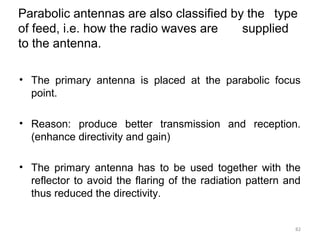
Parabolic antennas are also classified by the type
of feed, i.e. how the radio waves are
supplied
to the antenna.
• The primary antenna is placed at the parabolic focus
point.
• Reason: produce better transmission and reception.
(enhance directivity and gain)
• The primary antenna has to be used together with the
reflector to avoid the flaring of the radiation pattern and
thus reduced the directivity.

82
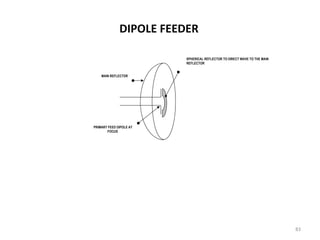
DIPOLE FEEDER
SPHERICAL REFLECTOR TO DIRECT WAVE TO THE MAIN
REFLECTOR
MAIN REFLECTOR

PRIMARY FEED DIPOLE AT
FOCUS

83
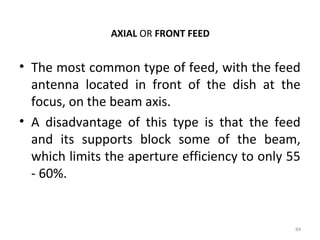
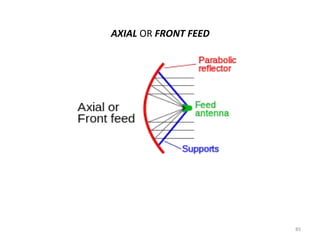
AXIAL OR FRONT FEED

• The most common type of feed, with the feed
antenna located in front of the dish at the
focus, on the beam axis.
• A disadvantage of this type is that the feed
and its supports block some of the beam,
which limits the aperture efficiency to only 55
- 60%.

84
AXIAL OR FRONT FEED

85
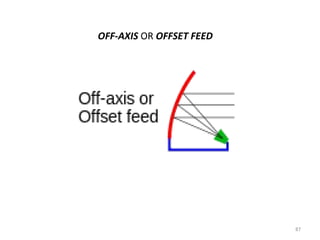
OFF-AXIS OR OFFSET FEED
•

•

•

•

The reflector is an asymmetrical segment of a
paraboloid, so the focus, and the feed antenna, is
located to one side of the dish.
The purpose of this design is to move the feed
structure out of the beam path, so it doesn't block the
beam.
It is widely used in home satellite television dishes,
which are small enough that the feed structure would
otherwise block a significant percentage of the signal.
Offset feed is also used in multiple reflector designs
such as the Cassegrain and Gregorian.

86
OFF-AXIS OR OFFSET FEED

87
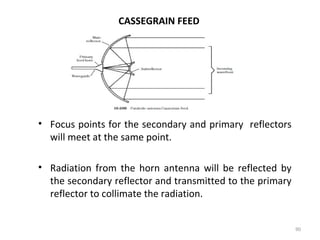
CASSEGRAIN FEED
•

•

The feed is located on or behind the dish, and
radiates
forward,
illuminating
a
convex
hyperboloidal secondary reflector at the focus of
the dish.
The radio waves from the feed reflect back off the
secondary reflector to the dish, which forms the
outgoing beam

88
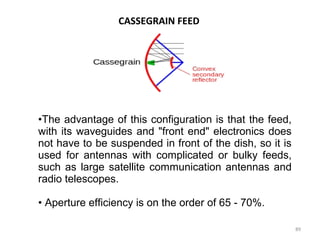
CASSEGRAIN FEED

•The advantage of this configuration is that the feed,
with its waveguides and "front end" electronics does
not have to be suspended in front of the dish, so it is
used for antennas with complicated or bulky feeds,
such as large satellite communication antennas and
radio telescopes.
• Aperture efficiency is on the order of 65 - 70%.
89
CASSEGRAIN FEED

• Focus points for the secondary and primary reflectors
will meet at the same point.
• Radiation from the horn antenna will be reflected by
the secondary reflector and transmitted to the primary
reflector to collimate the radiation.
90
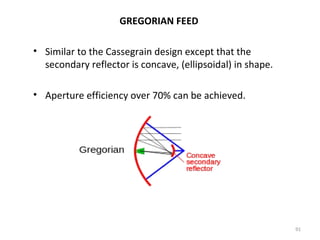
GREGORIAN FEED
• Similar to the Cassegrain design except that the
secondary reflector is concave, (ellipsoidal) in shape.
• Aperture efficiency over 70% can be achieved.

91
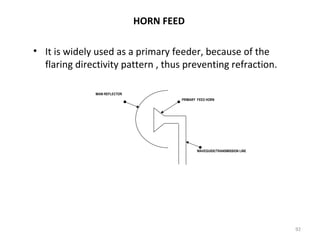
HORN FEED
• It is widely used as a primary feeder, because of the
flaring directivity pattern , thus preventing refraction.
MAIN REFLECTOR
PRIMARY FEED HORN

WAVEGUIDE/TRANSMISSION LINE

92
FACTORS AFFECTING THE ANTENNA
RADIATION PATTERN

Radiation pattern refers to the performance ot the
antenna for example when it is mounted far away
from objects such as buildings or mountain ( earth)
by which reflecting signal might affect the shape of
the pattern.

93
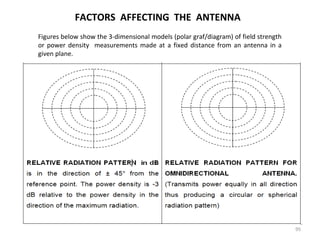
FACTORS AFFECTING THE ANTENNA
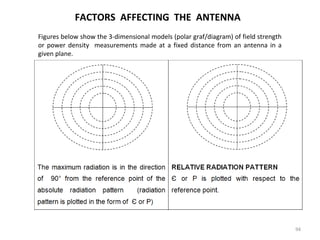
Figures below show the 3-dimensional models (polar graf/diagram) of field strength
or power density measurements made at a fixed distance from an antenna in a
given plane.

94
FACTORS AFFECTING THE ANTENNA
Figures below show the 3-dimensional models (polar graf/diagram) of field strength
or power density measurements made at a fixed distance from an antenna in a
given plane.

95
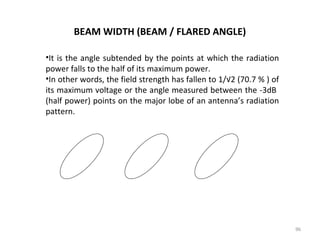
BEAM WIDTH (BEAM / FLARED ANGLE)
•It is the angle subtended by the points at which the radiation
power falls to the half of its maximum power.
•In other words, the field strength has fallen to 1/√2 (70.7 % ) of
its maximum voltage or the angle measured between the -3dB
(half power) points on the major lobe of an antenna’s radiation
pattern.

96
ANTENNA GAIN
•

It is defined as the ratio of power per unit area received from the
antenna at a point in space to the power received from an
isotropic antenna at the same point in space.

•

The capability of a directive antenna to concentrate power in a
given direction is the capability to direct radio frequency energy
into a given region and not in all direction.

•

For transmitting antenna, it refers to how far is the concentration
of transmission power in a given direction.

•

For receiving antenna, it refers to how far its receive the best
signal in a given direction rather than in all direction.

97
CHARACTERISTIC OF PARABOLOID ANTENNA

• To convert the spherical waveform produced at a focus point to
the plane wave.
• All the energy received from the free space which is the same as
the parabolic axis (Rx) will be reflected to the focus point.
ADVANTAGES
• The gain can be increased whenever needed.
• Can be operated at any frequency in the microwave zone.
• Simple Installation.
DISADVANTAGES
• Difficult to install with high accuracy.
• Operational frequency limited to the types of dish used.

98
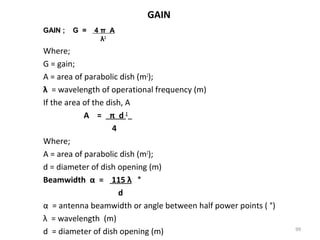
GAIN
GAIN ;

G =

4π A
λ2

Where;
G = gain;
A = area of parabolic dish (m2);
λ = wavelength of operational frequency (m)
If the area of the dish, A
A = π d2
4
Where;
A = area of parabolic dish (m2);
d = diameter of dish opening (m)
Beamwidth α = 115 λ °
d
α = antenna beamwidth or angle between half power points ( °)
λ = wavelength (m)
d = diameter of dish opening (m)

99

microwave_antenna

  • 1.
  • 3.
    MICROWAVE ANTENNA Definition A conductoror group of conductors used either for radiating electromagnetic energy into space or for collecting it from space. or Is a structure which may be described as a metallic object, often a wire or a collection of wires through specific design capable of converting high frequency current into EM wave and transmit it into free space at light velocity with high power (kW) besides receiving EM wave from free space and convert it into high frequency current at much lower power (mW).
  • 4.
    Basic operation oftransmit and receive antennas • Electrical energy from the transmitter is converted into electromagnetic energy by the antenna and radiated into space. Figure 5.1 : Basic operation of transmit and receive antennas On the receiving end, electromagnetic energy is converted into electrical energy by the antenna and fed into the receiver
  • 5.
    Basic operation oftransmit and receive antennas (cont) • Transmission - radiates electromagnetic energy into space • Reception - collects electromagnetic energy from space • In two-way communication, the same antenna can be used for transmission and reception. • Short wavelength produced by high frequency microwave, allows the usage of highly directive antenna. For long distant signal transmission, the usage of antenna at microwave frequency is more economical. Usage of waveguide is suitable for short distant signal transmission.
  • 6.
    FUNCTION OF ANTENNA • • • • • • Transmitenergy with high efficiency . Receive energy as low as mW. Provide matching between transmitter and free space and between free space and receiver, thus maximum power transfer is achieve besides preventing the occurrence of reflection. Directs radiation toward and suppresses radiation Two common features exist at the antenna Tx and Rx antenna is the radiation pattern and impedance, but it is different in terms of transmission power and reception power. Figure 5.2 below, shows the energy transmitted into free space via an open ended λ/4 transmission line. The proportion of wave escaping the system is very small due
  • 7.
    FUNCTION OF ANTENNA(cont) • • • Mismatch exist that is surrounding space as load. Since the two wires are closed together and in opposite direction (180°), therefore it is apparent that the radiation from one tip will cancelled that from the other. Figure 5.2 below, shows the energy transmitted into free space via an open ended λ/4 transmission line. The proportion of wave escaping the system is very small due Figure 5.2
  • 8.
    TYPES OF MICROWAVEANTENNA A. B. C. D. E. F. G. Horn / aperture antenna Parabolic / dish antenna Dipole antenna Slotted (leaky-wave) antenna Dielectric lens antenna Printed (patch or microstrip) antenna Phase Array antenna
  • 9.
    A - HORN/ APERTURE ANTENNA • Like parabolic reflectors, HORN RADIATORS can use to obtain directive radiation at microwave frequencies • Horn radiators are used with waveguides because they serve both as an impedance-matching device and as a directional radiator. Horn radiators may be fed by coaxial and other types of lines Figure 5.3 : Horn antenna
  • 10.
    Horn Antenna • Hornradiators are constructed in a variety of shapes, as illustrated in figure 5.4 • The shape of the horn determines the shape of the field pattern. The ratio of the horn length to the size of its mouth determines the beam angle and directivity. In general, the larger the mouth of the horn, the more directive is the field pattern. Figure 5.4 : Horn radiator
  • 11.
    DIFFERENT TYPES OFHORN ANTENNA
  • 12.
    THREE TYPES OFHORN ANTENNA • Horn antenna tapered / flared in one dimension only i.e in E-plane or H-plane (known as sectoral horn). • Horn antenna tapered / flared in two dimension i.e in E-plane and H-plane (known as pyramidal horn). • Conical taper / flares uniformly in all direction i.e in circular form.
  • 13.
    THE DIFFERENCES BETWEENTHE E-, H-PLANE & PYRAMIDAL HORN SECTORAL ANTENNA E- PLANE HORN SECTORAL H- PLANE HORN SECTORAL ANTENNA ANTENNA Radiation pattern exhibits side lobe Radiation pattern exhibits lobe, thus more popular. PYRAMIDAL HORN ANTENNA Radiation pattern flares in 2 direction i.e in E-plane and H-plane. Therefore improves directivity. no side
  • 14.
  • 15.
    DIMENSION OF HORNANTENNA (cont)
  • 16.
    B- PARABOLIC (REFLECTOR/ DISH) ANTENNA • Is a big dish like structure made from metal or wire mesh / grid. • Mesh hole ≤ λ / 12. • Widely used in microwave propagation via free space. • Also known as secondary antenna since it depends on primary antenna which acts as a feeder at the focal point (horn antenna or dipole antenna) to enhance the performance quality of the transmitter and the receiver
  • 17.
    Introduction of parabolicantenna • • A parabolic antenna is a high-gain reflector antenna used for radio, television and data communications, and also for radiolocation (radar), on the UHF and SHF parts of the electromagnetic spectrum With the advent of TVRO and DBS satellite television, the parabolic antenna became a ubiquitous feature of urban, suburban, and even rural landscapes. Figure 5.5 : Parabolic Antenna
  • 18.
    Why is itused? • • At higher microwave frequencies the physical size of the antenna becomes much smaller which in turn reduces the gain and directivity of the antenna The desired directivity can be achieved using suitably shaped parabolic reflector behind the main antenna which is known as primary antenna or feed .
  • 19.
    Working rules • A parabolicreflector follows the principle of geometrical optics. • When parallel rays of light incident on the reflector they will converge at focus or when a point source of light is kept at focus after reflection by the reflector they form a parallel beam of rays
  • 20.
    Basic Parabolic • Thebasic paraboloid reflector used to produce different beam shapes required by special applications. The basic characteristics of the most commonly used paraboloids are presented as below:
  • 21.
    TRUNCATED PARABOLOID • Sincethe reflector is parabolic in the horizontal plane, the energy is focused into a narrow beam. With the reflector TRUNCATED (cut) so that it is shortened vertically, the beam spreads out vertically instead of being focused. This fan-shaped beam is used in radar detection applications for the accurate determination of bearing. Since the beam is spread vertically, it will detect aircraft at different altitudes without changing the tilt of the antenna. The truncated paraboloid also works well for surface search radar applications to compensate for the pitch and roll of the ship • Truncated paraboloid may be used in target height-finding systems if the reflector is rotated 90 degrees, as shown in figure 3-5B. Since the reflector is now parabolic in the vertical plane, the energy is focused vertically into a narrow beam. If the reflector is truncated, or cut, so that it is shortened horizontally, the beam will spread out horizontally instead of being focused. Such a fan-shaped beam is used to accurately determine elevation
  • 22.
    ORANGE-PEEL PARABOLOID • Asection of a complete circular paraboloid, often called an ORANGE-PEEL REFLECTOR because of its orange-peel shape. Since the reflector is narrow in the horizontal plane and wide in the vertical plane, it produces a beam that is wide in the horizontal plane and narrow in the vertical plane. In shape, the beam resembles a huge beaver tail. The microwave energy is sent into the parabolic reflector by a horn radiator (not shown) which is fed by a waveguide. The horn radiation pattern covers nearly the entire shape of the reflector, so almost all of the microwave energy strikes the reflector and very little escapes at the sides. Antenna systems which use orange-peel paraboloids are often used in height-finding equipment. Orange-peel paraboloid Cylindrical paraboloid Corner reflector
  • 23.
    CYLINDRICAL PARABOLOID • Whena beam of radiated energy that is noticeably wider in one cross-sectional dimension than in another is desired, a cylindrical paraboloidal section which approximates a rectangle can be used. A PARABOLIC CYLINDER has a parabolic cross section in just one dimension which causes the reflector to be directive in one plane only. The cylindrical paraboloid reflector is fed either by a linear array of dipoles, a slit in the side of a waveguide, or by a thin waveguide radiator. It also has a series of focal points forming a straight line rather than a single focal point. Placing the radiator, or radiators, along this focal line produces a directed beam of energy. As the width of the parabolic section is changed, different beam shapes are obtained. You may see this type of antenna system used in search radar systems and in ground control approach (gca) radar systems.
  • 24.
    CORNER REFLECTOR • TheCORNER-REFLECTOR ANTENNA consists of two flat conducting sheets that meet at an angle to form a corner, as shown in figure 5.6. The corner reflector is normally driven by a HALFWAVE RADIATOR located on a line which bisects the angle formed by the sheet reflectors. Figure 5.6 : Parabolic reflector radiation.
  • 25.
    CORNER REFLECTOR (cont) •A microwave source is placed at focal point F. The field leaves this antenna as a spherical wavefront. As each part of the wavefront reaches the reflecting surface, it is phase-shifted 180 degrees. Each part is then sent outward at an angle that results in all parts of the field traveling in parallel paths. Because of the special shape of a parabolic surface, all paths from F to the reflector and back to line XY are the same length. Therefore, when the parts of the field are reflected from the parabolic surface, they travel to line XY in the same amount of time.
  • 26.
    CORNER REFLECTOR (cont) •A point-radiation source is placed at the focal point F. The field leaves this antenna with a spherical wavefront. As each part of the wavefront moving toward the reflector reaches the reflecting surface, it is shifted 180 degrees in phase and sent outward at angles that cause all parts of the field to travel in parallel paths. Because of the shape of a parabolic surface, all paths from F to the reflector and back to line XY are the same length. Therefore, all parts of the field arrive at line XY at the same time after reflection. • A parasitic array to direct the radiated field back to the reflector, or a feed horn pointed at the paraboloid is used to make the beam sharper and to concentrates the majority of the power in the beam. • The radiation pattern of the paraboloid contains a major lobe, which is directed along the axis of the paraboloid and several minor lobes. Very narrow beams are possible with this type of reflector.
  • 27.
    PARABOLIC RADIATION PATTERN Figure5.7 : Parabolic radiation pattern
  • 28.
    PARABOLIC (REFLECTOR /DISH) ANTENNA as TRANSMITTER • The wave at the focus point will be directed to the main reflector and will be reflected parallel to the parabola axis. Thus the wave will travel at the same the and phase at A`E` (XY) line and the plane wave produce will be transmitted to the free space. • Waves are emitted from the focal point of the wall and bounced back in line with the axis of the parabola and will arrive on time and with the same phase of the line and will form the next plane waves emitted into free space
  • 29.
    PARABOLIC (REFLECTOR /DISH) ANTENNA as RECEIVER • The plane wave received which is parallel to the parabola axis will be reflected by the main reflector to the focus point. • All received waves parallel to the axis of the parabola will be reflected by the wall to the point of convergence. • This characteristic makes the parabola antenna to possess high gain and a confined beam width. • These features causes a parabola has a high gain and width of the focused beam.
  • 30.
    C- SLOTTED (LEAKY-WAVE)ANTENNA • Can be fabricated from a length of a waveguide. They are simple to fabricate, have low-loss (high efficiency) and radiate linear polarization with low cross-polarization. • Slotted antenna arrays used with waveguides are a popular antenna in navigation, radar and other highfrequency systems. These antennas are often used in aircraft applications because they can be made to conform to the surface on which they are mounted. The slots are typically thin (< 0.1 ʎ) and 0.5 ʎ (at the center frequency of operation).
  • 31.
    SLOT ANTENNA What isSLOT Antenna:A slot antenna consists of a metal surface, usually a flat plate, with a hole or slot cut out. When the plate is driven as an antenna by a driving frequency, the slot radiates electromagnetic waves in similar way to a dipole antenna. The shape and size of the slot, as well as the driving frequency, determine the radiation distribution pattern. Figure 5.8 : Slot antenna.
  • 32.
    SLOTTED (LEAKY-WAVE) ANTENNA (CONT) •The slots on the waveguide will assumed to have a narrow width. Increasing the width increases the bandwidth (recall that a fatter antenna often has an increased bandwidth); the expense of a larger width is a higher degree of crosspolarization. The Fractional Bandwidth for thin slots can be as low as 3-5%; wide slots can have a FBW on the order of 75%. • An example of a slotted waveguide array is shown in Figure 5.9 (dimensions given by length a and width b) Figure 5.9 : slot waveguide with dimensions given by length a and width b.
  • 33.
    SLOTTED (LEAKY-WAVE) ANTENNA (CONT) •As in the cavity-backed slot antenna, each slot could be independently fed with a voltage source across the slot. This would be very difficult to construct especially for large arrays. The waveguide is used as the transmission line to feed the elements. • The position, shape and orientation of the slots will determine how (or if) they radiate. In addition, the shape of the waveguide and frequency of operation will play a major role.
  • 34.
    Slot antenna (cont) •EXAMPLE; • The dominant TE10 mode will be assumed to exist within the waveguide. Radiation occurs when the currents must "go around" the slots in order to continue on their desired direction. As an example, consider a narrow slot in the center of the waveguide, as shown in Figure 5.10 Figure 5.10 : example slot waveguide with dimensions given by length a and width b.
  • 35.
    Slot antenna (cont) •In this case, the z-component of the current will not be disturbed, because the slot is thin and the z-current would not need to travel around the slot. • Hence, the x-component of the current will be responsible for the radiation. However, at this location (x=a/2), the xcomponent of the current density is zero - i.e. no current and therefore no radiation. As a result, slots cannot be placed in the center of the waveguide as shown in Figure 5.10. • If the slots are displaced from the centerline as shown in Figure 5.9, the x-directed current will not be zero and will need to travel around the slot. Hence, radiation will occur.
  • 36.
    Slot antenna (cont) •If the slot is oriented as shown in Figure 3, the slot will disturb the z-component of the current density. This slot will then radiate. If this slot is displaced away from the center line, the amount of power that it radiates can be adjusted.
  • 37.
    Slot antenna (cont) •If the slot is rotated at an angle about the centerline as shown in Figure 4, it will radiate. The power it radiates will be a function of the angle (phi) that it is rotated specifically given by . Note that the z-component of the current is still responsible for radiation in this case. The xcomponent is disturbed; however the currents will have opposite magnitudes on either side of the centerline and will thus tend to cancel out the radiation
  • 38.
    Slot antenna (cont) •The most common slotted waveguide resembles that shown in Figure 5: • The front end (the open face at the y=0 in the x-z plane) is where the antenna is fed. The far end is usually shorted (enclosed in metal). The waveguide may be excited by a short dipole (as seen on the cavity-backed slot antenna) page, or by another waveguide
  • 39.
    Slot antenna (cont) •The waveguide itself acts as a transmission line, and the slots in the waveguide can be viewed as parallel (shunt) admittances.
  • 40.
  • 41.
  • 42.
    Slot antenna (cont) • • • • Theend of the waveguide is terminated in a pyramid terminator to avoid line reflections. The radiating field pattern depends on the spacing of the slots (phase relationship) and their orientation with reference to the waveguide. A slot cut in the wall of the waveguide, transverse to the direction of the interior boundary currents ( due to the interior em wave) will couple the em energy from inside the wave guide to a radiant free-space wave. The length of slot is cut to be a resonant one-half ( ʎ/2) wavelength.
  • 43.
    D) DIPOLE ANTENNAS TWOTYPES OF DIPOLE ANTENNAS: •Half-wave (ʎ/2) dipole antenna (or Hertz antenna) •Quarter-wave (ʎ /4) vertical antenna (or Marconi antenna) •Maxwell equations, the strength of the radiated field is ; Є = 60 π dl I cosӨ cos w ( t – r/Vc) λr
  • 44.
    D) DIPOLE ANTENNASCont. • A for a free space short-dipole and the radiation pattern (polar diagram) in the vertical plane and a circular in a horizontal plane. • The electric field, Є is directional in the vertical plane but is omnidirectional on the horizontal plane.
  • 45.
    D) DIPOLE ANTENNASCont. • Dipole antenna consists of 2 wires (ʎ/4 for its length) , the two wires are separated by a gap and their terminals are connected to the transmitter or the receiver. This type of dipoles is called half wave length dipole as the total length is ʎ / 2
  • 46.
    D) DIPOLE ANTENNASCont. Dipole geometry Dipole configuration
  • 47.
    D) DIPOLE ANTENNASCont. RADIATION PATTERN •The dipole is an electric field antenna, means that the magnetic field is zero at the near field. •The radiation pattern is like a donut cake with the maximum perpendicular to the dipole, and a null along it. •The polarization is along the dipole.
  • 48.
    D) DIPOLE ANTENNASCont. The 3D plot of the radiation pattern of a dipole antenna
  • 49.
    D) DIPOLE ANTENNASCont. The radiation pattern for the Electric field for a folded dipole antenna
  • 50.
    D) DIPOLE ANTENNASCont. The radiation pattern of the dipole all the field is electric as shown
  • 51.
    D) DIPOLE ANTENNASCont. The radiation pattern of the dipole, the magnetic field equals zero
  • 52.
    D) DIPOLE ANTENNASCont. • When the length of the dipole exceeds lambda the radiation pattern takes a new shape due to the appearance of the grating lobes where the major lobes divides into multiple lobes .
  • 53.
  • 54.
    E) DIELECTRIC (LENS)ANTENNAS • • Lenses play a similar role to that of reflectors in reflector antennas: they collimate divergent energy. Used at the higher microwave frequencies (often preferred to reflectors at frequencies > 100 GHz) and are useful in mm microwave region.
  • 55.
    E) DIELECTRIC (LENS)ANTENNAS cont. BASIC PRINCIPLE
  • 56.
    E) DIELECTRIC (LENS)ANTENNAS cont. • The velocity of em wave through a dielectric materal is less than that in free space. • The section of spherical em wave that travels through the center (the greatest thickness) of the dielectric material will travel most slowly compared to both end. • The velocities of the spherical wave entering the lens will be controlled and the curved wavefront will become a plane wavefront with constant phase in front of the dielectric antenna (refraction based on Snell’s law).
  • 57.
    E) DIELECTRIC (LENS)ANTENNAS cont. • Are contructed from polistyrene, teflon or any denser dielectric material to produce large diffraction (belauan) although its size and weight is small. The material use will cause the wave to attenuate greatly (losses and absortion of signal - greatest attenuation at center – thickest lens). • To avoid this situation, zoned and stepped dielectric antennas are used so that the optical path can be divided into paths differing by integral multiples of a wavelength from one zone to another.
  • 58.
    E) DIELECTRIC (LENS)ANTENNAS Cont. • Basic dielectric lens :• Requires a specific wavelength due to its thicness. • Its usage is not practical as compared to the stepped or zoned dielectric lens antenna which has different path for different wavelength.
  • 59.
    E) DIELECTRIC (LENS)ANTENNAS Cont. • Stepped or zoned dielectric lens antenna :• Used to reduced the lens thickness and to decrese the curveture of the spherical wave.
  • 60.
    • • • • F) PRINTED (MICROSTRIPOR PATCH) ANTENNA A patch antenna is a narrowband, wide-beam antenna. Fabricated by etching the antenna element pattern in metal trace bonded to an insulating dielectric substrate, such as a printed circuit board, with a continuous metal layer bonded to the opposite side of the substrate which forms a ground plane. Microstrip antenna shapes :- ex : square, rectangular, circular and elliptical Some patch antennas do not use a dielectric substrate and instead made of a metal patch mounted above a ground plane using dielectric spacers; the resulting structure is less rugged but has a wider bandwidth.
  • 61.
    F) PRINTED (MICROSTRIPOR PATCH) ANTENNA Cont. • Microstrip antenna a very low profile, are mechanically rugged and can be shaped to conform to the curving skin of a vehicle, they are often mounted on the exterior of aircraft and spacecraft, or are incorporated into mobile radio communications devices.
  • 62.
    F) PRINTED (MICROSTRIPOR PATCH) ANTENNA Cont. TYPES OF MICROSTRIP ANTENNAS:
  • 63.
    F) PRINTED (MICROSTRIPOR PATCH) ANTENNA Cont. ADVANTAGES •High accuracy in manufacturing , the design is executed by Photo etching. •Easy to integrate with other devices. •An array of microstrip antennas can be used to form a pattern that is difficult to synthesize using a single element. •We can obtain high directivity using microstrip arrays. •Have a main radiating edge , this makes it useful for mobile Phones to avoid radiation inside the device . •Small sized applicable for handheld portable communication. •Smart antennas when combined with phase shifters .
  • 64.
    F) PRINTED (MICROSTRIPOR PATCH) ANTENNA Cont. DISADVANTAGES •Narrow band width ( 1% ) , while mobiles need ( 8% ). •Low efficiency , especially for short circuited microstrip antenna. •Some feeding techniques like aperture and proximity coupling are difficult to fabricate. •An array suffers presence of feed network decreasing efficiency , also microstrip antennas are relatively expensive.
  • 65.
    F) PRINTED (MICROSTRIPOR PATCH) ANTENNA Cont. MICROSTRIP VS. REFLECTORS Microstrip Antennas • Preferred for low Reflector Antennas directivity • Performed for high directivity applications. applications as the effect of blockage is • Lower efficiency. less. • Suffers low efficiency caused by feed • Higher efficiency. • network for arrays. • Smart antennas, uses electronic Struts. scanning when combined with phase • • shifters. • More accurate manufacturing by photo etching. • Feeding is by coupling or coax feed lines. Suffers blockage caused by fixation Uses mechanical scanning . Less accuracy , sometimes parabolic surfaces are rough. • Uses other antenna (dipole , monopole, apertures , etc) as a feed.
  • 66.
    G- PHASED ARRAYANTENNA • Is an array of antennas in which the relative phases of the respective signals feeding the antennas are varied in such a way that the effective radiation pattern of the array is reinforced in a desired direction and suppressed in undesired directions. • Phased array transmission is use to enhance transmission of radio waves in one direction. • A phased array antenna is composed of lots of radiating elements each with a phase shifter. Beams are formed by shifting the phase of the signal emitted from each radiating element, to provide constructive/destructive interference so as to steer the beams in the desired direction
  • 67.
    Phased Array Antenna(Cont) • Areas of the antenna matrix can act as separate antennas. This allows many antenna beam patterns to be individually controlled at the same time. A large,phase-steered antenna system could be used to control the positions of many aircraft as at larger airport. • In the figure 1 (left) both radiating elements are fed with the same phase. The signal is amplified by constructive interference in the main direction. The beam sharpness is improved by the destructive interference
  • 68.
    Phased Array Antenna(Cont) • • In the figure 1 (right), the signal is emitted by the lower radiating element with a phase shift of 22 degrees earlier than of the upper radiating element. Because of this the main direction of the emitted sum-signal is moved upwards. (Note: Radiating elements have been used without reflector in the figure. Therefore the back lobe of the shown antenna diagrams is just as large as the main lobe.)
  • 69.
    Phased Array Antenna(Cont) • The main beam always points in the direction of the increasing phase shift. • If the signal to be radiated is delivered through an electronic phase shifter giving a continuous phase shift, the beam direction will be electronically adjustable. However, this cannot be extended unlimitedly. • The highest value, which can be achieved for the Field of View (FOV) of a phased array antenna is 120° (60° left and 60° right). With the sine theorem the necessary phase moving can be calculated
  • 70.
    Phased Array Antenna(Cont) Advantages Disadvantages • high gain width los side lobes • Ability to permit the beam to jump from one 120 degree sector in azimuth target to the next in a few microseconds and elevation • Ability to provide an agile beam under computer • • control the coverage is limited to a deformation of the beam while the deflection • arbitrarily modes of surveillance and tracking • low frequency agility • free eligible Dwell Time • very complex structure • multifunction operation by emitting several beams simultaneously • Fault of single components reduces the capability and beam sharpness, but the system remains operational (processor, phase shifters) • still high costs
  • 71.
    Phased Array Antenna(Cont) • CONCLUSION: • Beamforming antenna systems improve wireless network performance • increase system capacity • improve signal quality • suppress interference and noise • save power • Beamforming antennas improve infrastructure networks performance. They may improve ad hoc networks performance. New MAC protocol standards are needed. • Vector antennas may replace spatial arrays to further improve beamforming performance
  • 72.
    Phased Array Antenna(Cont) • The relative amplitudes of — and constructive and destructive interference effects among — the signals radiated by the individual antennas determine the effective radiation pattern of the array. A phased array may be used to point a fixed radiation pattern, or to scan rapidly in azimuth or elevation.
  • 73.
    DIFFERENT TYPES OFPHASED ARRAYS • • • • There are two main types of beamformers: time domain beamformers frequency domain beamformers A graduated attenuation window is sometimes applied across the face of the array to improve side-lobe suppression performance, in addition to the phase shift.
  • 74.
    TIME DOMAIN BEAMFORMER •works by introducing time delays. • The basic operation is called "delay and sum". It delays the incoming signal from each array element by a certain amount of time, and then adds them together. • The most common kind of time domain beam former is serpentine waveguide. • Active phase array uses individual delay lines that are switched on and off. Yttrium iron garnet phase shifters vary the phase delay using the strength of a magnetic field.
  • 75.
    FREQUENCY DOMAIN BEAMFORMERS • • • TWODIFFERENT TYPES OF FREQUENCY DOMAIN BEAMFORMERS: separates the different frequency components that are present in the received signal into multiple frequency bins (using either an DFT or a filterbank). When different delay and sum beamformers are applied to each frequency bin, the result is that the main lobe simultaneously points in multiple different directions at each of the different frequencies. This can be an advantage for communication links, and is used with the SPS-48 radar. makes use of Spatial Frequency. Discrete samples are taken from each of the individual array elements. The samples are processes using a Discrete Fourier Transform (DFT). The DFT introduces multiple different discrete phase shifts during processing. The outputs of the DFT are individual channels that correspond with evenly spaced beams formed simultaneously. A 1 dimensional DFT produces a fan of different beams. A 2 dimensional DFT produces beams with a pineapple configuration.
  • 76.
    FREQUENCY DOMAIN BEAMFORMERS (CONT) •These techniques are used to create two kinds of phase array. • Dynamic - an array of variable phase shifters are used to move the beam • Fixed - the beam position is stationary with respect to the array face and the whole antenna is moved • There are two further sub-categories that modify the kind of dynamic array or fixed array. • Active - amplifiers or processors in each phase shifter element • Passive - large central amplifier with attenuating phase shifters
  • 77.
    Dynamic Phased Array • • • • Eacharray element incorporates an adjustable phase shifter that are collectively used to move the beam with respect to the array face. Dynamic phase array require no physical movement to aim the beam. The beam is moved electronically. This can produce antenna motion fast enough to use a small pencil-beam to simultaneously track multiple targets while searching for new targets using just one radar set (track while search). As an example, an antenna with a 2 degree beam with a pulse rate of 1 kHz will require approximately 16 seconds to cover an entire a hemisphere consisting of 16,000 pointing positions. This configuration provides 6 opportunities to detect a Mach 3 vehicle over a range of 100 km (62 mi), which is suitable for military applications. The position of mechanically steered antennas can be predicted, which can be used to create electronic countermeasures that interfere with radar operation. The flexibility resulting from phase array operation allows beams to be aimed at random locations, which eliminates this vulnerability. This is also desirable for military applications.
  • 78.
    Fixed Phase Array • • • • • Fixedphase array antennas are typically used to create an antenna with a more desirable form factor than the conventional parabolic reflector or cassegrain reflector. Fixed phased array radar incorporate fixed phase shifters. This kind of phase array is physically moved during the track and scan process. There are two configurations. Multiple frequencies with a delay-line Multiple adjacent beams The SPS-48 radar uses multiple transmit frequencies with a serpentine delay line along the left side of the array to produce vertical fan of stacked beams. Each frequency experiences a different phase shift as it propagates down the serpentine delay line, which forms different beams. A filter bank is used to split apart the individual receive beams. The antenna is mechanically rotated. Semi-active radar homing uses monopulse radar that relies on a fixed phase array to produce multiple adjacent beams that measure angle errors. This form factor is suitable for gimbal mounting in missile seekers.
  • 79.
    Active Phase Array •Active phase arrays elements incorporate transmit amplification with phase shift in each antenna element (or group of elements). Each element also includes receive pre-amplification. The phase shifter setting is the same for transmit and receive. • Active phase array do not require phase reset after the end of the transmit pulse, which is compatible with Doppler radar and Pulse-Doppler radar.
  • 80.
    Passive Phase Array •Passive phase arrays typically use large amplifiers that produce all of the microwave transmit signal for the antenna. Phase shifters typically consist of waveguide elements that contain phase shifters controlled by magnetic field, voltage gradient, or equivalent technology. • The phase shift process used with passive phase array typically puts the receive beam and transmit beam into caddy-corner quadrants. The sign of the phase shift must be inverted after the transmit pulse is finished and before the receive period begins to place the receive beam into the same location as the transmit beam. That requires a phase impulse that degrades sub-clutter visibility performance on Doppler radar and Pulse-Doppler radar. As an example, Yttrium iron garnet phase shifters must be changed after transmit pulse quench and before receiver processing starts to align transmit and receive beams. That impulse introduces FM noise that degrades clutter performance.
  • 81.
    MICROWAVE FEEDER SYSTEM(DRIVER ELEMENT) TYPES OF FEEDER •Omnidirectional •Cassegrain •Gregorian •Horn feed 81
  • 82.
    Parabolic antennas arealso classified by the type of feed, i.e. how the radio waves are supplied to the antenna. • The primary antenna is placed at the parabolic focus point. • Reason: produce better transmission and reception. (enhance directivity and gain) • The primary antenna has to be used together with the reflector to avoid the flaring of the radiation pattern and thus reduced the directivity. 82
  • 83.
    DIPOLE FEEDER SPHERICAL REFLECTORTO DIRECT WAVE TO THE MAIN REFLECTOR MAIN REFLECTOR PRIMARY FEED DIPOLE AT FOCUS 83
  • 84.
    AXIAL OR FRONTFEED • The most common type of feed, with the feed antenna located in front of the dish at the focus, on the beam axis. • A disadvantage of this type is that the feed and its supports block some of the beam, which limits the aperture efficiency to only 55 - 60%. 84
  • 85.
  • 86.
    OFF-AXIS OR OFFSETFEED • • • • The reflector is an asymmetrical segment of a paraboloid, so the focus, and the feed antenna, is located to one side of the dish. The purpose of this design is to move the feed structure out of the beam path, so it doesn't block the beam. It is widely used in home satellite television dishes, which are small enough that the feed structure would otherwise block a significant percentage of the signal. Offset feed is also used in multiple reflector designs such as the Cassegrain and Gregorian. 86
  • 87.
  • 88.
    CASSEGRAIN FEED • • The feedis located on or behind the dish, and radiates forward, illuminating a convex hyperboloidal secondary reflector at the focus of the dish. The radio waves from the feed reflect back off the secondary reflector to the dish, which forms the outgoing beam 88
  • 89.
    CASSEGRAIN FEED •The advantageof this configuration is that the feed, with its waveguides and "front end" electronics does not have to be suspended in front of the dish, so it is used for antennas with complicated or bulky feeds, such as large satellite communication antennas and radio telescopes. • Aperture efficiency is on the order of 65 - 70%. 89
  • 90.
    CASSEGRAIN FEED • Focuspoints for the secondary and primary reflectors will meet at the same point. • Radiation from the horn antenna will be reflected by the secondary reflector and transmitted to the primary reflector to collimate the radiation. 90
  • 91.
    GREGORIAN FEED • Similarto the Cassegrain design except that the secondary reflector is concave, (ellipsoidal) in shape. • Aperture efficiency over 70% can be achieved. 91
  • 92.
    HORN FEED • Itis widely used as a primary feeder, because of the flaring directivity pattern , thus preventing refraction. MAIN REFLECTOR PRIMARY FEED HORN WAVEGUIDE/TRANSMISSION LINE 92
  • 93.
    FACTORS AFFECTING THEANTENNA RADIATION PATTERN Radiation pattern refers to the performance ot the antenna for example when it is mounted far away from objects such as buildings or mountain ( earth) by which reflecting signal might affect the shape of the pattern. 93
  • 94.
    FACTORS AFFECTING THEANTENNA Figures below show the 3-dimensional models (polar graf/diagram) of field strength or power density measurements made at a fixed distance from an antenna in a given plane. 94
  • 95.
    FACTORS AFFECTING THEANTENNA Figures below show the 3-dimensional models (polar graf/diagram) of field strength or power density measurements made at a fixed distance from an antenna in a given plane. 95
  • 96.
    BEAM WIDTH (BEAM/ FLARED ANGLE) •It is the angle subtended by the points at which the radiation power falls to the half of its maximum power. •In other words, the field strength has fallen to 1/√2 (70.7 % ) of its maximum voltage or the angle measured between the -3dB (half power) points on the major lobe of an antenna’s radiation pattern. 96
  • 97.
    ANTENNA GAIN • It isdefined as the ratio of power per unit area received from the antenna at a point in space to the power received from an isotropic antenna at the same point in space. • The capability of a directive antenna to concentrate power in a given direction is the capability to direct radio frequency energy into a given region and not in all direction. • For transmitting antenna, it refers to how far is the concentration of transmission power in a given direction. • For receiving antenna, it refers to how far its receive the best signal in a given direction rather than in all direction. 97
  • 98.
    CHARACTERISTIC OF PARABOLOIDANTENNA • To convert the spherical waveform produced at a focus point to the plane wave. • All the energy received from the free space which is the same as the parabolic axis (Rx) will be reflected to the focus point. ADVANTAGES • The gain can be increased whenever needed. • Can be operated at any frequency in the microwave zone. • Simple Installation. DISADVANTAGES • Difficult to install with high accuracy. • Operational frequency limited to the types of dish used. 98
  • 99.
    GAIN GAIN ; G = 4πA λ2 Where; G = gain; A = area of parabolic dish (m2); λ = wavelength of operational frequency (m) If the area of the dish, A A = π d2 4 Where; A = area of parabolic dish (m2); d = diameter of dish opening (m) Beamwidth α = 115 λ ° d α = antenna beamwidth or angle between half power points ( °) λ = wavelength (m) d = diameter of dish opening (m) 99