Presented by;
MURLI SHESHERAO KUMBHARKAR
141413003
T.Y Production ( S/W)
Mr. S.U. GHUNAGE
Guide,
Assistant Professor
Production Engineering & Industrial
Management Department
College of Engineering Pune.
STUDY OF DISCHARGE MECHANISM IN
ELECTROCHEMICAL DISCHARGE
MACHINING PROCESS
Contents:-
Introduction
Need of ECDM
Working Principle of ECDM
Material Removal Mechanism in ECDM
Experimental setup of ECDM
Main Subsystem of ECDM
Main Influencing parameters
Advantages over ECM/EDM
Disadvantages over EDM/ECM
Application of ECDM
Comparison between ECDM, EDM and ECM
References
Introduction:-
• Electrochemical discharge machining is the combination of
Electric discharge machining (EDM) and Electrochemical
machining (ECM) process.
• Electrochemical Discharge Machining (ECDM) process is
mostly applied for micro-machining and scribing hard and
brittle, non-conducting materials like glass, quartz, ceramics
etc.
• The work first on the Electrode effect, anode or cathode effects
reported by Fizeau and his group of researchers and Foucault
and his co-researchers in 1844.
Introduction:-
• It was introduced in 1968 as electro discharge drilling by
Karafuji and Suda.
• It knows different name such as :
 ESCM – Electro Chemical Spark Machining ( by V.K. Jain
et al.)
 SACE – Spark Assisted Chemical Engraving ( by Fascio et
al.)
 ECAM – Electro Chemical Anode Machining ( by Kubota)
 DMNC – Discharge Machining of Non-Conductors ( by
Cook et al. )
 SAE – Spark Assisted Etching ( by Daridon et al. )
Need of ECDM :
1. High Accuracy and Surface Finish
2. High Strength Alloys
3. Complex Surfaces
4. Technology Advancement
5. Machining on non-conducting materials
.
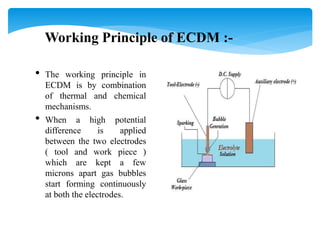
• The working principle in
ECDM is by combination
of thermal and chemical
mechanisms.
• When a high potential
difference is applied
between the two electrodes
( tool and work piece )
which are kept a few
microns apart gas bubbles
start forming continuously
at both the electrodes.
Working Principle of ECDM :-
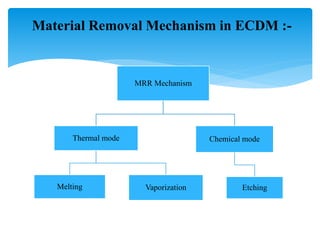
Material Removal Mechanism in ECDM :-
MRR Mechanism
Thermal mode
Melting Vaporization
Chemical mode
Etching
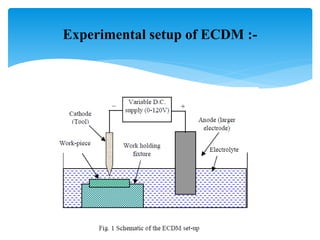
Experimental setup of ECDM :-
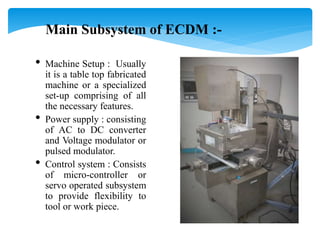
• Machine Setup : Usually
it is a table top fabricated
machine or a specialized
set-up comprising of all
the necessary features.
• Power supply : consisting
of AC to DC converter
and Voltage modulator or
pulsed modulator.
• Control system : Consists
of micro-controller or
servo operated subsystem
to provide flexibility to
tool or work piece.
Main Subsystem of ECDM :-
Main Influencing parameters :-
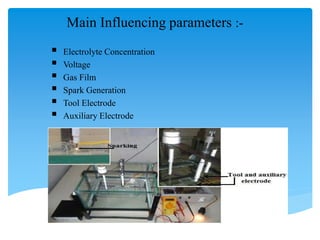
 Electrolyte Concentration
 Voltage
 Gas Film
 Spark Generation
 Tool Electrode
 Auxiliary Electrode
Advantages over ECM/EDM :-
• The surface obtained have better finish than EDM and
ECM.
• Suitable for non-conducting materials.
• High accuracy.
• Methods does not leave any chips or burrs.
• Less power consumption.
• Set-up is not costly and can be developed or fabricated
on exiting facility through modification and attachments.
Disadvantages over EDM/ECM:-
• Chances to electrode wear.
• Initial cost of is high.
• Thickness of ceramic material can be
machined is limited to 1.5 mm.
• Radial overcut.
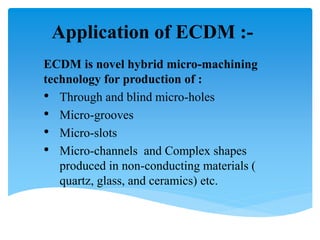
Application of ECDM :-
ECDM is novel hybrid micro-machining
technology for production of :
• Through and blind micro-holes
• Micro-grooves
• Micro-slots
• Micro-channels and Complex shapes
produced in non-conducting materials (
quartz, glass, and ceramics) etc.
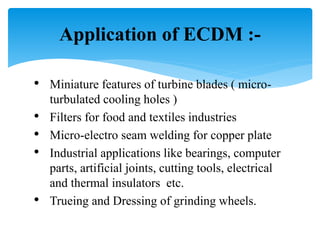
• Miniature features of turbine blades ( micro-
turbulated cooling holes )
• Filters for food and textiles industries
• Micro-electro seam welding for copper plate
• Industrial applications like bearings, computer
parts, artificial joints, cutting tools, electrical
and thermal insulators etc.
• Trueing and Dressing of grinding wheels.
Application of ECDM :-
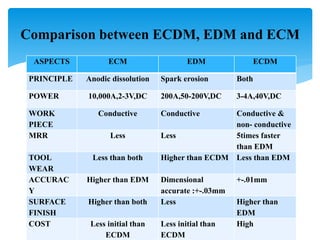
Comparison between ECDM, EDM and ECM
ASPECTS ECM EDM ECDM
PRINCIPLE Anodic dissolution Spark erosion Both
POWER 10,000A,2-3V,DC 200A,50-200V,DC 3-4A,40V,DC
WORK
PIECE
Conductive Conductive Conductive &
non- conductive
MRR Less Less 5times faster
than EDM
TOOL
WEAR
Less than both Higher than ECDM Less than EDM
ACCURAC
Y
Higher than EDM Dimensional
accurate :+-.03mm
+-.01mm
SURFACE
FINISH
Higher than both Less Higher than
EDM
COST Less initial than
ECDM
Less initial than
ECDM
High
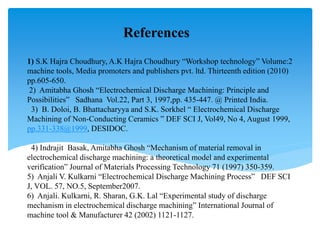
1) S.K Hajra Choudhury, A.K Hajra Choudhury “Workshop technology” Volume:2
machine tools, Media promoters and publishers pvt. ltd. Thirteenth edition (2010)
pp.605-650.
2) Amitabha Ghosh “Electrochemical Discharge Machining: Principle and
Possibilities” Sadhana Vol.22, Part 3, 1997,pp. 435-447. @ Printed India.
3) B. Doloi, B. Bhattacharyya and S.K. Sorkhel “ Electrochemical Discharge
Machining of Non-Conducting Ceramics ” DEF SCI J, Vol49, No 4, August 1999,
pp.331-338@1999, DESIDOC.
4) Indrajit Basak, Amitabha Ghosh “Mechanism of material removal in
electrochemical discharge machining: a theoretical model and experimental
verification” Journal of Materials Processing Technology 71 (1997) 350-359.
5) Anjali V. Kulkarni “Electrochemical Discharge Machining Process” DEF SCI
J, VOL. 57, NO.5, September2007.
6) Anjali. Kulkarni, R. Sharan, G.K. Lal “Experimental study of discharge
mechanism in electrochemical discharge machining” International Journal of
machine tool & Manufacturer 42 (2002) 1121-1127.
References
ECDM by Murli Kumbharkar

ECDM by Murli Kumbharkar

  • 1.
    Presented by; MURLI SHESHERAOKUMBHARKAR 141413003 T.Y Production ( S/W) Mr. S.U. GHUNAGE Guide, Assistant Professor Production Engineering & Industrial Management Department College of Engineering Pune. STUDY OF DISCHARGE MECHANISM IN ELECTROCHEMICAL DISCHARGE MACHINING PROCESS
  • 2.
    Contents:- Introduction Need of ECDM WorkingPrinciple of ECDM Material Removal Mechanism in ECDM Experimental setup of ECDM Main Subsystem of ECDM Main Influencing parameters Advantages over ECM/EDM Disadvantages over EDM/ECM Application of ECDM Comparison between ECDM, EDM and ECM References
  • 3.
    Introduction:- • Electrochemical dischargemachining is the combination of Electric discharge machining (EDM) and Electrochemical machining (ECM) process. • Electrochemical Discharge Machining (ECDM) process is mostly applied for micro-machining and scribing hard and brittle, non-conducting materials like glass, quartz, ceramics etc. • The work first on the Electrode effect, anode or cathode effects reported by Fizeau and his group of researchers and Foucault and his co-researchers in 1844.
  • 4.
    Introduction:- • It wasintroduced in 1968 as electro discharge drilling by Karafuji and Suda. • It knows different name such as :  ESCM – Electro Chemical Spark Machining ( by V.K. Jain et al.)  SACE – Spark Assisted Chemical Engraving ( by Fascio et al.)  ECAM – Electro Chemical Anode Machining ( by Kubota)  DMNC – Discharge Machining of Non-Conductors ( by Cook et al. )  SAE – Spark Assisted Etching ( by Daridon et al. )
  • 5.
    Need of ECDM: 1. High Accuracy and Surface Finish 2. High Strength Alloys 3. Complex Surfaces 4. Technology Advancement 5. Machining on non-conducting materials .
  • 6.
    • The workingprinciple in ECDM is by combination of thermal and chemical mechanisms. • When a high potential difference is applied between the two electrodes ( tool and work piece ) which are kept a few microns apart gas bubbles start forming continuously at both the electrodes. Working Principle of ECDM :-
  • 7.
    Material Removal Mechanismin ECDM :- MRR Mechanism Thermal mode Melting Vaporization Chemical mode Etching
  • 8.
  • 9.
    • Machine Setup: Usually it is a table top fabricated machine or a specialized set-up comprising of all the necessary features. • Power supply : consisting of AC to DC converter and Voltage modulator or pulsed modulator. • Control system : Consists of micro-controller or servo operated subsystem to provide flexibility to tool or work piece. Main Subsystem of ECDM :-
  • 10.
    Main Influencing parameters:-  Electrolyte Concentration  Voltage  Gas Film  Spark Generation  Tool Electrode  Auxiliary Electrode
  • 11.
    Advantages over ECM/EDM:- • The surface obtained have better finish than EDM and ECM. • Suitable for non-conducting materials. • High accuracy. • Methods does not leave any chips or burrs. • Less power consumption. • Set-up is not costly and can be developed or fabricated on exiting facility through modification and attachments.
  • 12.
    Disadvantages over EDM/ECM:- •Chances to electrode wear. • Initial cost of is high. • Thickness of ceramic material can be machined is limited to 1.5 mm. • Radial overcut.
  • 13.
    Application of ECDM:- ECDM is novel hybrid micro-machining technology for production of : • Through and blind micro-holes • Micro-grooves • Micro-slots • Micro-channels and Complex shapes produced in non-conducting materials ( quartz, glass, and ceramics) etc.
  • 14.
    • Miniature featuresof turbine blades ( micro- turbulated cooling holes ) • Filters for food and textiles industries • Micro-electro seam welding for copper plate • Industrial applications like bearings, computer parts, artificial joints, cutting tools, electrical and thermal insulators etc. • Trueing and Dressing of grinding wheels. Application of ECDM :-
  • 15.
    Comparison between ECDM,EDM and ECM ASPECTS ECM EDM ECDM PRINCIPLE Anodic dissolution Spark erosion Both POWER 10,000A,2-3V,DC 200A,50-200V,DC 3-4A,40V,DC WORK PIECE Conductive Conductive Conductive & non- conductive MRR Less Less 5times faster than EDM TOOL WEAR Less than both Higher than ECDM Less than EDM ACCURAC Y Higher than EDM Dimensional accurate :+-.03mm +-.01mm SURFACE FINISH Higher than both Less Higher than EDM COST Less initial than ECDM Less initial than ECDM High
  • 16.
    1) S.K HajraChoudhury, A.K Hajra Choudhury “Workshop technology” Volume:2 machine tools, Media promoters and publishers pvt. ltd. Thirteenth edition (2010) pp.605-650. 2) Amitabha Ghosh “Electrochemical Discharge Machining: Principle and Possibilities” Sadhana Vol.22, Part 3, 1997,pp. 435-447. @ Printed India. 3) B. Doloi, B. Bhattacharyya and S.K. Sorkhel “ Electrochemical Discharge Machining of Non-Conducting Ceramics ” DEF SCI J, Vol49, No 4, August 1999, pp.331-338@1999, DESIDOC. 4) Indrajit Basak, Amitabha Ghosh “Mechanism of material removal in electrochemical discharge machining: a theoretical model and experimental verification” Journal of Materials Processing Technology 71 (1997) 350-359. 5) Anjali V. Kulkarni “Electrochemical Discharge Machining Process” DEF SCI J, VOL. 57, NO.5, September2007. 6) Anjali. Kulkarni, R. Sharan, G.K. Lal “Experimental study of discharge mechanism in electrochemical discharge machining” International Journal of machine tool & Manufacturer 42 (2002) 1121-1127. References

Editor's Notes

  • #6 Glass also has the distinction of being transparent and having low electrical as well as thermal conductivity. It is increasingly being used in micro fabricated devices like solid oxide fuel cells, pumps, and reactors. The existing micromachining technologies for glass such as laser machining, ultrasonic machining, abrasive machining , and chemical etching techniques have certain undesirable effects and limitations