SELECTIVE LASER SINTERING
HARIPRIYA .M
Dr.Mahalingam college of engineering and technology
CONTENTS
• Defnition
• Process
• Input parameters
• Commonly used materials
• Advantages
• Limitations
• Applications
DEFNITION :
• Selective laser sintering (SLS) technique that uses a laser as the
power source to sinter powdered material aiming
the laser automatically at points in space defined by a 3D model,
binding the material together to create a solid structure.
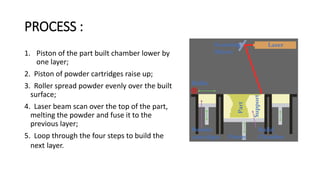
PROCESS :
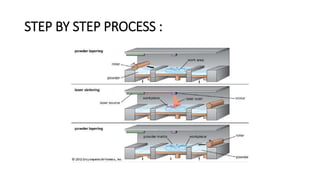
1. Piston of the part built chamber lower by
one layer;
2. Piston of powder cartridges raise up;
3. Roller spread powder evenly over the built
surface;
4. Laser beam scan over the top of the part,
melting the powder and fuse it to the
previous layer;
5. Loop through the four steps to build the
next layer.
LaserScanning
Mirror
Roller
Piston
Powder
cartridges
Build
Chamber
STEP BY STEP PROCESS :
INPUT PARAMETERS :
• POWDER CHARACTERISTICS
• FOR MACHING-Type of material(polycarbonate)
• FOR LASER
• Laser focus diameter {Fs=(AFMC)/D}
• Laser wave length
• Beam profile
• Laser power
• Scanning velocity
COMMONLY USED POWDER MATERIALS :
• Aluminum-Filled (PA12-AL)
• Polyamide(PA)
• Glass filled polyamide(PA-GF)
• Alumide.
• Impact-Resistant Nylon (Duraform EX)
• Nylon (Duraform PA)
• Glass-Filled Nylon (Duraform GF)
• Flame Retardant Nylon (Duraform FR100)
• Carbon Fiber Filled Nylon (Windform XT)
• Rubber-Like (Duraform Flex Plastic)
ADVANTAGES :
• No need for support structures
One of the chief benefits of using SLS printing is that it designs do not need any
support structure. As the print is being built, all hollow spaces are automatically filled with unused
powder, thus making SLS prints self-supporting. This offers modelers and product designers a huge
degree of design freedom.
• Fast
Since the nylon powder used in SLS only requires very brief exposure to the laser to be
sintered, SLS printing has the potential to be one of the fastest 3D printing technologies
• Excellent layer adhesion
SLS printing has been known to result in prints with very strong layer adhesion. Because
of this characteristic, SLS prints have virtually isotropic mechanical properties. This means that the tensile
strength, hardness, and elongation of an object printed using SLS are almost equal in all directions.
LIMITATIONS :
• Brittle
• Although SLS prints have a comparable tensile strength compared to SLA prints,
they are much less flexible and can undergo less deformation before failure. For this reason, SLS
prints are best used as proof-of-concept prototypes and not as functional parts.
• Prone to shrinkage and warping
The printed object will undergo a cooling process almost immediately after the solid
layer has formed. As the print cools, it contracts or shrinks in all directions which can lead to a
dimensionally inaccurate product. The stress due to the contraction can also accumulate in certain
parts of the print, particularly in sharp edges and corners, resulting in these parts getting warped or
distorted.
• Messy
One of the most bothersome parts of the SLS printing process comes when the part has
been built and cooled – the cleaning process. When you retrieve the printed part from the powder
fin, it will typically be hidden inside a firm block of the unused powder. You will have to break apart
this block of powder and clean off the excess powder from the printed part using compressed air.
• Expensive
Ultimately, the most significant factor that is preventing SLS printing from becoming
mainstream technology is its cost. While it’s possible to get a high-quality FDM printer for less than
$500 and a beginner SLA printer for less than $1000, a desktop-scale SLS printer will set you back at
least $5,000.
[1 dollar = 71.99 rupees]
APPLICATIONS :
• Aerospace Hardware.
• Medical and Healthcare.
• Electronics; Packaging, Connectors.
• Military Hardware.
• Automotive industries
• Consumer goods(domestic application, power tools, audio
components)
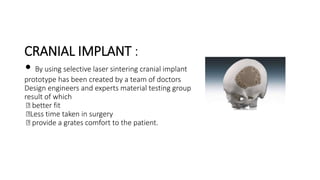
CRANIAL IMPLANT :
• By using selective laser sintering cranial implant
prototype has been created by a team of doctors
Design engineers and experts material testing group
result of which
better fit
Less time taken in surgery
provide a grates comfort to the patient.
THANK YOU !
REFERNCE
• Google & Slideshare

Selective laser sintering

  • 1.
    SELECTIVE LASER SINTERING HARIPRIYA.M Dr.Mahalingam college of engineering and technology
  • 2.
    CONTENTS • Defnition • Process •Input parameters • Commonly used materials • Advantages • Limitations • Applications
  • 3.
    DEFNITION : • Selectivelaser sintering (SLS) technique that uses a laser as the power source to sinter powdered material aiming the laser automatically at points in space defined by a 3D model, binding the material together to create a solid structure.
  • 4.
    PROCESS : 1. Pistonof the part built chamber lower by one layer; 2. Piston of powder cartridges raise up; 3. Roller spread powder evenly over the built surface; 4. Laser beam scan over the top of the part, melting the powder and fuse it to the previous layer; 5. Loop through the four steps to build the next layer. LaserScanning Mirror Roller Piston Powder cartridges Build Chamber
  • 5.
    STEP BY STEPPROCESS :
  • 7.
    INPUT PARAMETERS : •POWDER CHARACTERISTICS • FOR MACHING-Type of material(polycarbonate) • FOR LASER • Laser focus diameter {Fs=(AFMC)/D} • Laser wave length • Beam profile • Laser power • Scanning velocity
  • 8.
    COMMONLY USED POWDERMATERIALS : • Aluminum-Filled (PA12-AL) • Polyamide(PA) • Glass filled polyamide(PA-GF) • Alumide. • Impact-Resistant Nylon (Duraform EX) • Nylon (Duraform PA) • Glass-Filled Nylon (Duraform GF) • Flame Retardant Nylon (Duraform FR100) • Carbon Fiber Filled Nylon (Windform XT) • Rubber-Like (Duraform Flex Plastic)
  • 9.
    ADVANTAGES : • Noneed for support structures One of the chief benefits of using SLS printing is that it designs do not need any support structure. As the print is being built, all hollow spaces are automatically filled with unused powder, thus making SLS prints self-supporting. This offers modelers and product designers a huge degree of design freedom. • Fast Since the nylon powder used in SLS only requires very brief exposure to the laser to be sintered, SLS printing has the potential to be one of the fastest 3D printing technologies • Excellent layer adhesion SLS printing has been known to result in prints with very strong layer adhesion. Because of this characteristic, SLS prints have virtually isotropic mechanical properties. This means that the tensile strength, hardness, and elongation of an object printed using SLS are almost equal in all directions.
  • 10.
    LIMITATIONS : • Brittle •Although SLS prints have a comparable tensile strength compared to SLA prints, they are much less flexible and can undergo less deformation before failure. For this reason, SLS prints are best used as proof-of-concept prototypes and not as functional parts. • Prone to shrinkage and warping The printed object will undergo a cooling process almost immediately after the solid layer has formed. As the print cools, it contracts or shrinks in all directions which can lead to a dimensionally inaccurate product. The stress due to the contraction can also accumulate in certain parts of the print, particularly in sharp edges and corners, resulting in these parts getting warped or distorted.
  • 11.
    • Messy One ofthe most bothersome parts of the SLS printing process comes when the part has been built and cooled – the cleaning process. When you retrieve the printed part from the powder fin, it will typically be hidden inside a firm block of the unused powder. You will have to break apart this block of powder and clean off the excess powder from the printed part using compressed air. • Expensive Ultimately, the most significant factor that is preventing SLS printing from becoming mainstream technology is its cost. While it’s possible to get a high-quality FDM printer for less than $500 and a beginner SLA printer for less than $1000, a desktop-scale SLS printer will set you back at least $5,000. [1 dollar = 71.99 rupees]
  • 12.
    APPLICATIONS : • AerospaceHardware. • Medical and Healthcare. • Electronics; Packaging, Connectors. • Military Hardware. • Automotive industries • Consumer goods(domestic application, power tools, audio components)
  • 13.
    CRANIAL IMPLANT : •By using selective laser sintering cranial implant prototype has been created by a team of doctors Design engineers and experts material testing group result of which better fit Less time taken in surgery provide a grates comfort to the patient.
  • 14.
    THANK YOU ! REFERNCE •Google & Slideshare