GLOBAL POSITIONING SYSTEM
Prepared By : Patel Jay C
ME(EC)-140870705004
An easy to use
technology for everyone
What is GPS ?
A very precise positioning system
• Developed and maintained by the US Department of Defense
(DOD)
• Satellite Based
* 24 satellites
* 20,200 km high orbit
BUT!
Although it is a very precise geographic positioning system
•It is very easy to get yourself into trouble
•Why?
•Because you (probably) don’t understand how it works
•And that leads to garbage
•Now First We learn the prerequisite terms
Latitude
What is Latitude?
• Lines of Latitude run horizontally
• Latitude is measured in degrees.
• The Equator is 0 degrees Latitude.
• Lines of Latitude locate places North or South of the Equator.
• The North Pole is 90 degrees N Latitude, and the South Pole is 90 degrees
S Latitude.
Longitude
• Lines of Longitude run vertically.
• They are also called Meridians.
• The Prime Meridian is found in Greenwich, England.
• The Prime Meridian is 0 degrees Longitude.
• Lines of Longitude locate places East or West of the Prime Meridian.
• There are 180 degrees of east Longitude, and 180 degrees of west Longitude.
Characteristics of GPS
• Free
• Precise
• Reliable
• Anytime & anywhere
• All weather
• Unlimited user capacity
Almost!
Segments of GPS
1. Space Segment
A constellation of 24 satellites
2. Monitor Station
A network of earth-based facilities
3. Users & Equipment
Source:Trimble
Segments of GPS
1. Space Segment
A constellation
of 24 satellites
GPS Monitoring Station
How GPS Works ………
Uses measurements from 4+ satellites
Distance = travel time x speed of light
Source:Trimble
Determining GPS Position
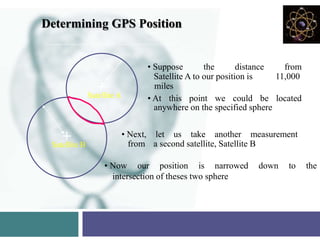
• Suppose the distance from
Satellite A to our position is 11,000
miles
• At this point we could be located
anywhere on the specified sphere
Satellite A
+
• Next, let us take another measurement
from a second satellite, Satellite BSatellite B
+
• Now our position is narrowed down to the
intersection of theses two sphere
Satellite C
+
Determining GPS Position
Satellite A
Satellite B
+
+
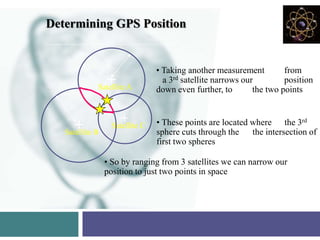
• Taking another measurement from
a 3rd satellite narrows our position
down even further, to the two points
• So by ranging from 3 satellites we can narrow our
position to just two points in space
• These points are located where the 3rd
sphere cuts through the the intersection of
first two spheres
Satellite C
+
How do we decide which one is our true
location?
Satellite A
Satellite B
+
+
• We could make a 4th measurement
from another satellite to determine
the true point
• However, GPS receivers use a 4th satellite to precisely
locate our position
• We can eliminate one of the two
points that gives a ridiculous
answer
• The ridiculous point may be too far
from the earth
OR
Determining GPS Position
How accurate is GPS?
Depends on some variables
• Design of receiver
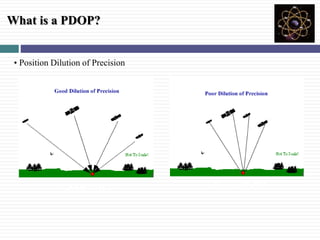
• Relative positions of satellites, technically known as PDOP (Position
dilution of precision)
• Postprocessing
• Time spent on measurement
GPS Receivers
GeoXT Versus Garmin
Mostly used for GIS data collection
Mostly used for
recreational purposes
How accurate is GPS?
Depends on some variables
• Design of receiver
• Relative positions of satellites, often known as DOP (Dilution of
Precision)
• Postprocessing
• Time spent on measurement
WAAS
• Wide Area Augmentation System.
• It provides FREE GPS differential correction data for visible satellites.
• Developed & operated by the FAA (Federal Aviation Administration) for flight
navigation but it’s available free to GPS users.
• WAAS-enabled receivers can provide sub-meter level accuracy anywhere in
most locations of the US and southern Canada.
WAAS
• Differential corrections are computed from ground stations and then
uploaded to geostationary satellites for broadcasting.
• WAAS-enabled GPS receiver automatically uses such correction data to
enhance the positional accuracy.
PDOP
Multipath
SNR
Sources of error
Source:Trimble
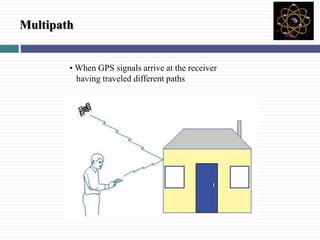
Multipath
• When GPS signals arrive at the receiver
having traveled different paths
What is a PDOP?
• Position Dilution of Precision
Good PDOP Poor PDOP
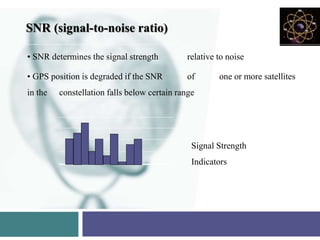
SNR (signal-to-noise ratio)
• SNR determines the signal strength relative to noise
• GPS position is degraded if the SNR of one or more satellites
in the constellation falls below certain range
Signal Strength
Indicators
Common use of GPS
A. GIS data collection & mapping
B. Navigation
C. Recreation
GPS for Navigation
GPS for Navigation
• GPS in PDA
are getting popular in car
comes with voice guidance.
GPS in Recreation
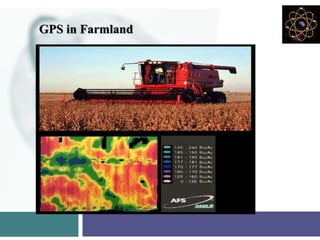
GPS in Farmland
Future GPS
A. GPS in USA
B. GLONASS program from Russia
C. GALILEO from European countries
Global positioning system

Global positioning system

  • 1.
    GLOBAL POSITIONING SYSTEM PreparedBy : Patel Jay C ME(EC)-140870705004 An easy to use technology for everyone
  • 2.
    What is GPS? A very precise positioning system • Developed and maintained by the US Department of Defense (DOD) • Satellite Based * 24 satellites * 20,200 km high orbit
  • 3.
    BUT! Although it isa very precise geographic positioning system •It is very easy to get yourself into trouble •Why? •Because you (probably) don’t understand how it works •And that leads to garbage •Now First We learn the prerequisite terms
  • 4.
    Latitude What is Latitude? •Lines of Latitude run horizontally • Latitude is measured in degrees. • The Equator is 0 degrees Latitude. • Lines of Latitude locate places North or South of the Equator. • The North Pole is 90 degrees N Latitude, and the South Pole is 90 degrees S Latitude.
  • 5.
    Longitude • Lines ofLongitude run vertically. • They are also called Meridians. • The Prime Meridian is found in Greenwich, England. • The Prime Meridian is 0 degrees Longitude. • Lines of Longitude locate places East or West of the Prime Meridian. • There are 180 degrees of east Longitude, and 180 degrees of west Longitude.
  • 6.
    Characteristics of GPS •Free • Precise • Reliable • Anytime & anywhere • All weather • Unlimited user capacity Almost!
  • 7.
    Segments of GPS 1.Space Segment A constellation of 24 satellites 2. Monitor Station A network of earth-based facilities 3. Users & Equipment Source:Trimble
  • 8.
    Segments of GPS 1.Space Segment A constellation of 24 satellites
  • 9.
  • 10.
    How GPS Works……… Uses measurements from 4+ satellites Distance = travel time x speed of light Source:Trimble
  • 11.
    Determining GPS Position •Suppose the distance from Satellite A to our position is 11,000 miles • At this point we could be located anywhere on the specified sphere Satellite A + • Next, let us take another measurement from a second satellite, Satellite BSatellite B + • Now our position is narrowed down to the intersection of theses two sphere
  • 12.
    Satellite C + Determining GPSPosition Satellite A Satellite B + + • Taking another measurement from a 3rd satellite narrows our position down even further, to the two points • So by ranging from 3 satellites we can narrow our position to just two points in space • These points are located where the 3rd sphere cuts through the the intersection of first two spheres
  • 13.
    Satellite C + How dowe decide which one is our true location? Satellite A Satellite B + + • We could make a 4th measurement from another satellite to determine the true point • However, GPS receivers use a 4th satellite to precisely locate our position • We can eliminate one of the two points that gives a ridiculous answer • The ridiculous point may be too far from the earth OR
  • 14.
  • 15.
    How accurate isGPS? Depends on some variables • Design of receiver • Relative positions of satellites, technically known as PDOP (Position dilution of precision) • Postprocessing • Time spent on measurement
  • 16.
  • 17.
    GeoXT Versus Garmin Mostlyused for GIS data collection Mostly used for recreational purposes
  • 18.
    How accurate isGPS? Depends on some variables • Design of receiver • Relative positions of satellites, often known as DOP (Dilution of Precision) • Postprocessing • Time spent on measurement
  • 19.
    WAAS • Wide AreaAugmentation System. • It provides FREE GPS differential correction data for visible satellites. • Developed & operated by the FAA (Federal Aviation Administration) for flight navigation but it’s available free to GPS users. • WAAS-enabled receivers can provide sub-meter level accuracy anywhere in most locations of the US and southern Canada.
  • 20.
    WAAS • Differential correctionsare computed from ground stations and then uploaded to geostationary satellites for broadcasting. • WAAS-enabled GPS receiver automatically uses such correction data to enhance the positional accuracy.
  • 21.
  • 22.
    Multipath • When GPSsignals arrive at the receiver having traveled different paths
  • 23.
    What is aPDOP? • Position Dilution of Precision Good PDOP Poor PDOP
  • 24.
    SNR (signal-to-noise ratio) •SNR determines the signal strength relative to noise • GPS position is degraded if the SNR of one or more satellites in the constellation falls below certain range Signal Strength Indicators
  • 25.
    Common use ofGPS A. GIS data collection & mapping B. Navigation C. Recreation
  • 26.
  • 27.
    GPS for Navigation •GPS in PDA are getting popular in car comes with voice guidance.
  • 28.
  • 29.
  • 30.
    Future GPS A. GPSin USA B. GLONASS program from Russia C. GALILEO from European countries