 Web server basics
 Software for Web servers
 E-mail management and spam control issues
 Internet and Web site utility programs
 Web server hardware
2
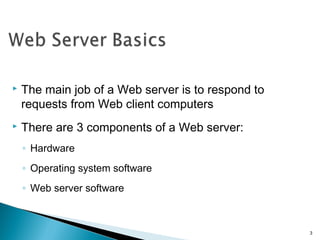
 The main job of a Web server is to respond to
requests from Web client computers
 There are 3 components of a Web server:
◦ Hardware
◦ Operating system software
◦ Web server software
3
 Development sites: Used to evaluate different Web designs
 Intranets: Corporate networks that house internal memos,
corporate policy handbooks, and a variety of other corporate
documents
 Extranets: Intranets that allow authorized parties outside the
company to access information stored in the system
 Transaction-processing sites: Commerce sites that must be
available 24 hours a day, seven days a week
 Content-delivery sites: Deliver content such as news, histories,
summaries, and other digital information
4
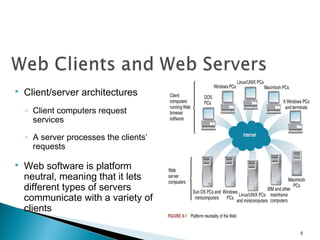
 Client/server architectures
◦ Client computers request
services
◦ A server processes the clients’
requests
 Web software is platform
neutral, meaning that it lets
different types of servers
communicate with a variety of
clients
5
 Dynamic content is nonstatic information
constructed in response to a Web client’s request
◦ Dynamic page: Web page whose content is shaped by a
program in response to user requests
◦ Static page: An unchanging page retrieved from disk
6
 Server-side scripting (or includes)
◦ Programs running on a Web server create Web pages
before sending them back to the requesting Web clients
 Dynamic page-generation technologies: Server
side scripts are combined with html tags to create
dynamic content
◦ Active Server Pages (ASP)
◦ JavaServer Pages (JSP)
◦ PHP: Hypertext Preprocessor (PHP)
7
 Server
◦ Computer used to provide files or make programs
available to other computers
 Server software: Used by a server to make files and programs
available to other computers
 Database server: Server on which database management software
runs
8
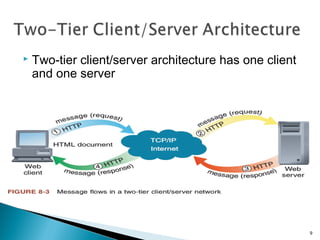
 Two-tier client/server architecture has one client
and one server
9
 Request message: Message that a Web client sends to
request a file or files from a Web server
◦ Typical request message contains:
 Request line
 Contains a command, the name of the target resource, and the
protocol name and version number
 Request headers
 Can contain information about types of files that the client will accept
in response to a request
 Entity body
 Used to pass bulk information to the server
10
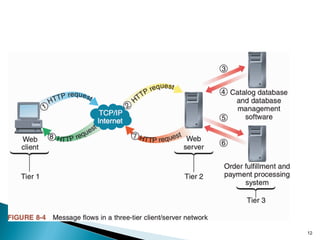
 Three-tier architecture
◦ Extends two-tier architecture to allow additional processing (e.g.,
collection of data from a database) before reponses to requests are
made
 N-tier architectures
◦ Higher-order architectures
◦ Third tier includes software applications that interactively supply and
update information to and from the web server
11
12
 Operating system tasks include running programs
and allocating computer resources
◦ Open-source software: Developed by a community of
programmers who make it available for download at no cost
 Linux: Open-source operating system that is easy to install, fast,
and efficient
13

Internet server components

  • 2.
     Web serverbasics  Software for Web servers  E-mail management and spam control issues  Internet and Web site utility programs  Web server hardware 2
  • 3.
     The mainjob of a Web server is to respond to requests from Web client computers  There are 3 components of a Web server: ◦ Hardware ◦ Operating system software ◦ Web server software 3
  • 4.
     Development sites:Used to evaluate different Web designs  Intranets: Corporate networks that house internal memos, corporate policy handbooks, and a variety of other corporate documents  Extranets: Intranets that allow authorized parties outside the company to access information stored in the system  Transaction-processing sites: Commerce sites that must be available 24 hours a day, seven days a week  Content-delivery sites: Deliver content such as news, histories, summaries, and other digital information 4
  • 5.
     Client/server architectures ◦Client computers request services ◦ A server processes the clients’ requests  Web software is platform neutral, meaning that it lets different types of servers communicate with a variety of clients 5
  • 6.
     Dynamic contentis nonstatic information constructed in response to a Web client’s request ◦ Dynamic page: Web page whose content is shaped by a program in response to user requests ◦ Static page: An unchanging page retrieved from disk 6
  • 7.
     Server-side scripting(or includes) ◦ Programs running on a Web server create Web pages before sending them back to the requesting Web clients  Dynamic page-generation technologies: Server side scripts are combined with html tags to create dynamic content ◦ Active Server Pages (ASP) ◦ JavaServer Pages (JSP) ◦ PHP: Hypertext Preprocessor (PHP) 7
  • 8.
     Server ◦ Computerused to provide files or make programs available to other computers  Server software: Used by a server to make files and programs available to other computers  Database server: Server on which database management software runs 8
  • 9.
     Two-tier client/serverarchitecture has one client and one server 9
  • 10.
     Request message:Message that a Web client sends to request a file or files from a Web server ◦ Typical request message contains:  Request line  Contains a command, the name of the target resource, and the protocol name and version number  Request headers  Can contain information about types of files that the client will accept in response to a request  Entity body  Used to pass bulk information to the server 10
  • 11.
     Three-tier architecture ◦Extends two-tier architecture to allow additional processing (e.g., collection of data from a database) before reponses to requests are made  N-tier architectures ◦ Higher-order architectures ◦ Third tier includes software applications that interactively supply and update information to and from the web server 11
  • 12.
  • 13.
     Operating systemtasks include running programs and allocating computer resources ◦ Open-source software: Developed by a community of programmers who make it available for download at no cost  Linux: Open-source operating system that is easy to install, fast, and efficient 13