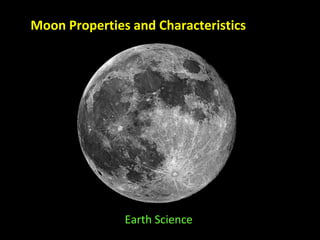
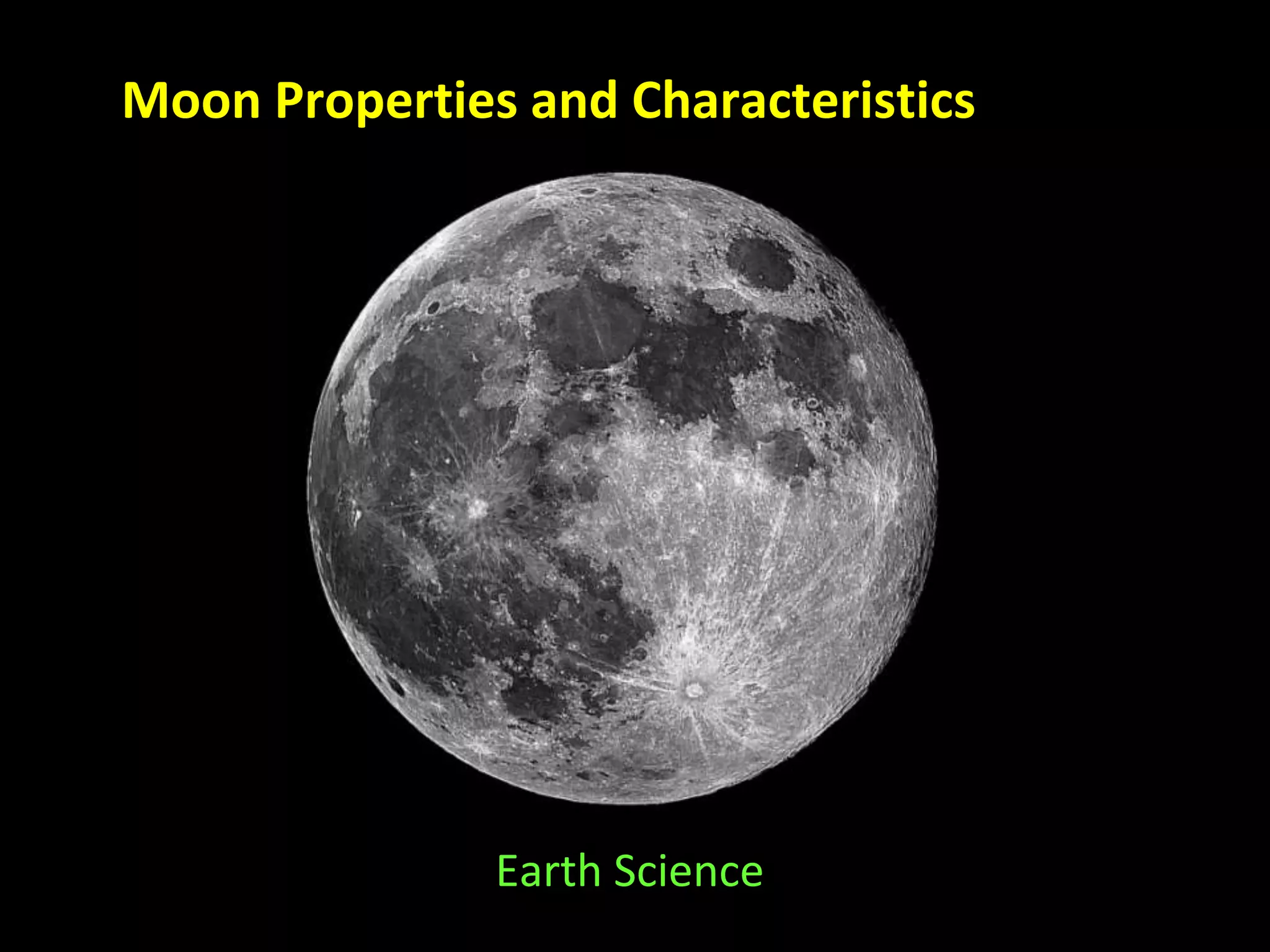
Moon Properties and Characteristics

Earth Science
The Moon

Reaching for the Moon
1. Plans for a crewed lunar expedition began in
the late 1950s.
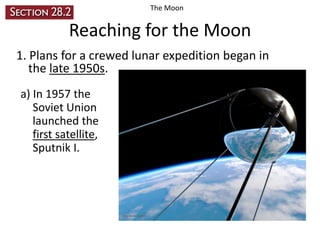
a) In 1957 the
Soviet Union
launched the
first satellite,
Sputnik I.
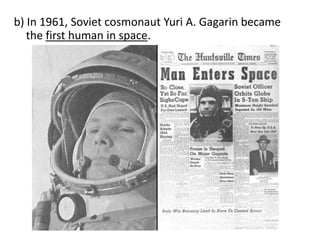
b) In 1961, Soviet cosmonaut Yuri A. Gagarin became
the first human in space.
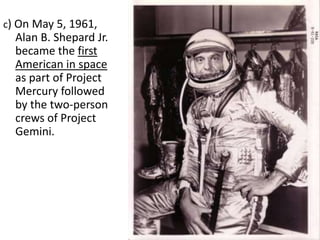
c) On May 5, 1961,

Alan B. Shepard Jr.
became the first
American in space
as part of Project
Mercury followed
by the two-person
crews of Project
Gemini.
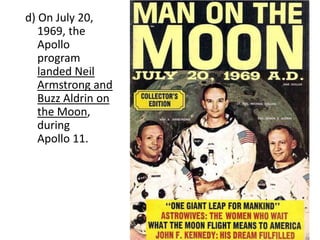
d) On July 20,
1969, the
Apollo
program
landed Neil
Armstrong and
Buzz Aldrin on
the Moon,
during
Apollo 11.
The Moon

The Lunar Surface
1) The albedo of the Moon, the amount of sunlight that its
surface reflects, is only about 0.07 (7 percent) contrasted
with Earth’s average of 0.31 (31 percent).
2) No atmosphere.
3) Surface temperatures can range from 400 K (127°C) in
sunlight.
4) 100 K (–173°C) where it is dark.
The Moon

The Lunar Surface
5) The surface of the Moon consists of several features:
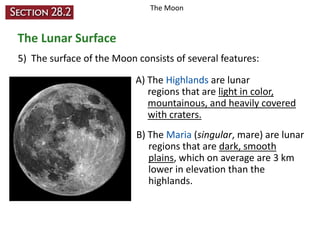
A) The Highlands are lunar
regions that are light in color,
mountainous, and heavily covered
with craters.
B) The Maria (singular, mare) are lunar
regions that are dark, smooth
plains, which on average are 3 km
lower in elevation than the
highlands.
The Moon

The Lunar Surface
– The surface of the Moon consists of several features:

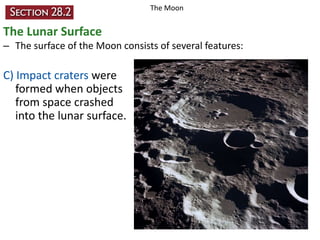
C) Impact craters were
formed when objects
from space crashed
into the lunar surface.
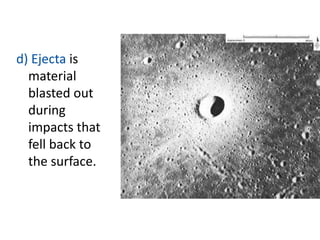
d) Ejecta is
material
blasted out
during
impacts that
fell back to
the surface.
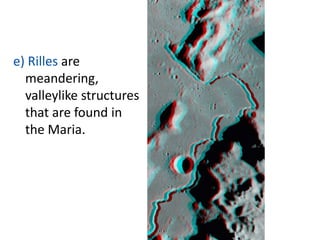
e) Rilles are
meandering,
valleylike structures
that are found in
the Maria.
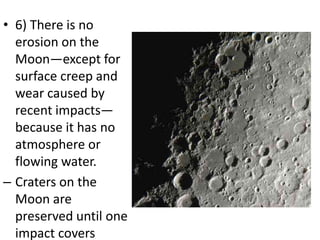
• 6) There is no
erosion on the
Moon—except for
surface creep and
wear caused by
recent impacts—
because it has no
atmosphere or
flowing water.
– Craters on the
Moon are
preserved until one
impact covers
The Moon

1) Composition
– The Moon is made up of minerals similar to those of Earth—
mostly silicates.
– The highlands are predominately lunar breccias, which are
rocks formed by the fusing together of smaller pieces of rock
during impacts.
– The maria are predominately basalts that contain
no water.
The Moon

History of the Moon
• Radiometric dating of lunar rocks from the
highlands indicates an age between 3.8 and
4.6 billion years.
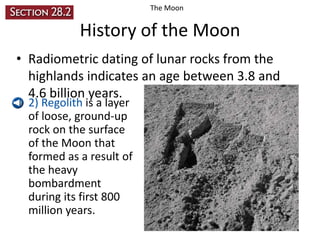
• 2) Regolith is a layer
of loose, ground-up
rock on the surface
of the Moon that
formed as a result of
the heavy
bombardment
during its first 800
million years.
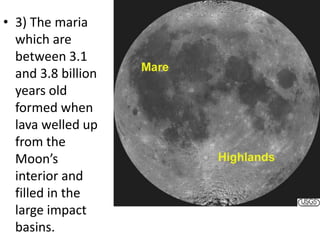
• 3) The maria
which are
between 3.1
and 3.8 billion
years old
formed when
lava welled up
from the
Moon’s
interior and
filled in the
large impact
basins.
The Moon

History of the Moon
Tectonics on the Moon?
1 & 2. Although the Moon experiences moderate moonquakes
approximately once a year, scientists theorize that the Moon
is not tectonically active.
3.. That the Moon has no active volcanoes and no significant
magnetic field supports this conclusion.
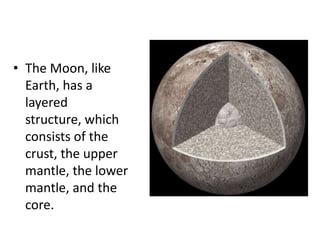
• The Moon, like
Earth, has a
layered
structure, which
consists of the
crust, the upper
mantle, the lower
mantle, and the
core.
The Moon

History of the Moon
2. Formation Theories
– The capture theory proposes that as the solar system was
forming, a large object ventured too near to the forming
Earth, became trapped in its gravitational pull, and formed
into what is now the Moon.
– The simultaneous formation theory states that the Moon and
Earth formed at the same time and in the same general area,
and thus the materials from which they formed were
essentially the same.
The Moon

History of the Moon
6. Formation Theories
– The impact theory is the most commonly accepted theory
of how the Moon formed.
– This theory proposes that the Moon formed as the result of
a gigantic collision between Earth and a Mars-sized object
about 4.5 billion years ago, when the solar system was
forming.

Moon's Properties and Characteristics

  • 1.
    Moon Properties andCharacteristics Earth Science
  • 2.
    The Moon Reaching forthe Moon 1. Plans for a crewed lunar expedition began in the late 1950s. a) In 1957 the Soviet Union launched the first satellite, Sputnik I.
  • 3.
    b) In 1961,Soviet cosmonaut Yuri A. Gagarin became the first human in space.
  • 4.
    c) On May5, 1961, Alan B. Shepard Jr. became the first American in space as part of Project Mercury followed by the two-person crews of Project Gemini.
  • 5.
    d) On July20, 1969, the Apollo program landed Neil Armstrong and Buzz Aldrin on the Moon, during Apollo 11.
  • 6.
    The Moon The LunarSurface 1) The albedo of the Moon, the amount of sunlight that its surface reflects, is only about 0.07 (7 percent) contrasted with Earth’s average of 0.31 (31 percent). 2) No atmosphere. 3) Surface temperatures can range from 400 K (127°C) in sunlight. 4) 100 K (–173°C) where it is dark.
  • 7.
    The Moon The LunarSurface 5) The surface of the Moon consists of several features: A) The Highlands are lunar regions that are light in color, mountainous, and heavily covered with craters. B) The Maria (singular, mare) are lunar regions that are dark, smooth plains, which on average are 3 km lower in elevation than the highlands.
  • 8.
    The Moon The LunarSurface – The surface of the Moon consists of several features: C) Impact craters were formed when objects from space crashed into the lunar surface.
  • 9.
    d) Ejecta is material blastedout during impacts that fell back to the surface.
  • 10.
    e) Rilles are meandering, valleylikestructures that are found in the Maria.
  • 11.
    • 6) Thereis no erosion on the Moon—except for surface creep and wear caused by recent impacts— because it has no atmosphere or flowing water. – Craters on the Moon are preserved until one impact covers
  • 12.
    The Moon 1) Composition –The Moon is made up of minerals similar to those of Earth— mostly silicates. – The highlands are predominately lunar breccias, which are rocks formed by the fusing together of smaller pieces of rock during impacts. – The maria are predominately basalts that contain no water.
  • 13.
    The Moon History ofthe Moon • Radiometric dating of lunar rocks from the highlands indicates an age between 3.8 and 4.6 billion years. • 2) Regolith is a layer of loose, ground-up rock on the surface of the Moon that formed as a result of the heavy bombardment during its first 800 million years.
  • 14.
    • 3) Themaria which are between 3.1 and 3.8 billion years old formed when lava welled up from the Moon’s interior and filled in the large impact basins.
  • 15.
    The Moon History ofthe Moon Tectonics on the Moon? 1 & 2. Although the Moon experiences moderate moonquakes approximately once a year, scientists theorize that the Moon is not tectonically active. 3.. That the Moon has no active volcanoes and no significant magnetic field supports this conclusion.
  • 16.
    • The Moon,like Earth, has a layered structure, which consists of the crust, the upper mantle, the lower mantle, and the core.
  • 17.
    The Moon History ofthe Moon 2. Formation Theories – The capture theory proposes that as the solar system was forming, a large object ventured too near to the forming Earth, became trapped in its gravitational pull, and formed into what is now the Moon. – The simultaneous formation theory states that the Moon and Earth formed at the same time and in the same general area, and thus the materials from which they formed were essentially the same.
  • 18.
    The Moon History ofthe Moon 6. Formation Theories – The impact theory is the most commonly accepted theory of how the Moon formed. – This theory proposes that the Moon formed as the result of a gigantic collision between Earth and a Mars-sized object about 4.5 billion years ago, when the solar system was forming.