The Solar System By: Aurelne Thian
General Information Revolve: When a smaller object circles a larger one.  Rotate: When an object spins on its own axis. 8 Planets were discovered in our solar system Inner Planets: Mercury, Venus, Earth, Mars Outer Planets: Jupiter, Saturn, Uranus, Neptune Inner planets have more craters because they were constantly hit by asteroids at their first 600 million years.
General Information Orbit : A path that a celestial body follows 3 Requirements to become a Planet: Must orbit the sun Have enough mass to become spherical (caused by own gravity) Made its orbit path clear of any objects similar in size. Dwarf planets are not considered planets because they fulfill the first 2 requirements, but didn’t pass for the third. The three dwarf planets are: Pluto, Ceres, Eris
Inner and Outer planets The difference between inner and outer planets is that… Inner planets are between the sun and asteroid belt and the planets are constantly being hit by asteroids (at the beginning, on their first 600 million years) Outer planets are outside the asteroid belt Inner planets were made of sphere shaped rocks while Outer planets are gaseous spheres. Outer planets have rings.
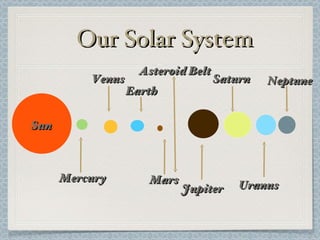
Our Solar System Asteroid Belt Mercury Venus Earth Mars Jupiter Saturn Uranus Neptune Sun
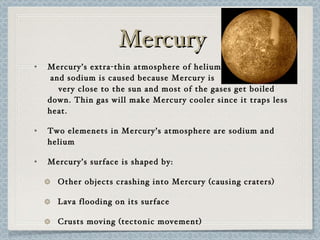
Mercury Mercury’s extra-thin atmosphere of helium  and sodium is caused because Mercury is  very close to the sun and most of the gases get boiled down. Thin gas will make Mercury cooler since it traps less heat. Two elemenets in Mercury’s atmosphere are sodium and helium Mercury’s surface is shaped by: Other objects crashing into Mercury (causing craters) Lava flooding on its surface Crusts moving (tectonic movement)
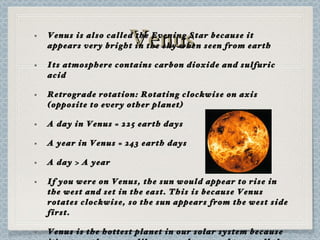
Venus Venus is also called the Evening Star because it appears very bright in the sky when seen from earth Its atmosphere contains carbon dioxide and sulfuric acid Retrograde rotation: Rotating clockwise on axis (opposite to every other planet) A day in Venus = 225 earth days A year in Venus = 243 earth days A day > A year If you were on Venus, the sun would appear to rise in the west and set in the east. This is because Venus rotates clockwise, so the sun appears from the west side first. Venus is the hottest planet in our solar system because it’s atmosphere acts like a greenhouse and traps all the heat from the sun.
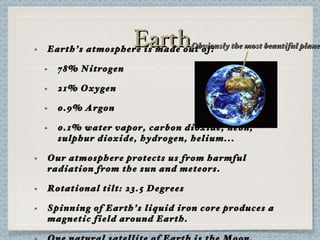
Earth Earth’s atmosphere is made out of: 78% Nitrogen 21% Oxygen 0.9% Argon 0.1% water vapor, carbon dioxide, neon, sulphur dioxide, hydrogen, helium... Our atmosphere protects us from harmful radiation from the sun and meteors. Rotational tilt: 23.5 Degrees Spinning of Earth’s liquid iron core produces a magnetic field around Earth. One natural satellite of Earth is the Moon. Obviously the most beautiful planet
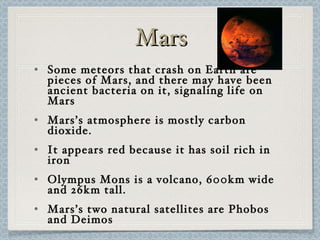
Mars Some meteors that crash on Earth are pieces of Mars, and there may have been ancient bacteria on it, signaling life on Mars Mars’s atmosphere is mostly carbon dioxide. It appears red because it has soil rich in iron Olympus Mons is a volcano, 600km wide and 26km tall. Mars’s two natural satellites are Phobos and Deimos
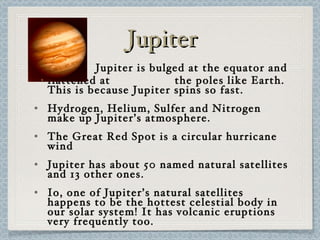
Jupiter Jupiter is bulged at the equator and flattened at  the poles like Earth. This is because Jupiter spins so fast. Hydrogen, Helium, Sulfer and Nitrogen make up Jupiter’s atmosphere. The Great Red Spot is a circular hurricane wind Jupiter has about 50 named natural satellites and 13 other ones. Io, one of Jupiter’s natural satellites happens to be the hottest celestial body in our solar system! It has volcanic eruptions very frequently too.
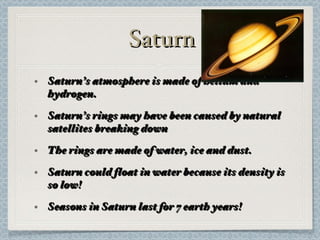
Saturn Saturn’s atmosphere is made of helium and hydrogen. Saturn’s rings may have been caused by natural satellites breaking down The rings are made of water, ice and dust. Saturn could float in water because its density is so low! Seasons in Saturn last for 7 earth years!
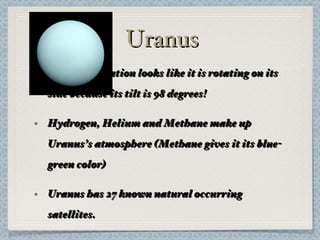
Uranus Uranus’s rotation looks like it is rotating on its side because its tilt is 98 degrees! Hydrogen, Helium and Methane make up Uranus’s atmosphere (Methane gives it its blue-green color) Uranus has 27 known natural occurring satellites.
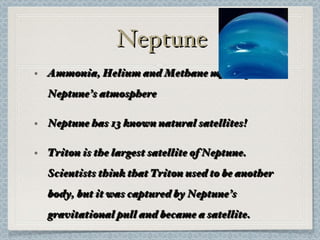
Neptune Ammonia, Helium and Methane make up Neptune’s atmosphere Neptune has 13 known natural satellites! Triton is the largest satellite of Neptune. Scientists think that Triton used to be another body, but it was captured by Neptune’s gravitational pull and became a satellite.
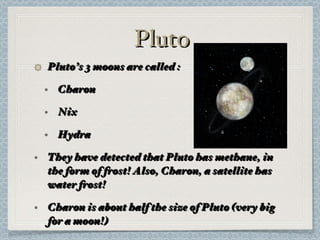
Pluto Pluto’s 3 moons are called : Charon Nix Hydra They have detected that Pluto has methane, in the form of frost! Also, Charon, a satellite has water frost! Charon is about half the size of Pluto (very big for a moon!)
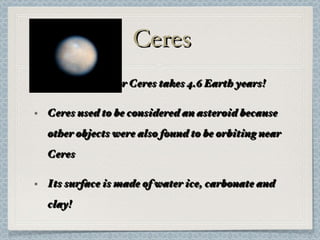
Ceres A revolution for Ceres takes 4.6 Earth years! Ceres used to be considered an asteroid because other objects were also found to be orbiting near Ceres Its surface is made of water ice, carbonate and clay!
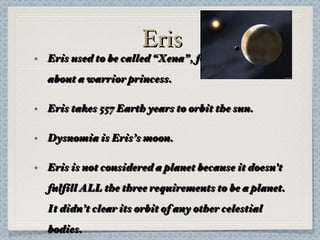
Eris Eris used to be called “Xena”, following the show about a warrior princess. Eris takes 557 Earth years to orbit the sun. Dysnomia is Eris’s moon. Eris is not considered a planet because it doesn't fulfill ALL the three requirements to be a planet. It didn’t clear its orbit of any other celestial bodies.
Citations http://starchild.gsfc.nasa.gov/docs/StarChild/solar_system_level2/eris.html

Planets ppt

  • 1.
    The Solar SystemBy: Aurelne Thian
  • 2.
    General Information Revolve:When a smaller object circles a larger one. Rotate: When an object spins on its own axis. 8 Planets were discovered in our solar system Inner Planets: Mercury, Venus, Earth, Mars Outer Planets: Jupiter, Saturn, Uranus, Neptune Inner planets have more craters because they were constantly hit by asteroids at their first 600 million years.
  • 3.
    General Information Orbit: A path that a celestial body follows 3 Requirements to become a Planet: Must orbit the sun Have enough mass to become spherical (caused by own gravity) Made its orbit path clear of any objects similar in size. Dwarf planets are not considered planets because they fulfill the first 2 requirements, but didn’t pass for the third. The three dwarf planets are: Pluto, Ceres, Eris
  • 4.
    Inner and Outerplanets The difference between inner and outer planets is that… Inner planets are between the sun and asteroid belt and the planets are constantly being hit by asteroids (at the beginning, on their first 600 million years) Outer planets are outside the asteroid belt Inner planets were made of sphere shaped rocks while Outer planets are gaseous spheres. Outer planets have rings.
  • 5.
    Our Solar SystemAsteroid Belt Mercury Venus Earth Mars Jupiter Saturn Uranus Neptune Sun
  • 6.
    Mercury Mercury’s extra-thinatmosphere of helium and sodium is caused because Mercury is very close to the sun and most of the gases get boiled down. Thin gas will make Mercury cooler since it traps less heat. Two elemenets in Mercury’s atmosphere are sodium and helium Mercury’s surface is shaped by: Other objects crashing into Mercury (causing craters) Lava flooding on its surface Crusts moving (tectonic movement)
  • 7.
    Venus Venus isalso called the Evening Star because it appears very bright in the sky when seen from earth Its atmosphere contains carbon dioxide and sulfuric acid Retrograde rotation: Rotating clockwise on axis (opposite to every other planet) A day in Venus = 225 earth days A year in Venus = 243 earth days A day > A year If you were on Venus, the sun would appear to rise in the west and set in the east. This is because Venus rotates clockwise, so the sun appears from the west side first. Venus is the hottest planet in our solar system because it’s atmosphere acts like a greenhouse and traps all the heat from the sun.
  • 8.
    Earth Earth’s atmosphereis made out of: 78% Nitrogen 21% Oxygen 0.9% Argon 0.1% water vapor, carbon dioxide, neon, sulphur dioxide, hydrogen, helium... Our atmosphere protects us from harmful radiation from the sun and meteors. Rotational tilt: 23.5 Degrees Spinning of Earth’s liquid iron core produces a magnetic field around Earth. One natural satellite of Earth is the Moon. Obviously the most beautiful planet
  • 9.
    Mars Some meteorsthat crash on Earth are pieces of Mars, and there may have been ancient bacteria on it, signaling life on Mars Mars’s atmosphere is mostly carbon dioxide. It appears red because it has soil rich in iron Olympus Mons is a volcano, 600km wide and 26km tall. Mars’s two natural satellites are Phobos and Deimos
  • 10.
    Jupiter Jupiter isbulged at the equator and flattened at the poles like Earth. This is because Jupiter spins so fast. Hydrogen, Helium, Sulfer and Nitrogen make up Jupiter’s atmosphere. The Great Red Spot is a circular hurricane wind Jupiter has about 50 named natural satellites and 13 other ones. Io, one of Jupiter’s natural satellites happens to be the hottest celestial body in our solar system! It has volcanic eruptions very frequently too.
  • 11.
    Saturn Saturn’s atmosphereis made of helium and hydrogen. Saturn’s rings may have been caused by natural satellites breaking down The rings are made of water, ice and dust. Saturn could float in water because its density is so low! Seasons in Saturn last for 7 earth years!
  • 12.
    Uranus Uranus’s rotationlooks like it is rotating on its side because its tilt is 98 degrees! Hydrogen, Helium and Methane make up Uranus’s atmosphere (Methane gives it its blue-green color) Uranus has 27 known natural occurring satellites.
  • 13.
    Neptune Ammonia, Heliumand Methane make up Neptune’s atmosphere Neptune has 13 known natural satellites! Triton is the largest satellite of Neptune. Scientists think that Triton used to be another body, but it was captured by Neptune’s gravitational pull and became a satellite.
  • 14.
    Pluto Pluto’s 3moons are called : Charon Nix Hydra They have detected that Pluto has methane, in the form of frost! Also, Charon, a satellite has water frost! Charon is about half the size of Pluto (very big for a moon!)
  • 15.
    Ceres A revolutionfor Ceres takes 4.6 Earth years! Ceres used to be considered an asteroid because other objects were also found to be orbiting near Ceres Its surface is made of water ice, carbonate and clay!
  • 16.
    Eris Eris usedto be called “Xena”, following the show about a warrior princess. Eris takes 557 Earth years to orbit the sun. Dysnomia is Eris’s moon. Eris is not considered a planet because it doesn't fulfill ALL the three requirements to be a planet. It didn’t clear its orbit of any other celestial bodies.
  • 17.