Moon
The Moon is Earth’s only satellite.
It is a cold, dry orb whose surface is
studded with craters and strewn with
rocks and dust called regolith. The
moon has no atmosphere. Recent
lunar missions indicate that there
might have been some frozen ice at
the poles.
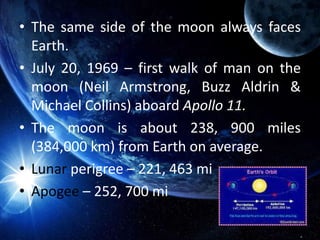
• The same side of the moon always faces
Earth.
• July 20, 1969 – first walk of man on the
moon (Neil Armstrong, Buzz Aldrin &
Michael Collins) aboard Apollo 11.
• The moon is about 238, 900 miles
(384,000 km) from Earth on average.
• Lunar perigree – 221, 463 mi
• Apogee – 252, 700 mi
• Revolution – 27 days and 8 hours
• Rotation – 27 days and 8 hours
(synchronous rotation with the Earth)
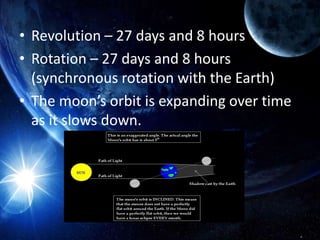
• The moon’s orbit is expanding over time
as it slows down.
SAROS
Saros is the roughly 18-year periodic
cycle of the Earth-Moon-Sun system.
Every 6,585 days, the Earth, Moon and
Sun are in exactly the same position.
When there is a lunar eclipse, there
will also be one exactly 6,585 days
later.
Size
The moon's diameter is 2,159 miles
(3,474 km), 27% of the diameter of
the Earth (a bit over a quarter of
the Earth's diameter).
Mass and Gravity
The moon's mass is (7.35 x 10 22 kg), about 1/81
of the Earth's mass.
The moon's gravitational force is only 17% of the
Earth's gravity. For example, a 100 pound (45 kg)
person would weigh only 17 pounds (7.6 kg) on
the Moon.
The moon's density is 3340 kg/m 3. This is about
3/5 the density of the Earth.
TEMPERATURE
The temperature on the Moon ranges
from daytime highs of about 130°C =
265°F to nighttime lows of about -
110°C = -170°F.
ATMOSPHERE
The moon has no atmosphere. On the
moon, the sky is always appears dark,
even on the bright side (because there
is no atmosphere). Also, since sound
waves travel through air, the moon is
silent; there can be no sound
transmission on the moon.
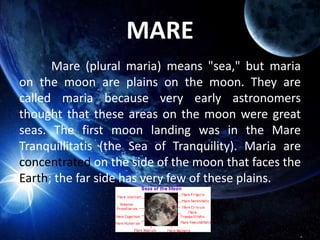
MARE
Mare (plural maria) means "sea," but maria
on the moon are plains on the moon. They are
called maria because very early astronomers
thought that these areas on the moon were great
seas. The first moon landing was in the Mare
Tranquillitatis (the Sea of Tranquility). Maria are
concentrated on the side of the moon that faces the
Earth; the far side has very few of these plains.
CRATERS AND RILLES
Craters range in size up to many
hundreds of kilometers, but the most
enormous craters have been flooded
by lava, and only parts of the outline
are visible. The biggest intact lunar
crater is Clavius which is 100 miles
(160 km) in diameter.
A rille is a long, narrow valley on the
surface of the moon. Hadley Rille is a long
valley on the surface of the moon. This rille
is 75 miles (125 km) long, 1300 feet (400
m) deep, and almost 1 mile (1500 m) wide
at its widest point. It was formed by
molten basaltic lava that carved out a
steep channel along the base of the
Apennine Front (which was explored by the
Apollo 15 astronauts in 1971).
LIBRATION
Libration is a rocking movement of the Moon.
Librations cause us to view the Moon from
different angles at different times, enabling us to
see about 59 percent of the Moon's surface
from Earth. There are librations due to
variations in the rate of the Moon's orbital
motion (longitudinal libration) and to the
inclination of the Moon's equator with respect
to its orbital plane (latitudinal libration).
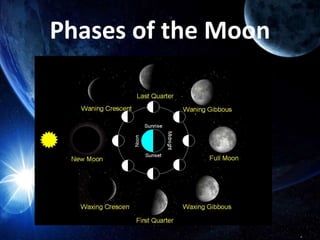
Phases of the Moon
“THE MOON”
SCI 105 ASTRONOMY
Presented by:
ISSAH JAPSON, BSED Math

The Moon

  • 2.
    Moon The Moon isEarth’s only satellite. It is a cold, dry orb whose surface is studded with craters and strewn with rocks and dust called regolith. The moon has no atmosphere. Recent lunar missions indicate that there might have been some frozen ice at the poles.
  • 3.
    • The sameside of the moon always faces Earth. • July 20, 1969 – first walk of man on the moon (Neil Armstrong, Buzz Aldrin & Michael Collins) aboard Apollo 11. • The moon is about 238, 900 miles (384,000 km) from Earth on average. • Lunar perigree – 221, 463 mi • Apogee – 252, 700 mi
  • 4.
    • Revolution –27 days and 8 hours • Rotation – 27 days and 8 hours (synchronous rotation with the Earth) • The moon’s orbit is expanding over time as it slows down.
  • 5.
    SAROS Saros is theroughly 18-year periodic cycle of the Earth-Moon-Sun system. Every 6,585 days, the Earth, Moon and Sun are in exactly the same position. When there is a lunar eclipse, there will also be one exactly 6,585 days later.
  • 6.
    Size The moon's diameteris 2,159 miles (3,474 km), 27% of the diameter of the Earth (a bit over a quarter of the Earth's diameter).
  • 7.
    Mass and Gravity Themoon's mass is (7.35 x 10 22 kg), about 1/81 of the Earth's mass. The moon's gravitational force is only 17% of the Earth's gravity. For example, a 100 pound (45 kg) person would weigh only 17 pounds (7.6 kg) on the Moon. The moon's density is 3340 kg/m 3. This is about 3/5 the density of the Earth.
  • 8.
    TEMPERATURE The temperature onthe Moon ranges from daytime highs of about 130°C = 265°F to nighttime lows of about - 110°C = -170°F.
  • 9.
    ATMOSPHERE The moon hasno atmosphere. On the moon, the sky is always appears dark, even on the bright side (because there is no atmosphere). Also, since sound waves travel through air, the moon is silent; there can be no sound transmission on the moon.
  • 10.
    MARE Mare (plural maria)means "sea," but maria on the moon are plains on the moon. They are called maria because very early astronomers thought that these areas on the moon were great seas. The first moon landing was in the Mare Tranquillitatis (the Sea of Tranquility). Maria are concentrated on the side of the moon that faces the Earth; the far side has very few of these plains.
  • 11.
    CRATERS AND RILLES Cratersrange in size up to many hundreds of kilometers, but the most enormous craters have been flooded by lava, and only parts of the outline are visible. The biggest intact lunar crater is Clavius which is 100 miles (160 km) in diameter.
  • 12.
    A rille isa long, narrow valley on the surface of the moon. Hadley Rille is a long valley on the surface of the moon. This rille is 75 miles (125 km) long, 1300 feet (400 m) deep, and almost 1 mile (1500 m) wide at its widest point. It was formed by molten basaltic lava that carved out a steep channel along the base of the Apennine Front (which was explored by the Apollo 15 astronauts in 1971).
  • 13.
    LIBRATION Libration is arocking movement of the Moon. Librations cause us to view the Moon from different angles at different times, enabling us to see about 59 percent of the Moon's surface from Earth. There are librations due to variations in the rate of the Moon's orbital motion (longitudinal libration) and to the inclination of the Moon's equator with respect to its orbital plane (latitudinal libration).
  • 14.
  • 15.
    “THE MOON” SCI 105ASTRONOMY Presented by: ISSAH JAPSON, BSED Math