Erath Crust
Vivek
Srivastava
Earth Layers
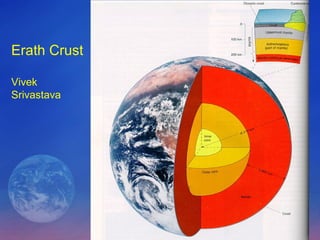
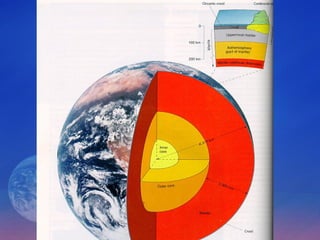
• The Earth is divided into four main
layers.
*Inner Core
*Outer Core
*Mantle
*Crust
The Earth’s Crust
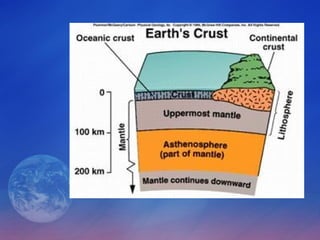
• The crust is the thinnest layer on Earth, 5 km to 100 km
• There are two types of crust

• Oceanic crust – made mostly of the igneous rock
basalt. Found under the ocean. Relatively thin,
5 km to 7 km. Contains more iron than the
Continental crust, therefore is more dense.

• Continental crust – made mostly of granite.

Found under the continents. Relatively thick, up
to 100 km.
Special parts of the Crust
• Lithosphere
• Crust is the upper part of the lithosphere.
• Broken up into large plates.
• The uppermost part of the mantle is also
part of the Lithosphere
• Asthenosphere
• Upper part of mantle, below lithosphere
• 130 – 160 km thick
• Cooler part of the mantle that the
lithosphere plates slide on top of.
The Earth’s Mantle
• Located directly above the outer core
• Starts below the crust
• Is the largest layer
• 80% of the Earth’s volume & 68% of Earth’s mass
The Earth’s Mantle
• Composed of more iron than the crust.
• Density, pressure, and temperature all increase
the deeper you go in the mantle
• Temperature ranges from 870 C – 2200 C
Special layers of the mantle
• Lithosphere – crust plus the upper, solid
part of the mantle. Forms plates.
• Asthenosphere – just under the
lithosphere. Slow moving “Silly putty”
layer on which the lithospheric plates
slide. (Solid rock that flows very
slowly.)
The Earth’s Core
The Earth’s Core
• Composed of the inner and outer core
• Both are made of iron and nickel
The Earth’s Outer Core
The Outer Core - Liquid
• Surrounds the inner core
• Temperature ranges from 2200 C – 5000 C
near inner core
• Molten (liquid) iron and nickel
The Earth’s Inner Core
The Inner Core - Solid
• Temperature reaches 5000 C
• Solid iron and nickel
• Usually both would be liquid but are solid in the
core because of the incredible pressure
• The solid core is the source of Earth’s magnetic
field
Magnetosphere
• The inner core and outer cores do not
turn at the same speed as the rest of
the earth.
• Causes a generator effect which
produces a magnetic field.
• It protects us from some of the sun’s
harmful radiation.
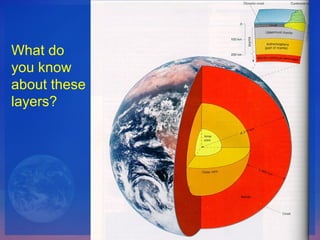
• What does the inside of the
Earth look like?
• How do scientists know that
there is a solid inner core?
Determining the composition of the Earth
• Scientists cannot see the interior of the planet,
or drill to the core, so they use seismic waves to
determine the composition of the layers.
• Seismic waves: are vibrations that are produced
when an earthquake happens.
• Seismic waves travel at different speed
depending on the composition and density of
material. Measuring these waves tells us what is
in the Earth’s layers, and how the materials
change.
i
What do
you know
about these
layers?

Earth crust

  • 1.
  • 2.
    Earth Layers • TheEarth is divided into four main layers. *Inner Core *Outer Core *Mantle *Crust
  • 3.
    The Earth’s Crust •The crust is the thinnest layer on Earth, 5 km to 100 km • There are two types of crust • Oceanic crust – made mostly of the igneous rock basalt. Found under the ocean. Relatively thin, 5 km to 7 km. Contains more iron than the Continental crust, therefore is more dense. • Continental crust – made mostly of granite. Found under the continents. Relatively thick, up to 100 km.
  • 4.
    Special parts ofthe Crust • Lithosphere • Crust is the upper part of the lithosphere. • Broken up into large plates. • The uppermost part of the mantle is also part of the Lithosphere • Asthenosphere • Upper part of mantle, below lithosphere • 130 – 160 km thick • Cooler part of the mantle that the lithosphere plates slide on top of.
  • 7.
    The Earth’s Mantle •Located directly above the outer core • Starts below the crust • Is the largest layer • 80% of the Earth’s volume & 68% of Earth’s mass
  • 8.
    The Earth’s Mantle •Composed of more iron than the crust. • Density, pressure, and temperature all increase the deeper you go in the mantle • Temperature ranges from 870 C – 2200 C
  • 10.
    Special layers ofthe mantle • Lithosphere – crust plus the upper, solid part of the mantle. Forms plates. • Asthenosphere – just under the lithosphere. Slow moving “Silly putty” layer on which the lithospheric plates slide. (Solid rock that flows very slowly.)
  • 12.
    The Earth’s Core TheEarth’s Core • Composed of the inner and outer core • Both are made of iron and nickel
  • 13.
    The Earth’s OuterCore The Outer Core - Liquid • Surrounds the inner core • Temperature ranges from 2200 C – 5000 C near inner core • Molten (liquid) iron and nickel
  • 15.
    The Earth’s InnerCore The Inner Core - Solid • Temperature reaches 5000 C • Solid iron and nickel • Usually both would be liquid but are solid in the core because of the incredible pressure • The solid core is the source of Earth’s magnetic field
  • 16.
    Magnetosphere • The innercore and outer cores do not turn at the same speed as the rest of the earth. • Causes a generator effect which produces a magnetic field. • It protects us from some of the sun’s harmful radiation.
  • 19.
    • What doesthe inside of the Earth look like? • How do scientists know that there is a solid inner core?
  • 20.
    Determining the compositionof the Earth • Scientists cannot see the interior of the planet, or drill to the core, so they use seismic waves to determine the composition of the layers. • Seismic waves: are vibrations that are produced when an earthquake happens. • Seismic waves travel at different speed depending on the composition and density of material. Measuring these waves tells us what is in the Earth’s layers, and how the materials change.
  • 21.
  • 22.