Solar
System
T- 1-855-694-8886
Email- info@iTutor.com
By iTutor.com
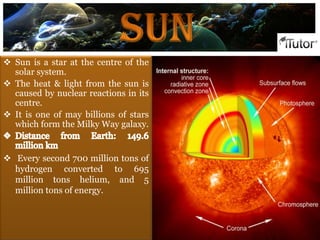
 Sun is a star at the centre of the
solar system.
 The heat & light from the sun is
caused by nuclear reactions in its
centre.
 It is one of may billions of stars
which form the Milky Way galaxy.
 Every second 700 million tons of
hydrogen converted to 695
million tons helium, and 5
million tons of energy.
`Solar System
`
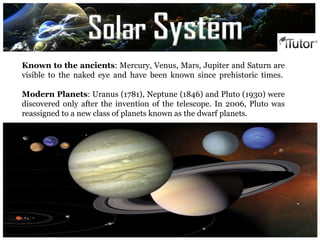
Known to the ancients: Mercury, Venus, Mars, Jupiter and Saturn are
visible to the naked eye and have been known since prehistoric times.
Modern Planets: Uranus (1781), Neptune (1846) and Pluto (1930) were
discovered only after the invention of the telescope. In 2006, Pluto was
reassigned to a new class of planets known as the dwarf planets.
Solar System
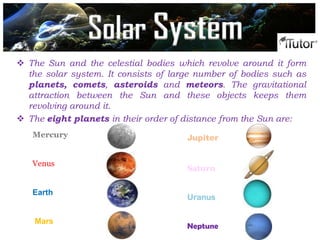
 The Sun and the celestial bodies which revolve around it form
the solar system. It consists of large number of bodies such as
planets, comets, asteroids and meteors. The gravitational
attraction between the Sun and these objects keeps them
revolving around it.
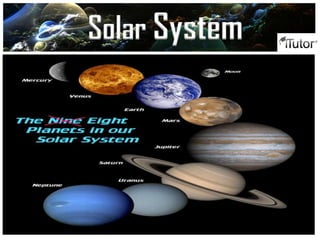
 The eight planets in their order of distance from the Sun are:
Mercury
Venus
Earth
Mars
Jupiter
Saturn
Uranus
Neptune
Solar System
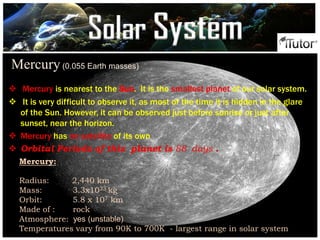
Mercury(0.055 Earth masses)
 Mercury is nearest to the Sun. It is the smallest planet of our solar system.
 It is very difficult to observe it, as most of the time it is hidden in the glare
of the Sun. However, it can be observed just before sunrise or just after

sunset, near the horizon.
 Mercury has no satellite of its own
 Orbital Periods of this planet is 88 days .
Mercury:
Radius: 2,440 km
Mass: 3.3x10²³ kg
Orbit: 5.8 x 10⁷ km
Made of : rock
Atmosphere: yes (unstable)
Temperatures vary from 90K to 700K - largest range in solar system
Solar System
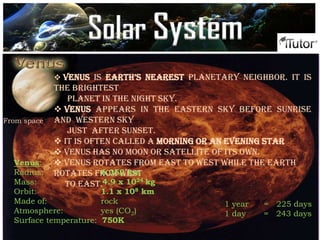
From space
 Venus is earth’s nearest planetary neighbor. It is
the brightest
planet in the night sky.
 Venus appears in the eastern sky before sunrise
and western sky
just after sunset.
 It is often called a morning or an evening star
 Venus has no moon or satellite of its own.
 Venus rotates from east to west while the Earth
rotates from west
to east.
Venus:
Radius: 6,052 km
Mass: 4.9 x 1024 kg
Orbit: 1.1 x 10⁸ km
Made of: rock
Atmosphere: yes (CO2)
Surface temperature: 750K
1 year = 225 days
1 day = 243 days
Solar System
The Earth
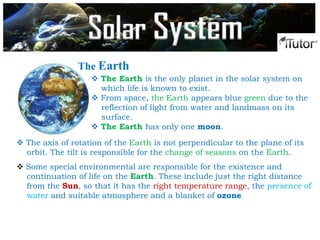
 The Earth is the only planet in the solar system on
which life is known to exist.
 From space, the Earth appears blue green due to the
reflection of light from water and landmass on its
surface.
 The Earth has only one moon.
 Some special environmental are responsible for the existence and
continuation of life on the Earth. These include just the right distance
from the Sun, so that it has the right temperature range, the presence of
water and suitable atmosphere and a blanket of ozone
 The axis of rotation of the Earth is not perpendicular to the plane of its
orbit. The tilt is responsible for the change of seasons on the Earth.
Solar System
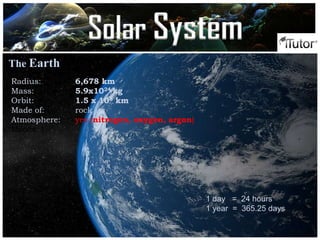
The Earth
Radius: 6,678 km
Mass: 5.9x1024 kg
Orbit: 1.5 x 10⁸ km
Made of: rock
Atmosphere: yes (nitrogen, oxygen, argon)
Moons: 1
1 day = 24 hours
1 year = 365.25 days
Solar System
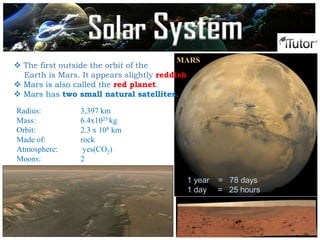
 The first outside the orbit of the
Earth is Mars. It appears slightly reddish
 Mars is also called the red planet.
 Mars has two small natural satellites.
MARS
Radius: 3,397 km
Mass: 6.4x10²³ kg
Orbit: 2.3 x 10⁸ km
Made of: rock
Atmosphere: yes(CO2)
Moons: 2
1 year = 78 days
1 day = 25 hours
Solar System
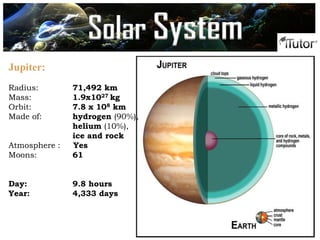
Jupiter
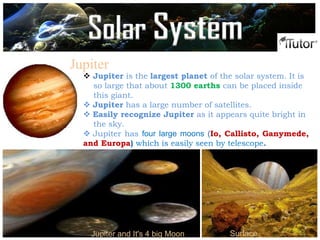
 Jupiter is the largest planet of the solar system. It is
so large that about 1300 earths can be placed inside
this giant.
 Jupiter has a large number of satellites.
 Easily recognize Jupiter as it appears quite bright in
the sky.
 Jupiter has four large moons (Io, Callisto, Ganymede,
and Europa) which is easily seen by telescope.
Jupiter and It's 4 big Moon Surface
Solar System
Jupiter:
Radius: 71,492 km
Mass: 1.9x1027 kg
Orbit: 7.8 x 10⁸ km
Made of: hydrogen (90%),
helium (10%),
ice and rock
Atmosphere : Yes
Moons: 61
Day: 9.8 hours
Year: 4,333 days
Solar System
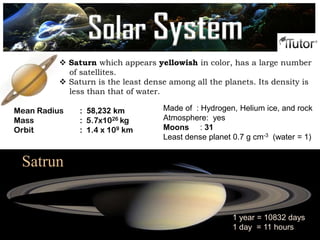
 Saturn which appears yellowish in color, has a large number
of satellites.
 Saturn is the least dense among all the planets. Its density is
less than that of water.
Satrun
1 year = 10832 days
1 day = 11 hours
Mean Radius : 58,232 km
Mass : 5.7x1026 kg
Orbit : 1.4 x 10⁹ km
Made of : Hydrogen, Helium ice, and rock
Atmosphere: yes
Moons : 31
Least dense planet 0.7 g cm-3 (water = 1)
Solar System
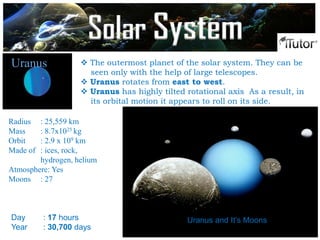
 The outermost planet of the solar system. They can be
seen only with the help of large telescopes.
 Uranus rotates from east to west.
 Uranus has highly tilted rotational axis As a result, in
its orbital motion it appears to roll on its side.
Uranus
Radius : 25,559 km
Mass : 8.7x1025 kg
Orbit : 2.9 x 10⁹ km
Made of : ices, rock,
hydrogen, helium
Atmosphere: Yes
Moons : 27
Day : 17 hours
Year : 30,700 days
Uranus and It’s Moons
Solar System
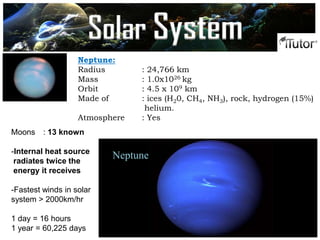
Neptune:
Radius : 24,766 km
Mass : 1.0x1026 kg
Orbit : 4.5 x 10⁹ km
Made of : ices (H20, CH4, NH3), rock, hydrogen (15%)
helium.
Atmosphere : Yes
Moons : 13 known
-Internal heat source
radiates twice the
energy it receives
-Fastest winds in solar
system > 2000km/hr
1 day = 16 hours
1 year = 60,225 days
Neptune
Solar System
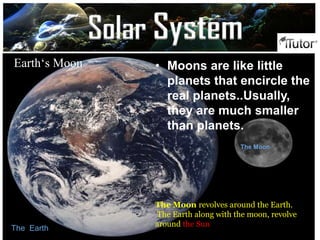
The Earth
The Moon
Earth‘s Moon • Moons are like little
planets that encircle the
real planets..Usually,
they are much smaller
than planets.
The Moon revolves around the Earth.
The Earth along with the moon, revolve
around the Sun
Solar System
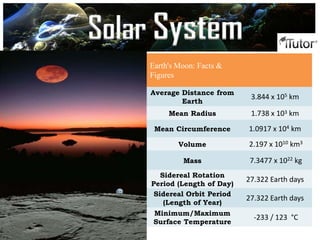
Earth's Moon: Facts &
Figures
Average Distance from
Earth
3.844 x 10⁵ km
Mean Radius 1.738 x 10³ km
Mean Circumference 1.0917 x 10⁴ km
Volume 2.197 x 10¹⁰ km3
Mass 7.3477 x 10²² kg
Sidereal Rotation
Period (Length of Day)
27.322 Earth days
Sidereal Orbit Period
(Length of Year)
27.322 Earth days
Minimum/Maximum
Surface Temperature
-233 / 123 °C
The Moon
Solar System
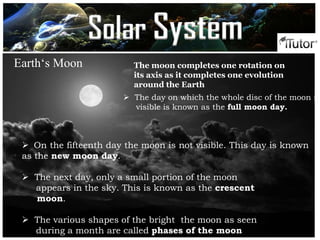
 The day on which the whole disc of the moon is
visible is known as the full moon day.
 On the fifteenth day the moon is not visible. This day is known
as the new moon day.
 The next day, only a small portion of the moon
appears in the sky. This is known as the crescent
moon.
 The various shapes of the bright the moon as seen
during a month are called phases of the moon
Earth‘s Moon The moon completes one rotation on
its axis as it completes one evolution
around the Earth
Solar System
Earth‘s Moon
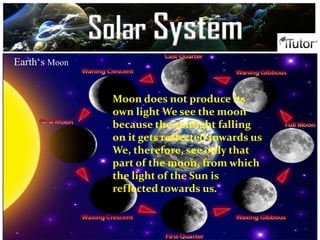
Moon does not produce its
own light We see the moon
because the sunlight falling
on it gets reflected towards us
We, therefore, see only that
part of the moon, from which
the light of the Sun is
reflected towards us.
Solar System
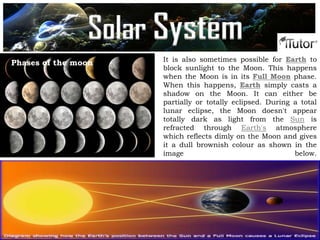
Phases of the moon It is also sometimes possible for Earth to
block sunlight to the Moon. This happens
when the Moon is in its Full Moon phase.
When this happens, Earth simply casts a
shadow on the Moon. It can either be
partially or totally eclipsed. During a total
lunar eclipse, the Moon doesn't appear
totally dark as light from the Sun is
refracted through Earth's atmosphere
which reflects dimly on the Moon and gives
it a dull brownish colour as shown in the
image below.
Solar System
Phases of the moon
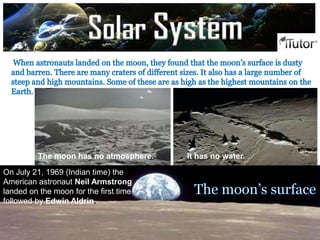
The moon has no atmosphere. It has no water.
On July 21, 1969 (Indian time) the
American astronaut Neil Armstrong
landed on the moon for the first time
followed by Edwin Aldrin.
Solar System
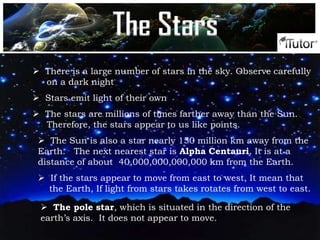
 There is a large number of stars in the sky. Observe carefully
on a dark night
 Stars emit light of their own
 The stars are millions of times farther away than the Sun.
Therefore, the stars appear to us like points.
 The Sun is also a star nearly 150 million km away from the
Earth. The next nearest star is Alpha Centauri. It is at a
distance of about 40,000,000,000,000 km from the Earth.
 If the stars appear to move from east to west, It mean that
the Earth, If light from stars takes rotates from west to east.
 The pole star, which is situated in the direction of the
earth’s axis. It does not appear to move.
The Stars
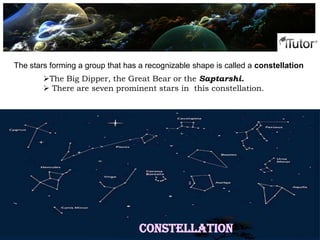
The stars forming a group that has a recognizable shape is called a constellation
The Big Dipper, the Great Bear or the Saptarshi.
 There are seven prominent stars in this constellation.
constellation
Phases of the moon
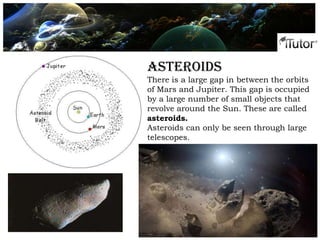
Asteroids
There is a large gap in between the orbits
of Mars and Jupiter. This gap is occupied
by a large number of small objects that
revolve around the Sun. These are called
asteroids.
Asteroids can only be seen through large
telescopes.
Phases of the moon
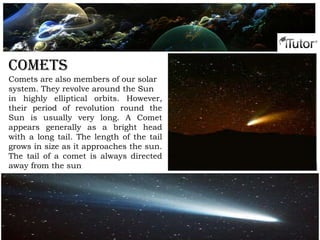
Comets
Comets are also members of our solar
system. They revolve around the Sun
in highly elliptical orbits. However,
their period of revolution round the
Sun is usually very long. A Comet
appears generally as a bright head
with a long tail. The length of the tail
grows in size as it approaches the sun.
The tail of a comet is always directed
away from the sun
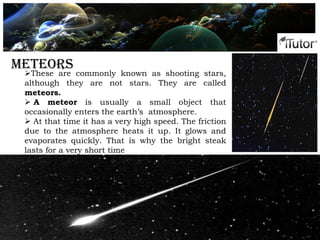
Phases of the moonMeteors
These are commonly known as shooting stars,
although they are not stars. They are called
meteors.
 A meteor is usually a small object that
occasionally enters the earth’s atmosphere.
 At that time it has a very high speed. The friction
due to the atmosphere heats it up. It glows and
evaporates quickly. That is why the bright steak
lasts for a very short time
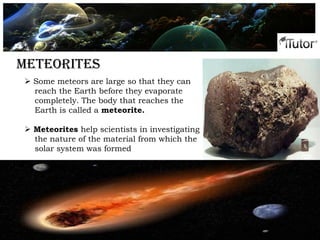
Meteorites
 Some meteors are large so that they can
reach the Earth before they evaporate
completely. The body that reaches the
Earth is called a meteorite.
 Meteorites help scientists in investigating
the nature of the material from which the
solar system was formed
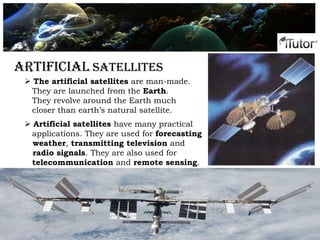
Artificial Satellites
 The artificial satellites are man-made.
They are launched from the Earth.
They revolve around the Earth much
closer than earth’s natural satellite.
 Artificial satellites have many practical
applications. They are used for forecasting
weather, transmitting television and
radio signals. They are also used for
telecommunication and remote sensing.
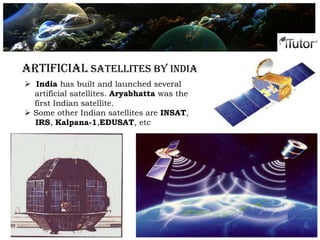
Artificial Satellites By India
 India has built and launched several
artificial satellites. Aryabhatta was the
first Indian satellite.
 Some other Indian satellites are INSAT,
IRS, Kalpana-1,EDUSAT, etc
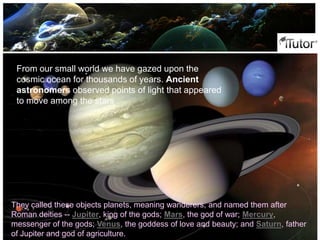
They called these objects planets, meaning wanderers, and named them after
Roman deities -- Jupiter, king of the gods; Mars, the god of war; Mercury,
messenger of the gods; Venus, the goddess of love and beauty; and Saturn, father
of Jupiter and god of agriculture.
From our small world we have gazed upon the
cosmic ocean for thousands of years. Ancient
astronomers observed points of light that appeared
to move among the stars
Call us for more
information:
www.iTutor.com
1-855-694-8886
Visit

Stars & The Solar System

  • 1.
  • 2.
     Sun isa star at the centre of the solar system.  The heat & light from the sun is caused by nuclear reactions in its centre.  It is one of may billions of stars which form the Milky Way galaxy.  Every second 700 million tons of hydrogen converted to 695 million tons helium, and 5 million tons of energy.
  • 4.
  • 5.
    ` Known to theancients: Mercury, Venus, Mars, Jupiter and Saturn are visible to the naked eye and have been known since prehistoric times. Modern Planets: Uranus (1781), Neptune (1846) and Pluto (1930) were discovered only after the invention of the telescope. In 2006, Pluto was reassigned to a new class of planets known as the dwarf planets. Solar System
  • 6.
     The Sunand the celestial bodies which revolve around it form the solar system. It consists of large number of bodies such as planets, comets, asteroids and meteors. The gravitational attraction between the Sun and these objects keeps them revolving around it.  The eight planets in their order of distance from the Sun are: Mercury Venus Earth Mars Jupiter Saturn Uranus Neptune Solar System
  • 7.
    Mercury(0.055 Earth masses) Mercury is nearest to the Sun. It is the smallest planet of our solar system.  It is very difficult to observe it, as most of the time it is hidden in the glare of the Sun. However, it can be observed just before sunrise or just after sunset, near the horizon.  Mercury has no satellite of its own  Orbital Periods of this planet is 88 days . Mercury: Radius: 2,440 km Mass: 3.3x10²³ kg Orbit: 5.8 x 10⁷ km Made of : rock Atmosphere: yes (unstable) Temperatures vary from 90K to 700K - largest range in solar system Solar System
  • 8.
    From space  Venusis earth’s nearest planetary neighbor. It is the brightest planet in the night sky.  Venus appears in the eastern sky before sunrise and western sky just after sunset.  It is often called a morning or an evening star  Venus has no moon or satellite of its own.  Venus rotates from east to west while the Earth rotates from west to east. Venus: Radius: 6,052 km Mass: 4.9 x 1024 kg Orbit: 1.1 x 10⁸ km Made of: rock Atmosphere: yes (CO2) Surface temperature: 750K 1 year = 225 days 1 day = 243 days Solar System
  • 9.
    The Earth  TheEarth is the only planet in the solar system on which life is known to exist.  From space, the Earth appears blue green due to the reflection of light from water and landmass on its surface.  The Earth has only one moon.  Some special environmental are responsible for the existence and continuation of life on the Earth. These include just the right distance from the Sun, so that it has the right temperature range, the presence of water and suitable atmosphere and a blanket of ozone  The axis of rotation of the Earth is not perpendicular to the plane of its orbit. The tilt is responsible for the change of seasons on the Earth. Solar System
  • 10.
    The Earth Radius: 6,678km Mass: 5.9x1024 kg Orbit: 1.5 x 10⁸ km Made of: rock Atmosphere: yes (nitrogen, oxygen, argon) Moons: 1 1 day = 24 hours 1 year = 365.25 days Solar System
  • 11.
     The firstoutside the orbit of the Earth is Mars. It appears slightly reddish  Mars is also called the red planet.  Mars has two small natural satellites. MARS Radius: 3,397 km Mass: 6.4x10²³ kg Orbit: 2.3 x 10⁸ km Made of: rock Atmosphere: yes(CO2) Moons: 2 1 year = 78 days 1 day = 25 hours Solar System
  • 12.
    Jupiter  Jupiter isthe largest planet of the solar system. It is so large that about 1300 earths can be placed inside this giant.  Jupiter has a large number of satellites.  Easily recognize Jupiter as it appears quite bright in the sky.  Jupiter has four large moons (Io, Callisto, Ganymede, and Europa) which is easily seen by telescope. Jupiter and It's 4 big Moon Surface Solar System
  • 13.
    Jupiter: Radius: 71,492 km Mass:1.9x1027 kg Orbit: 7.8 x 10⁸ km Made of: hydrogen (90%), helium (10%), ice and rock Atmosphere : Yes Moons: 61 Day: 9.8 hours Year: 4,333 days Solar System
  • 14.
     Saturn whichappears yellowish in color, has a large number of satellites.  Saturn is the least dense among all the planets. Its density is less than that of water. Satrun 1 year = 10832 days 1 day = 11 hours Mean Radius : 58,232 km Mass : 5.7x1026 kg Orbit : 1.4 x 10⁹ km Made of : Hydrogen, Helium ice, and rock Atmosphere: yes Moons : 31 Least dense planet 0.7 g cm-3 (water = 1) Solar System
  • 15.
     The outermostplanet of the solar system. They can be seen only with the help of large telescopes.  Uranus rotates from east to west.  Uranus has highly tilted rotational axis As a result, in its orbital motion it appears to roll on its side. Uranus Radius : 25,559 km Mass : 8.7x1025 kg Orbit : 2.9 x 10⁹ km Made of : ices, rock, hydrogen, helium Atmosphere: Yes Moons : 27 Day : 17 hours Year : 30,700 days Uranus and It’s Moons Solar System
  • 16.
    Neptune: Radius : 24,766km Mass : 1.0x1026 kg Orbit : 4.5 x 10⁹ km Made of : ices (H20, CH4, NH3), rock, hydrogen (15%) helium. Atmosphere : Yes Moons : 13 known -Internal heat source radiates twice the energy it receives -Fastest winds in solar system > 2000km/hr 1 day = 16 hours 1 year = 60,225 days Neptune Solar System
  • 17.
    The Earth The Moon Earth‘sMoon • Moons are like little planets that encircle the real planets..Usually, they are much smaller than planets. The Moon revolves around the Earth. The Earth along with the moon, revolve around the Sun Solar System
  • 18.
    Earth's Moon: Facts& Figures Average Distance from Earth 3.844 x 10⁵ km Mean Radius 1.738 x 10³ km Mean Circumference 1.0917 x 10⁴ km Volume 2.197 x 10¹⁰ km3 Mass 7.3477 x 10²² kg Sidereal Rotation Period (Length of Day) 27.322 Earth days Sidereal Orbit Period (Length of Year) 27.322 Earth days Minimum/Maximum Surface Temperature -233 / 123 °C The Moon Solar System
  • 19.
     The dayon which the whole disc of the moon is visible is known as the full moon day.  On the fifteenth day the moon is not visible. This day is known as the new moon day.  The next day, only a small portion of the moon appears in the sky. This is known as the crescent moon.  The various shapes of the bright the moon as seen during a month are called phases of the moon Earth‘s Moon The moon completes one rotation on its axis as it completes one evolution around the Earth Solar System
  • 20.
    Earth‘s Moon Moon doesnot produce its own light We see the moon because the sunlight falling on it gets reflected towards us We, therefore, see only that part of the moon, from which the light of the Sun is reflected towards us. Solar System
  • 21.
    Phases of themoon It is also sometimes possible for Earth to block sunlight to the Moon. This happens when the Moon is in its Full Moon phase. When this happens, Earth simply casts a shadow on the Moon. It can either be partially or totally eclipsed. During a total lunar eclipse, the Moon doesn't appear totally dark as light from the Sun is refracted through Earth's atmosphere which reflects dimly on the Moon and gives it a dull brownish colour as shown in the image below. Solar System
  • 22.
    Phases of themoon The moon has no atmosphere. It has no water. On July 21, 1969 (Indian time) the American astronaut Neil Armstrong landed on the moon for the first time followed by Edwin Aldrin. Solar System
  • 23.
     There isa large number of stars in the sky. Observe carefully on a dark night  Stars emit light of their own  The stars are millions of times farther away than the Sun. Therefore, the stars appear to us like points.  The Sun is also a star nearly 150 million km away from the Earth. The next nearest star is Alpha Centauri. It is at a distance of about 40,000,000,000,000 km from the Earth.  If the stars appear to move from east to west, It mean that the Earth, If light from stars takes rotates from west to east.  The pole star, which is situated in the direction of the earth’s axis. It does not appear to move. The Stars
  • 24.
    The stars forminga group that has a recognizable shape is called a constellation The Big Dipper, the Great Bear or the Saptarshi.  There are seven prominent stars in this constellation. constellation
  • 25.
    Phases of themoon Asteroids There is a large gap in between the orbits of Mars and Jupiter. This gap is occupied by a large number of small objects that revolve around the Sun. These are called asteroids. Asteroids can only be seen through large telescopes.
  • 26.
    Phases of themoon Comets Comets are also members of our solar system. They revolve around the Sun in highly elliptical orbits. However, their period of revolution round the Sun is usually very long. A Comet appears generally as a bright head with a long tail. The length of the tail grows in size as it approaches the sun. The tail of a comet is always directed away from the sun
  • 27.
    Phases of themoonMeteors These are commonly known as shooting stars, although they are not stars. They are called meteors.  A meteor is usually a small object that occasionally enters the earth’s atmosphere.  At that time it has a very high speed. The friction due to the atmosphere heats it up. It glows and evaporates quickly. That is why the bright steak lasts for a very short time
  • 28.
    Meteorites  Some meteorsare large so that they can reach the Earth before they evaporate completely. The body that reaches the Earth is called a meteorite.  Meteorites help scientists in investigating the nature of the material from which the solar system was formed
  • 29.
    Artificial Satellites  Theartificial satellites are man-made. They are launched from the Earth. They revolve around the Earth much closer than earth’s natural satellite.  Artificial satellites have many practical applications. They are used for forecasting weather, transmitting television and radio signals. They are also used for telecommunication and remote sensing.
  • 30.
    Artificial Satellites ByIndia  India has built and launched several artificial satellites. Aryabhatta was the first Indian satellite.  Some other Indian satellites are INSAT, IRS, Kalpana-1,EDUSAT, etc
  • 31.
    They called theseobjects planets, meaning wanderers, and named them after Roman deities -- Jupiter, king of the gods; Mars, the god of war; Mercury, messenger of the gods; Venus, the goddess of love and beauty; and Saturn, father of Jupiter and god of agriculture. From our small world we have gazed upon the cosmic ocean for thousands of years. Ancient astronomers observed points of light that appeared to move among the stars
  • 32.
    Call us formore information: www.iTutor.com 1-855-694-8886 Visit