MINERAL
RESOURCES
A PROJECT REPORTAND CASE STUDY ON MINING
Presented By-
Manpreet Singh
E&EC
12105070
Mineral Resource is defined as a
occurrence of natural, solid, inorganic
or fossilized organic material in or on
the Earth’s crust in such form and
quantity and of such a grade or quality
that it has reasonable prospects for
economic extraction.
National Mineral Scenario
India produces as many as 87 minerals,
which includes 4 fuel, 10 metallic, 47 non-
metallic, 3 atomic and 23 minor minerals
(including building and other materials).
• India possesses a large variety of
mineral-ores in fairly huge quantities.
• India is rich in coal, manganese, iron,
chromites and mica. It is deficient in the
gold, silver, nickel etc.
Major Reserve and important uses
Metal Major World Resources Major uses
Aluminium Australia, Guinea, Jamaica Packaging food items, transportations, utensils
Chromium CIS, South Africa For making high strength steel alloys
Copper USA, Canada, CIS, Chile, Zambia Electric and Electronic goods
Iron CIS, South America, Canada, USA Heavy machinery, steel production transportation means
Lead North America, USA,CIS Leaded gasoline,Car batteries, paints
Manganese South Africa, CIS, Brazil, Gabon High strength, heat resistant steel alloys
Platinum group South Africa , CIS Use in Automobiles, catalytic converters, electronics, medical uses
Gold South Africa ,CIS, Canada Ornaments, medical use, electronics use
Silver Canada, South Africa, Mexico Photography, electronics, jeweler
Nickel CIS, Canada, New CaledoniaJuly 22, 2012 Footer text here4
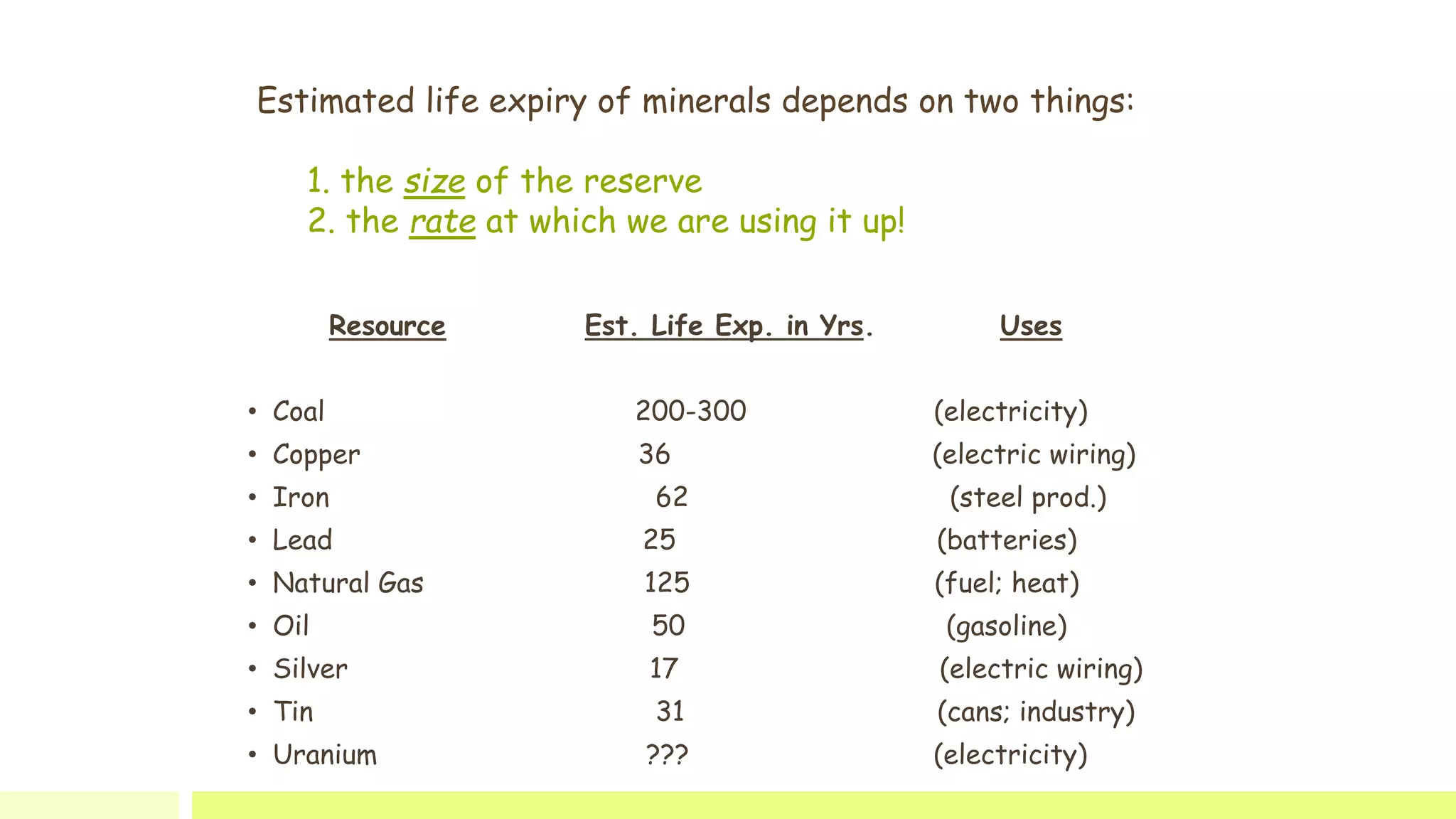
Estimated life expiry of minerals depends on two things:
1. the size of the reserve
2. the rate at which we are using it up!
Resource Est. Life Exp. in Yrs. Uses
• Coal 200-300 (electricity)
• Copper 36 (electric wiring)
• Iron 62 (steel prod.)
• Lead 25 (batteries)
• Natural Gas 125 (fuel; heat)
• Oil 50 (gasoline)
• Silver 17 (electric wiring)
• Tin 31 (cans; industry)
• Uranium ??? (electricity)
July 22, 2012 Footer text here6
July 22, 2012 Footer text here7
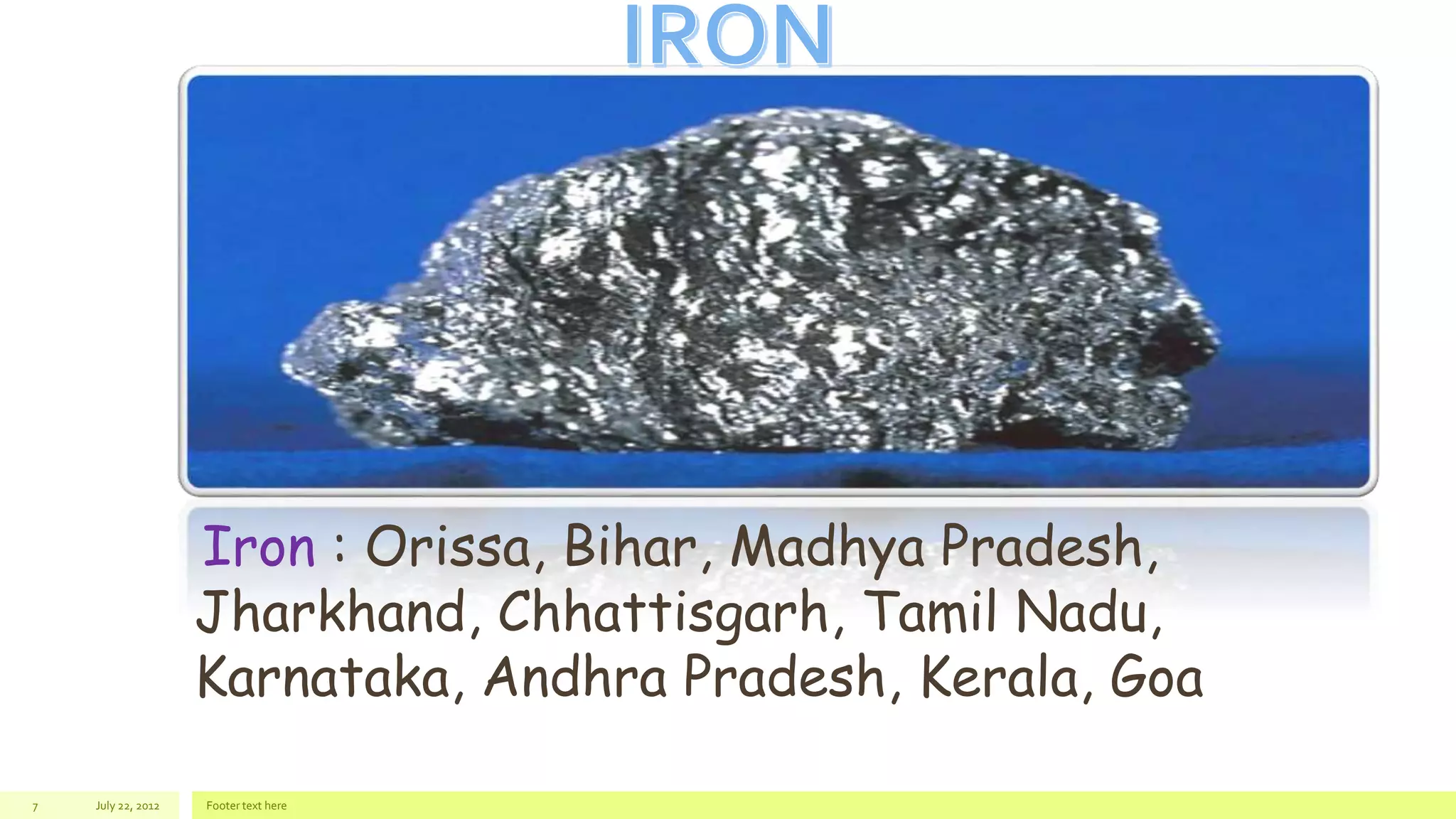
Iron : Orissa, Bihar, Madhya Pradesh,
Jharkhand, Chhattisgarh, Tamil Nadu,
Karnataka, Andhra Pradesh, Kerala, Goa
Copper
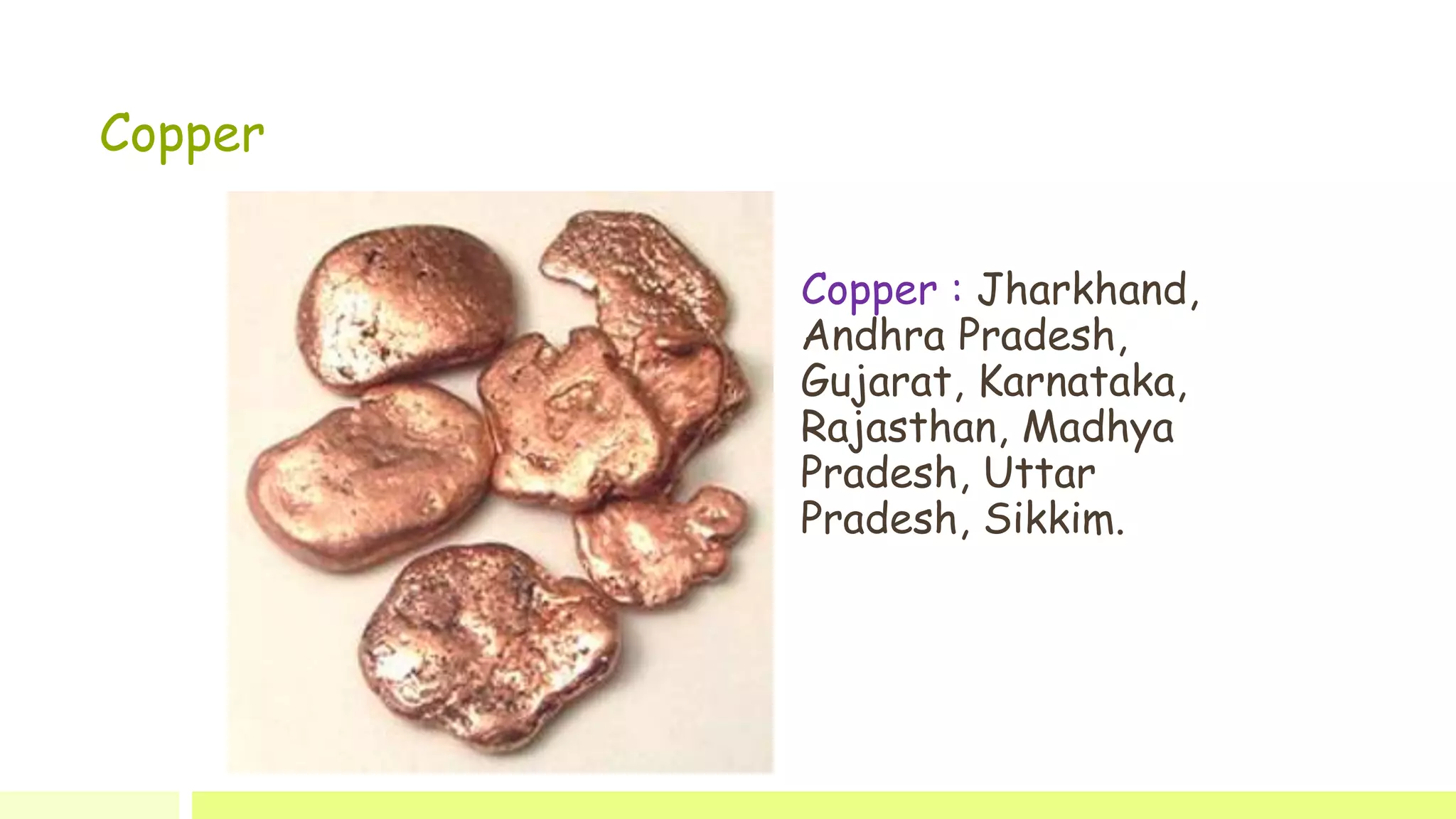
Copper : Jharkhand,
Andhra Pradesh,
Gujarat, Karnataka,
Rajasthan, Madhya
Pradesh, Uttar
Pradesh, Sikkim.
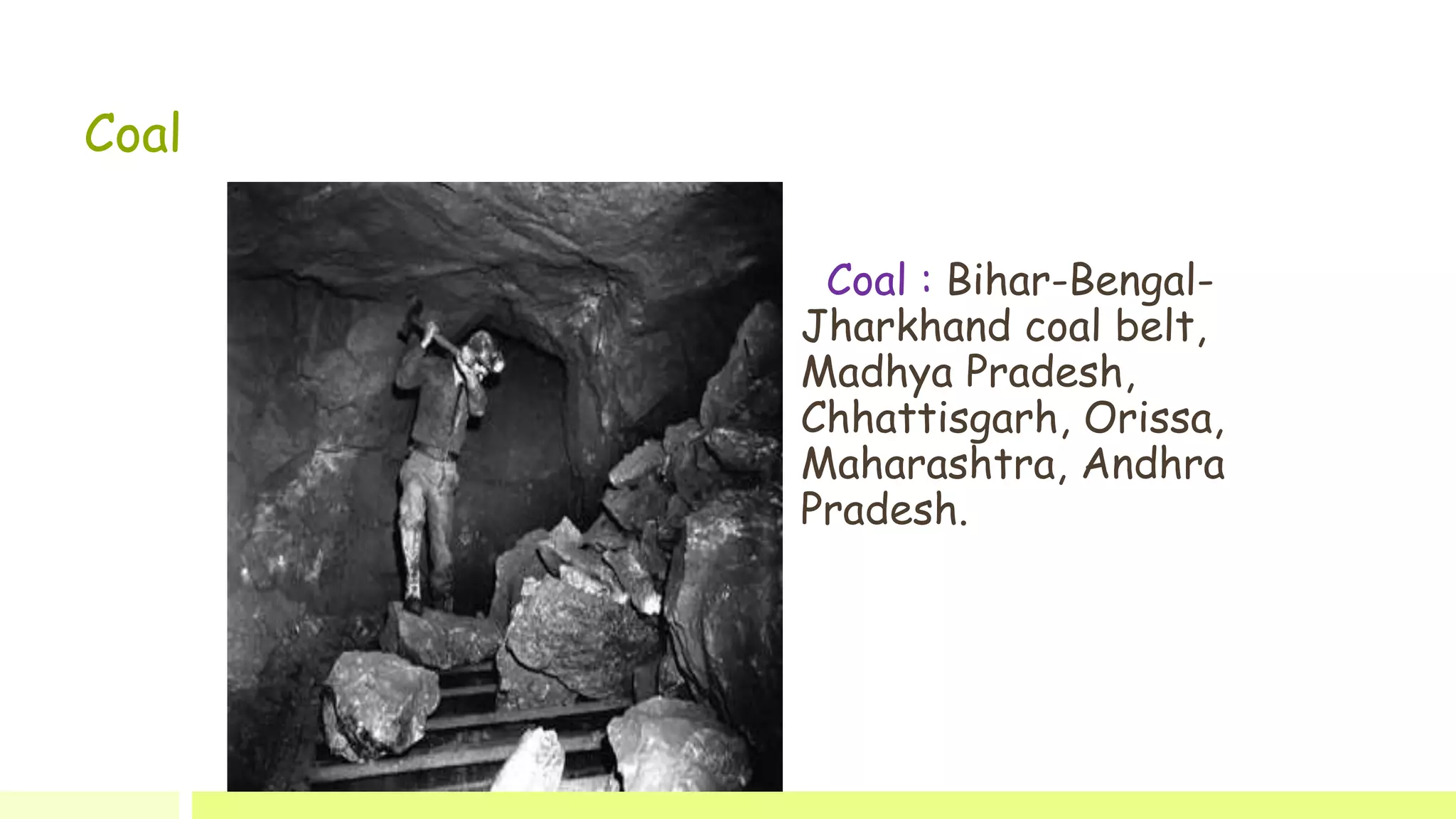
Coal
Coal : Bihar-Bengal-
Jharkhand coal belt,
Madhya Pradesh,
Chhattisgarh, Orissa,
Maharashtra, Andhra
Pradesh.
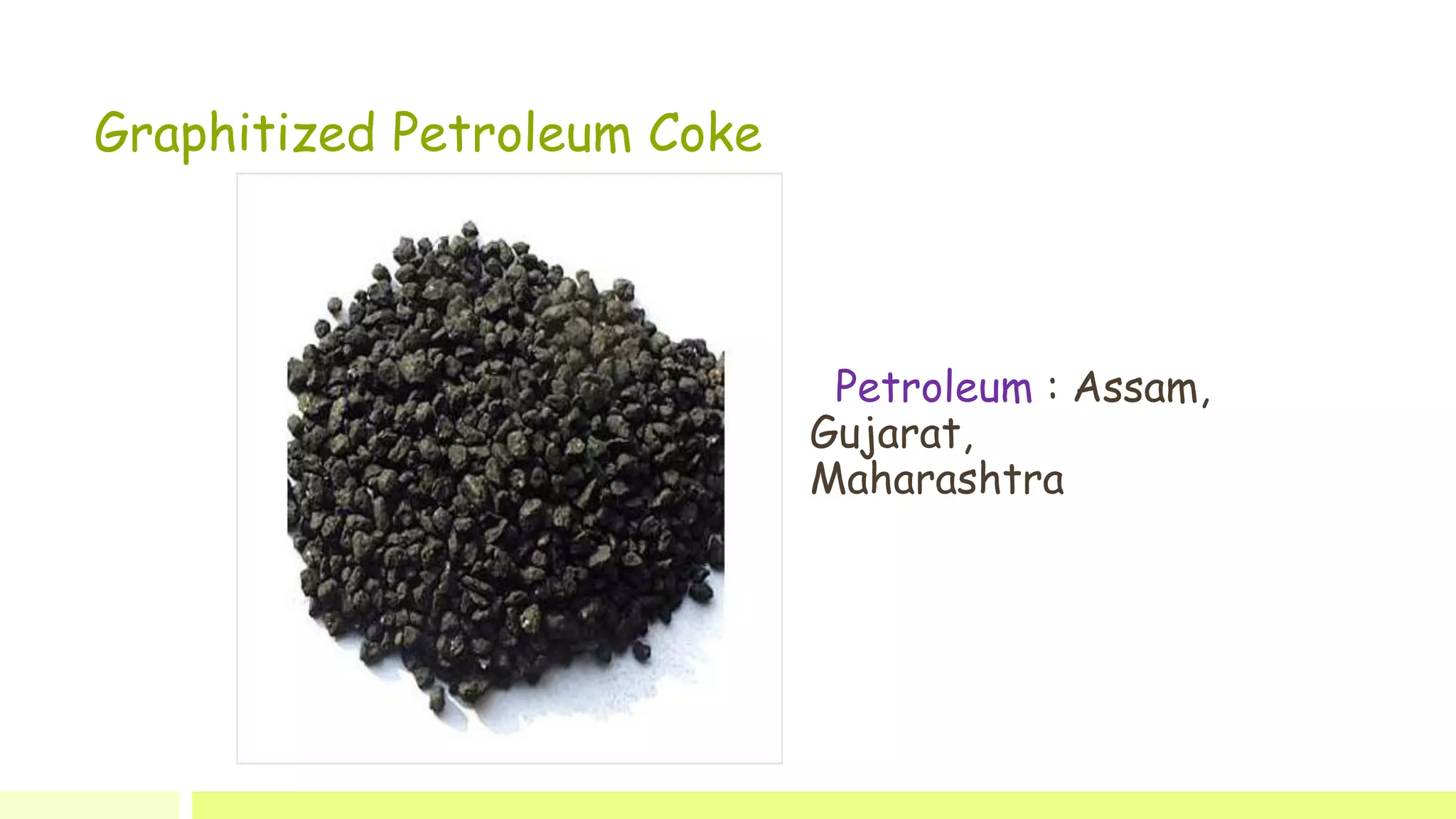
Graphitized Petroleum Coke
Petroleum : Assam,
Gujarat,
Maharashtra
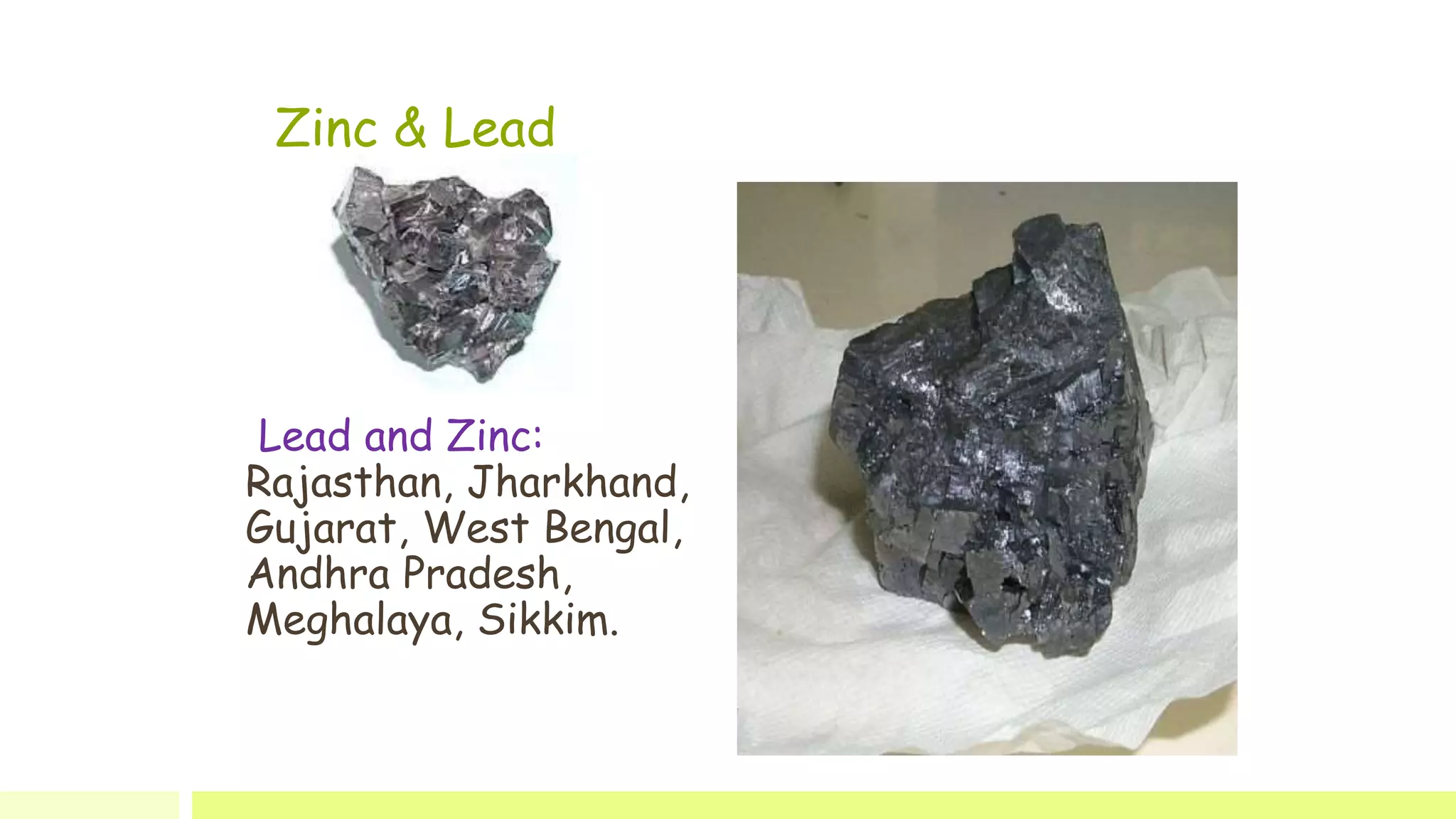
Zinc & Lead
Lead and Zinc:
Rajasthan, Jharkhand,
Gujarat, West Bengal,
Andhra Pradesh,
Meghalaya, Sikkim.
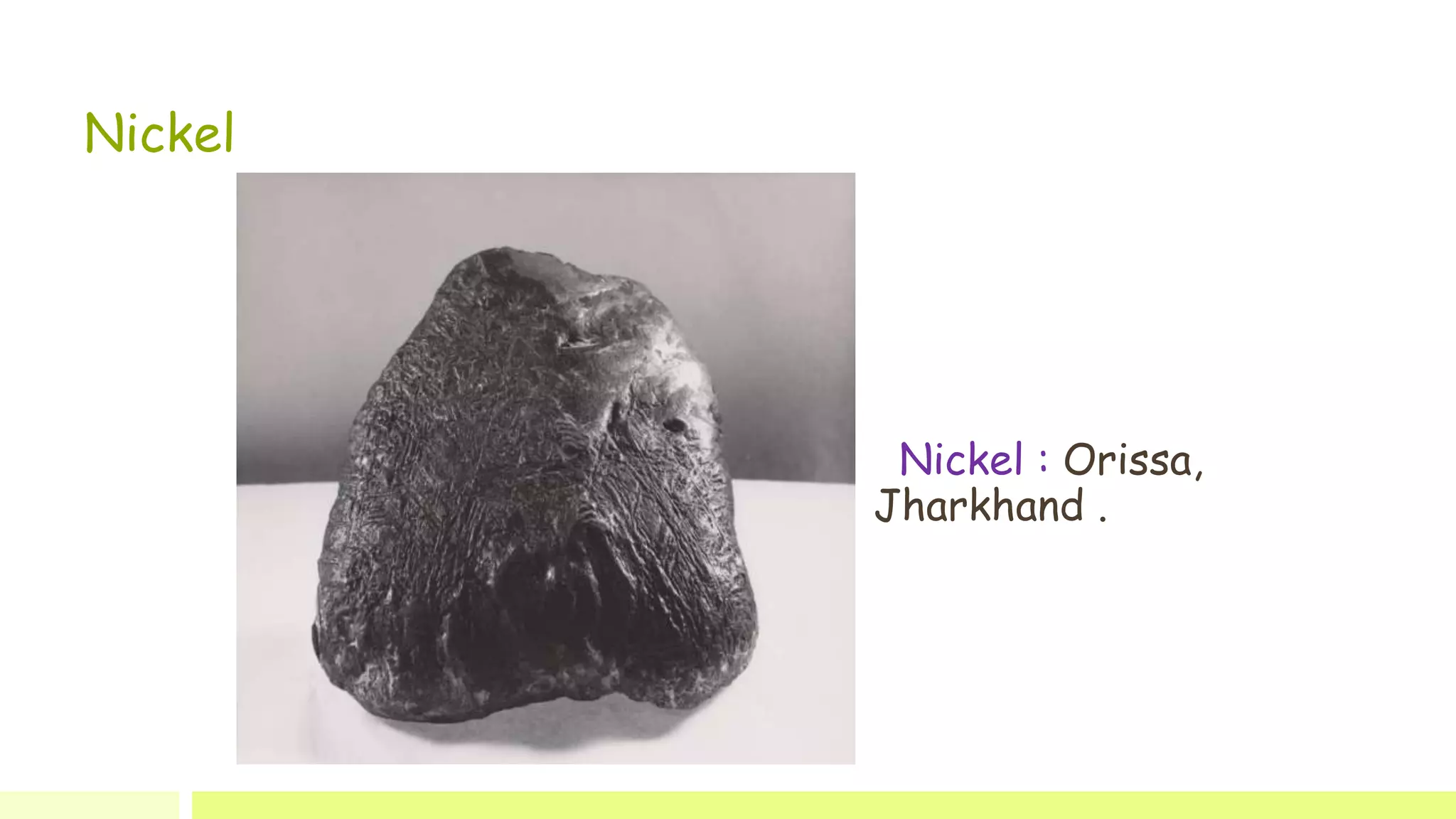
Nickel
Nickel : Orissa,
Jharkhand .
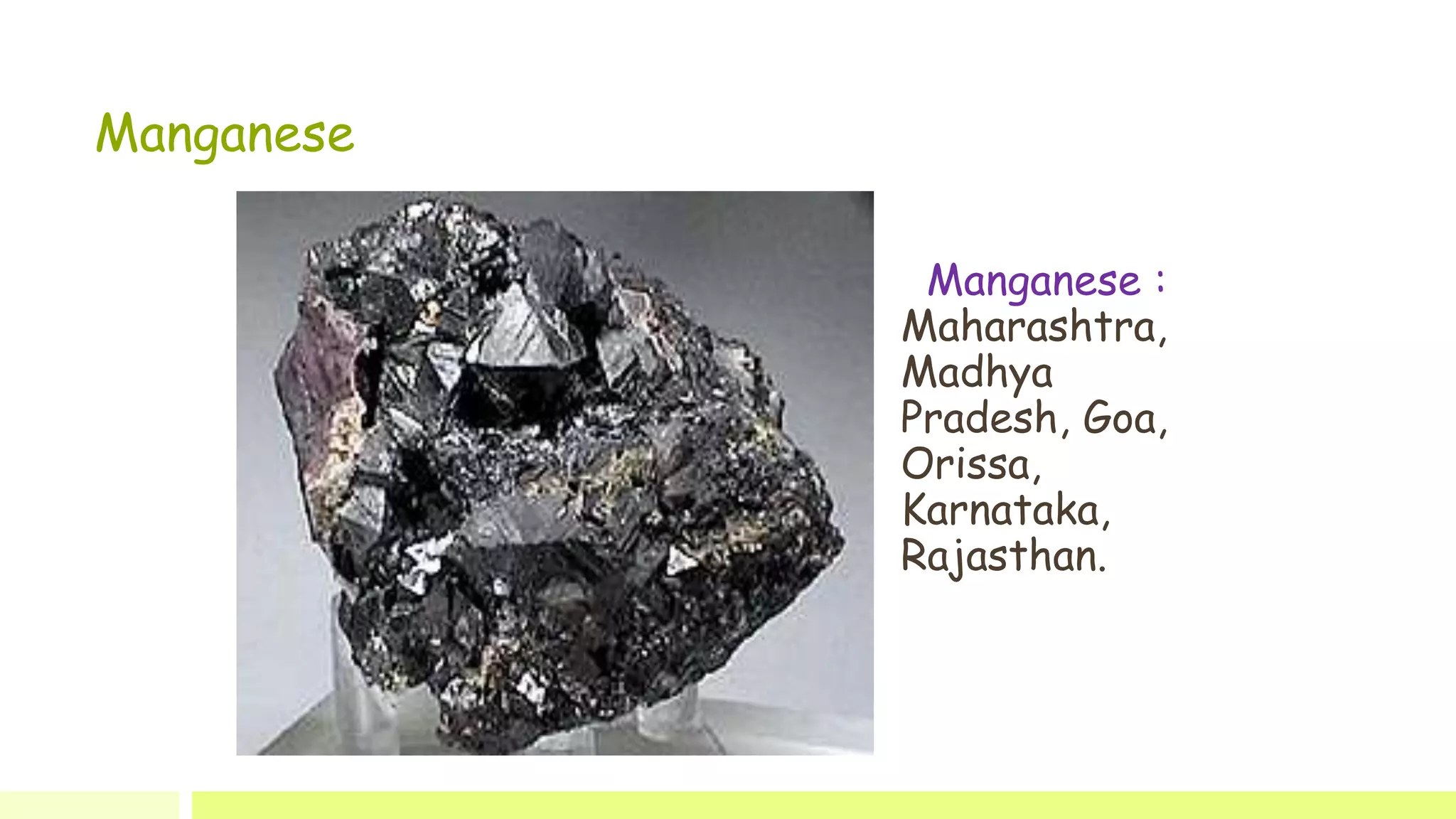
Manganese
Manganese :
Maharashtra,
Madhya
Pradesh, Goa,
Orissa,
Karnataka,
Rajasthan.
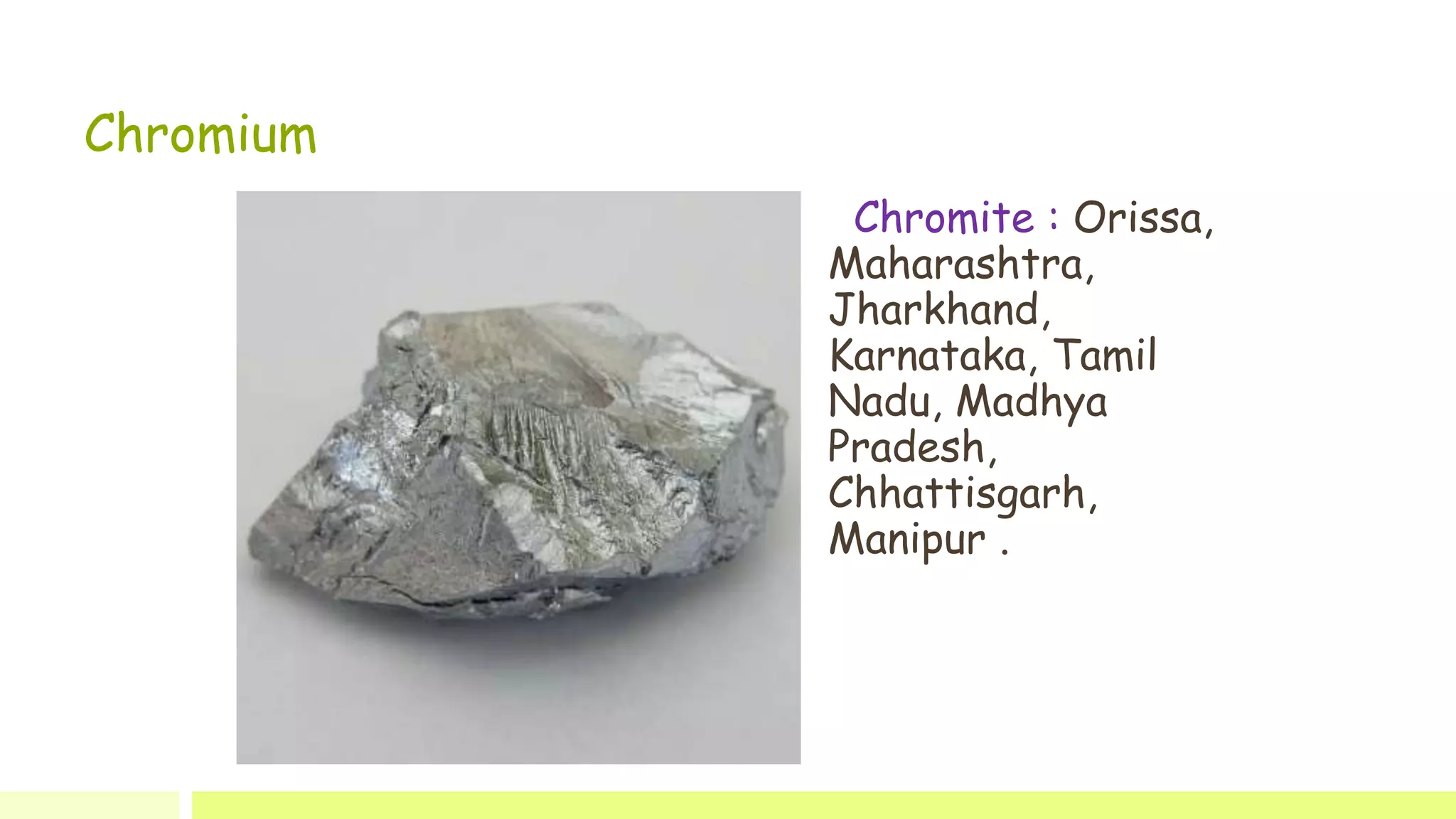
Chromium
Chromite : Orissa,
Maharashtra,
Jharkhand,
Karnataka, Tamil
Nadu, Madhya
Pradesh,
Chhattisgarh,
Manipur .
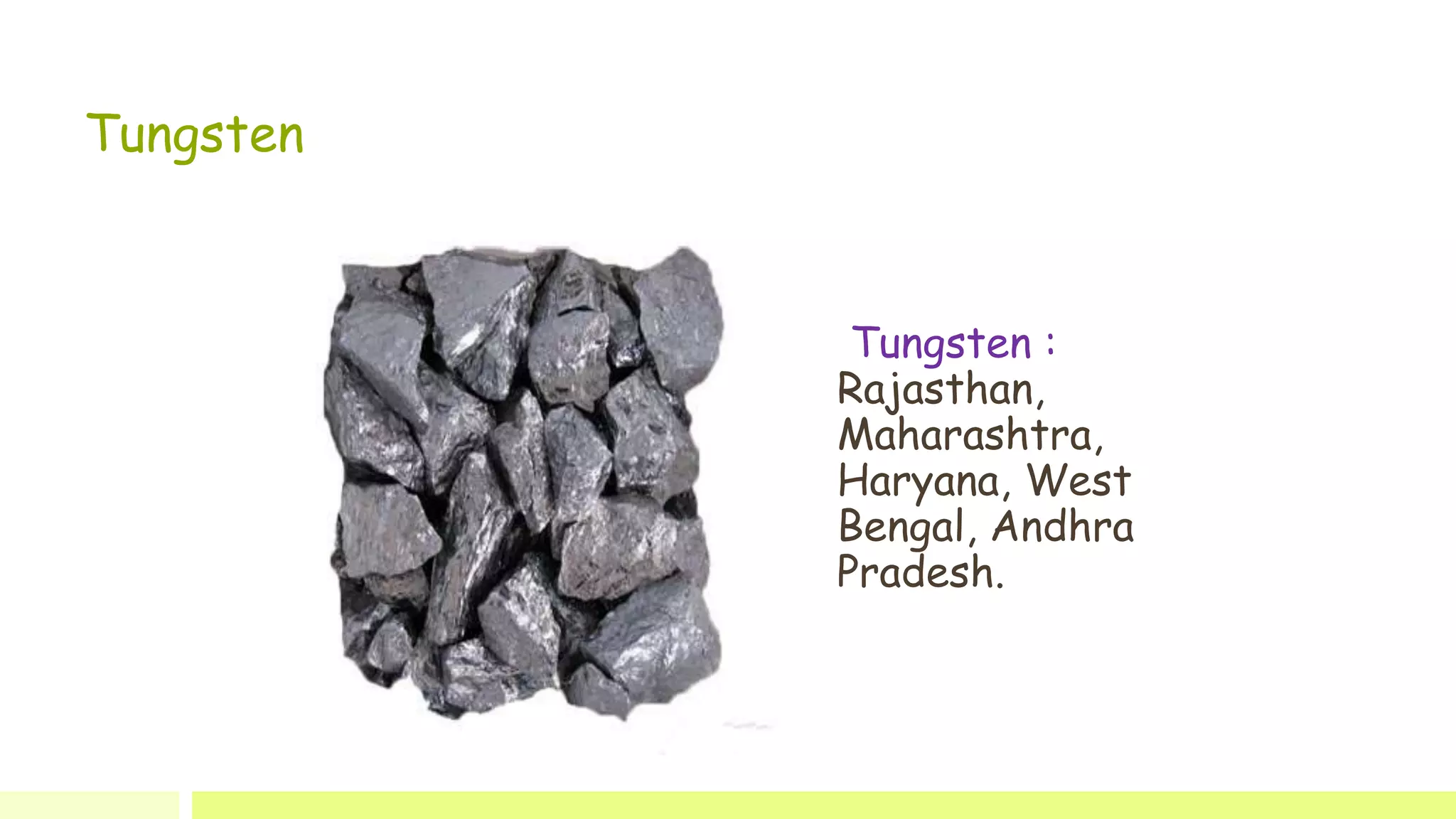
Tungsten
Tungsten :
Rajasthan,
Maharashtra,
Haryana, West
Bengal, Andhra
Pradesh.
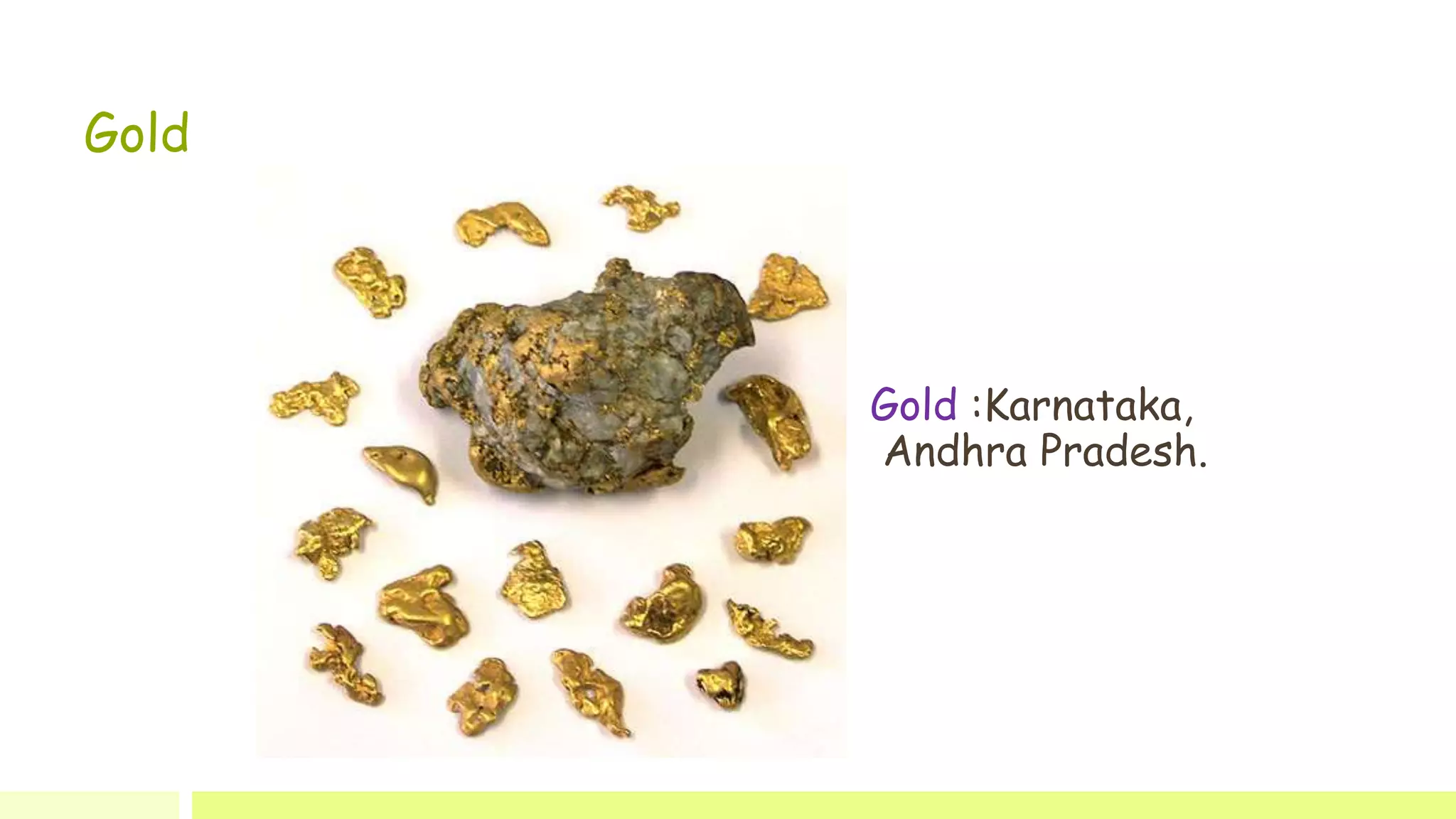
Gold
Gold :Karnataka,
Andhra Pradesh.
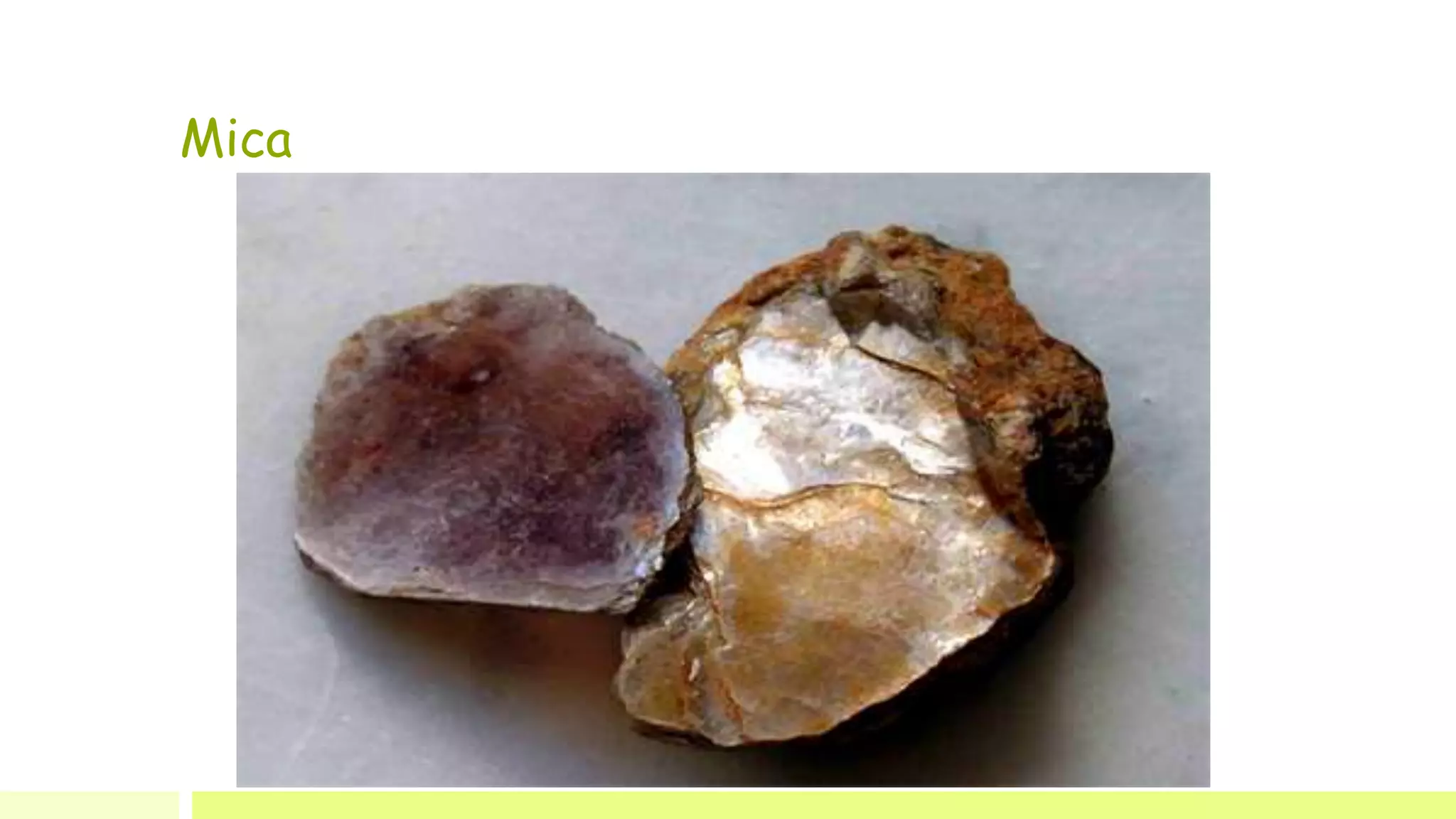
Mica
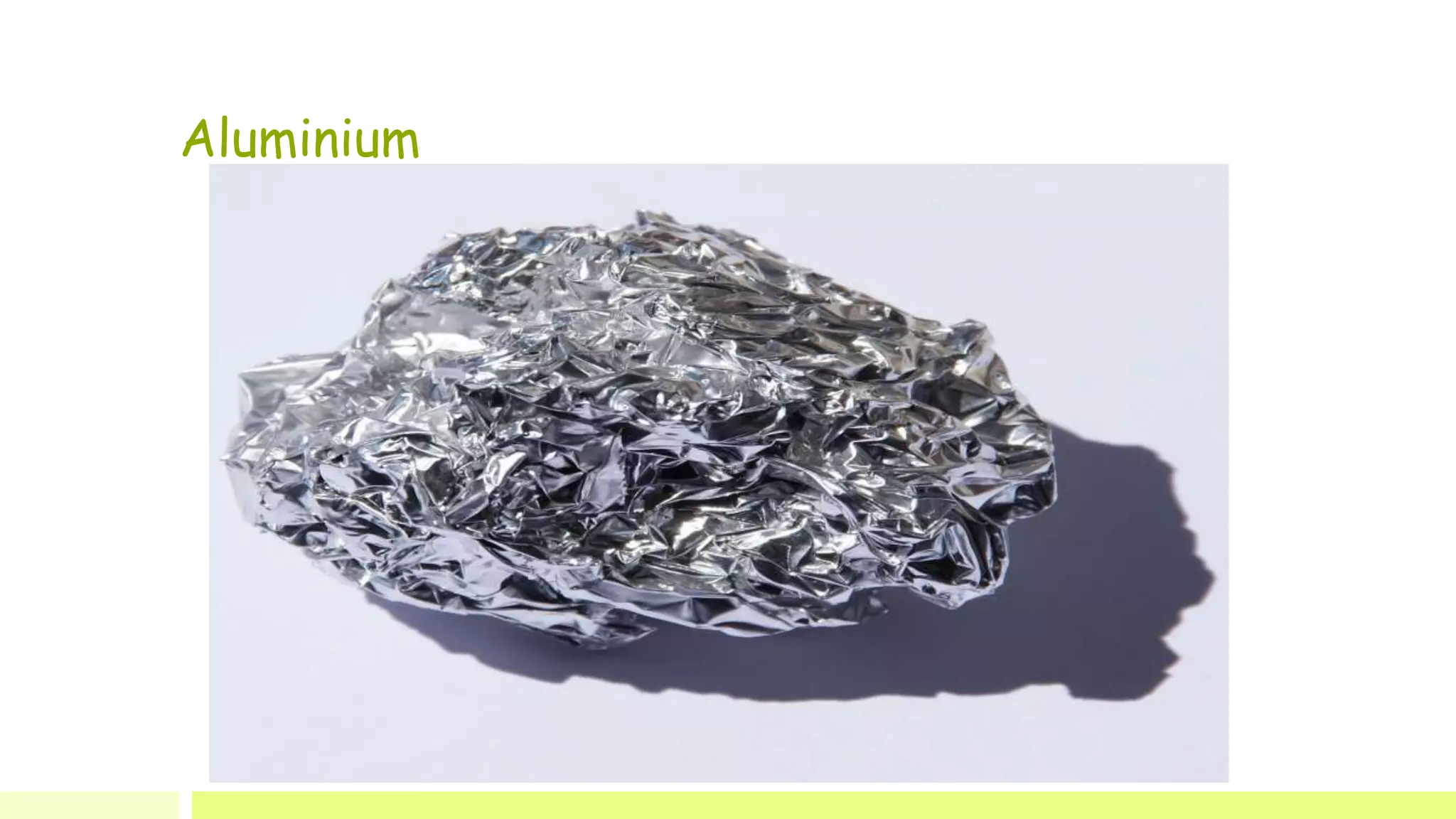
Aluminium
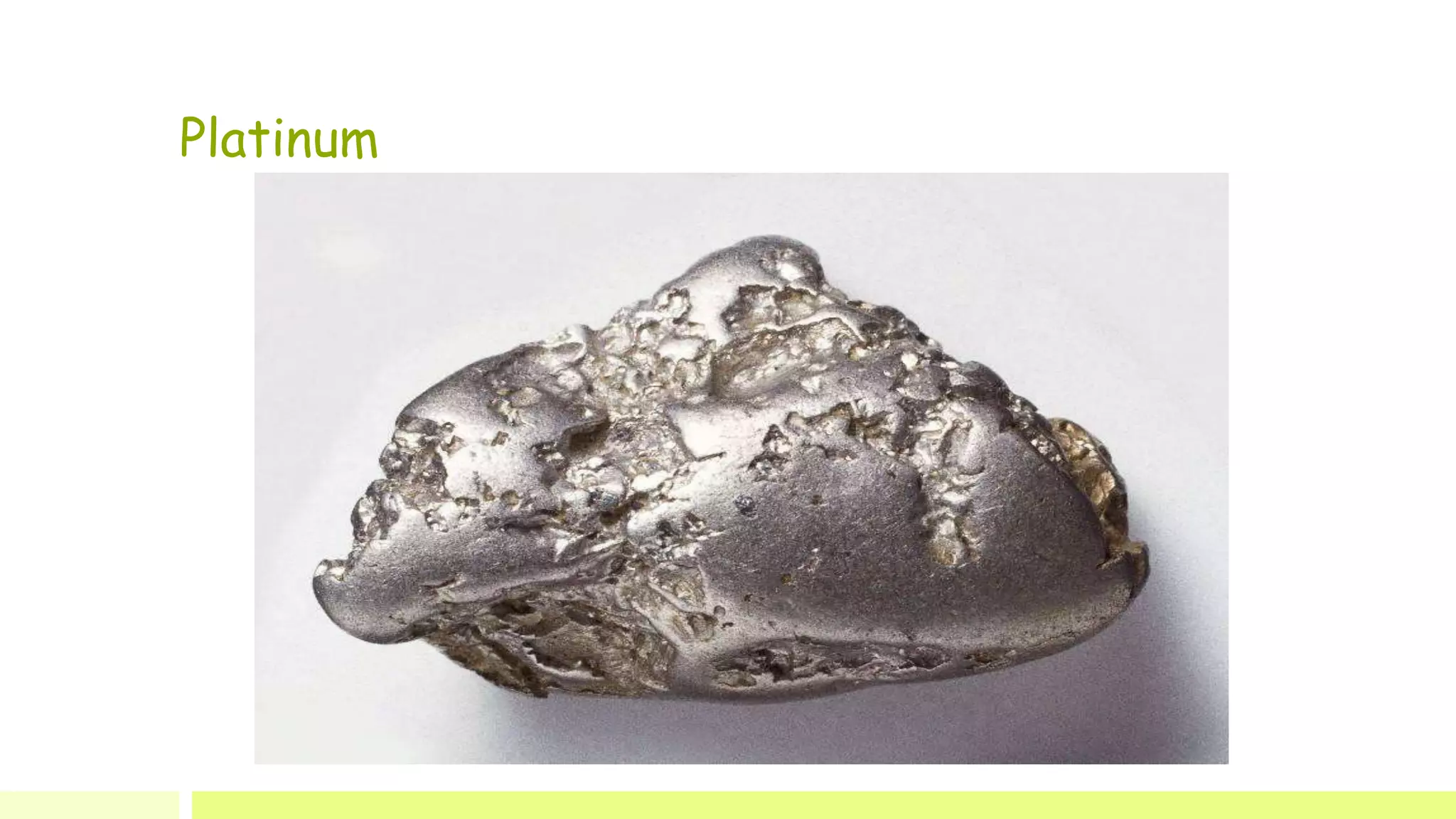
Platinum
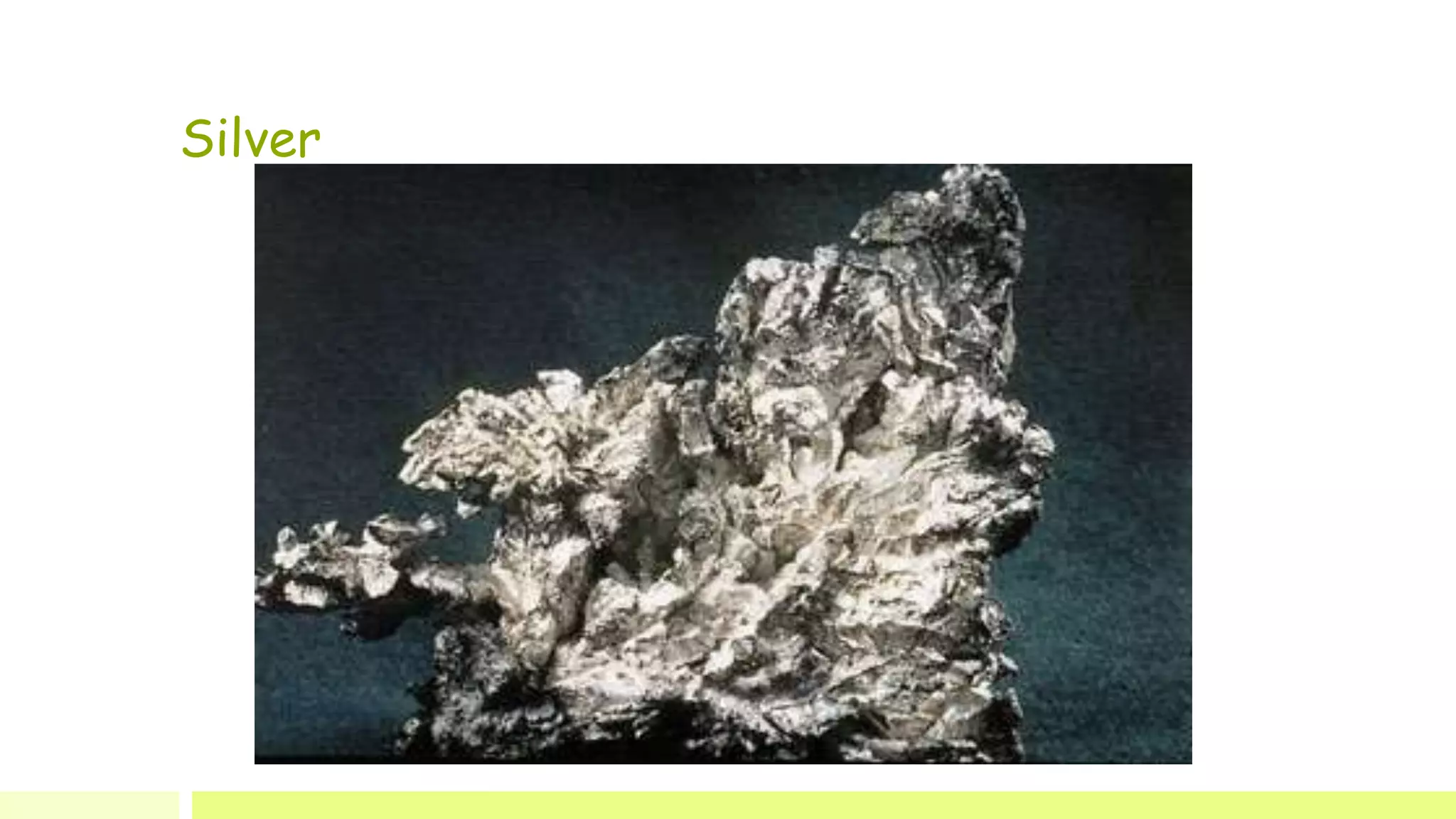
Silver
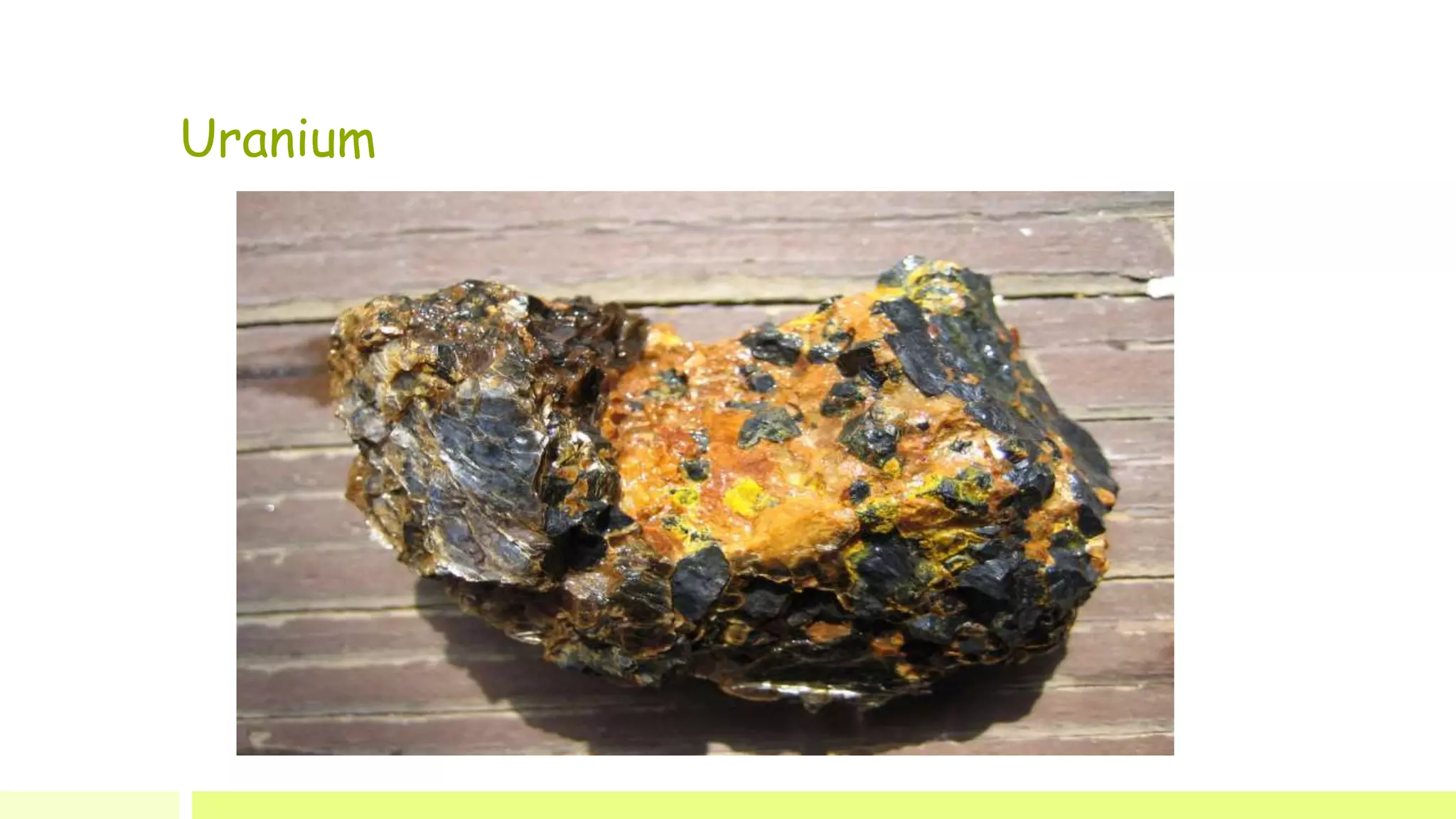
Uranium
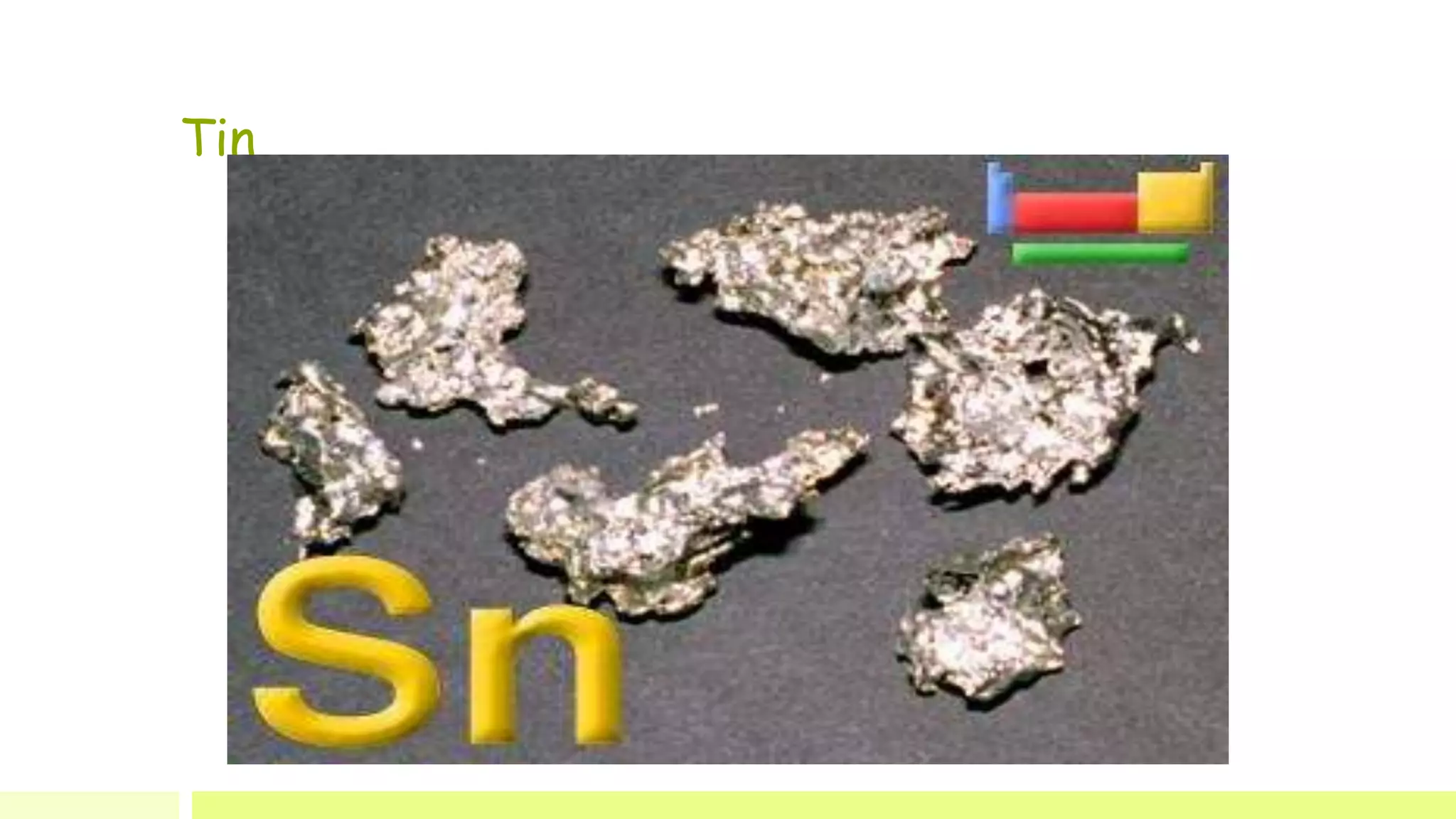
Tin
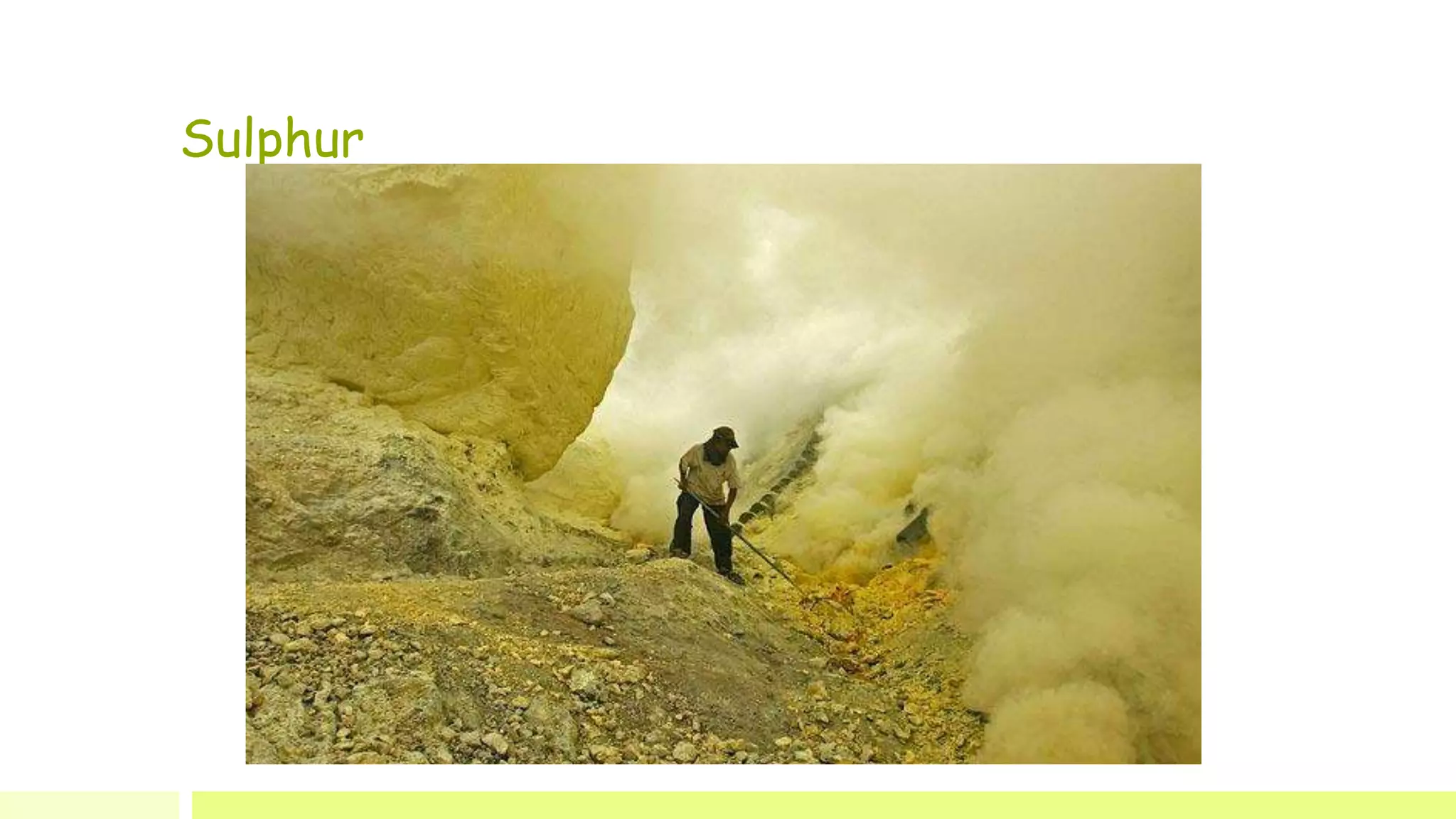
Sulphur
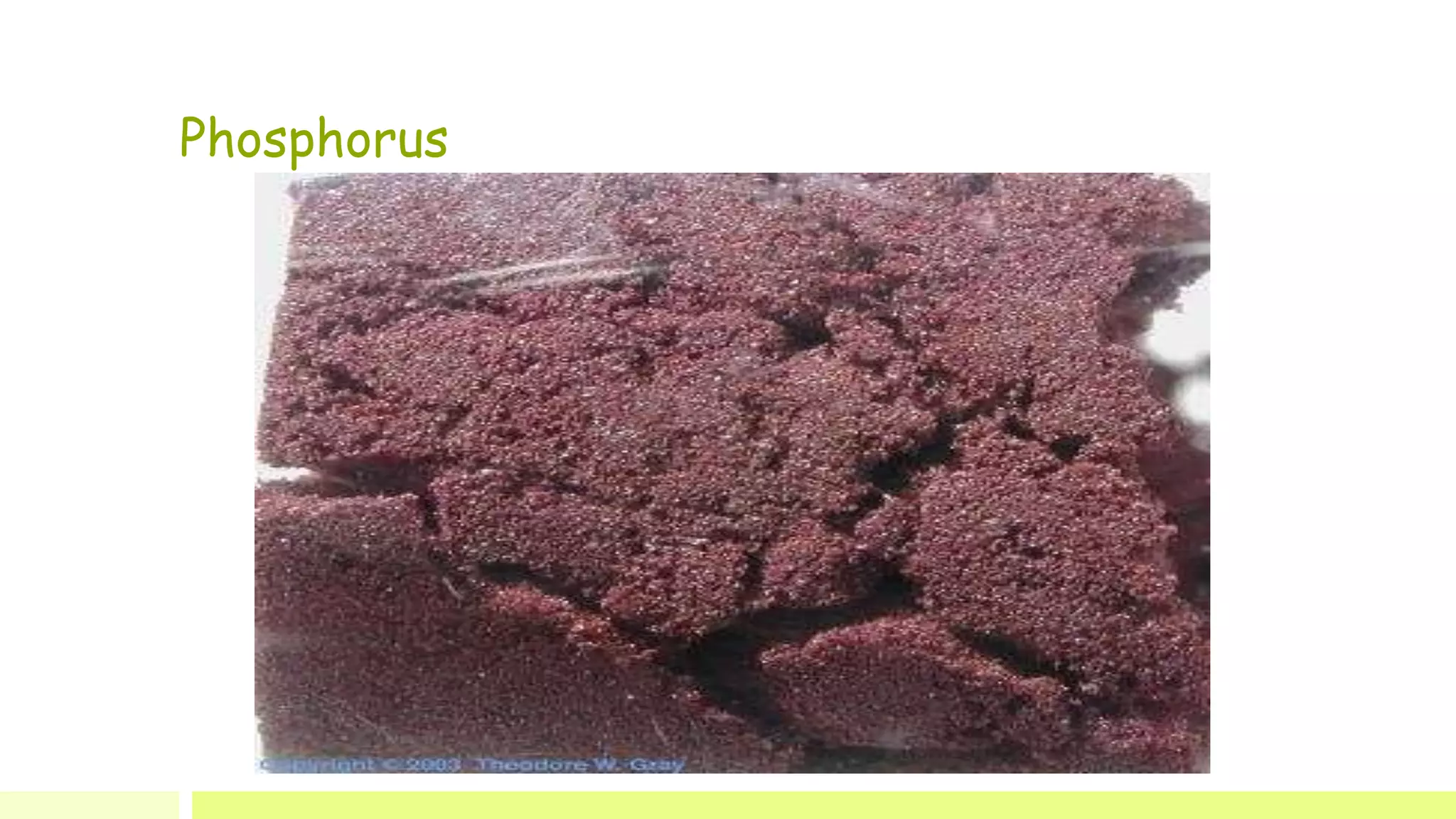
Phosphorus
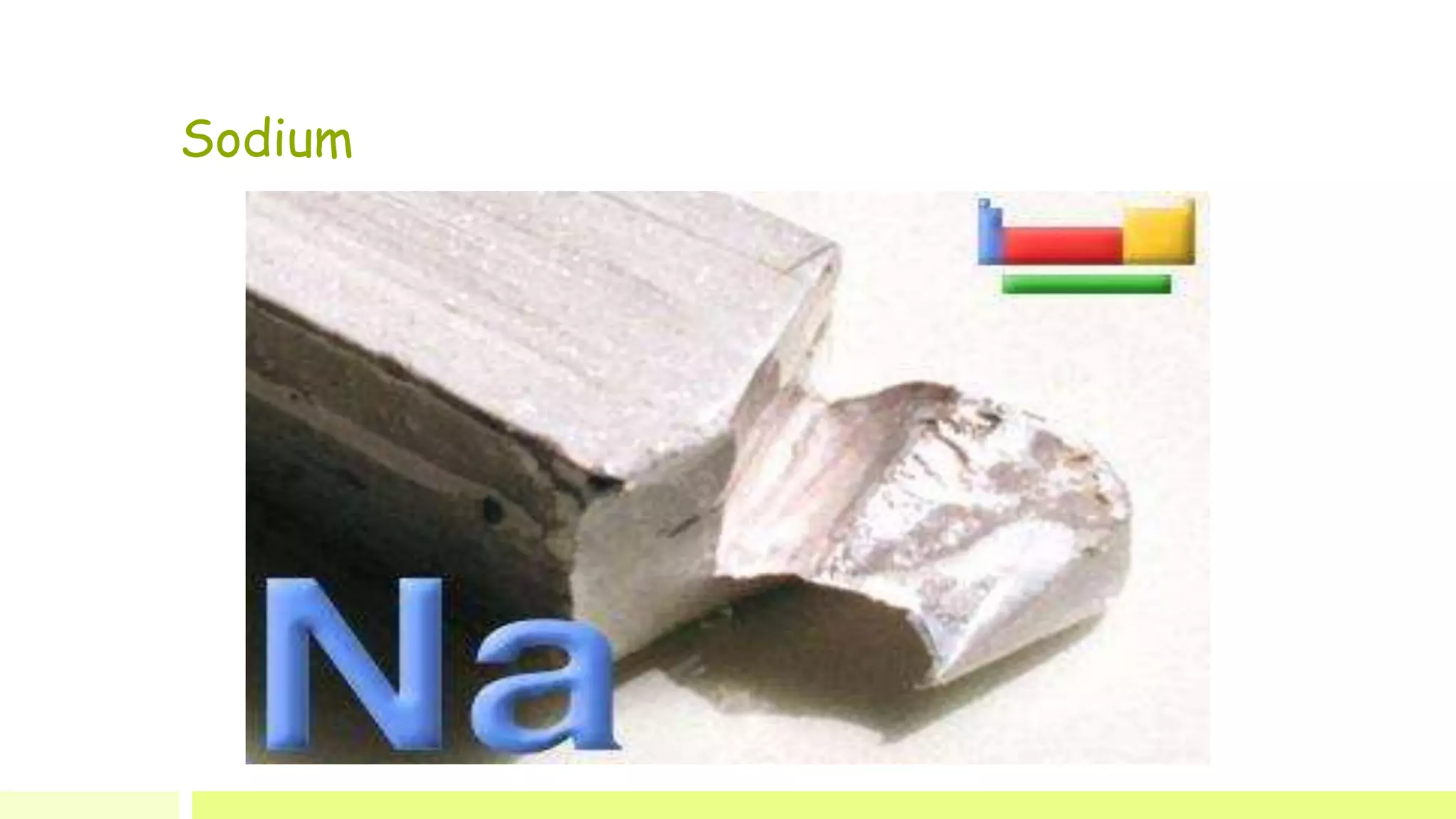
Sodium
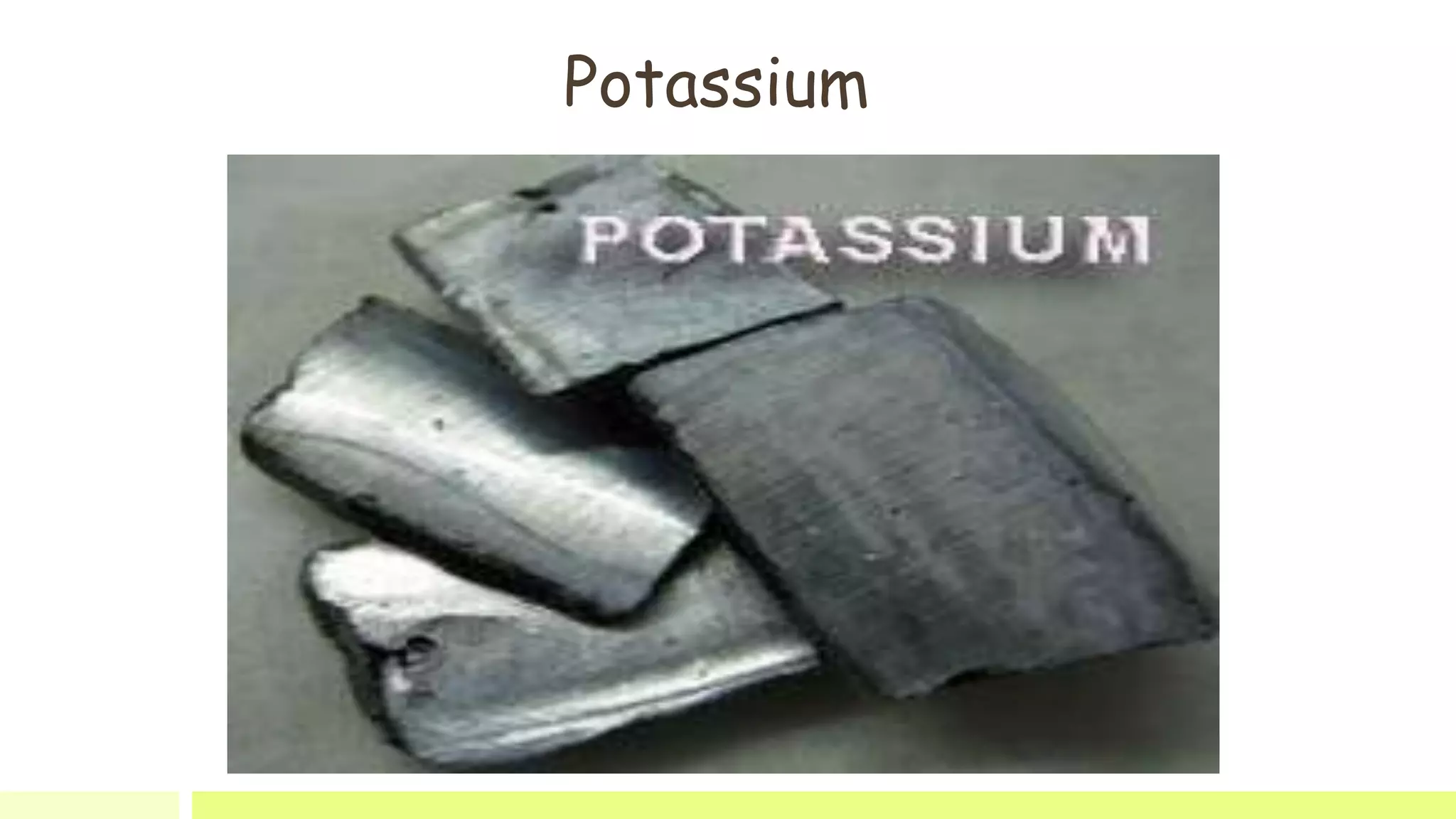
Potassium
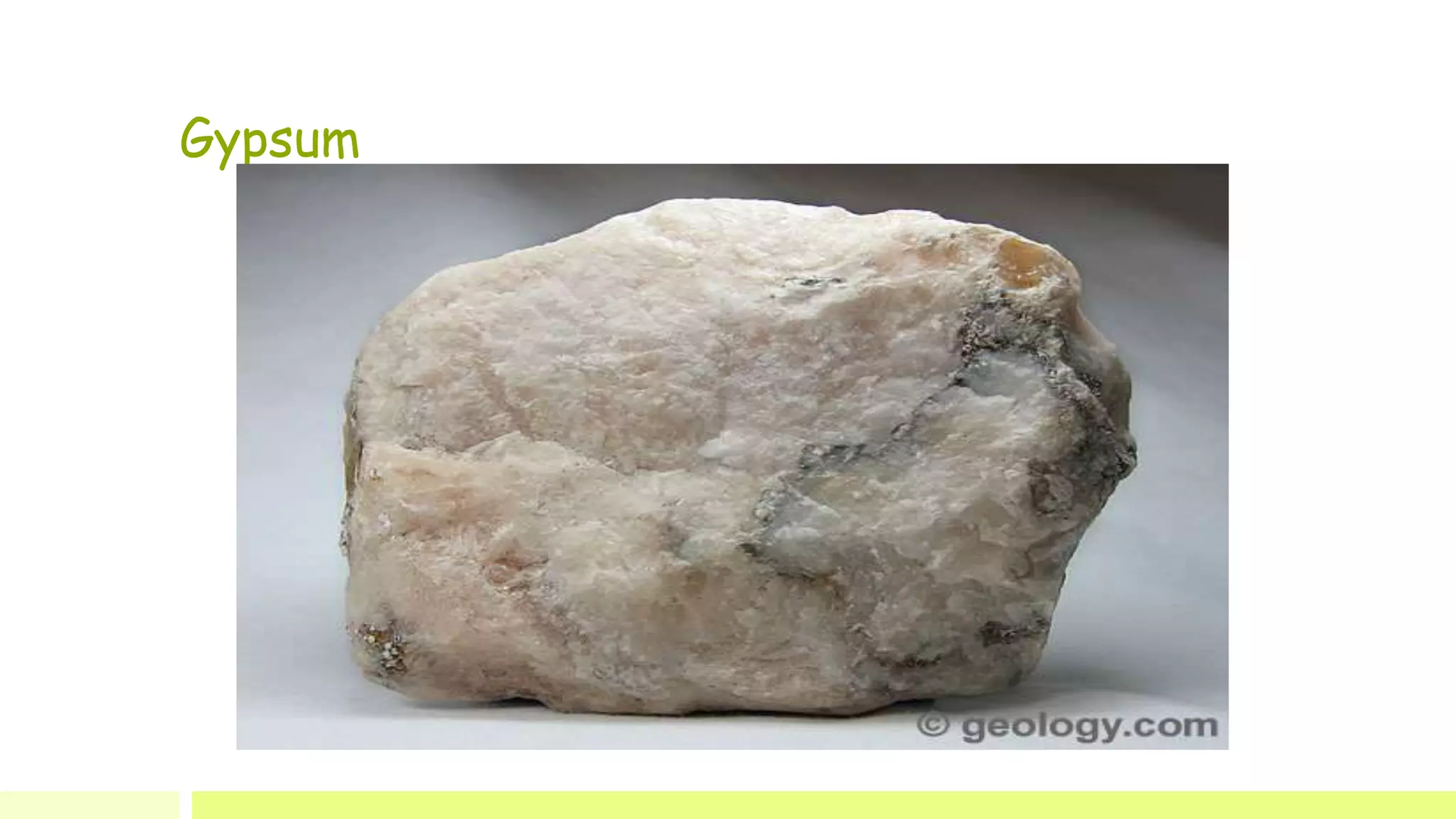
Gypsum
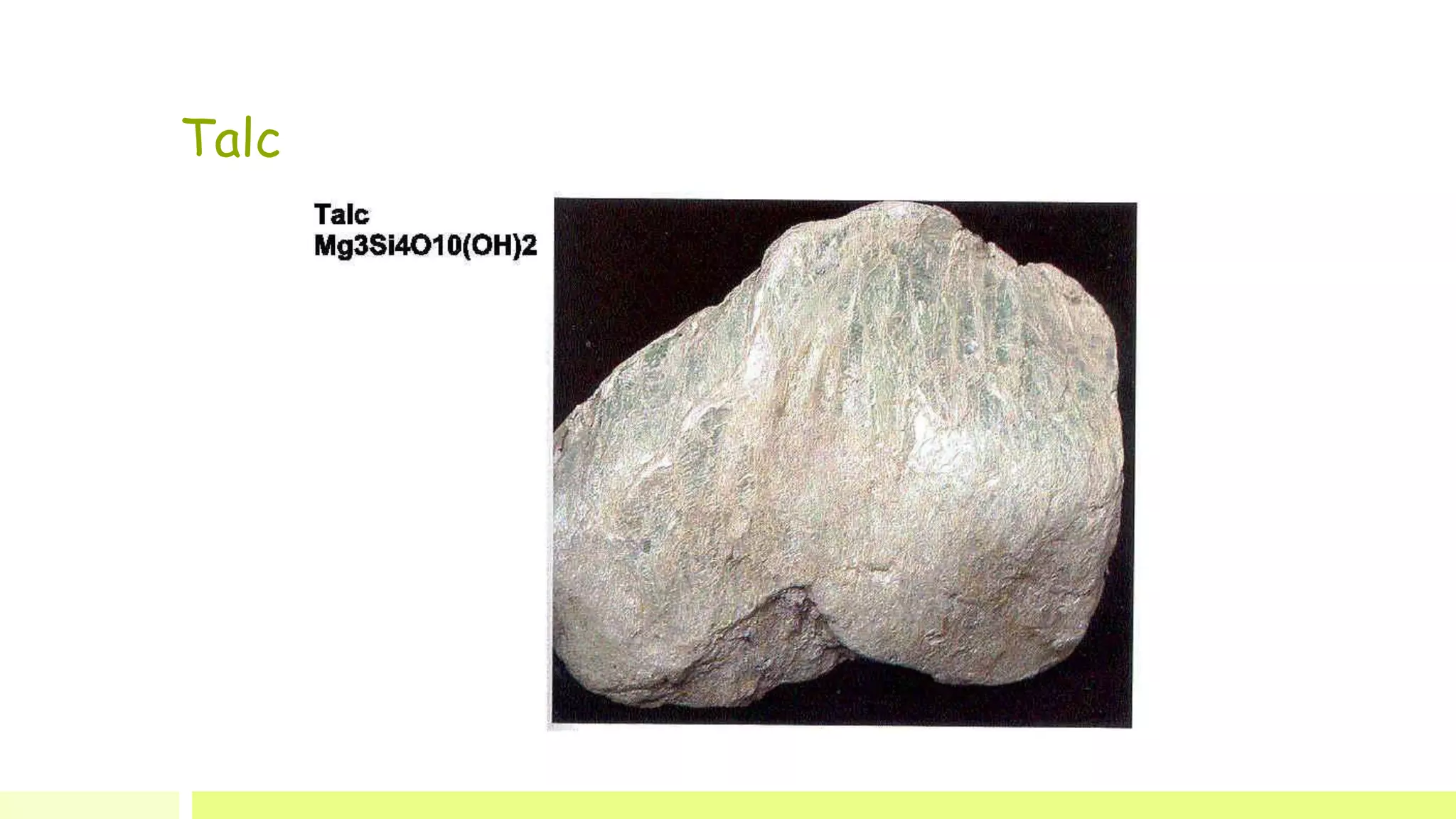
Talc
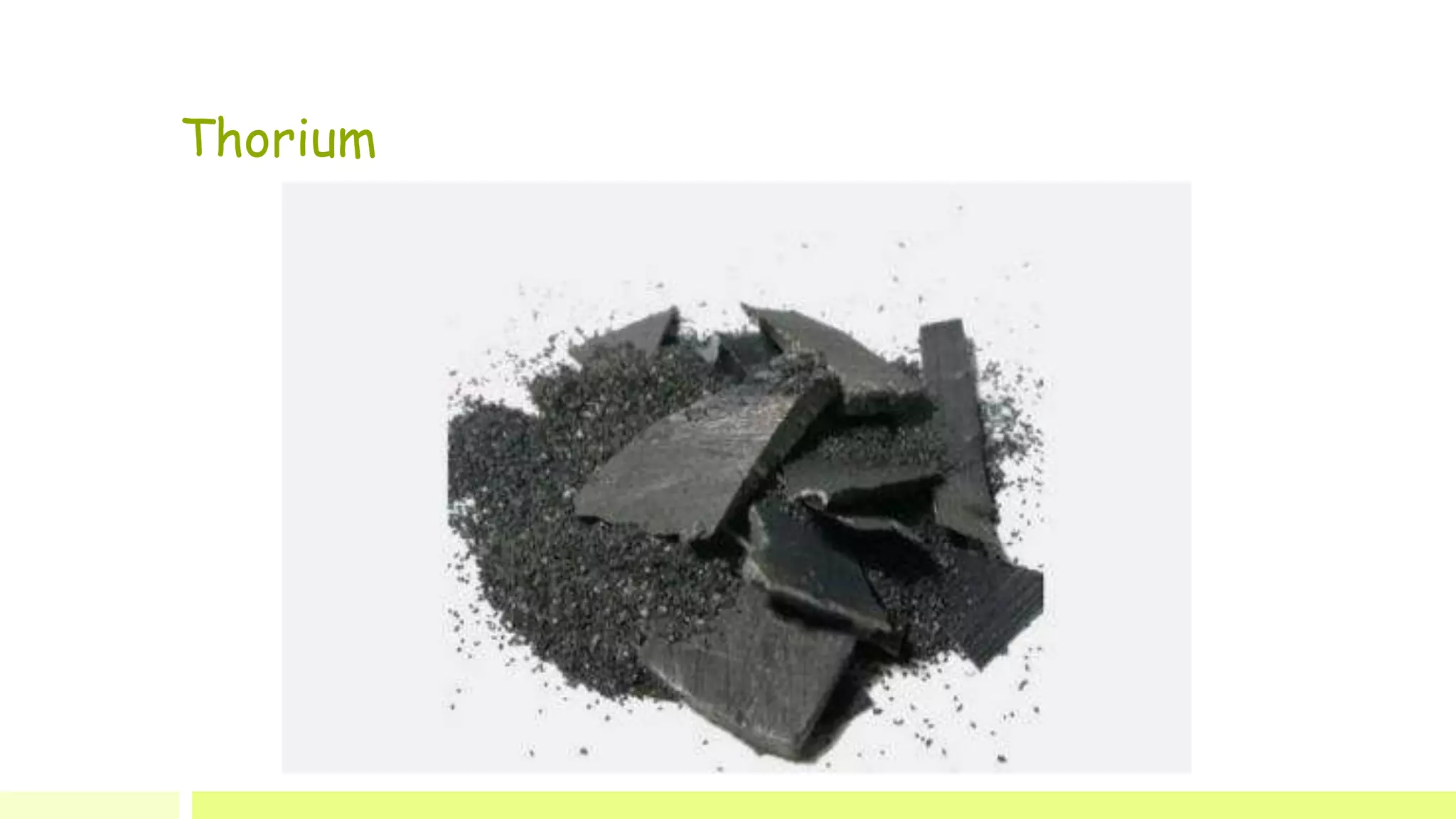
Thorium
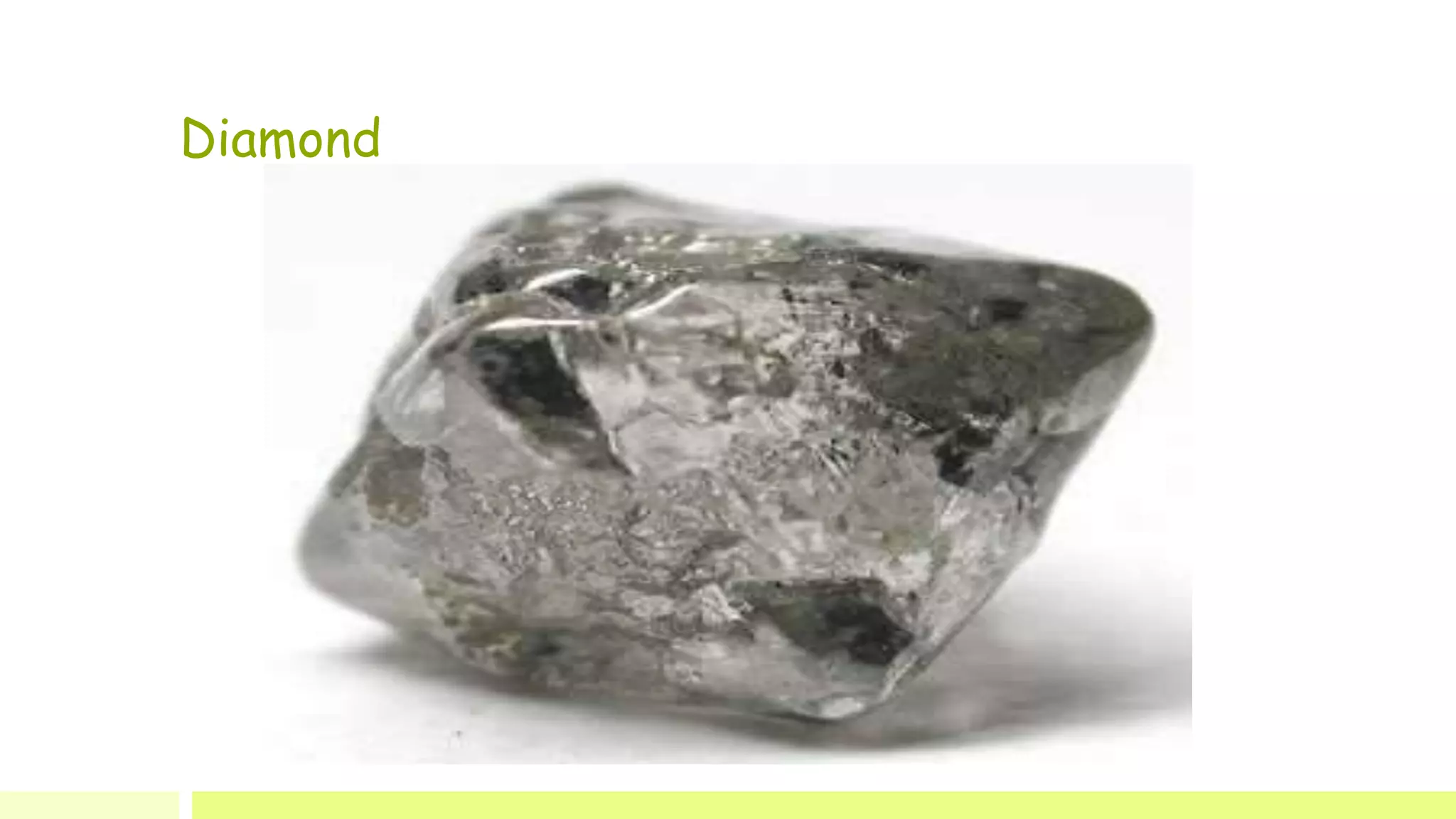
Diamond
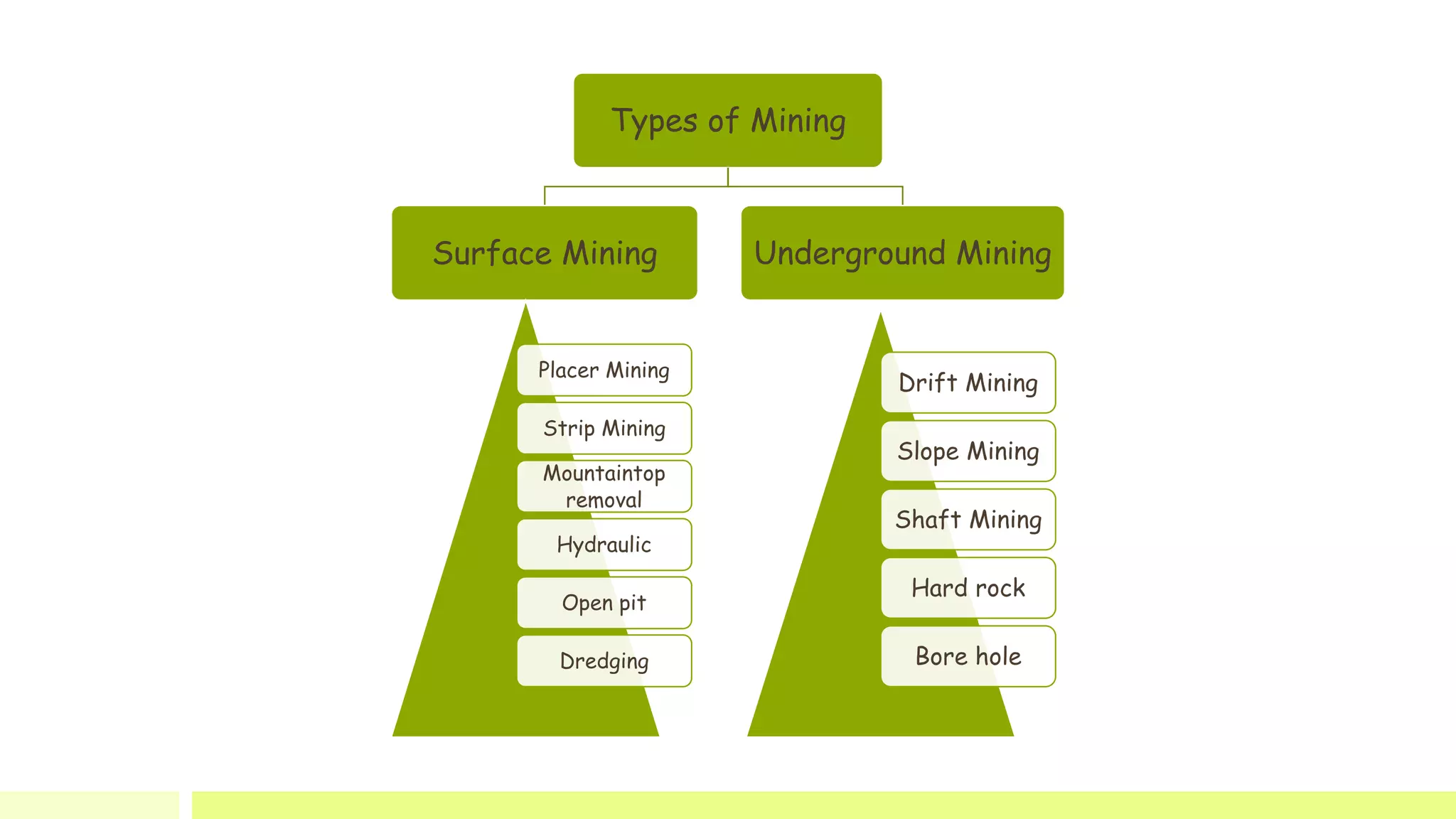
Types of Mining
Surface Mining Underground Mining
Placer Mining
Strip Mining
Mountaintop
removal
Hydraulic
Open pit
Dredging
Drift Mining
Slope Mining
Shaft Mining
Hard rock
Bore hole
Surface mines are mining operations that delve into rock to
extract deposits of mineral resources that are close to the
surface .
In most forms of surface mining, heavy equipment, such as
earthmovers, first remove the overburden (the soil and rock
above the deposit). Next, huge machines such as drag line
excavators extract the mineral.
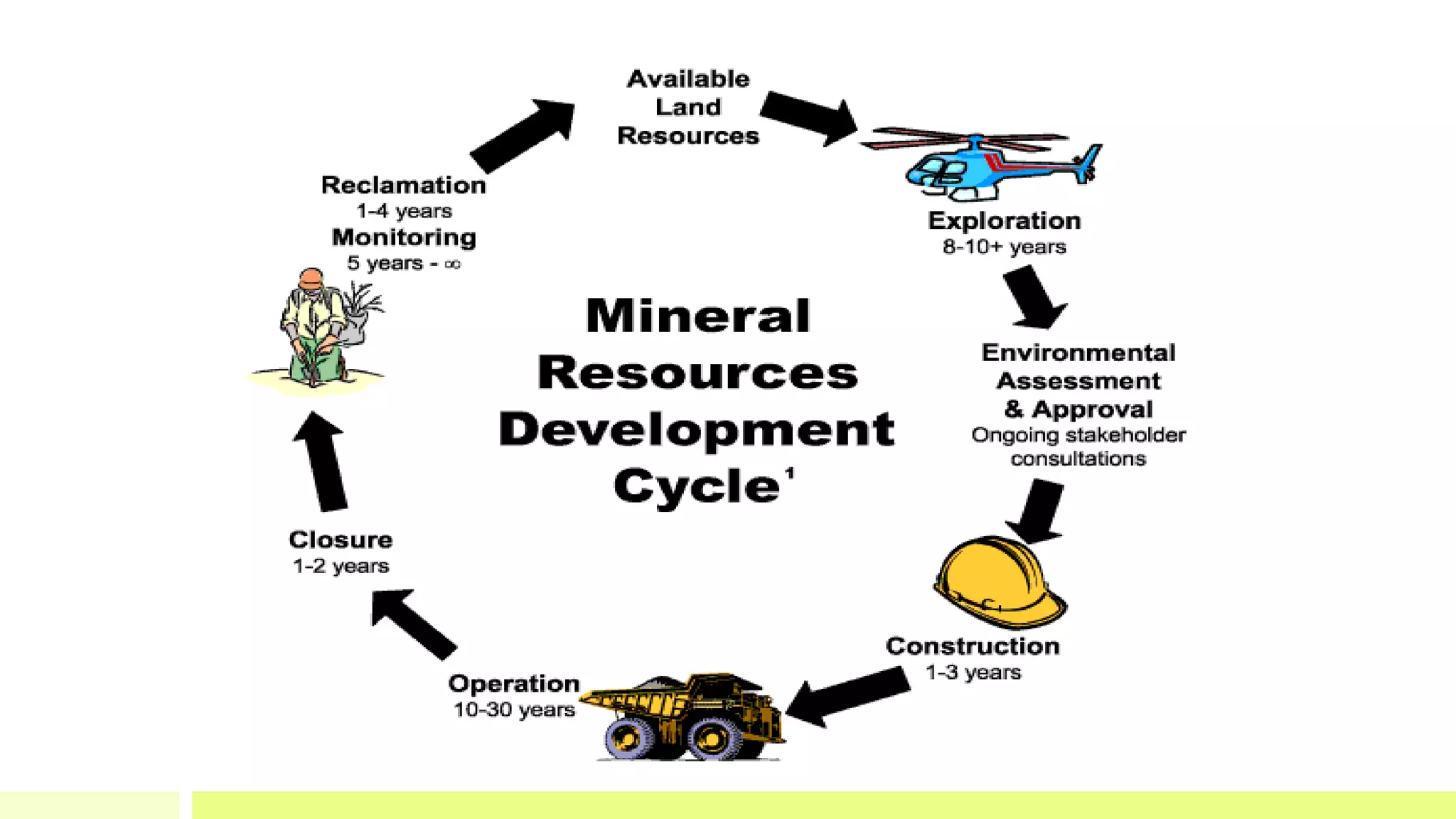
Once the material has been removed, the land is
recovered for safe use on the surface through a process called
reclamation.
Surface Mining
Some effects of mining on the
environment
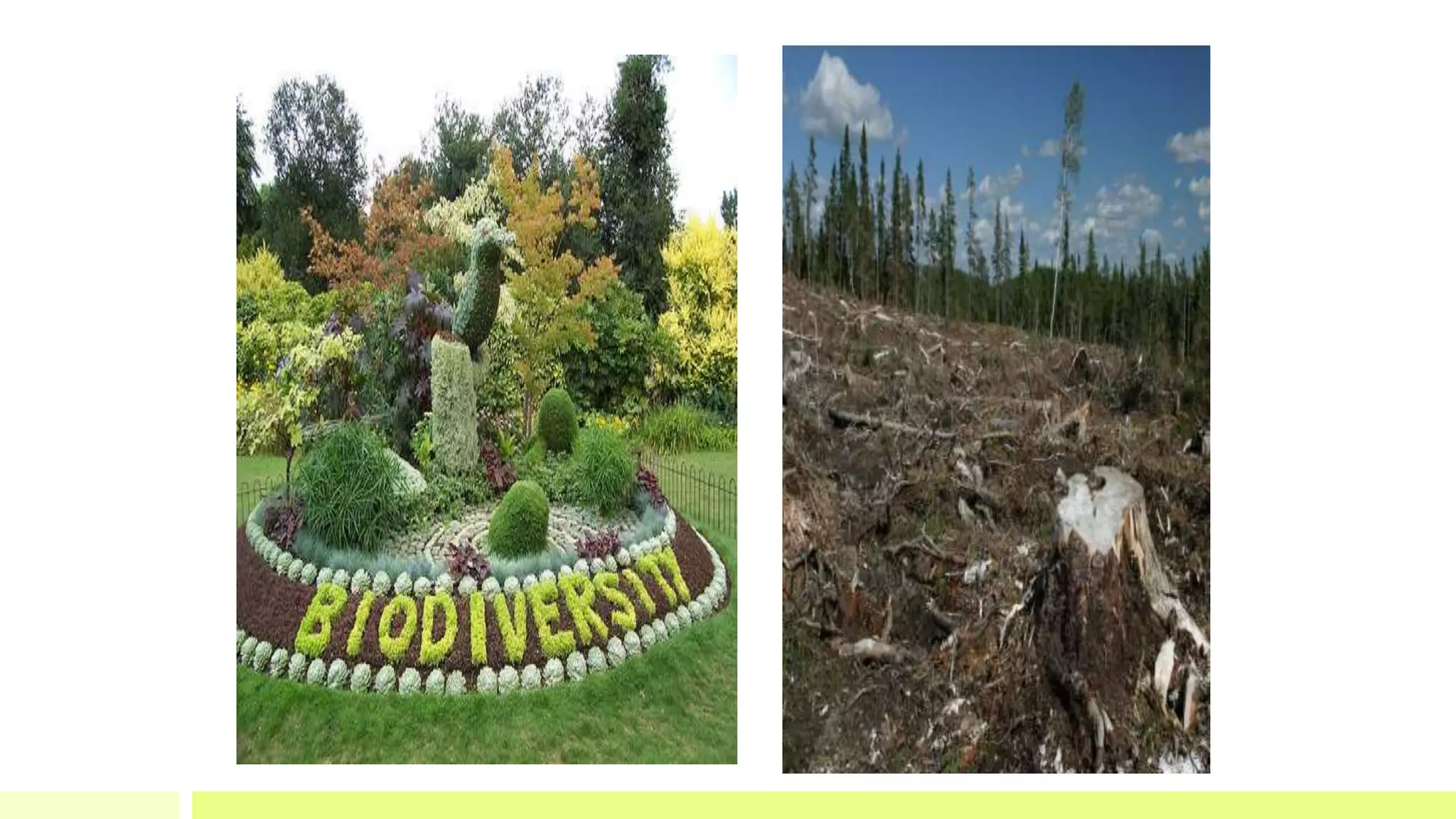
•Deforestation and loss of biodiversity are
major effects of mining.(It destroys forest and
wetlands. It may mean that you have to cut down lots of
trees just to get to the spot that has all the gold or
iron ore).
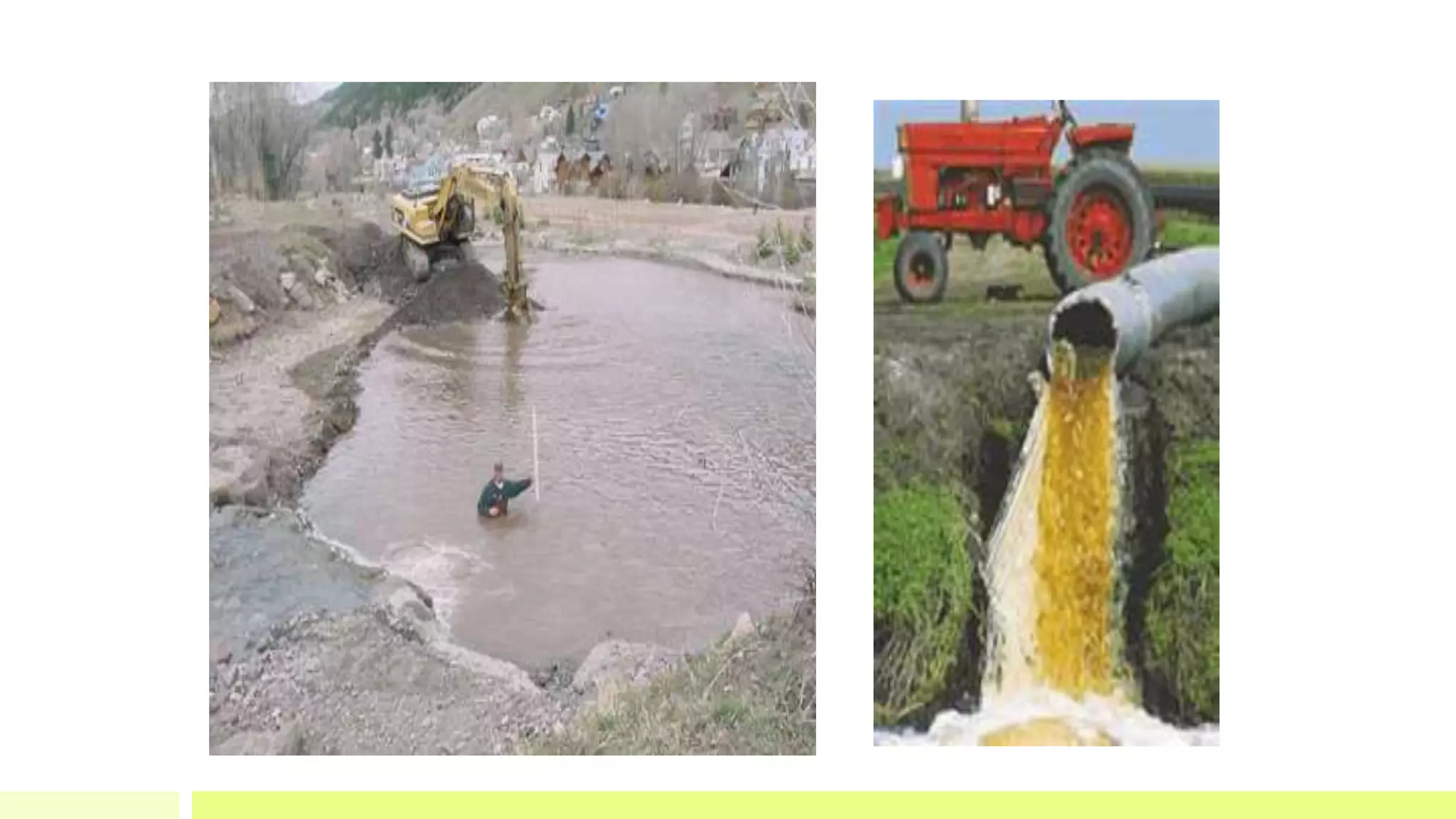
•Many mine require tailings dams to prevent waste being
washed into the rivers. Unethical miners can dispense
with the dams, to save costs, resulting in massive
pollution downstream. In other cases, the tailings dam
can overflow, and even breach, during periods of heavy
rain.
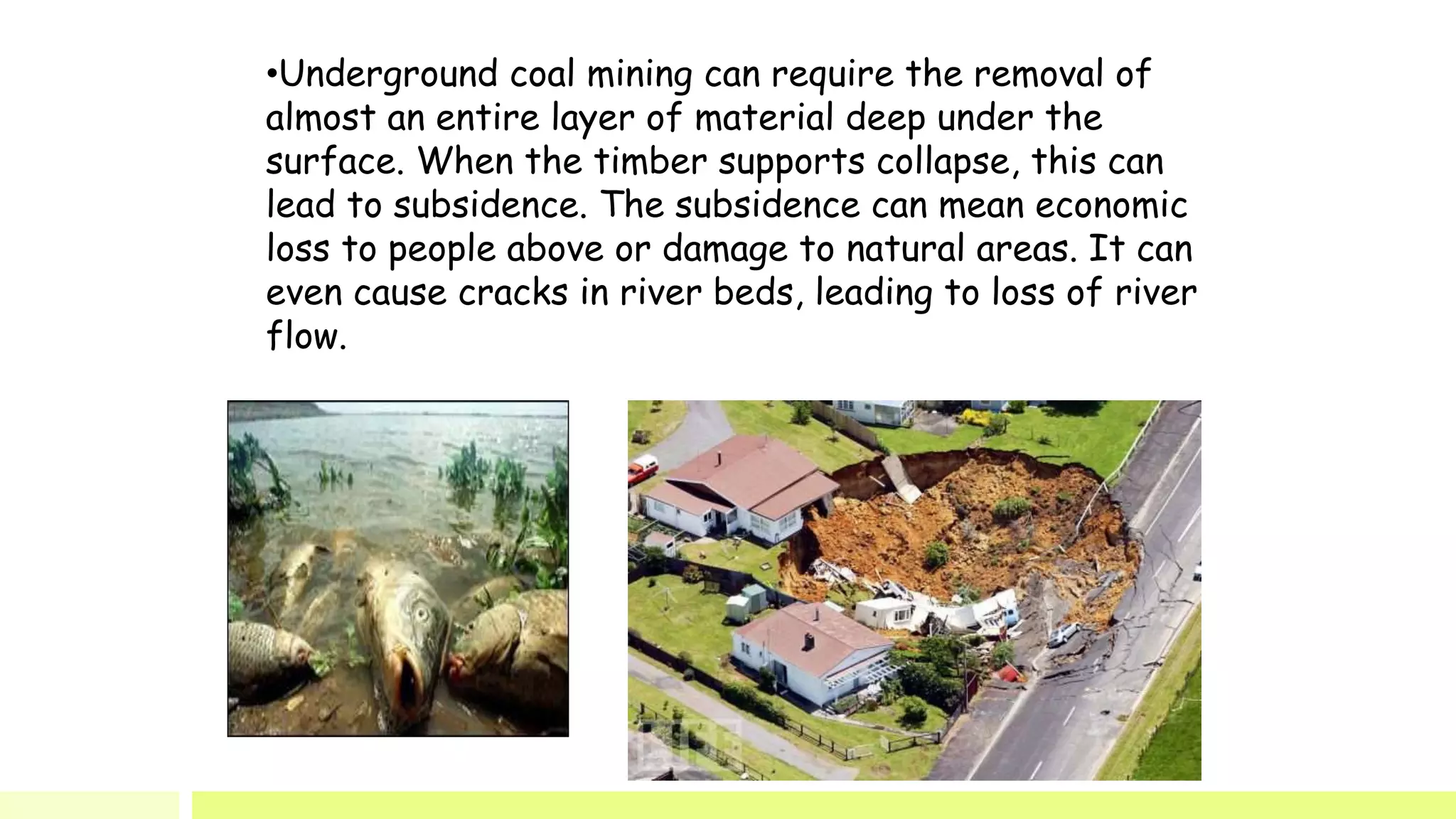
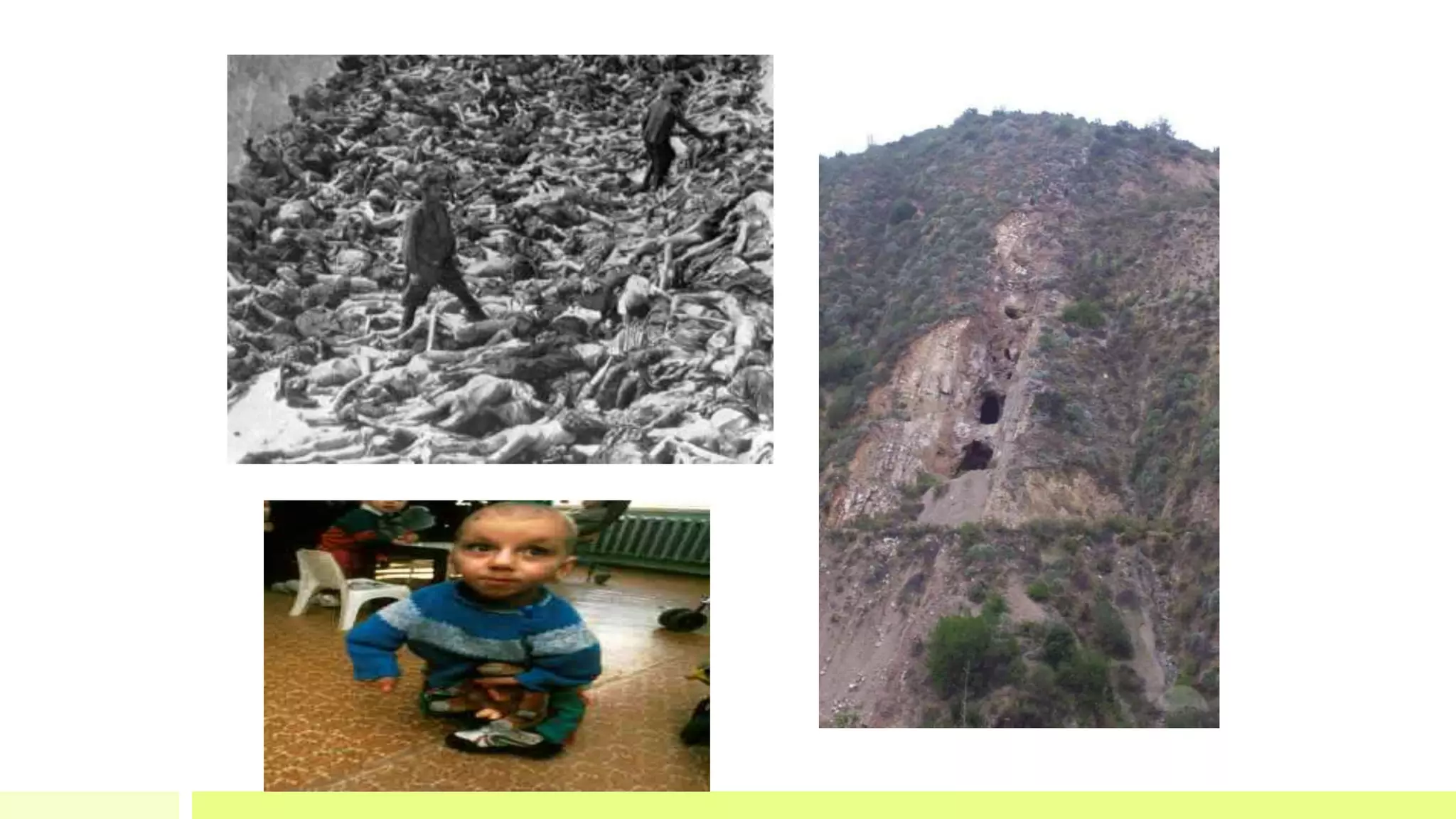
•Underground coal mining can require the removal of
almost an entire layer of material deep under the
surface. When the timber supports collapse, this can
lead to subsidence. The subsidence can mean economic
loss to people above or damage to natural areas. It can
even cause cracks in river beds, leading to loss of river
flow.
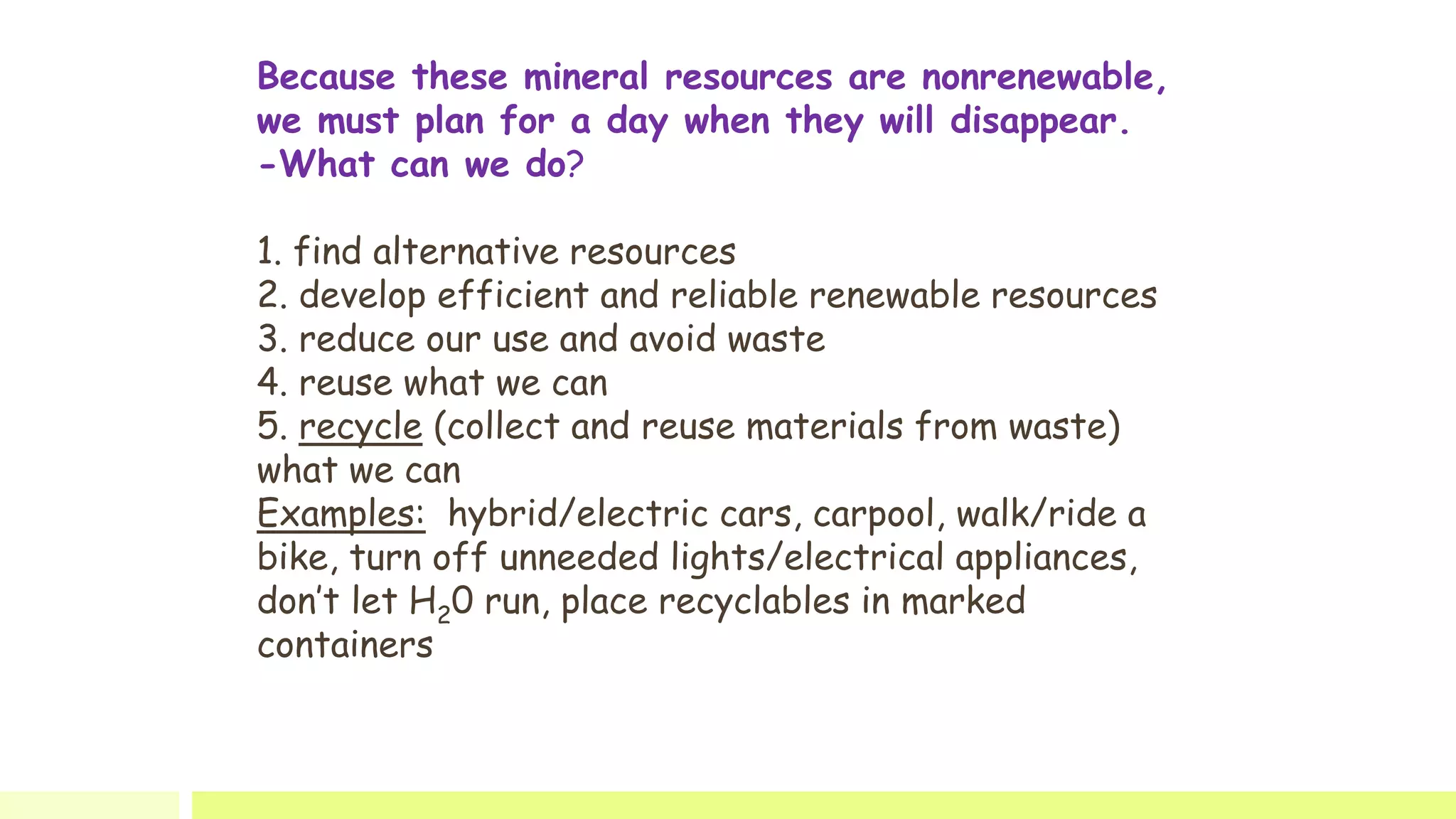
•Some mining involves the inadvertent dispersal of
heavy metals, such as lead, into the atmosphere. This
can have serious health effects, including mental
retardation in children.
•Asbestos mining causes the dispersal of asbestos
into the environment. This will cause deaths among
local residents and workers, often several decades
later. Fortunately, the mining and use of asbestos are
banned in most parts of the world.
Because these mineral resources are nonrenewable,
we must plan for a day when they will disappear.
-What can we do?
1. find alternative resources
2. develop efficient and reliable renewable resources
3. reduce our use and avoid waste
4. reuse what we can
5. recycle (collect and reuse materials from waste)
what we can
Examples: hybrid/electric cars, carpool, walk/ride a
bike, turn off unneeded lights/electrical appliances,
don’t let H20 run, place recyclables in marked
containers
A Case Study-
UDAIPUR
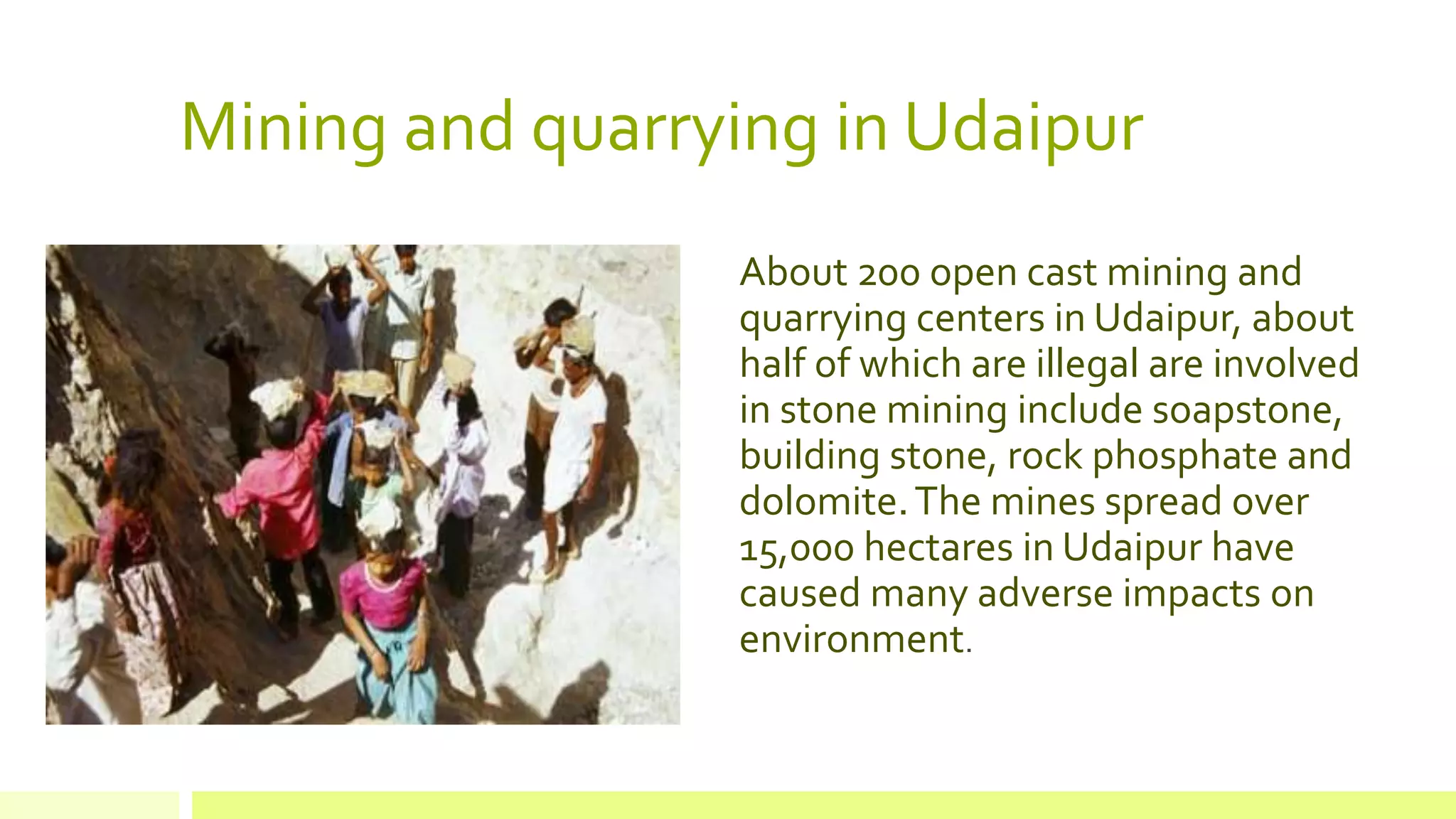
Mining and quarrying in Udaipur
About 200 open cast mining and
quarrying centers in Udaipur, about
half of which are illegal are involved
in stone mining include soapstone,
building stone, rock phosphate and
dolomite.The mines spread over
15,000 hectares in Udaipur have
caused many adverse impacts on
environment.
July 22, 2012 Footer text here44
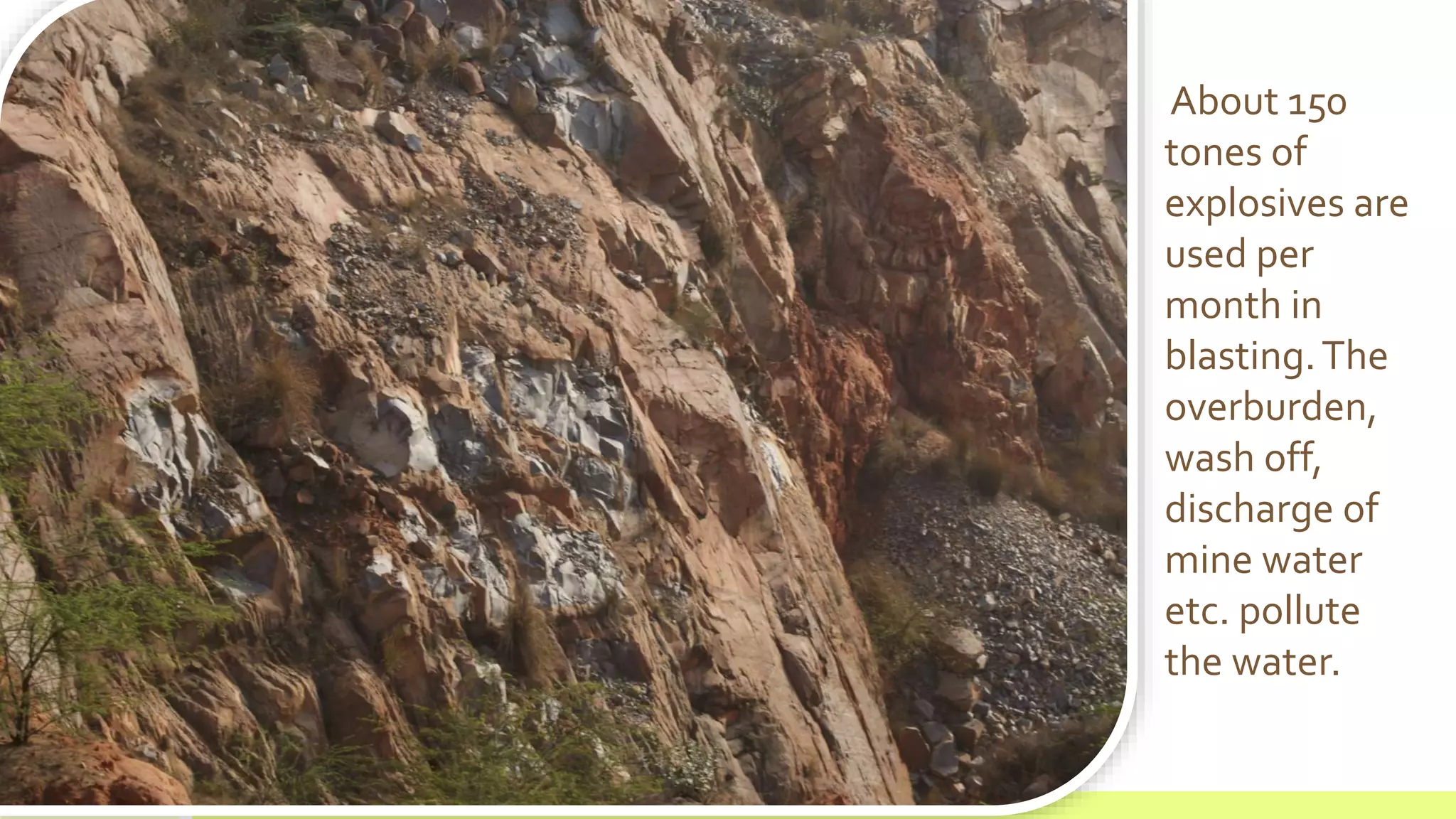
About 150
tones of
explosives are
used per
month in
blasting.The
overburden,
wash off,
discharge of
mine water
etc. pollute
the water.
July 22, 2012 Footer text here45
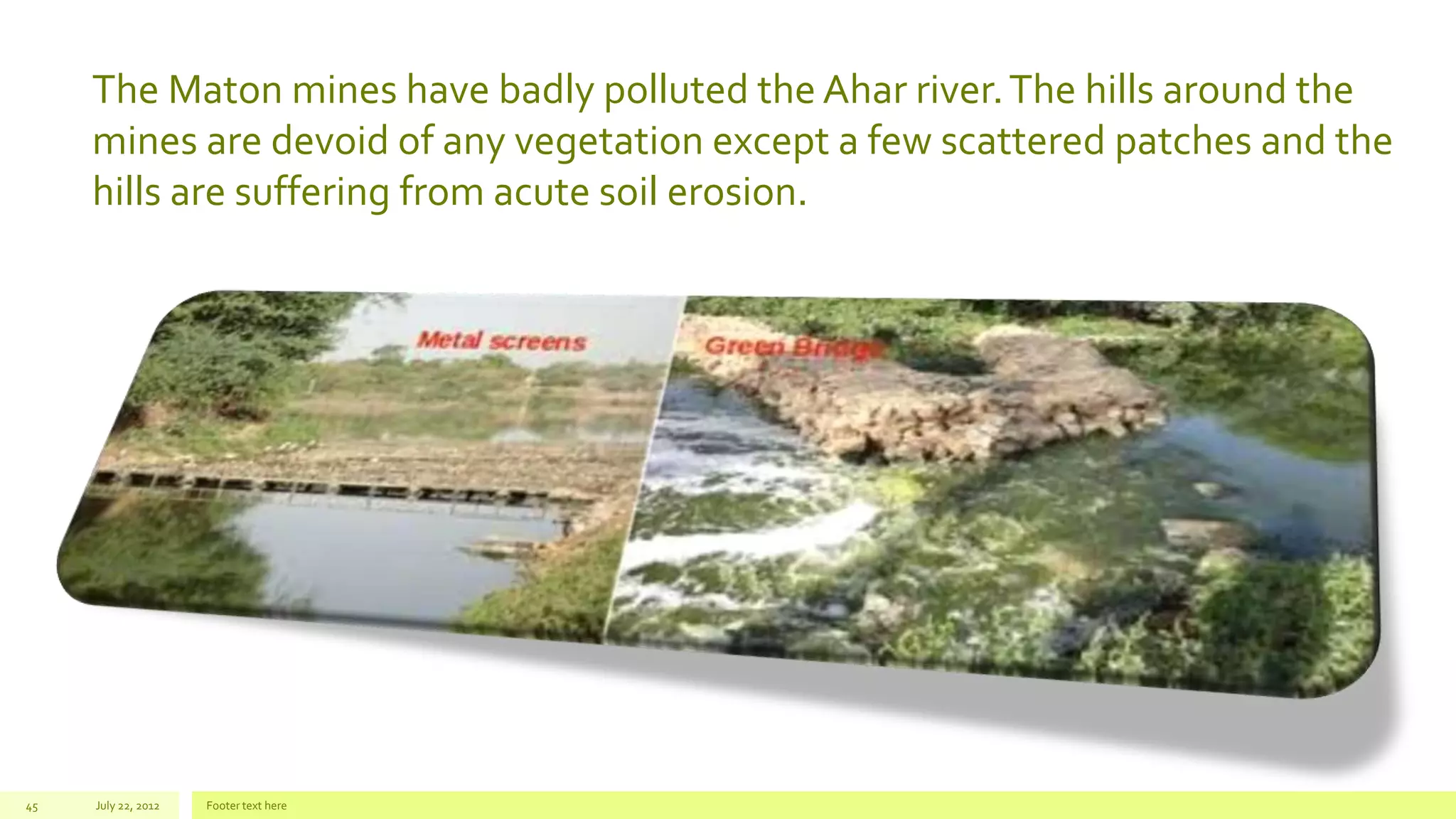
The Maton mines have badly polluted the Ahar river.The hills around the
mines are devoid of any vegetation except a few scattered patches and the
hills are suffering from acute soil erosion.
July 22, 2012 Footer text here46
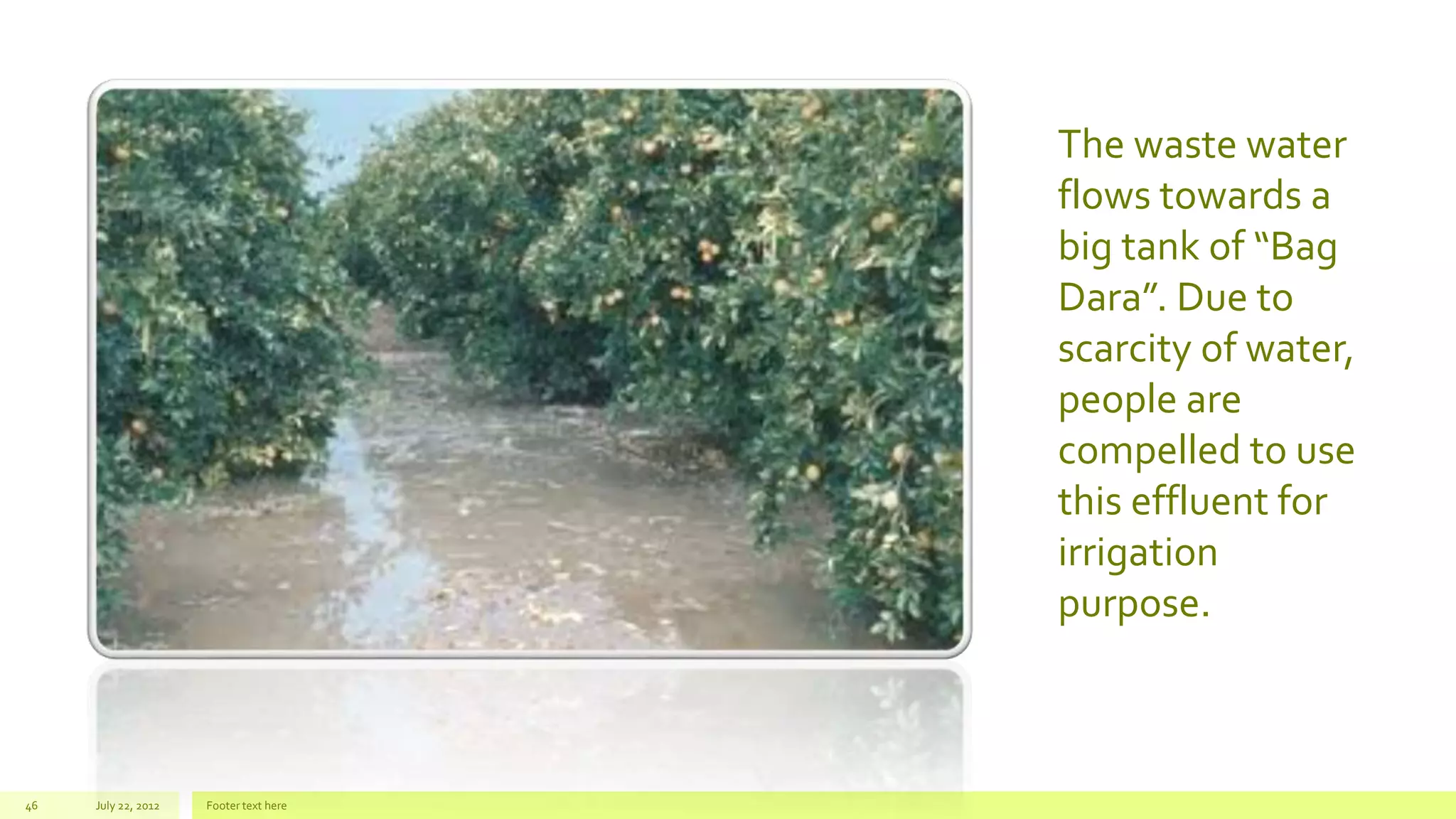
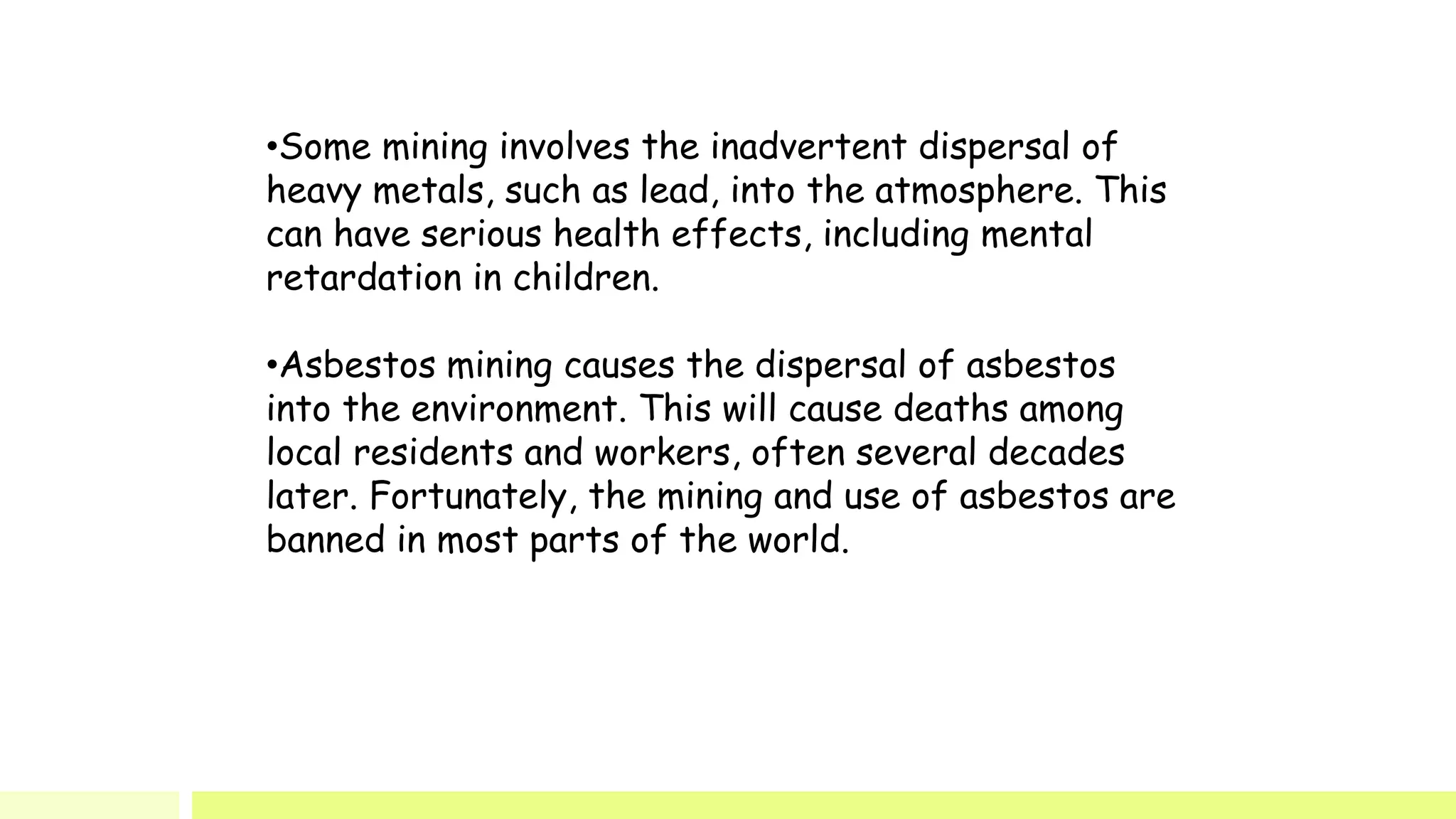
The waste water
flows towards a
big tank of “Bag
Dara”. Due to
scarcity of water,
people are
compelled to use
this effluent for
irrigation
purpose.
July 22, 2012 Footer text here47
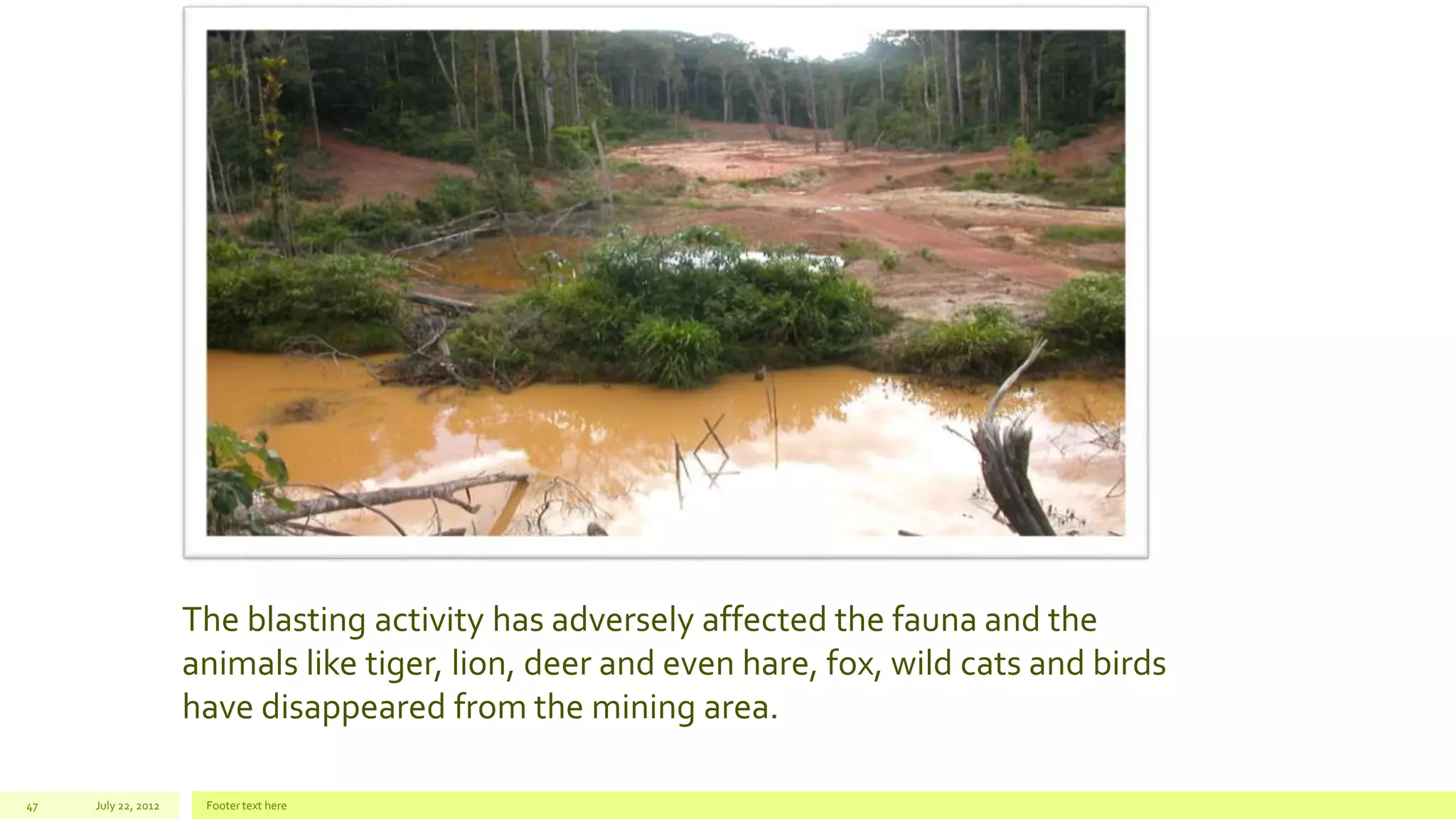
The blasting activity has adversely affected the fauna and the
animals like tiger, lion, deer and even hare, fox, wild cats and birds
have disappeared from the mining area.
July 22, 2012 Footer text here48

Mineral Resources and case study

  • 1.
    MINERAL RESOURCES A PROJECT REPORTANDCASE STUDY ON MINING Presented By- Manpreet Singh E&EC 12105070
  • 2.
    Mineral Resource isdefined as a occurrence of natural, solid, inorganic or fossilized organic material in or on the Earth’s crust in such form and quantity and of such a grade or quality that it has reasonable prospects for economic extraction.
  • 3.
    National Mineral Scenario Indiaproduces as many as 87 minerals, which includes 4 fuel, 10 metallic, 47 non- metallic, 3 atomic and 23 minor minerals (including building and other materials). • India possesses a large variety of mineral-ores in fairly huge quantities. • India is rich in coal, manganese, iron, chromites and mica. It is deficient in the gold, silver, nickel etc.
  • 4.
    Major Reserve andimportant uses Metal Major World Resources Major uses Aluminium Australia, Guinea, Jamaica Packaging food items, transportations, utensils Chromium CIS, South Africa For making high strength steel alloys Copper USA, Canada, CIS, Chile, Zambia Electric and Electronic goods Iron CIS, South America, Canada, USA Heavy machinery, steel production transportation means Lead North America, USA,CIS Leaded gasoline,Car batteries, paints Manganese South Africa, CIS, Brazil, Gabon High strength, heat resistant steel alloys Platinum group South Africa , CIS Use in Automobiles, catalytic converters, electronics, medical uses Gold South Africa ,CIS, Canada Ornaments, medical use, electronics use Silver Canada, South Africa, Mexico Photography, electronics, jeweler Nickel CIS, Canada, New CaledoniaJuly 22, 2012 Footer text here4
  • 5.
    Estimated life expiryof minerals depends on two things: 1. the size of the reserve 2. the rate at which we are using it up! Resource Est. Life Exp. in Yrs. Uses • Coal 200-300 (electricity) • Copper 36 (electric wiring) • Iron 62 (steel prod.) • Lead 25 (batteries) • Natural Gas 125 (fuel; heat) • Oil 50 (gasoline) • Silver 17 (electric wiring) • Tin 31 (cans; industry) • Uranium ??? (electricity)
  • 6.
    July 22, 2012Footer text here6
  • 7.
    July 22, 2012Footer text here7 Iron : Orissa, Bihar, Madhya Pradesh, Jharkhand, Chhattisgarh, Tamil Nadu, Karnataka, Andhra Pradesh, Kerala, Goa
  • 8.
    Copper Copper : Jharkhand, AndhraPradesh, Gujarat, Karnataka, Rajasthan, Madhya Pradesh, Uttar Pradesh, Sikkim.
  • 9.
    Coal Coal : Bihar-Bengal- Jharkhandcoal belt, Madhya Pradesh, Chhattisgarh, Orissa, Maharashtra, Andhra Pradesh.
  • 10.
    Graphitized Petroleum Coke Petroleum: Assam, Gujarat, Maharashtra
  • 11.
    Zinc & Lead Leadand Zinc: Rajasthan, Jharkhand, Gujarat, West Bengal, Andhra Pradesh, Meghalaya, Sikkim.
  • 12.
  • 13.
  • 14.
    Chromium Chromite : Orissa, Maharashtra, Jharkhand, Karnataka,Tamil Nadu, Madhya Pradesh, Chhattisgarh, Manipur .
  • 15.
  • 16.
  • 18.
  • 19.
  • 20.
  • 21.
  • 22.
  • 23.
  • 24.
  • 25.
  • 26.
  • 27.
  • 28.
  • 29.
  • 30.
  • 31.
  • 32.
    Types of Mining SurfaceMining Underground Mining Placer Mining Strip Mining Mountaintop removal Hydraulic Open pit Dredging Drift Mining Slope Mining Shaft Mining Hard rock Bore hole
  • 33.
    Surface mines aremining operations that delve into rock to extract deposits of mineral resources that are close to the surface . In most forms of surface mining, heavy equipment, such as earthmovers, first remove the overburden (the soil and rock above the deposit). Next, huge machines such as drag line excavators extract the mineral. Once the material has been removed, the land is recovered for safe use on the surface through a process called reclamation. Surface Mining
  • 35.
    Some effects ofmining on the environment •Deforestation and loss of biodiversity are major effects of mining.(It destroys forest and wetlands. It may mean that you have to cut down lots of trees just to get to the spot that has all the gold or iron ore). •Many mine require tailings dams to prevent waste being washed into the rivers. Unethical miners can dispense with the dams, to save costs, resulting in massive pollution downstream. In other cases, the tailings dam can overflow, and even breach, during periods of heavy rain.
  • 37.
    •Underground coal miningcan require the removal of almost an entire layer of material deep under the surface. When the timber supports collapse, this can lead to subsidence. The subsidence can mean economic loss to people above or damage to natural areas. It can even cause cracks in river beds, leading to loss of river flow.
  • 39.
    •Some mining involvesthe inadvertent dispersal of heavy metals, such as lead, into the atmosphere. This can have serious health effects, including mental retardation in children. •Asbestos mining causes the dispersal of asbestos into the environment. This will cause deaths among local residents and workers, often several decades later. Fortunately, the mining and use of asbestos are banned in most parts of the world.
  • 41.
    Because these mineralresources are nonrenewable, we must plan for a day when they will disappear. -What can we do? 1. find alternative resources 2. develop efficient and reliable renewable resources 3. reduce our use and avoid waste 4. reuse what we can 5. recycle (collect and reuse materials from waste) what we can Examples: hybrid/electric cars, carpool, walk/ride a bike, turn off unneeded lights/electrical appliances, don’t let H20 run, place recyclables in marked containers
  • 42.
  • 43.
    Mining and quarryingin Udaipur About 200 open cast mining and quarrying centers in Udaipur, about half of which are illegal are involved in stone mining include soapstone, building stone, rock phosphate and dolomite.The mines spread over 15,000 hectares in Udaipur have caused many adverse impacts on environment.
  • 44.
    July 22, 2012Footer text here44 About 150 tones of explosives are used per month in blasting.The overburden, wash off, discharge of mine water etc. pollute the water.
  • 45.
    July 22, 2012Footer text here45 The Maton mines have badly polluted the Ahar river.The hills around the mines are devoid of any vegetation except a few scattered patches and the hills are suffering from acute soil erosion.
  • 46.
    July 22, 2012Footer text here46 The waste water flows towards a big tank of “Bag Dara”. Due to scarcity of water, people are compelled to use this effluent for irrigation purpose.
  • 47.
    July 22, 2012Footer text here47 The blasting activity has adversely affected the fauna and the animals like tiger, lion, deer and even hare, fox, wild cats and birds have disappeared from the mining area.
  • 48.
    July 22, 2012Footer text here48