LESSON 5:
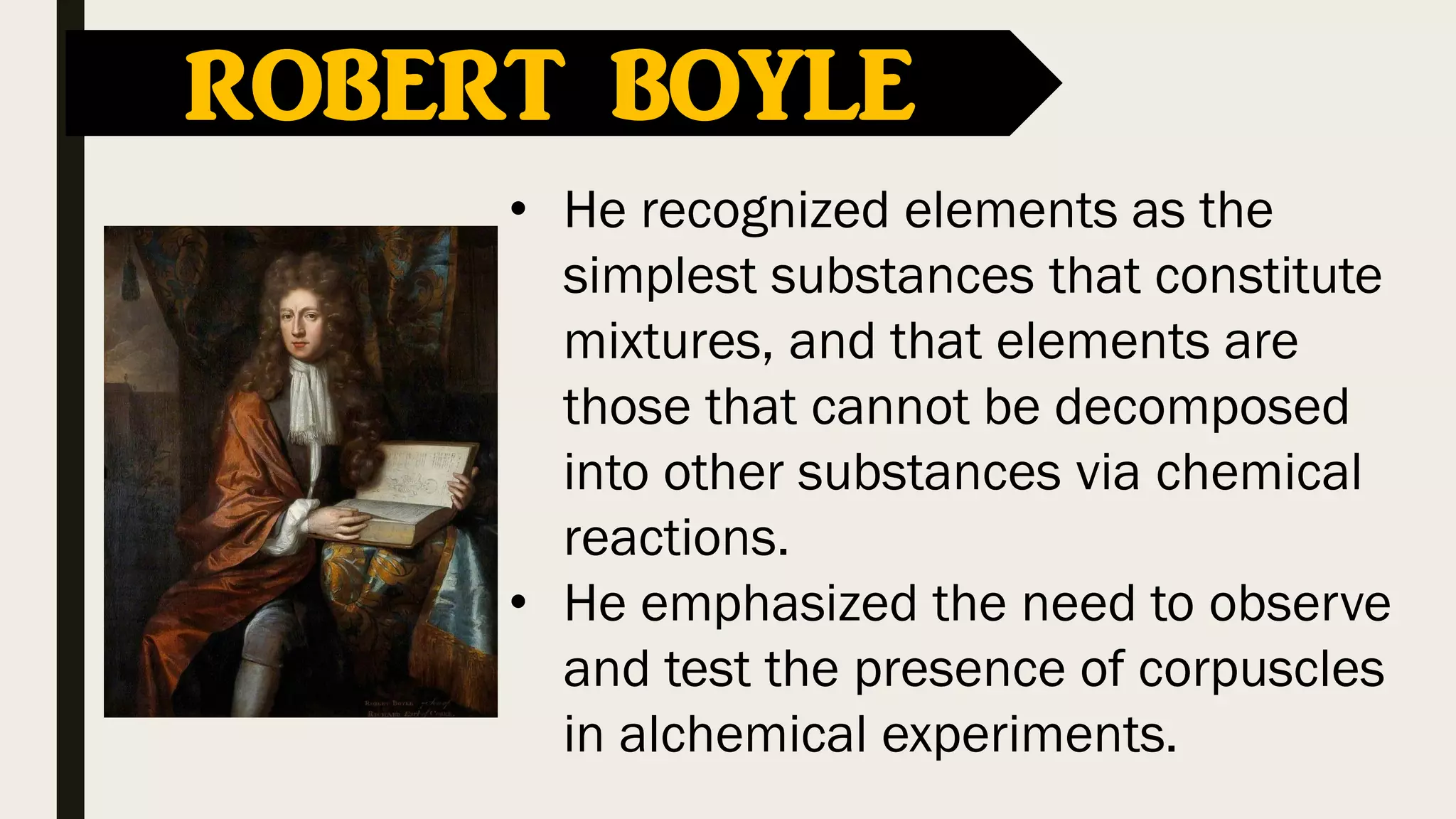
• He recognized elements as the
simplest substances that constitute
mixtures, and that elements are
those that cannot be decomposed
into other substances via chemical
reactions.
• He emphasized the need to observe
and test the presence of corpuscles
in alchemical experiments.
ROBERT BOYLE
ROBERT BOYLE
• Had the idea of:
Corpuscles
 “certain primitive and simple, or
perfectly unmingled bodies” that
were indivisible and whole.
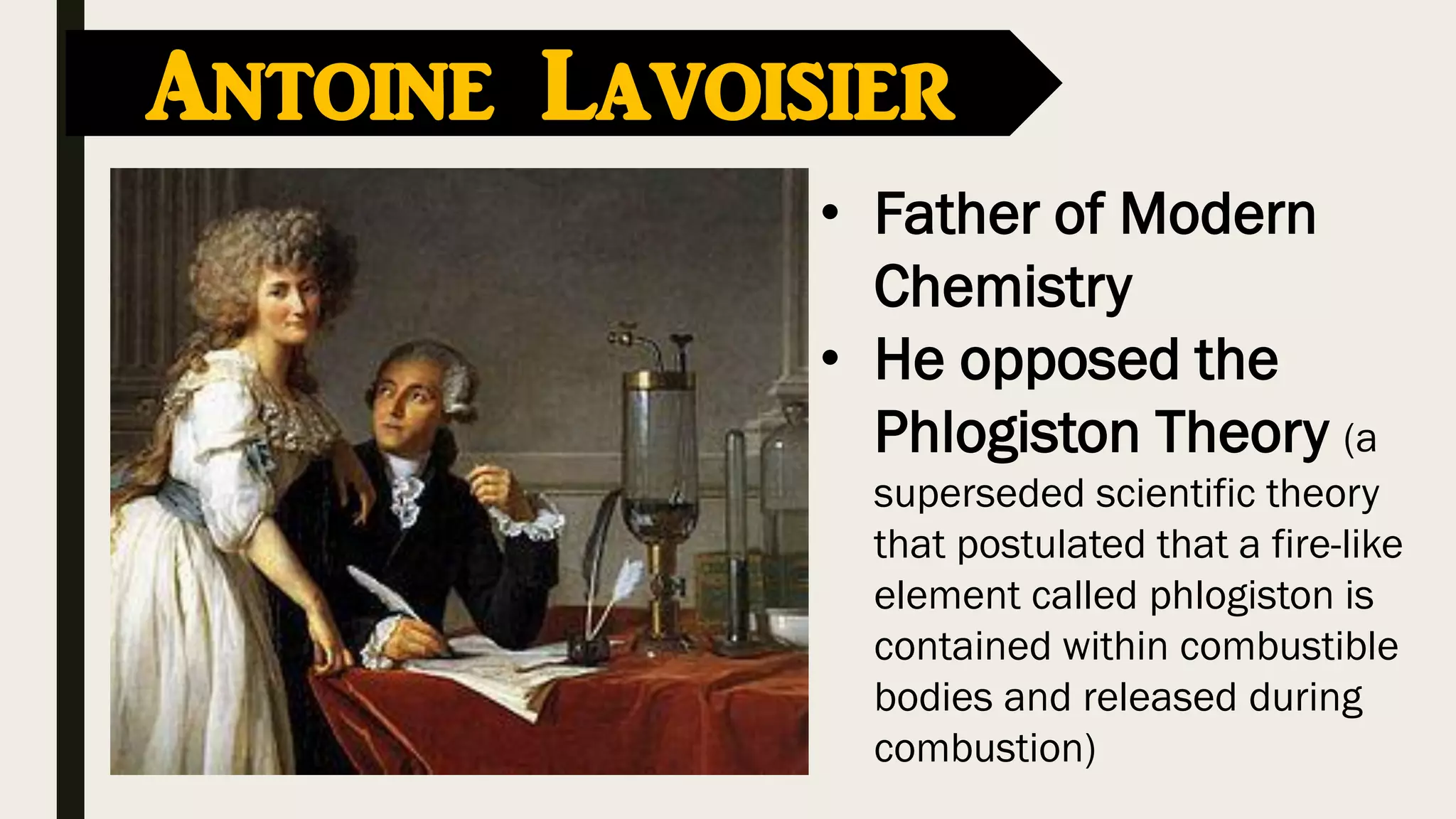
Antoine Lavoisier
• Father of Modern
Chemistry
• He opposed the
Phlogiston Theory (a
superseded scientific theory
that postulated that a fire-like
element called phlogiston is
contained within combustible
bodies and released during
combustion)
Antoine Lavoisier
 Defined CHEMICAL ELEMENT (substance that
cannot be broken down into simpler components.)
 Defined COMPOUND (a substance composed of
these elements.)
 Made an initial list of 33 elements, and
created a systematic way of naming elements
and the compounds they created.
 He also wrote the first Chemistry textbook.
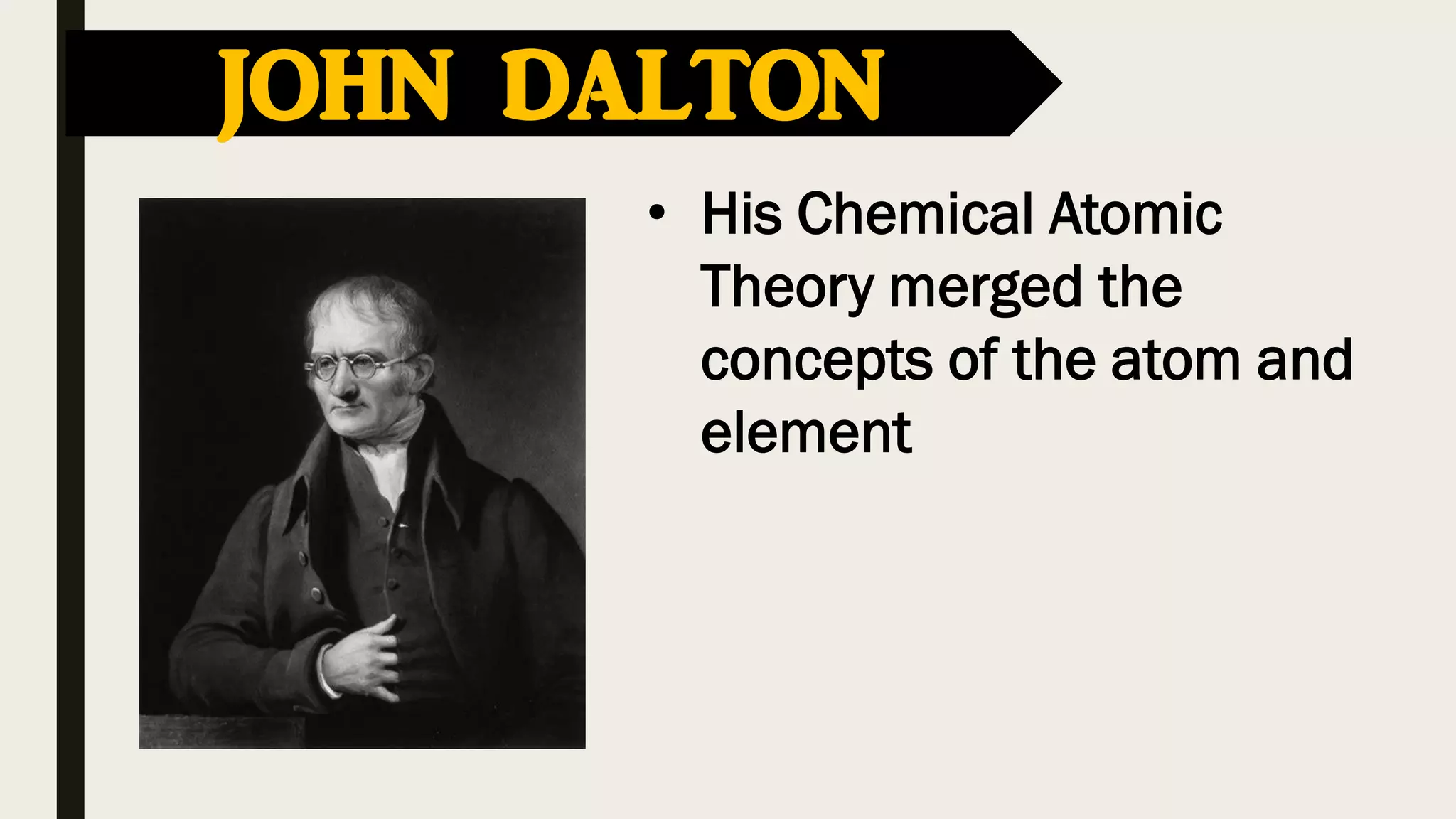
JOHN DALTON
• His Chemical Atomic
Theory merged the
concepts of the atom and
element
• Gases, and all chemically inseparable
elements, are made of atoms.
• The atoms of an element are identical in their
masses.
• Atoms of different elements have different
masses.
• Atoms combine in small, whole number
ratios.
Chemical atomic theory
•Antoine Lavoisier’s Law of
Conservation of Mass
•Joseph Proust’s Law of Definite
Proportions
•John Dalton’s Law of Multiple
Proportions
3 Fundamental laws
Antoine Lavoisier’s Law of
Conservation of Mass
mass is neither created nor
destroyed during an ordinary
chemical reaction or physical
reaction.
3 Fundamental laws
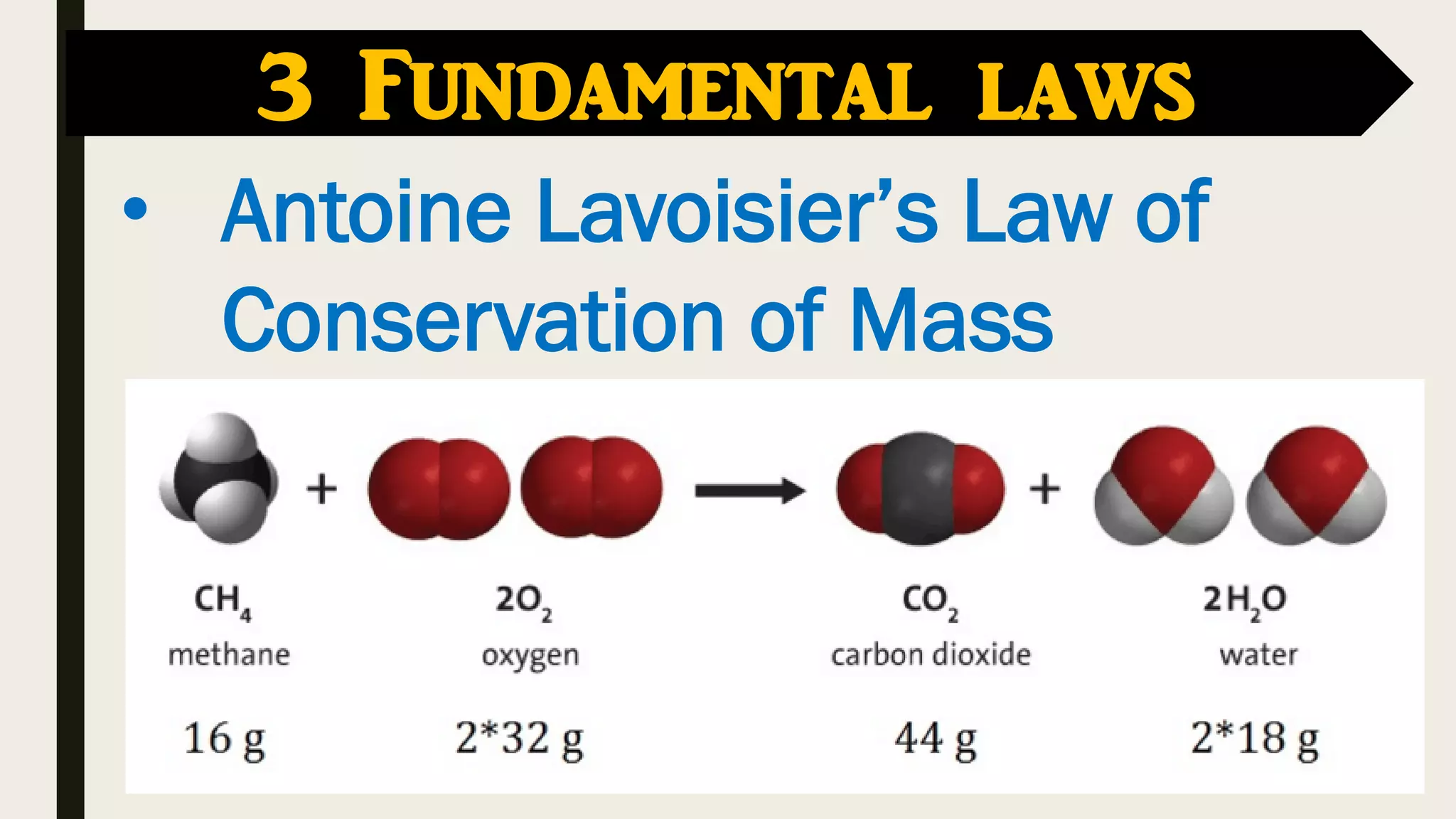
• Antoine Lavoisier’s Law of
Conservation of Mass
3 Fundamental laws
•Joseph Proust’s Law of Definite
Proportions
 chemical compound contains the
same elements in exactly the same
proportions by mass regardless of the
sample of the source of the compound.
3 Fundamental laws
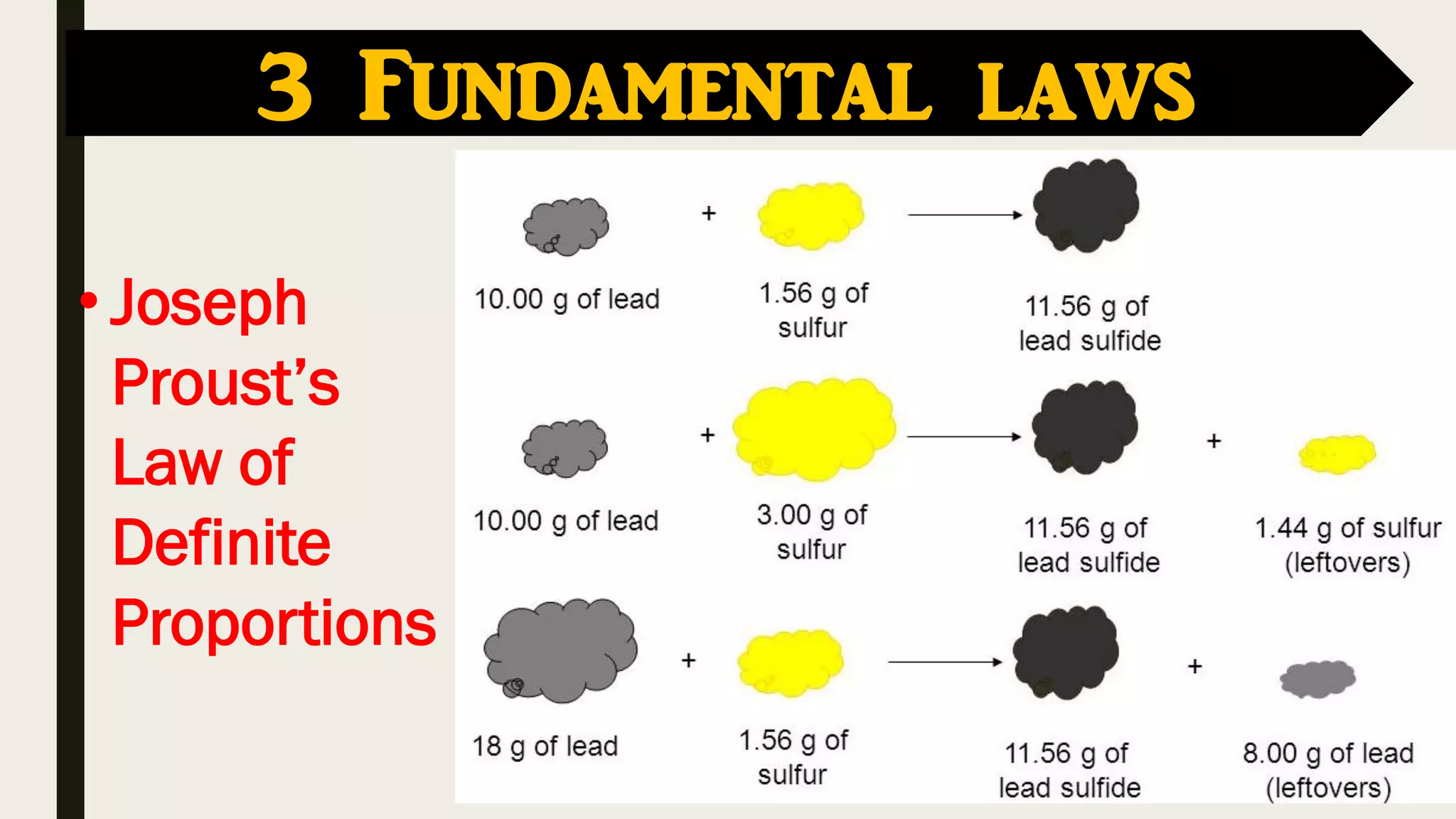
• Joseph
Proust’s
Law of
Definite
Proportions
3 Fundamental laws
•John Dalton’s Law of Multiple
Proportions
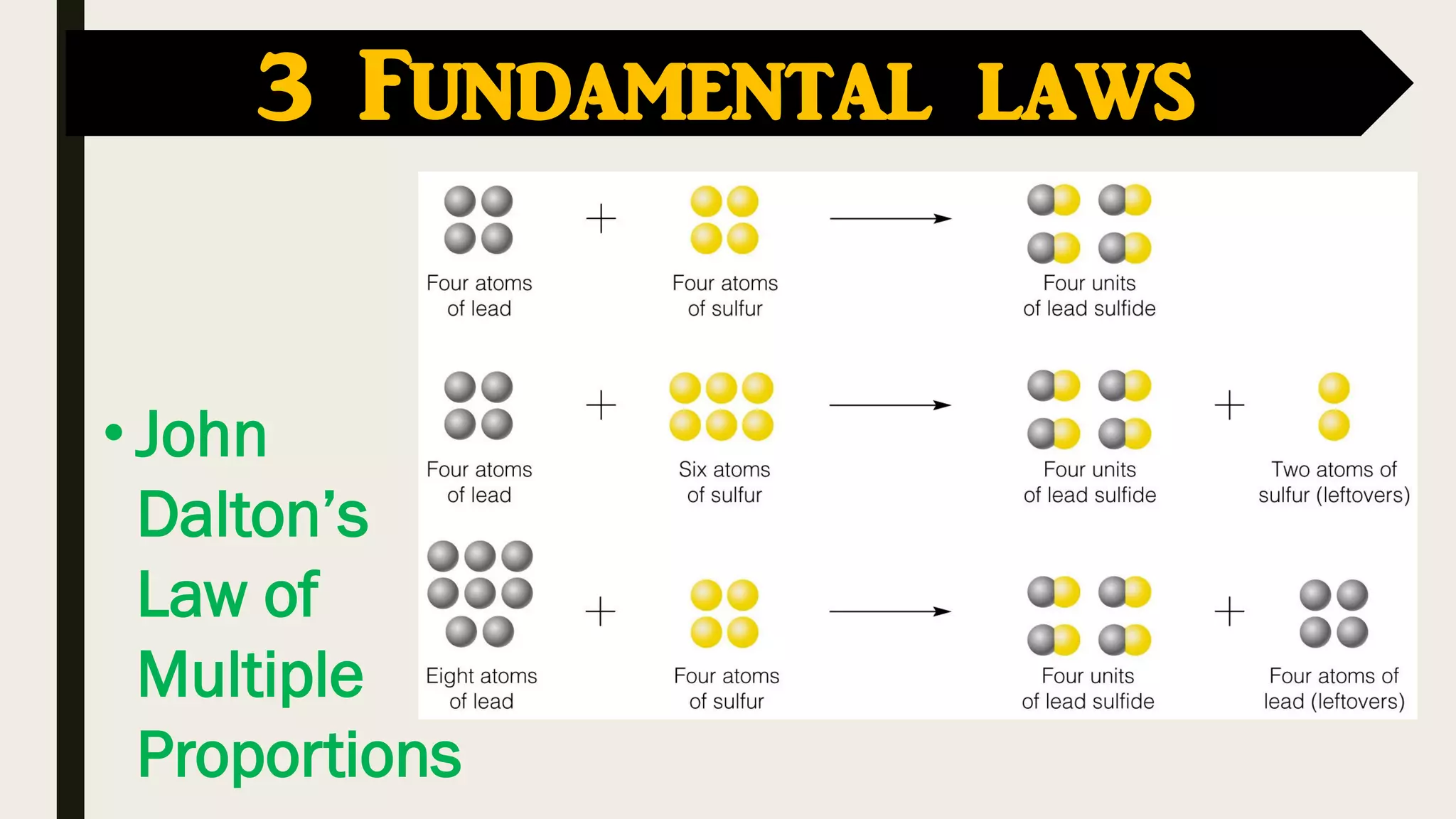
 if two or more different compounds are
composed of the same two elements, then
the ratios of the masses of the second
element, combined with a certain mass of
the first element is always a ratio of small
whole numbers
3 Fundamental laws
• John
Dalton’s
Law of
Multiple
Proportions
3 Fundamental laws
• that elements were made of the same atoms and had
properties unique to the element, while chemical
compounds were made of different combined or
compounded atoms, and exhibited different sets of
properties.
• that one could compute the weights of elements (and their
atoms) by looking at comparable amounts of the
compounds they formed.
• that one could compute atomic weights compared to a
reference.
Dalton’s Chemical Atomic Theory
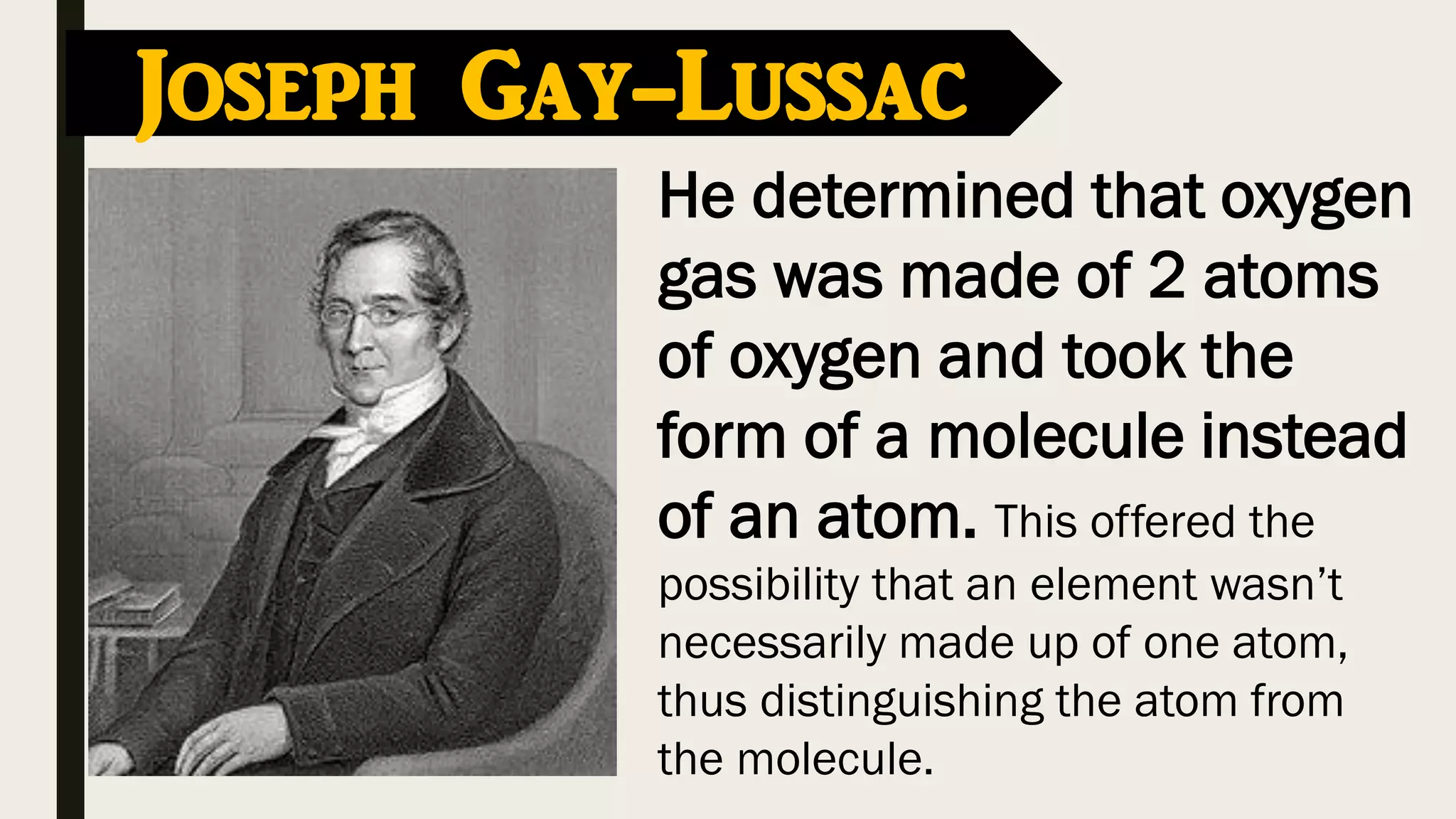
Joseph Gay-Lussac
He determined that oxygen
gas was made of 2 atoms
of oxygen and took the
form of a molecule instead
of an atom. This offered the
possibility that an element wasn’t
necessarily made up of one atom,
thus distinguishing the atom from
the molecule.
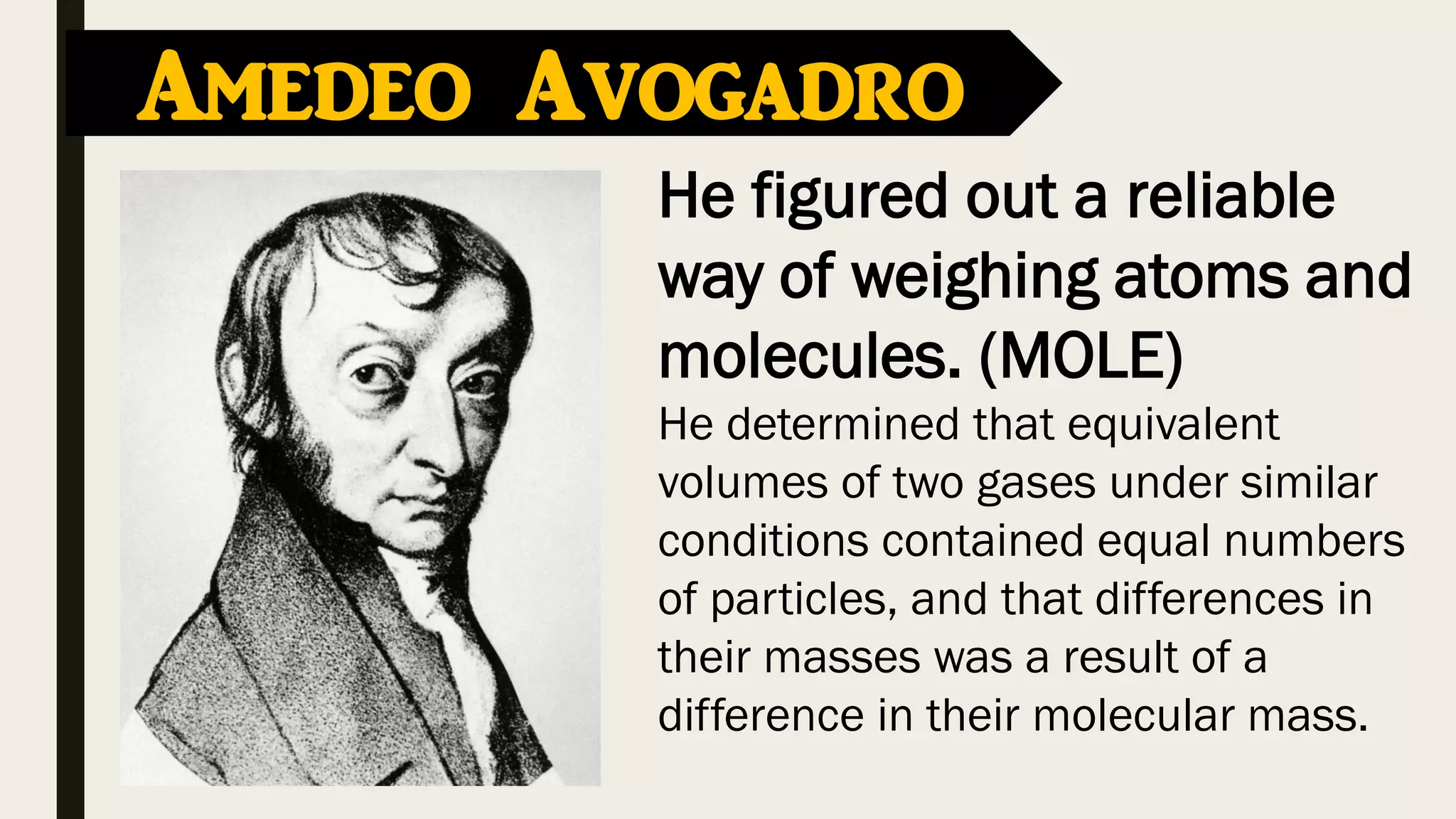
Amedeo Avogadro
He figured out a reliable
way of weighing atoms and
molecules. (MOLE)
He determined that equivalent
volumes of two gases under similar
conditions contained equal numbers
of particles, and that differences in
their masses was a result of a
difference in their molecular mass.
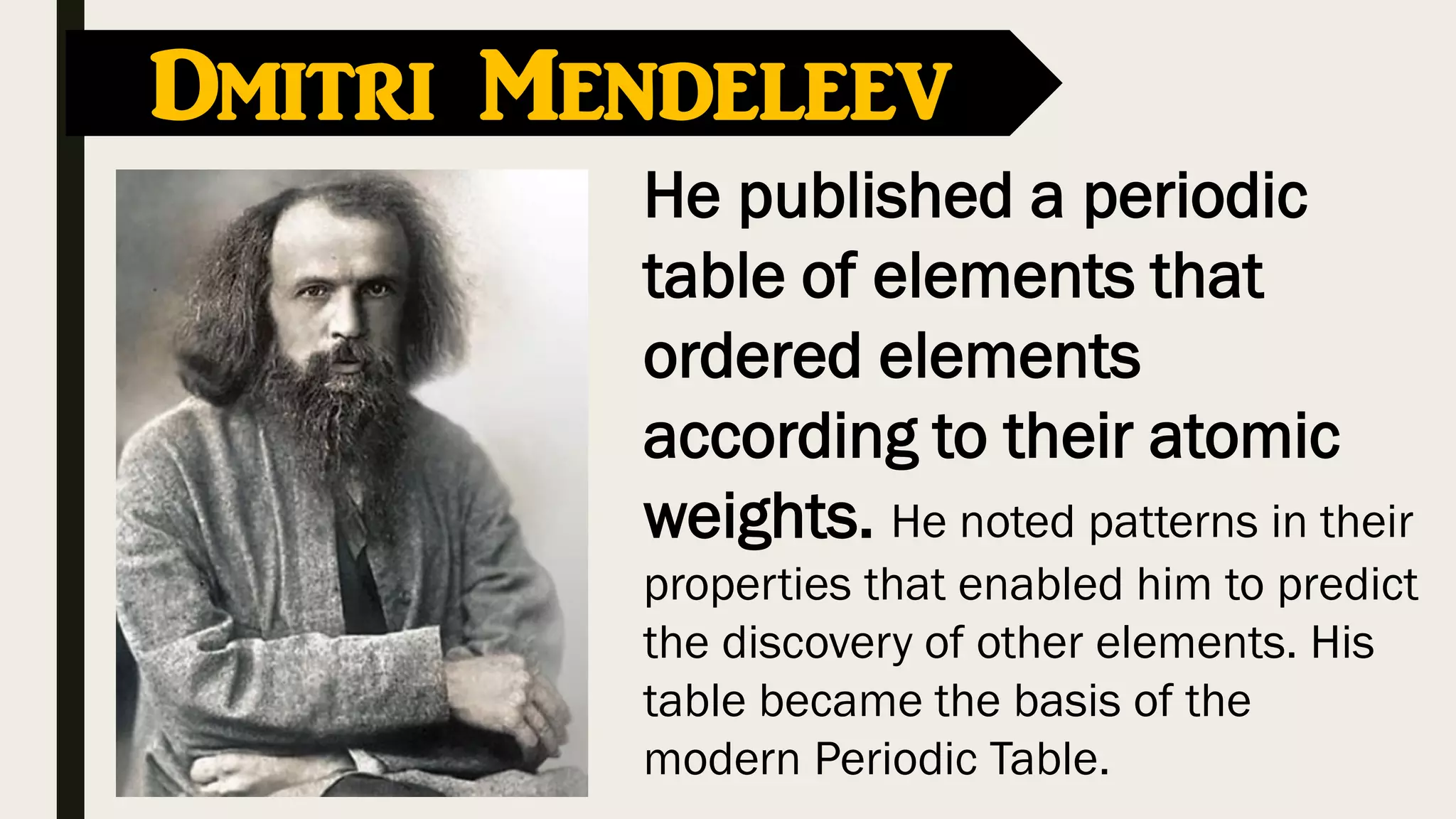
He published a periodic
table of elements that
ordered elements
according to their atomic
weights. He noted patterns in their
properties that enabled him to predict
the discovery of other elements. His
table became the basis of the
modern Periodic Table.
Dmitri Mendeleev

Lesson 5: Corpuscles to Chemical Atomic Theory (The Development of Atomic Theory)

  • 1.
  • 2.
    • He recognizedelements as the simplest substances that constitute mixtures, and that elements are those that cannot be decomposed into other substances via chemical reactions. • He emphasized the need to observe and test the presence of corpuscles in alchemical experiments. ROBERT BOYLE
  • 3.
    ROBERT BOYLE • Hadthe idea of: Corpuscles  “certain primitive and simple, or perfectly unmingled bodies” that were indivisible and whole.
  • 4.
    Antoine Lavoisier • Fatherof Modern Chemistry • He opposed the Phlogiston Theory (a superseded scientific theory that postulated that a fire-like element called phlogiston is contained within combustible bodies and released during combustion)
  • 5.
    Antoine Lavoisier  DefinedCHEMICAL ELEMENT (substance that cannot be broken down into simpler components.)  Defined COMPOUND (a substance composed of these elements.)  Made an initial list of 33 elements, and created a systematic way of naming elements and the compounds they created.  He also wrote the first Chemistry textbook.
  • 6.
    JOHN DALTON • HisChemical Atomic Theory merged the concepts of the atom and element
  • 7.
    • Gases, andall chemically inseparable elements, are made of atoms. • The atoms of an element are identical in their masses. • Atoms of different elements have different masses. • Atoms combine in small, whole number ratios. Chemical atomic theory
  • 8.
    •Antoine Lavoisier’s Lawof Conservation of Mass •Joseph Proust’s Law of Definite Proportions •John Dalton’s Law of Multiple Proportions 3 Fundamental laws
  • 9.
    Antoine Lavoisier’s Lawof Conservation of Mass mass is neither created nor destroyed during an ordinary chemical reaction or physical reaction. 3 Fundamental laws
  • 10.
    • Antoine Lavoisier’sLaw of Conservation of Mass 3 Fundamental laws
  • 11.
    •Joseph Proust’s Lawof Definite Proportions  chemical compound contains the same elements in exactly the same proportions by mass regardless of the sample of the source of the compound. 3 Fundamental laws
  • 12.
  • 13.
    •John Dalton’s Lawof Multiple Proportions  if two or more different compounds are composed of the same two elements, then the ratios of the masses of the second element, combined with a certain mass of the first element is always a ratio of small whole numbers 3 Fundamental laws
  • 14.
  • 15.
    • that elementswere made of the same atoms and had properties unique to the element, while chemical compounds were made of different combined or compounded atoms, and exhibited different sets of properties. • that one could compute the weights of elements (and their atoms) by looking at comparable amounts of the compounds they formed. • that one could compute atomic weights compared to a reference. Dalton’s Chemical Atomic Theory
  • 16.
    Joseph Gay-Lussac He determinedthat oxygen gas was made of 2 atoms of oxygen and took the form of a molecule instead of an atom. This offered the possibility that an element wasn’t necessarily made up of one atom, thus distinguishing the atom from the molecule.
  • 17.
    Amedeo Avogadro He figuredout a reliable way of weighing atoms and molecules. (MOLE) He determined that equivalent volumes of two gases under similar conditions contained equal numbers of particles, and that differences in their masses was a result of a difference in their molecular mass.
  • 18.
    He published aperiodic table of elements that ordered elements according to their atomic weights. He noted patterns in their properties that enabled him to predict the discovery of other elements. His table became the basis of the modern Periodic Table. Dmitri Mendeleev