Topic Name: EARTHQUAKES
Gandhinagar Institute
OF Technology
Presented By: Guided By:
Prof. SANDESH SHARMA
RAHUL PANCHAL(40)
KISHAN PANCHAL(37)
HIREN PANCHAL(36)
DHRUVIL PANCHAL(34)
What are Earthquakes?
• The shaking or trembling caused by the sudden
release of energy
• Usually associated with faulting or breaking of rocks
• Continuing adjustment of position results in
aftershocks
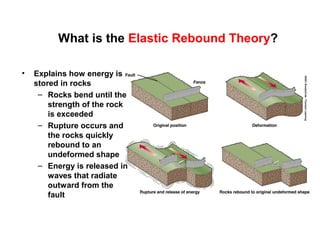
What is the Elastic Rebound Theory?
• Explains how energy is
stored in rocks
– Rocks bend until the
strength of the rock
is exceeded
– Rupture occurs and
the rocks quickly
rebound to an
undeformed shape
– Energy is released in
waves that radiate
outward from the
fault
The Focus and Epicenter of an Earthquake
• The point within Earth
where faulting begins is
the focus, or hypocenter
• The point directly above
the focus on the surface
is the epicenter
Where Do Earthquakes Occur and How Often?
~80% of all earthquakes occur in the circum-Pacific belt
– most of these result from convergent margin activity
– ~15% occur in the Mediterranean-Asiatic belt
– remaining 5% occur in the interiors of plates and on
spreading ridge centers
– more than 150,000 quakes strong enough to be felt are
recorded each year
FOR EARTHQUAKES
DETAILS VIDEO
The Economics and Societal Impacts of EQs
Damage in Oakland, CA,
1989• Building collapse
• Fire
• Tsunami
• Ground failure
EARTHQUAKE IN NEPAL
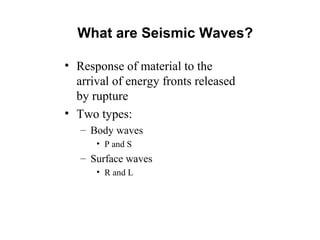
What are Seismic Waves?
• Response of material to the
arrival of energy fronts released
by rupture
• Two types:
– Body waves
• P and S
– Surface waves
• R and L
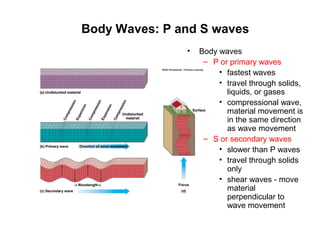
Body Waves: P and S waves
• Body waves
– P or primary waves
• fastest waves
• travel through solids,
liquids, or gases
• compressional wave,
material movement is
in the same direction
as wave movement
– S or secondary waves
• slower than P waves
• travel through solids
only
• shear waves - move
material
perpendicular to
wave movement
Surface Waves: R and L waves
• Surface Waves
– Travel just below or along the ground’s surface
– Slower than body waves; rolling and side-to-side
movement
– Especially damaging to buildings
• Ground motion
• Duration of Shaking
• Surface Rupture
• Poor building design
Damage: Causes
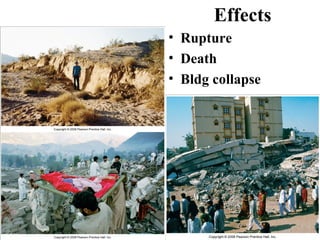
• Rupture
• Death
• Bldg collapse
Effects
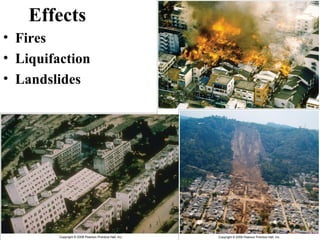
Effects
• Fires
• Liquifaction
• Landslides
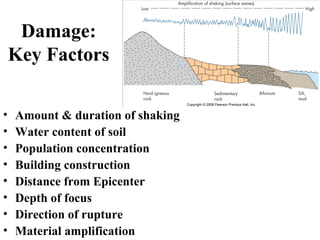
Damage:
Key Factors
• Amount & duration of shaking
• Water content of soil
• Population concentration
• Building construction
• Distance from Epicenter
• Depth of focus
• Direction of rupture
• Material amplification
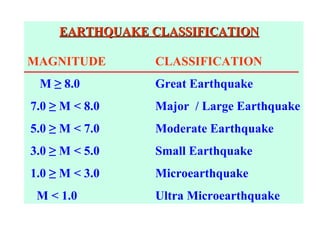
EARTHQUAKE CLASSIFICATIONEARTHQUAKE CLASSIFICATION
MAGNITUDE CLASSIFICATION
M ≥ 8.0 Great Earthquake
7.0 ≥ M < 8.0 Major / Large Earthquake
5.0 ≥ M < 7.0 Moderate Earthquake
3.0 ≥ M < 5.0 Small Earthquake
1.0 ≥ M < 3.0 Microearthquake
M < 1.0 Ultra Microearthquake
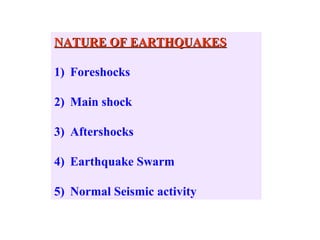
NATURE OF EARTHQUAKESNATURE OF EARTHQUAKES
1) Foreshocks
2) Main shock
3) Aftershocks
4) Earthquake Swarm
5) Normal Seismic activity
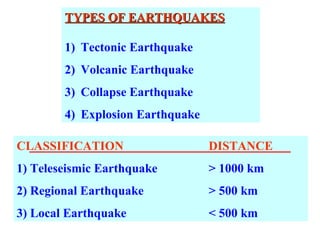
CLASSIFICATION DISTANCE
1) Teleseismic Earthquake > 1000 km
2) Regional Earthquake > 500 km
3) Local Earthquake < 500 km
TYPES OF EARTHQUAKESTYPES OF EARTHQUAKES
1) Tectonic Earthquake
2) Volcanic Earthquake
3) Collapse Earthquake
4) Explosion Earthquake
Earthquake ,causes,effects- ES ppt

Earthquake ,causes,effects- ES ppt

  • 1.
    Topic Name: EARTHQUAKES GandhinagarInstitute OF Technology Presented By: Guided By: Prof. SANDESH SHARMA RAHUL PANCHAL(40) KISHAN PANCHAL(37) HIREN PANCHAL(36) DHRUVIL PANCHAL(34)
  • 2.
    What are Earthquakes? •The shaking or trembling caused by the sudden release of energy • Usually associated with faulting or breaking of rocks • Continuing adjustment of position results in aftershocks
  • 3.
    What is theElastic Rebound Theory? • Explains how energy is stored in rocks – Rocks bend until the strength of the rock is exceeded – Rupture occurs and the rocks quickly rebound to an undeformed shape – Energy is released in waves that radiate outward from the fault
  • 4.
    The Focus andEpicenter of an Earthquake • The point within Earth where faulting begins is the focus, or hypocenter • The point directly above the focus on the surface is the epicenter
  • 5.
    Where Do EarthquakesOccur and How Often? ~80% of all earthquakes occur in the circum-Pacific belt – most of these result from convergent margin activity – ~15% occur in the Mediterranean-Asiatic belt – remaining 5% occur in the interiors of plates and on spreading ridge centers – more than 150,000 quakes strong enough to be felt are recorded each year
  • 6.
  • 7.
    The Economics andSocietal Impacts of EQs Damage in Oakland, CA, 1989• Building collapse • Fire • Tsunami • Ground failure
  • 8.
  • 9.
    What are SeismicWaves? • Response of material to the arrival of energy fronts released by rupture • Two types: – Body waves • P and S – Surface waves • R and L
  • 10.
    Body Waves: Pand S waves • Body waves – P or primary waves • fastest waves • travel through solids, liquids, or gases • compressional wave, material movement is in the same direction as wave movement – S or secondary waves • slower than P waves • travel through solids only • shear waves - move material perpendicular to wave movement
  • 11.
    Surface Waves: Rand L waves • Surface Waves – Travel just below or along the ground’s surface – Slower than body waves; rolling and side-to-side movement – Especially damaging to buildings
  • 12.
    • Ground motion •Duration of Shaking • Surface Rupture • Poor building design Damage: Causes
  • 13.
    • Rupture • Death •Bldg collapse Effects
  • 14.
  • 15.
    Damage: Key Factors • Amount& duration of shaking • Water content of soil • Population concentration • Building construction • Distance from Epicenter • Depth of focus • Direction of rupture • Material amplification
  • 16.
    EARTHQUAKE CLASSIFICATIONEARTHQUAKE CLASSIFICATION MAGNITUDECLASSIFICATION M ≥ 8.0 Great Earthquake 7.0 ≥ M < 8.0 Major / Large Earthquake 5.0 ≥ M < 7.0 Moderate Earthquake 3.0 ≥ M < 5.0 Small Earthquake 1.0 ≥ M < 3.0 Microearthquake M < 1.0 Ultra Microearthquake
  • 17.
    NATURE OF EARTHQUAKESNATUREOF EARTHQUAKES 1) Foreshocks 2) Main shock 3) Aftershocks 4) Earthquake Swarm 5) Normal Seismic activity
  • 18.
    CLASSIFICATION DISTANCE 1) TeleseismicEarthquake > 1000 km 2) Regional Earthquake > 500 km 3) Local Earthquake < 500 km TYPES OF EARTHQUAKESTYPES OF EARTHQUAKES 1) Tectonic Earthquake 2) Volcanic Earthquake 3) Collapse Earthquake 4) Explosion Earthquake