12/19/2017
1
EARTH
EARTHQUAKES
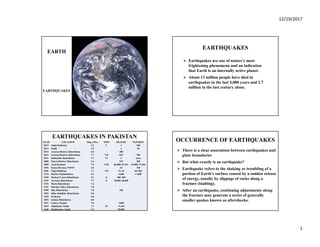
 Earthquakes are one of nature’s most
frightening phenomena and an indication
that Earth is an internally active planet.
 About 13 million people have died in
earthquakes in the last 4,000 years and 2.7
million in the last century alone.
EARTHQUAKES
YEAR LOCATION Mag. (Mw) MMI DEATHS INJURIES
2015 Gilgit-Baltistan 6.3 V 4 100
2014 Sindh 4.5 2 50
2013 Awaran District, Balochistan 6.8 400
2013 Awaran District, Balochistan 7.7 VII 825 700
2011 Dalbandin, Balochistan 7.2 VI 3 some
2008 Ziarat District, Balochistan 6.4 215 200
2005 Azad Kashmir 7.6 VIII 86,000–87,351 69,000–75,266
1992 Kohat Division, NWFP 6.0 36 100
1983 Gilgit-Baltistan 7.2 VII 12–26 60–483
1974 Khyber Pakhtunkhwa 6.2 5,300 17,000
1945 Makran Coast, Baluchistan 8.1 X 300–400
1935 Ali Jaan, Balochistan 7.7 X 30,000–60,000
1931 Mach, Balochistan 7.4
1931 Sharigh Valley, Balochistan 7.0
1909 Sibi, Balochistan 7.0 100
1892 Qilla Abdullah, Balochistan 6.8
1965 Peshawar 6.0
1852 Kahan, Balochistan 8.0
1827 Lahore, Punjab 7.8 1,000
1819 Allahbund, Sindh 7.7 XI >1,543
1668 Shahbandar, Sindh 7.6 50,000
EARTHQUAKES IN PAKISTAN
 There is a clear association between earthquakes and
plate boundaries
 But what exactly is an earthquake?
 Earthquake refers to the shaking or trembling of a
portion of Earth’s surface caused by a sudden release
of energy, usually by slippage of rocks along a
fracture (faulting).
 After an earthquake, continuing adjustments along
the fracture may generate a series of generally
smaller quakes known as aftershocks.
OCCURRENCE OF EARTHQUAKES
12/19/2017
2
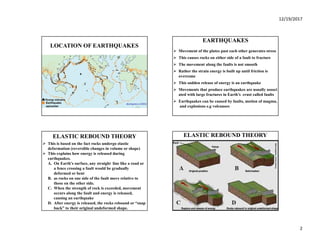
LOCATION OF EARTHQUAKES
 Movement of the plates past each other generates stress
 This causes rocks on either side of a fault to fracture
 The movement along the faults is not smooth
 Rather the strain energy is built up until friction is
overcome
 This sudden release of energy is an earthquake
 Movements that produce earthquakes are usually associ
ated with large fractures in Earth’s crust called faults
 Earthquakes can be caused by faults, motion of magma,
and explosions e.g volcanoes
EARTHQUAKES
 This is based on the fact rocks undergo elastic
deformation (reversible changes in volume or shape)
 This explains how energy is released during
earthquakes.
A. On Earth’s surface, any straight line like a road or
a fence crossing a fault would be gradually
deformed or bent
B. as rocks on one side of the fault move relative to
those on the other side.
C. When the strength of rock is exceeded, movement
occurs along the fault and energy is released,
causing an earthquake
D. After energy is released, the rocks rebound or “snap
back” to their original undeformed shape.
ELASTIC REBOUND THEORY ELASTIC REBOUND THEORY
12/19/2017
3
 Seismology is the study of earthquakes.
 The energy released by movement along a fault
travels as seismic waves outward in a concentric
pattern from the place of movement.
 The passage of these waves through Earth
materials is detected, recorded, and measured by
seismographs
 The record made is a seismogram
SEISMOLOGY
SEISMOGRAPHS
 When the ground vibrates the spring expands and
contracts but the mass remains stationary
 Difference between the movement of the ground and
the pendulum serves as a measure of ground motion
SEISMOGRAMS
SEISMIC WAVES
 Seismic Waves are produced as energy is released by
movement along a fault.
 The passage of seismic waves through Earth materials
produces vibrations that cause an earthquake.
1. Body Waves are seismic waves that travel
through the solid body of Earth, much like
sound waves.
2. Surface Waves travel along the ground surface
and are similar to waves on water.
12/19/2017
4
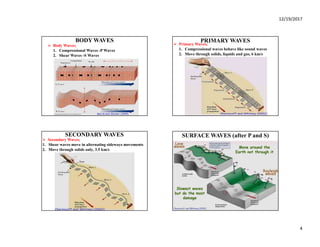
BODY WAVES
 Body Waves;
1. Compressional Waves -P Waves
2. Shear Waves -S Waves
PRIMARY WAVES Primary Waves;
1. Compressional waves behave like sound waves
2. Move through solids, liquids and gas, 6 km/s
SECONDARY WAVES
 Secondary Waves;
1. Shear waves move in alternating sideways movements
2. Move through solids only, 3.5 km/s
SURFACE WAVES (after P and S)
12/19/2017
5
SURFACE WAVES
 Surface Waves
1. Rayleigh Waves; like water waves, move material in
an elliptical path and are slower than Love waves.
2. Loves Waves; The motion of Loves waves is similar
to S-waves except that movement is restricted to a
horizontal plane
FOCUS AND EPICENTER
 Focus;
The focus of an earthquake is the point within Earth
where fracturing first begins, that is, the point where
energy is first released.
 Epicenter;
Location of earthquakes, the point on Earth’s
surface directly above the focus.
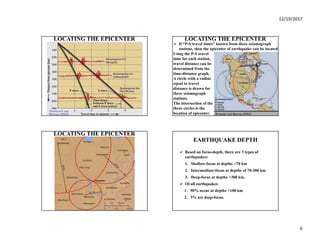
LOCATING THE EPICENTER
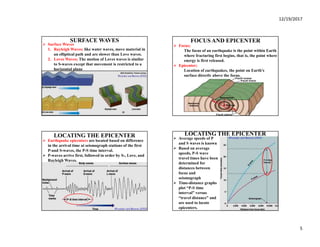
 Earthquake epicenters are located based on difference
in the arrival time at seismograph stations of the first
P-and S-waves, the P-S time interval.
 P-waves arrive first, followed in order by S-, Love, and
Rayleigh Waves.
LOCATING THE EPICENTER
 Average speeds of P
and S waves is known
 Based on average
speeds, P-S wave
travel times have been
determined for
distances between
focus and
seismograph
 Time-distance graphs
plot “P-S time
interval” versus
“travel distance” and
are used to locate
epicenters.
12/19/2017
6
LOCATING THE EPICENTER LOCATING THE EPICENTER
 If “P-S travel times” known from three seismograph
stations, then the epicenter of earthquake can be located
Using the P-S travel
time for each station,
travel distance can be
determined from the
time-distance graph.
A circle with a radius
equal to travel
distance is drawn for
three seismograph
stations.
The intersection of the
three circles is the
location of epicenter.
LOCATING THE EPICENTER
EARTHQUAKE DEPTH
 Based on focus-depth, there are 3 types of
earthquakes:
1. Shallow-focus at depths <70 km
2. Intermediate-focus at depths of 70-300 km
3. Deep-focus at depths >300 km.
 Of all earthquakes
1. 90% occur at depths <100 km
2. 3% are deep-focus.
12/19/2017
7
MEASURING EARTHQUAKES
 Richter Magnitude Scale is a quantitative measure of
earthquake magnitude, the amount of energy released
by an earthquake at its source.
 It is determined based on the amplitude of the largest
seismic wave recorded for a given earthquake.
 Richter Scale ranges from 1 to 9, with 9 assigned to the
largest quakes theoretically possible.
 An increase of one unit on the Richter Scale, from 5.5 to
6.5 for example, is equivalent to a 10-fold increase in
the amplitude of the largest seismic wave produced.
 In terms of energy released, each one unit increase on
Richter Scale equals a 30-fold increase in energy
released at focus. It would take about 30 quakes of 5.5
magnitude to release as much energy as one 6.5 quake.
 Named after Charles Richter who developed it in
1935
 In addition to being logarithmic the Richter scale
is corrected for distance
 So the magnitude for a given quake is the same
no matter how far away you are
 Magnitude is the same but the effects are not
 The largest quakes recorded had amplitudes of
8.6
THE RICHTER SCALE
 The scale was developed in 1902
 Unlike the Richter scale the Mercalli scale varies
with distance.
 A IX near the epicenter would register as a I or
II further away
 Dependent on rock and soil type
 Useful for classifying historic quakes
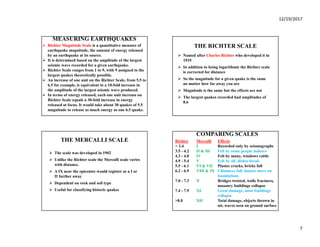
THE MERCALLI SCALE Richter Mercalli Effects
< 3.4 I Recorded only by seismographs
3.5 - 4.2 II & III Felt by some people indoors
4.3 - 4.8 IV Felt by many, windows rattle
4.9 - 5.4 V Felt by all, dishes break
5.5 - 6.1 VI & VII Plaster cracks, bricks fall
6.2 - 6.9 VIII & IX Chimneys fall, houses move on
foundations
7.0 - 7.3 X Bridges twisted, walls fractures,
masonry buildings collapse
7.4 - 7.9 XI Great damage, most buildings
collapse
>8.0 XII Total damage, objects thrown in
air, waves seen on ground surface
COMPARING SCALES

EARTH EARTHQUAKES

  • 1.
    12/19/2017 1 EARTH EARTHQUAKES  Earthquakes areone of nature’s most frightening phenomena and an indication that Earth is an internally active planet.  About 13 million people have died in earthquakes in the last 4,000 years and 2.7 million in the last century alone. EARTHQUAKES YEAR LOCATION Mag. (Mw) MMI DEATHS INJURIES 2015 Gilgit-Baltistan 6.3 V 4 100 2014 Sindh 4.5 2 50 2013 Awaran District, Balochistan 6.8 400 2013 Awaran District, Balochistan 7.7 VII 825 700 2011 Dalbandin, Balochistan 7.2 VI 3 some 2008 Ziarat District, Balochistan 6.4 215 200 2005 Azad Kashmir 7.6 VIII 86,000–87,351 69,000–75,266 1992 Kohat Division, NWFP 6.0 36 100 1983 Gilgit-Baltistan 7.2 VII 12–26 60–483 1974 Khyber Pakhtunkhwa 6.2 5,300 17,000 1945 Makran Coast, Baluchistan 8.1 X 300–400 1935 Ali Jaan, Balochistan 7.7 X 30,000–60,000 1931 Mach, Balochistan 7.4 1931 Sharigh Valley, Balochistan 7.0 1909 Sibi, Balochistan 7.0 100 1892 Qilla Abdullah, Balochistan 6.8 1965 Peshawar 6.0 1852 Kahan, Balochistan 8.0 1827 Lahore, Punjab 7.8 1,000 1819 Allahbund, Sindh 7.7 XI >1,543 1668 Shahbandar, Sindh 7.6 50,000 EARTHQUAKES IN PAKISTAN  There is a clear association between earthquakes and plate boundaries  But what exactly is an earthquake?  Earthquake refers to the shaking or trembling of a portion of Earth’s surface caused by a sudden release of energy, usually by slippage of rocks along a fracture (faulting).  After an earthquake, continuing adjustments along the fracture may generate a series of generally smaller quakes known as aftershocks. OCCURRENCE OF EARTHQUAKES
  • 2.
    12/19/2017 2 LOCATION OF EARTHQUAKES Movement of the plates past each other generates stress  This causes rocks on either side of a fault to fracture  The movement along the faults is not smooth  Rather the strain energy is built up until friction is overcome  This sudden release of energy is an earthquake  Movements that produce earthquakes are usually associ ated with large fractures in Earth’s crust called faults  Earthquakes can be caused by faults, motion of magma, and explosions e.g volcanoes EARTHQUAKES  This is based on the fact rocks undergo elastic deformation (reversible changes in volume or shape)  This explains how energy is released during earthquakes. A. On Earth’s surface, any straight line like a road or a fence crossing a fault would be gradually deformed or bent B. as rocks on one side of the fault move relative to those on the other side. C. When the strength of rock is exceeded, movement occurs along the fault and energy is released, causing an earthquake D. After energy is released, the rocks rebound or “snap back” to their original undeformed shape. ELASTIC REBOUND THEORY ELASTIC REBOUND THEORY
  • 3.
    12/19/2017 3  Seismology isthe study of earthquakes.  The energy released by movement along a fault travels as seismic waves outward in a concentric pattern from the place of movement.  The passage of these waves through Earth materials is detected, recorded, and measured by seismographs  The record made is a seismogram SEISMOLOGY SEISMOGRAPHS  When the ground vibrates the spring expands and contracts but the mass remains stationary  Difference between the movement of the ground and the pendulum serves as a measure of ground motion SEISMOGRAMS SEISMIC WAVES  Seismic Waves are produced as energy is released by movement along a fault.  The passage of seismic waves through Earth materials produces vibrations that cause an earthquake. 1. Body Waves are seismic waves that travel through the solid body of Earth, much like sound waves. 2. Surface Waves travel along the ground surface and are similar to waves on water.
  • 4.
    12/19/2017 4 BODY WAVES  BodyWaves; 1. Compressional Waves -P Waves 2. Shear Waves -S Waves PRIMARY WAVES Primary Waves; 1. Compressional waves behave like sound waves 2. Move through solids, liquids and gas, 6 km/s SECONDARY WAVES  Secondary Waves; 1. Shear waves move in alternating sideways movements 2. Move through solids only, 3.5 km/s SURFACE WAVES (after P and S)
  • 5.
    12/19/2017 5 SURFACE WAVES  SurfaceWaves 1. Rayleigh Waves; like water waves, move material in an elliptical path and are slower than Love waves. 2. Loves Waves; The motion of Loves waves is similar to S-waves except that movement is restricted to a horizontal plane FOCUS AND EPICENTER  Focus; The focus of an earthquake is the point within Earth where fracturing first begins, that is, the point where energy is first released.  Epicenter; Location of earthquakes, the point on Earth’s surface directly above the focus. LOCATING THE EPICENTER  Earthquake epicenters are located based on difference in the arrival time at seismograph stations of the first P-and S-waves, the P-S time interval.  P-waves arrive first, followed in order by S-, Love, and Rayleigh Waves. LOCATING THE EPICENTER  Average speeds of P and S waves is known  Based on average speeds, P-S wave travel times have been determined for distances between focus and seismograph  Time-distance graphs plot “P-S time interval” versus “travel distance” and are used to locate epicenters.
  • 6.
    12/19/2017 6 LOCATING THE EPICENTERLOCATING THE EPICENTER  If “P-S travel times” known from three seismograph stations, then the epicenter of earthquake can be located Using the P-S travel time for each station, travel distance can be determined from the time-distance graph. A circle with a radius equal to travel distance is drawn for three seismograph stations. The intersection of the three circles is the location of epicenter. LOCATING THE EPICENTER EARTHQUAKE DEPTH  Based on focus-depth, there are 3 types of earthquakes: 1. Shallow-focus at depths <70 km 2. Intermediate-focus at depths of 70-300 km 3. Deep-focus at depths >300 km.  Of all earthquakes 1. 90% occur at depths <100 km 2. 3% are deep-focus.
  • 7.
    12/19/2017 7 MEASURING EARTHQUAKES  RichterMagnitude Scale is a quantitative measure of earthquake magnitude, the amount of energy released by an earthquake at its source.  It is determined based on the amplitude of the largest seismic wave recorded for a given earthquake.  Richter Scale ranges from 1 to 9, with 9 assigned to the largest quakes theoretically possible.  An increase of one unit on the Richter Scale, from 5.5 to 6.5 for example, is equivalent to a 10-fold increase in the amplitude of the largest seismic wave produced.  In terms of energy released, each one unit increase on Richter Scale equals a 30-fold increase in energy released at focus. It would take about 30 quakes of 5.5 magnitude to release as much energy as one 6.5 quake.  Named after Charles Richter who developed it in 1935  In addition to being logarithmic the Richter scale is corrected for distance  So the magnitude for a given quake is the same no matter how far away you are  Magnitude is the same but the effects are not  The largest quakes recorded had amplitudes of 8.6 THE RICHTER SCALE  The scale was developed in 1902  Unlike the Richter scale the Mercalli scale varies with distance.  A IX near the epicenter would register as a I or II further away  Dependent on rock and soil type  Useful for classifying historic quakes THE MERCALLI SCALE Richter Mercalli Effects < 3.4 I Recorded only by seismographs 3.5 - 4.2 II & III Felt by some people indoors 4.3 - 4.8 IV Felt by many, windows rattle 4.9 - 5.4 V Felt by all, dishes break 5.5 - 6.1 VI & VII Plaster cracks, bricks fall 6.2 - 6.9 VIII & IX Chimneys fall, houses move on foundations 7.0 - 7.3 X Bridges twisted, walls fractures, masonry buildings collapse 7.4 - 7.9 XI Great damage, most buildings collapse >8.0 XII Total damage, objects thrown in air, waves seen on ground surface COMPARING SCALES