Submitted by : Jaideep kaur tiwana
Msc 2nd
year
Submitted to : Prof. G.S. Gill
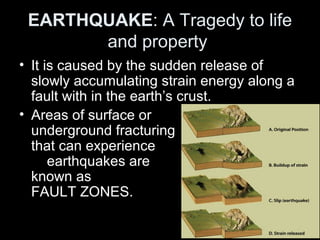
EARTHQUAKE: A Tragedy to life
and property
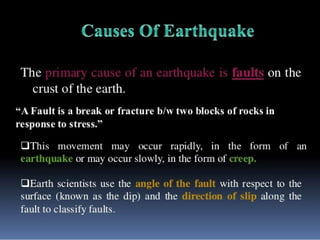
• It is caused by the sudden release of
slowly accumulating strain energy along a
fault with in the earth’s crust.
• Areas of surface or
underground fracturing
that can experience
earthquakes are
known as
FAULT ZONES.
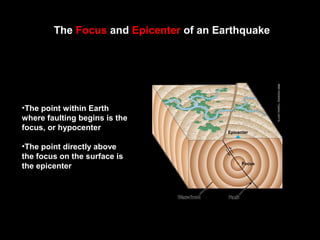
The Focus and Epicenter of an Earthquake
•The point within Earth
where faulting begins is the
focus, or hypocenter
•The point directly above
the focus on the surface is
the epicenter
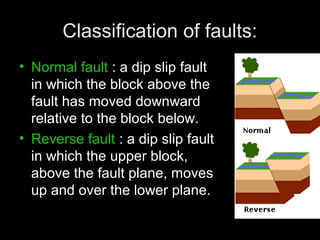
Classification of faults:
• Normal fault : a dip slip fault
in which the block above the
fault has moved downward
relative to the block below.
• Reverse fault : a dip slip fault
in which the upper block,
above the fault plane, moves
up and over the lower plane.
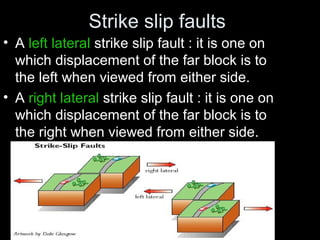
Strike slip faults
• A left lateral strike slip fault : it is one on
which displacement of the far block is to
the left when viewed from either side.
• A right lateral strike slip fault : it is one on
which displacement of the far block is to
the right when viewed from either side.
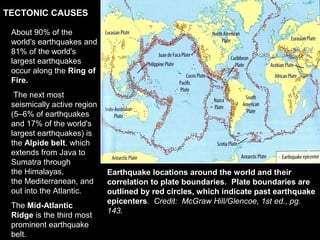
Earthquake locations around the world and their
correlation to plate boundaries. Plate boundaries are
outlined by red circles, which indicate past earthquake
epicenters. Credit: McGraw Hill/Glencoe, 1st ed., pg.
143.
TECTONIC CAUSES
About 90% of the
world's earthquakes and
81% of the world's
largest earthquakes
occur along the Ring of
Fire.
The next most
seismically active region
(5–6% of earthquakes
and 17% of the world's
largest earthquakes) is
the Alpide belt, which
extends from Java to
Sumatra through
the Himalayas,
the Mediterranean, and
out into the Atlantic.
The Mid-Atlantic
Ridge is the third most
prominent earthquake
belt.
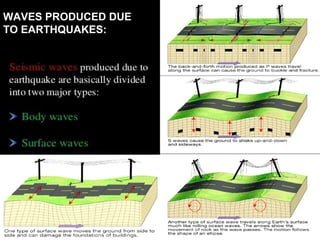
WAVES PRODUCED DUE
TO EARTHQUAKES:
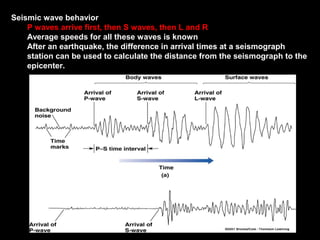
Seismic wave behavior
P waves arrive first, then S waves, then L and R
Average speeds for all these waves is known
After an earthquake, the difference in arrival times at a seismograph
station can be used to calculate the distance from the seismograph to the
epicenter.
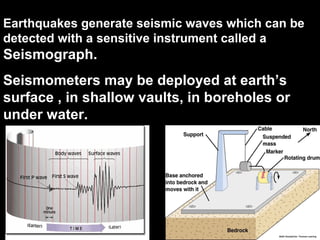
Earthquakes generate seismic waves which can be
detected with a sensitive instrument called a
Seismograph.
Seismometers may be deployed at earth’s
surface , in shallow vaults, in boreholes or
under water.
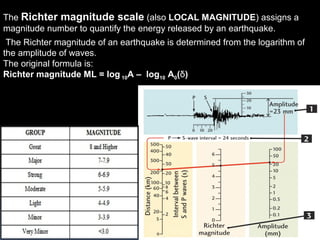
The Richter magnitude of an earthquake is determined from the logarithm of
the amplitude of waves.
The original formula is:
Richter magnitude ML = log 10A – log10 A0(δ)
The Richter magnitude scale (also LOCAL MAGNITUDE) assigns a
magnitude number to quantify the energy released by an earthquake.
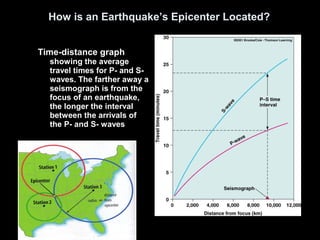
How is an Earthquake’s Epicenter Located?
Time-distance graph
showing the average
travel times for P- and S-
waves. The farther away a
seismograph is from the
focus of an earthquake,
the longer the interval
between the arrivals of
the P- and S- waves
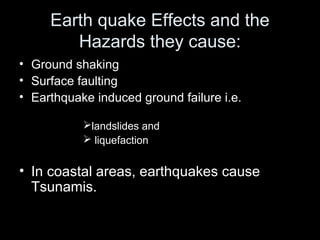
Earth quake Effects and the
Hazards they cause:
• Ground shaking
• Surface faulting
• Earthquake induced ground failure i.e.
landslides and
 liquefaction
• In coastal areas, earthquakes cause
Tsunamis.
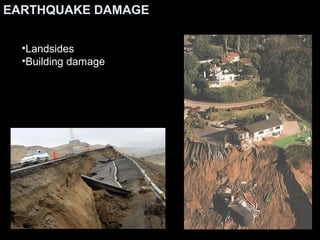
EARTHQUAKE DAMAGEEARTHQUAKE DAMAGE
•LandsidesLandsides
•Building damageBuilding damage
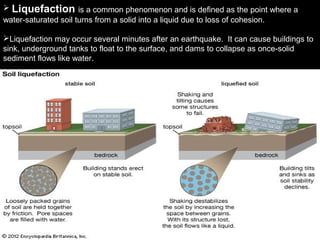
 Liquefaction is a common phenomenon and is defined as the point where a
water-saturated soil turns from a solid into a liquid due to loss of cohesion.
Liquefaction may occur several minutes after an earthquake. It can cause buildings to
sink, underground tanks to float to the surface, and dams to collapse as once-solid
sediment flows like water.
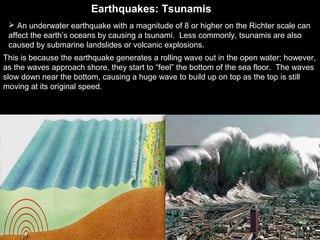
Earthquakes: TsunamisEarthquakes: Tsunamis
 An underwater earthquake with a magnitude of 8 or higher on the Richter scale can
affect the earth’s oceans by causing a tsunami. Less commonly, tsunamis are also
caused by submarine landslides or volcanic explosions.
This is because the earthquake generates a rolling wave out in the open water; however,
as the waves approach shore, they start to “feel” the bottom of the sea floor. The waves
slow down near the bottom, causing a huge wave to build up on top as the top is still
moving at its original speed.
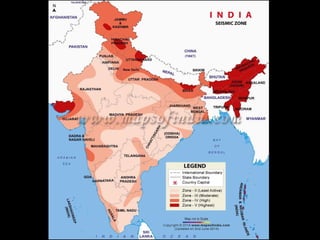
Types of zones in India:
• ZONE 5: Very High damage risk zone. Kashmir, the
western and central himalayas, the North East Indian
region and the Rann of Kutch fall in this zone.
• ZONE 4: High damage risk zone. The indo Gangetic
basin and Delhi, Jammu and Kashmir , Faltan area
(Maharashtra) is also in this zone.
• ZONE 3: Moderate Damage Risk zone.The Andaman
and Nicobar Islands, parts of kashmir, Western
Himalayas fall under this zone.
• ZONE 2: Low damage Risk zone. Southern parts and
some Eastern coasts fall under this.
Major earthquakes in India:
DATE PLACE MAGNITUDE
December 26,
2004
off west coast
northern
Sumatra India
9.1
1869, Jan 10 Cocher Assam 7.5
1885, May 30 Sopar J&K 7
1897,June 12 Shillong Assam 8.7
1905,April 04 Kangra 7.8
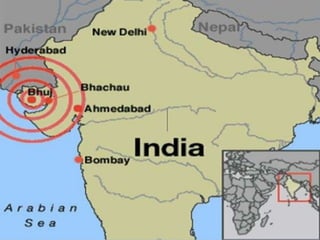
2001,Jan 26 (Bhuj) Gujarat 7.7
2005,Oct 8 Muzzaffrabad in
pakistan.
(kashmir)
7.4
Can Earthquakes be Predicted?
Earthquake Prediction Programs
•include laboratory and field studies of rocks before, during, and after
earthquakes.
•monitor activity along major faults
•produce risk assessments
Earthquake Precursors
•changes in elevation or tilting of land surface, fluctuations in
groundwater levels, magnetic field, electrical resistance of the ground
•Increase in rate of a seismic creep and slow movement along the fault.
•Animal behavior: hibernating animals leaving their underground nests
and seeking higher grounds.
•Birds vacating the area
•Deep water fish come closer to the surface.
Conclusion: No 100% accurate way to predict an earthquake . As more data is
collected , predictions will get better.
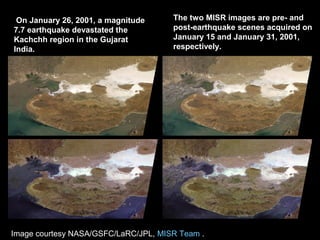
On January 26, 2001, a magnitude
7.7 earthquake devastated the
Kachchh region in the Gujarat
India.
The two MISR images are pre- and
post-earthquake scenes acquired on
January 15 and January 31, 2001,
respectively.
Image courtesy NASA/GSFC/LaRC/JPL, MISR Team .
Earthquake and its causes

Earthquake and its causes

  • 1.
    Submitted by :Jaideep kaur tiwana Msc 2nd year Submitted to : Prof. G.S. Gill
  • 2.
    EARTHQUAKE: A Tragedyto life and property • It is caused by the sudden release of slowly accumulating strain energy along a fault with in the earth’s crust. • Areas of surface or underground fracturing that can experience earthquakes are known as FAULT ZONES.
  • 3.
    The Focus andEpicenter of an Earthquake •The point within Earth where faulting begins is the focus, or hypocenter •The point directly above the focus on the surface is the epicenter
  • 5.
    Classification of faults: •Normal fault : a dip slip fault in which the block above the fault has moved downward relative to the block below. • Reverse fault : a dip slip fault in which the upper block, above the fault plane, moves up and over the lower plane.
  • 6.
    Strike slip faults •A left lateral strike slip fault : it is one on which displacement of the far block is to the left when viewed from either side. • A right lateral strike slip fault : it is one on which displacement of the far block is to the right when viewed from either side.
  • 9.
    Earthquake locations aroundthe world and their correlation to plate boundaries. Plate boundaries are outlined by red circles, which indicate past earthquake epicenters. Credit: McGraw Hill/Glencoe, 1st ed., pg. 143. TECTONIC CAUSES About 90% of the world's earthquakes and 81% of the world's largest earthquakes occur along the Ring of Fire. The next most seismically active region (5–6% of earthquakes and 17% of the world's largest earthquakes) is the Alpide belt, which extends from Java to Sumatra through the Himalayas, the Mediterranean, and out into the Atlantic. The Mid-Atlantic Ridge is the third most prominent earthquake belt.
  • 10.
  • 11.
    Seismic wave behavior Pwaves arrive first, then S waves, then L and R Average speeds for all these waves is known After an earthquake, the difference in arrival times at a seismograph station can be used to calculate the distance from the seismograph to the epicenter.
  • 12.
    Earthquakes generate seismicwaves which can be detected with a sensitive instrument called a Seismograph. Seismometers may be deployed at earth’s surface , in shallow vaults, in boreholes or under water.
  • 13.
    The Richter magnitudeof an earthquake is determined from the logarithm of the amplitude of waves. The original formula is: Richter magnitude ML = log 10A – log10 A0(δ) The Richter magnitude scale (also LOCAL MAGNITUDE) assigns a magnitude number to quantify the energy released by an earthquake.
  • 14.
    How is anEarthquake’s Epicenter Located? Time-distance graph showing the average travel times for P- and S- waves. The farther away a seismograph is from the focus of an earthquake, the longer the interval between the arrivals of the P- and S- waves
  • 15.
    Earth quake Effectsand the Hazards they cause: • Ground shaking • Surface faulting • Earthquake induced ground failure i.e. landslides and  liquefaction • In coastal areas, earthquakes cause Tsunamis.
  • 16.
  • 17.
     Liquefaction isa common phenomenon and is defined as the point where a water-saturated soil turns from a solid into a liquid due to loss of cohesion. Liquefaction may occur several minutes after an earthquake. It can cause buildings to sink, underground tanks to float to the surface, and dams to collapse as once-solid sediment flows like water.
  • 18.
    Earthquakes: TsunamisEarthquakes: Tsunamis An underwater earthquake with a magnitude of 8 or higher on the Richter scale can affect the earth’s oceans by causing a tsunami. Less commonly, tsunamis are also caused by submarine landslides or volcanic explosions. This is because the earthquake generates a rolling wave out in the open water; however, as the waves approach shore, they start to “feel” the bottom of the sea floor. The waves slow down near the bottom, causing a huge wave to build up on top as the top is still moving at its original speed.
  • 20.
    Types of zonesin India: • ZONE 5: Very High damage risk zone. Kashmir, the western and central himalayas, the North East Indian region and the Rann of Kutch fall in this zone. • ZONE 4: High damage risk zone. The indo Gangetic basin and Delhi, Jammu and Kashmir , Faltan area (Maharashtra) is also in this zone. • ZONE 3: Moderate Damage Risk zone.The Andaman and Nicobar Islands, parts of kashmir, Western Himalayas fall under this zone. • ZONE 2: Low damage Risk zone. Southern parts and some Eastern coasts fall under this.
  • 21.
    Major earthquakes inIndia: DATE PLACE MAGNITUDE December 26, 2004 off west coast northern Sumatra India 9.1 1869, Jan 10 Cocher Assam 7.5 1885, May 30 Sopar J&K 7 1897,June 12 Shillong Assam 8.7 1905,April 04 Kangra 7.8 2001,Jan 26 (Bhuj) Gujarat 7.7 2005,Oct 8 Muzzaffrabad in pakistan. (kashmir) 7.4
  • 22.
    Can Earthquakes bePredicted? Earthquake Prediction Programs •include laboratory and field studies of rocks before, during, and after earthquakes. •monitor activity along major faults •produce risk assessments Earthquake Precursors •changes in elevation or tilting of land surface, fluctuations in groundwater levels, magnetic field, electrical resistance of the ground •Increase in rate of a seismic creep and slow movement along the fault. •Animal behavior: hibernating animals leaving their underground nests and seeking higher grounds. •Birds vacating the area •Deep water fish come closer to the surface. Conclusion: No 100% accurate way to predict an earthquake . As more data is collected , predictions will get better.
  • 26.
    On January 26,2001, a magnitude 7.7 earthquake devastated the Kachchh region in the Gujarat India. The two MISR images are pre- and post-earthquake scenes acquired on January 15 and January 31, 2001, respectively. Image courtesy NASA/GSFC/LaRC/JPL, MISR Team .