STANDARD 8-3.8
EARTHQUAKES
The definition of an earthquake is…
vibrations that cause the breaking of
rocks.
These vibrations move in all directions
through the earth. They begin at a point
along a fault.
EARTHQUAKES
• Forces___ and __Stresses__ (8-3.7– tension, compression, and
shearing) along faults can build up as blocks of rock are pushed
(compression or shearing) or pulled apart (tension). If the
__pressure___ or stress becomes too great, the rock breaks at a
weak point along the fault and ___energy_____ is released
The earth’s crust is constantly
experiencing pressure from forces
within and around it. This pressure
builds up over time, and eventually
causes the crust to break. This
becomes a fault.
Let’s experience it…
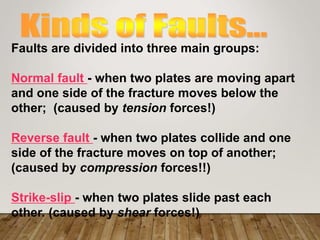
Faults are divided into three main groups:
Normal fault - when two plates are moving apart
and one side of the fracture moves below the
other; (caused by tension forces!)
Reverse fault - when two plates collide and one
side of the fracture moves on top of another;
(caused by compression forces!!)
Strike-slip - when two plates slide past each
other. (caused by shear forces!)
An earthquake begins along a fault (a
crack in the earth’s surface) at a point
called the focus.
Directly above the focus is a point on
the earth’s surface called the epicenter.
PARTS OF THE EARTHQUAKE
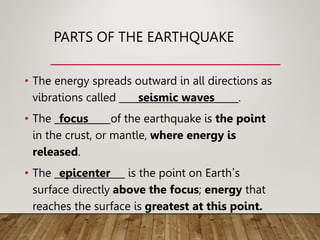
• The energy spreads outward in all directions as
vibrations called ____seismic waves_____.
• The _focus____ of the earthquake is the point
in the crust, or mantle, where energy is
released.
• The _epicenter___ is the point on Earth’s
surface directly above the focus; energy that
reaches the surface is greatest at this point.
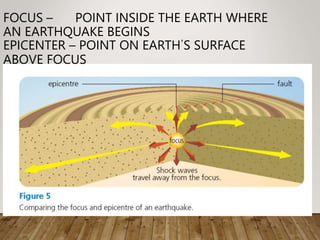
FOCUS – POINT INSIDE THE EARTH WHERE
AN EARTHQUAKE BEGINS
EPICENTER – POINT ON EARTH’S SURFACE
ABOVE FOCUS
WHAT CAUSES EARTHQUAKES?
• Used to describe both sudden slip on a fault, and the resulting
ground shaking and radiated seismic energy caused by the slip
• Caused by volcanic or magmatic activity,
• Caused by other sudden stress changes in the earth.
WHAT CAUSES EARTHQUAKES?
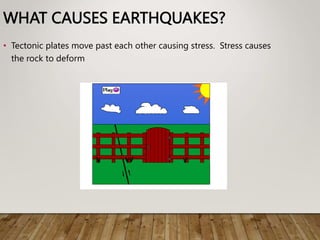
• Tectonic plates move past each other causing stress. Stress causes
the rock to deform
Cause of Earthquakes
WHAT CAUSES AN EARTHQUAKE?
• An aftershock is a small earthquake that
follows the main earthquake.
• A foreshock is a small earthquake that often
precedes a major earthquake.
 Aftershocks and Foreshocks
Earthquakes can also cause landslides, sudden
eruptions as in the case of a hot lava flow from a
volcano or giant waves called tsunamis. Sometimes new
land mass are also formed. Such earthquakes are
attributed with the creation of the greatest undersea
mountain range and the longest land mountain range.
WHERE DO EARTHQUAKES OCCUR AND HOW OFTEN?
~80% of all earthquakes occur in the circum-
Pacific belt
• most of these result from convergent margin
activity
• ~15% occur in the Mediterranean-Asiatic belt
• remaining 5% occur in the interiors of plates
and on spreading ridge centers
• more than 150,000 quakes strong enough to
be felt are recorded each year
SEISMIC WAVES
• _SEISMIC WAVES___ are waves generated by
an earthquake that travel through the Earth.
These waves can cause the ground to move
forward, backward, up, down, and even to
ripple. Seismic Waves are generated at the
__SAME___ time but move in different ways,
and at different speeds.
3 TYPES OF SEISMIC WAVES
•PRIMARY (P) WAVES
•SECONDARY (S) WAVES
•SURFACE WAVES
Earthquake Waves
8.2 MEASURING EARTHQUAKES
 Body Waves
• P waves
• Identified as P waves or S waves
- Have the greatest velocity of all earthquake waves
- Are push-pull waves that push (compress) and pull (expand) in
the direction that the waves travel
- Travel through solids, liquids, and gases
PRIMARY (P) WAVE
• Move out from the earthquake focus, the
point where the energy is released
• Travel the fastest of the three waves
• Move through solid and liquid layers of
Earth (it also can move in gas)
• Push and pull rock creating a back-and-forth
motion in the direction the wave is moving
(longitudinal wave)
Earthquake Waves
8.2 MEASURING EARTHQUAKES
 Body Waves
• S waves
- Seismic waves that travel along Earth’s outer
layer
- Slower velocity than P waves
- Shake particles at right angles to the direction
that they travel
- Travel only through solids
 A seismogram shows all three types of
seismic waves—surface waves, P
waves, and S waves.
SECONDARY WAVES (S
WAVES)
• Move out from the earthquake focus
• Move slower than primary waves
• Can only move through solid rock
• Move at right angles to primary waves
causing rocks to move up and down and side
to side (transverse wave)
COMPARING SEISMIC WAVES
SURFACE WAVES
• Form when P and S waves reach the surface
• Can cause the ground to shake making rock
sway from side to side and roll like an ocean
wave
• These waves cause the most destruction
• They move back and forth and in a rolling
motion along the surface
• They release all of the energy of the
earthquake
SURFACE WAVES: R AND L WAVES
• Surface Waves
• Travel just below or along the ground’s surface
• Slower than body waves; rolling and side-to-side
movement
• Especially damaging to buildings
SURFACE WAVES
• Move along the Earth’s surface
•Produces motion in the upper crust
• Motion can be up and down
• Motion can be around
• Motion can be back and forth
• Travel more slowly than S and P
waves
• More destructive
Earthquake Waves
MEASURING EARTHQUAKES
 Seismographs are instruments that
record earthquake waves.
 Seismograms are traces of amplified,
electronically recorded ground motion
made by seismographs.
Earthquakes are measured using the Richter
Scale. The strongest earthquake ever
measured was a 9.5 on the Richter Scale. This
is a measurement of the amount of energy
released from the earthquake.
Measuring Earthquakes
8.2 MEASURING EARTHQUAKES
 Historically, scientists have used two
different types of measurements to
describe the size of an earthquake
—intensity and magnitude.
 Richter Scale
• The _Richter Scale expresses the magnitude of
an Earthquake and measures the energy released.
The scale goes from 1 to 10 .
• Based on the amplitude of the largest seismic
wave
Determining the magnitude of an earthquake
Magnitude -- measure of energy released during earthquake.
There are several different ways to measure magnitude.
Most common magnitude measure is Richter Scale, named for
the renowned seismologist, Charles Richter.
Richter Magnitude
• Measure amplitude of largest S wave on seismograph record.
• Take into account distance between seismograph & epicenter.
Intensity
• Intensity refers to the amount of damage done in an
earthquake
• Intensity
• subjective measure of the
kind of damage done and
people’s reactions to it
HOW ARE EARTHQUAKES MEASURED?
RICHTER SCALE
HOMEWORK
• Study for Quiz
• Place the following words in your
glossary.
• Primary wave, Secondary wave, Surfaces
wave, Longitudinal wave, Transverse
wave, Richter Scale, Seismograph,
Seismogram, Magnitude, and Intensity.

Earthquake PPT. ppt for grade 9 sciences

  • 1.
  • 2.
    The definition ofan earthquake is… vibrations that cause the breaking of rocks. These vibrations move in all directions through the earth. They begin at a point along a fault.
  • 3.
    EARTHQUAKES • Forces___ and__Stresses__ (8-3.7– tension, compression, and shearing) along faults can build up as blocks of rock are pushed (compression or shearing) or pulled apart (tension). If the __pressure___ or stress becomes too great, the rock breaks at a weak point along the fault and ___energy_____ is released
  • 4.
    The earth’s crustis constantly experiencing pressure from forces within and around it. This pressure builds up over time, and eventually causes the crust to break. This becomes a fault. Let’s experience it…
  • 5.
    Faults are dividedinto three main groups: Normal fault - when two plates are moving apart and one side of the fracture moves below the other; (caused by tension forces!) Reverse fault - when two plates collide and one side of the fracture moves on top of another; (caused by compression forces!!) Strike-slip - when two plates slide past each other. (caused by shear forces!)
  • 6.
    An earthquake beginsalong a fault (a crack in the earth’s surface) at a point called the focus. Directly above the focus is a point on the earth’s surface called the epicenter.
  • 7.
    PARTS OF THEEARTHQUAKE • The energy spreads outward in all directions as vibrations called ____seismic waves_____. • The _focus____ of the earthquake is the point in the crust, or mantle, where energy is released. • The _epicenter___ is the point on Earth’s surface directly above the focus; energy that reaches the surface is greatest at this point.
  • 8.
    FOCUS – POINTINSIDE THE EARTH WHERE AN EARTHQUAKE BEGINS EPICENTER – POINT ON EARTH’S SURFACE ABOVE FOCUS
  • 9.
    WHAT CAUSES EARTHQUAKES? •Used to describe both sudden slip on a fault, and the resulting ground shaking and radiated seismic energy caused by the slip • Caused by volcanic or magmatic activity, • Caused by other sudden stress changes in the earth.
  • 10.
    WHAT CAUSES EARTHQUAKES? •Tectonic plates move past each other causing stress. Stress causes the rock to deform
  • 11.
    Cause of Earthquakes WHATCAUSES AN EARTHQUAKE? • An aftershock is a small earthquake that follows the main earthquake. • A foreshock is a small earthquake that often precedes a major earthquake.  Aftershocks and Foreshocks
  • 12.
    Earthquakes can alsocause landslides, sudden eruptions as in the case of a hot lava flow from a volcano or giant waves called tsunamis. Sometimes new land mass are also formed. Such earthquakes are attributed with the creation of the greatest undersea mountain range and the longest land mountain range.
  • 13.
    WHERE DO EARTHQUAKESOCCUR AND HOW OFTEN? ~80% of all earthquakes occur in the circum- Pacific belt • most of these result from convergent margin activity • ~15% occur in the Mediterranean-Asiatic belt • remaining 5% occur in the interiors of plates and on spreading ridge centers • more than 150,000 quakes strong enough to be felt are recorded each year
  • 14.
    SEISMIC WAVES • _SEISMICWAVES___ are waves generated by an earthquake that travel through the Earth. These waves can cause the ground to move forward, backward, up, down, and even to ripple. Seismic Waves are generated at the __SAME___ time but move in different ways, and at different speeds.
  • 15.
    3 TYPES OFSEISMIC WAVES •PRIMARY (P) WAVES •SECONDARY (S) WAVES •SURFACE WAVES
  • 16.
    Earthquake Waves 8.2 MEASURINGEARTHQUAKES  Body Waves • P waves • Identified as P waves or S waves - Have the greatest velocity of all earthquake waves - Are push-pull waves that push (compress) and pull (expand) in the direction that the waves travel - Travel through solids, liquids, and gases
  • 17.
    PRIMARY (P) WAVE •Move out from the earthquake focus, the point where the energy is released • Travel the fastest of the three waves • Move through solid and liquid layers of Earth (it also can move in gas) • Push and pull rock creating a back-and-forth motion in the direction the wave is moving (longitudinal wave)
  • 18.
    Earthquake Waves 8.2 MEASURINGEARTHQUAKES  Body Waves • S waves - Seismic waves that travel along Earth’s outer layer - Slower velocity than P waves - Shake particles at right angles to the direction that they travel - Travel only through solids  A seismogram shows all three types of seismic waves—surface waves, P waves, and S waves.
  • 19.
    SECONDARY WAVES (S WAVES) •Move out from the earthquake focus • Move slower than primary waves • Can only move through solid rock • Move at right angles to primary waves causing rocks to move up and down and side to side (transverse wave)
  • 20.
  • 21.
    SURFACE WAVES • Formwhen P and S waves reach the surface • Can cause the ground to shake making rock sway from side to side and roll like an ocean wave • These waves cause the most destruction • They move back and forth and in a rolling motion along the surface • They release all of the energy of the earthquake
  • 22.
    SURFACE WAVES: RAND L WAVES • Surface Waves • Travel just below or along the ground’s surface • Slower than body waves; rolling and side-to-side movement • Especially damaging to buildings
  • 23.
    SURFACE WAVES • Movealong the Earth’s surface •Produces motion in the upper crust • Motion can be up and down • Motion can be around • Motion can be back and forth • Travel more slowly than S and P waves • More destructive
  • 24.
    Earthquake Waves MEASURING EARTHQUAKES Seismographs are instruments that record earthquake waves.  Seismograms are traces of amplified, electronically recorded ground motion made by seismographs.
  • 25.
    Earthquakes are measuredusing the Richter Scale. The strongest earthquake ever measured was a 9.5 on the Richter Scale. This is a measurement of the amount of energy released from the earthquake.
  • 26.
    Measuring Earthquakes 8.2 MEASURINGEARTHQUAKES  Historically, scientists have used two different types of measurements to describe the size of an earthquake —intensity and magnitude.  Richter Scale • The _Richter Scale expresses the magnitude of an Earthquake and measures the energy released. The scale goes from 1 to 10 . • Based on the amplitude of the largest seismic wave
  • 27.
    Determining the magnitudeof an earthquake Magnitude -- measure of energy released during earthquake. There are several different ways to measure magnitude. Most common magnitude measure is Richter Scale, named for the renowned seismologist, Charles Richter. Richter Magnitude • Measure amplitude of largest S wave on seismograph record. • Take into account distance between seismograph & epicenter. Intensity • Intensity refers to the amount of damage done in an earthquake
  • 28.
    • Intensity • subjectivemeasure of the kind of damage done and people’s reactions to it
  • 29.
    HOW ARE EARTHQUAKESMEASURED? RICHTER SCALE
  • 30.
    HOMEWORK • Study forQuiz • Place the following words in your glossary. • Primary wave, Secondary wave, Surfaces wave, Longitudinal wave, Transverse wave, Richter Scale, Seismograph, Seismogram, Magnitude, and Intensity.