Presented by:-
Govind Kumar Gulashan
Biotechnology 6th
Sem student
NIT ARUNACHAL PRADESH
Objectives
• Introduction of earthquake
• focus and epicenter of an earthquake.
• Relate earthquake activity to plate tectonics
• Describe the types of waves emitted during an
earthquake.
• Distinguish between earthquake intensity and
magnitude.
• Review some current methods of earthquake
prediction.
• Preparation and steps during and after
earthquake.
INTRODUCTION
EARTHQUAKE:
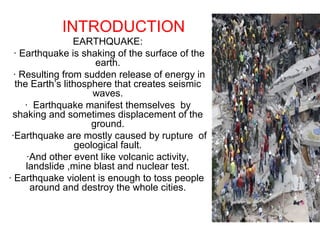
∙ Earthquake is shaking of the surface of the
earth.
∙ Resulting from sudden release of energy in
the Earth’s lithosphere that creates seismic
waves.
∙ Earthquake manifest themselves by
shaking and sometimes displacement of the
ground.
∙Earthquake are mostly caused by rupture of
geological fault.
∙And other event like volcanic activity,
landslide ,mine blast and nuclear test.
∙ Earthquake violent is enough to toss people
around and destroy the whole cities.
definitions
• Earthquake = Vibration of the Earth produced by
the rapid release of energy
• Seismic waves = Energy moving outward from
the focus of an earthquake
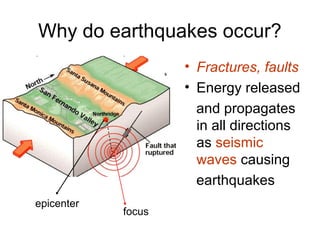
• Focus= location of initial slip on the fault; where
the earthquake origins
• Epicenter= spot on Earth’s surface directly
above the focus
Why do earthquakes occur?
• Fractures, faults
• Energy released
and propagates
in all directions
as seismic
waves causing
earthquakes
focus
epicenter
Causes
Why earthquake happens…..?
As we know that, earth divide into 4 parts—
Very thin crust,mantle,hard inner core & outer core.
inner core is solid however the mantle is liquid and
can flow.
Due to this large difference in temperature & pressure,
convection currents develop in mantle & mantle
material flows like we see while heating water.
The moving mantle causes the crust to move or slide.
Tectonic plates
• Earth crust slides in big pieces and these huge
pieces of crust that slide are called tectonic
plates.
• These plates constitute the whole of earth’s
crust but they slide in different directions at
different speeds. On an average these plates
move few cms a year.
• It is this extremely slow differential movement of
plates that causes earthquake.
 Causes of earthquake fall into following broad
categories:
a.Volcanic eruption
b.Folding & faulting
c.Plate tectonics
d.Human interference with nature
Some of the earthquake are artificial/while
others are natural.But it is undoubtedly true
that all the earthquakes are caused due to
disequilibrium in the earth’s crust.
However, all earthquakes caused by human
activities are not as terrifying & disastrous as
tectonic earthquakes.
CAUSE S OF AN EARTHQUAKE
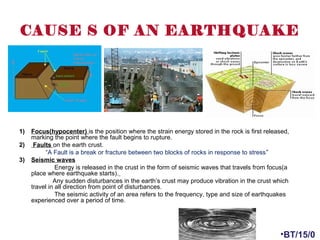
1) Focus(hypocenter) is the position where the strain energy stored in the rock is first released,
marking the point where the fault begins to rupture.
2) Faults on the earth crust.
“A Fault is a break or fracture between two blocks of rocks in response to stress”
3) Seismic waves
Energy is released in the crust in the form of seismic waves that travels from focus(a
place where earthquake starts).
Any sudden disturbances in the earth’s crust may produce vibration in the crust which
travel in all direction from point of disturbances.
The seismic activity of an area refers to the frequency, type and size of earthquakes
experienced over a period of time.
•BT/15/0
Where do earthquakes occur:
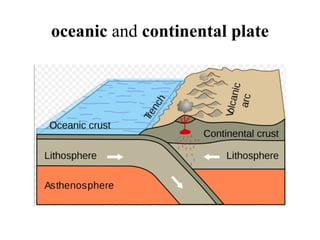
1) Most earthquakes occur along the edge
of the oceanic and continental plate
2) Along faults: normal, reverse, transform
oceanic and continental plate
Let’s see how
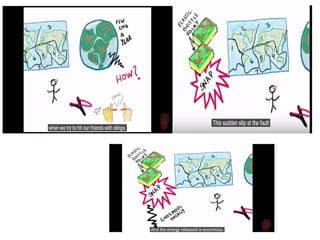
• Consider a rubber band. Keep stretching the rubber till
it hits a limit and snaps.At that time all the energy
stored in the rubber releases.
• Like same….earth tectonic plates are made of elastic
& brittle rocky material which also keep sliding against
each other. The line where these plates meet is called
fault. This sudden slip at fault releases the stored
energy & causes earthquake.
• The released energy is spread by the seismic waves
which travel along the earth surface. These waves
cause to shake the ground violently and cause huge
devastation far & wide.
Seismic waves: forms
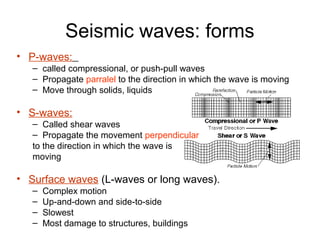
• P-waves:
– called compressional, or push-pull waves
– Propagate parralel to the direction in which the wave is moving
– Move through solids, liquids
• S-waves:
– Called shear waves
– Propagate the movement perpendicular
to the direction in which the wave is
moving
• Surface waves (L-waves or long waves).
– Complex motion
– Up-and-down and side-to-side
– Slowest
– Most damage to structures, buildings
Seismic waves: properties
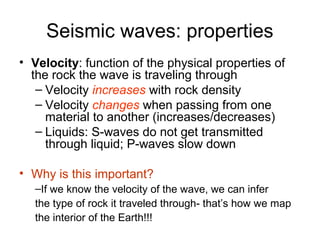
• Velocity: function of the physical properties of
the rock the wave is traveling through
– Velocity increases with rock density
– Velocity changes when passing from one
material to another (increases/decreases)
– Liquids: S-waves do not get transmitted
through liquid; P-waves slow down
• Why is this important?
–If we know the velocity of the wave, we can infer
the type of rock it traveled through- that’s how we map
the interior of the Earth!!!
Measuring earthquakes
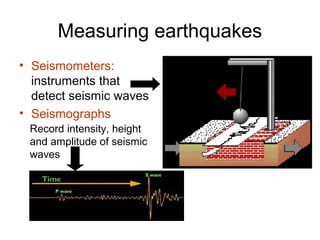
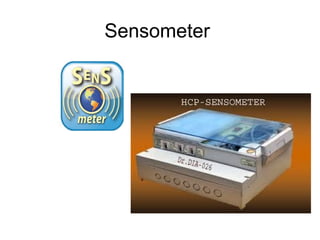
• Seismometers:
instruments that
detect seismic waves
• Seismographs
Record intensity, height
and amplitude of seismic
waves
Sensometer
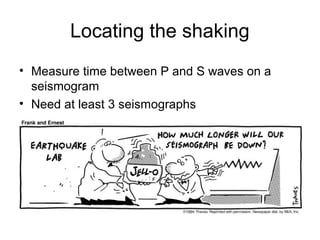
Locating the shaking
• Measure time between P and S waves on a
seismogram
• Need at least 3 seismographs
Earthquake size: two ways to
measure
1) Magnitude: Richter Scale
• Measures the energy released by fault
movement
• related to the maximum amplitude of the S
wave measured from the seismogram
• Logarithmic-scale; quantitative measure
• For each whole number there is a 31.5 times
increase in energy
• eg. an increase from 5 to 7 on the Richter scale =
an increase in energy of 992 times!!
2) Intensity: Mercalli Scale:
– What did you feel?
– Assigns an intensity or rating to measure an
earthquake at a particular location (qualitative)
– I (not felt) to XII (buildings nearly destroyed)
– Measures the destructive effect
• Intensity is a function of:
• Energy released by fault
• Geology of the location
• Surface substrate: can magnify shock waves e.g.
Mexico City (1985) and San Francisco (1989)
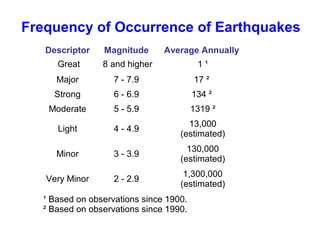
Frequency of Occurrence of Earthquakes
Descriptor Magnitude Average Annually
Great 8 and higher 1 ¹
Major 7 - 7.9 17 ²
Strong 6 - 6.9 134 ²
Moderate 5 - 5.9 1319 ²
Light 4 - 4.9
13,000
(estimated)
Minor 3 - 3.9
130,000
(estimated)
Very Minor 2 - 2.9
1,300,000
(estimated)
¹ Based on observations since 1900.
² Based on observations since 1990.
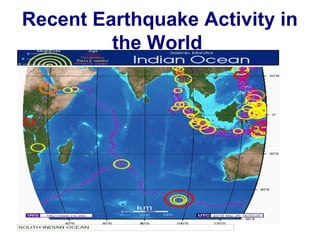
Recent Earthquake Activity in
the World
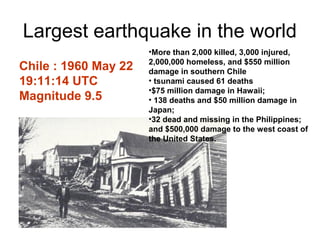
Largest earthquake in the world
Chile : 1960 May 22
19:11:14 UTC
Magnitude 9.5
•More than 2,000 killed, 3,000 injured,
2,000,000 homeless, and $550 million
damage in southern Chile
• tsunami caused 61 deaths
•$75 million damage in Hawaii;
• 138 deaths and $50 million damage in
Japan;
•32 dead and missing in the Philippines;
and $500,000 damage to the west coast of
the United States.
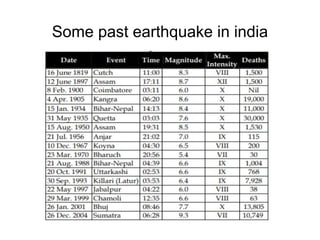
Some past earthquake in india
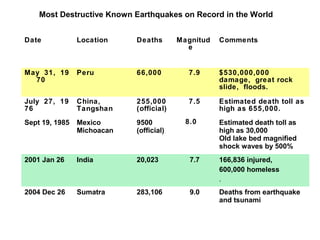
Most Destructive Known Earthquakes on Record in the World
Date Location Deaths Magnitud
e
Comments
May 31, 19
70
Peru 66,000 7.9 $530,000,000
damage, great rock
slide, floods.
July 27, 19
76
China,
Tangshan
255,000
(official)
7.5 Estimated death toll as
high as 655,000.
Sept 19, 1985 Mexico
Michoacan
9500
(official)
8.0 Estimated death toll as
high as 30,000
Old lake bed magnified
shock waves by 500%
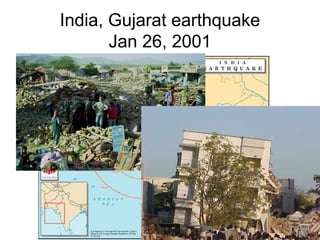
2001 Jan 26 India 20,023 7.7 166,836 injured,
600,000 homeless
.
2004 Dec 26 Sumatra 283,106 9.0 Deaths from earthquake
and tsunami
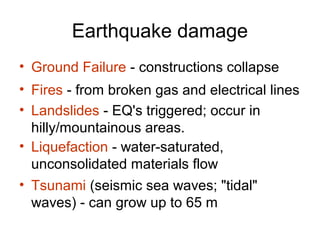
Earthquake damage
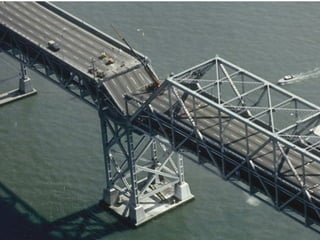
• Ground Failure - constructions collapse
• Fires - from broken gas and electrical lines
• Landslides - EQ's triggered; occur in
hilly/mountainous areas.
• Liquefaction - water-saturated,
unconsolidated materials flow
• Tsunami (seismic sea waves; "tidal"
waves) - can grow up to 65 m
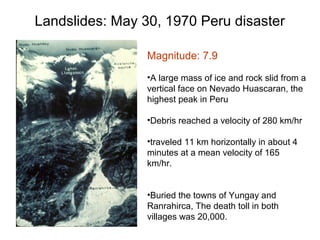
Landslides: May 30, 1970 Peru disaster
Magnitude: 7.9
•A large mass of ice and rock slid from a
vertical face on Nevado Huascaran, the
highest peak in Peru
•Debris reached a velocity of 280 km/hr
•traveled 11 km horizontally in about 4
minutes at a mean velocity of 165
km/hr.
•Buried the towns of Yungay and
Ranrahirca, The death toll in both
villages was 20,000.
India, Gujarat earthquake
Jan 26, 2001
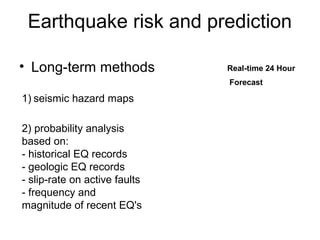
Earthquake risk and prediction
• Long-term methods
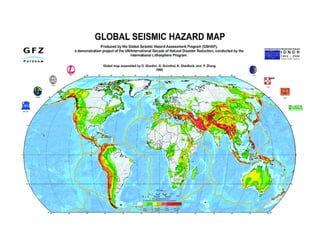
1) seismic hazard maps
2) probability analysis
based on:
- historical EQ records
- geologic EQ records
- slip-rate on active faults
- frequency and
magnitude of recent EQ's
Real-time 24 Hour
Forecast
Short-term predictions
Precursor phenomena (<1 year to days)
1. Foreshocks: usually increase in magnitude
2. Ground deformation
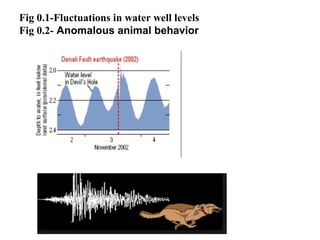
3. Fluctuations in water well levels
4. Changes in local radio wave characteristics
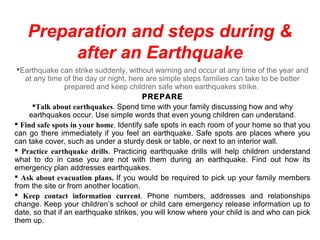
5. Anomalous animal behavior???
Fig 0.1-Fluctuations in water well levels
Fig 0.2- Anomalous animal behavior
Preparation and steps during &
after an Earthquake
Earthquake can strike suddenly, without warning and occur at any time of the year and
at any time of the day or night, here are simple steps families can take to be better
prepared and keep children safe when earthquakes strike.
PREPARE
Talk about earthquakes. Spend time with your family discussing how and why
earthquakes occur. Use simple words that even young children can understand.
 Find safe spots in your home. Identify safe spots in each room of your home so that you
can go there immediately if you feel an earthquake. Safe spots are places where you
can take cover, such as under a sturdy desk or table, or next to an interior wall.
 Practice earthquake drills. Practicing earthquake drills will help children understand
what to do in case you are not with them during an earthquake. Find out how its
emergency plan addresses earthquakes.
 Ask about evacuation plans. If you would be required to pick up your family members
from the site or from another location.
 Keep contact information current. Phone numbers, addresses and relationships
change. Keep your children’s school or child care emergency release information up to
date, so that if an earthquake strikes, you will know where your child is and who can pick
them up.
During an earthquake
If inside
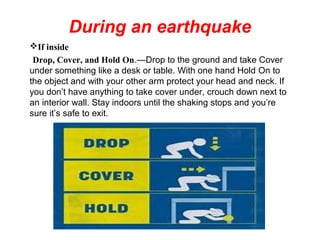
Drop, Cover, and Hold On.—Drop to the ground and take Cover
under something like a desk or table. With one hand Hold On to
the object and with your other arm protect your head and neck. If
you don’t have anything to take cover under, crouch down next to
an interior wall. Stay indoors until the shaking stops and you’re
sure it’s safe to exit.
During an earthquake
 If outside - find an open spot. Find a clear spot away from buildings,
trees, streetlights and power lines. Drop to the ground and stay there
until the shaking stops.
 If in a vehicle - stop. Pull over to a clear location, stop and stay there
with your seatbelt fastened until the shaking stops.
After an Earthquake
Check yourself and others for injuries. Provide first aid for anyone
who needs it.
Check water, gas, and electric lines for damage. If any are damaged,
shut off the valves. Check for the smell of gas. If you smell it, open all
the windows and doors, leave immediately, and report it to the
authorities .
Turn on the radio. Don't use the phone unless it's an emergency.
Stay out of damaged buildings.
Be careful around broken glass and debris. Wear boots or sturdy shoes
to keep from cutting your feet.
Stay away from beaches. Tsunamis may sometimes hit after the ground
has stopped shaking.
Stay away from damaged areas.
If you're at school or work, follow the emergency plan or the
instructions of the person in charge.
Presented by:-
Biotech 6th
sem students

Earthquakes presentation biotechnology

  • 1.
    Presented by:- Govind KumarGulashan Biotechnology 6th Sem student NIT ARUNACHAL PRADESH
  • 3.
    Objectives • Introduction ofearthquake • focus and epicenter of an earthquake. • Relate earthquake activity to plate tectonics • Describe the types of waves emitted during an earthquake. • Distinguish between earthquake intensity and magnitude. • Review some current methods of earthquake prediction. • Preparation and steps during and after earthquake.
  • 4.
    INTRODUCTION EARTHQUAKE: ∙ Earthquake isshaking of the surface of the earth. ∙ Resulting from sudden release of energy in the Earth’s lithosphere that creates seismic waves. ∙ Earthquake manifest themselves by shaking and sometimes displacement of the ground. ∙Earthquake are mostly caused by rupture of geological fault. ∙And other event like volcanic activity, landslide ,mine blast and nuclear test. ∙ Earthquake violent is enough to toss people around and destroy the whole cities.
  • 5.
    definitions • Earthquake =Vibration of the Earth produced by the rapid release of energy • Seismic waves = Energy moving outward from the focus of an earthquake • Focus= location of initial slip on the fault; where the earthquake origins • Epicenter= spot on Earth’s surface directly above the focus
  • 6.
    Why do earthquakesoccur? • Fractures, faults • Energy released and propagates in all directions as seismic waves causing earthquakes focus epicenter
  • 7.
    Causes Why earthquake happens…..? Aswe know that, earth divide into 4 parts— Very thin crust,mantle,hard inner core & outer core. inner core is solid however the mantle is liquid and can flow. Due to this large difference in temperature & pressure, convection currents develop in mantle & mantle material flows like we see while heating water. The moving mantle causes the crust to move or slide.
  • 8.
    Tectonic plates • Earthcrust slides in big pieces and these huge pieces of crust that slide are called tectonic plates. • These plates constitute the whole of earth’s crust but they slide in different directions at different speeds. On an average these plates move few cms a year. • It is this extremely slow differential movement of plates that causes earthquake.
  • 9.
     Causes ofearthquake fall into following broad categories: a.Volcanic eruption b.Folding & faulting c.Plate tectonics d.Human interference with nature Some of the earthquake are artificial/while others are natural.But it is undoubtedly true that all the earthquakes are caused due to disequilibrium in the earth’s crust. However, all earthquakes caused by human activities are not as terrifying & disastrous as tectonic earthquakes.
  • 10.
    CAUSE S OFAN EARTHQUAKE 1) Focus(hypocenter) is the position where the strain energy stored in the rock is first released, marking the point where the fault begins to rupture. 2) Faults on the earth crust. “A Fault is a break or fracture between two blocks of rocks in response to stress” 3) Seismic waves Energy is released in the crust in the form of seismic waves that travels from focus(a place where earthquake starts). Any sudden disturbances in the earth’s crust may produce vibration in the crust which travel in all direction from point of disturbances. The seismic activity of an area refers to the frequency, type and size of earthquakes experienced over a period of time. •BT/15/0
  • 11.
    Where do earthquakesoccur: 1) Most earthquakes occur along the edge of the oceanic and continental plate 2) Along faults: normal, reverse, transform
  • 12.
  • 13.
    Let’s see how •Consider a rubber band. Keep stretching the rubber till it hits a limit and snaps.At that time all the energy stored in the rubber releases. • Like same….earth tectonic plates are made of elastic & brittle rocky material which also keep sliding against each other. The line where these plates meet is called fault. This sudden slip at fault releases the stored energy & causes earthquake. • The released energy is spread by the seismic waves which travel along the earth surface. These waves cause to shake the ground violently and cause huge devastation far & wide.
  • 15.
    Seismic waves: forms •P-waves: – called compressional, or push-pull waves – Propagate parralel to the direction in which the wave is moving – Move through solids, liquids • S-waves: – Called shear waves – Propagate the movement perpendicular to the direction in which the wave is moving • Surface waves (L-waves or long waves). – Complex motion – Up-and-down and side-to-side – Slowest – Most damage to structures, buildings
  • 16.
    Seismic waves: properties •Velocity: function of the physical properties of the rock the wave is traveling through – Velocity increases with rock density – Velocity changes when passing from one material to another (increases/decreases) – Liquids: S-waves do not get transmitted through liquid; P-waves slow down • Why is this important? –If we know the velocity of the wave, we can infer the type of rock it traveled through- that’s how we map the interior of the Earth!!!
  • 17.
    Measuring earthquakes • Seismometers: instrumentsthat detect seismic waves • Seismographs Record intensity, height and amplitude of seismic waves
  • 18.
  • 19.
    Locating the shaking •Measure time between P and S waves on a seismogram • Need at least 3 seismographs
  • 20.
    Earthquake size: twoways to measure 1) Magnitude: Richter Scale • Measures the energy released by fault movement • related to the maximum amplitude of the S wave measured from the seismogram • Logarithmic-scale; quantitative measure • For each whole number there is a 31.5 times increase in energy • eg. an increase from 5 to 7 on the Richter scale = an increase in energy of 992 times!!
  • 21.
    2) Intensity: MercalliScale: – What did you feel? – Assigns an intensity or rating to measure an earthquake at a particular location (qualitative) – I (not felt) to XII (buildings nearly destroyed) – Measures the destructive effect • Intensity is a function of: • Energy released by fault • Geology of the location • Surface substrate: can magnify shock waves e.g. Mexico City (1985) and San Francisco (1989)
  • 22.
    Frequency of Occurrenceof Earthquakes Descriptor Magnitude Average Annually Great 8 and higher 1 ¹ Major 7 - 7.9 17 ² Strong 6 - 6.9 134 ² Moderate 5 - 5.9 1319 ² Light 4 - 4.9 13,000 (estimated) Minor 3 - 3.9 130,000 (estimated) Very Minor 2 - 2.9 1,300,000 (estimated) ¹ Based on observations since 1900. ² Based on observations since 1990.
  • 23.
  • 24.
    Largest earthquake inthe world Chile : 1960 May 22 19:11:14 UTC Magnitude 9.5 •More than 2,000 killed, 3,000 injured, 2,000,000 homeless, and $550 million damage in southern Chile • tsunami caused 61 deaths •$75 million damage in Hawaii; • 138 deaths and $50 million damage in Japan; •32 dead and missing in the Philippines; and $500,000 damage to the west coast of the United States.
  • 25.
  • 26.
    Most Destructive KnownEarthquakes on Record in the World Date Location Deaths Magnitud e Comments May 31, 19 70 Peru 66,000 7.9 $530,000,000 damage, great rock slide, floods. July 27, 19 76 China, Tangshan 255,000 (official) 7.5 Estimated death toll as high as 655,000. Sept 19, 1985 Mexico Michoacan 9500 (official) 8.0 Estimated death toll as high as 30,000 Old lake bed magnified shock waves by 500% 2001 Jan 26 India 20,023 7.7 166,836 injured, 600,000 homeless . 2004 Dec 26 Sumatra 283,106 9.0 Deaths from earthquake and tsunami
  • 27.
    Earthquake damage • GroundFailure - constructions collapse • Fires - from broken gas and electrical lines • Landslides - EQ's triggered; occur in hilly/mountainous areas. • Liquefaction - water-saturated, unconsolidated materials flow • Tsunami (seismic sea waves; "tidal" waves) - can grow up to 65 m
  • 29.
    Landslides: May 30,1970 Peru disaster Magnitude: 7.9 •A large mass of ice and rock slid from a vertical face on Nevado Huascaran, the highest peak in Peru •Debris reached a velocity of 280 km/hr •traveled 11 km horizontally in about 4 minutes at a mean velocity of 165 km/hr. •Buried the towns of Yungay and Ranrahirca, The death toll in both villages was 20,000.
  • 30.
  • 31.
    Earthquake risk andprediction • Long-term methods 1) seismic hazard maps 2) probability analysis based on: - historical EQ records - geologic EQ records - slip-rate on active faults - frequency and magnitude of recent EQ's Real-time 24 Hour Forecast
  • 33.
    Short-term predictions Precursor phenomena(<1 year to days) 1. Foreshocks: usually increase in magnitude 2. Ground deformation 3. Fluctuations in water well levels 4. Changes in local radio wave characteristics 5. Anomalous animal behavior???
  • 34.
    Fig 0.1-Fluctuations inwater well levels Fig 0.2- Anomalous animal behavior
  • 35.
    Preparation and stepsduring & after an Earthquake Earthquake can strike suddenly, without warning and occur at any time of the year and at any time of the day or night, here are simple steps families can take to be better prepared and keep children safe when earthquakes strike. PREPARE Talk about earthquakes. Spend time with your family discussing how and why earthquakes occur. Use simple words that even young children can understand.  Find safe spots in your home. Identify safe spots in each room of your home so that you can go there immediately if you feel an earthquake. Safe spots are places where you can take cover, such as under a sturdy desk or table, or next to an interior wall.  Practice earthquake drills. Practicing earthquake drills will help children understand what to do in case you are not with them during an earthquake. Find out how its emergency plan addresses earthquakes.  Ask about evacuation plans. If you would be required to pick up your family members from the site or from another location.  Keep contact information current. Phone numbers, addresses and relationships change. Keep your children’s school or child care emergency release information up to date, so that if an earthquake strikes, you will know where your child is and who can pick them up.
  • 36.
    During an earthquake Ifinside Drop, Cover, and Hold On.—Drop to the ground and take Cover under something like a desk or table. With one hand Hold On to the object and with your other arm protect your head and neck. If you don’t have anything to take cover under, crouch down next to an interior wall. Stay indoors until the shaking stops and you’re sure it’s safe to exit.
  • 37.
    During an earthquake If outside - find an open spot. Find a clear spot away from buildings, trees, streetlights and power lines. Drop to the ground and stay there until the shaking stops.  If in a vehicle - stop. Pull over to a clear location, stop and stay there with your seatbelt fastened until the shaking stops.
  • 38.
    After an Earthquake Checkyourself and others for injuries. Provide first aid for anyone who needs it. Check water, gas, and electric lines for damage. If any are damaged, shut off the valves. Check for the smell of gas. If you smell it, open all the windows and doors, leave immediately, and report it to the authorities . Turn on the radio. Don't use the phone unless it's an emergency. Stay out of damaged buildings. Be careful around broken glass and debris. Wear boots or sturdy shoes to keep from cutting your feet. Stay away from beaches. Tsunamis may sometimes hit after the ground has stopped shaking. Stay away from damaged areas. If you're at school or work, follow the emergency plan or the instructions of the person in charge.
  • 39.

Editor's Notes

  • #6 A drop of water – analogy between ripples in the water and seismic waves
  • #7 Why do rock break? Review three types of stress: tension, compression, shear Three types of deformation resulting: elastic, plastic and brittle We’re concerned with the brittle deformation – causes faults, fractures through which energy, created by the friction, is released Define Focus, epicenter and seismic waves
  • #16 P-waves: the bell analogy: waves felt by both sound
  • #18 Earliest seismograph was invented in China ~ 2000 years ago (or 136 AD) Easy to make; can make your own at home
  • #21 Write Table 11-1 on the board, to help relate to Richter scale
  • #30 A large mass of ice and rock separated from a vertical face on Nevado Huascaran, the highest peak in Peru The slab fell 1000 m vertically, disintegrated, slid down the lateral slopes of the mountain, and then was launched off a &amp;apos;ski jump&amp;apos;. Debris reached a velocity as high as 280 km/hr buried the towns of Yungay and Ranrahirca, having traveled 11 km horizontally in about 4 minutes at a mean velocity of 165 km/hr. The death toll in both villages was 20,000.
  • #34 Animals and earthquakes: On February 4, 1975 the Chinese successfully evacuated the city of Haicheng several hours before a 7.3 magnitude earthquake-- based primarily on observations of unusual animal behavior. Conventional science has never been able to adequately explain the phenomenon. Although the majority of accounts pertain to dogs and cats, there are also many stories about other types of animals in the wild, on farms, and in zoos; including horses, cows, deer, goats, possums, rats, chickens, and other birds. The behavior has been reported in many other animal species as well, including fish, reptiles, and even insects. Deep sea fish, for example, have been caught close to the surface of the ocean on numerous occasions around Japan prior to earthquakes (Tributsch, 1982). A number of theories have been proposed to explain this phenomenon, and what the precursory signals that the animals are picking up on might be. Because many animals possess auditory capacities beyond the human range, it has been suggested that some animals may be reacting to ultrasound emitted as microseisms from fracturing rock (Armstrong, 1969). Another candidate is fluctuations in the earth&amp;apos;s magnetic field. Because some animals have a sensitivity to variations in the earth&amp;apos;s magnetic field (usually as a means of orientation), and since variations in the magnetic field occur near the epicenters of earthquakes (Chapman and Bartels, 1940), it has been suggested that this is what the animals are picking up on.