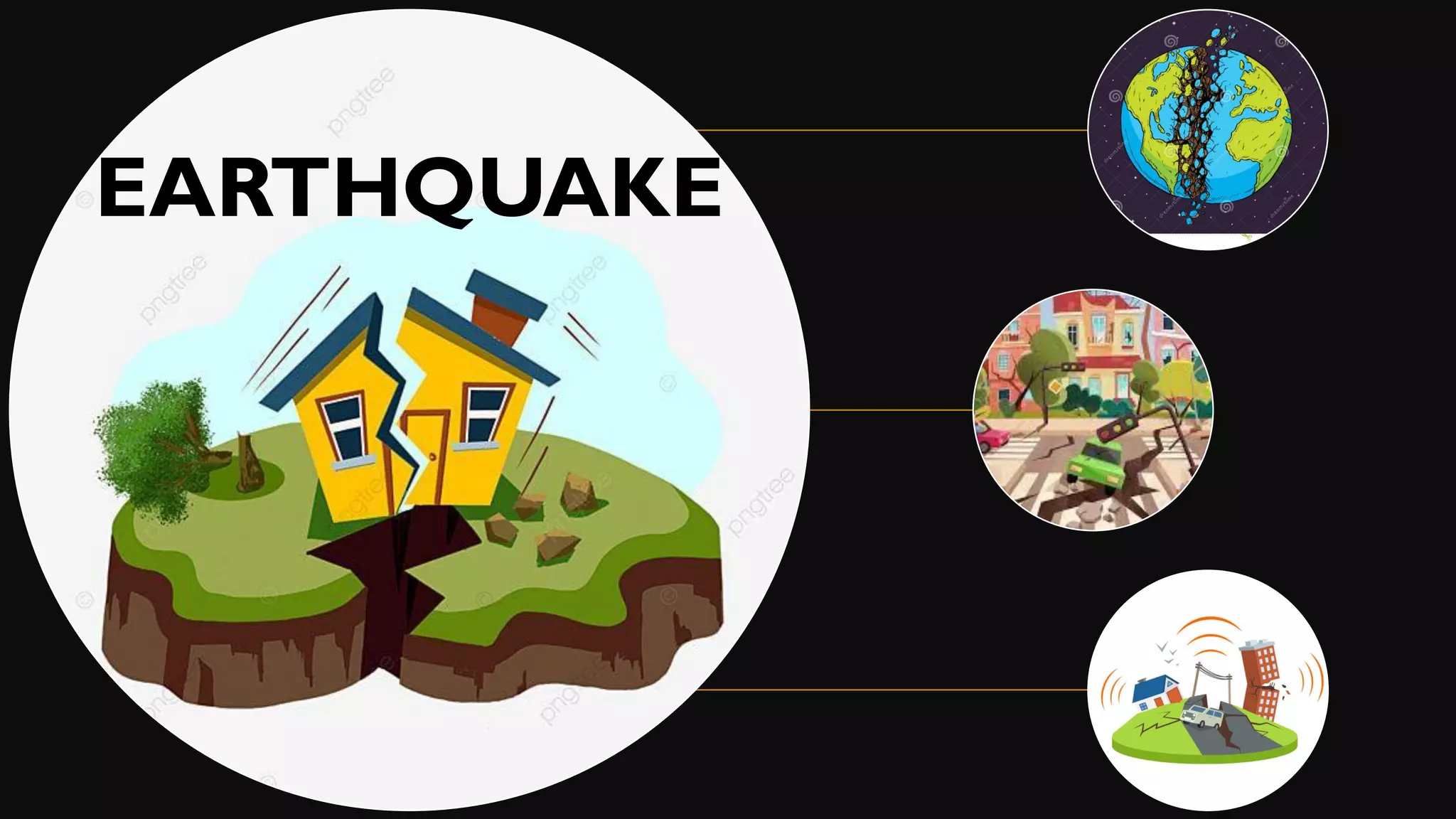
EARTHQUAKE
CONTENT
• WHAT IS EARTHQUAKE ?
• TERMS RELATEDTO EARTHQUAKE
• CAUSES OF EARTHQUAKE
• SEISMOMETER
• WAVES PRODUCE DUE TO EARTHQUAKE
• CLASSIFICATION OF EATHQUAKES
• INDIAN SEISMIC ZONES
• MOST HAZARDOUS EARTHQUAKES
• HAZARDEOUS EFFECT OF THE EARTHQUAKE
• PRECAUTIONS DURING EARTHQUAKE
WHAT IS EATHQUAKE ?
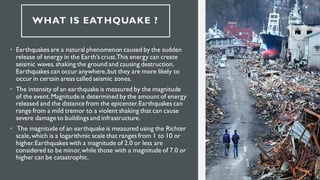
• Earthquakes are a natural phenomenon caused by the sudden
release of energy in the Earth’s crust.This energy can create
seismic waves, shaking the ground and causing destruction.
Earthquakes can occur anywhere,but they are more likely to
occur in certain areas called seismic zones.
• The intensity of an earthquake is measured by the magnitude
of the event.Magnitude is determined by the amount of energy
released and the distance from the epicenter.Earthquakes can
range from a mild tremor to a violent shaking that can cause
severe damage to buildings and infrastructure.
• The magnitude of an earthquake is measured using the Richter
scale,which is a logarithmic scale that ranges from 1 to 10 or
higher.Earthquakes with a magnitude of 2.0 or less are
considered to be minor,while those with a magnitude of 7.0 or
higher can be catastrophic.
TERMS RELATED TO EARTHQUAKE
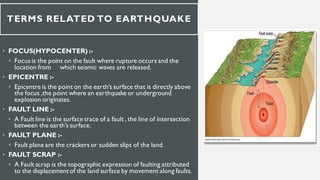
• FOCUS(HYPOCENTER) :-
• Focus is the point on the fault where rupture occurs and the
location from which seismic waves are released.
• EPICENTRE :-
• Epicentre is the point on the earth’s surface that is directly above
the focus ,the point where an earthquake or underground
explosion originates.
• FAULT LINE :-
• A Fault line is the surface trace of a fault , the line of intersection
between the earth’s surface.
• FAULT PLANE :-
• Fault plane are the crackers or sudden slips of the land.
• FAULT SCRAP :-
• A Fault scrap is the topographic expression of faulting attributed
to the displacementof the land surface by movement along faults.
CAUSES OF EARTHQUAKE
• VULCANICITY :-
• Earthquakes can be triggered by volcanic activity,
• The movement of magma and molten rock within a volcanic system can
cause earthquakes.
• Major volcanic eruptions can cause powerful earthquakes as the Earth's
crust is shaken by the explosive release of energy.
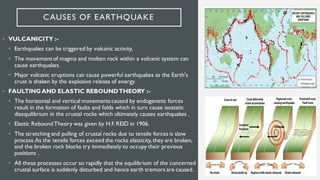
• FAULTINGAND ELASTIC REBOUNDTHEORY :-
• The horizontal and vertical movements caused by endogenetic forces
result in the formation of faults and folds which in turn cause isostatic
disequilibrium in the crustal rocks which ultimately causes earthquakes .
• Elastic ReboundTheory was given by H.F. REID in 1906.
• The stretching and pulling of crustal rocks due to tensile forces is slow
process.As the tensile forces exceed the rocks elasticity, they are broken,
and the broken rock blocks try immediately to occupy their previous
positions .
• All these processes occur so rapidly that the equilibrium of the concerned
crustal surface is suddenly disturbed and hence earth tremors are caused.
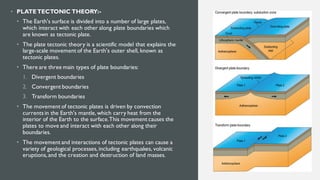
• PLATETECTONIC THEORY:-
• The Earth's surface is divided into a number of large plates,
which interact with each other along plate boundaries which
are known as tectonic plate.
• The plate tectonic theory is a scientific model that explains the
large-scale movement of the Earth's outer shell, known as
tectonic plates.
• There are three main types of plate boundaries:
1. Divergent boundaries
2. Convergent boundaries
3. Transform boundaries
• The movement of tectonic plates is driven by convection
currents in the Earth's mantle, which carry heat from the
interior of the Earth to the surface.This movement causes the
plates to move and interact with each other along their
boundaries.
• The movement and interactions of tectonic plates can cause a
variety of geological processes, including earthquakes, volcanic
eruptions, and the creation and destruction of land masses.
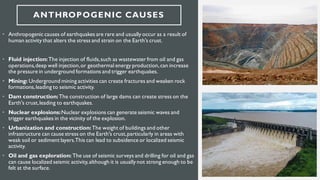
ANTHROPOGENIC CAUSES
• Anthropogenic causes of earthquakes are rare and usually occur as a result of
human activity that alters the stress and strain on the Earth's crust.
• Fluid injection:The injection of fluids,such as wastewater from oil and gas
operations,deep well injection,or geothermal energy production,can increase
the pressure in underground formations and trigger earthquakes.
• Mining: Underground mining activities can create fractures and weaken rock
formations,leading to seismic activity.
• Dam construction:The construction of large dams can create stress on the
Earth's crust,leading to earthquakes.
• Nuclear explosions:Nuclear explosions can generate seismic waves and
trigger earthquakes in the vicinity of the explosion.
• Urbanization and construction:The weight of buildings and other
infrastructure can cause stress on the Earth's crust,particularly in areas with
weak soil or sediment layers.This can lead to subsidence or localized seismic
activity.
• Oil and gas exploration: The use of seismic surveys and drilling for oil and gas
can cause localized seismic activity,although it is usually not strong enough to be
felt at the surface.
SIESMOMETER
• A seismometer is a device used to measure the motion of the
ground during seismic activity.
• It consists of a mass attached to a spring, which is suspended in
a frame.
• When the ground moves,the mass remains stationary due to
its inertia, causing the frame to move relative to the mass.
• The electrical signal is amplified and recorded,producing a
seismogram, which shows the intensity and duration of the
seismic activity.
• The Richter magnitude scale, also known as the Richter
scale, is a measure of the magnitude or size of an earthquake. It
was developed by Charles Richter in 1935 and is based on the
logarithmic scale, meaning that each increase in magnitude
represents a ten-fold increase in ground motion.
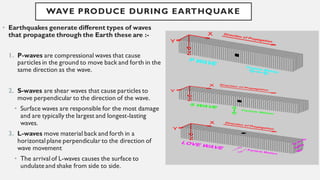
WAVE PRODUCE DURING EARTHQUAKE
• Earthquakes generate different types of waves
that propagate through the Earth these are :-
1. P-waves are compressional waves that cause
particles in the ground to move back and forth in the
same direction as the wave.
2. S-waves are shear waves that cause particles to
move perpendicular to the direction of the wave.
• Surface waves are responsible for the most damage
and are typically the largest and longest-lasting
waves.
3. L-waves move material back and forth in a
horizontal plane perpendicular to the direction of
wave movement
• The arrival of L-waves causes the surface to
undulate and shake from side to side.
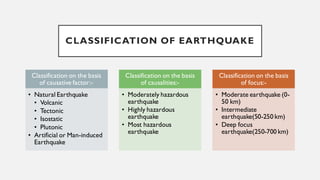
CLASSIFICATION OF EARTHQUAKE
Classification on the basis
of causative factor:-
• Natural Earthquake
• Volcanic
• Tectonic
• Isostatic
• Plutonic
• Artificial or Man-induced
Earthquake
Classification on the basis
of causalities:-
• Moderately hazardous
earthquake
• Highly hazardous
earthquake
• Most hazardous
earthquake
Classification on the basis
of focus:-
• Moderate earthquake (0-
50 km)
• Intermediate
earthquake(50-250 km)
• Deep focus
earthquake(250-700 km)
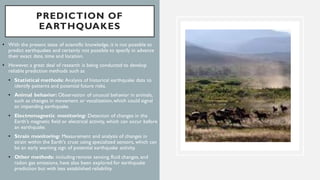
PREDICTION OF
EARTHQUAKES
• With the present state of scientific knowledge, it is not possible to
predict earthquakes and certainly not possible to specify in advance
their exact date, time and location.
• However, a great deal of research is being conducted to develop
reliable prediction methods such as
• Statistical methods: Analysis of historical earthquake data to
identify patterns and potential future risks.
• Animal behavior: Observation of unusual behavior in animals,
such as changes in movement or vocalization,which could signal
an impending earthquake.
• Electromagnetic monitoring: Detection of changes in the
Earth's magnetic field or electrical activity, which can occur before
an earthquake.
• Strain monitoring: Measurement and analysis of changes in
strain within the Earth's crust using specialized sensors, which can
be an early warning sign of potential earthquake activity.
• Other methods: including remote sensing, fluid changes, and
radon gas emissions, have also been explored for earthquake
prediction but with less established reliability.
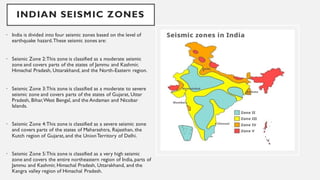
INDIAN SEISMIC ZONES
• India is divided into four seismic zones based on the level of
earthquake hazard.These seismic zones are:
• Seismic Zone 2:This zone is classified as a moderate seismic
zone and covers parts of the states of Jammu and Kashmir,
Himachal Pradesh, Uttarakhand, and the North-Eastern region.
• Seismic Zone 3:This zone is classified as a moderate to severe
seismic zone and covers parts of the states of Gujarat, Uttar
Pradesh, Bihar,West Bengal, and the Andaman and Nicobar
Islands.
• Seismic Zone 4:This zone is classified as a severe seismic zone
and covers parts of the states of Maharashtra, Rajasthan, the
Kutch region of Gujarat, and the UnionTerritory of Delhi.
• Seismic Zone 5:This zone is classified as a very high seismic
zone and covers the entire northeastern region of India, parts of
Jammu and Kashmir, Himachal Pradesh, Uttarakhand, and the
Kangra valley region of Himachal Pradesh.
MOST
HAZARDOUS
EARTHQUAKES
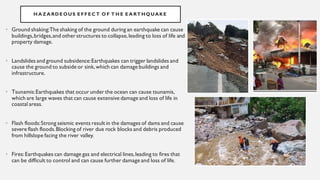
H A ZA RDE OUS E FFE C T O F T H E E A RT HQUAKE
• Ground shaking:The shaking of the ground during an earthquake can cause
buildings,bridges,and other structures to collapse,leading to loss of life and
property damage.
• Landslides and ground subsidence:Earthquakes can trigger landslides and
cause the ground to subside or sink,which can damage buildings and
infrastructure.
• Tsunamis:Earthquakes that occur under the ocean can cause tsunamis,
which are large waves that can cause extensive damage and loss of life in
coastal areas.
• Flash floods:Strong seismic events result in the damages of dams and cause
severe flash floods.Blocking of river due rock blocks and debris produced
from hillslope facing the river valley.
• Fires:Earthquakes can damage gas and electrical lines,leading to fires that
can be difficult to control and can cause further damage and loss of life.
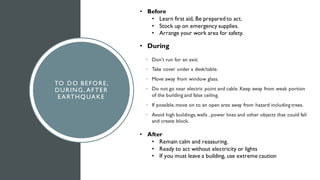
TO DO BEFORE,
DURING, AFTER
EARTHQUAKE
• Don’t run for an exit.
• Take cover under a desk/table.
• Move away from window glass.
• Do not go near electric point and cable. Keep away from weak portion
of the building and false ceiling.
• If possible, move on to an open area away from hazard including trees.
• Avoid high buildings,walls , power lines and other objects that could fall
and create block.
• During
• Before
• Learn first aid, Be prepared to act.
• Stock up on emergency supplies.
• Arrange your work area for safety.
• After
• Remain calm and reassuring.
• Ready to act without electricity or lights
• If you must leave a building, use extreme caution
Samar Pratap singh
Sanjay Kumar
Shiva Ram
Shivansh Dutt Shukla
Shivansh Jaiswal
ShouryaVijay
Dr Roohi
Rawat
• Professor
• Department of
Geography Mahila
MahaVidyalaya,
BHU
Thank
You
Group
Members

EARTHQUAKE (25 to 30).pdf

  • 1.
  • 2.
    CONTENT • WHAT ISEARTHQUAKE ? • TERMS RELATEDTO EARTHQUAKE • CAUSES OF EARTHQUAKE • SEISMOMETER • WAVES PRODUCE DUE TO EARTHQUAKE • CLASSIFICATION OF EATHQUAKES • INDIAN SEISMIC ZONES • MOST HAZARDOUS EARTHQUAKES • HAZARDEOUS EFFECT OF THE EARTHQUAKE • PRECAUTIONS DURING EARTHQUAKE
  • 3.
    WHAT IS EATHQUAKE? • Earthquakes are a natural phenomenon caused by the sudden release of energy in the Earth’s crust.This energy can create seismic waves, shaking the ground and causing destruction. Earthquakes can occur anywhere,but they are more likely to occur in certain areas called seismic zones. • The intensity of an earthquake is measured by the magnitude of the event.Magnitude is determined by the amount of energy released and the distance from the epicenter.Earthquakes can range from a mild tremor to a violent shaking that can cause severe damage to buildings and infrastructure. • The magnitude of an earthquake is measured using the Richter scale,which is a logarithmic scale that ranges from 1 to 10 or higher.Earthquakes with a magnitude of 2.0 or less are considered to be minor,while those with a magnitude of 7.0 or higher can be catastrophic.
  • 4.
    TERMS RELATED TOEARTHQUAKE • FOCUS(HYPOCENTER) :- • Focus is the point on the fault where rupture occurs and the location from which seismic waves are released. • EPICENTRE :- • Epicentre is the point on the earth’s surface that is directly above the focus ,the point where an earthquake or underground explosion originates. • FAULT LINE :- • A Fault line is the surface trace of a fault , the line of intersection between the earth’s surface. • FAULT PLANE :- • Fault plane are the crackers or sudden slips of the land. • FAULT SCRAP :- • A Fault scrap is the topographic expression of faulting attributed to the displacementof the land surface by movement along faults.
  • 5.
    CAUSES OF EARTHQUAKE •VULCANICITY :- • Earthquakes can be triggered by volcanic activity, • The movement of magma and molten rock within a volcanic system can cause earthquakes. • Major volcanic eruptions can cause powerful earthquakes as the Earth's crust is shaken by the explosive release of energy. • FAULTINGAND ELASTIC REBOUNDTHEORY :- • The horizontal and vertical movements caused by endogenetic forces result in the formation of faults and folds which in turn cause isostatic disequilibrium in the crustal rocks which ultimately causes earthquakes . • Elastic ReboundTheory was given by H.F. REID in 1906. • The stretching and pulling of crustal rocks due to tensile forces is slow process.As the tensile forces exceed the rocks elasticity, they are broken, and the broken rock blocks try immediately to occupy their previous positions . • All these processes occur so rapidly that the equilibrium of the concerned crustal surface is suddenly disturbed and hence earth tremors are caused.
  • 6.
    • PLATETECTONIC THEORY:- •The Earth's surface is divided into a number of large plates, which interact with each other along plate boundaries which are known as tectonic plate. • The plate tectonic theory is a scientific model that explains the large-scale movement of the Earth's outer shell, known as tectonic plates. • There are three main types of plate boundaries: 1. Divergent boundaries 2. Convergent boundaries 3. Transform boundaries • The movement of tectonic plates is driven by convection currents in the Earth's mantle, which carry heat from the interior of the Earth to the surface.This movement causes the plates to move and interact with each other along their boundaries. • The movement and interactions of tectonic plates can cause a variety of geological processes, including earthquakes, volcanic eruptions, and the creation and destruction of land masses.
  • 7.
    ANTHROPOGENIC CAUSES • Anthropogeniccauses of earthquakes are rare and usually occur as a result of human activity that alters the stress and strain on the Earth's crust. • Fluid injection:The injection of fluids,such as wastewater from oil and gas operations,deep well injection,or geothermal energy production,can increase the pressure in underground formations and trigger earthquakes. • Mining: Underground mining activities can create fractures and weaken rock formations,leading to seismic activity. • Dam construction:The construction of large dams can create stress on the Earth's crust,leading to earthquakes. • Nuclear explosions:Nuclear explosions can generate seismic waves and trigger earthquakes in the vicinity of the explosion. • Urbanization and construction:The weight of buildings and other infrastructure can cause stress on the Earth's crust,particularly in areas with weak soil or sediment layers.This can lead to subsidence or localized seismic activity. • Oil and gas exploration: The use of seismic surveys and drilling for oil and gas can cause localized seismic activity,although it is usually not strong enough to be felt at the surface.
  • 8.
    SIESMOMETER • A seismometeris a device used to measure the motion of the ground during seismic activity. • It consists of a mass attached to a spring, which is suspended in a frame. • When the ground moves,the mass remains stationary due to its inertia, causing the frame to move relative to the mass. • The electrical signal is amplified and recorded,producing a seismogram, which shows the intensity and duration of the seismic activity. • The Richter magnitude scale, also known as the Richter scale, is a measure of the magnitude or size of an earthquake. It was developed by Charles Richter in 1935 and is based on the logarithmic scale, meaning that each increase in magnitude represents a ten-fold increase in ground motion.
  • 9.
    WAVE PRODUCE DURINGEARTHQUAKE • Earthquakes generate different types of waves that propagate through the Earth these are :- 1. P-waves are compressional waves that cause particles in the ground to move back and forth in the same direction as the wave. 2. S-waves are shear waves that cause particles to move perpendicular to the direction of the wave. • Surface waves are responsible for the most damage and are typically the largest and longest-lasting waves. 3. L-waves move material back and forth in a horizontal plane perpendicular to the direction of wave movement • The arrival of L-waves causes the surface to undulate and shake from side to side.
  • 10.
    CLASSIFICATION OF EARTHQUAKE Classificationon the basis of causative factor:- • Natural Earthquake • Volcanic • Tectonic • Isostatic • Plutonic • Artificial or Man-induced Earthquake Classification on the basis of causalities:- • Moderately hazardous earthquake • Highly hazardous earthquake • Most hazardous earthquake Classification on the basis of focus:- • Moderate earthquake (0- 50 km) • Intermediate earthquake(50-250 km) • Deep focus earthquake(250-700 km)
  • 11.
    PREDICTION OF EARTHQUAKES • Withthe present state of scientific knowledge, it is not possible to predict earthquakes and certainly not possible to specify in advance their exact date, time and location. • However, a great deal of research is being conducted to develop reliable prediction methods such as • Statistical methods: Analysis of historical earthquake data to identify patterns and potential future risks. • Animal behavior: Observation of unusual behavior in animals, such as changes in movement or vocalization,which could signal an impending earthquake. • Electromagnetic monitoring: Detection of changes in the Earth's magnetic field or electrical activity, which can occur before an earthquake. • Strain monitoring: Measurement and analysis of changes in strain within the Earth's crust using specialized sensors, which can be an early warning sign of potential earthquake activity. • Other methods: including remote sensing, fluid changes, and radon gas emissions, have also been explored for earthquake prediction but with less established reliability.
  • 12.
    INDIAN SEISMIC ZONES •India is divided into four seismic zones based on the level of earthquake hazard.These seismic zones are: • Seismic Zone 2:This zone is classified as a moderate seismic zone and covers parts of the states of Jammu and Kashmir, Himachal Pradesh, Uttarakhand, and the North-Eastern region. • Seismic Zone 3:This zone is classified as a moderate to severe seismic zone and covers parts of the states of Gujarat, Uttar Pradesh, Bihar,West Bengal, and the Andaman and Nicobar Islands. • Seismic Zone 4:This zone is classified as a severe seismic zone and covers parts of the states of Maharashtra, Rajasthan, the Kutch region of Gujarat, and the UnionTerritory of Delhi. • Seismic Zone 5:This zone is classified as a very high seismic zone and covers the entire northeastern region of India, parts of Jammu and Kashmir, Himachal Pradesh, Uttarakhand, and the Kangra valley region of Himachal Pradesh.
  • 13.
  • 14.
    H A ZARDE OUS E FFE C T O F T H E E A RT HQUAKE • Ground shaking:The shaking of the ground during an earthquake can cause buildings,bridges,and other structures to collapse,leading to loss of life and property damage. • Landslides and ground subsidence:Earthquakes can trigger landslides and cause the ground to subside or sink,which can damage buildings and infrastructure. • Tsunamis:Earthquakes that occur under the ocean can cause tsunamis, which are large waves that can cause extensive damage and loss of life in coastal areas. • Flash floods:Strong seismic events result in the damages of dams and cause severe flash floods.Blocking of river due rock blocks and debris produced from hillslope facing the river valley. • Fires:Earthquakes can damage gas and electrical lines,leading to fires that can be difficult to control and can cause further damage and loss of life.
  • 15.
    TO DO BEFORE, DURING,AFTER EARTHQUAKE • Don’t run for an exit. • Take cover under a desk/table. • Move away from window glass. • Do not go near electric point and cable. Keep away from weak portion of the building and false ceiling. • If possible, move on to an open area away from hazard including trees. • Avoid high buildings,walls , power lines and other objects that could fall and create block. • During • Before • Learn first aid, Be prepared to act. • Stock up on emergency supplies. • Arrange your work area for safety. • After • Remain calm and reassuring. • Ready to act without electricity or lights • If you must leave a building, use extreme caution
  • 16.
    Samar Pratap singh SanjayKumar Shiva Ram Shivansh Dutt Shukla Shivansh Jaiswal ShouryaVijay Dr Roohi Rawat • Professor • Department of Geography Mahila MahaVidyalaya, BHU Thank You Group Members