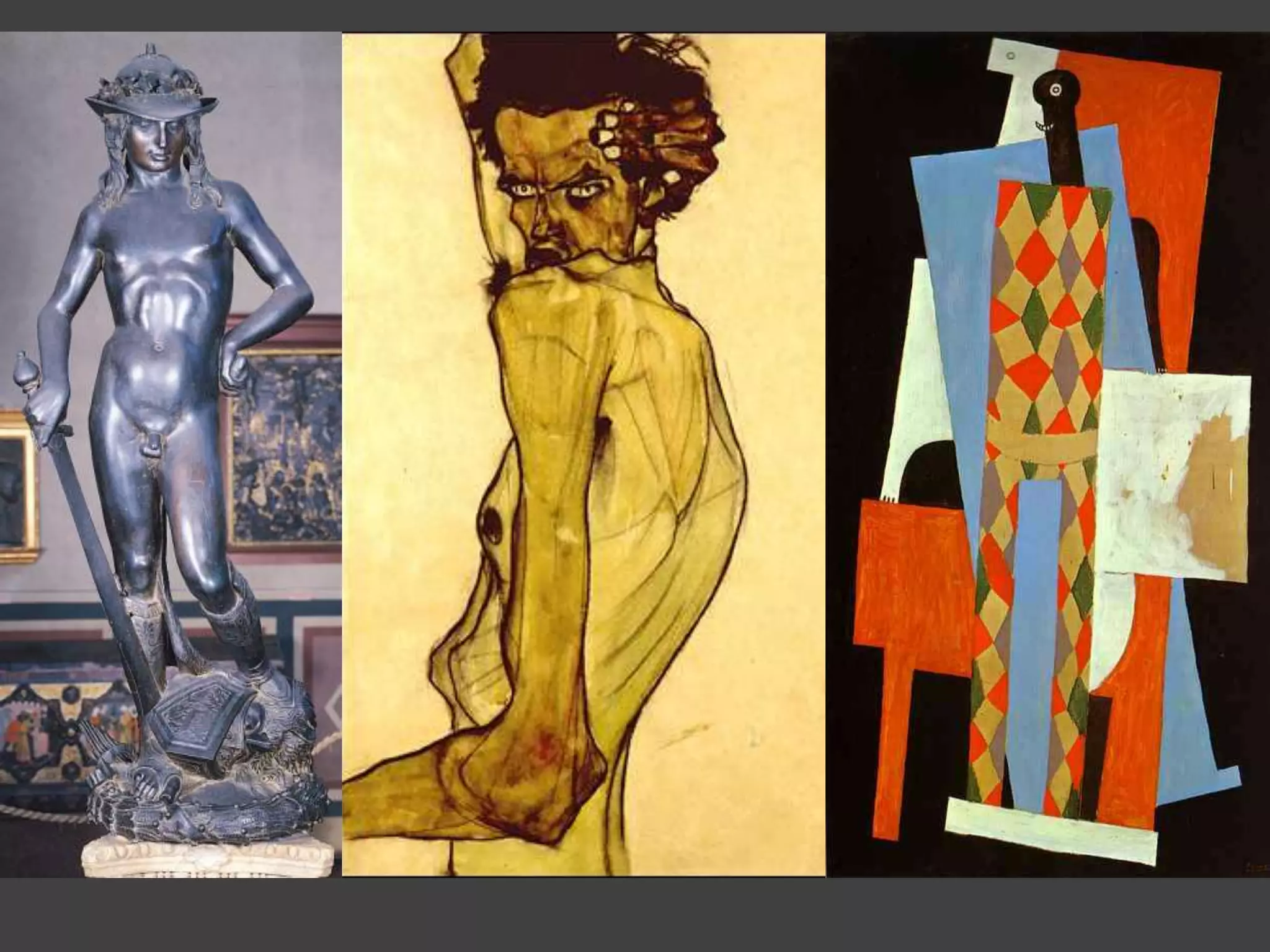
Introduction: What is Art History??
Art 109: Renaissance to Modern
Spring 2013
© Dr. Melissa Hall
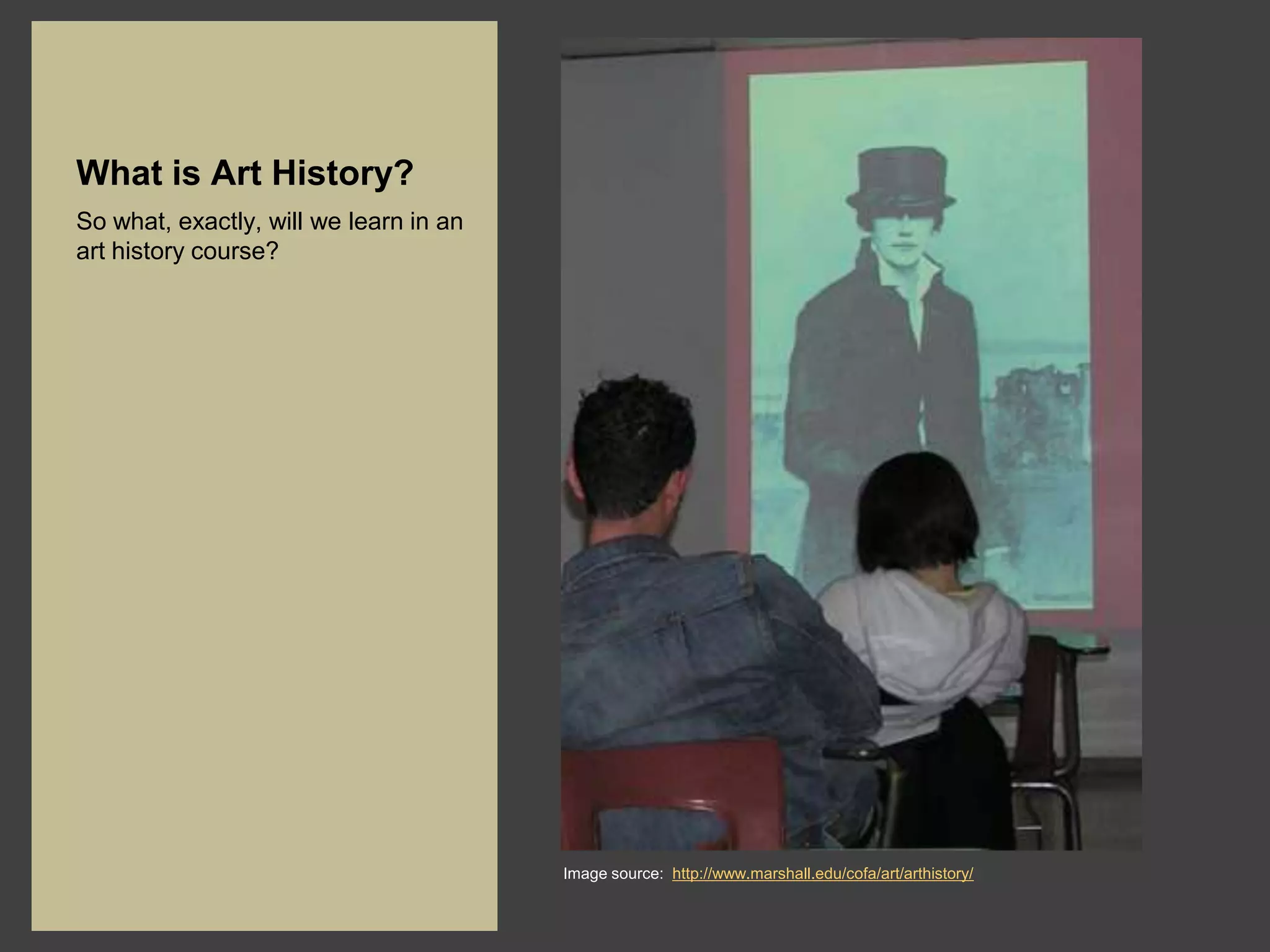
What is Art History?
So what, exactly, will we learn in an
art history course?


                                        Image source: http://www.marshall.edu/cofa/art/arthistory/
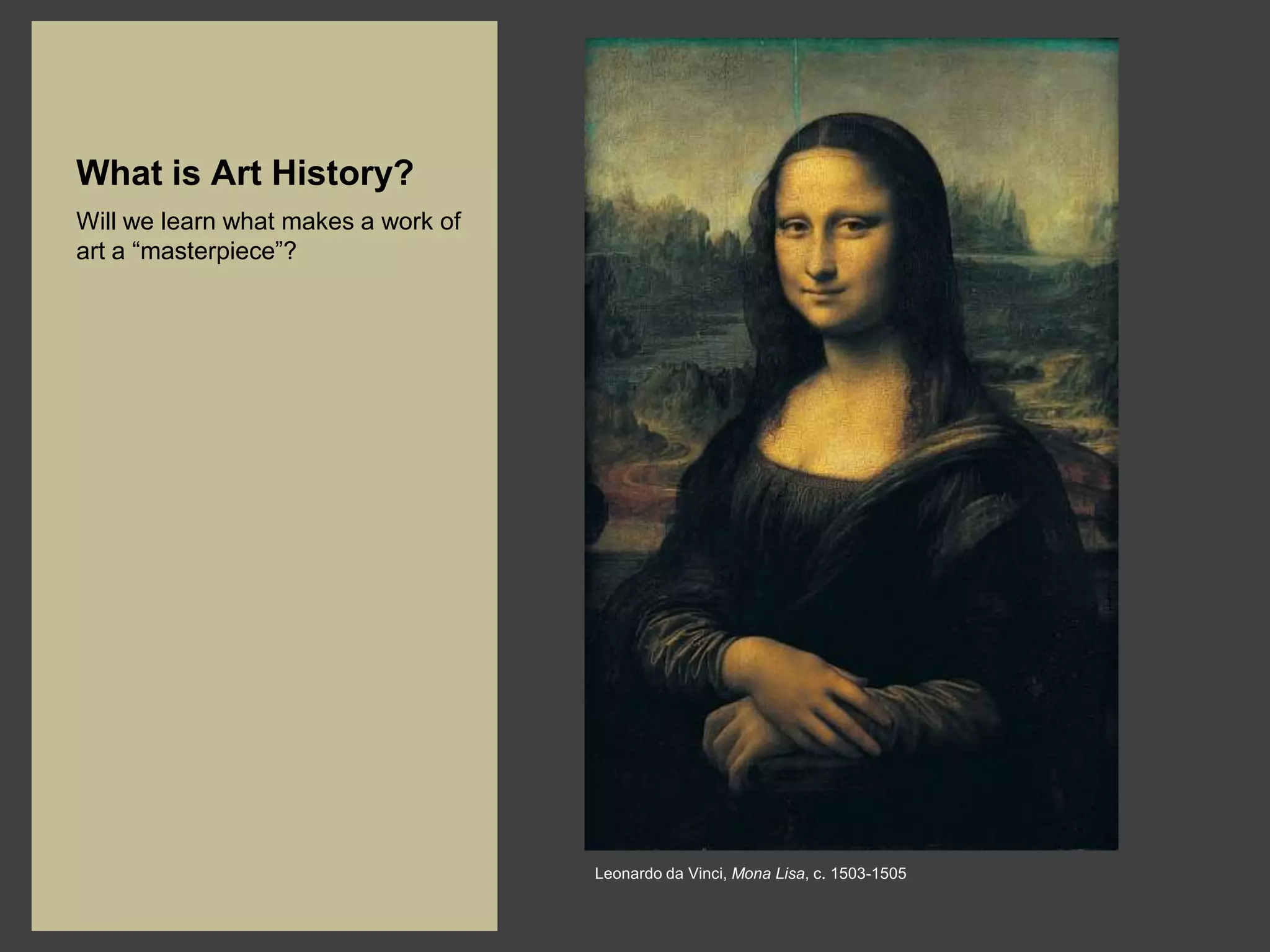
What is Art History?
Will we learn what makes a work of
art a “masterpiece”?


                                     Leonardo da Vinci, Mona Lisa, c. 1503-1505
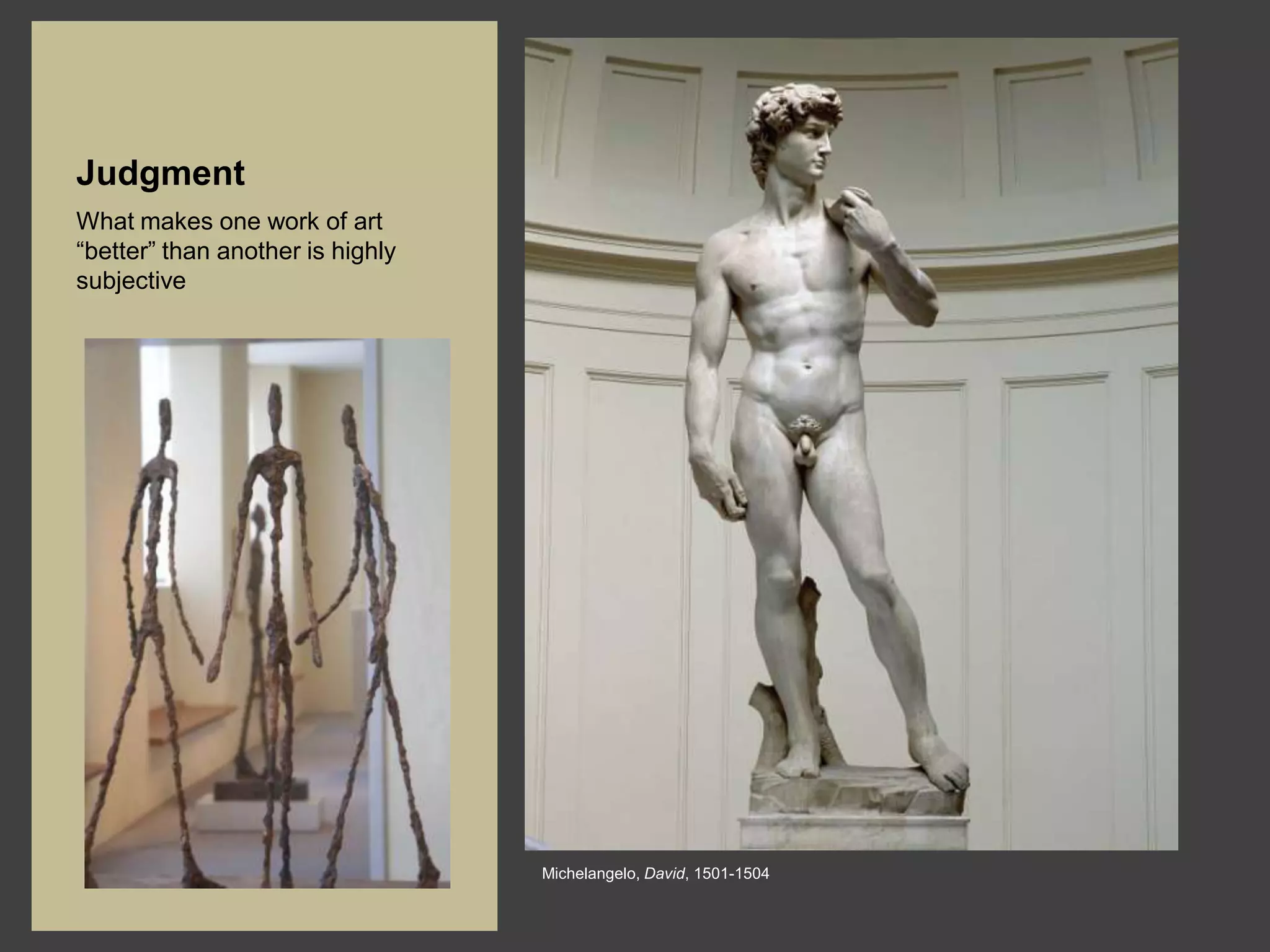
Judgment
What makes one work of art
“better” than another is highly
subjective


                                  Michelangelo, David, 1501-1504
Judgment
Who is to say if something is a
masterpiece or not?


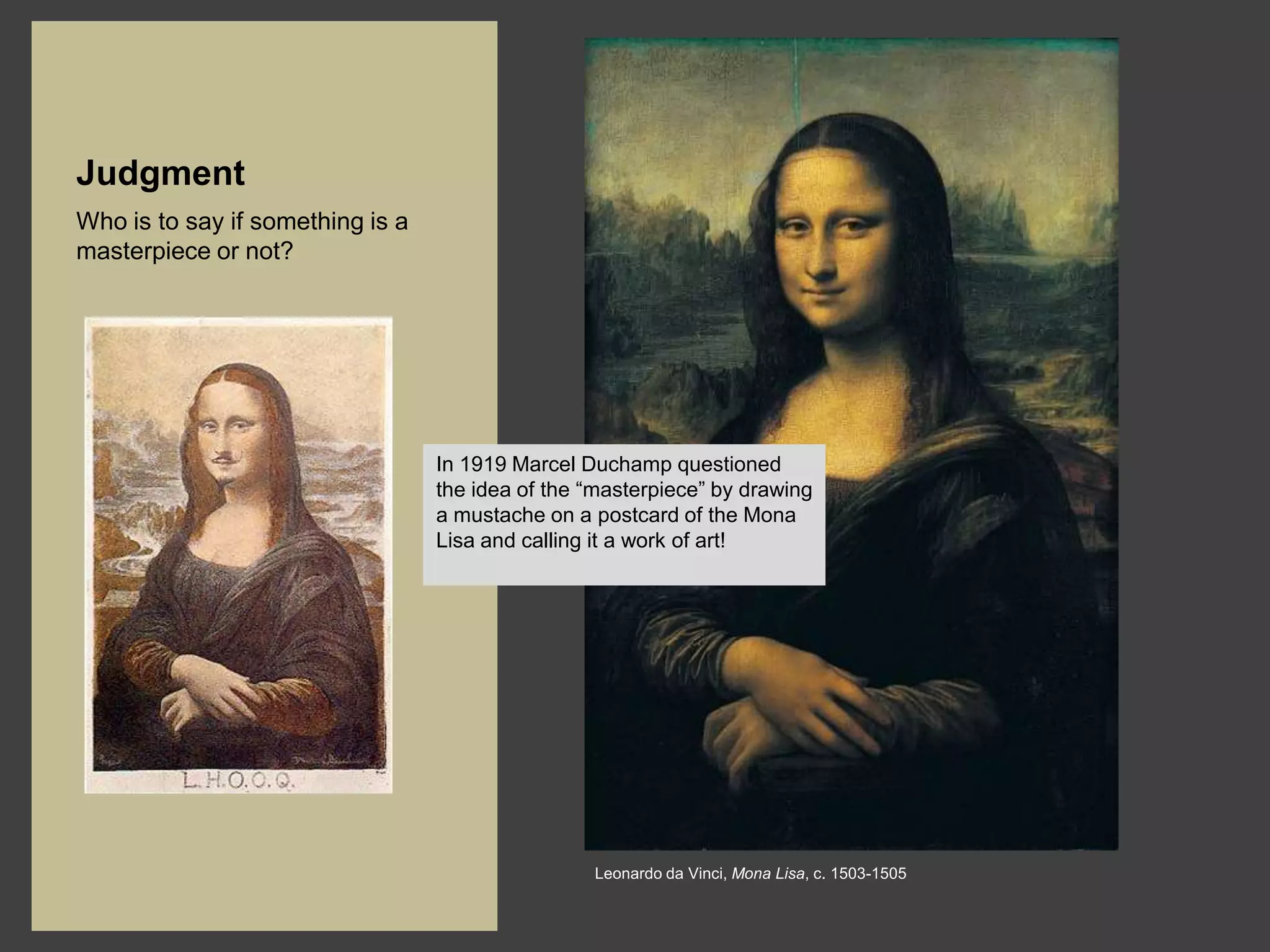
                                  In 1919 Marcel Duchamp questioned
                                  the idea of the “masterpiece” by drawing
                                  a mustache on a postcard of the Mona
                                  Lisa and calling it a work of art!


                                                  Leonardo da Vinci, Mona Lisa, c. 1503-1505
Judgment
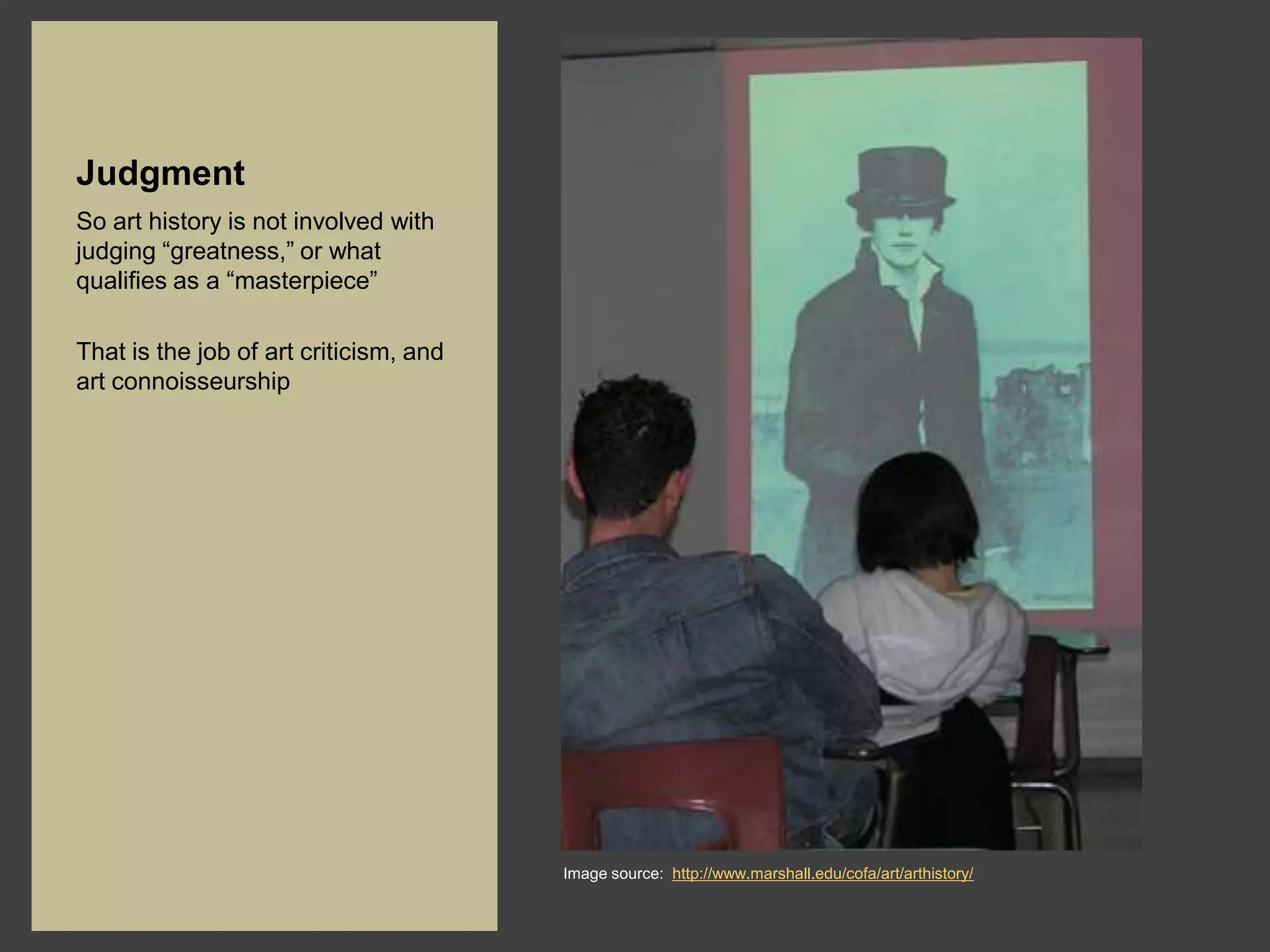
So art history is not involved with
judging “greatness,” or what
qualifies as a “masterpiece”

That is the job of art criticism, and
art connoisseurship


                                        Image source: http://www.marshall.edu/cofa/art/arthistory/
Judgment
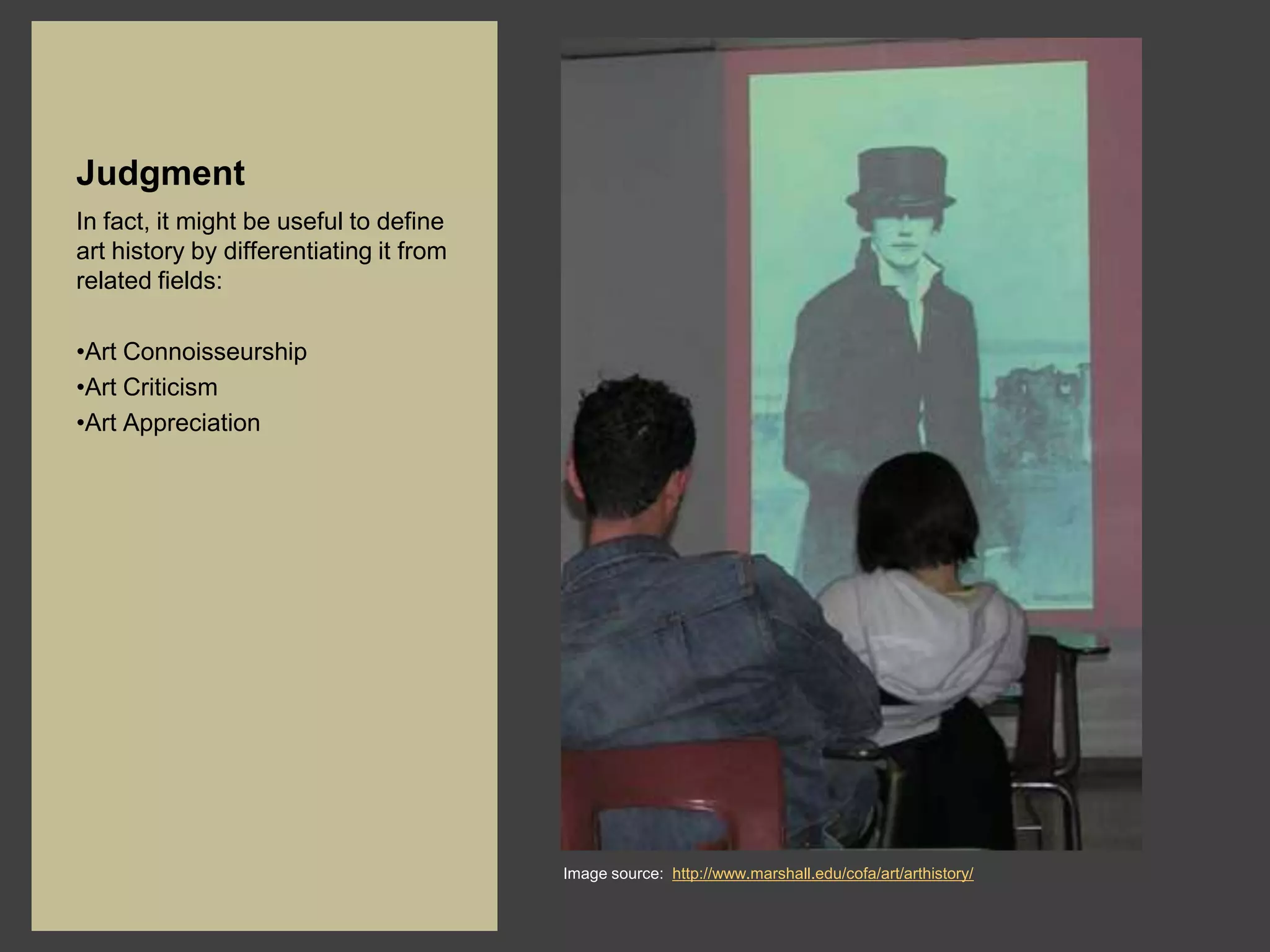
In fact, it might be useful to define
art history by differentiating it from
related fields:

•Art Connoisseurship
•Art Criticism
•Art Appreciation


                                         Image source: http://www.marshall.edu/cofa/art/arthistory/
Connoisseurship
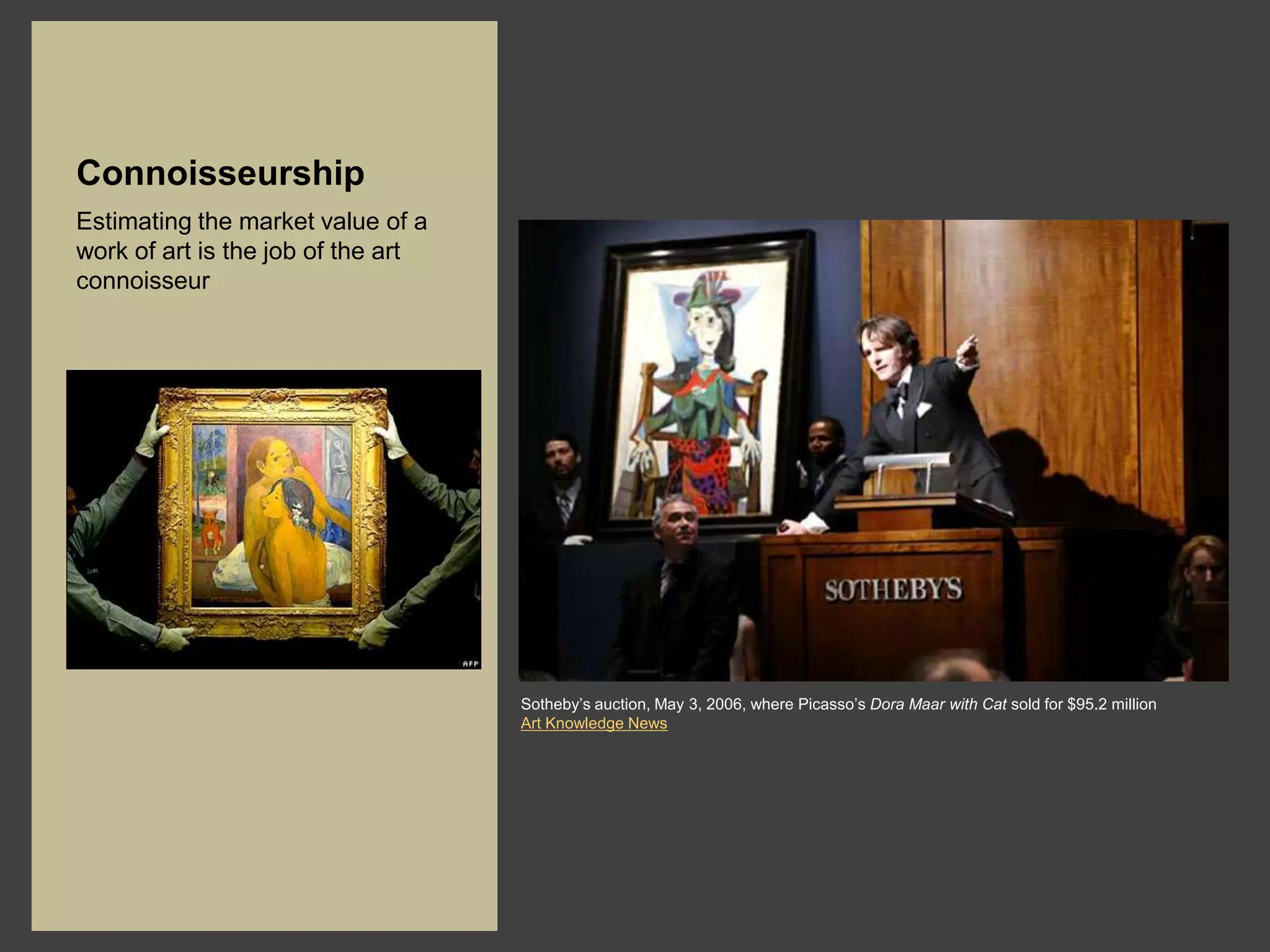
Estimating the market value of a
work of art is the job of the art
connoisseur


                                    Sotheby’s auction, May 3, 2006, where Picasso’s Dora Maar with Cat sold for $95.2 million
                                    Art Knowledge News
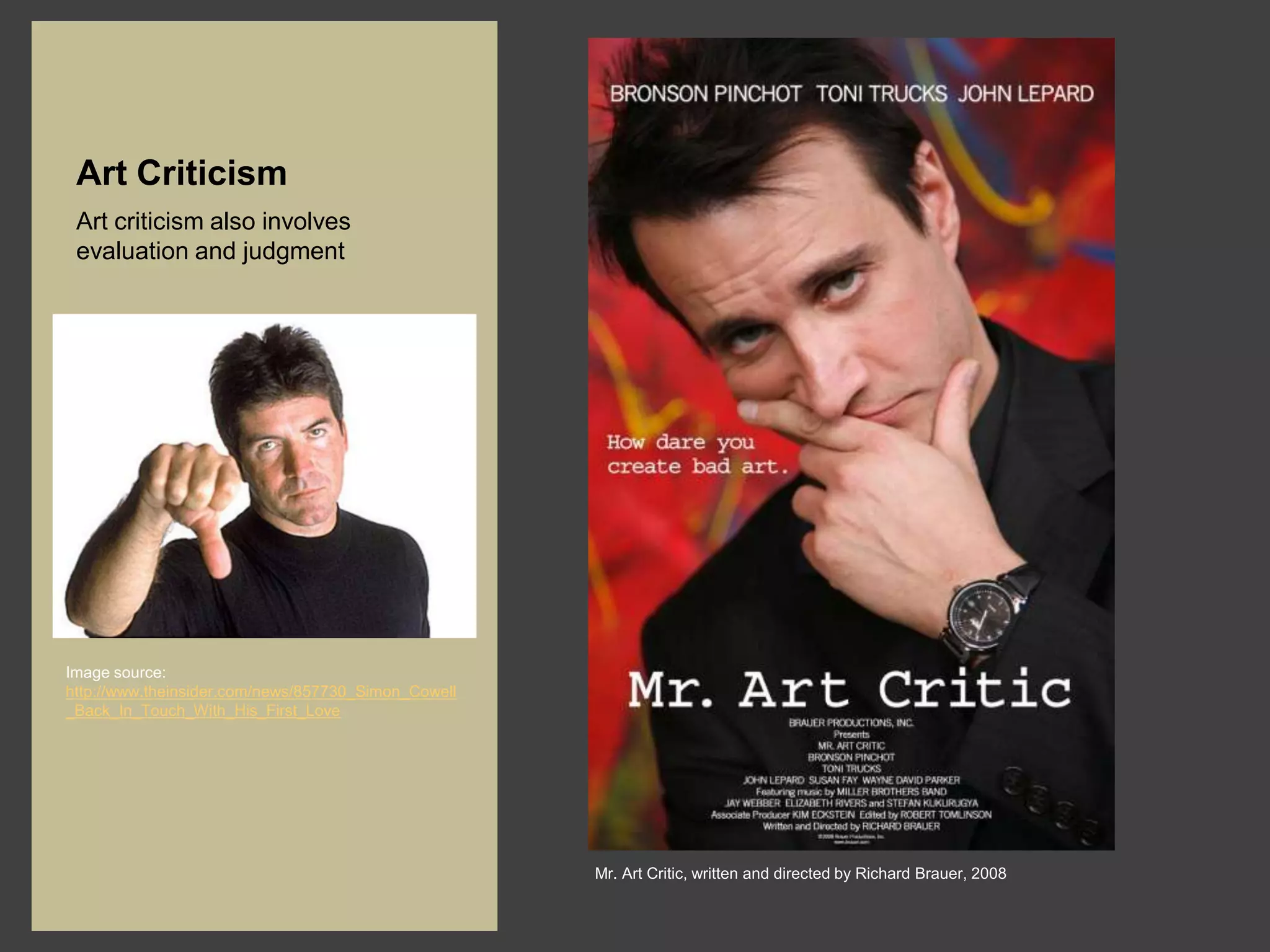
Art Criticism
 Art criticism also involves
 evaluation and judgment


Image source:
http://www.theinsider.com/news/857730_Simon_Cowell
_Back_In_Touch_With_His_First_Love


                                                     Mr. Art Critic, written and directed by Richard Brauer, 2008
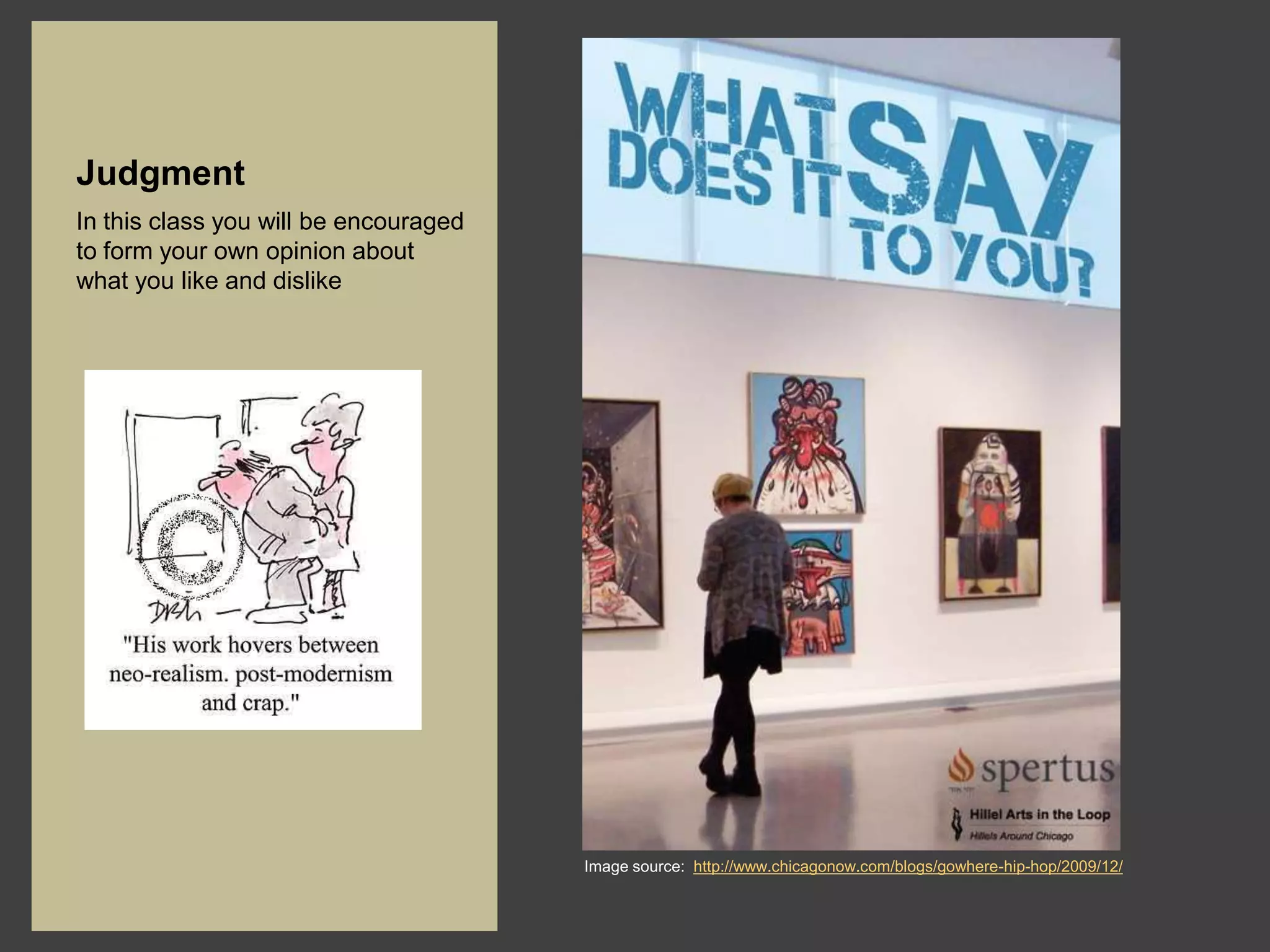
Judgment
In this class you will be encouraged
to form your own opinion about
what you like and dislike


                                       Image source: http://www.chicagonow.com/blogs/gowhere-hip-hop/2009/12/
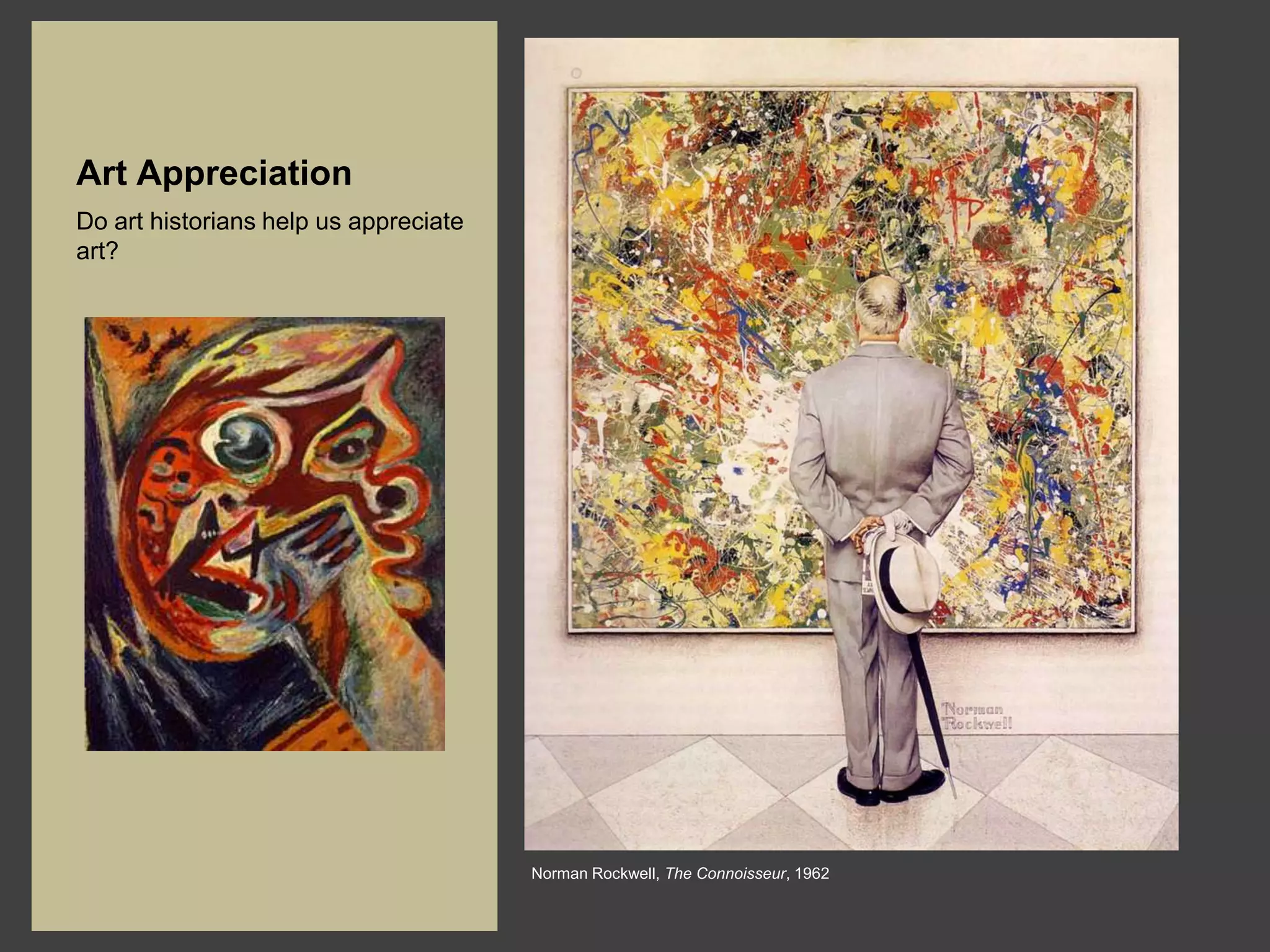
Art Appreciation
Do art historians help us appreciate
art?


                                       Norman Rockwell, The Connoisseur, 1962
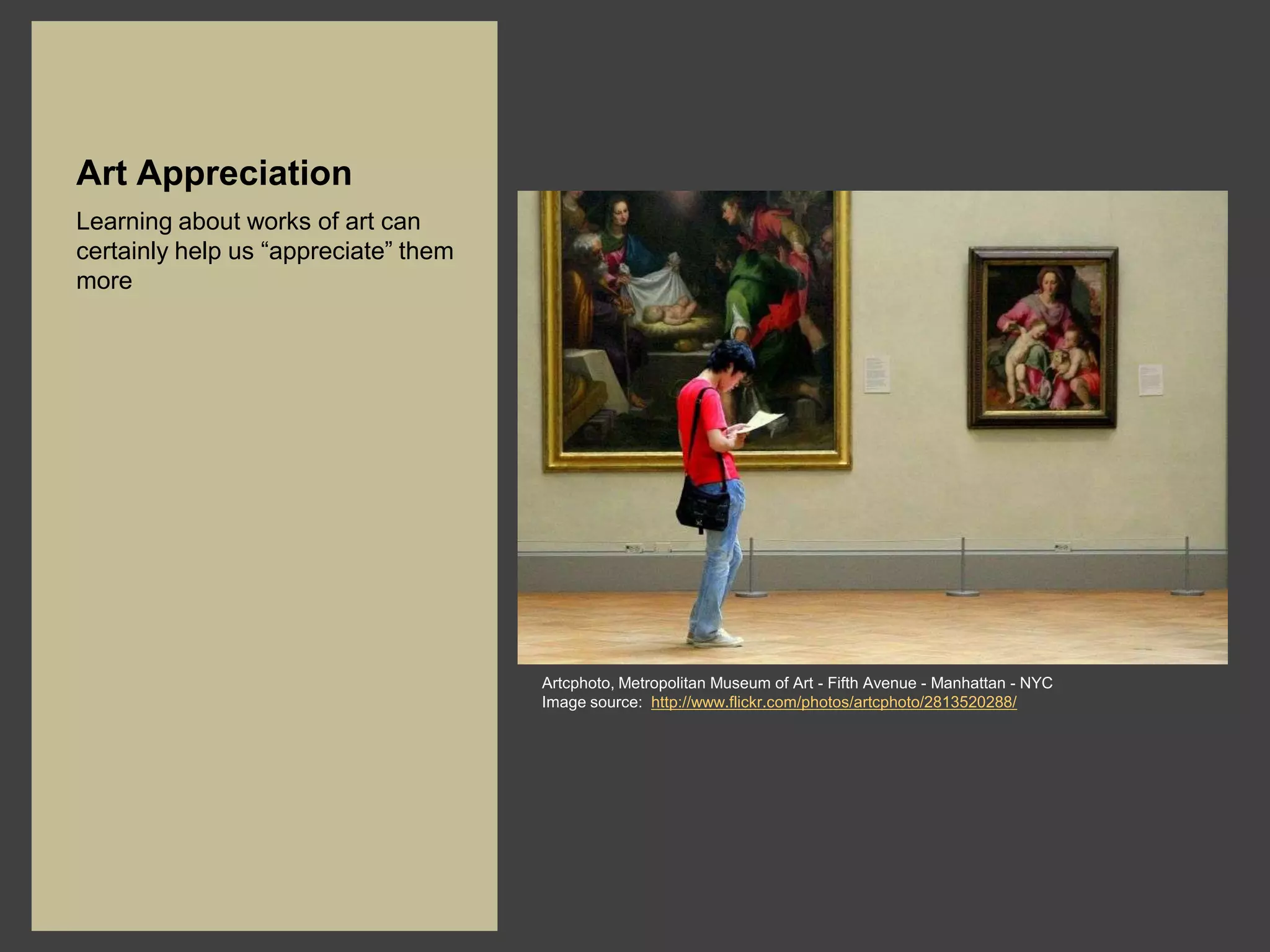
Art Appreciation
Learning about works of art can
certainly help us “appreciate” them
more


                                      Artcphoto, Metropolitan Museum of Art - Fifth Avenue - Manhattan - NYC
                                      Image source: http://www.flickr.com/photos/artcphoto/2813520288/
Art Appreciation
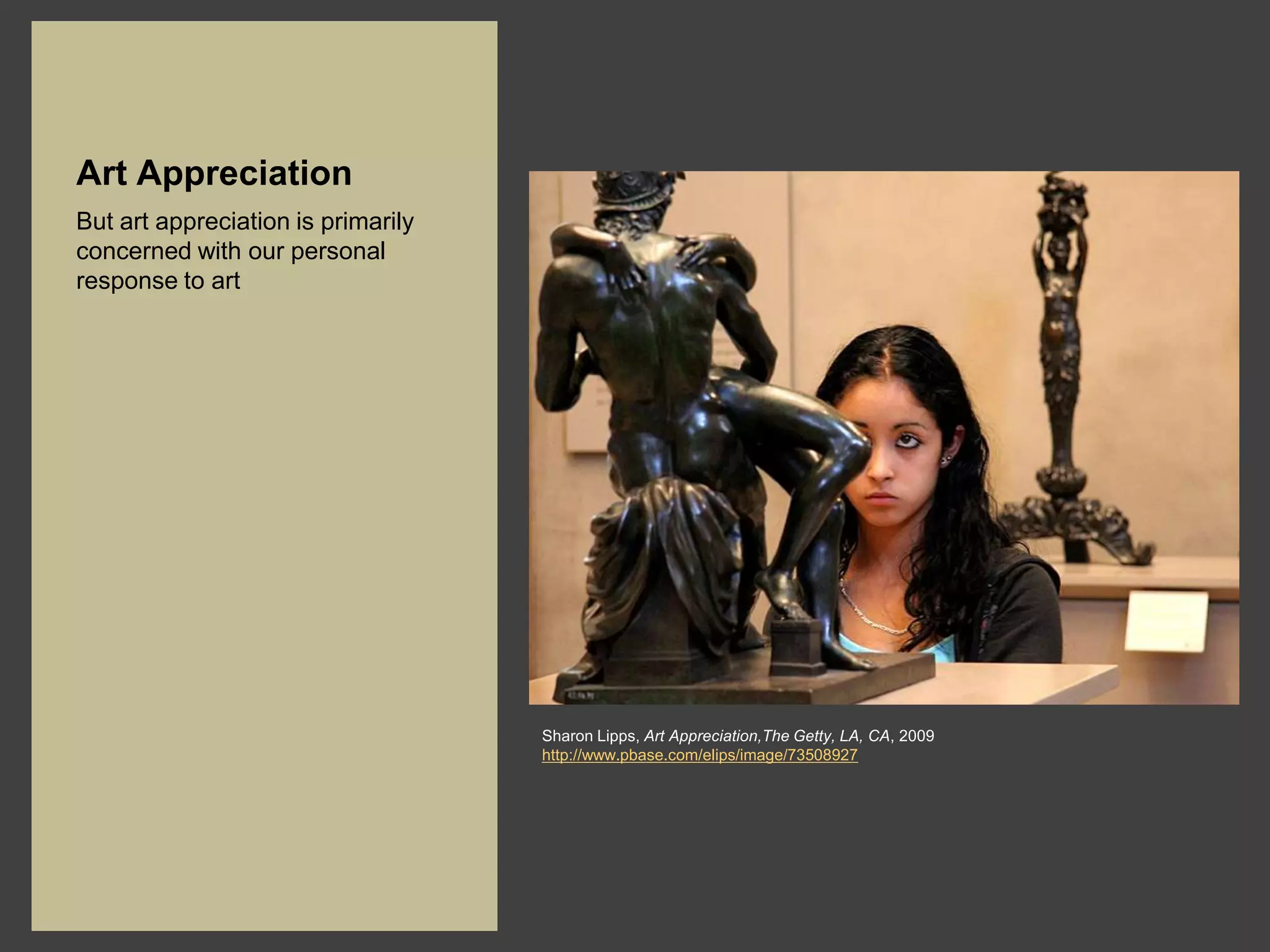
But art appreciation is primarily
concerned with our personal
response to art


                                    Sharon Lipps, Art Appreciation,The Getty, LA, CA, 2009
                                    http://www.pbase.com/elips/image/73508927
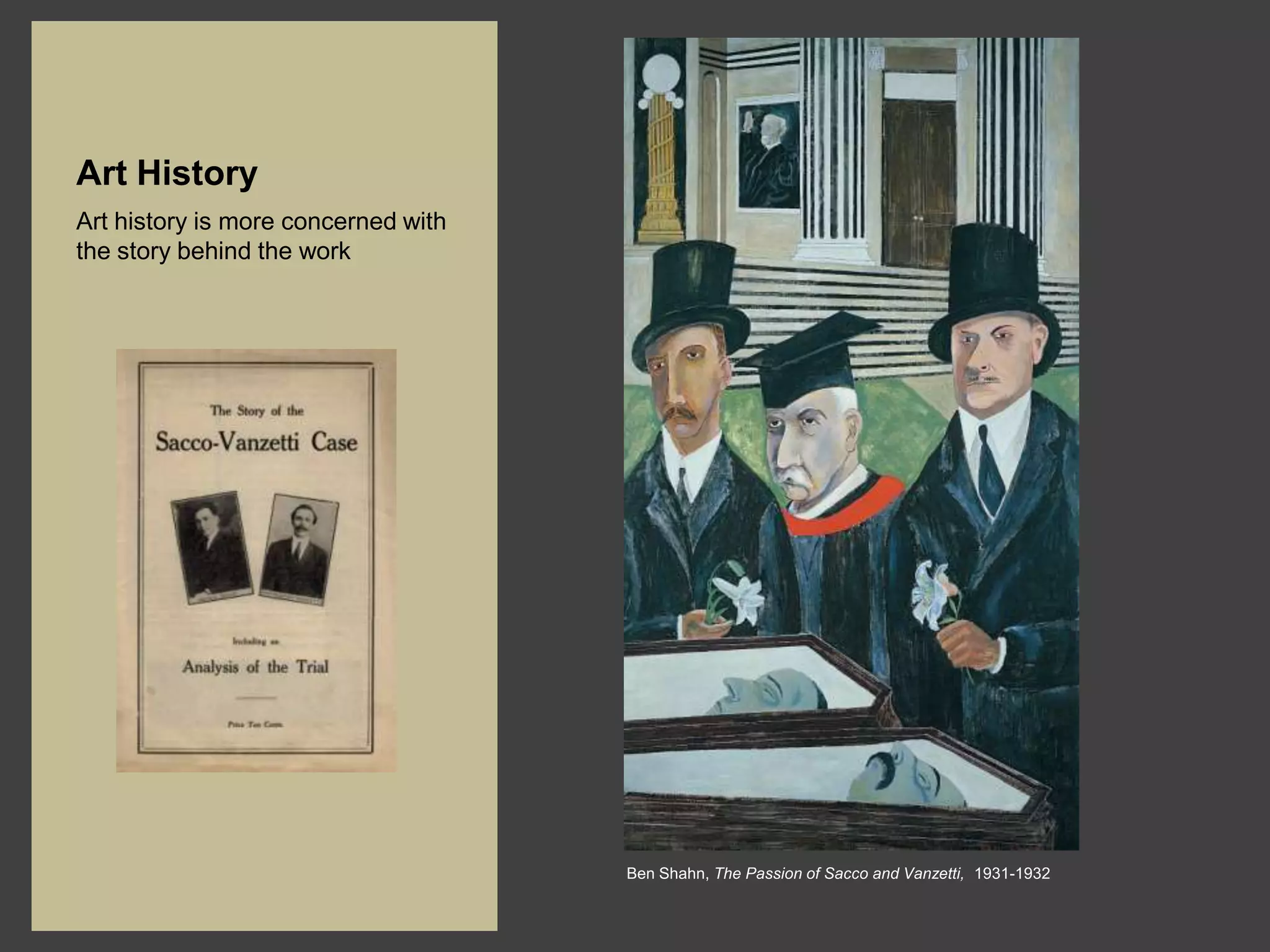
Art History
Art history is more concerned with
the story behind the work


                                     Ben Shahn, The Passion of Sacco and Vanzetti, 1931-1932
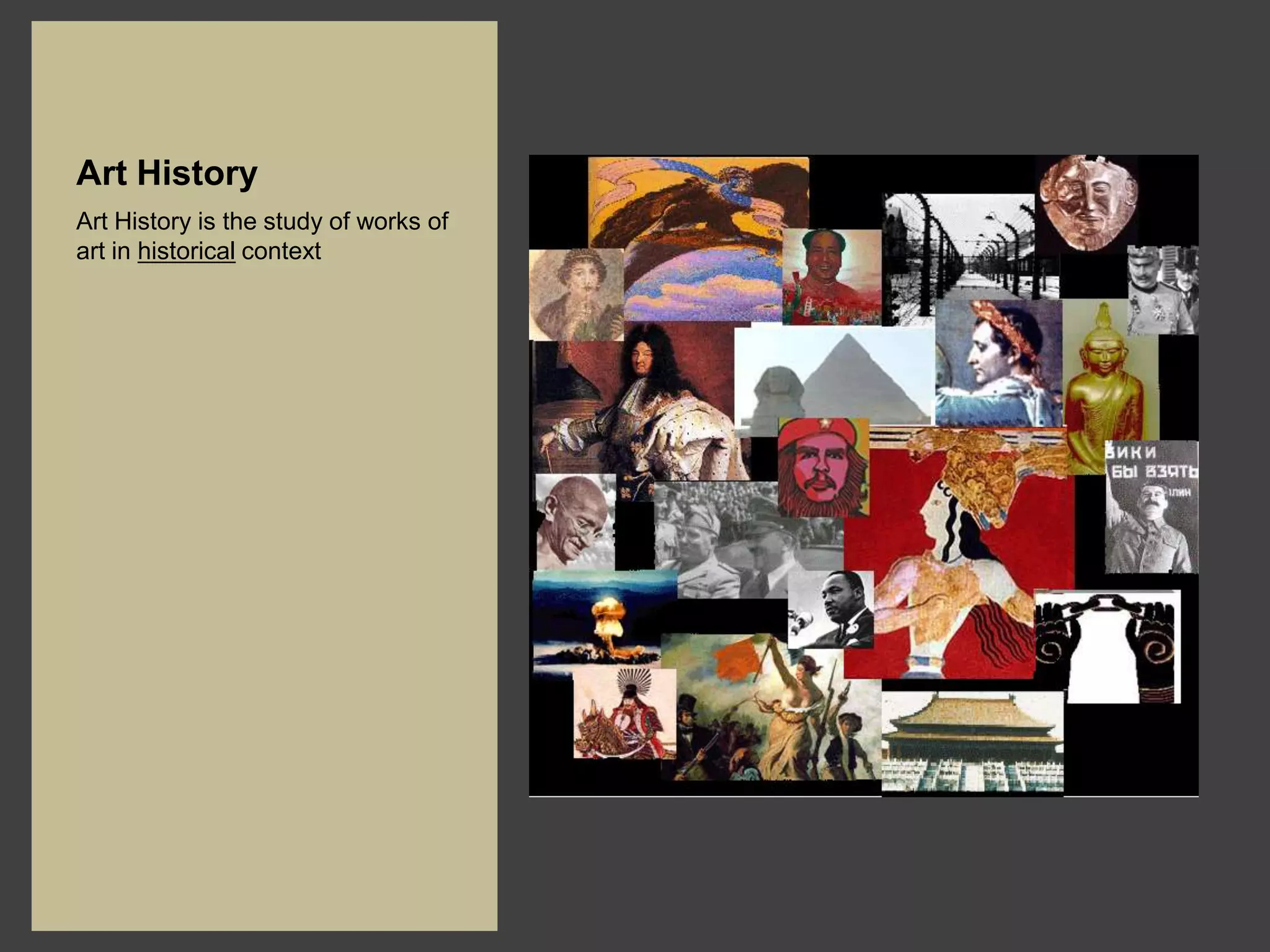
Art History
Art History is the study of works of
art in historical context
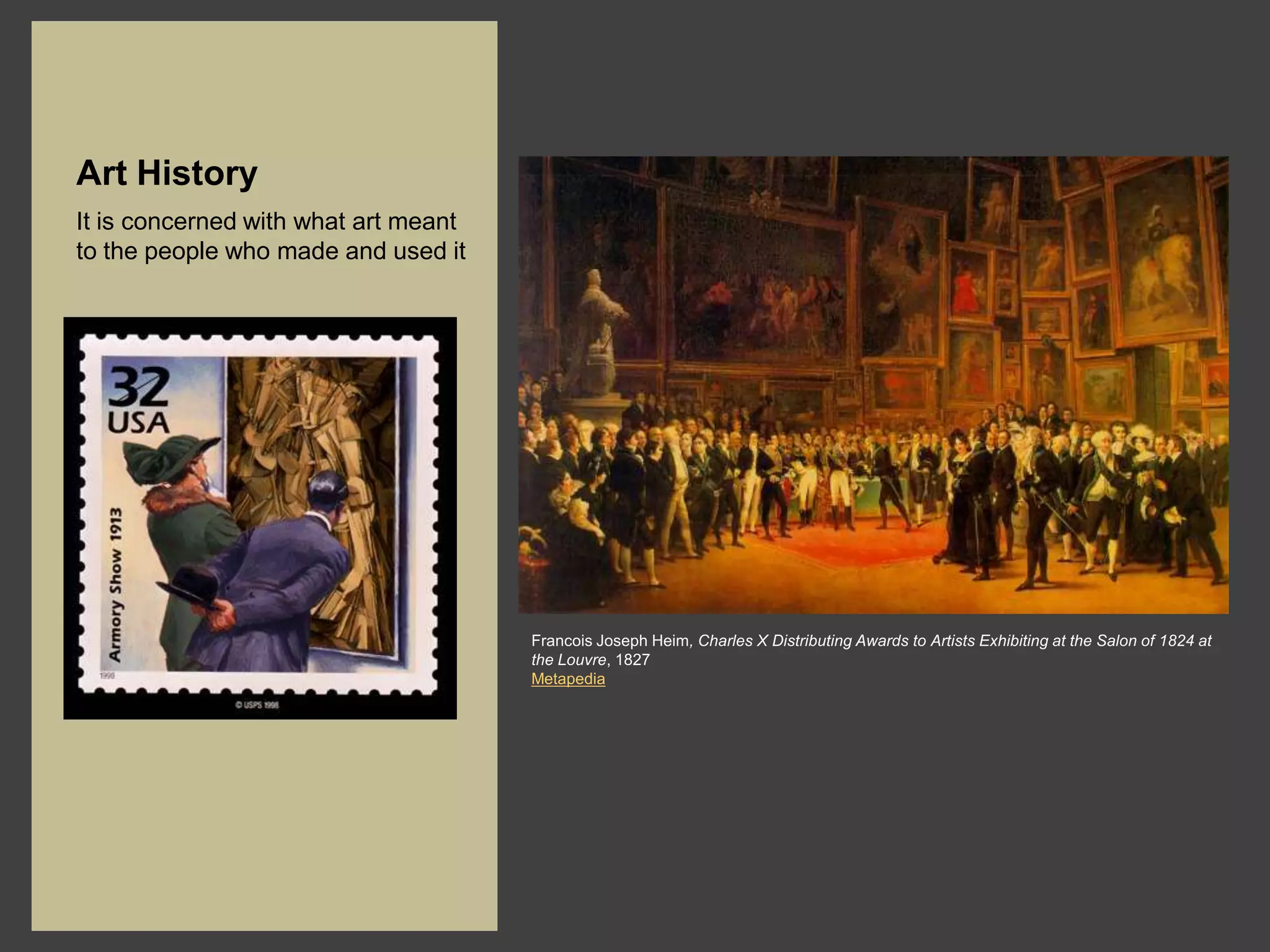
Art History
It is concerned with what art meant
to the people who made and used it


                                      Francois Joseph Heim, Charles X Distributing Awards to Artists Exhibiting at the Salon of 1824 at
                                      the Louvre, 1827
                                      Metapedia
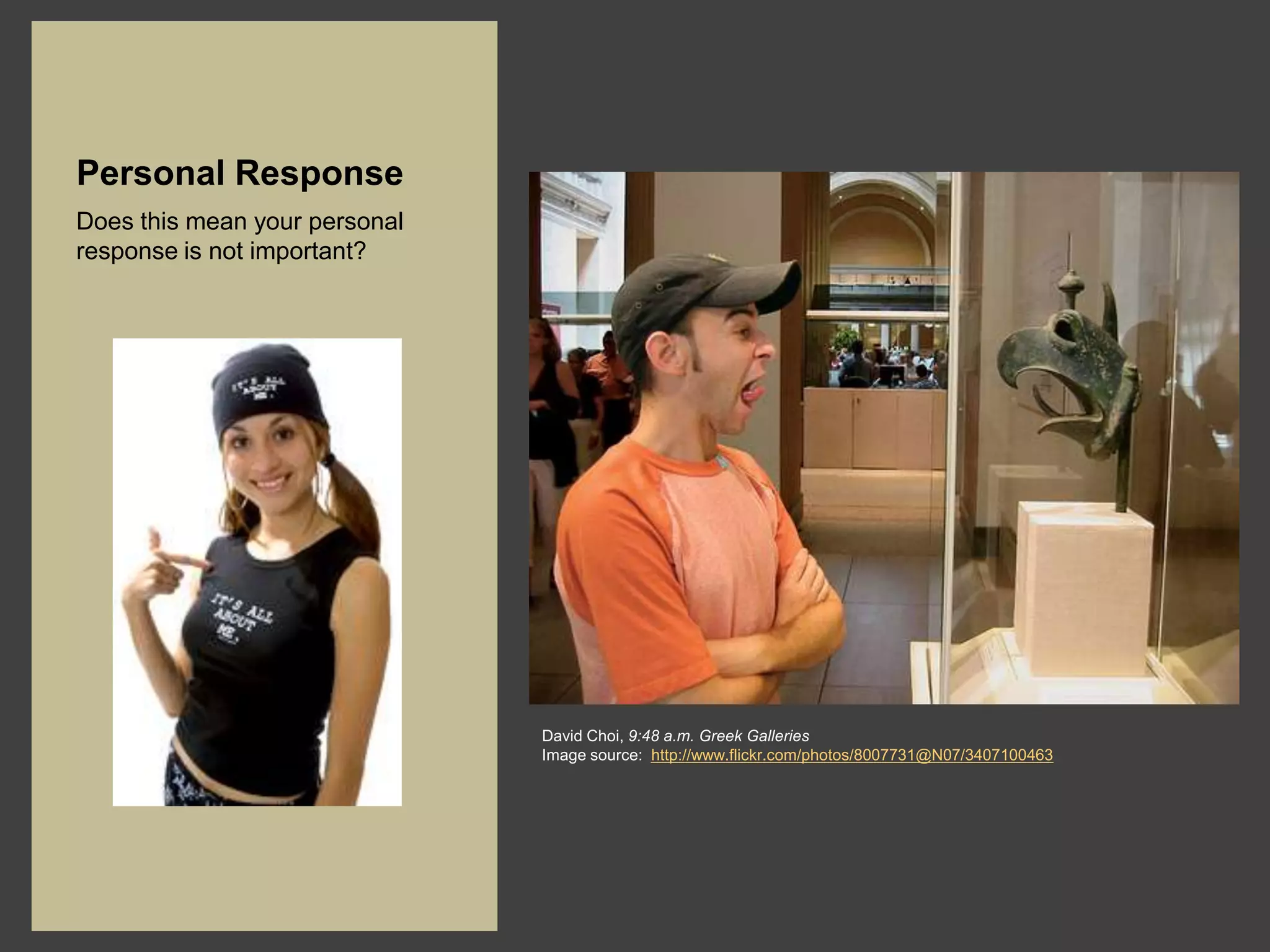
Personal Response
Does this mean your personal
response is not important?


                               David Choi, 9:48 a.m. Greek Galleries
                               Image source: http://www.flickr.com/photos/8007731@N07/3407100463
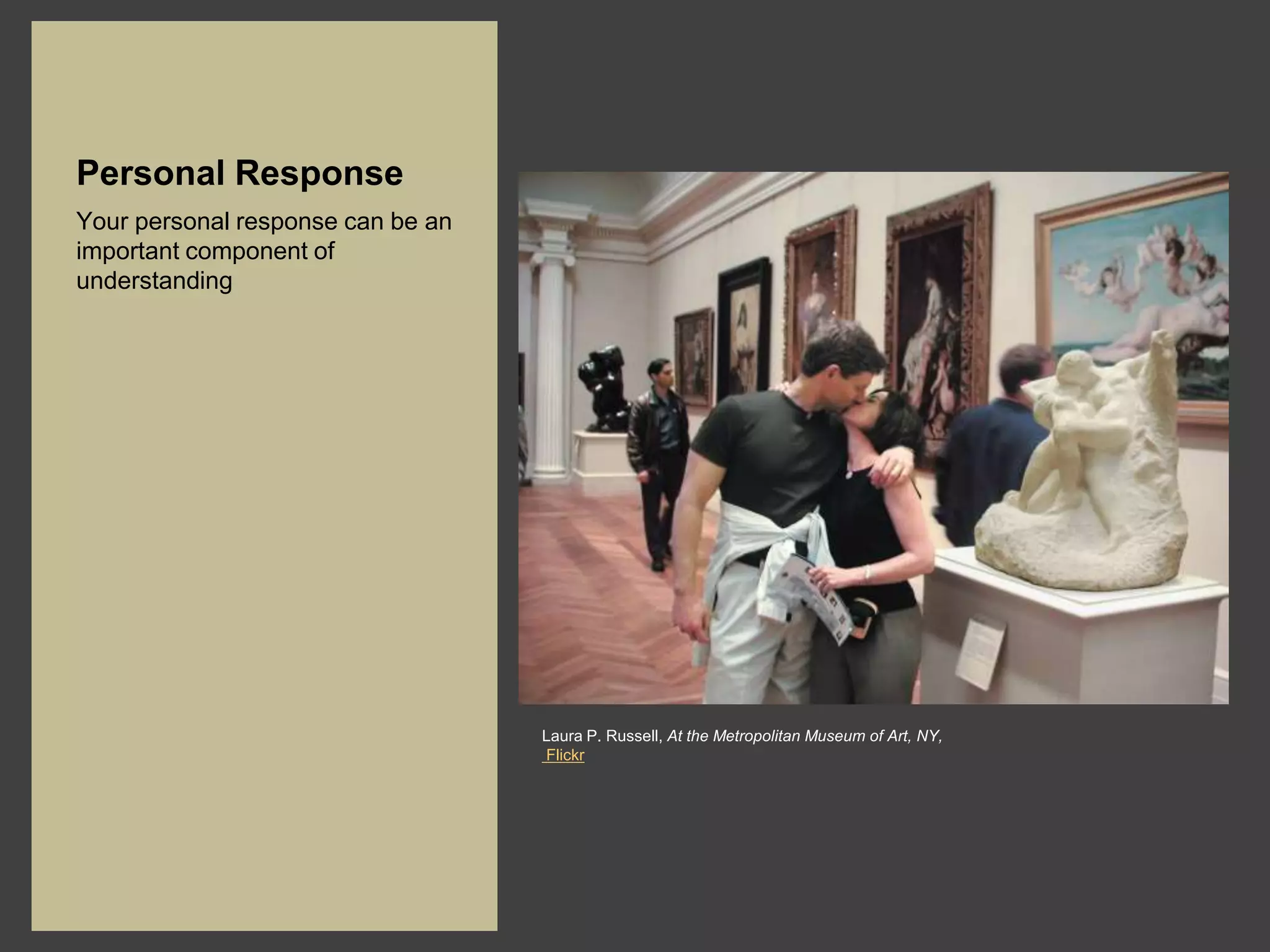
Personal Response
Your personal response can be an
important component of
understanding


                                   Laura P. Russell, At the Metropolitan Museum of Art, NY,
                                   Flickr
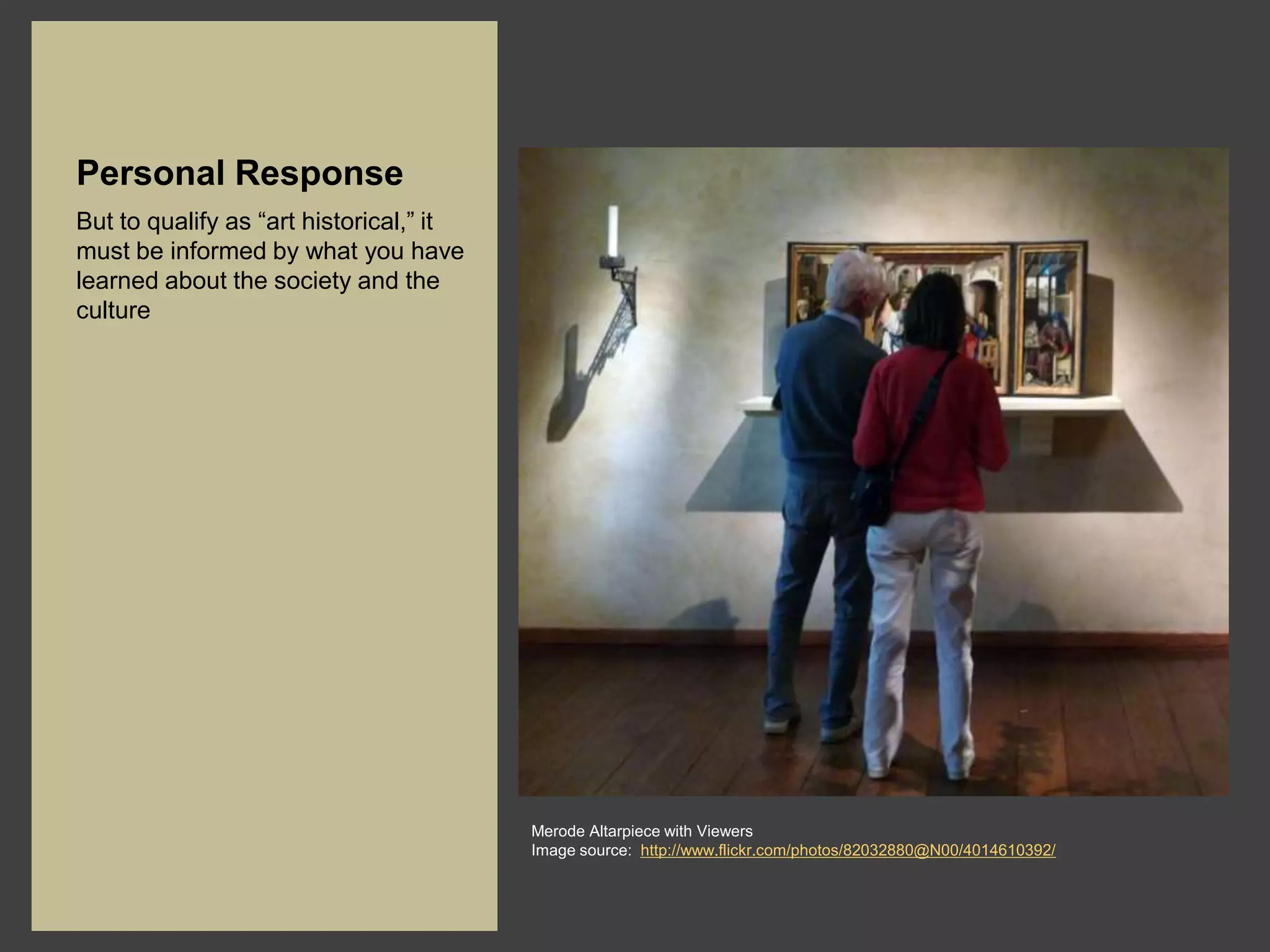
Personal Response
But to qualify as “art historical,” it
must be informed by what you have
learned about the society and the
culture


                                         Merode Altarpiece with Viewers
                                         Image source: http://www.flickr.com/photos/82032880@N00/4014610392/
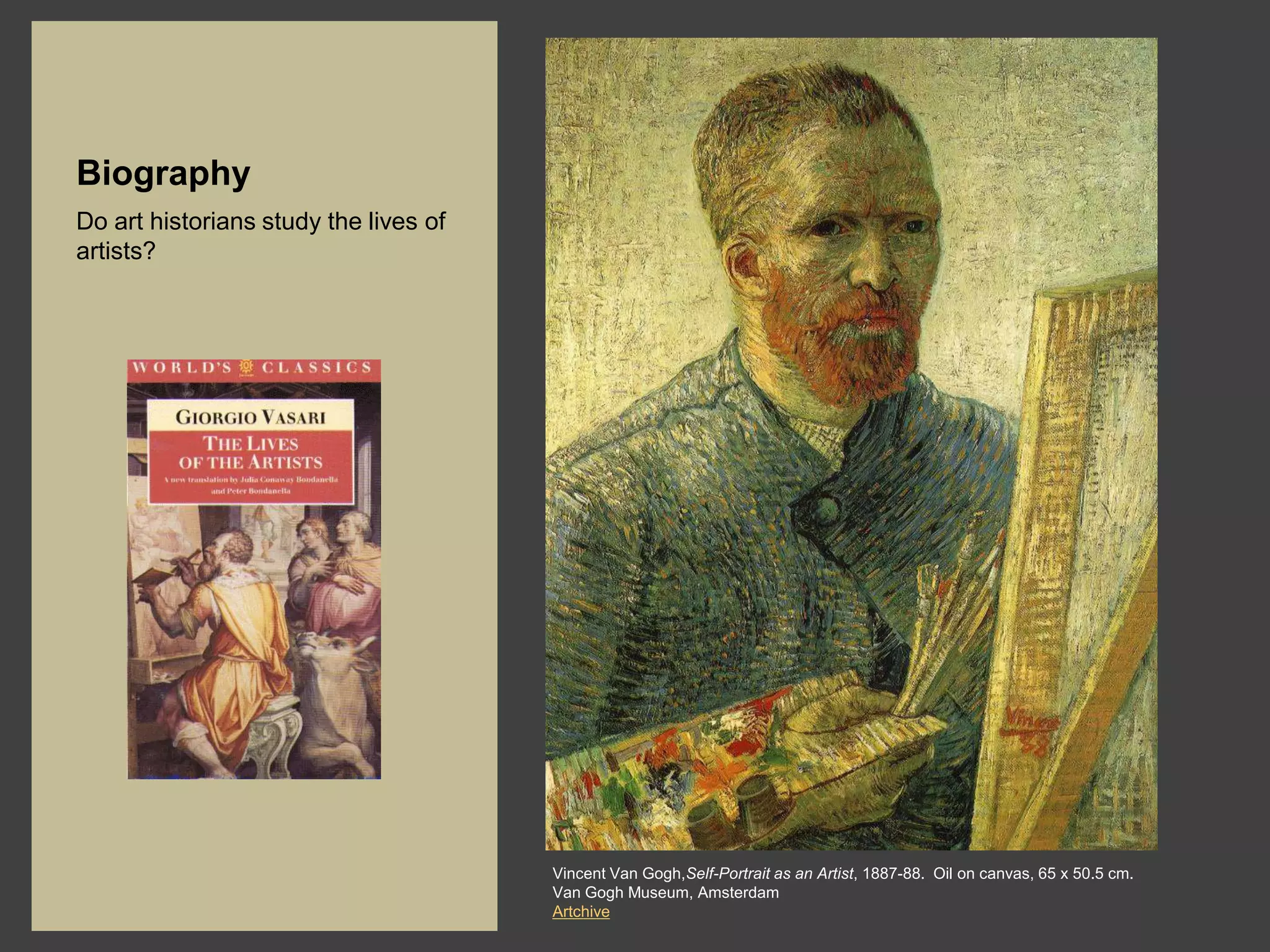
Biography
Do art historians study the lives of
artists?


                                       Vincent Van Gogh,Self-Portrait as an Artist, 1887-88. Oil on canvas, 65 x 50.5 cm.
                                       Van Gogh Museum, Amsterdam
                                       Artchive
Biography
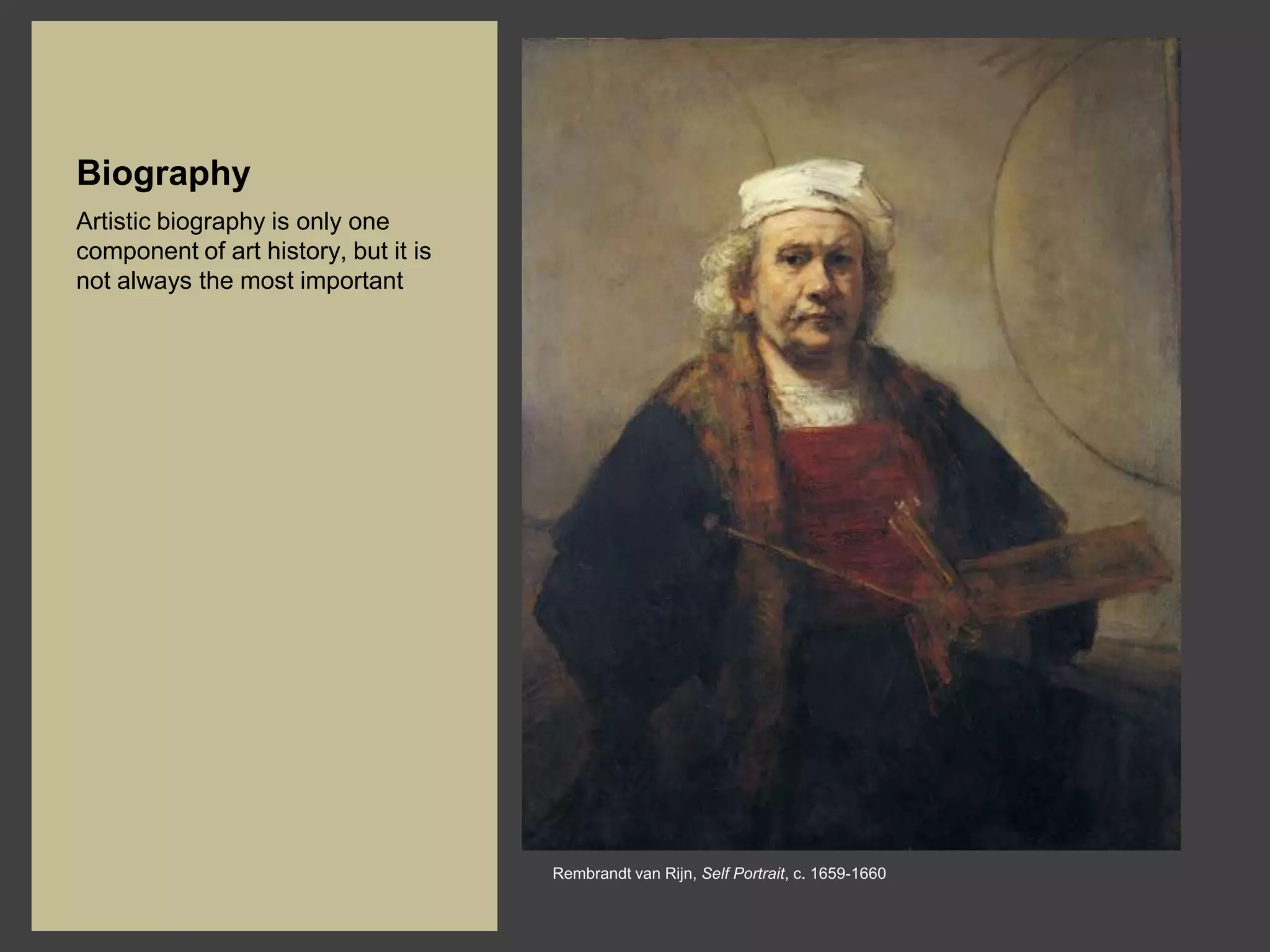
Artistic biography is only one
component of art history, but it is
not always the most important


                                      Rembrandt van Rijn, Self Portrait, c. 1659-1660
Role of the Artist
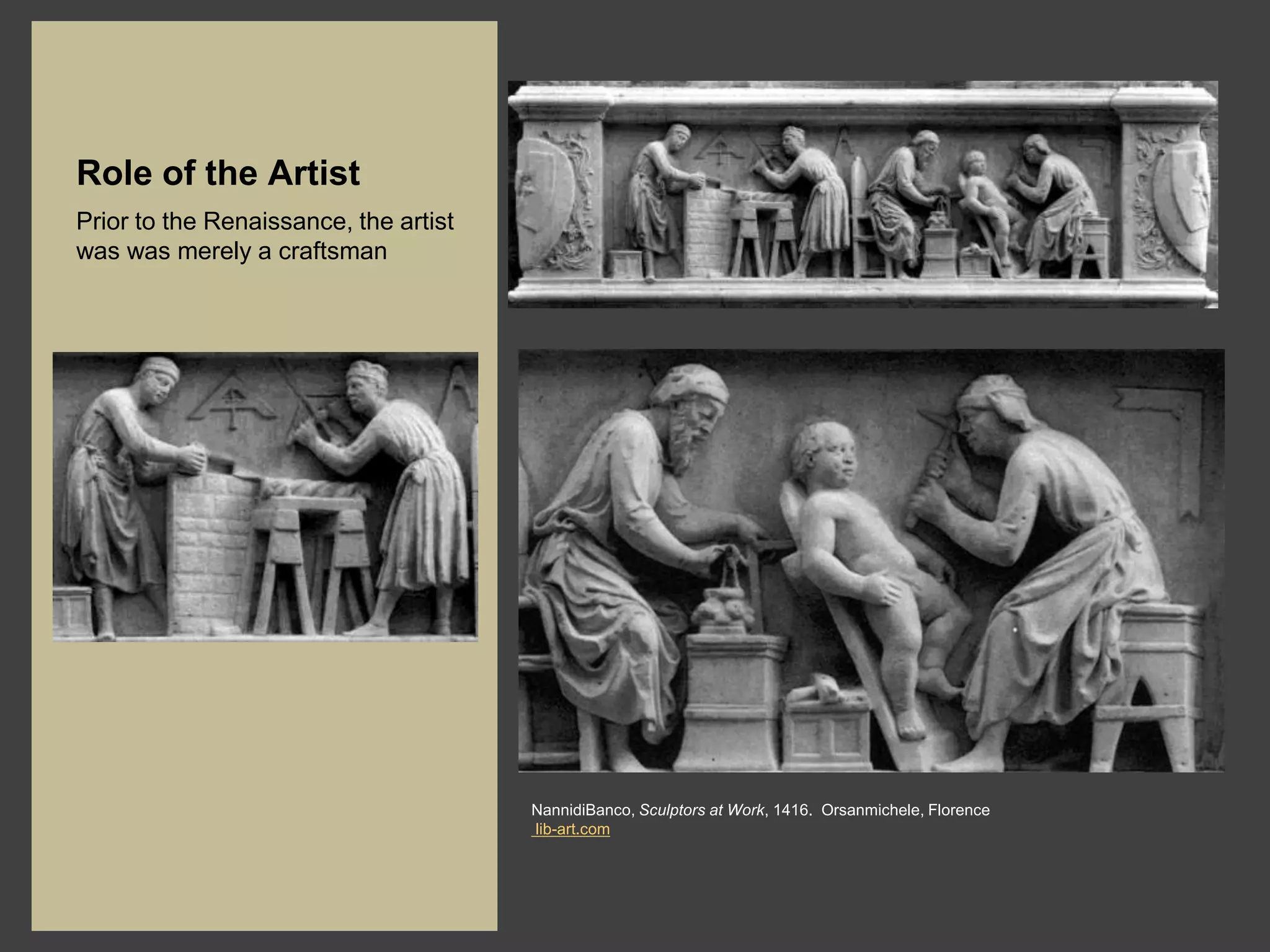
Prior to the Renaissance, the artist
was was merely a craftsman


                                       NannidiBanco, Sculptors at Work, 1416. Orsanmichele, Florence
                                       lib-art.com
Role of the Artist
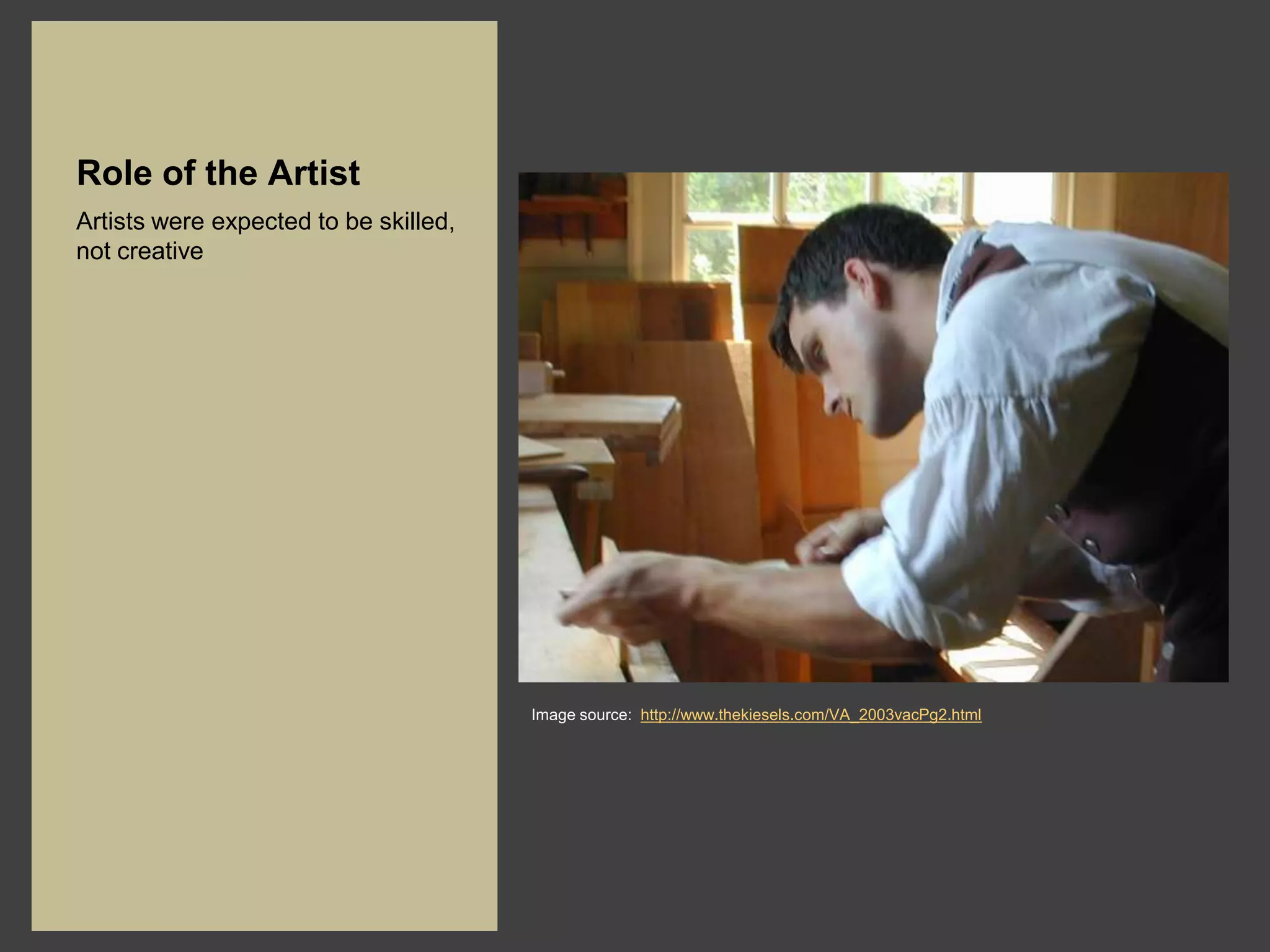
Artists were expected to be skilled,
not creative


                                       Image source: http://www.thekiesels.com/VA_2003vacPg2.html
Role of the Artist
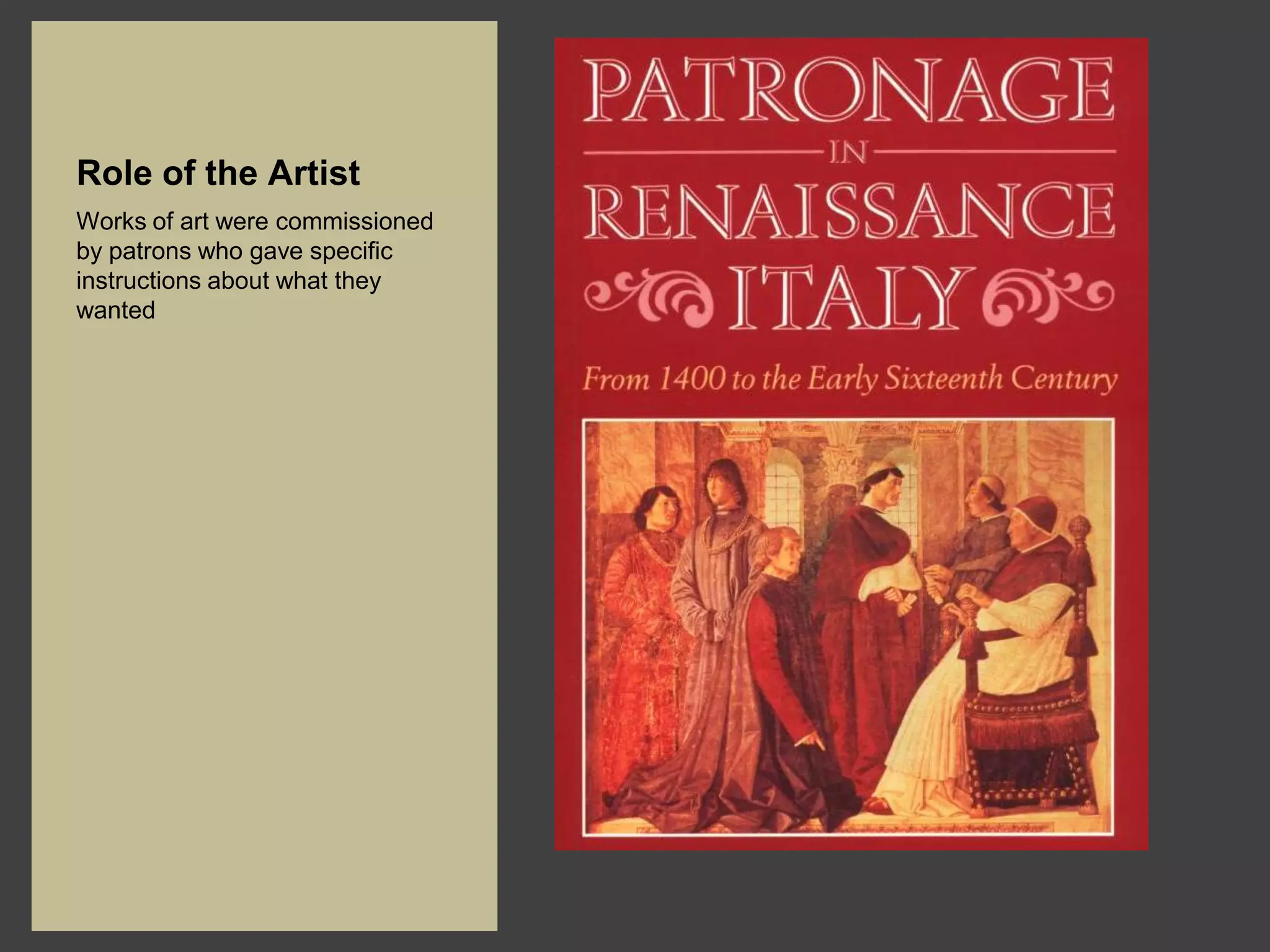
Works of art were commissioned
by patrons who gave specific
instructions about what they
wanted
Role of the Artist
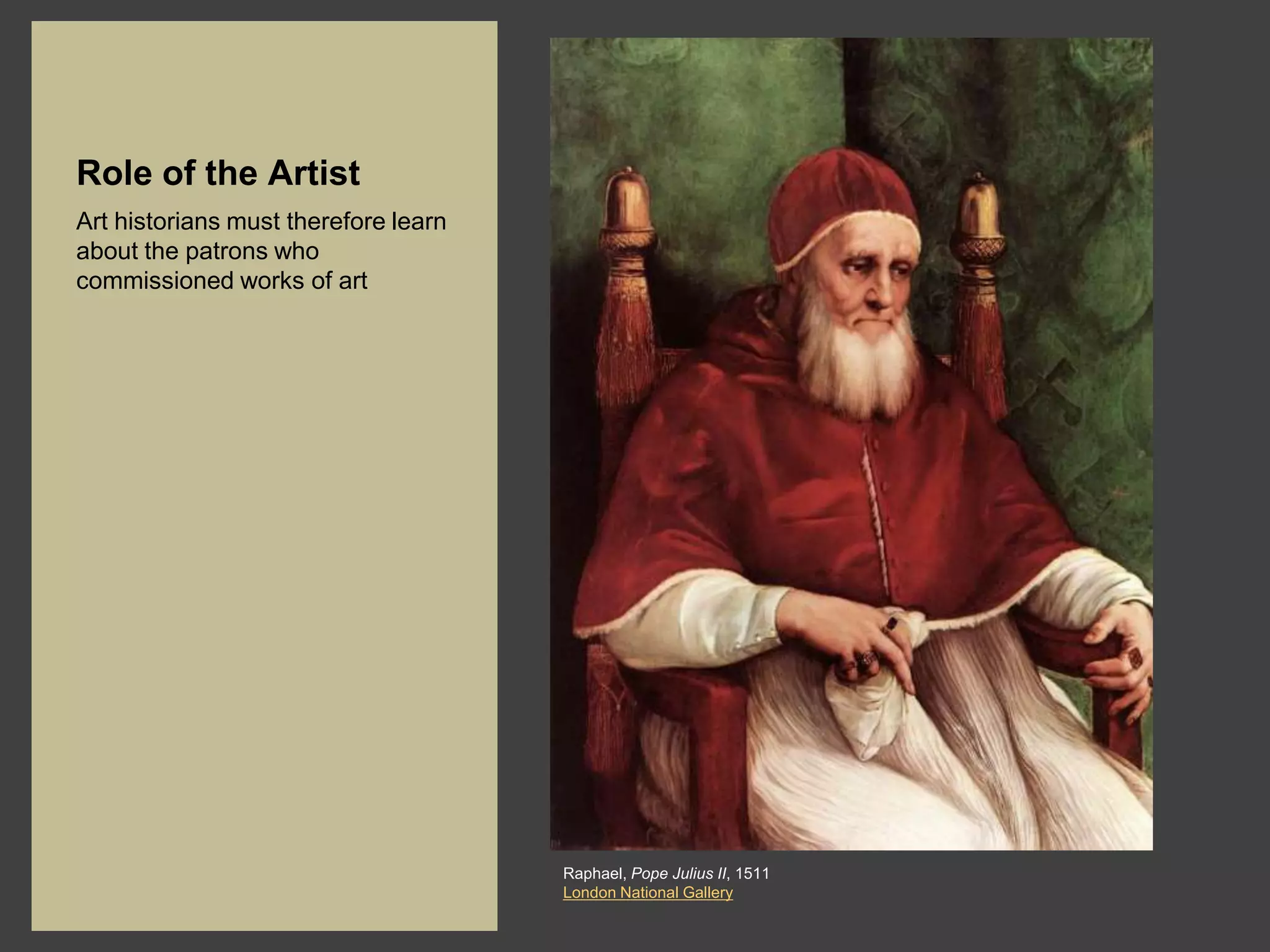
Art historians must therefore learn
about the patrons who
commissioned works of art


                                      Raphael, Pope Julius II, 1511
                                      London National Gallery
Role of the Artist
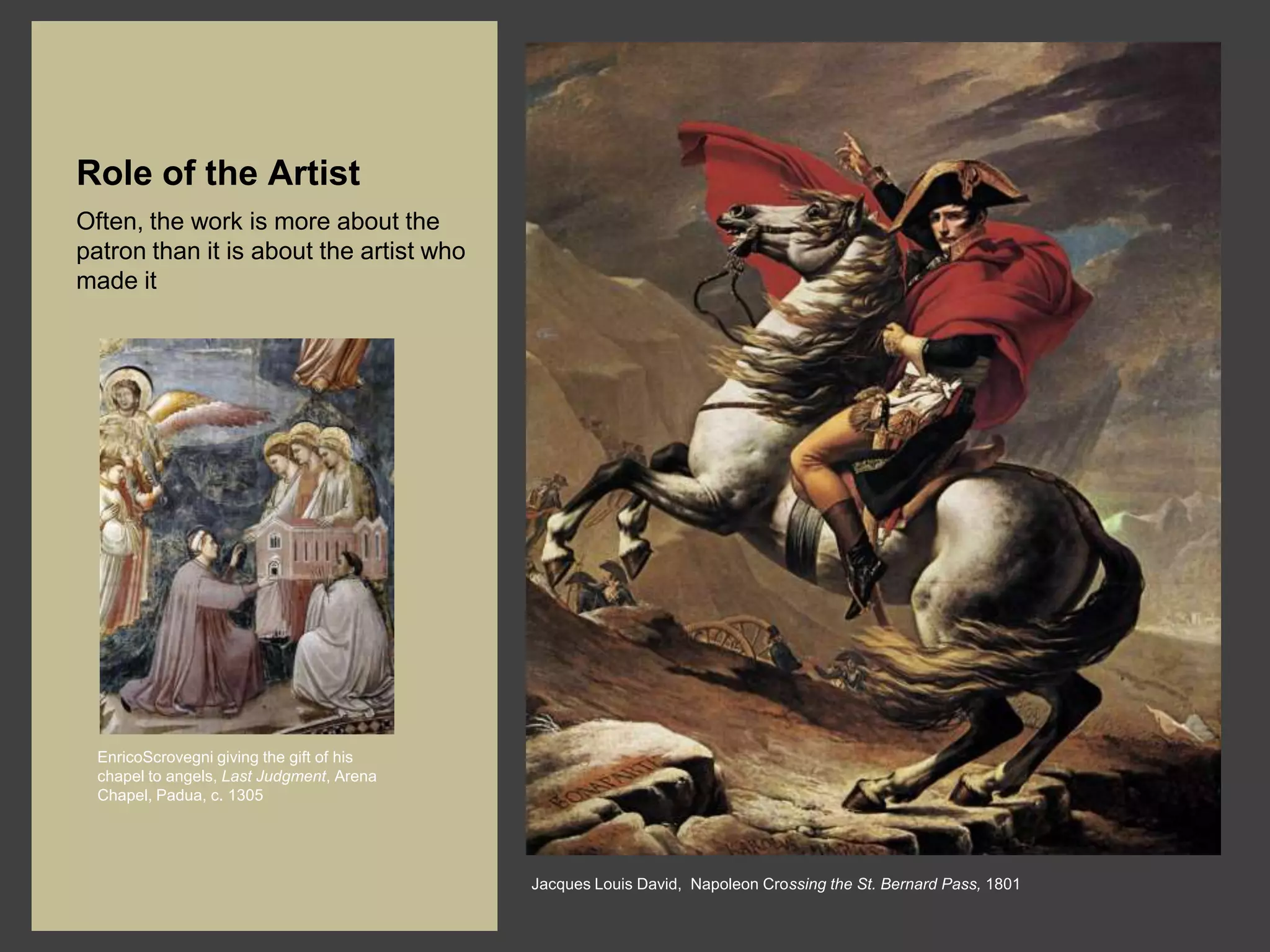
Often, the work is more about the
patron than it is about the artist who
made it


  EnricoScrovegni giving the gift of his
  chapel to angels, Last Judgment, Arena
  Chapel, Padua, c. 1305


                                           Jacques Louis David, Napoleon Crossing the St. Bernard Pass, 1801
Methodology
How do art historians study works
of art?
Methodology
1.   Subject Matter (iconographic
     analysis)
2.   Style (formal analysis)
3.   Context (cultural analysis)


                                    Image source: www.thinkandthrive.com
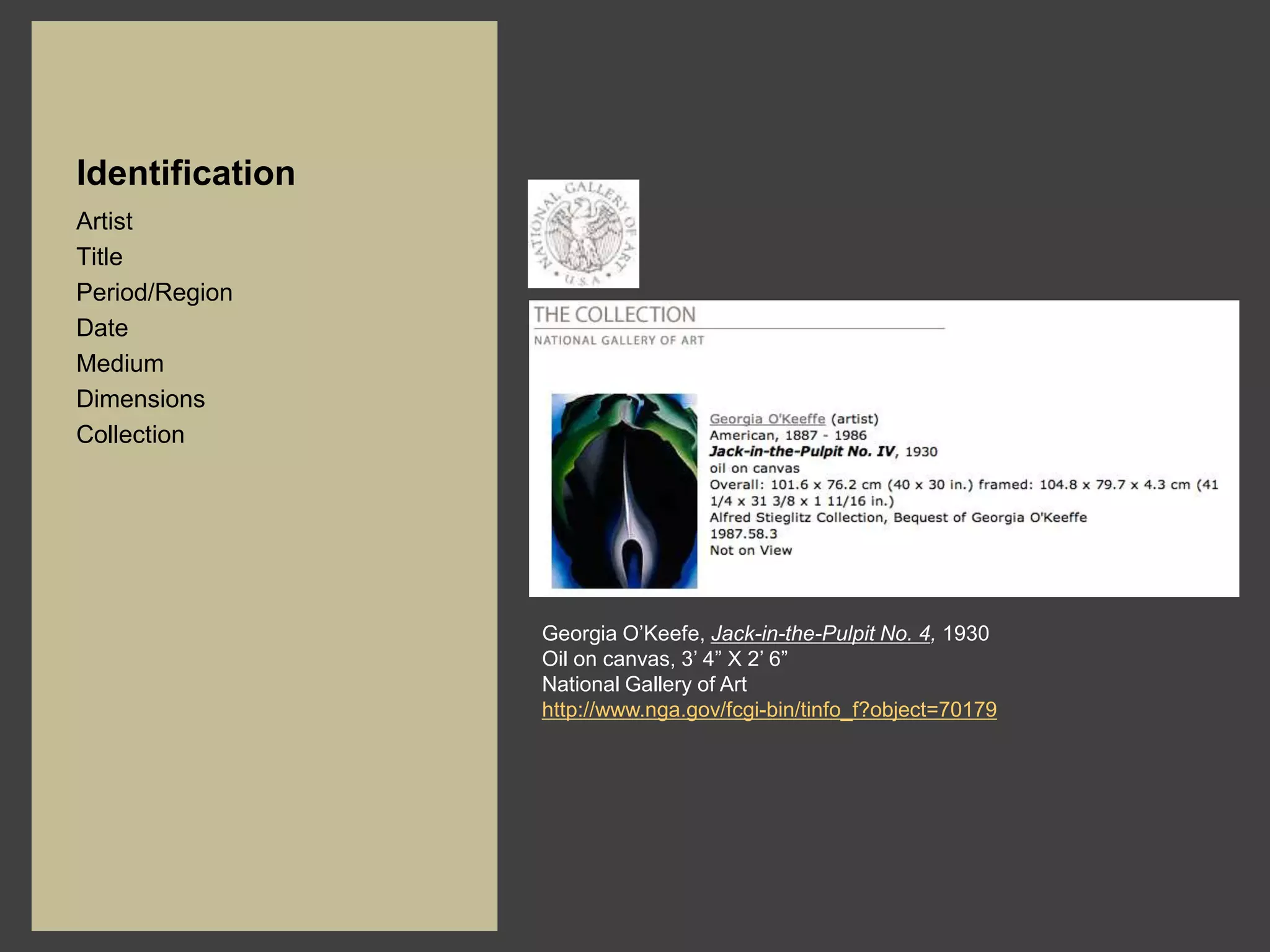
Identification
Artist
Title
Period/Region
Date
Medium
Dimensions
Collection


                 Georgia O’Keefe, Jack-in-the-Pulpit No. 4, 1930
                 Oil on canvas, 3’ 4” X 2’ 6”
                 National Gallery of Art
                 http://www.nga.gov/fcgi-bin/tinfo_f?object=70179
Identification
Note: titles of works of art are
treated like book titles

“Georgia O’Keefe painted Jack-in-
the-Pulpit in 1930.”

“The Mona Lisa is a painting by
Leonardo da Vinci.”
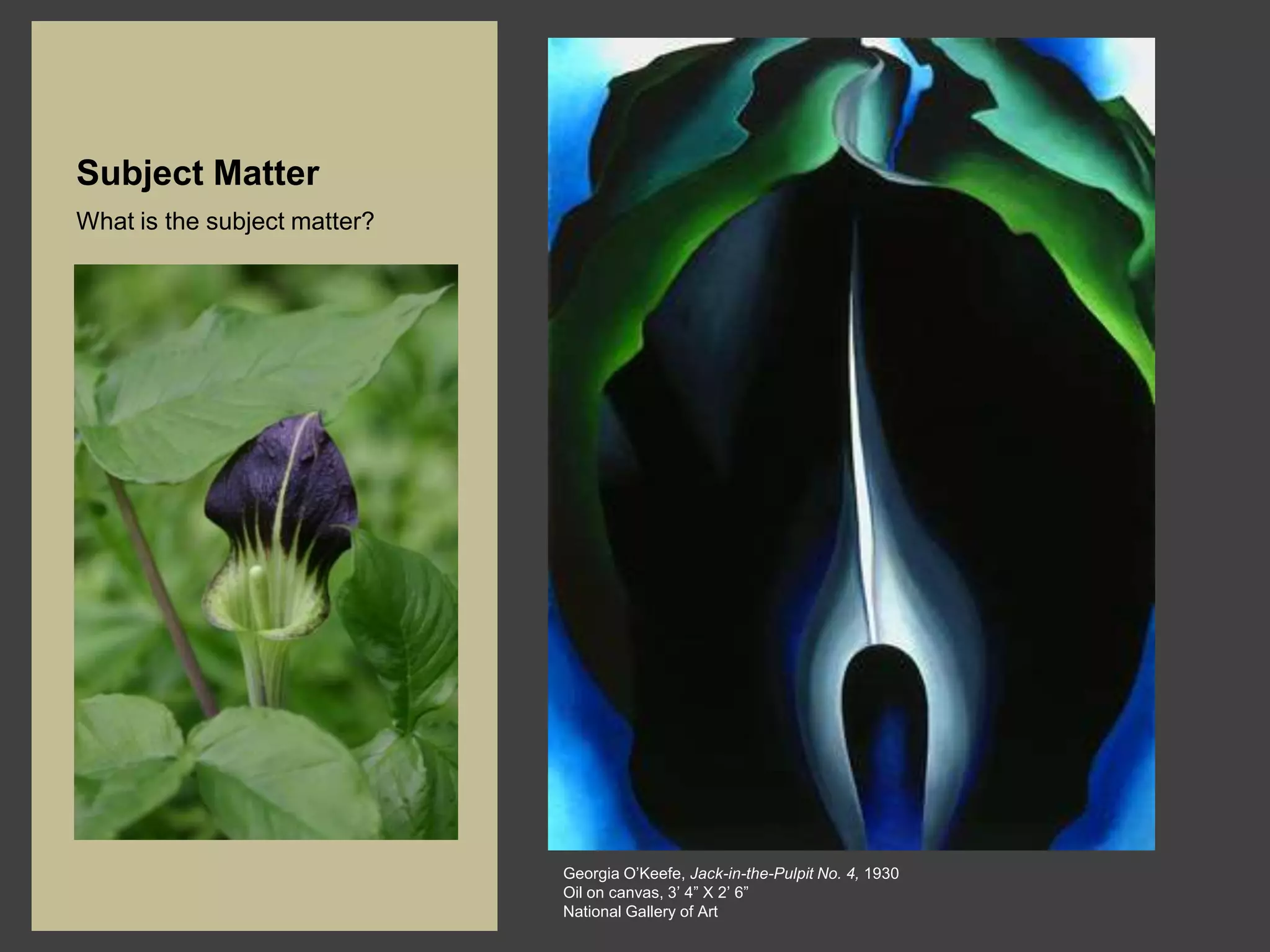
Subject Matter
What is the subject matter?


                              Georgia O’Keefe, Jack-in-the-Pulpit No. 4, 1930
                              Oil on canvas, 3’ 4” X 2’ 6”
                              National Gallery of Art
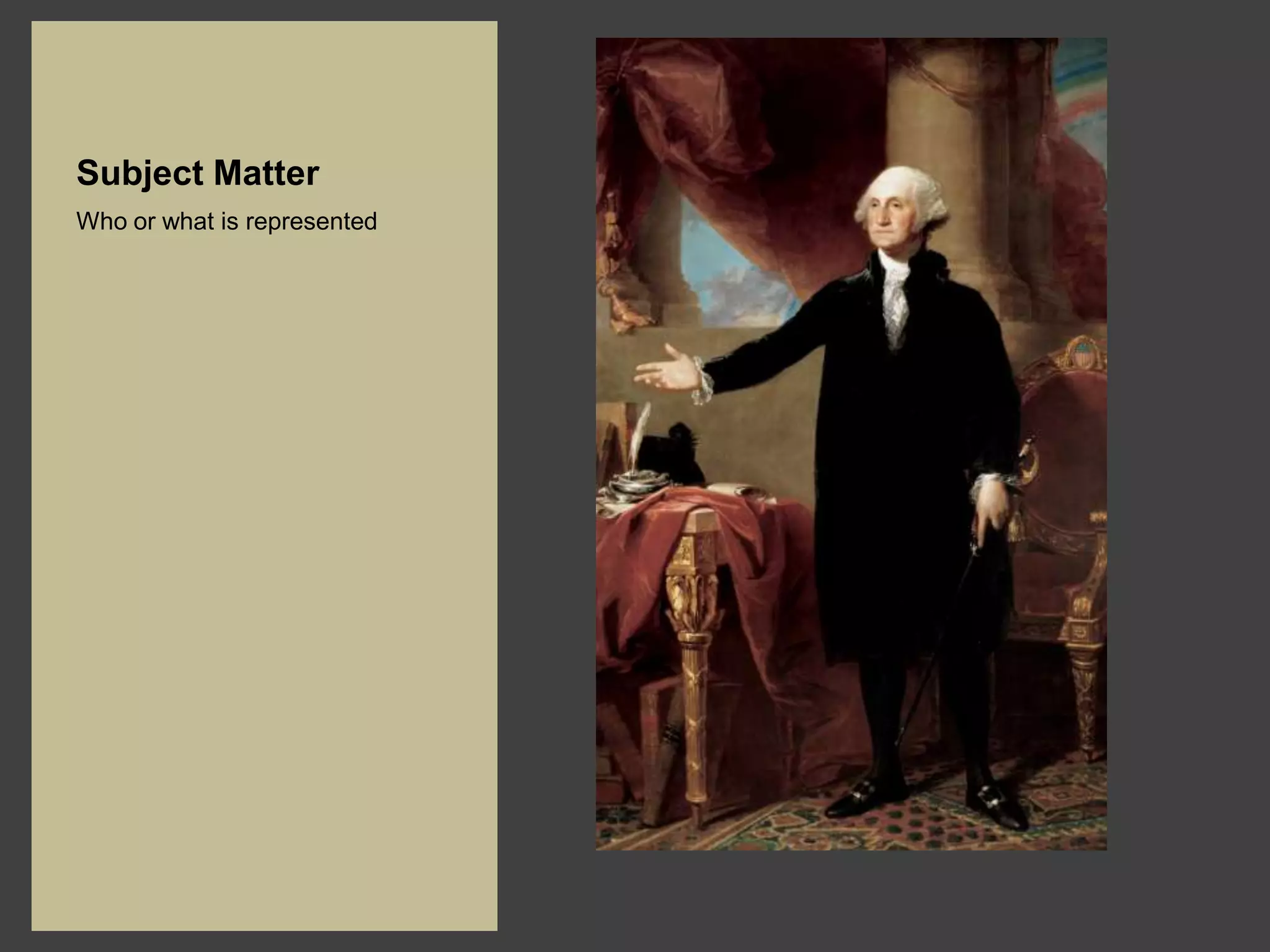
Subject Matter
Who or what is represented
Visual Literacy
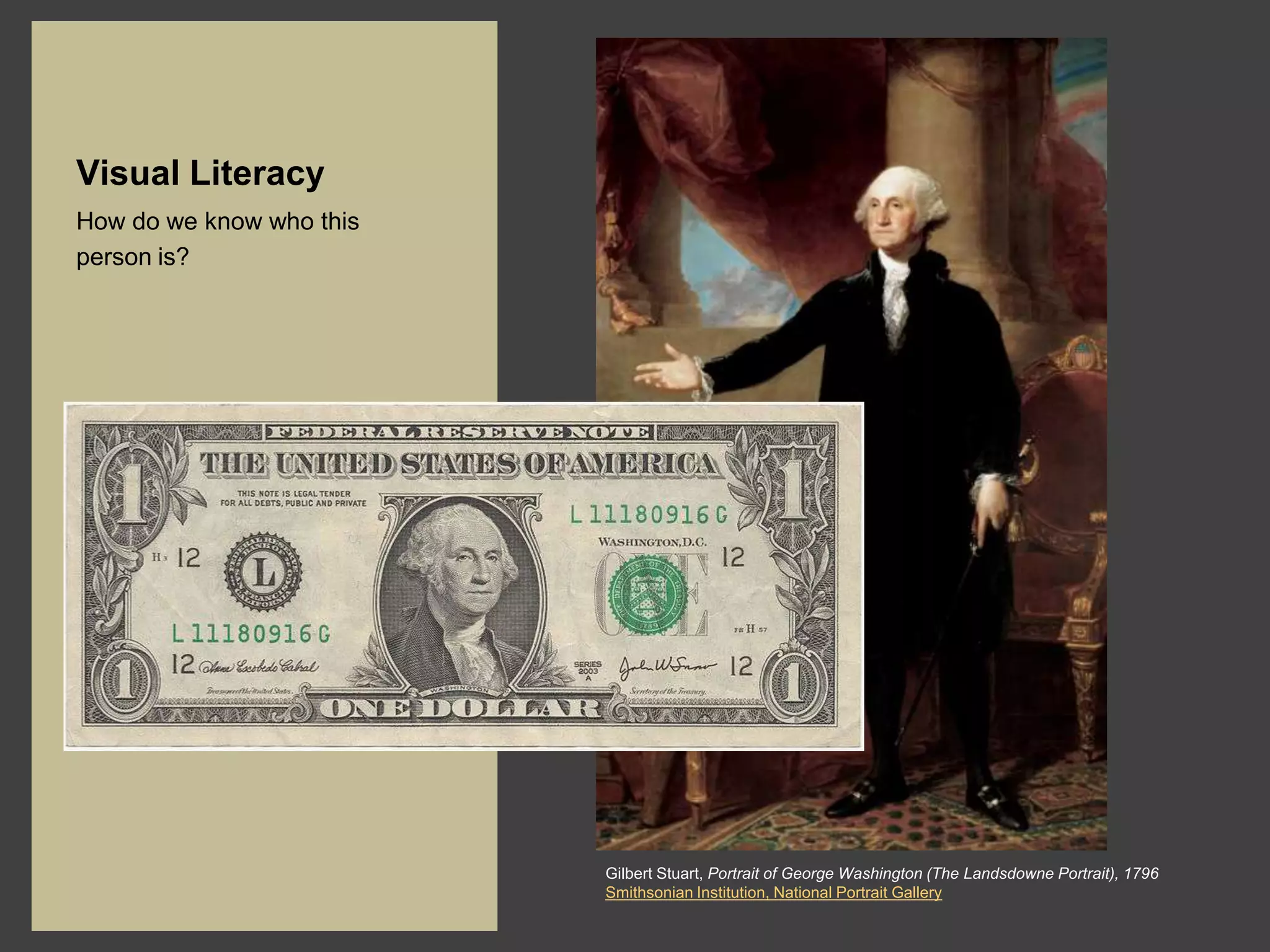
How do we know who this
person is?


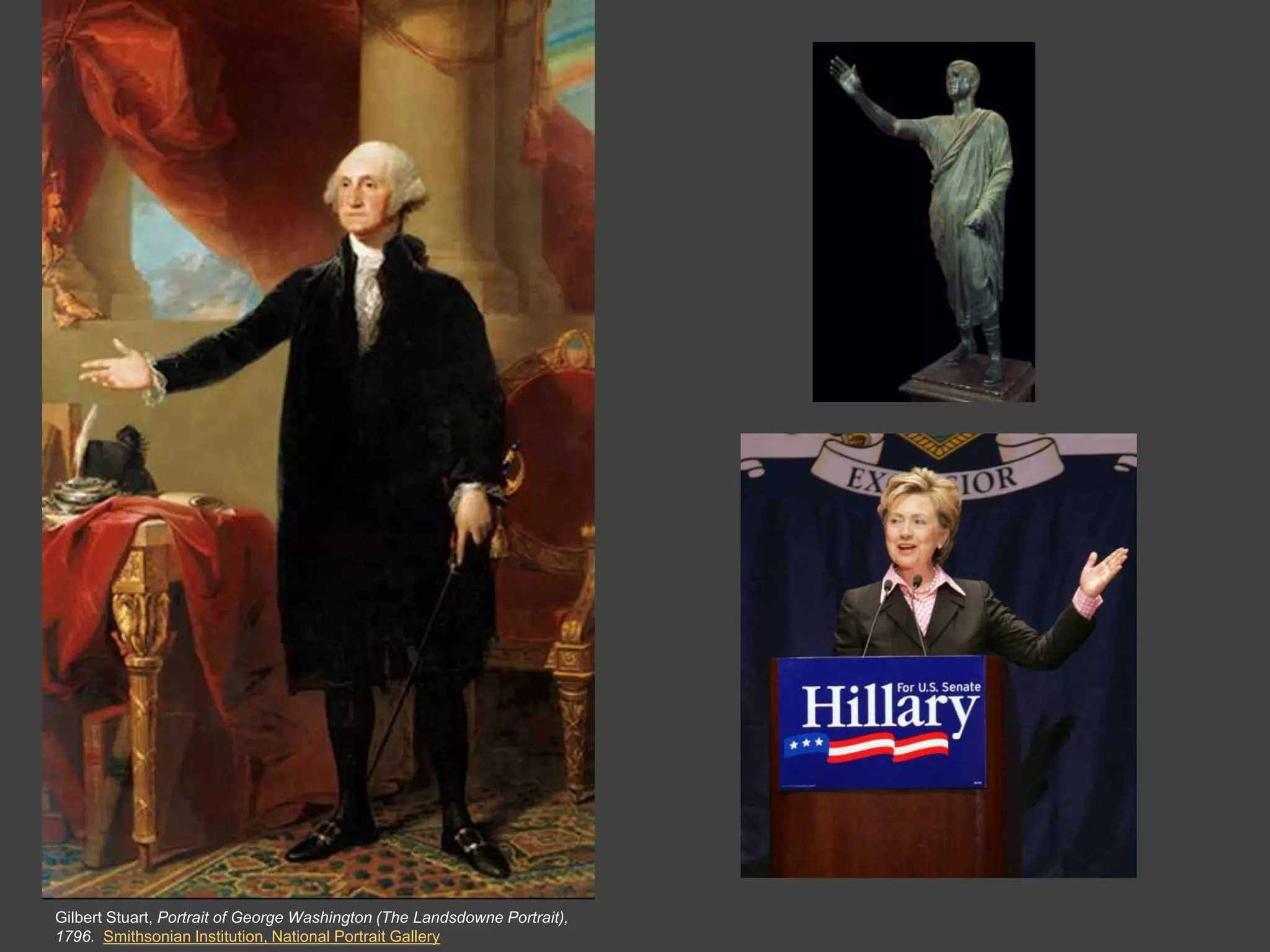
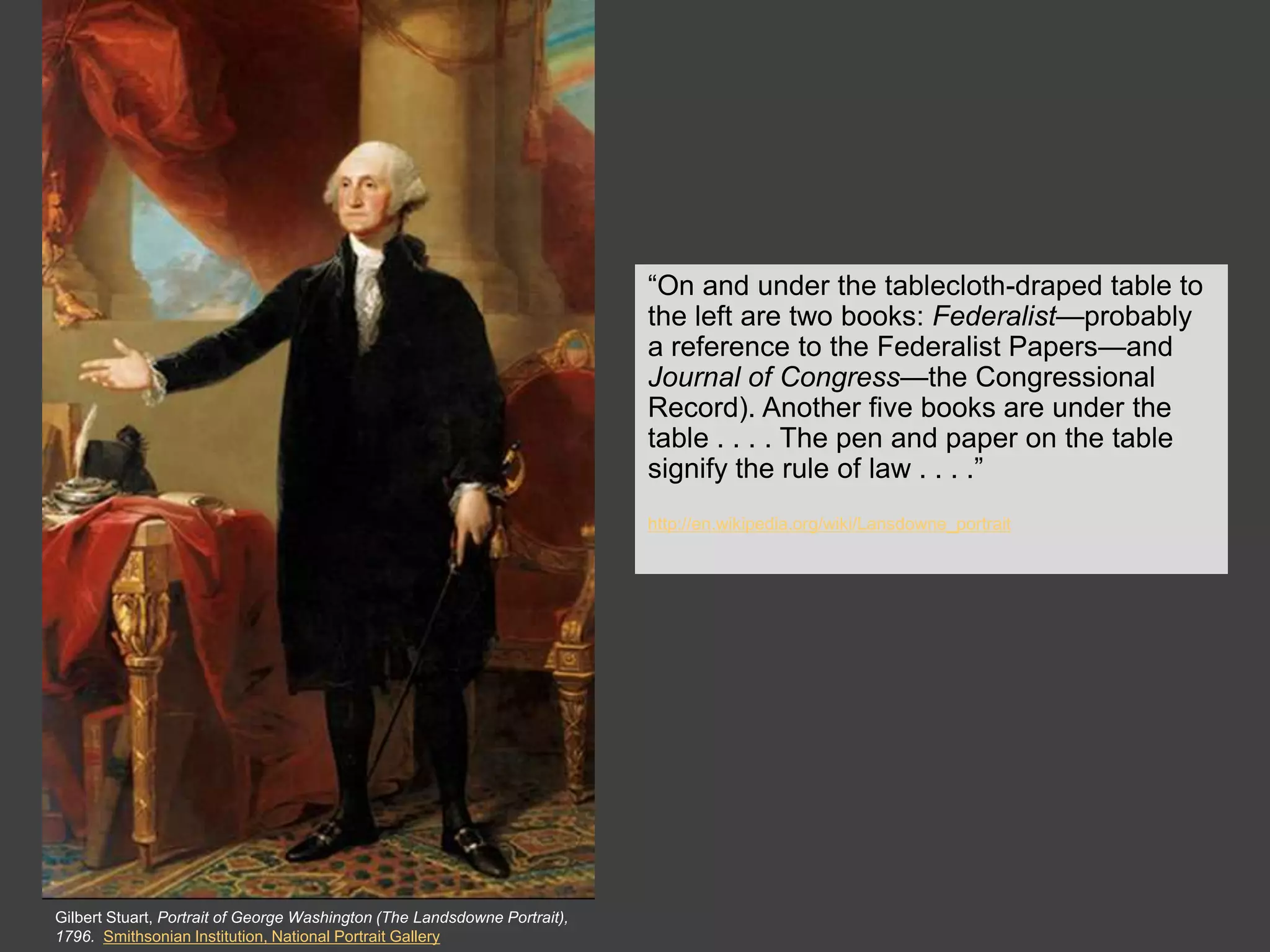
                          Gilbert Stuart, Portrait of George Washington (The Landsdowne Portrait), 1796
                          Smithsonian Institution, National Portrait Gallery
Visual Literacy
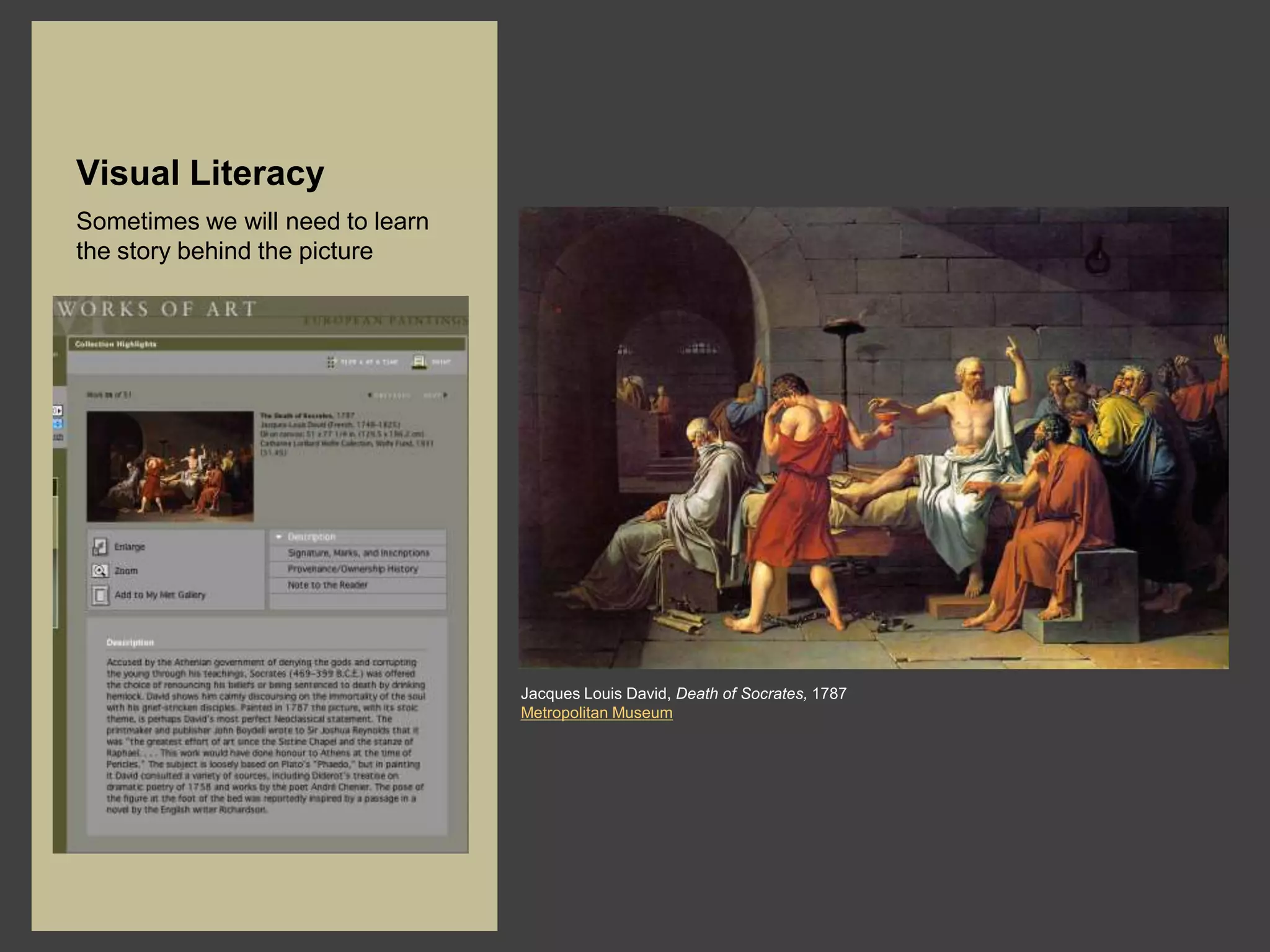
Sometimes we will need to learn
the story behind the picture


                                  Jacques Louis David, Death of Socrates, 1787
                                  Metropolitan Museum
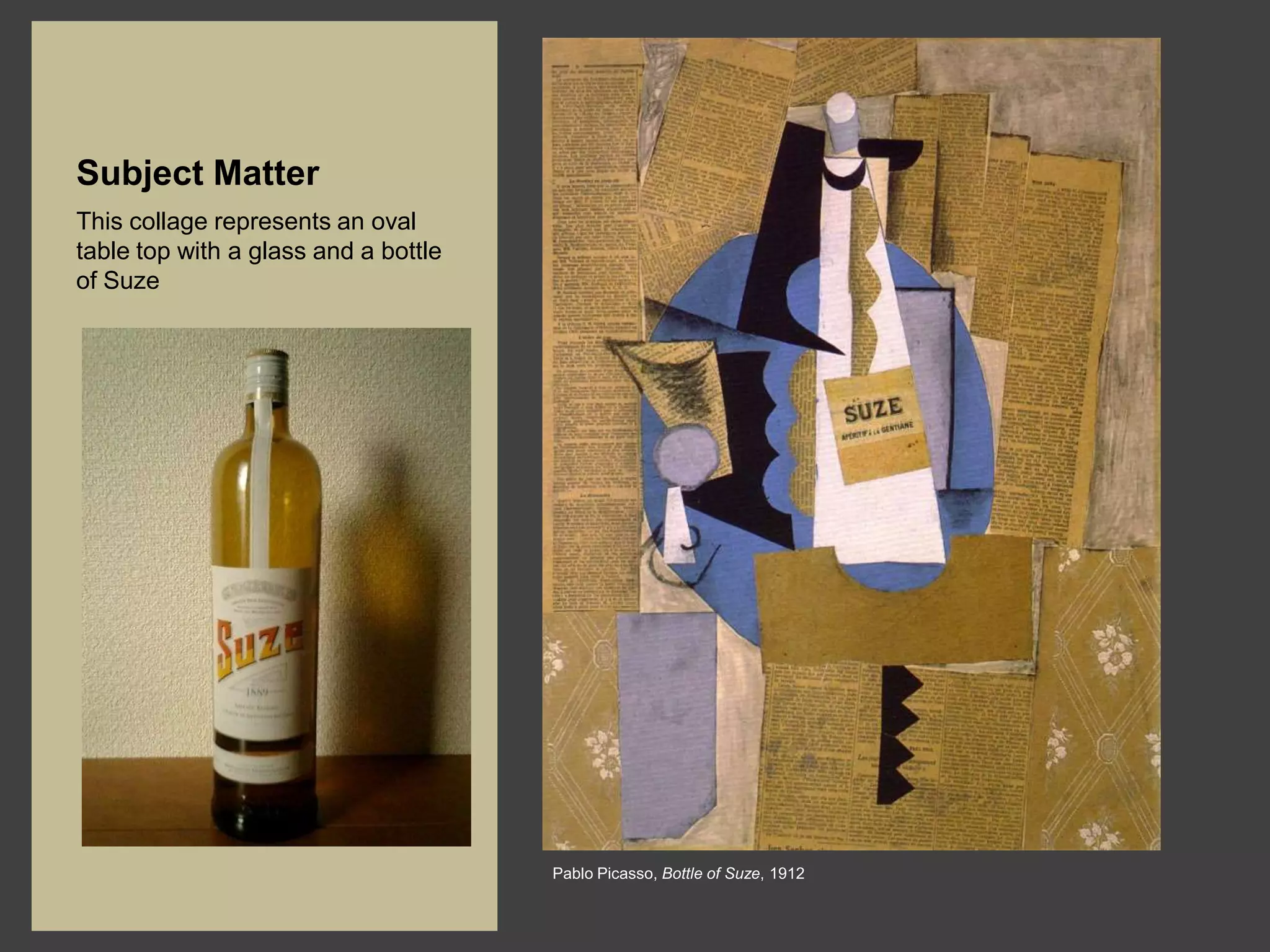
Subject Matter
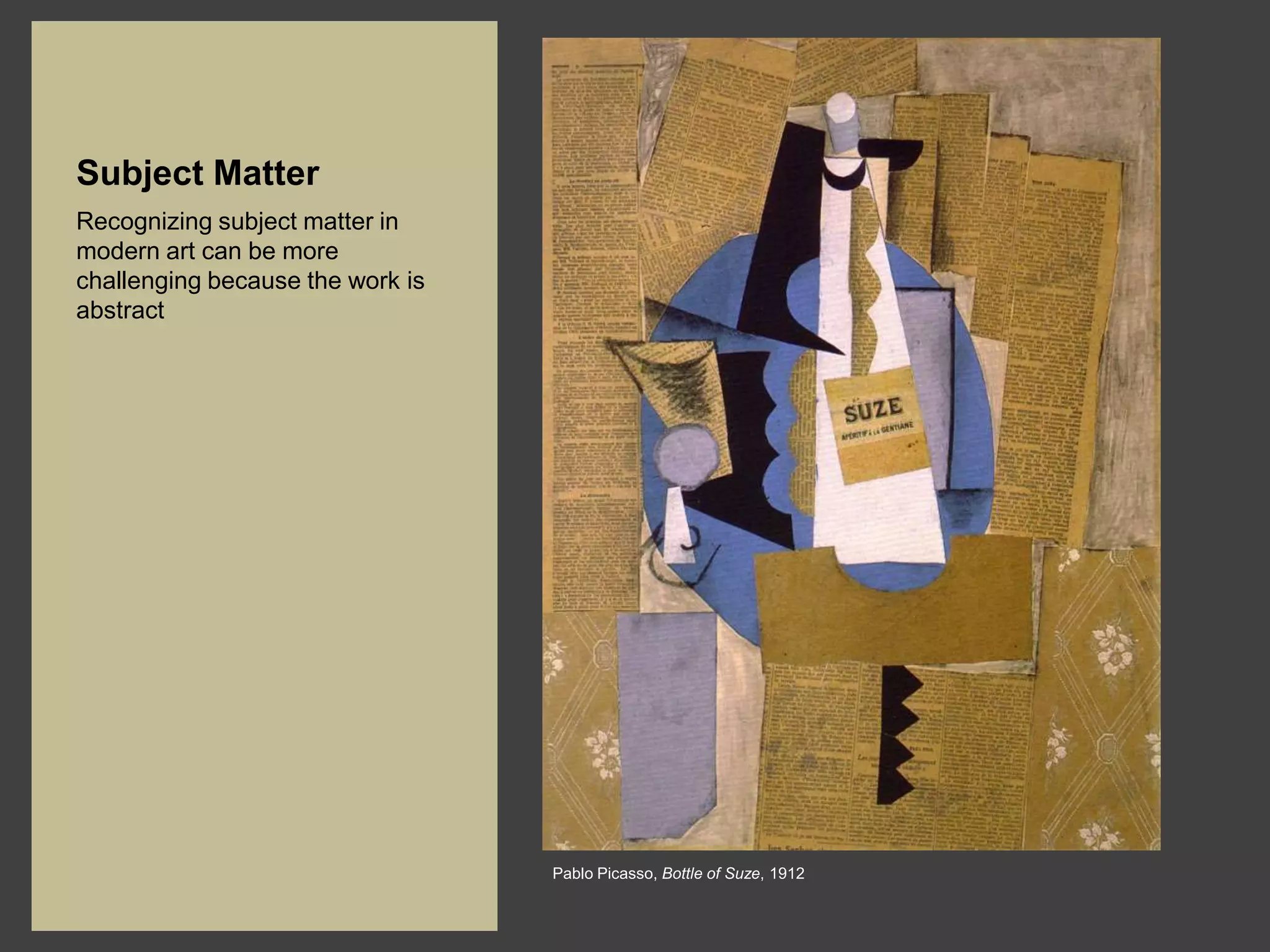
Recognizing subject matter in
modern art can be more
challenging because the work is
abstract


                                  Pablo Picasso, Bottle of Suze, 1912
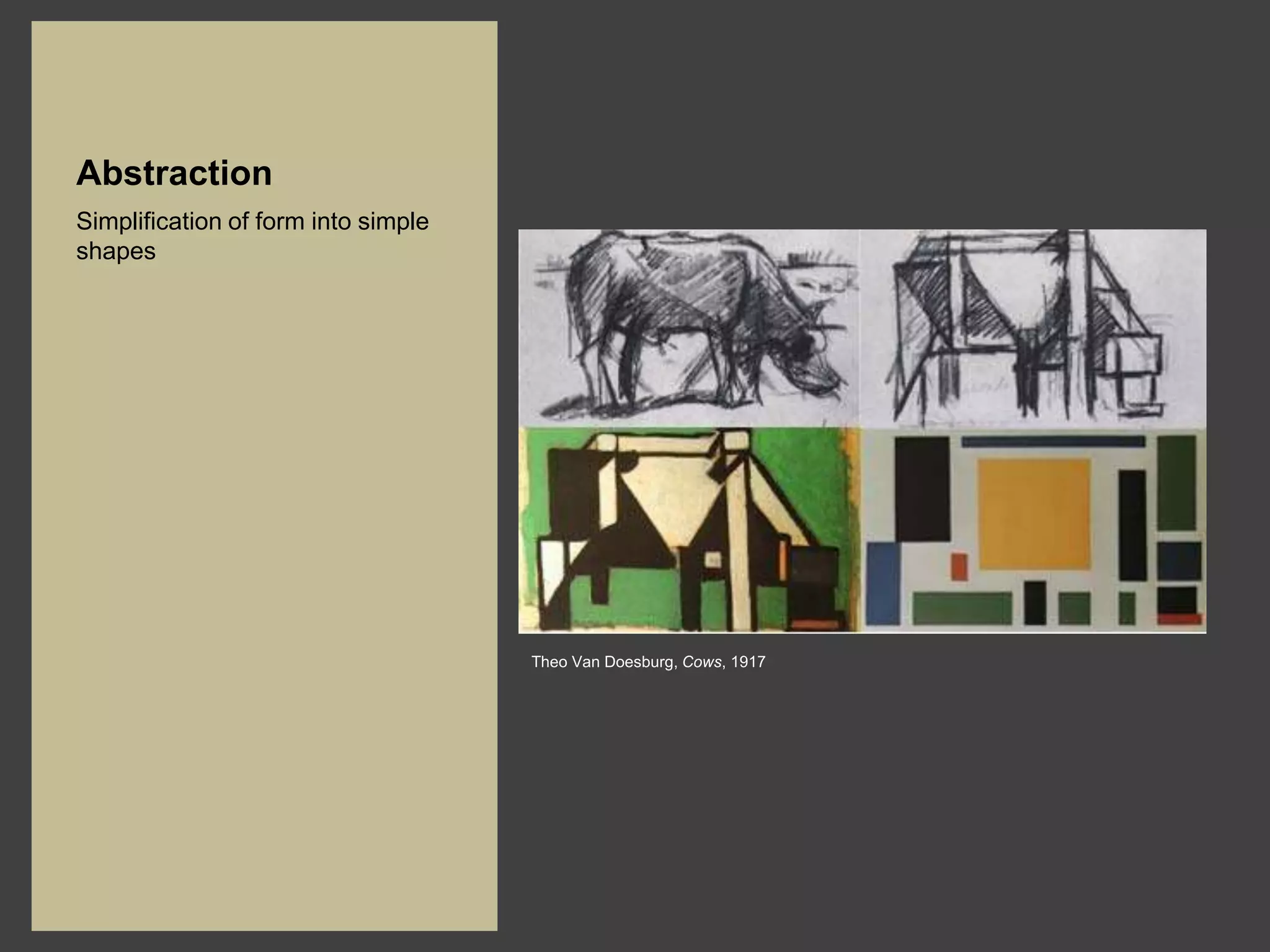
Abstraction
Simplification of form into simple
shapes


                                     Theo Van Doesburg, Cows, 1917
Subject Matter
This collage represents an oval
table top with a glass and a bottle
of Suze


                                      Pablo Picasso, Bottle of Suze, 1912
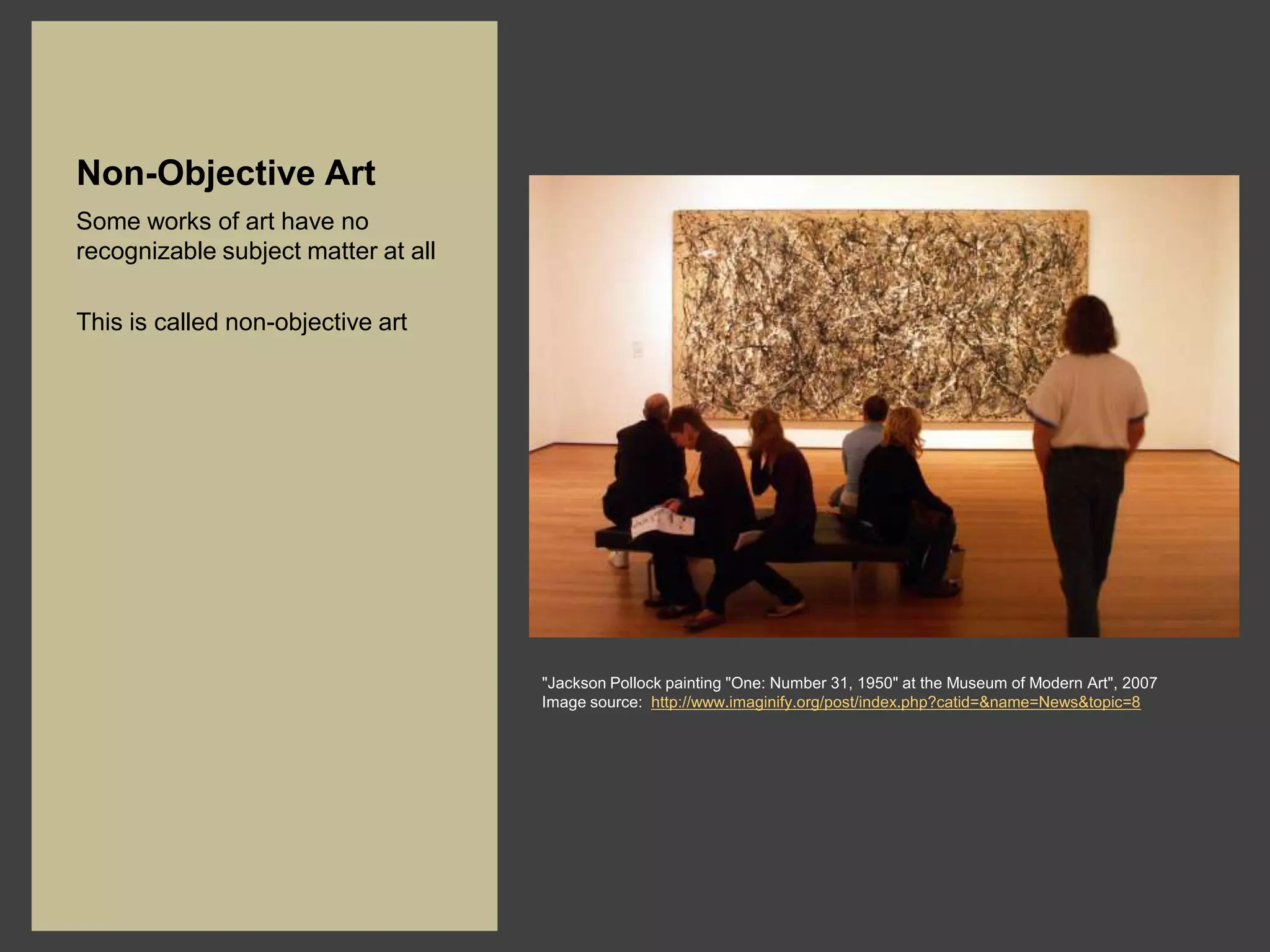
Non-Objective Art
Some works of art have no
recognizable subject matter at all

This is called non-objective art


                                     "Jackson Pollock painting "One: Number 31, 1950" at the Museum of Modern Art", 2007
                                     Image source: http://www.imaginify.org/post/index.php?catid=&name=News&topic=8
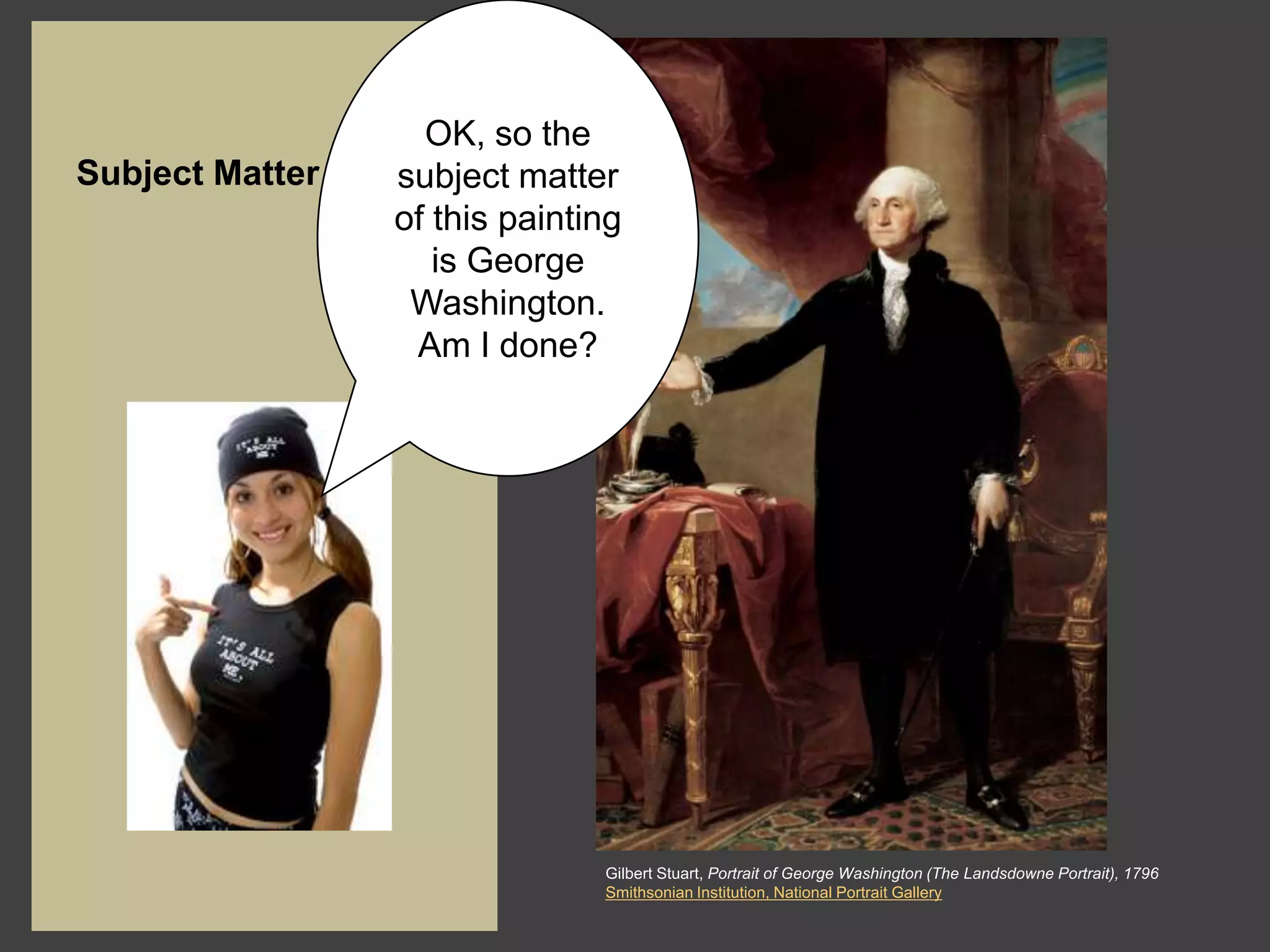
OK, so the
Subject Matter   subject matter
                 of this painting
                    is George
                  Washington.
                  Am I done?


                               Gilbert Stuart, Portrait of George Washington (The Landsdowne Portrait), 1796
                               Smithsonian Institution, National Portrait Gallery
Subject Matter
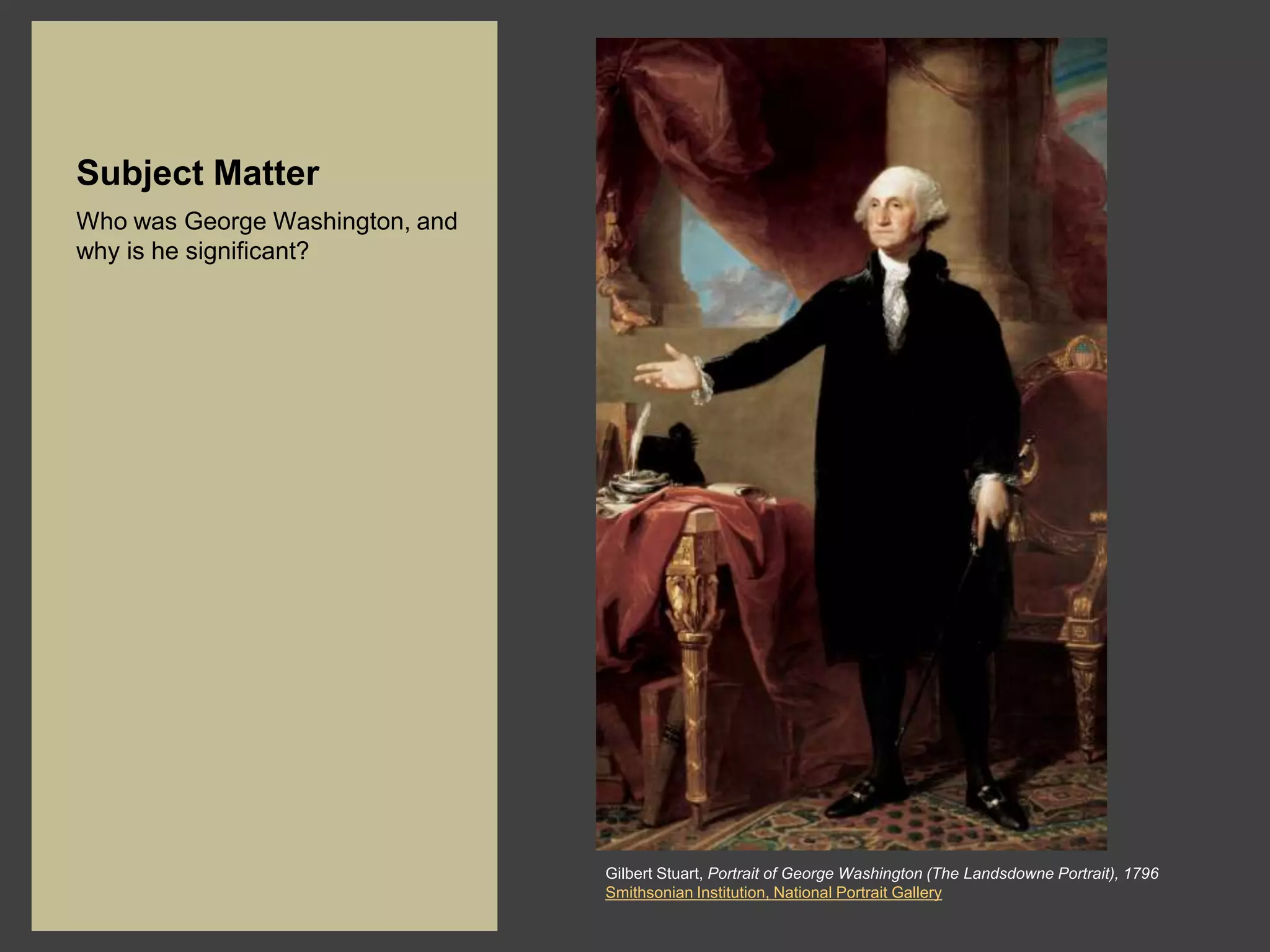
Who was George Washington, and
why is he significant?


                                 Gilbert Stuart, Portrait of George Washington (The Landsdowne Portrait), 1796
                                 Smithsonian Institution, National Portrait Gallery
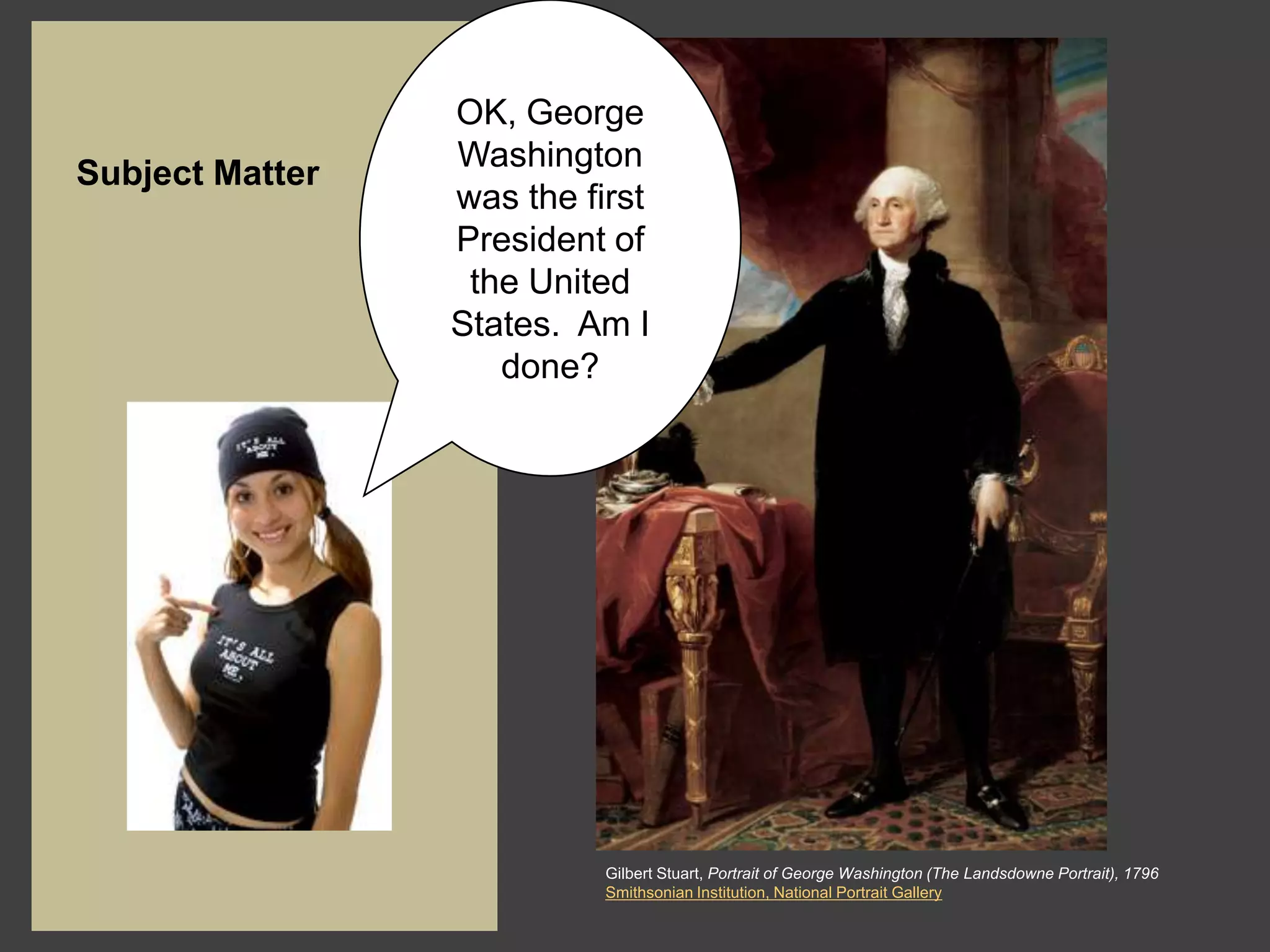
OK, George
                 Washington
Subject Matter
                 was the first
                 President of
                  the United
                 States. Am I
                    done?


                           Gilbert Stuart, Portrait of George Washington (The Landsdowne Portrait), 1796
                           Smithsonian Institution, National Portrait Gallery
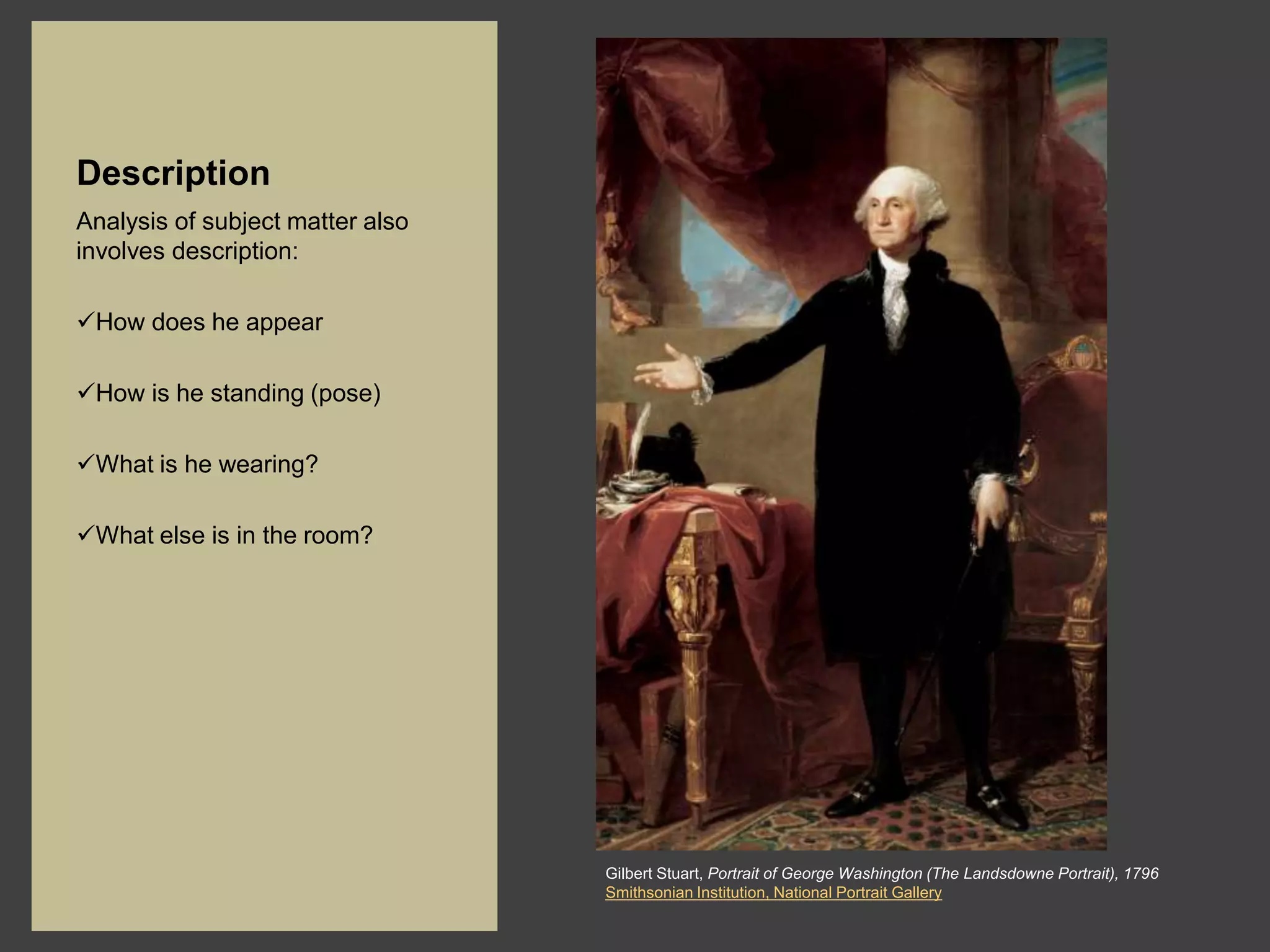
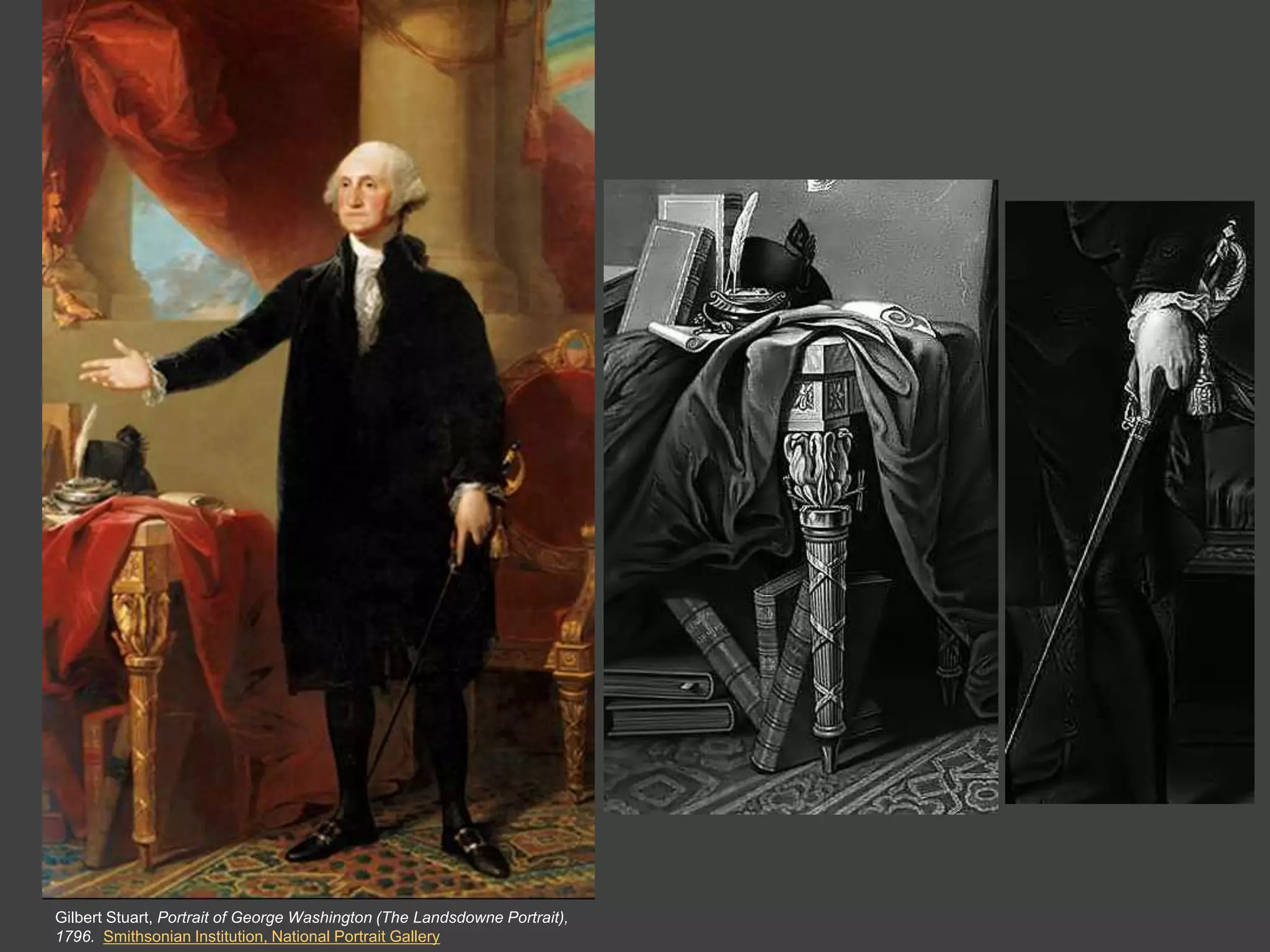
Description
Analysis of subject matter also
involves description:

How does he appear

How is he standing (pose)

What is he wearing?

What else is in the room?


                                  Gilbert Stuart, Portrait of George Washington (The Landsdowne Portrait), 1796
                                  Smithsonian Institution, National Portrait Gallery
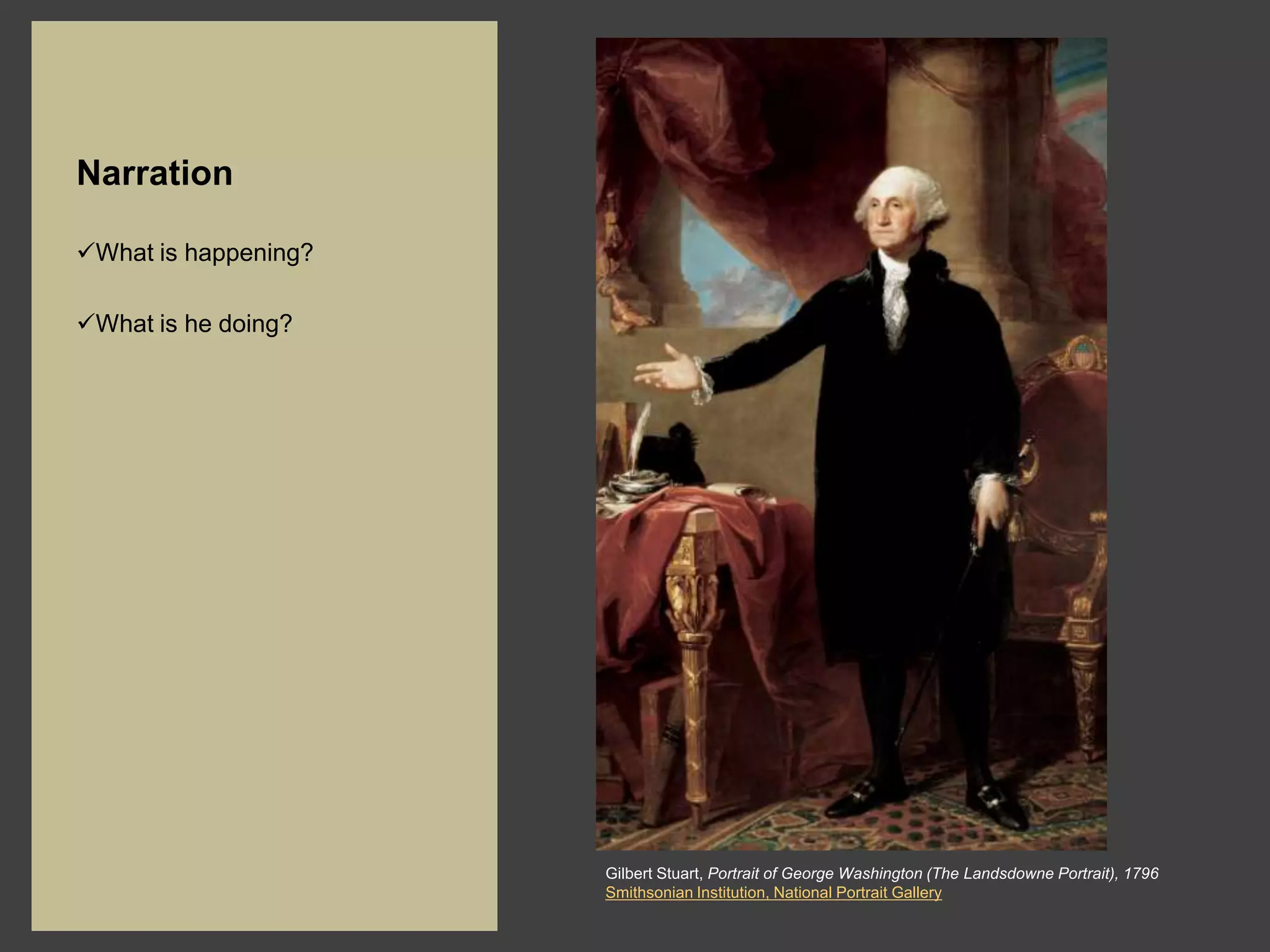
Narration

What is happening?

What is he doing?


                      Gilbert Stuart, Portrait of George Washington (The Landsdowne Portrait), 1796
                      Smithsonian Institution, National Portrait Gallery
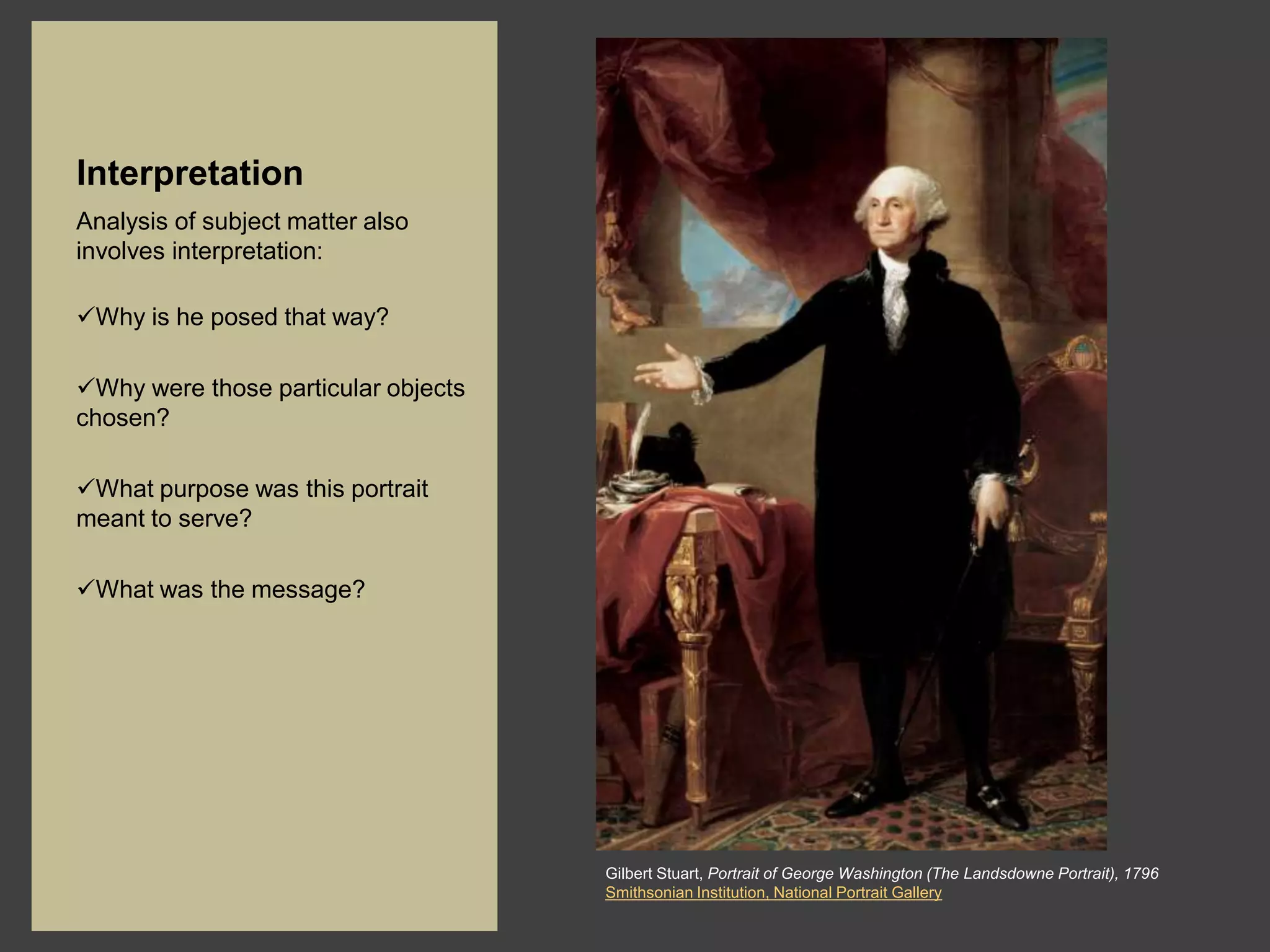
Interpretation
Analysis of subject matter also
involves interpretation:

Why is he posed that way?

Why were those particular objects
chosen?

What purpose was this portrait
meant to serve?

What was the message?


                                     Gilbert Stuart, Portrait of George Washington (The Landsdowne Portrait), 1796
                                     Smithsonian Institution, National Portrait Gallery
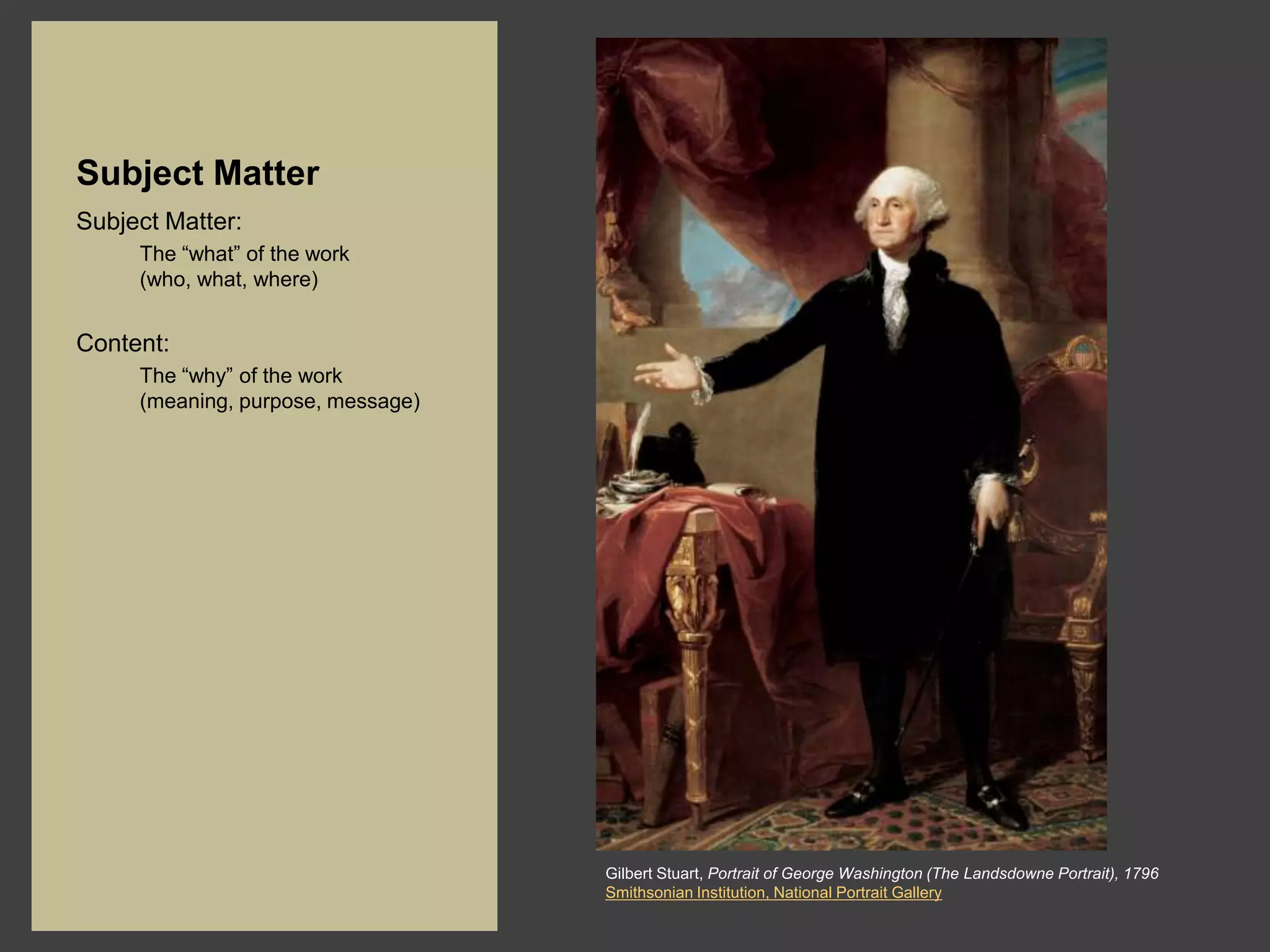
Subject Matter
Subject Matter:
     The “what” of the work
     (who, what, where)


Content:
     The “why” of the work
     (meaning, purpose, message)


                                   Gilbert Stuart, Portrait of George Washington (The Landsdowne Portrait), 1796
                                   Smithsonian Institution, National Portrait Gallery
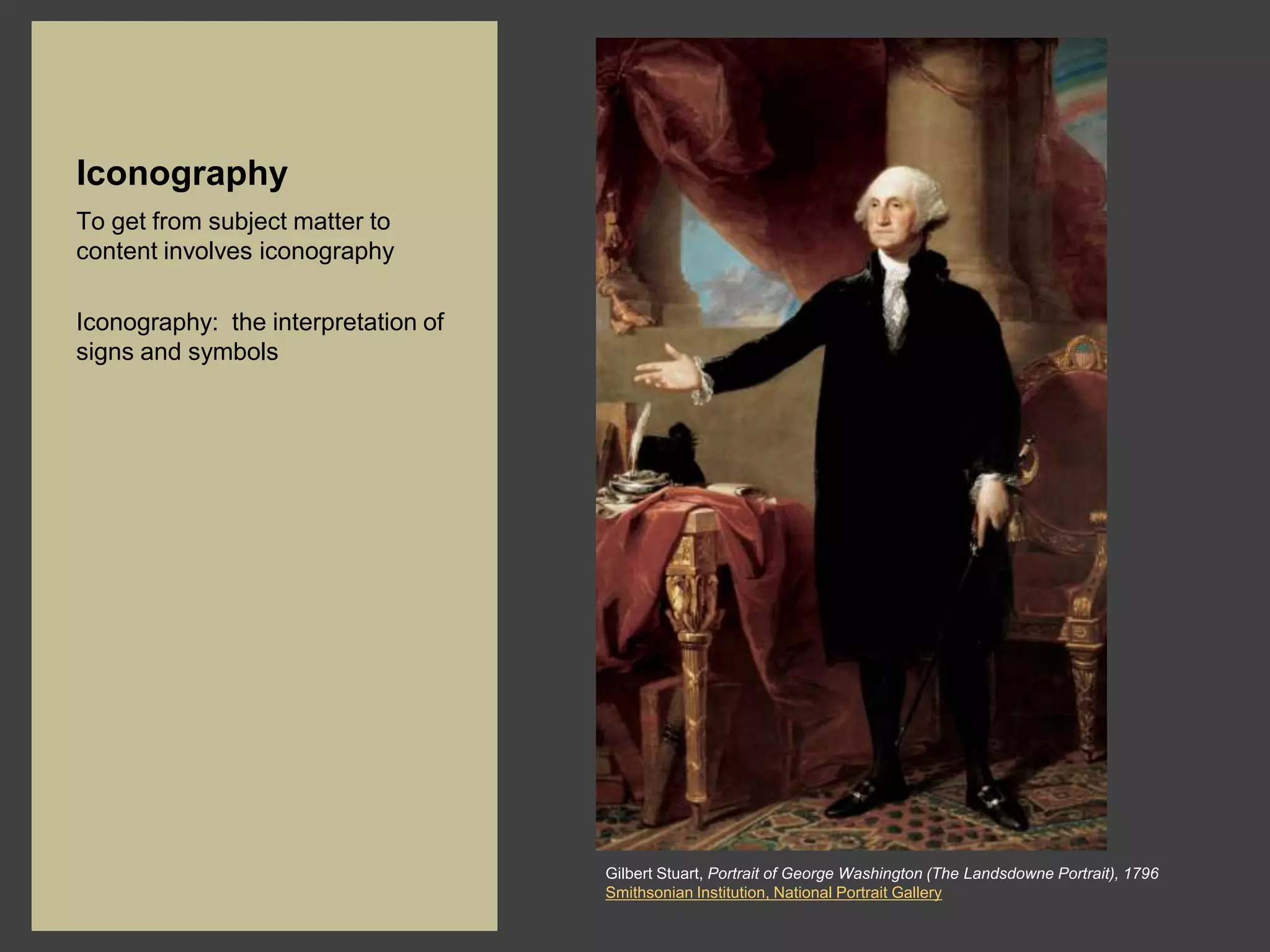
Iconography
To get from subject matter to
content involves iconography

Iconography: the interpretation of
signs and symbols


                                     Gilbert Stuart, Portrait of George Washington (The Landsdowne Portrait), 1796
                                     Smithsonian Institution, National Portrait Gallery
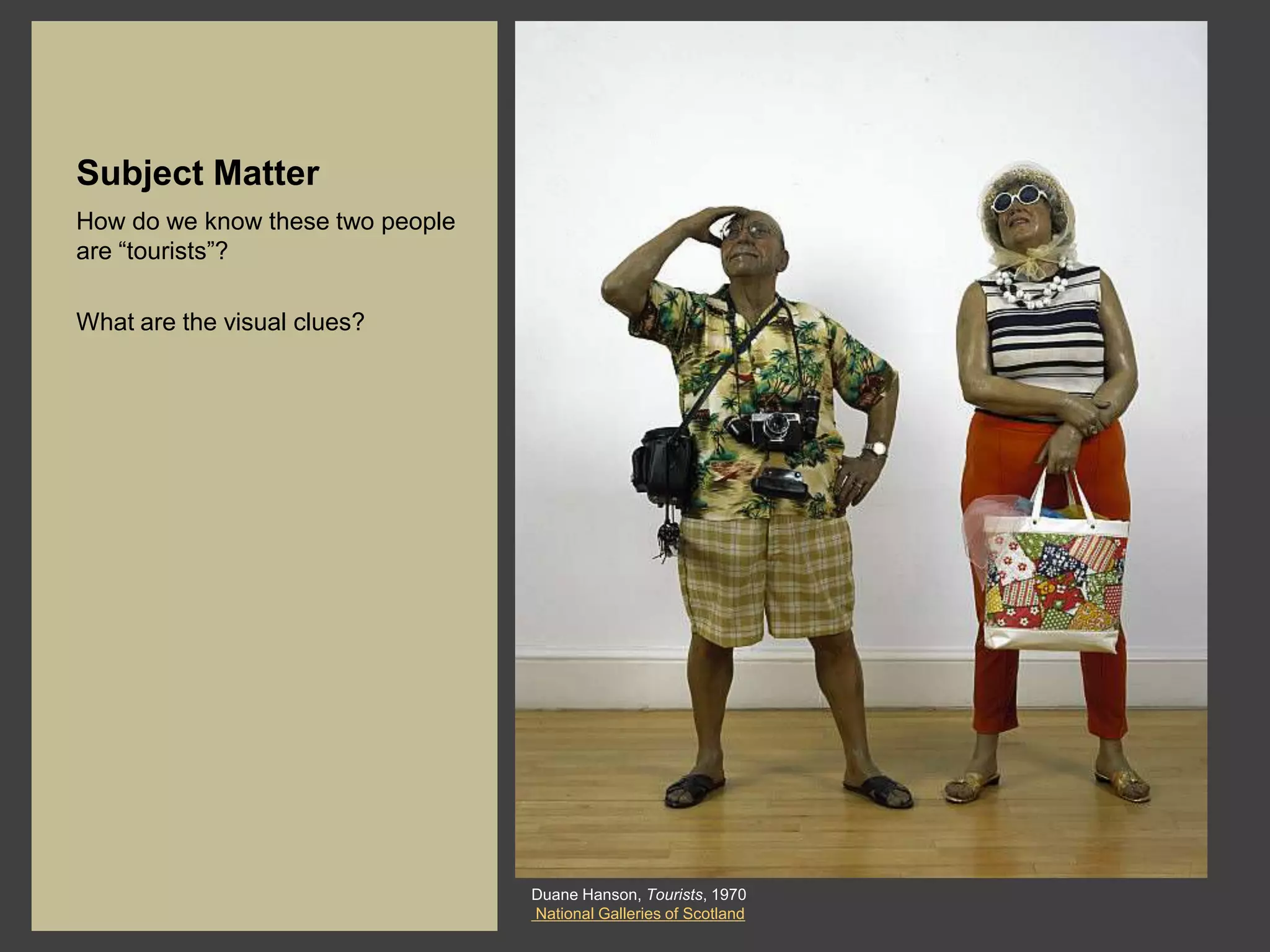
Subject Matter
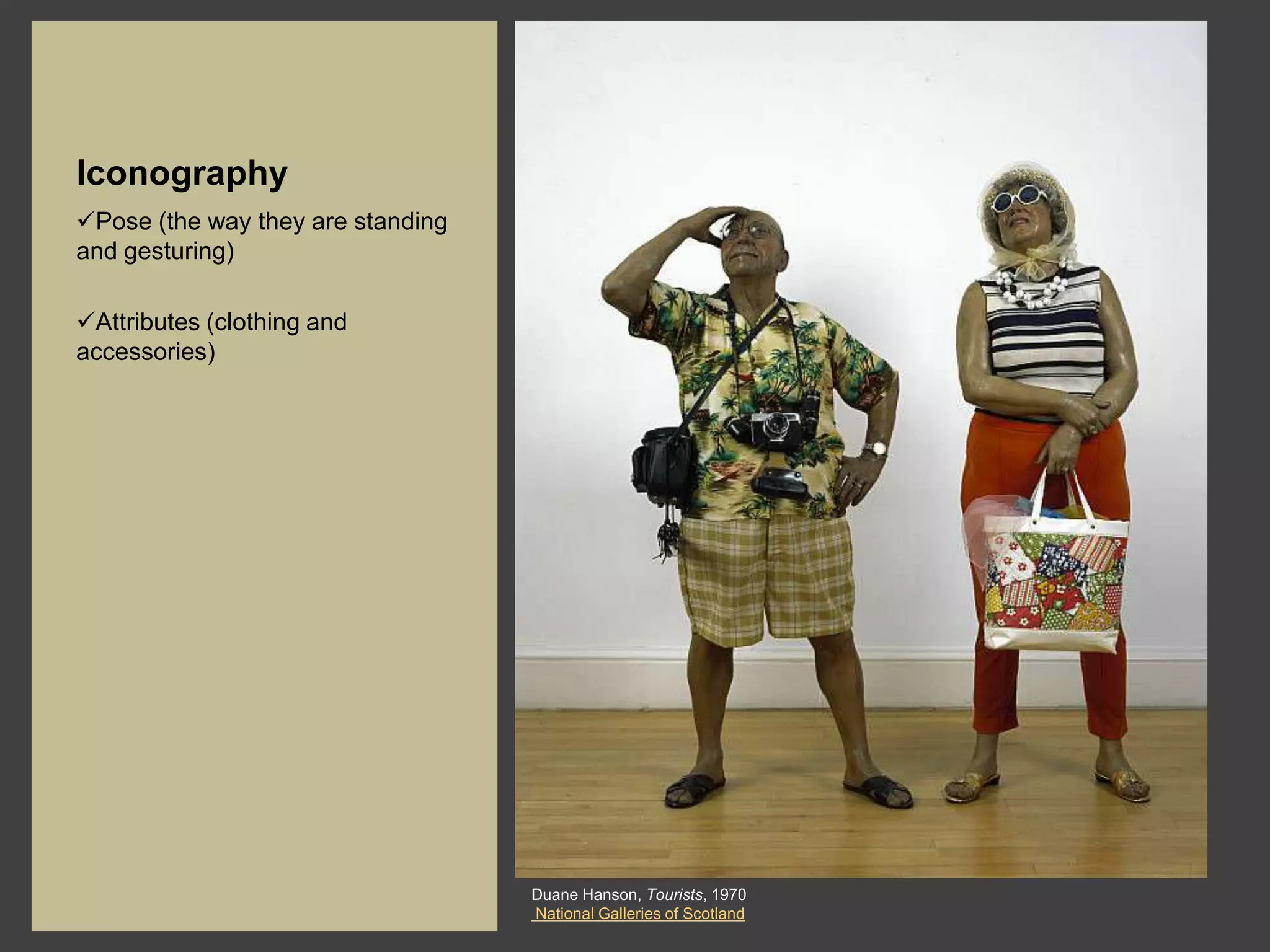
How do we know these two people
are “tourists”?

What are the visual clues?


                                  Duane Hanson, Tourists, 1970
                                  National Galleries of Scotland
Iconography
Pose (the way they are standing
and gesturing)

Attributes (clothing and
accessories)


                                   Duane Hanson, Tourists, 1970
                                   National Galleries of Scotland
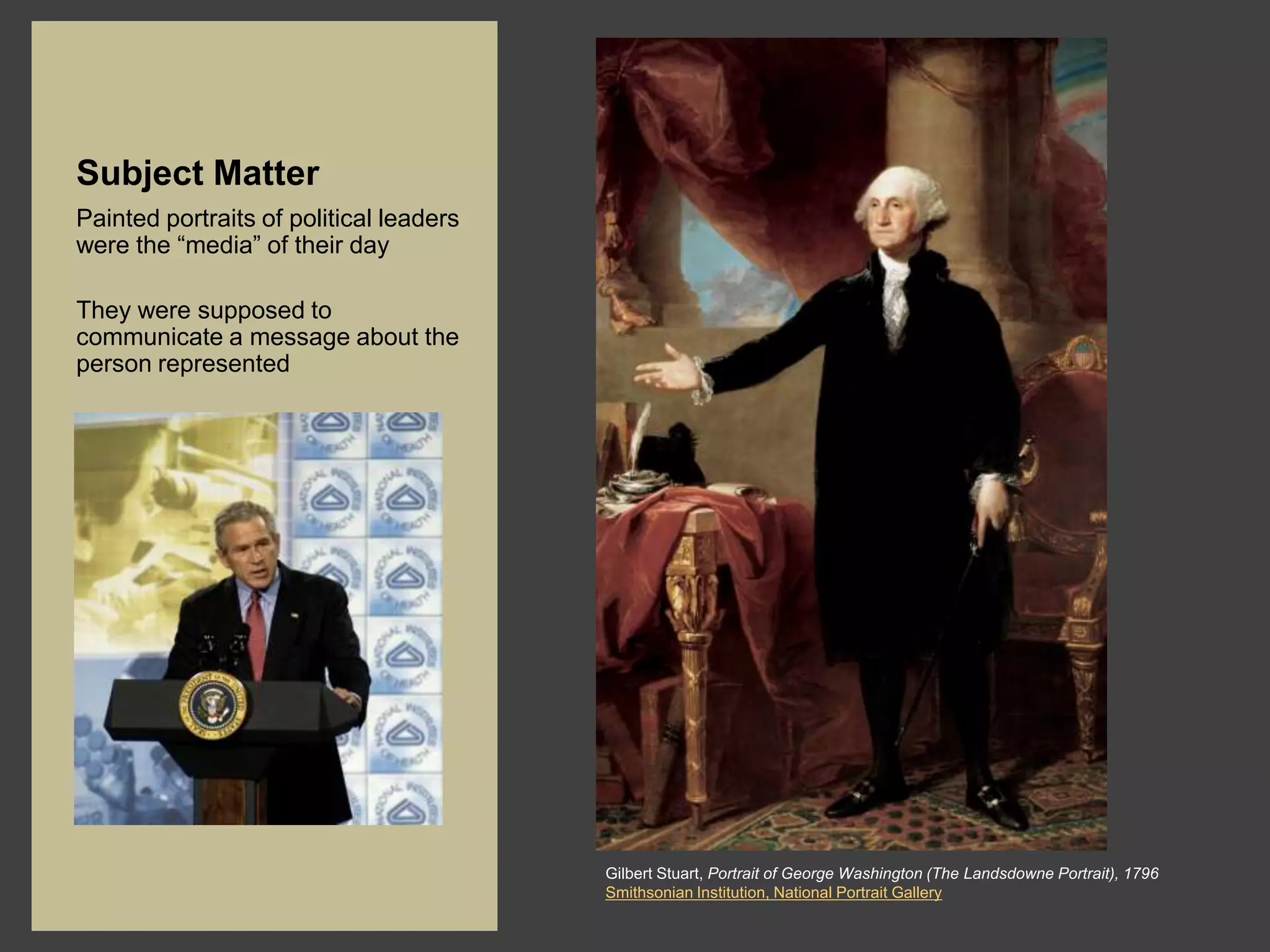
Subject Matter
Painted portraits of political leaders
were the “media” of their day

They were supposed to
communicate a message about the
person represented


                                         Gilbert Stuart, Portrait of George Washington (The Landsdowne Portrait), 1796
                                         Smithsonian Institution, National Portrait Gallery
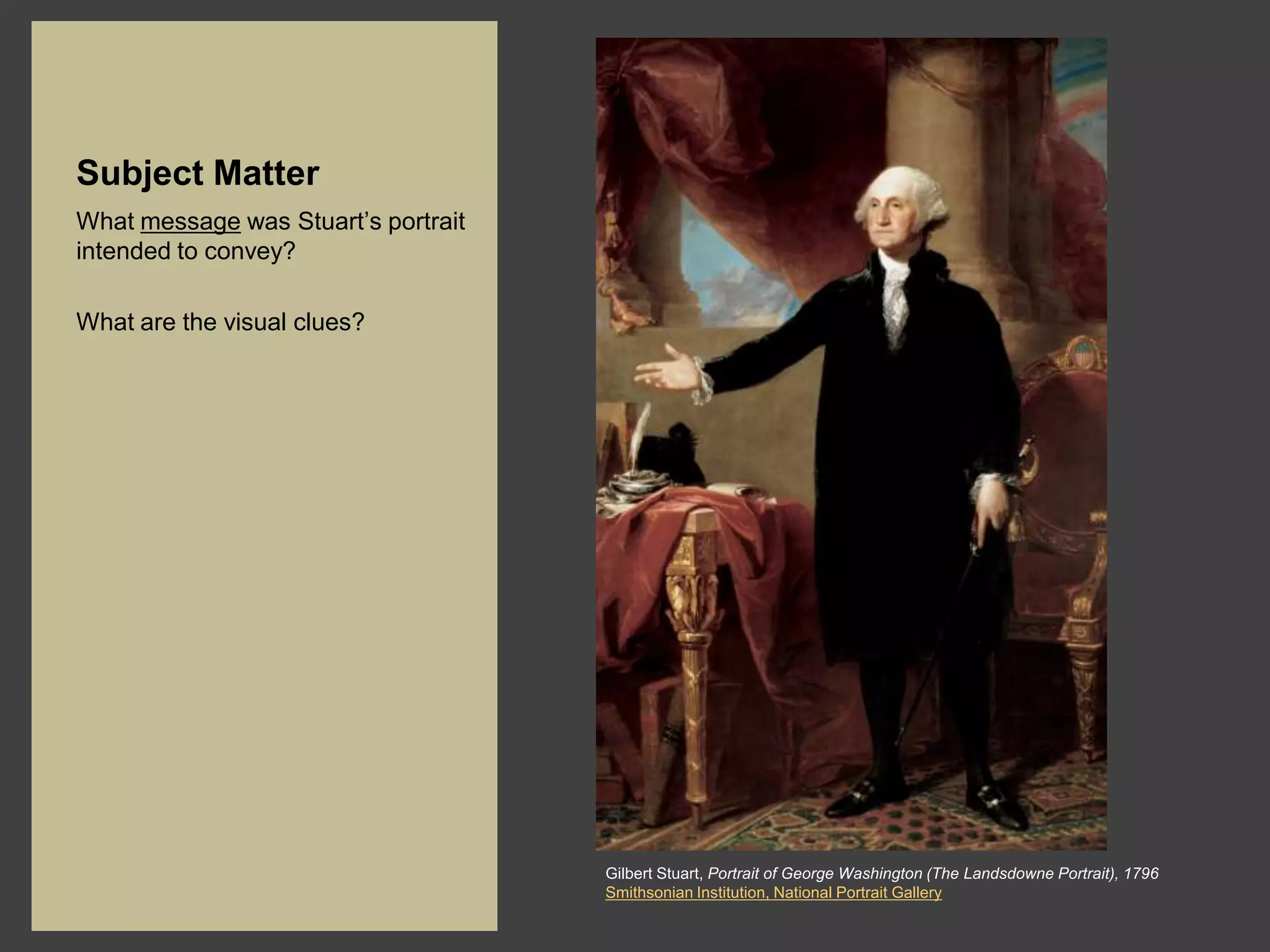
Subject Matter
What message was Stuart’s portrait
intended to convey?

What are the visual clues?


                                     Gilbert Stuart, Portrait of George Washington (The Landsdowne Portrait), 1796
                                     Smithsonian Institution, National Portrait Gallery
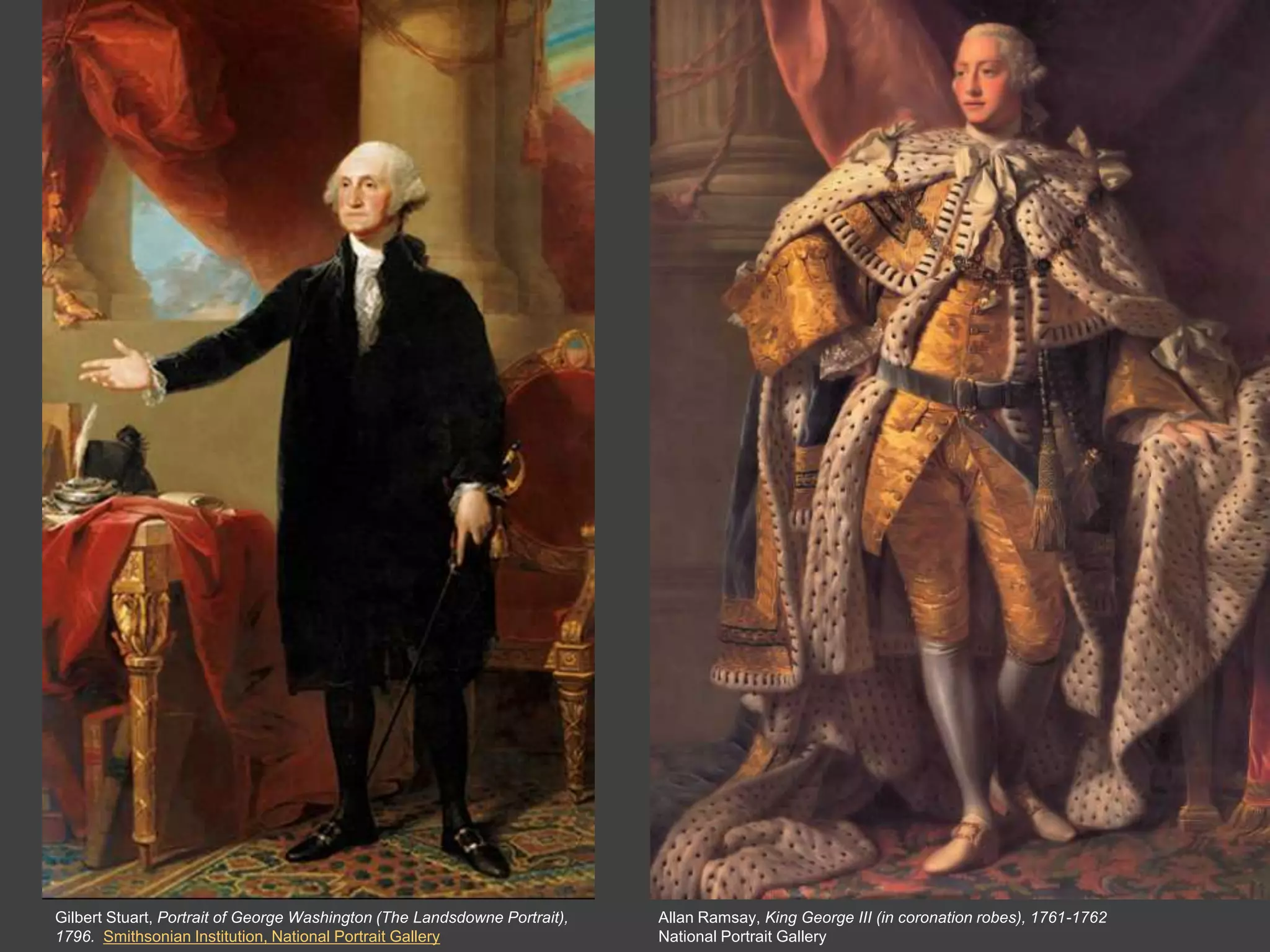
The Clothing


Gilbert Stuart, Portrait of George Washington (The Landsdowne Portrait),   Allan Ramsay, King George III (in coronation robes), 1761-1762
1796. Smithsonian Institution, National Portrait Gallery                   National Portrait Gallery
The Clothing


Gilbert Stuart, Portrait of George Washington (The Landsdowne Portrait),
1796. Smithsonian Institution, National Portrait Gallery
The Clothing


Gilbert Stuart, Portrait of George Washington (The Landsdowne Portrait),
1796. Smithsonian Institution, National Portrait Gallery
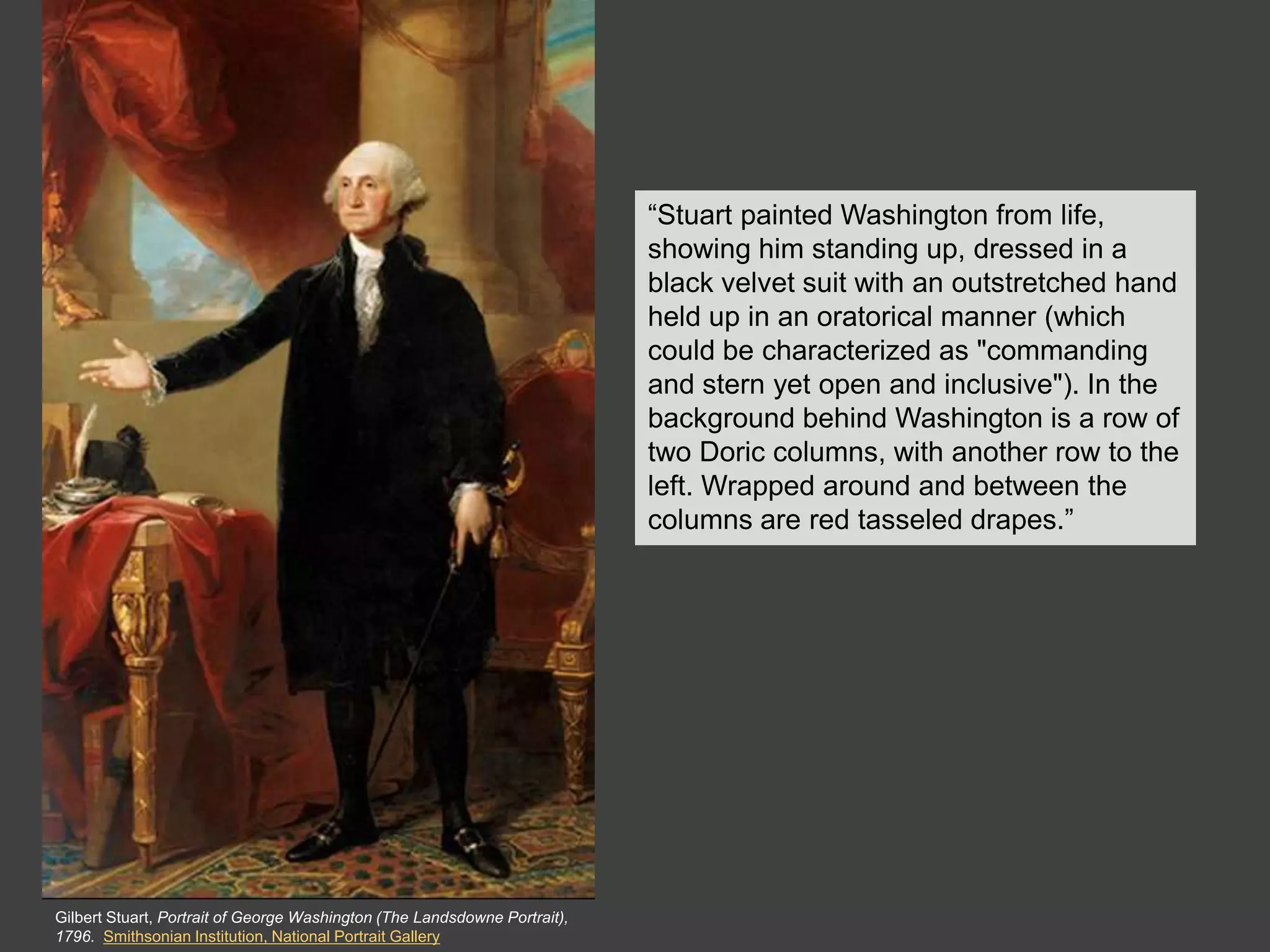
The Clothing
                                                                           “Stuart painted Washington from life,
                                                                           showing him standing up, dressed in a
                                                                           black velvet suit with an outstretched hand
                                                                           held up in an oratorical manner (which
                                                                           could be characterized as "commanding
                                                                           and stern yet open and inclusive"). In the
                                                                           background behind Washington is a row of
                                                                           two Doric columns, with another row to the
                                                                           left. Wrapped around and between the
                                                                           columns are red tasseled drapes.”


Gilbert Stuart, Portrait of George Washington (The Landsdowne Portrait),
1796. Smithsonian Institution, National Portrait Gallery
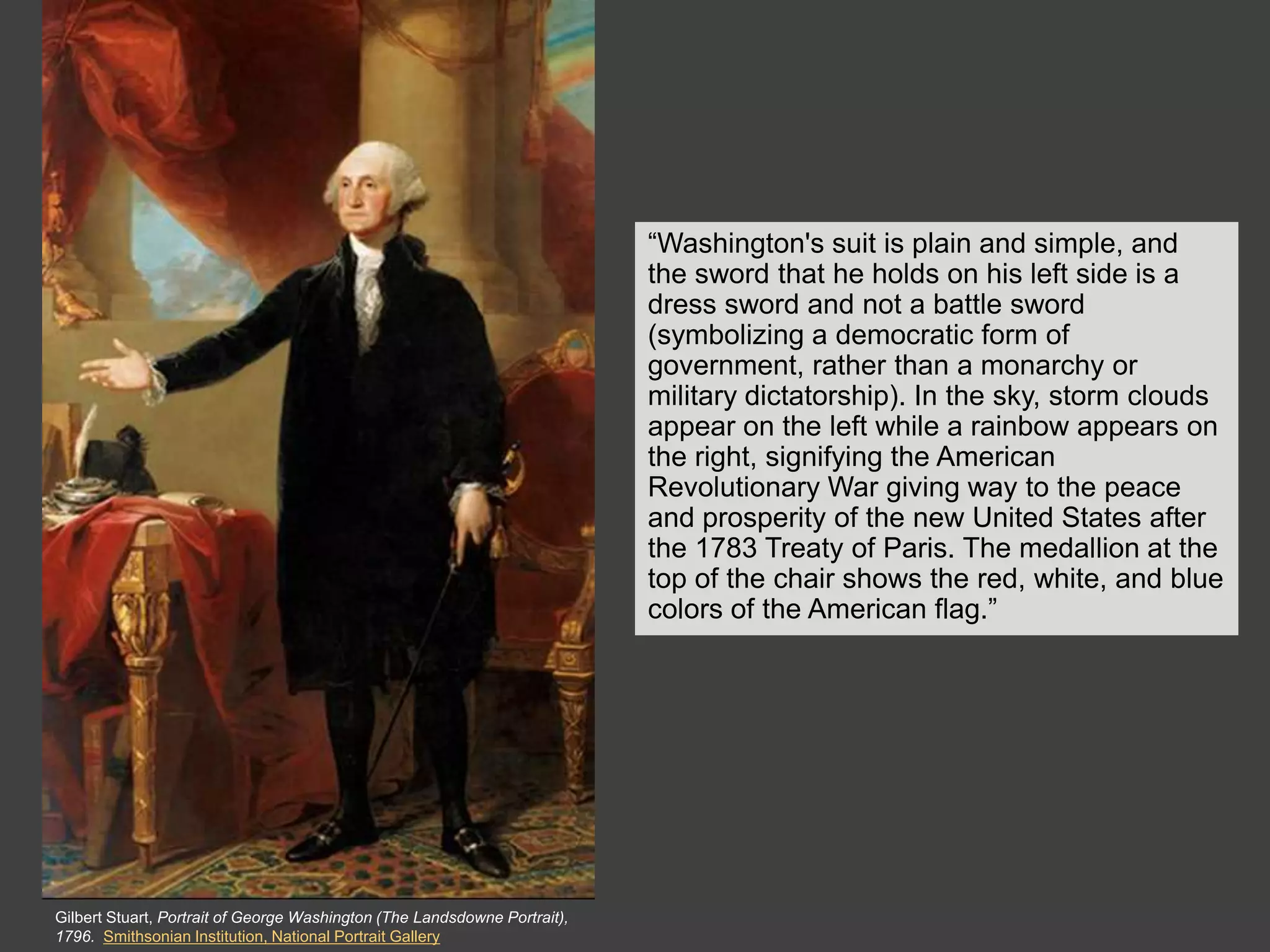
The Clothing

                                                                           “Washington's suit is plain and simple, and
                                                                           the sword that he holds on his left side is a
                                                                           dress sword and not a battle sword
                                                                           (symbolizing a democratic form of
                                                                           government, rather than a monarchy or
                                                                           military dictatorship). In the sky, storm clouds
                                                                           appear on the left while a rainbow appears on
                                                                           the right, signifying the American
                                                                           Revolutionary War giving way to the peace
                                                                           and prosperity of the new United States after
                                                                           the 1783 Treaty of Paris. The medallion at the
                                                                           top of the chair shows the red, white, and blue
                                                                           colors of the American flag.”


Gilbert Stuart, Portrait of George Washington (The Landsdowne Portrait),
1796. Smithsonian Institution, National Portrait Gallery
The Clothing


                                                                           “On and under the tablecloth-draped table to
                                                                           the left are two books: Federalist—probably
                                                                           a reference to the Federalist Papers—and
                                                                           Journal of Congress—the Congressional
                                                                           Record). Another five books are under the
                                                                           table . . . . The pen and paper on the table
                                                                           signify the rule of law . . . .”
                                                                           http://en.wikipedia.org/wiki/Lansdowne_portrait


Gilbert Stuart, Portrait of George Washington (The Landsdowne Portrait),
1796. Smithsonian Institution, National Portrait Gallery
Subject Matter
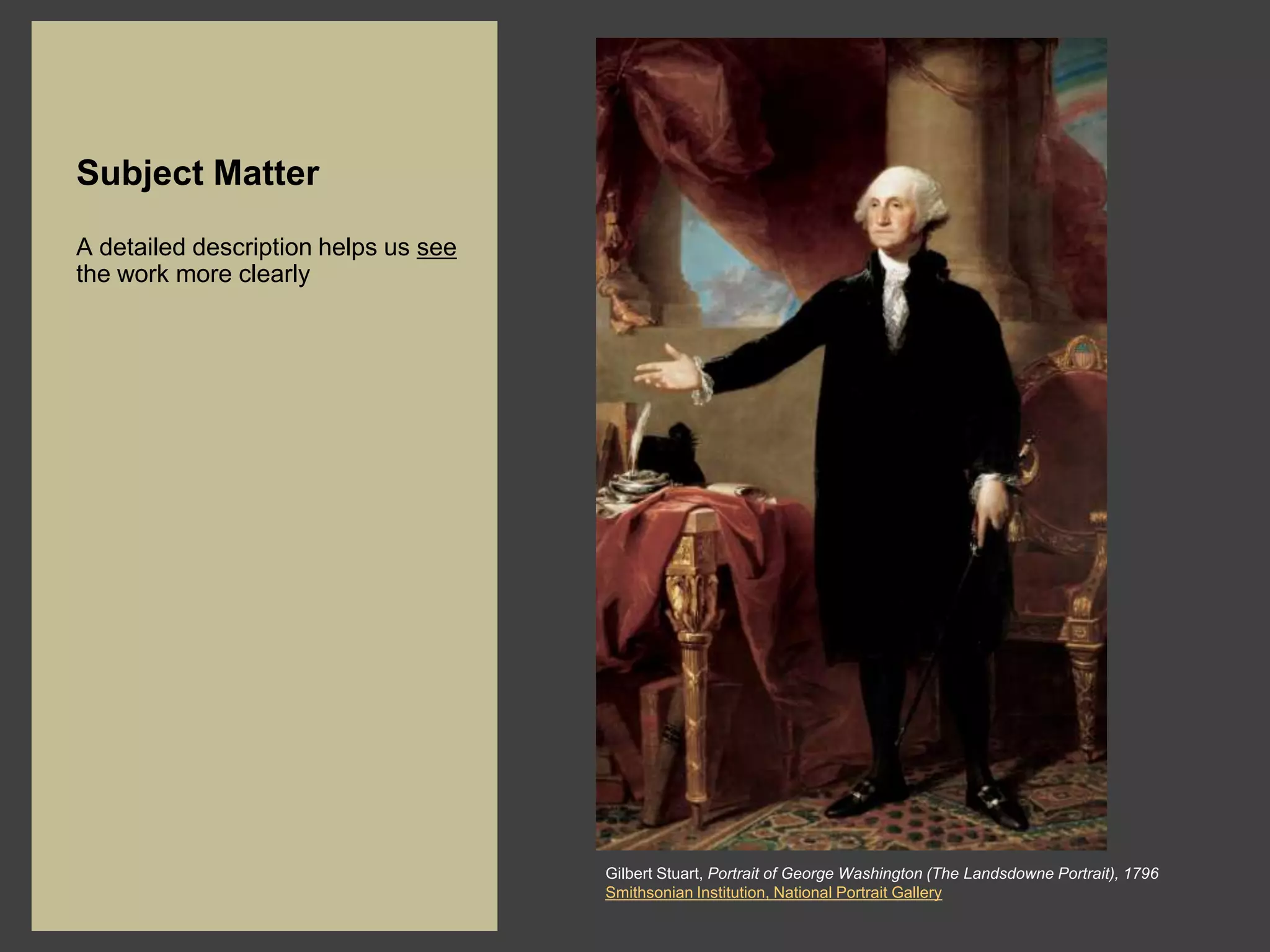
A detailed description helps us see
the work more clearly


                                      Gilbert Stuart, Portrait of George Washington (The Landsdowne Portrait), 1796
                                      Smithsonian Institution, National Portrait Gallery
Style
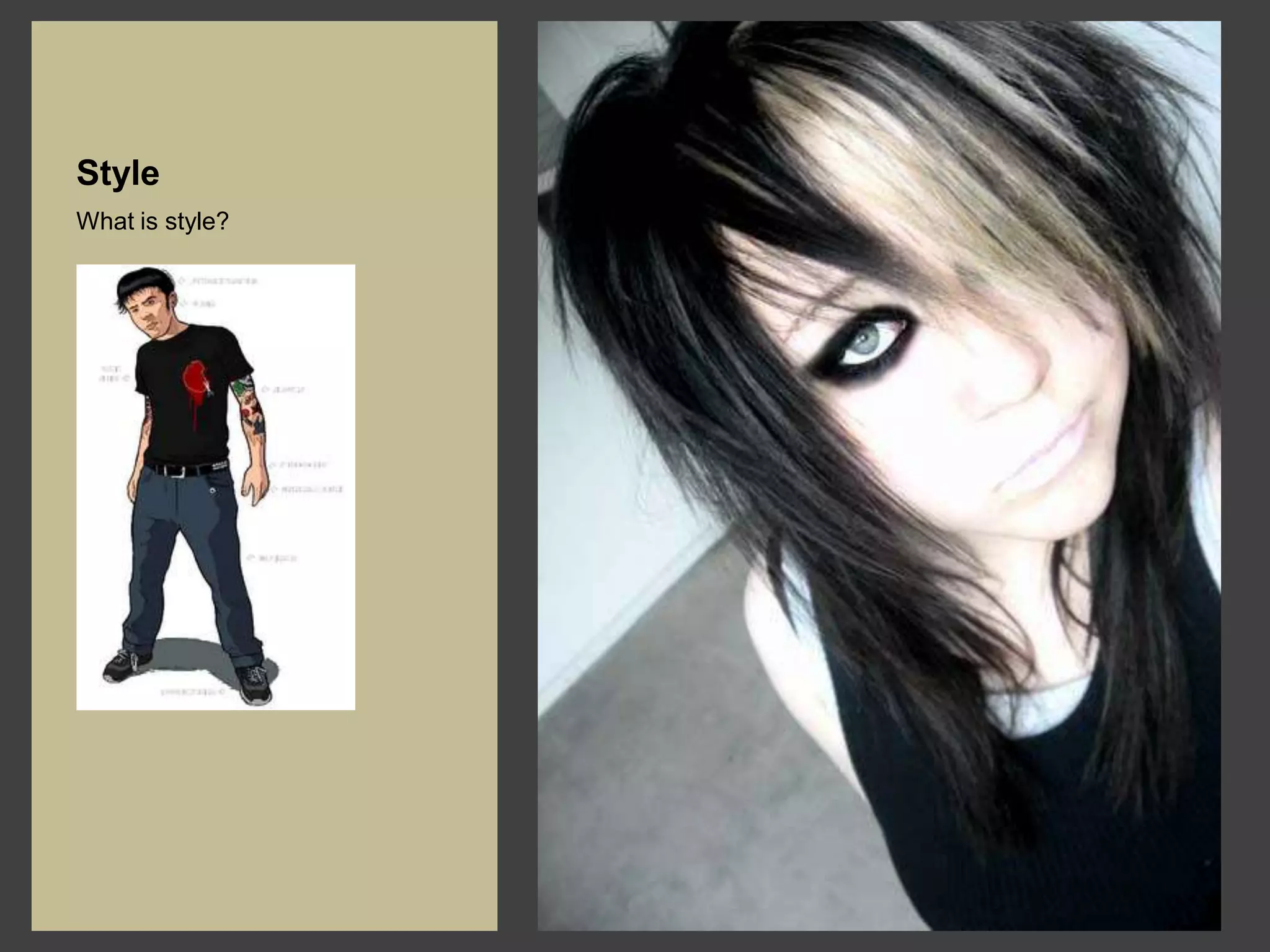
What is style?
Style
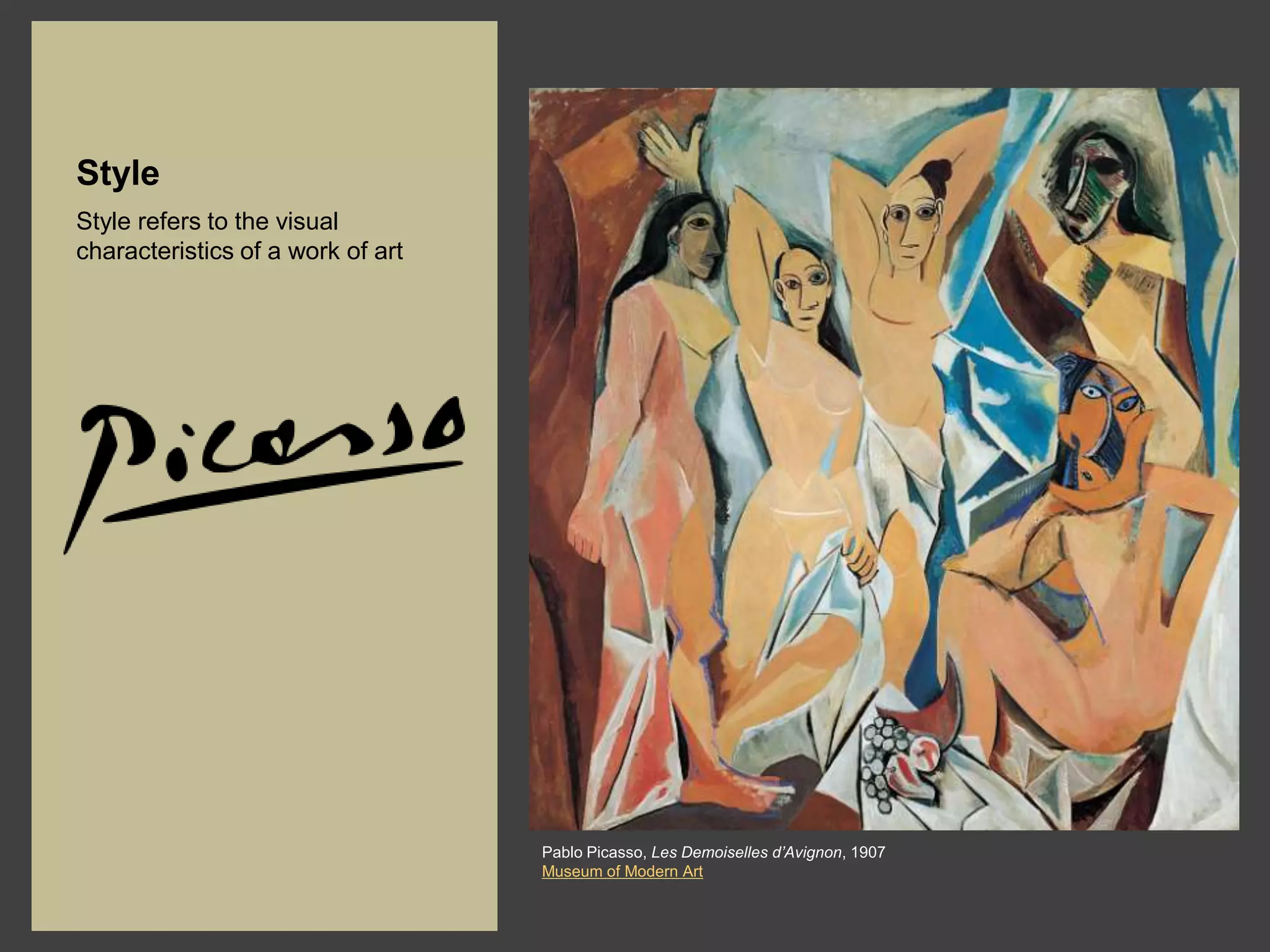
Style refers to the visual
characteristics of a work of art


                                   Pablo Picasso, Les Demoiselles d’Avignon, 1907
                                   Museum of Modern Art
Style
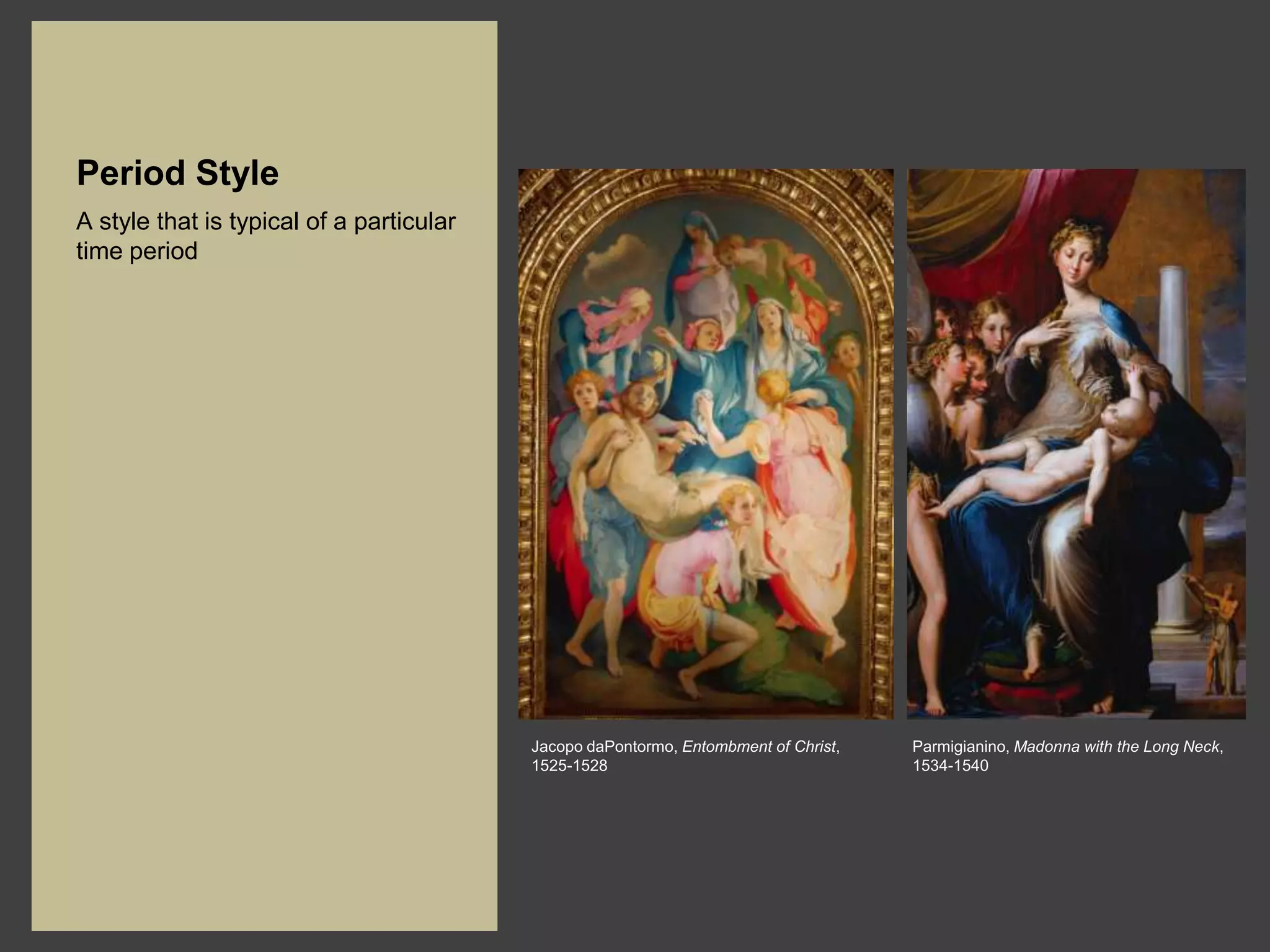
Period Style
A style that is typical of a particular
time period


                                          Jacopo daPontormo, Entombment of Christ,   Parmigianino, Madonna with the Long Neck,
                                          1525-1528                                  1534-1540
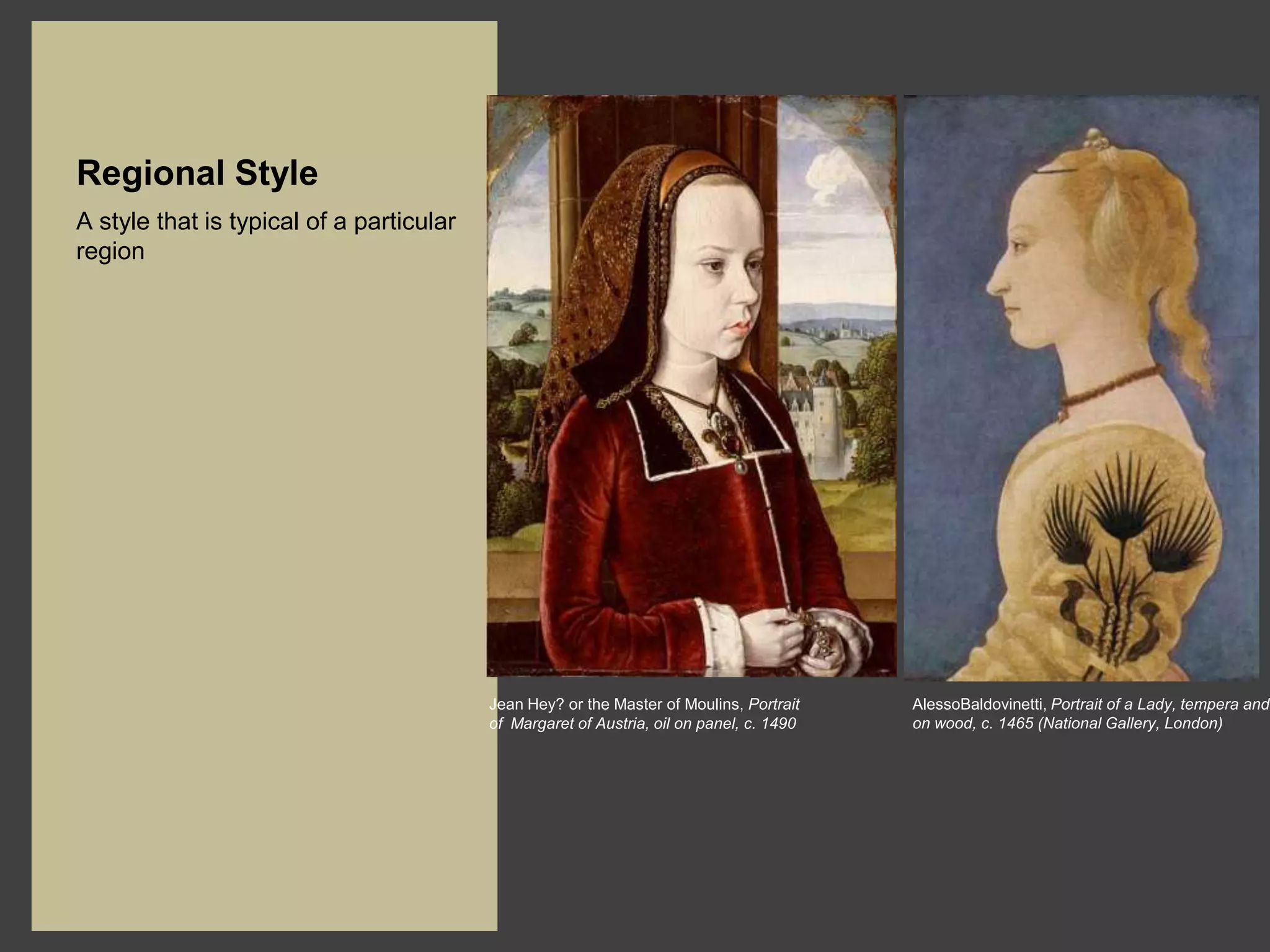
Regional Style
A style that is typical of a particular
region


                                          Jean Hey? or the Master of Moulins, Portrait    AlessoBaldovinetti, Portrait of a Lady, tempera and
                                          of
Margaret of Austria, oil on panel, c. 1490   on wood, c. 1465 (National Gallery, London)
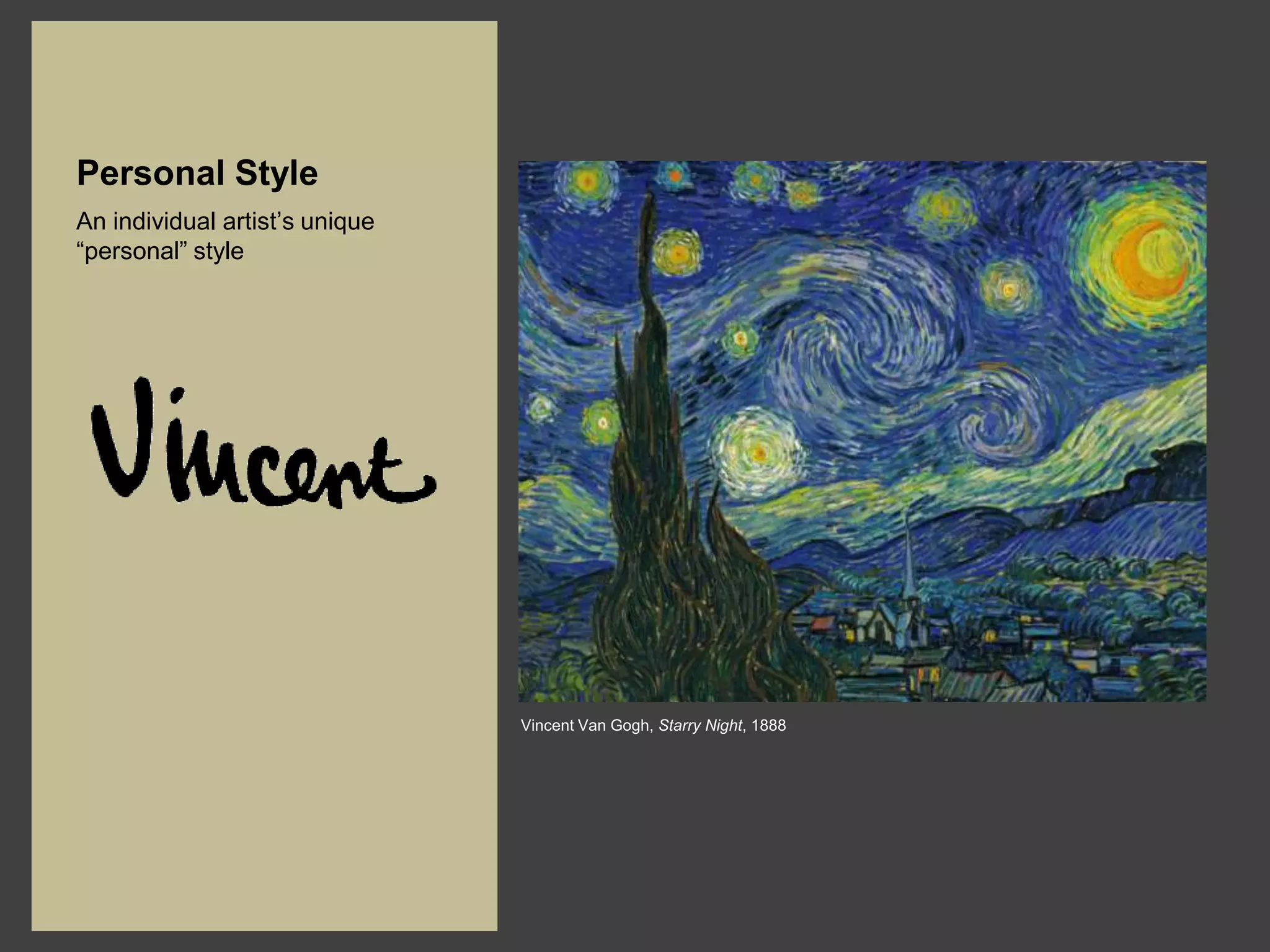
Personal Style
An individual artist’s unique
“personal” style


                                Vincent Van Gogh, Starry Night, 1888
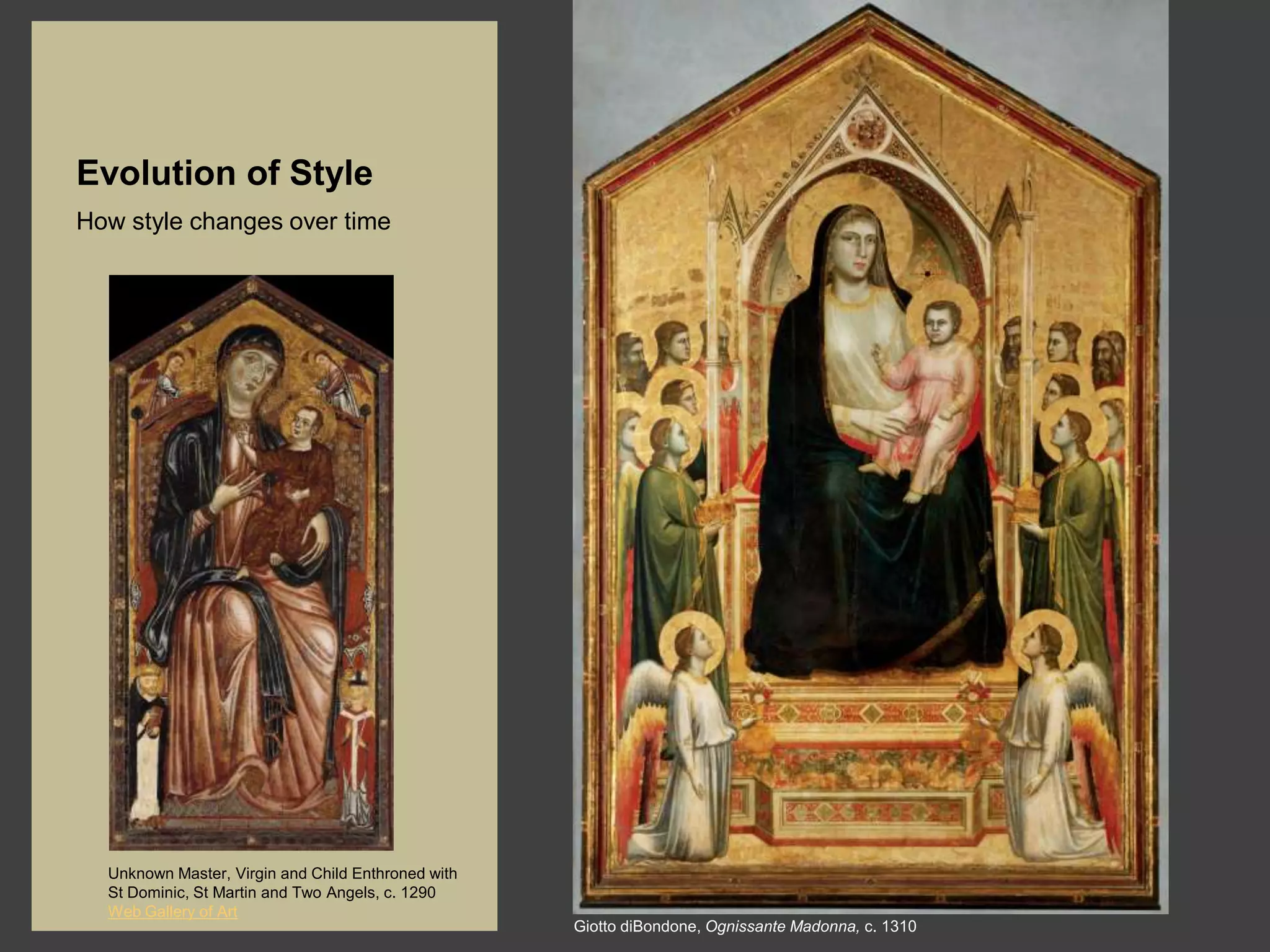
Evolution of Style
How style changes over time


  Unknown Master, Virgin and Child Enthroned with
  St Dominic, St Martin and Two Angels, c. 1290
  Web Gallery of Art
                                                    Giotto diBondone, Ognissante Madonna, c. 1310
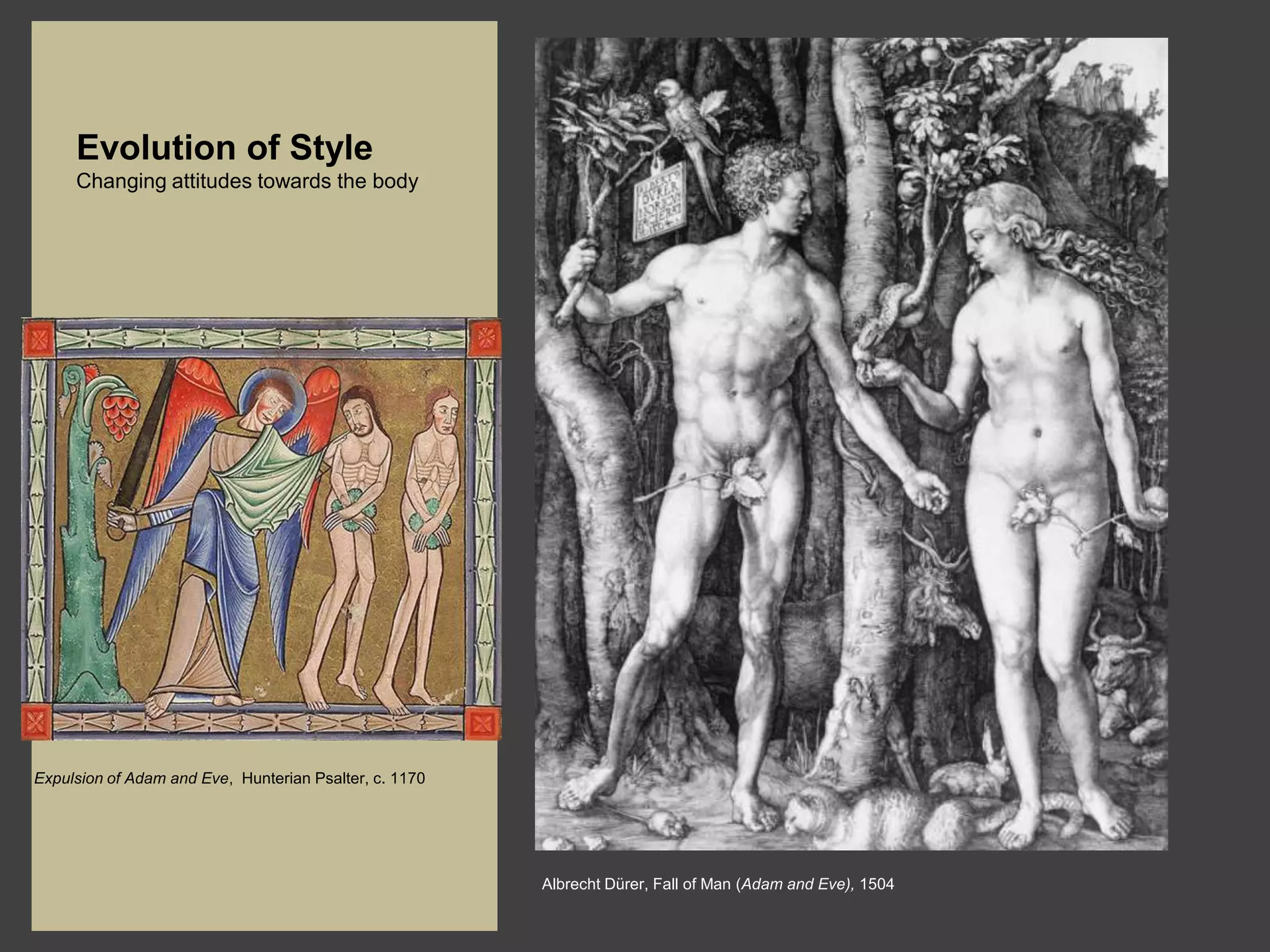
Evolution of Style
     Changing attitudes towards the body


Expulsion of Adam and Eve, Hunterian Psalter, c. 1170


                                                        Albrecht Dürer, Fall of Man (Adam and Eve), 1504
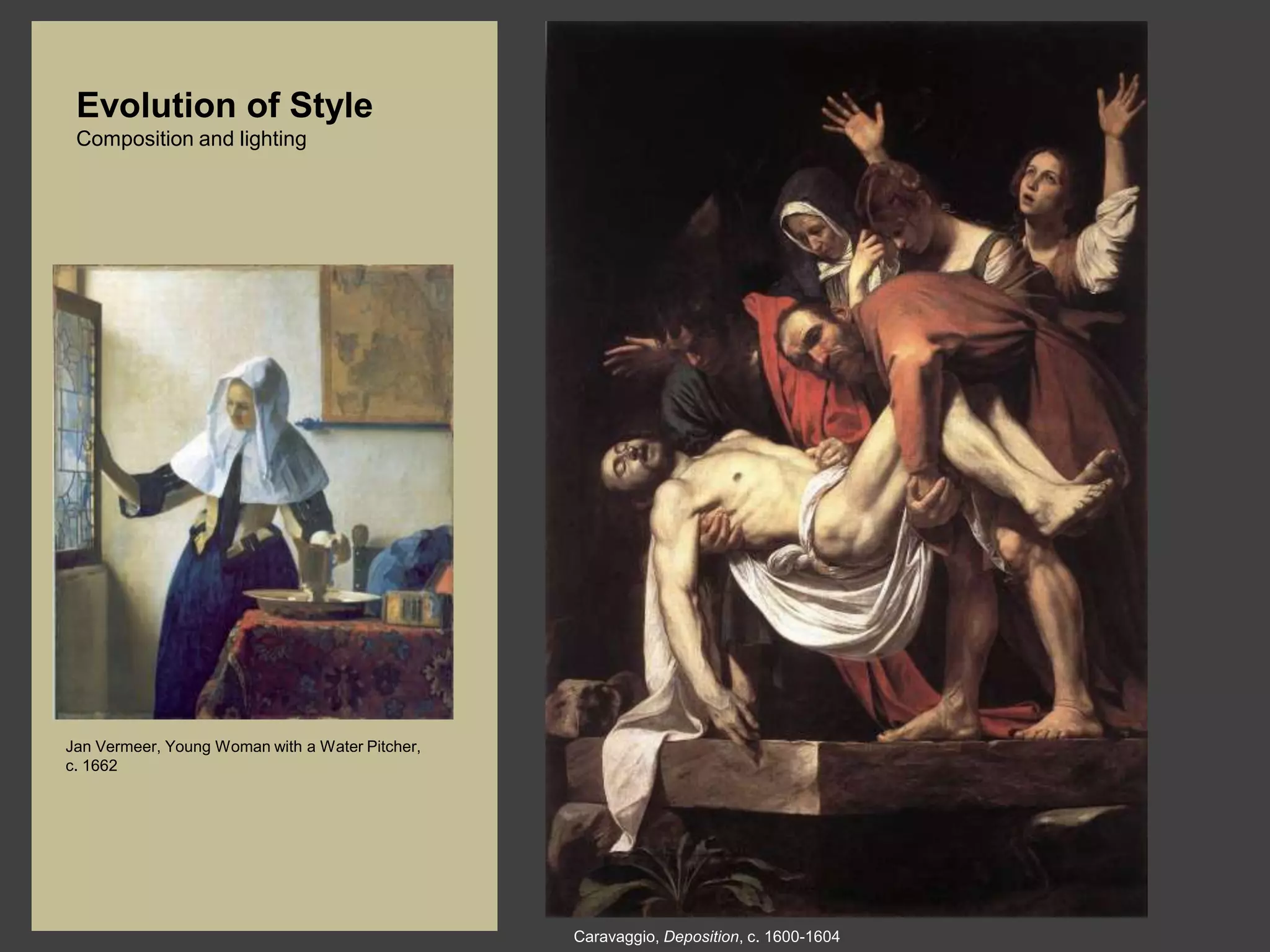
Evolution of Style
 Composition and lighting


Jan Vermeer, Young Woman with a Water Pitcher,
c. 1662


                                                 Caravaggio, Deposition, c. 1600-1604
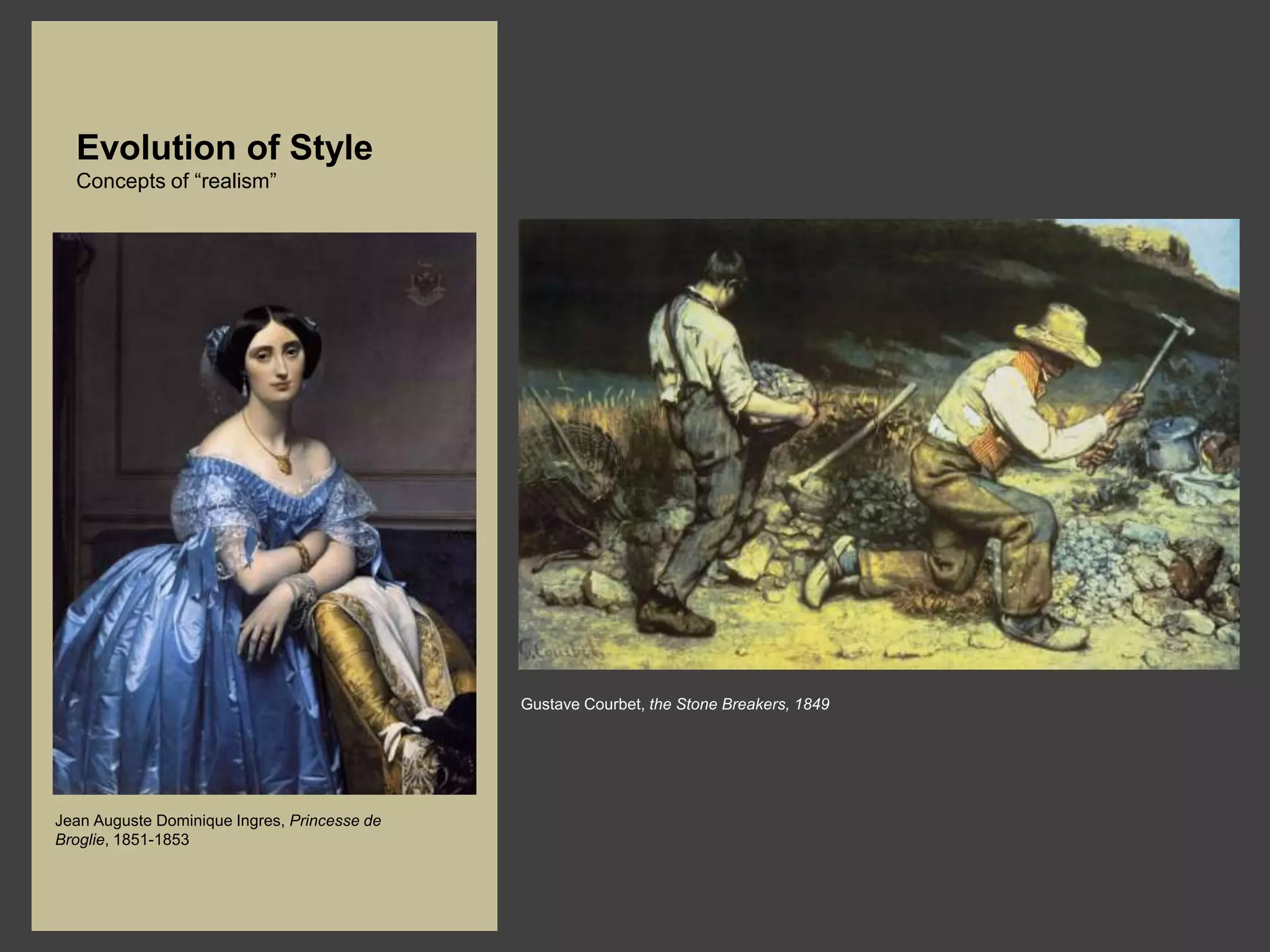
Evolution of Style
  Concepts of “realism”


                                              Gustave Courbet, the Stone Breakers, 1849


Jean Auguste Dominique Ingres, Princesse de
Broglie, 1851-1853
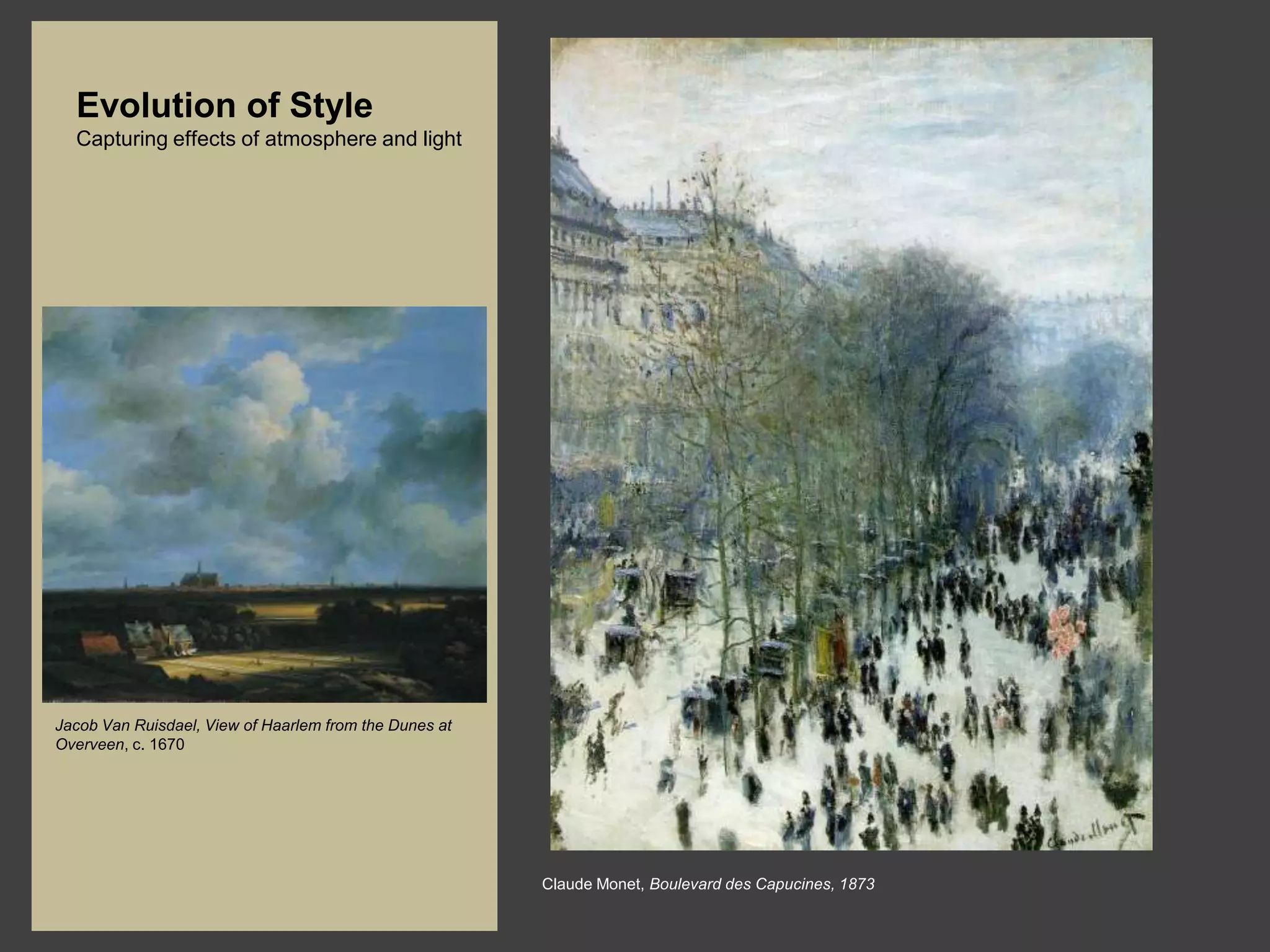
Evolution of Style
  Capturing effects of atmosphere and light


Jacob Van Ruisdael, View of Haarlem from the Dunes at
Overveen, c. 1670


                                                        Claude Monet, Boulevard des Capucines, 1873
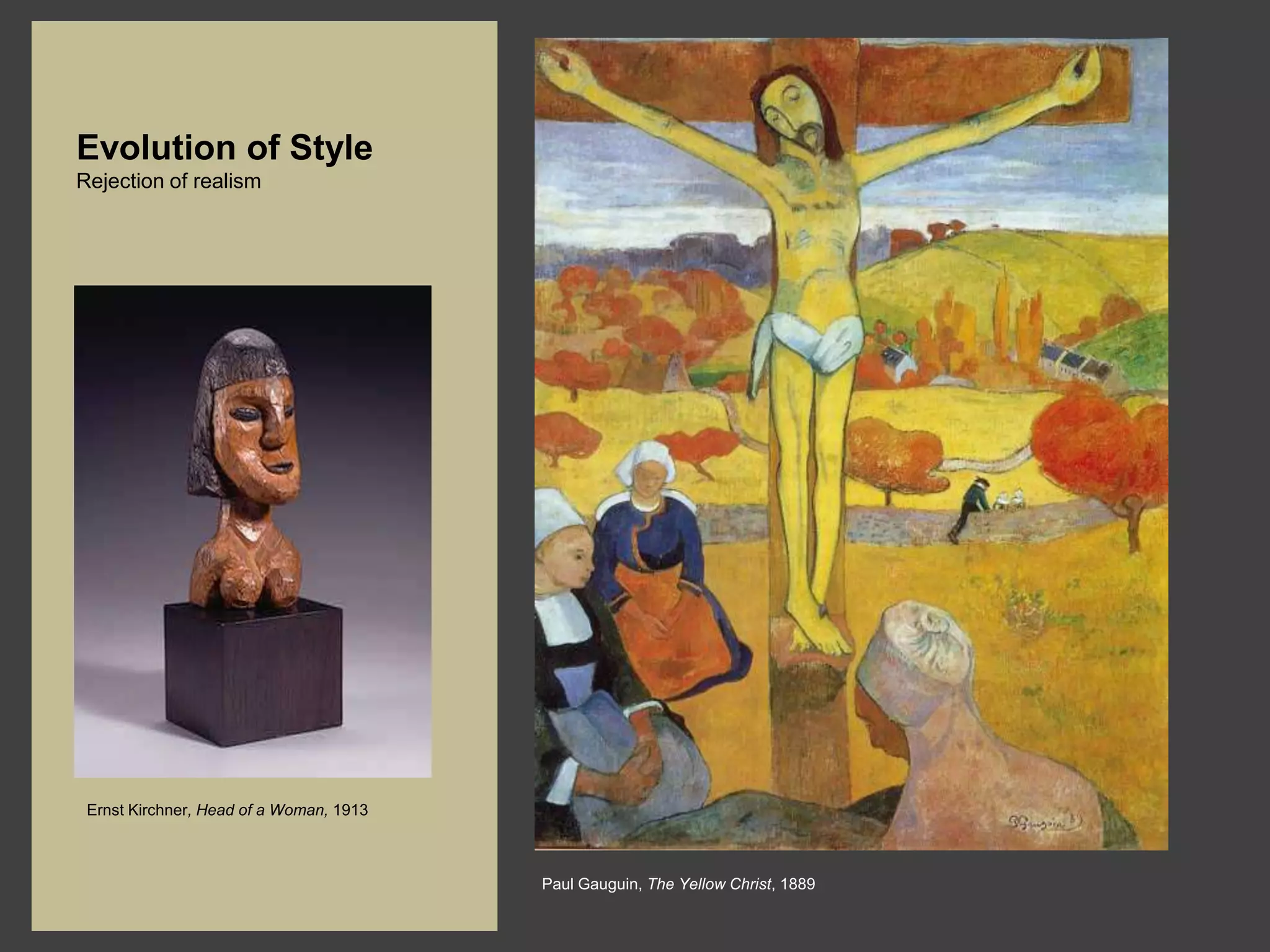
Evolution of Style
Rejection of realism


 Ernst Kirchner, Head of a Woman, 1913


                                         Paul Gauguin, The Yellow Christ, 1889
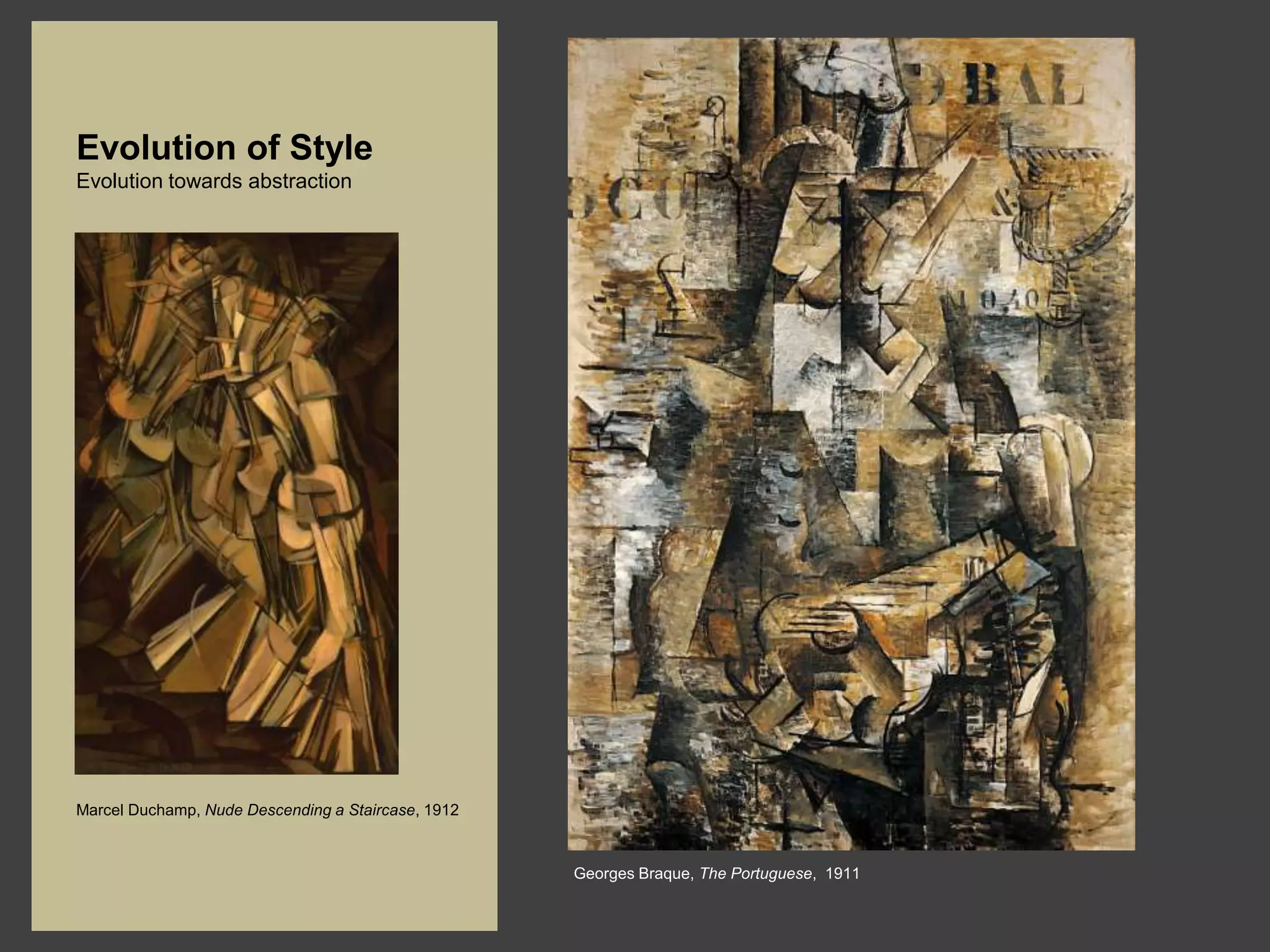
Evolution of Style
Evolution towards abstraction


Marcel Duchamp, Nude Descending a Staircase, 1912


                                                    Georges Braque, The Portuguese, 1911
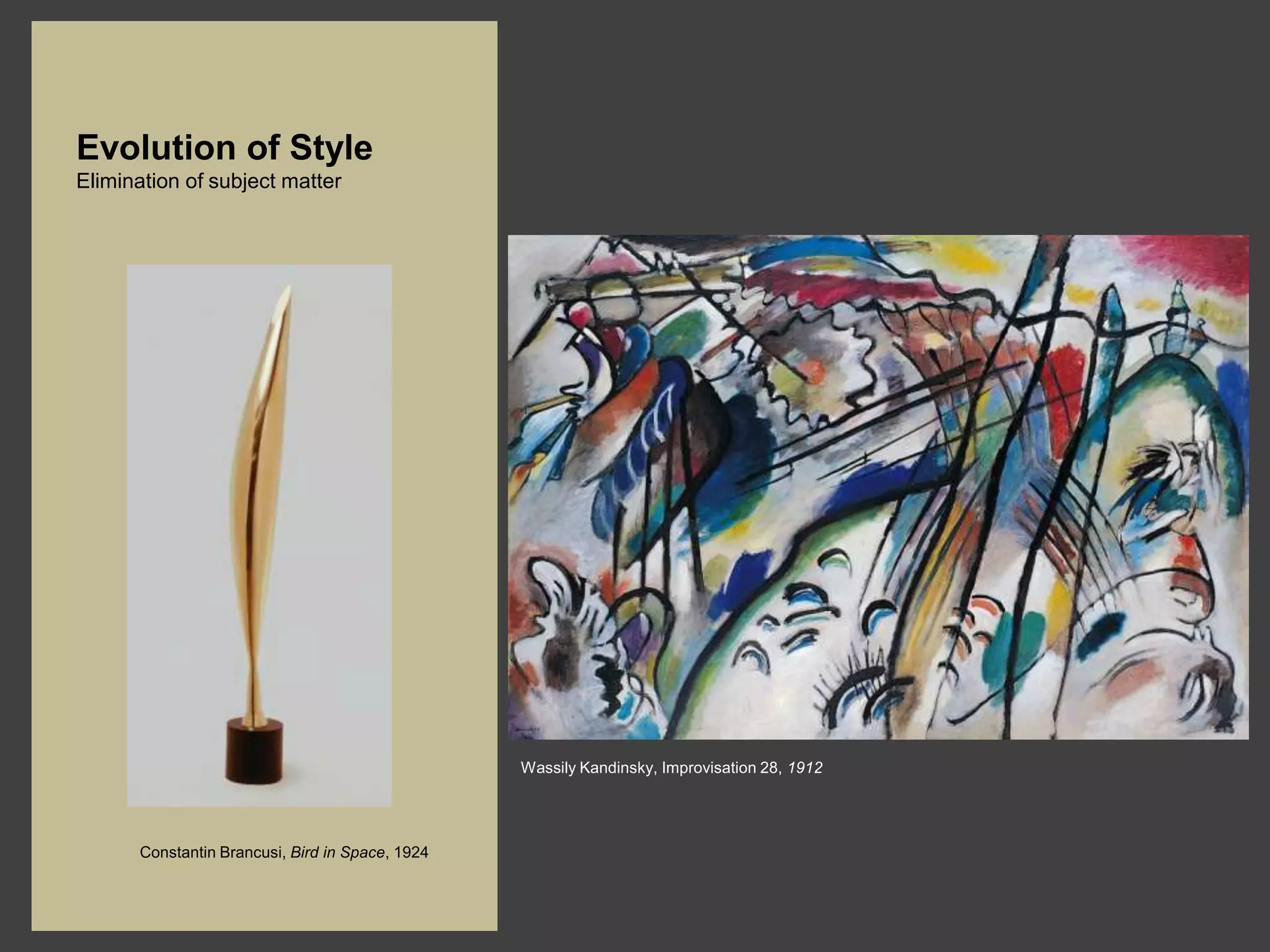
Evolution of Style
Elimination of subject matter


                                                 Wassily Kandinsky, Improvisation 28, 1912


      Constantin Brancusi, Bird in Space, 1924
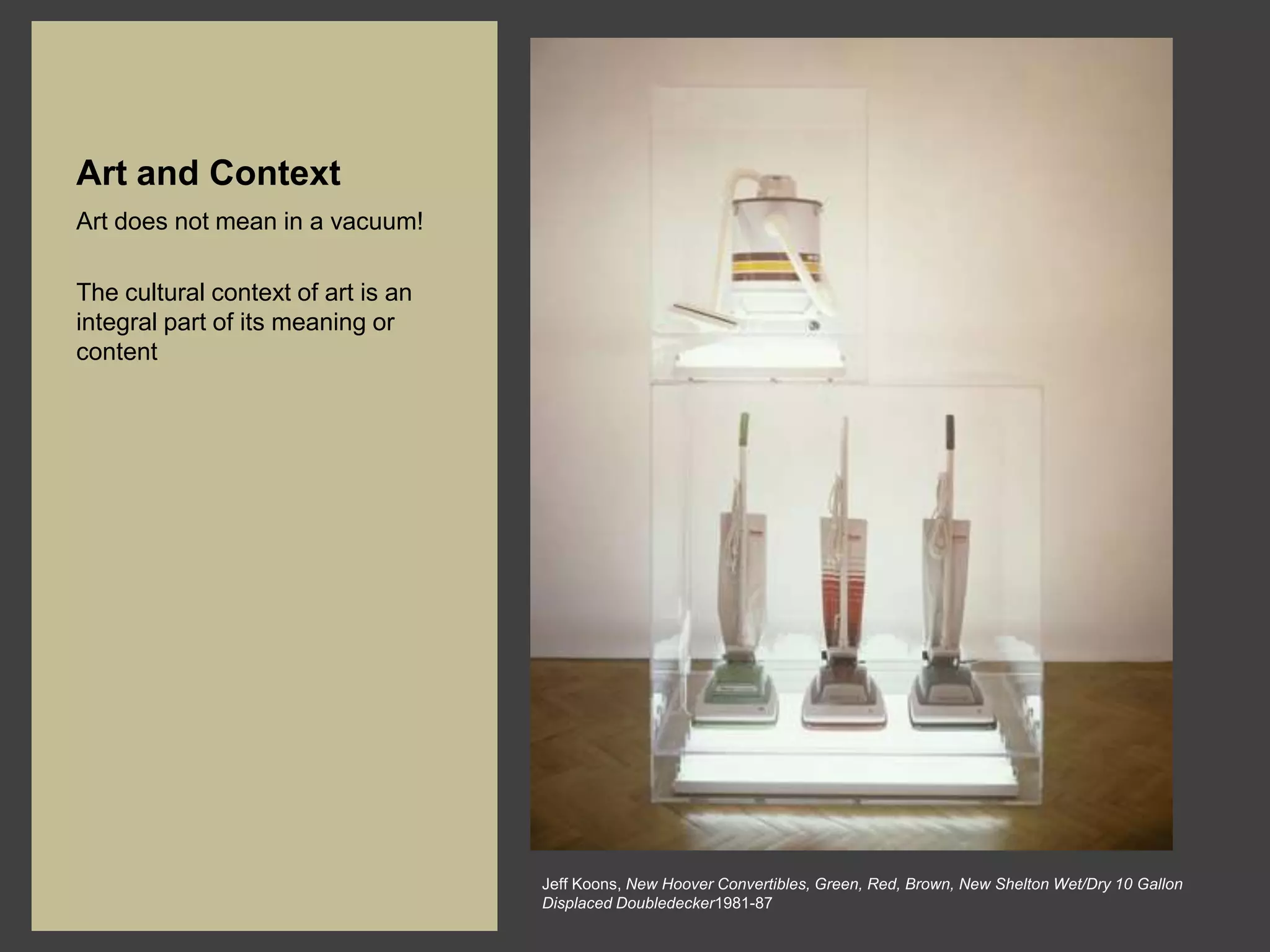
Art and Context
Art does not mean in a vacuum!

The cultural context of art is an
integral part of its meaning or
content


                                    Jeff Koons, New Hoover Convertibles, Green, Red, Brown, New Shelton Wet/Dry 10 Gallon
                                    Displaced Doubledecker1981-87
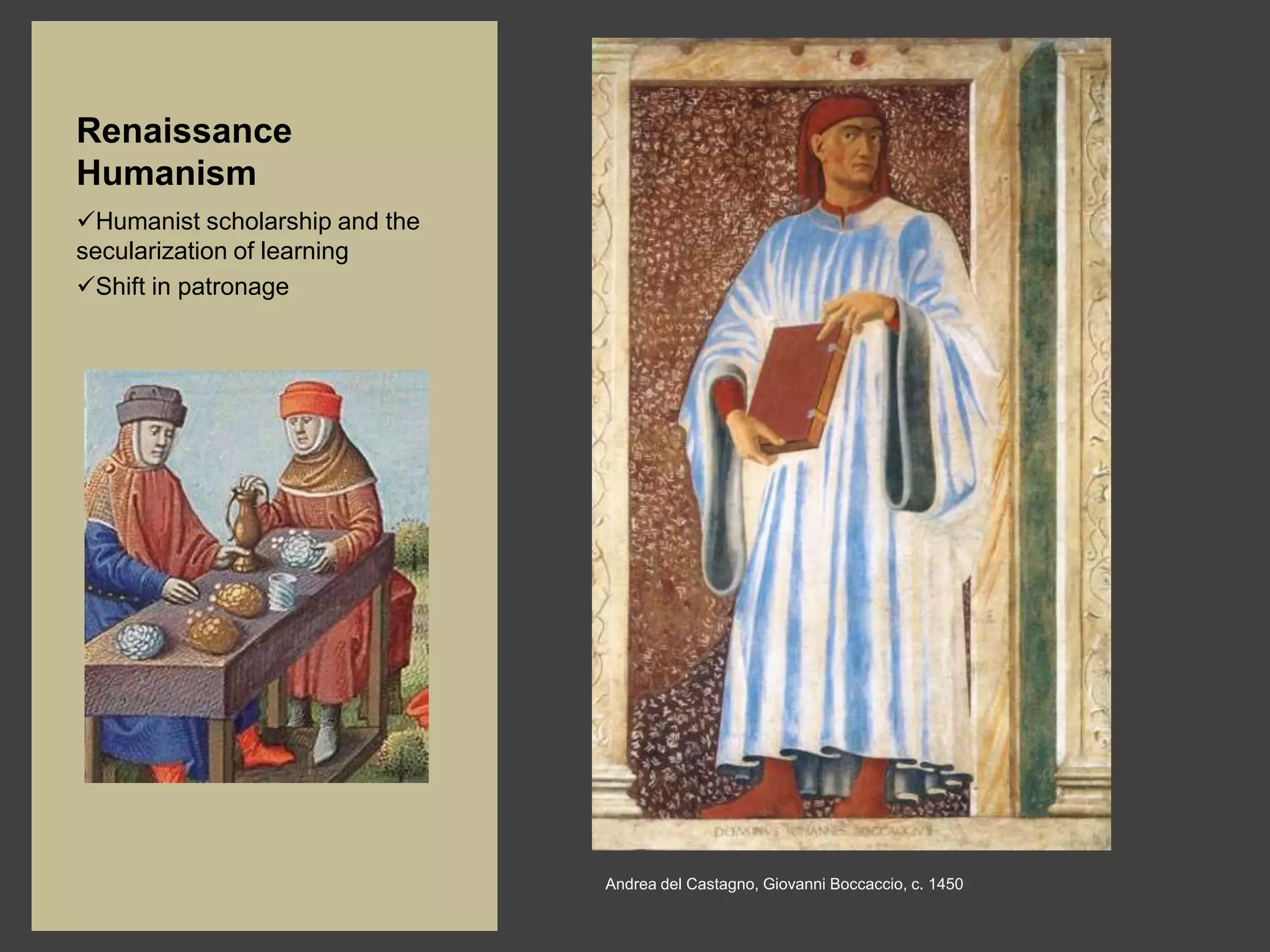
Renaissance
Humanism
Humanist scholarship and the
secularization of learning
Shift in patronage


                                Andrea del Castagno, Giovanni Boccaccio, c. 1450
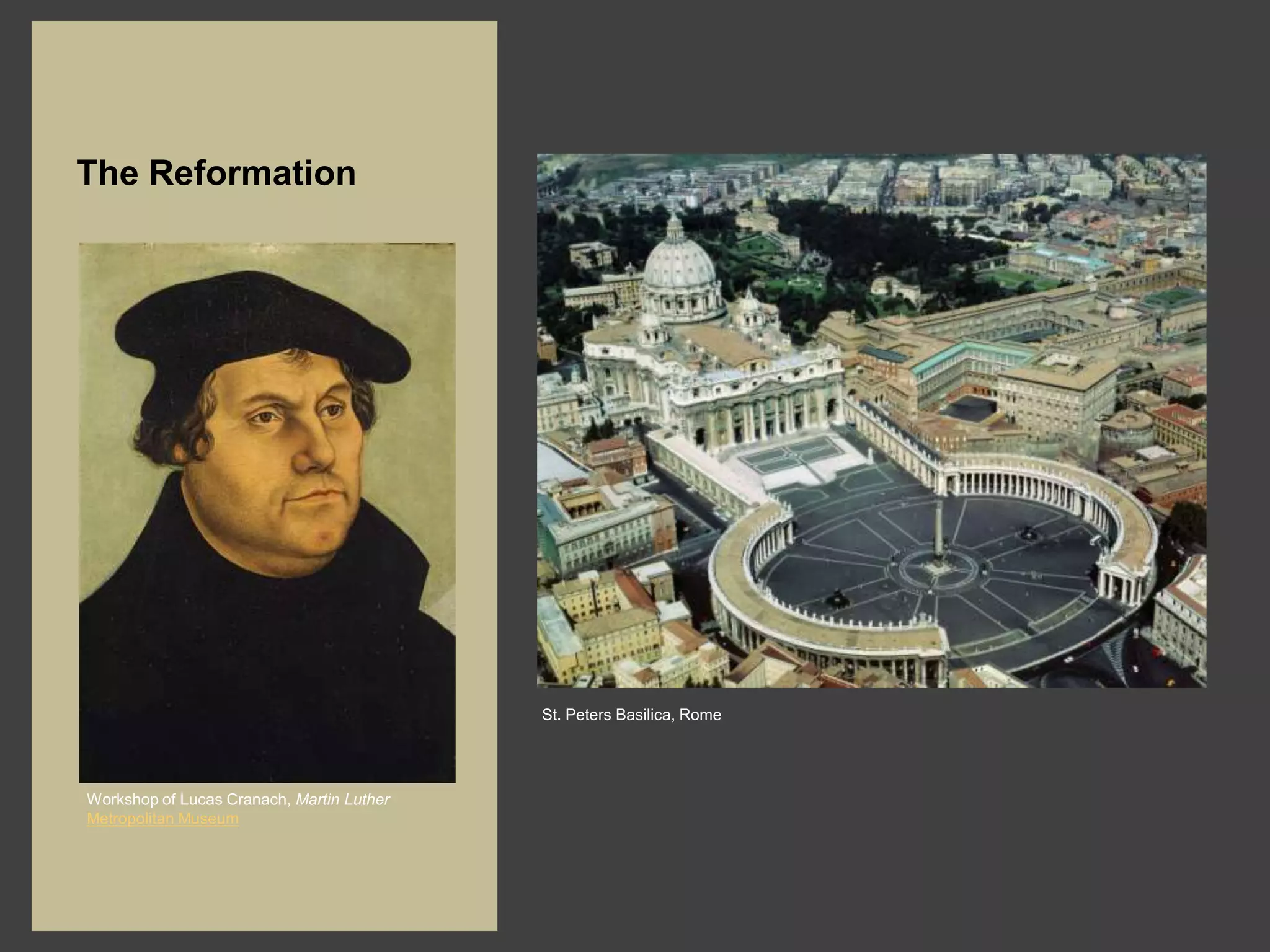
The Reformation


                                           St. Peters Basilica, Rome


Workshop of Lucas Cranach, Martin Luther
Metropolitan Museum
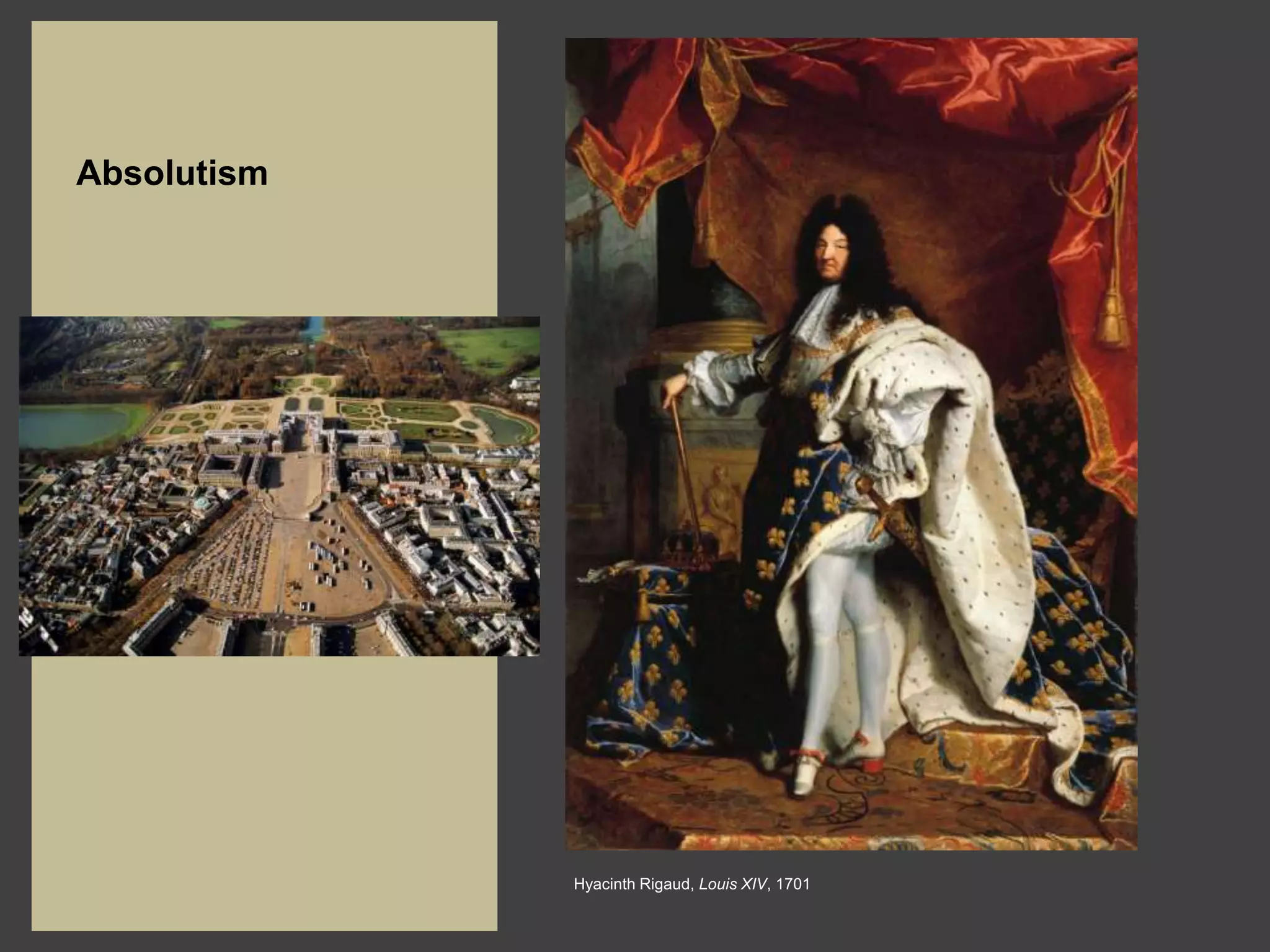
Absolutism


             Hyacinth Rigaud, Louis XIV, 1701
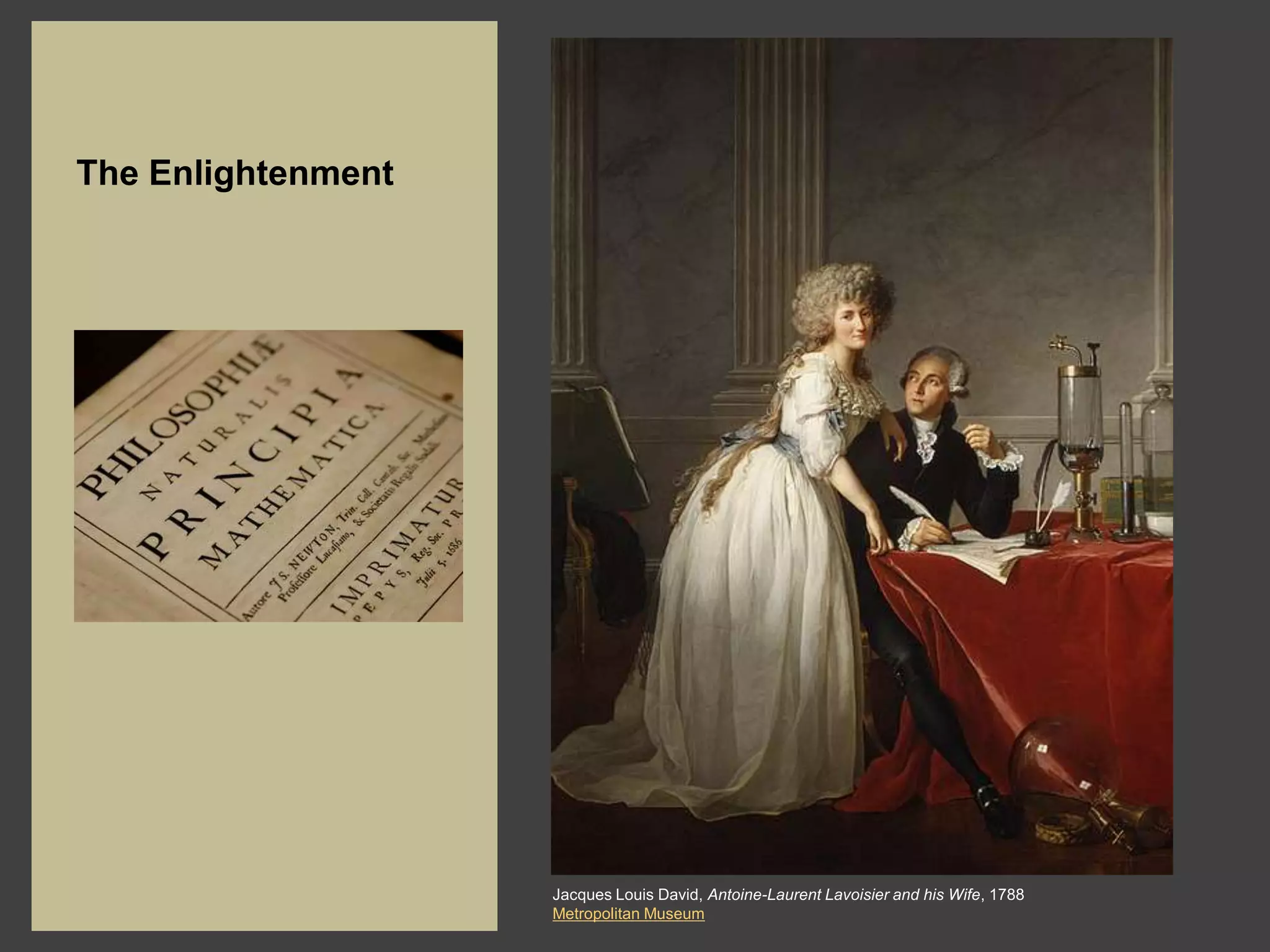
The Enlightenment


                    Jacques Louis David, Antoine-Laurent Lavoisier and his Wife, 1788
                    Metropolitan Museum
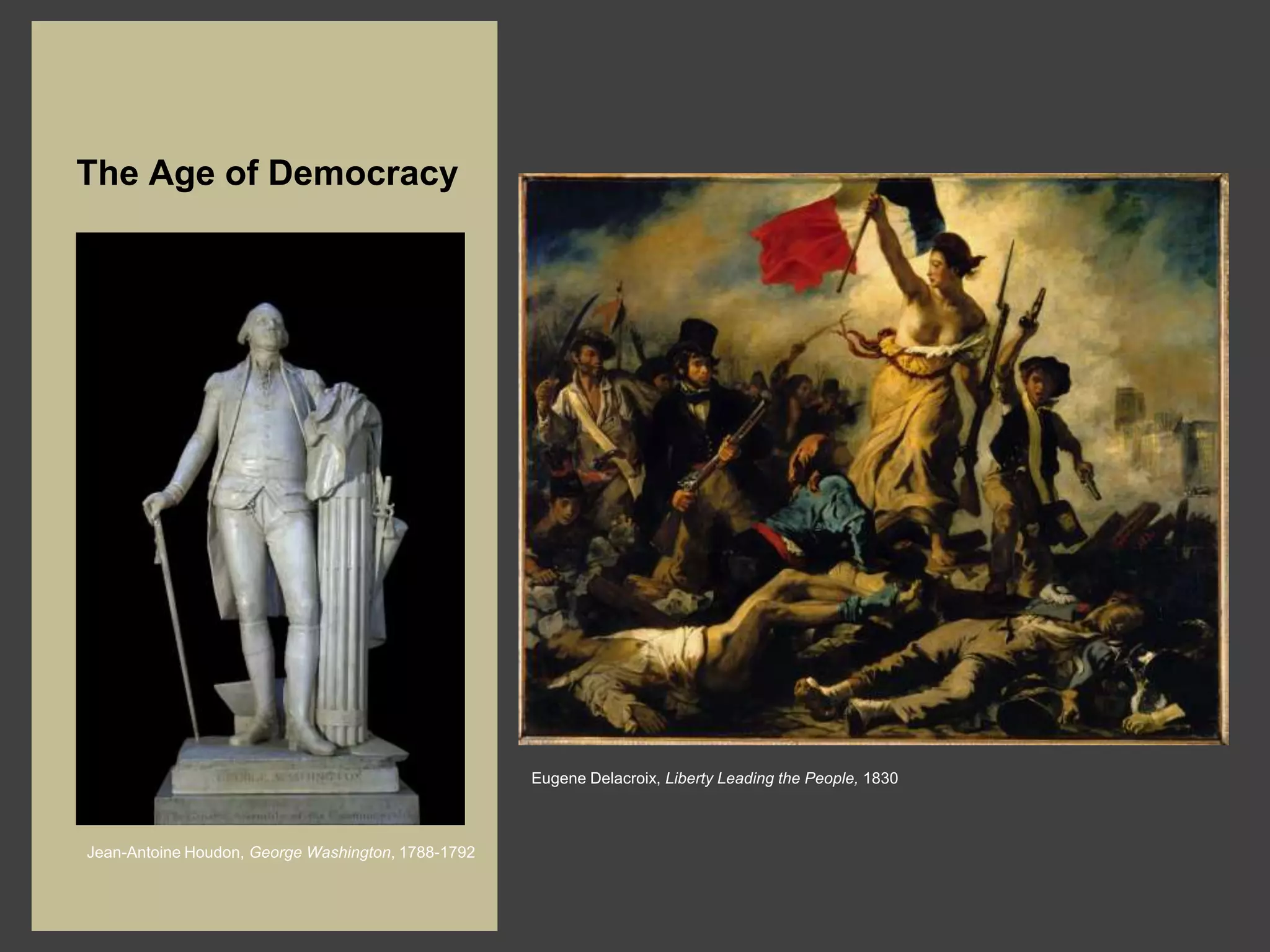
The Age of Democracy


                                                    Eugene Delacroix, Liberty Leading the People, 1830


Jean-Antoine Houdon, George Washington, 1788-1792
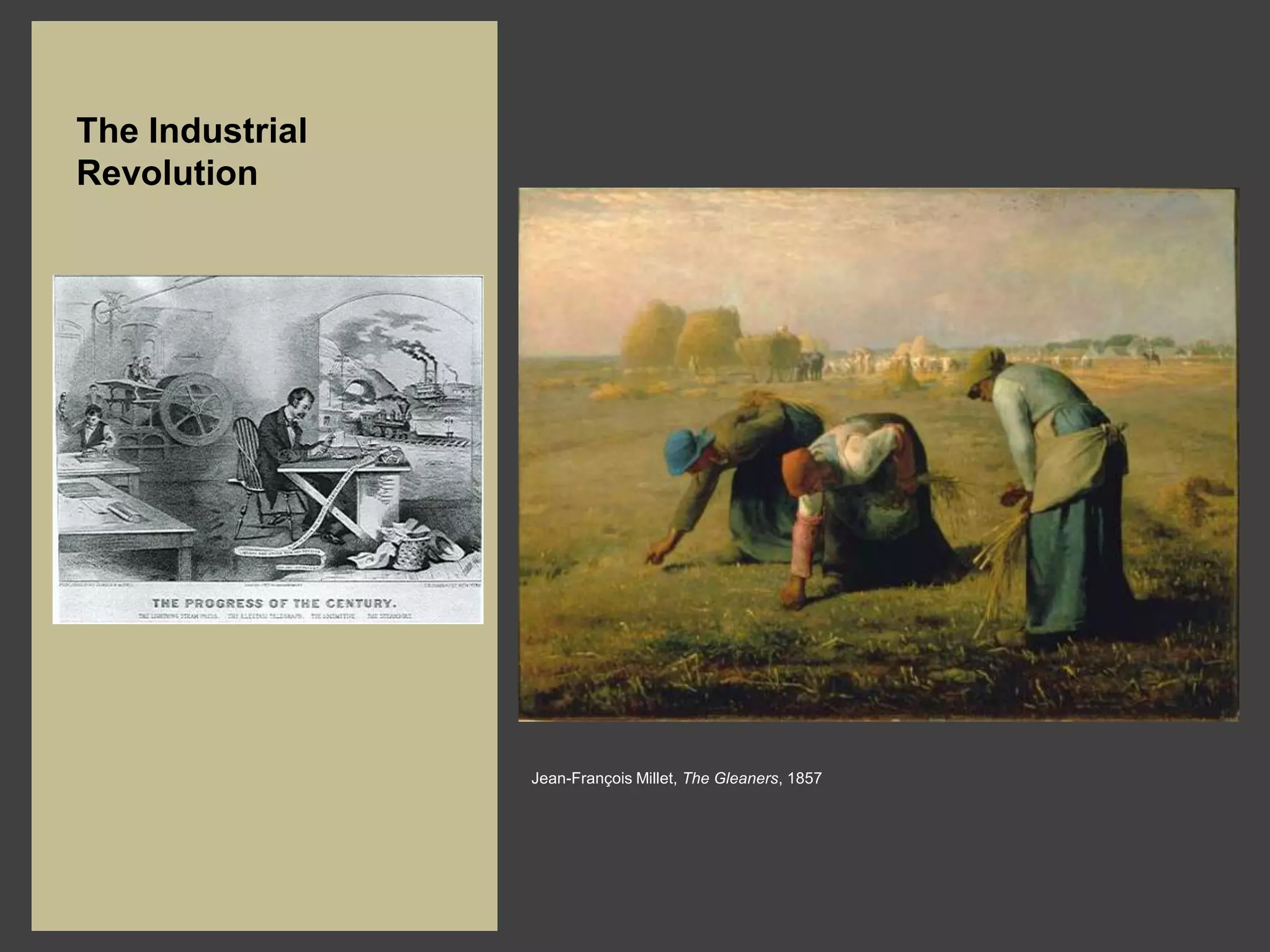
The Industrial
Revolution


                 Jean-François Millet, The Gleaners, 1857
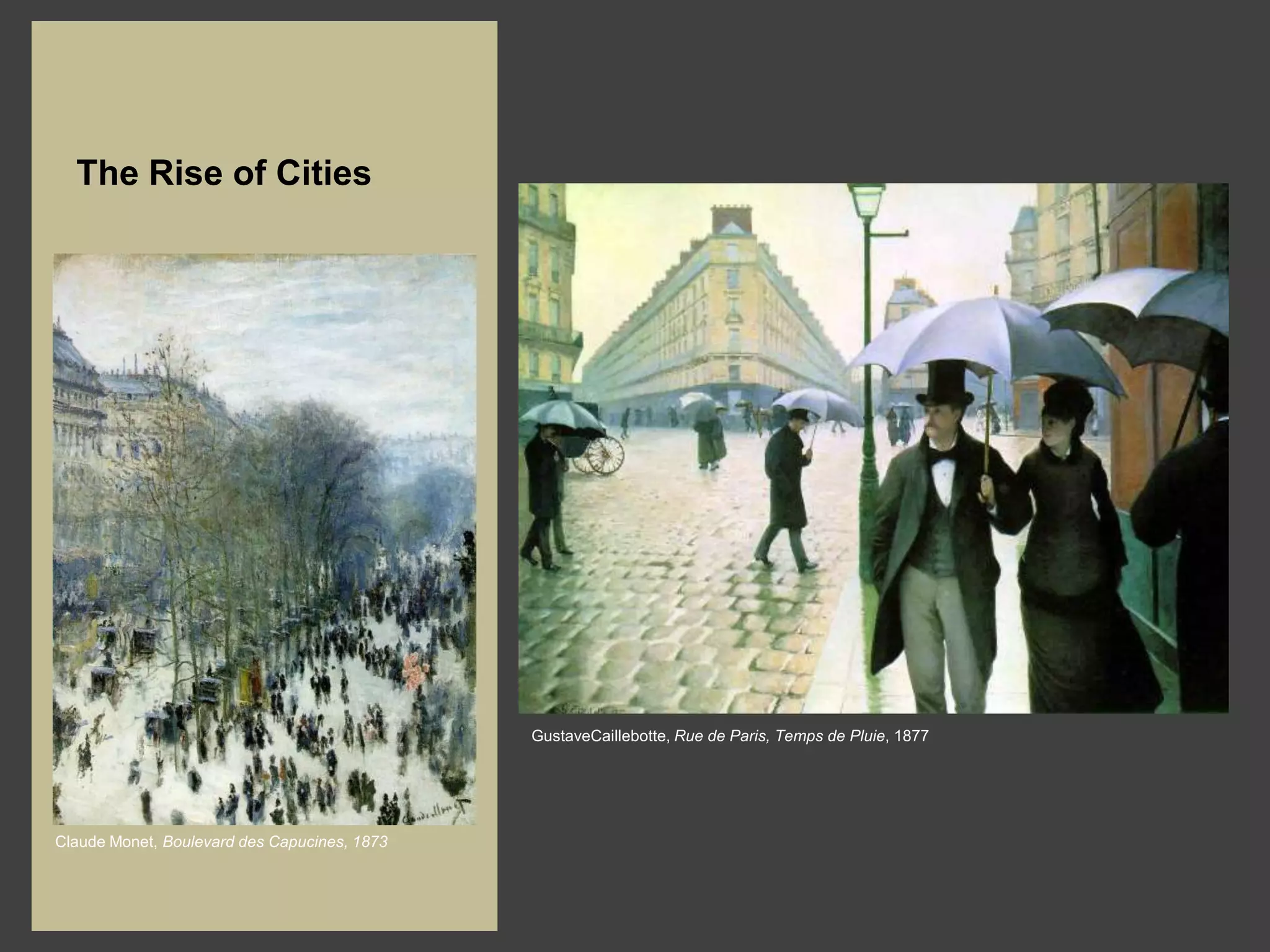
The Rise of Cities


                                              GustaveCaillebotte, Rue de Paris, Temps de Pluie, 1877


Claude Monet, Boulevard des Capucines, 1873
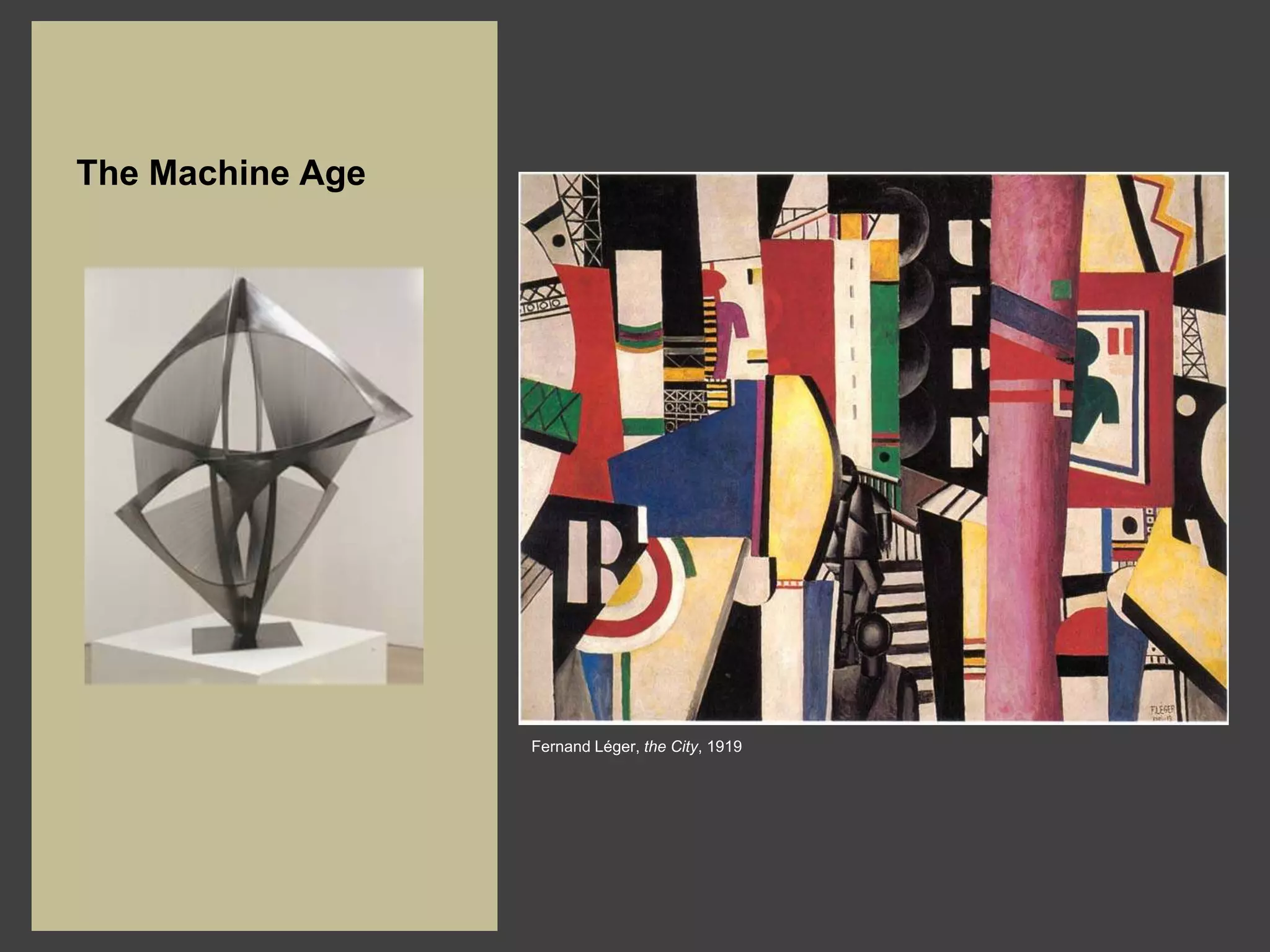
The Machine Age


                  Fernand Léger, the City, 1919
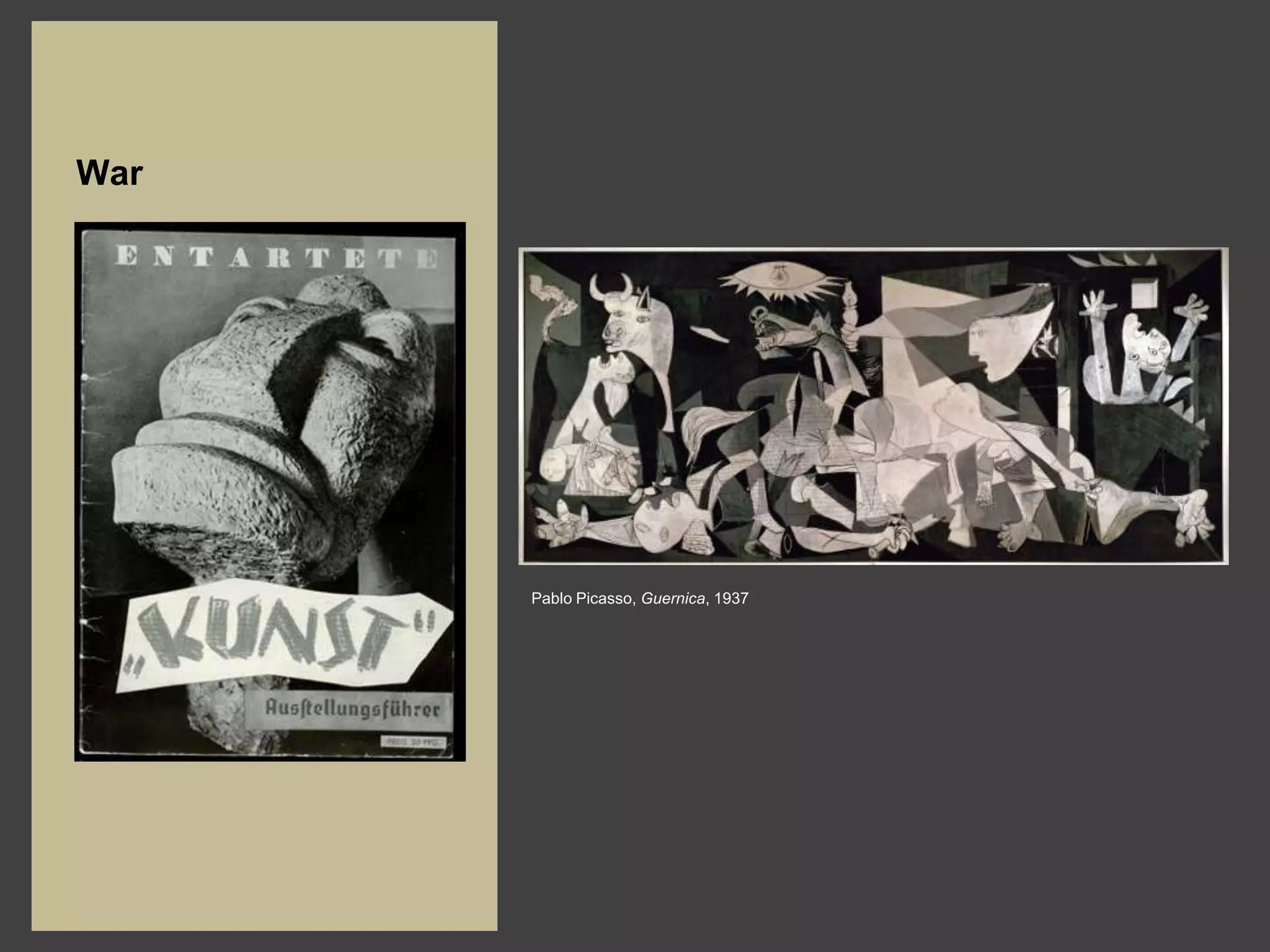
War


      Pablo Picasso, Guernica, 1937
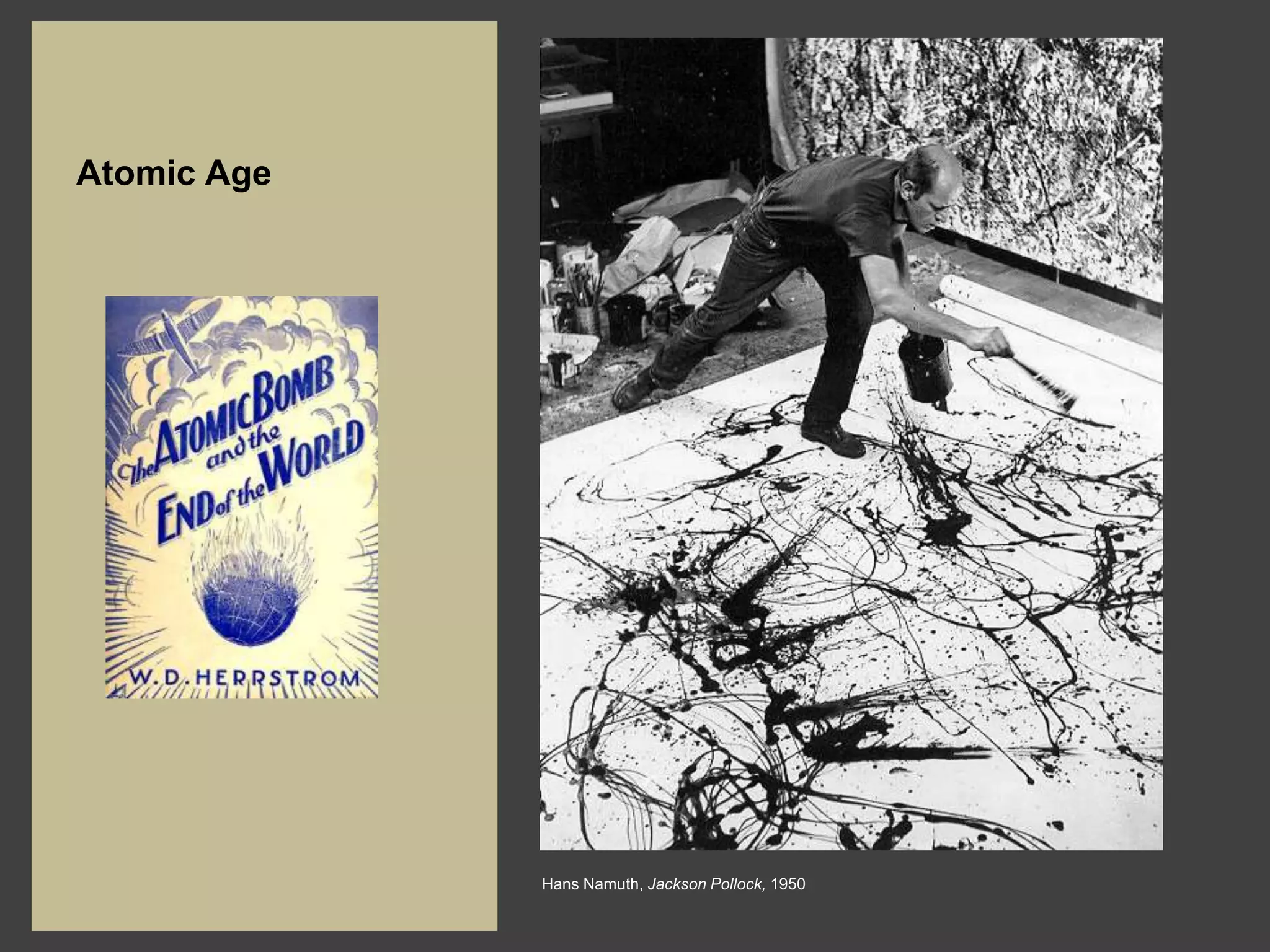
Atomic Age


             Hans Namuth, Jackson Pollock, 1950
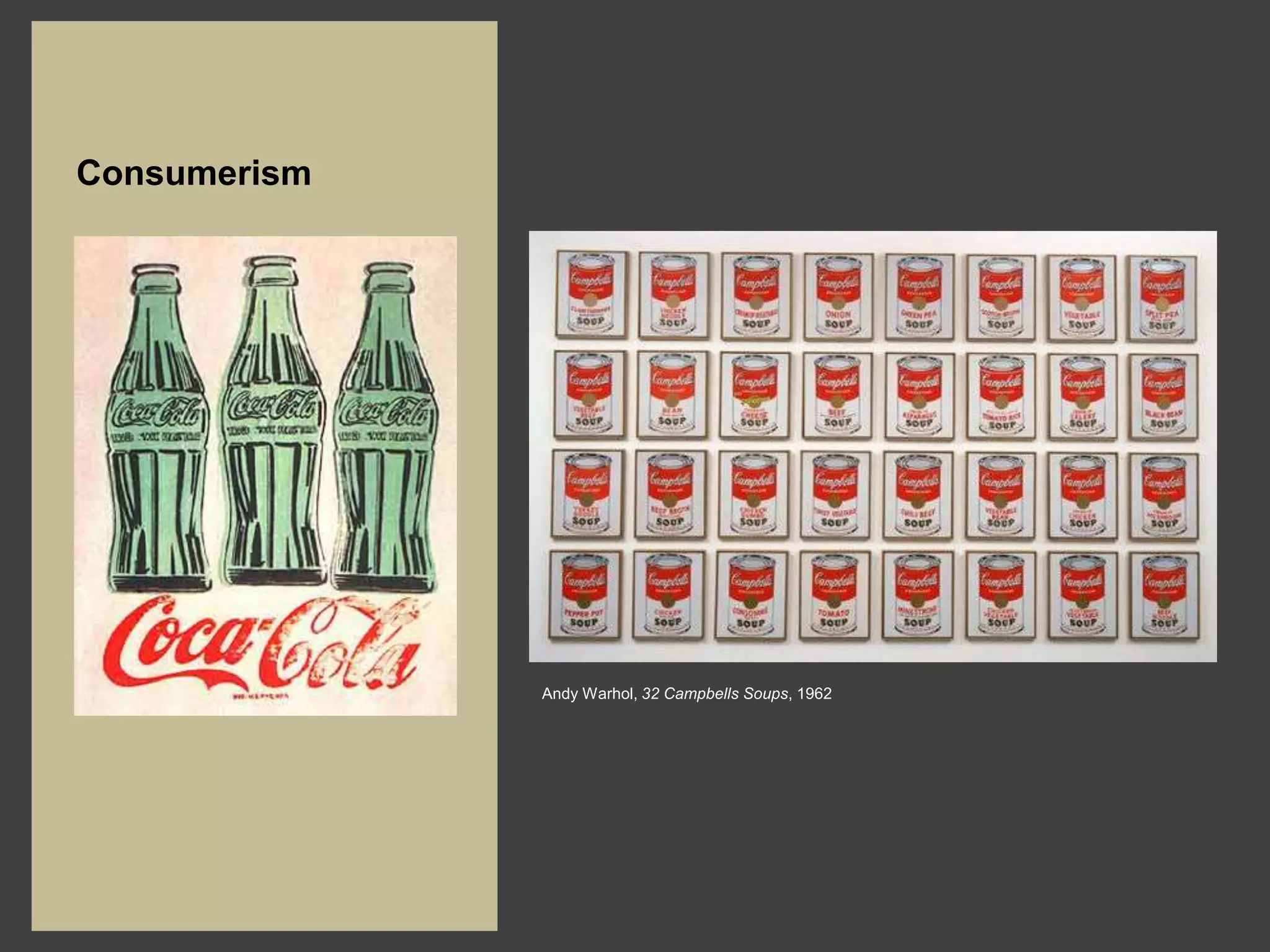
Consumerism


              Andy Warhol, 32 Campbells Soups, 1962

Introduction: What is Art History?

  • 1.
    Introduction: What isArt History?? Art 109: Renaissance to Modern Spring 2013 © Dr. Melissa Hall
  • 2.
    What is ArtHistory? So what, exactly, will we learn in an art history course? Image source: http://www.marshall.edu/cofa/art/arthistory/
  • 3.
    What is ArtHistory? Will we learn what makes a work of art a “masterpiece”? Leonardo da Vinci, Mona Lisa, c. 1503-1505
  • 4.
    Judgment What makes onework of art “better” than another is highly subjective Michelangelo, David, 1501-1504
  • 5.
    Judgment Who is tosay if something is a masterpiece or not? In 1919 Marcel Duchamp questioned the idea of the “masterpiece” by drawing a mustache on a postcard of the Mona Lisa and calling it a work of art! Leonardo da Vinci, Mona Lisa, c. 1503-1505
  • 6.
    Judgment So art historyis not involved with judging “greatness,” or what qualifies as a “masterpiece” That is the job of art criticism, and art connoisseurship Image source: http://www.marshall.edu/cofa/art/arthistory/
  • 7.
    Judgment In fact, itmight be useful to define art history by differentiating it from related fields: •Art Connoisseurship •Art Criticism •Art Appreciation Image source: http://www.marshall.edu/cofa/art/arthistory/
  • 8.
    Connoisseurship Estimating the marketvalue of a work of art is the job of the art connoisseur Sotheby’s auction, May 3, 2006, where Picasso’s Dora Maar with Cat sold for $95.2 million Art Knowledge News
  • 9.
    Art Criticism Artcriticism also involves evaluation and judgment Image source: http://www.theinsider.com/news/857730_Simon_Cowell _Back_In_Touch_With_His_First_Love Mr. Art Critic, written and directed by Richard Brauer, 2008
  • 10.
    Judgment In this classyou will be encouraged to form your own opinion about what you like and dislike Image source: http://www.chicagonow.com/blogs/gowhere-hip-hop/2009/12/
  • 11.
    Art Appreciation Do arthistorians help us appreciate art? Norman Rockwell, The Connoisseur, 1962
  • 12.
    Art Appreciation Learning aboutworks of art can certainly help us “appreciate” them more Artcphoto, Metropolitan Museum of Art - Fifth Avenue - Manhattan - NYC Image source: http://www.flickr.com/photos/artcphoto/2813520288/
  • 13.
    Art Appreciation But artappreciation is primarily concerned with our personal response to art Sharon Lipps, Art Appreciation,The Getty, LA, CA, 2009 http://www.pbase.com/elips/image/73508927
  • 14.
    Art History Art historyis more concerned with the story behind the work Ben Shahn, The Passion of Sacco and Vanzetti, 1931-1932
  • 15.
    Art History Art Historyis the study of works of art in historical context
  • 16.
    Art History It isconcerned with what art meant to the people who made and used it Francois Joseph Heim, Charles X Distributing Awards to Artists Exhibiting at the Salon of 1824 at the Louvre, 1827 Metapedia
  • 17.
    Personal Response Does thismean your personal response is not important? David Choi, 9:48 a.m. Greek Galleries Image source: http://www.flickr.com/photos/8007731@N07/3407100463
  • 18.
    Personal Response Your personalresponse can be an important component of understanding Laura P. Russell, At the Metropolitan Museum of Art, NY, Flickr
  • 19.
    Personal Response But toqualify as “art historical,” it must be informed by what you have learned about the society and the culture Merode Altarpiece with Viewers Image source: http://www.flickr.com/photos/82032880@N00/4014610392/
  • 20.
    Biography Do art historiansstudy the lives of artists? Vincent Van Gogh,Self-Portrait as an Artist, 1887-88. Oil on canvas, 65 x 50.5 cm. Van Gogh Museum, Amsterdam Artchive
  • 21.
    Biography Artistic biography isonly one component of art history, but it is not always the most important Rembrandt van Rijn, Self Portrait, c. 1659-1660
  • 22.
    Role of theArtist Prior to the Renaissance, the artist was was merely a craftsman NannidiBanco, Sculptors at Work, 1416. Orsanmichele, Florence lib-art.com
  • 23.
    Role of theArtist Artists were expected to be skilled, not creative Image source: http://www.thekiesels.com/VA_2003vacPg2.html
  • 24.
    Role of theArtist Works of art were commissioned by patrons who gave specific instructions about what they wanted
  • 25.
    Role of theArtist Art historians must therefore learn about the patrons who commissioned works of art Raphael, Pope Julius II, 1511 London National Gallery
  • 26.
    Role of theArtist Often, the work is more about the patron than it is about the artist who made it EnricoScrovegni giving the gift of his chapel to angels, Last Judgment, Arena Chapel, Padua, c. 1305 Jacques Louis David, Napoleon Crossing the St. Bernard Pass, 1801
  • 27.
    Methodology How do arthistorians study works of art?
  • 28.
    Methodology 1. Subject Matter (iconographic analysis) 2. Style (formal analysis) 3. Context (cultural analysis) Image source: www.thinkandthrive.com
  • 29.
    Identification Artist Title Period/Region Date Medium Dimensions Collection Georgia O’Keefe, Jack-in-the-Pulpit No. 4, 1930 Oil on canvas, 3’ 4” X 2’ 6” National Gallery of Art http://www.nga.gov/fcgi-bin/tinfo_f?object=70179
  • 30.
    Identification Note: titles ofworks of art are treated like book titles “Georgia O’Keefe painted Jack-in- the-Pulpit in 1930.” “The Mona Lisa is a painting by Leonardo da Vinci.”
  • 31.
    Subject Matter What isthe subject matter? Georgia O’Keefe, Jack-in-the-Pulpit No. 4, 1930 Oil on canvas, 3’ 4” X 2’ 6” National Gallery of Art
  • 32.
    Subject Matter Who orwhat is represented
  • 33.
    Visual Literacy How dowe know who this person is? Gilbert Stuart, Portrait of George Washington (The Landsdowne Portrait), 1796 Smithsonian Institution, National Portrait Gallery
  • 34.
    Visual Literacy Sometimes wewill need to learn the story behind the picture Jacques Louis David, Death of Socrates, 1787 Metropolitan Museum
  • 35.
    Subject Matter Recognizing subjectmatter in modern art can be more challenging because the work is abstract Pablo Picasso, Bottle of Suze, 1912
  • 36.
    Abstraction Simplification of forminto simple shapes Theo Van Doesburg, Cows, 1917
  • 37.
    Subject Matter This collagerepresents an oval table top with a glass and a bottle of Suze Pablo Picasso, Bottle of Suze, 1912
  • 38.
    Non-Objective Art Some worksof art have no recognizable subject matter at all This is called non-objective art "Jackson Pollock painting "One: Number 31, 1950" at the Museum of Modern Art", 2007 Image source: http://www.imaginify.org/post/index.php?catid=&name=News&topic=8
  • 39.
    OK, so the SubjectMatter subject matter of this painting is George Washington. Am I done? Gilbert Stuart, Portrait of George Washington (The Landsdowne Portrait), 1796 Smithsonian Institution, National Portrait Gallery
  • 40.
    Subject Matter Who wasGeorge Washington, and why is he significant? Gilbert Stuart, Portrait of George Washington (The Landsdowne Portrait), 1796 Smithsonian Institution, National Portrait Gallery
  • 41.
    OK, George Washington Subject Matter was the first President of the United States. Am I done? Gilbert Stuart, Portrait of George Washington (The Landsdowne Portrait), 1796 Smithsonian Institution, National Portrait Gallery
  • 42.
    Description Analysis of subjectmatter also involves description: How does he appear How is he standing (pose) What is he wearing? What else is in the room? Gilbert Stuart, Portrait of George Washington (The Landsdowne Portrait), 1796 Smithsonian Institution, National Portrait Gallery
  • 43.
    Narration What is happening? Whatis he doing? Gilbert Stuart, Portrait of George Washington (The Landsdowne Portrait), 1796 Smithsonian Institution, National Portrait Gallery
  • 44.
    Interpretation Analysis of subjectmatter also involves interpretation: Why is he posed that way? Why were those particular objects chosen? What purpose was this portrait meant to serve? What was the message? Gilbert Stuart, Portrait of George Washington (The Landsdowne Portrait), 1796 Smithsonian Institution, National Portrait Gallery
  • 45.
    Subject Matter Subject Matter: The “what” of the work (who, what, where) Content: The “why” of the work (meaning, purpose, message) Gilbert Stuart, Portrait of George Washington (The Landsdowne Portrait), 1796 Smithsonian Institution, National Portrait Gallery
  • 46.
    Iconography To get fromsubject matter to content involves iconography Iconography: the interpretation of signs and symbols Gilbert Stuart, Portrait of George Washington (The Landsdowne Portrait), 1796 Smithsonian Institution, National Portrait Gallery
  • 47.
    Subject Matter How dowe know these two people are “tourists”? What are the visual clues? Duane Hanson, Tourists, 1970 National Galleries of Scotland
  • 48.
    Iconography Pose (the waythey are standing and gesturing) Attributes (clothing and accessories) Duane Hanson, Tourists, 1970 National Galleries of Scotland
  • 49.
    Subject Matter Painted portraitsof political leaders were the “media” of their day They were supposed to communicate a message about the person represented Gilbert Stuart, Portrait of George Washington (The Landsdowne Portrait), 1796 Smithsonian Institution, National Portrait Gallery
  • 50.
    Subject Matter What messagewas Stuart’s portrait intended to convey? What are the visual clues? Gilbert Stuart, Portrait of George Washington (The Landsdowne Portrait), 1796 Smithsonian Institution, National Portrait Gallery
  • 51.
    The Clothing Gilbert Stuart,Portrait of George Washington (The Landsdowne Portrait), Allan Ramsay, King George III (in coronation robes), 1761-1762 1796. Smithsonian Institution, National Portrait Gallery National Portrait Gallery
  • 52.
    The Clothing Gilbert Stuart,Portrait of George Washington (The Landsdowne Portrait), 1796. Smithsonian Institution, National Portrait Gallery
  • 53.
    The Clothing Gilbert Stuart,Portrait of George Washington (The Landsdowne Portrait), 1796. Smithsonian Institution, National Portrait Gallery
  • 54.
    The Clothing “Stuart painted Washington from life, showing him standing up, dressed in a black velvet suit with an outstretched hand held up in an oratorical manner (which could be characterized as "commanding and stern yet open and inclusive"). In the background behind Washington is a row of two Doric columns, with another row to the left. Wrapped around and between the columns are red tasseled drapes.” Gilbert Stuart, Portrait of George Washington (The Landsdowne Portrait), 1796. Smithsonian Institution, National Portrait Gallery
  • 55.
    The Clothing “Washington's suit is plain and simple, and the sword that he holds on his left side is a dress sword and not a battle sword (symbolizing a democratic form of government, rather than a monarchy or military dictatorship). In the sky, storm clouds appear on the left while a rainbow appears on the right, signifying the American Revolutionary War giving way to the peace and prosperity of the new United States after the 1783 Treaty of Paris. The medallion at the top of the chair shows the red, white, and blue colors of the American flag.” Gilbert Stuart, Portrait of George Washington (The Landsdowne Portrait), 1796. Smithsonian Institution, National Portrait Gallery
  • 56.
    The Clothing “On and under the tablecloth-draped table to the left are two books: Federalist—probably a reference to the Federalist Papers—and Journal of Congress—the Congressional Record). Another five books are under the table . . . . The pen and paper on the table signify the rule of law . . . .” http://en.wikipedia.org/wiki/Lansdowne_portrait Gilbert Stuart, Portrait of George Washington (The Landsdowne Portrait), 1796. Smithsonian Institution, National Portrait Gallery
  • 57.
    Subject Matter A detaileddescription helps us see the work more clearly Gilbert Stuart, Portrait of George Washington (The Landsdowne Portrait), 1796 Smithsonian Institution, National Portrait Gallery
  • 58.
  • 59.
    Style Style refers tothe visual characteristics of a work of art Pablo Picasso, Les Demoiselles d’Avignon, 1907 Museum of Modern Art
  • 60.
  • 61.
    Period Style A stylethat is typical of a particular time period Jacopo daPontormo, Entombment of Christ, Parmigianino, Madonna with the Long Neck, 1525-1528 1534-1540
  • 62.
    Regional Style A stylethat is typical of a particular region Jean Hey? or the Master of Moulins, Portrait AlessoBaldovinetti, Portrait of a Lady, tempera and of
Margaret of Austria, oil on panel, c. 1490 on wood, c. 1465 (National Gallery, London)
  • 63.
    Personal Style An individualartist’s unique “personal” style Vincent Van Gogh, Starry Night, 1888
  • 64.
    Evolution of Style Howstyle changes over time Unknown Master, Virgin and Child Enthroned with St Dominic, St Martin and Two Angels, c. 1290 Web Gallery of Art Giotto diBondone, Ognissante Madonna, c. 1310
  • 65.
    Evolution of Style Changing attitudes towards the body Expulsion of Adam and Eve, Hunterian Psalter, c. 1170 Albrecht Dürer, Fall of Man (Adam and Eve), 1504
  • 66.
    Evolution of Style Composition and lighting Jan Vermeer, Young Woman with a Water Pitcher, c. 1662 Caravaggio, Deposition, c. 1600-1604
  • 67.
    Evolution of Style Concepts of “realism” Gustave Courbet, the Stone Breakers, 1849 Jean Auguste Dominique Ingres, Princesse de Broglie, 1851-1853
  • 68.
    Evolution of Style Capturing effects of atmosphere and light Jacob Van Ruisdael, View of Haarlem from the Dunes at Overveen, c. 1670 Claude Monet, Boulevard des Capucines, 1873
  • 69.
    Evolution of Style Rejectionof realism Ernst Kirchner, Head of a Woman, 1913 Paul Gauguin, The Yellow Christ, 1889
  • 70.
    Evolution of Style Evolutiontowards abstraction Marcel Duchamp, Nude Descending a Staircase, 1912 Georges Braque, The Portuguese, 1911
  • 71.
    Evolution of Style Eliminationof subject matter Wassily Kandinsky, Improvisation 28, 1912 Constantin Brancusi, Bird in Space, 1924
  • 72.
    Art and Context Artdoes not mean in a vacuum! The cultural context of art is an integral part of its meaning or content Jeff Koons, New Hoover Convertibles, Green, Red, Brown, New Shelton Wet/Dry 10 Gallon Displaced Doubledecker1981-87
  • 73.
    Renaissance Humanism Humanist scholarship andthe secularization of learning Shift in patronage Andrea del Castagno, Giovanni Boccaccio, c. 1450
  • 74.
    The Reformation St. Peters Basilica, Rome Workshop of Lucas Cranach, Martin Luther Metropolitan Museum
  • 75.
    Absolutism Hyacinth Rigaud, Louis XIV, 1701
  • 76.
    The Enlightenment Jacques Louis David, Antoine-Laurent Lavoisier and his Wife, 1788 Metropolitan Museum
  • 77.
    The Age ofDemocracy Eugene Delacroix, Liberty Leading the People, 1830 Jean-Antoine Houdon, George Washington, 1788-1792
  • 78.
    The Industrial Revolution Jean-François Millet, The Gleaners, 1857
  • 79.
    The Rise ofCities GustaveCaillebotte, Rue de Paris, Temps de Pluie, 1877 Claude Monet, Boulevard des Capucines, 1873
  • 80.
    The Machine Age Fernand Léger, the City, 1919
  • 81.
    War Pablo Picasso, Guernica, 1937
  • 82.
    Atomic Age Hans Namuth, Jackson Pollock, 1950
  • 83.
    Consumerism Andy Warhol, 32 Campbells Soups, 1962