Art 109A: Contemporary Art (Arts Since 1945)
Westchester Community College
Alberto Giacometti
(1901-1966)
Alberto Giacometti
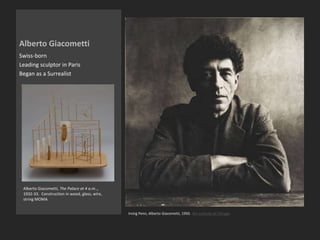
Swiss-born
Leading sculptor in Paris
Began as a Surrealist
Irving Penn, Alberto Giacometti, 1950. Art Institute of Chicago
Alberto Giacometti, The Palace at 4 a.m..,
1932-33. Construction in wood, glass, wire,
string MOMA
Alberto Giacometti
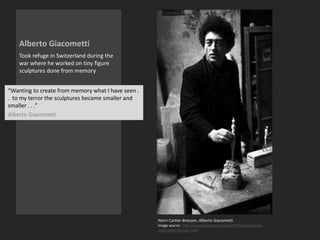
Took refuge in Switzerland during the
war where he worked on tiny figure
sculptures done from memory
Henri Cartier-Bresson, Alberto Giacametti
Image source: http://ionarts.blogspot.com/2005/02/giacometti-
and-cartier-bresson.html
“Wanting to create from memory what I have seen .
. to my terror the sculptures became smaller and
smaller . . .”
Alberto Giacometti
Alberto Giacometti
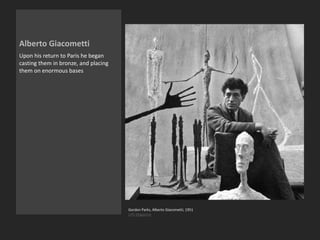
Upon his return to Paris he began
casting them in bronze, and placing
them on enormous bases
Gordon Parks, Alberto Giacometti, 1951
LIFE Magazine
Alberto Giacometti
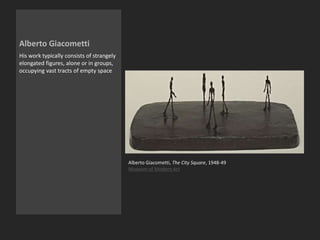
His work typically consists of strangely
elongated figures, alone or in groups,
occupying vast tracts of empty space
Alberto Giacometti, The City Square, 1948-49
Museum of Modern Art
Alberto Giacometti
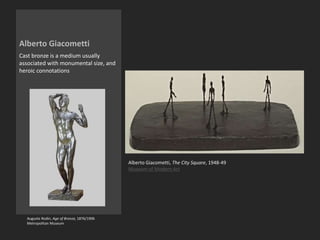
Cast bronze is a medium usually
associated with monumental size, and
heroic connotations
Alberto Giacometti, The City Square, 1948-49
Museum of Modern Art
Auguste Rodin, Age of Bronze, 1876/1906
Metropolitan Museum
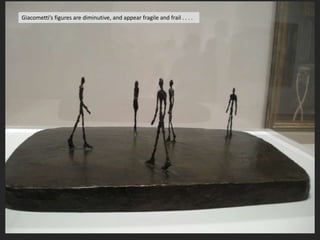
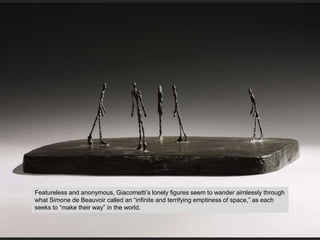
Giacometti’s figures are diminutive, and appear fragile and frail . . . .
Image source: http://www.flickr.com/photos/profzucker/3256792359/sizes/l/
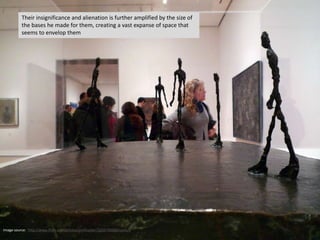
Their insignificance and alienation is further amplified by the size of
the bases he made for them, creating a vast expanse of space that
seems to envelop them
Featureless and anonymous, Giacometti’s lonely figures seem to wander aimlessly through
what Simone de Beauvoir called an “infinite and terrifying emptiness of space,” as each
seeks to “make their way” in the world.
Alberto Giacometti
1945 began working on a larger scale
Henri Cartier-Bresson, Giacometti in his Studio, c. 1952.
Wikipedia
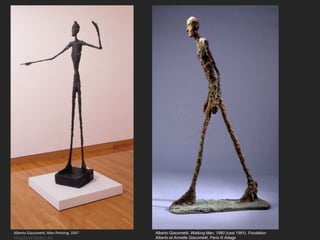
“But then to my surprise, [the figures] achieved a
likeness only when tall and slender.”
Alberto Giacometti
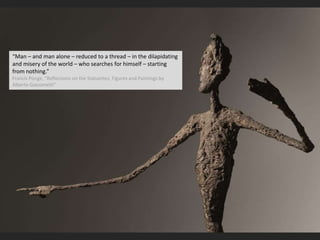
Alberto Giacometti, Man Pointing, 1947
Museum of Modern Art
Alberto Giacometti. Walking Man, 1960 (cast 1981). Fondation
Alberto et Annette Giacometti, Paris © Adagp
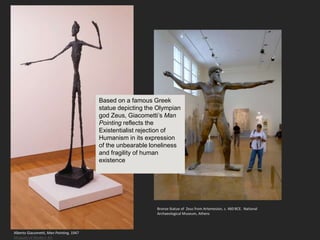
Alberto Giacometti, Man Pointing, 1947
Museum of Modern Art
Bronze Statue of Zeus from Artemesion, c. 460 BCE. National
Archaeological Museum, Athens
Based on a famous Greek
statue depicting the Olympian
god Zeus, Giacometti’s Man
Pointing reflects the
Existentialist rejection of
Humanism in its expression
of the unbearable loneliness
and fragility of human
existence
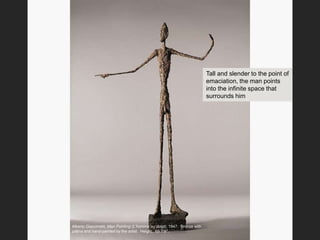
Alberto Giacometti, Man Pointing (L’homme au doigt), 1947. Bronze with
patina and hand-painted by the artist. Height: 69 7/8″. Christies
Tall and slender to the point of
emaciation, the man points
into the infinite space that
surrounds him
“Man – and man alone – reduced to a thread – in the dilapidating
and misery of the world – who searches for himself – starting
from nothing.”
Francis Ponge, “Reflections on the Statuettes, Figures and Paintings by
Alberto Giacometti”
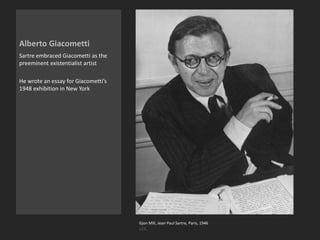
Alberto Giacometti
Sartre embraced Giacometti as the
preeminent existentialist artist
He wrote an essay for Giacometti’s
1948 exhibition in New York
Gjon Mili, Jean Paul Sartre, Paris, 1946
LIFE
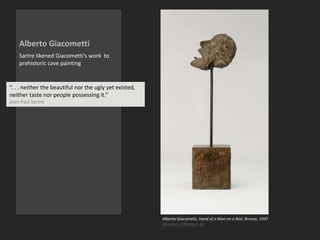
Alberto Giacometti
Sartre likened Giacometti’s work to
prehistoric cave painting
Alberto Giacometti, Head of a Man on a Rod, Bronze, 1947
Museum of Modern Art
“. . . neither the beautiful nor the ugly yet existed,
neither taste nor people possessing it.”
Jean Paul Sartre
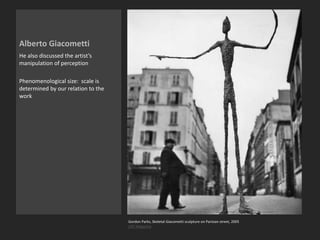
Alberto Giacometti
He also discussed the artist’s
manipulation of perception
Phenomenological size: scale is
determined by our relation to the
work
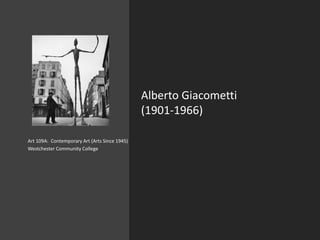
Gordon Parks, Skeletal Giacometti sculpture on Parisian street, 2005
LIFE Magazine
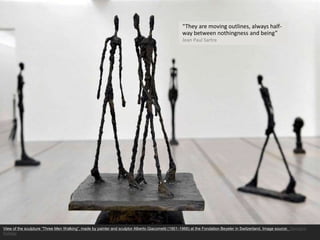
“They are moving outlines, always half-
way between nothingness and being”
Jean Paul Sartre
View of the sculpture “Three Men Walking”, made by painter and sculptor Alberto Giacometti (1901-1966) at the Fondation Beyeler in Switzerland. Image source: Georgios
Kefalas
Alberto Giacometti
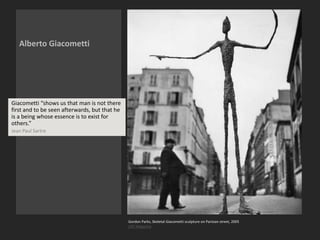
Gordon Parks, Skeletal Giacometti sculpture on Parisian street, 2005
LIFE Magazine
Giacometti “shows us that man is not there
first and to be seen afterwards, but that he
is a being whose essence is to exist for
others.”
Jean Paul Sartre
Alberto Giacometti
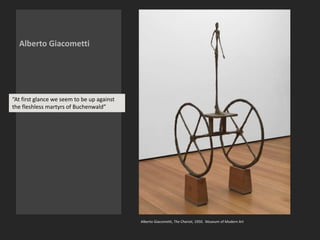
Alberto Giacometti, The Chariot, 1950. Museum of Modern Art
“At first glance we seem to be up against
the fleshless martyrs of Buchenwald”
Alberto Giacometti
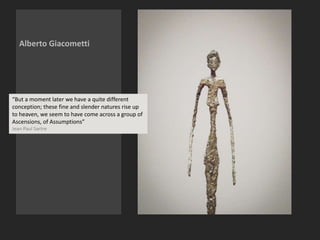
“But a moment later we have a quite different
conception; these fine and slender natures rise up
to heaven, we seem to have come across a group of
Ascensions, of Assumptions”
Jean Paul Sartre

1.3 Alberto Giacometti

  • 1.
    Art 109A: ContemporaryArt (Arts Since 1945) Westchester Community College Alberto Giacometti (1901-1966)
  • 2.
    Alberto Giacometti Swiss-born Leading sculptorin Paris Began as a Surrealist Irving Penn, Alberto Giacometti, 1950. Art Institute of Chicago Alberto Giacometti, The Palace at 4 a.m.., 1932-33. Construction in wood, glass, wire, string MOMA
  • 3.
    Alberto Giacometti Took refugein Switzerland during the war where he worked on tiny figure sculptures done from memory Henri Cartier-Bresson, Alberto Giacametti Image source: http://ionarts.blogspot.com/2005/02/giacometti- and-cartier-bresson.html “Wanting to create from memory what I have seen . . to my terror the sculptures became smaller and smaller . . .” Alberto Giacometti
  • 4.
    Alberto Giacometti Upon hisreturn to Paris he began casting them in bronze, and placing them on enormous bases Gordon Parks, Alberto Giacometti, 1951 LIFE Magazine
  • 5.
    Alberto Giacometti His worktypically consists of strangely elongated figures, alone or in groups, occupying vast tracts of empty space Alberto Giacometti, The City Square, 1948-49 Museum of Modern Art
  • 6.
    Alberto Giacometti Cast bronzeis a medium usually associated with monumental size, and heroic connotations Alberto Giacometti, The City Square, 1948-49 Museum of Modern Art Auguste Rodin, Age of Bronze, 1876/1906 Metropolitan Museum
  • 7.
    Giacometti’s figures arediminutive, and appear fragile and frail . . . .
  • 8.
    Image source: http://www.flickr.com/photos/profzucker/3256792359/sizes/l/ Theirinsignificance and alienation is further amplified by the size of the bases he made for them, creating a vast expanse of space that seems to envelop them
  • 9.
    Featureless and anonymous,Giacometti’s lonely figures seem to wander aimlessly through what Simone de Beauvoir called an “infinite and terrifying emptiness of space,” as each seeks to “make their way” in the world.
  • 10.
    Alberto Giacometti 1945 beganworking on a larger scale Henri Cartier-Bresson, Giacometti in his Studio, c. 1952. Wikipedia “But then to my surprise, [the figures] achieved a likeness only when tall and slender.” Alberto Giacometti
  • 11.
    Alberto Giacometti, ManPointing, 1947 Museum of Modern Art Alberto Giacometti. Walking Man, 1960 (cast 1981). Fondation Alberto et Annette Giacometti, Paris © Adagp
  • 12.
    Alberto Giacometti, ManPointing, 1947 Museum of Modern Art Bronze Statue of Zeus from Artemesion, c. 460 BCE. National Archaeological Museum, Athens Based on a famous Greek statue depicting the Olympian god Zeus, Giacometti’s Man Pointing reflects the Existentialist rejection of Humanism in its expression of the unbearable loneliness and fragility of human existence
  • 13.
    Alberto Giacometti, ManPointing (L’homme au doigt), 1947. Bronze with patina and hand-painted by the artist. Height: 69 7/8″. Christies Tall and slender to the point of emaciation, the man points into the infinite space that surrounds him
  • 14.
    “Man – andman alone – reduced to a thread – in the dilapidating and misery of the world – who searches for himself – starting from nothing.” Francis Ponge, “Reflections on the Statuettes, Figures and Paintings by Alberto Giacometti”
  • 15.
    Alberto Giacometti Sartre embracedGiacometti as the preeminent existentialist artist He wrote an essay for Giacometti’s 1948 exhibition in New York Gjon Mili, Jean Paul Sartre, Paris, 1946 LIFE
  • 16.
    Alberto Giacometti Sartre likenedGiacometti’s work to prehistoric cave painting Alberto Giacometti, Head of a Man on a Rod, Bronze, 1947 Museum of Modern Art “. . . neither the beautiful nor the ugly yet existed, neither taste nor people possessing it.” Jean Paul Sartre
  • 17.
    Alberto Giacometti He alsodiscussed the artist’s manipulation of perception Phenomenological size: scale is determined by our relation to the work Gordon Parks, Skeletal Giacometti sculpture on Parisian street, 2005 LIFE Magazine
  • 18.
    “They are movingoutlines, always half- way between nothingness and being” Jean Paul Sartre View of the sculpture “Three Men Walking”, made by painter and sculptor Alberto Giacometti (1901-1966) at the Fondation Beyeler in Switzerland. Image source: Georgios Kefalas
  • 19.
    Alberto Giacometti Gordon Parks,Skeletal Giacometti sculpture on Parisian street, 2005 LIFE Magazine Giacometti “shows us that man is not there first and to be seen afterwards, but that he is a being whose essence is to exist for others.” Jean Paul Sartre
  • 20.
    Alberto Giacometti Alberto Giacometti,The Chariot, 1950. Museum of Modern Art “At first glance we seem to be up against the fleshless martyrs of Buchenwald”
  • 21.
    Alberto Giacometti “But amoment later we have a quite different conception; these fine and slender natures rise up to heaven, we seem to have come across a group of Ascensions, of Assumptions” Jean Paul Sartre