Art 108 Ancient to Medieval
Westchester Community College
Fall 2013
Professor Melissa Hall
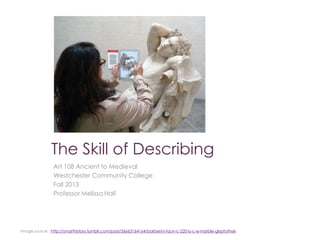
The Skill of Describing
Image source: http://smarthistory.tumblr.com/post/36663164164/barberini-faun-c-220-b-c-e-marble-glyptothek
The Skill of Describing
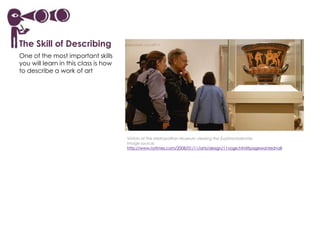
One of the most important skills
you will learn in this class is how
to describe a work of art
Visitors at the Metropolitan Museum viewing the Euphronioskrater.
Image source:
http://www.nytimes.com/2008/01/11/arts/design/11voge.html?pagewanted=all
The Skill of Describing
There are four basic
components to a visual
description
Visual Analysis
1. Identification
2. Subject matter description
3. Stylistic analysis
4. Contextual analysis (explanation of
meaning/function/purpose
The Skill of Describing
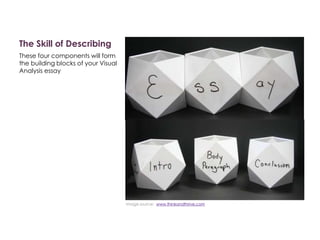
These four components will form
the building blocks of your Visual
Analysis essay
Image source: www.thinkandthrive.com
Identification
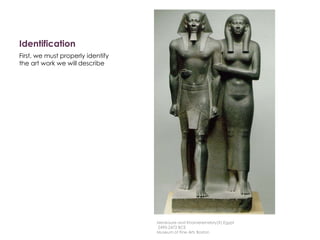
First, we must properly identify
the art work we will describe
Menkaure and Khamerernebty(?),Egypt
2490-2472 BCE
Museum of Fine Arts Boston
Identification
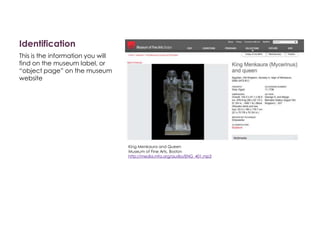
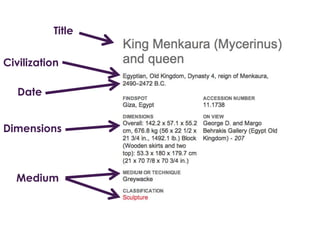
This is the information you will
find on the museum label, or
“object page” on the museum
website
King Menkaura and Queen
Museum of Fine Arts, Boston
http://media.mfa.org/audio/ENG_401.mp3
Title
Civilization
Date
Dimensions
Medium
Identification
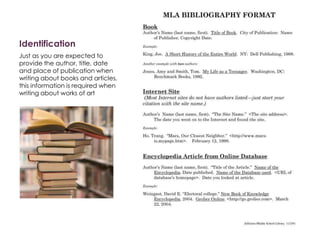
Just as you are expected to
provide the author, title, date
and place of publication when
writing about books and articles,
this information is required when
writing about works of art
Subject Matter
Description
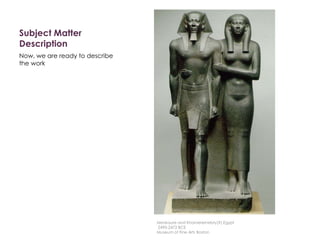
Now, we are ready to describe
the work
Menkaure and Khamerernebty(?),Egypt
2490-2472 BCE
Museum of Fine Arts Boston
Subject Matter
Description
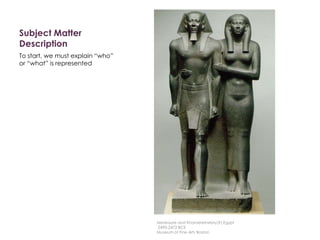
To start, we must explain “who”
or “what” is represented
Menkaure and Khamerernebty(?),Egypt
2490-2472 BCE
Museum of Fine Arts Boston
Subject Matter
Description
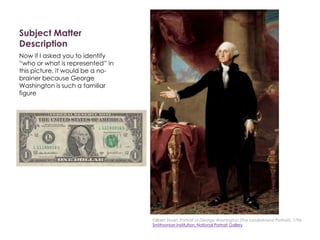
Now if I asked you to identify
“who or what is represented” in
this picture, it would be a no-
brainer because George
Washington is such a familiar
figure
Gilbert Stuart, Portrait of George Washington (The Landsdowne Portrait), 1796
Smithsonian Institution, National Portrait Gallery
Subject Matter
Description
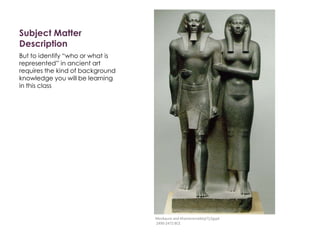
But to identify “who or what is
represented” in ancient art
requires the kind of background
knowledge you will be learning
in this class
Menkaure and Khamerernebty(?),Egypt
2490-2472 BCE
Subject Matter
Description
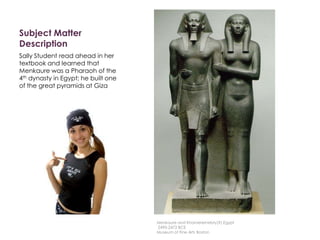
Sally Student read ahead in her
textbook and learned that
Menkaure was a Pharaoh of the
4th dynasty in Egypt; he built one
of the great pyramids at Giza
Menkaure and Khamerernebty(?),Egypt
2490-2472 BCE
Museum of Fine Arts Boston
Subject Matter
Description
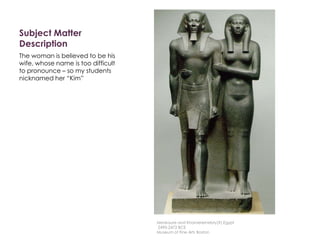
The woman is believed to be his
wife, whose name is too difficult
to pronounce – so my students
nicknamed her “Kim”
Menkaure and Khamerernebty(?),Egypt
2490-2472 BCE
Museum of Fine Arts Boston
Subject Matter
Description
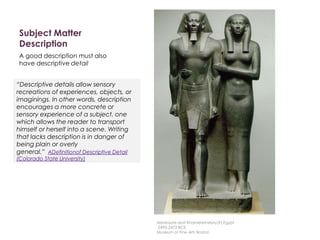
A good description must also
have descriptive detail
“Descriptive details allow sensory
recreations of experiences, objects, or
imaginings. In other words, description
encourages a more concrete or
sensory experience of a subject, one
which allows the reader to transport
himself or herself into a scene. Writing
that lacks description is in danger of
being plain or overly
general.”
ADefinitionof Descriptive Detail
(Colorado State University)
Menkaure and Khamerernebty(?),Egypt
2490-2472 BCE
Museum of Fine Arts Boston
Subject Matter
Description
When describing a work of art,
imagine that you are talking to
someone on the phone, or that
your reader has their eyes
closed
Image source: http://link2power.org/wordpress/2011/05/can-you-hear-me-now/
Subject Matter
Description
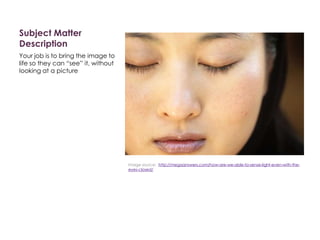
Your job is to bring the image to
life so they can “see” it, without
looking at a picture
Image source: http://megaanswers.com/how-are-we-able-to-sense-light-even-with-the-
eyes-closed/
Subject Matter
Description
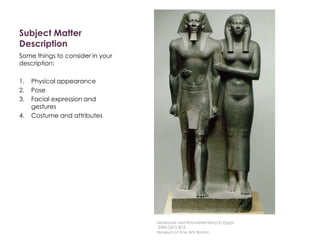
Some things to consider in your
description:
1. Physical appearance
2. Pose
3. Facial expression and
gestures
4. Costume and attributes
Menkaure and Khamerernebty(?),Egypt
2490-2472 BCE
Museum of Fine Arts Boston
Subject Matter
Description
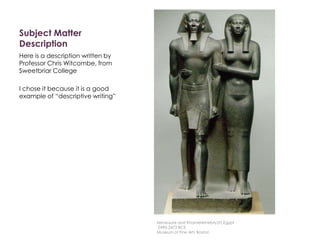
Here is a description written by
Professor Chris Witcombe, from
Sweetbriar College
I chose it because it is a good
example of “descriptive writing”
Menkaure and Khamerernebty(?),Egypt
2490-2472 BCE
Museum of Fine Arts Boston
Menkaure and Khamerernebty(?),Egypt
2490-2472 BCE
Museum of Fine Arts Boston
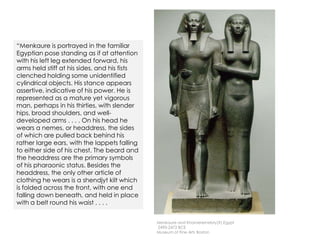
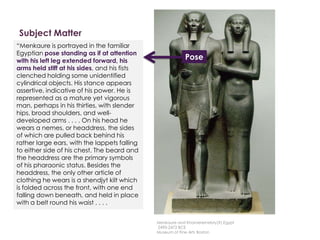
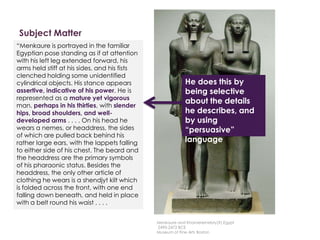
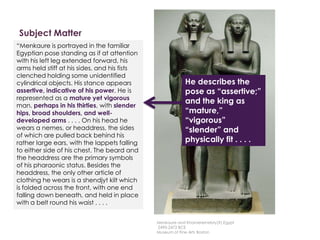
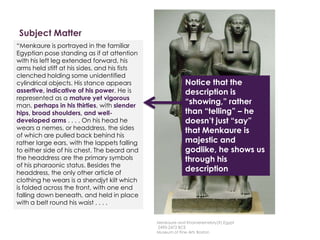
“Menkaure is portrayed in the familiar
Egyptian pose standing as if at attention
with his left leg extended forward, his
arms held stiff at his sides, and his fists
clenched holding some unidentified
cylindrical objects. His stance appears
assertive, indicative of his power. He is
represented as a mature yet vigorous
man, perhaps in his thirties, with slender
hips, broad shoulders, and well-
developed arms . . . . On his head he
wears a nemes, or headdress, the sides
of which are pulled back behind his
rather large ears, with the lappets falling
to either side of his chest. The beard and
the headdress are the primary symbols
of his pharaonic status. Besides the
headdress, the only other article of
clothing he wears is a shendjyt kilt which
is folded across the front, with one end
falling down beneath, and held in place
with a belt round his waist . . . .
Subject Matter
Description
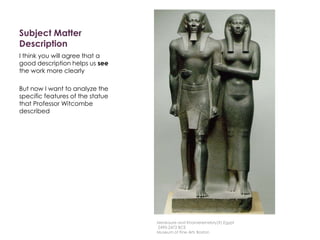
I think you will agree that a
good description helps us see
the work more clearly
But now I want to analyze the
specific features of the statue
that Professor Witcombe
described
Menkaure and Khamerernebty(?),Egypt
2490-2472 BCE
Museum of Fine Arts Boston
Subject Matter
Description
Here is a description written by
Professor Witcombe, from
Sweetbriar College
“Menkaure is portrayed in the familiar
Egyptian pose standing as if at attention
with his left leg extended forward, his
arms held stiff at his sides, and his fists
clenched holding some unidentified
cylindrical objects. His stance appears
assertive, indicative of his power. He is
represented as a mature yet vigorous
man, perhaps in his thirties, with slender
hips, broad shoulders, and well-
developed arms . . . . On his head he
wears a nemes, or headdress, the sides
of which are pulled back behind his
rather large ears, with the lappets falling
to either side of his chest. The beard and
the headdress are the primary symbols
of his pharaonic status. Besides the
headdress, the only other article of
clothing he wears is a shendjyt kilt which
is folded across the front, with one end
falling down beneath, and held in place
with a belt round his waist . . . .
Pose
Menkaure and Khamerernebty(?),Egypt
2490-2472 BCE
Museum of Fine Arts Boston
Subject Matter
Description
Here is a description written by
Professor Witcombe, from
Sweetbriar College
“Menkaure is portrayed in the familiar
Egyptian pose standing as if at attention
with his left leg extended forward, his
arms held stiff at his sides, and his fists
clenched holding some unidentified
cylindrical objects. His stance appears
assertive, indicative of his power. He is
represented as a mature yet vigorous
man, perhaps in his thirties, with slender
hips, broad shoulders, and well-
developed arms . . . . On his head he
wears a nemes, or headdress, the sides
of which are pulled back behind his
rather large ears, with the lappets falling
to either side of his chest. The beard and
the headdress are the primary symbols
of his pharaonic status. Besides the
headdress, the only other article of
clothing he wears is a shendjyt kilt which
is folded across the front, with one end
falling down beneath, and held in place
with a belt round his waist . . . .
Pose
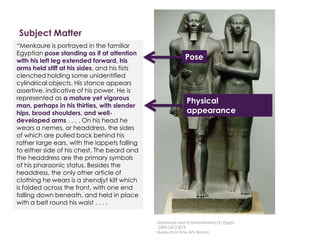
Physical
appearance
Menkaure and Khamerernebty(?),Egypt
2490-2472 BCE
Museum of Fine Arts Boston
Subject Matter
Description
Here is a description written by
Professor Witcombe, from
Sweetbriar College
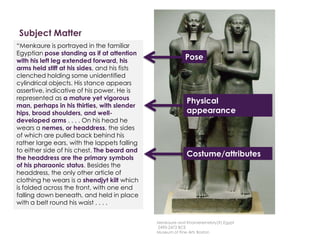
“Menkaure is portrayed in the familiar
Egyptian pose standing as if at attention
with his left leg extended forward, his
arms held stiff at his sides, and his fists
clenched holding some unidentified
cylindrical objects. His stance appears
assertive, indicative of his power. He is
represented as a mature yet vigorous
man, perhaps in his thirties, with slender
hips, broad shoulders, and well-
developed arms . . . . On his head he
wears a nemes, or headdress, the sides
of which are pulled back behind his
rather large ears, with the lappets falling
to either side of his chest. The beard and
the headdress are the primary symbols
of his pharaonic status. Besides the
headdress, the only other article of
clothing he wears is a shendjyt kilt which
is folded across the front, with one end
falling down beneath, and held in place
with a belt round his waist . . . .
Pose
Physical
appearance
Costume/attributes
Menkaure and Khamerernebty(?),Egypt
2490-2472 BCE
Museum of Fine Arts Boston
Subject Matter
Description
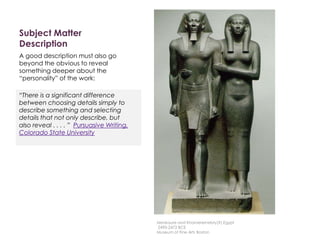
A good description must also go
beyond the obvious to reveal
something deeper about the
“personality” of the work:
“There is a significant difference
between choosing details simply to
describe something and selecting
details that not only describe, but
also reveal . . . . ”
Pursuasive Writing,
Colorado State University
Menkaure and Khamerernebty(?),Egypt
2490-2472 BCE
Museum of Fine Arts Boston
Subject Matter
Description
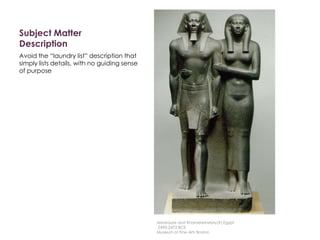
Avoid the “laundry list” description that
simply lists details, with no guiding sense
of purpose
Menkaure and Khamerernebty(?),Egypt
2490-2472 BCE
Museum of Fine Arts Boston
Subject Matter
Description
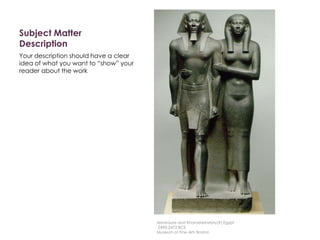
Your description should have a clear
idea of what you want to “show” your
reader about the work
Menkaure and Khamerernebty(?),Egypt
2490-2472 BCE
Museum of Fine Arts Boston
Subject Matter
Description
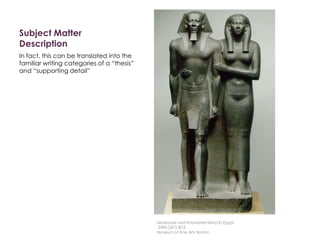
In fact, this can be translated into the
familiar writing categories of a “thesis”
and “supporting detail”
Menkaure and Khamerernebty(?),Egypt
2490-2472 BCE
Museum of Fine Arts Boston
Subject Matter
Description
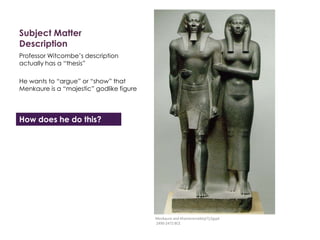
Professor Witcombe’s description
actually has a “thesis”
He wants to “argue” or “show” that
Menkaure is a “majestic” godlike figure
Menkaure and Khamerernebty(?),Egypt
2490-2472 BCE
How does he do this?
Subject Matter
Description
Here is a description written by
Professor Witcombe, from
Sweetbriar College
“Menkaure is portrayed in the familiar
Egyptian pose standing as if at attention
with his left leg extended forward, his
arms held stiff at his sides, and his fists
clenched holding some unidentified
cylindrical objects. His stance appears
assertive, indicative of his power. He is
represented as a mature yet vigorous
man, perhaps in his thirties, with slender
hips, broad shoulders, and well-
developed arms . . . . On his head he
wears a nemes, or headdress, the sides
of which are pulled back behind his
rather large ears, with the lappets falling
to either side of his chest. The beard and
the headdress are the primary symbols
of his pharaonic status. Besides the
headdress, the only other article of
clothing he wears is a shendjyt kilt which
is folded across the front, with one end
falling down beneath, and held in place
with a belt round his waist . . . .
He does this by
being selective
about the details
he describes, and
by using
“persuasive”
language
Menkaure and Khamerernebty(?),Egypt
2490-2472 BCE
Museum of Fine Arts Boston
Subject Matter
Description
Here is a description written by
Professor Witcombe, from
Sweetbriar College
“Menkaure is portrayed in the familiar
Egyptian pose standing as if at attention
with his left leg extended forward, his
arms held stiff at his sides, and his fists
clenched holding some unidentified
cylindrical objects. His stance appears
assertive, indicative of his power. He is
represented as a mature yet vigorous
man, perhaps in his thirties, with slender
hips, broad shoulders, and well-
developed arms . . . . On his head he
wears a nemes, or headdress, the sides
of which are pulled back behind his
rather large ears, with the lappets falling
to either side of his chest. The beard and
the headdress are the primary symbols
of his pharaonic status. Besides the
headdress, the only other article of
clothing he wears is a shendjyt kilt which
is folded across the front, with one end
falling down beneath, and held in place
with a belt round his waist . . . .
He describes the
pose as “assertive;”
and the king as
“mature,”
“vigorous”
“slender” and
physically fit . . . .
Menkaure and Khamerernebty(?),Egypt
2490-2472 BCE
Museum of Fine Arts Boston
Subject Matter
Description
Here is a description written by
Professor Witcombe, from
Sweetbriar College
“Menkaure is portrayed in the familiar
Egyptian pose standing as if at attention
with his left leg extended forward, his
arms held stiff at his sides, and his fists
clenched holding some unidentified
cylindrical objects. His stance appears
assertive, indicative of his power. He is
represented as a mature yet vigorous
man, perhaps in his thirties, with slender
hips, broad shoulders, and well-
developed arms . . . . On his head he
wears a nemes, or headdress, the sides
of which are pulled back behind his
rather large ears, with the lappets falling
to either side of his chest. The beard and
the headdress are the primary symbols
of his pharaonic status. Besides the
headdress, the only other article of
clothing he wears is a shendjyt kilt which
is folded across the front, with one end
falling down beneath, and held in place
with a belt round his waist . . . .
Notice that the
description is
“showing,” rather
than “telling” – he
doesn’t just “say”
that Menkaure is
majestic and
godlike, he shows us
through his
description
Menkaure and Khamerernebty(?),Egypt
2490-2472 BCE
Museum of Fine Arts Boston
Showing versus Telling
The reader will have no problem
imagining the statue (even if
they don’t have a picture!), and
will reach the same conclusion
as the author: this is truly a
majestic representation of the
Pharaoh!
Wow . . . It sounds like
Menkaure is totally
awesome!
Subject Matter
Description
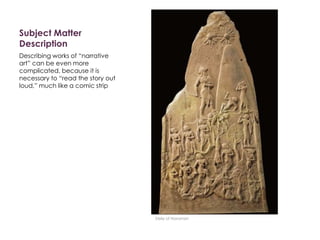
Describing works of “narrative
art” can be even more
complicated, because it is
necessary to “read the story out
loud,” much like a comic strip
Stele of Naramsin
Subject Matter
Description
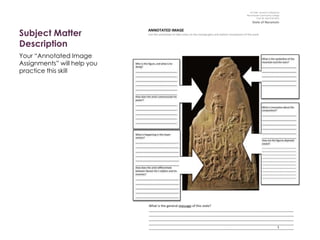
Your “Annotated Image
Assignments” will help you
practice this skill
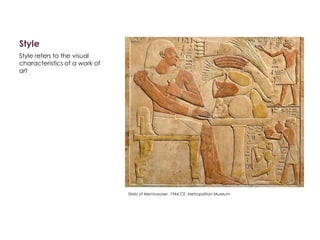
Style
Style refers to the visual
characteristics of a work of
art
Stela of Mentuwoser, 1944 CE. Metropolitan Museum
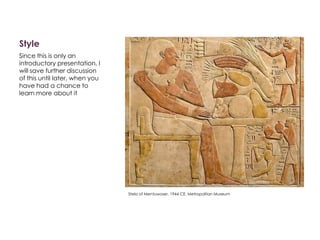
Style
Since this is only an
introductory presentation, I
will save further discussion
of this until later, when you
have had a chance to
learn more about it
Stela of Mentuwoser, 1944 CE. Metropolitan Museum
Style
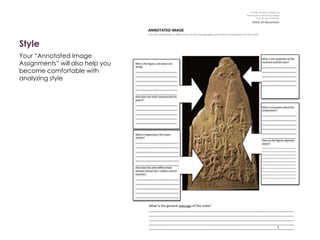
Your “Annotated Image
Assignments” will also help you
become comfortable with
analyzing style
Contextual Analysis
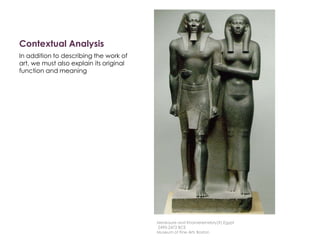
In addition to describing the work of
art, we must also explain its original
function and meaning
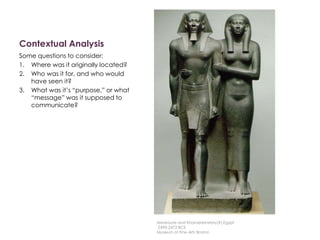
Menkaure and Khamerernebty(?),Egypt
2490-2472 BCE
Museum of Fine Arts Boston
Contextual Analysis
Some questions to consider:
1. Where was it originally located?
2. Who was it for, and who would
have seen it?
3. What was it’s “purpose,” or what
“message” was it supposed to
communicate?
Menkaure and Khamerernebty(?),Egypt
2490-2472 BCE
Museum of Fine Arts Boston
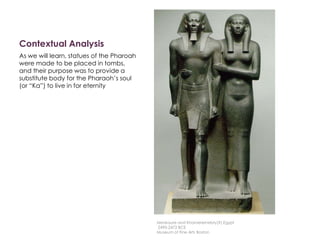
Contextual Analysis
As we will learn, statues of the Pharoah
were made to be placed in tombs,
and their purpose was to provide a
substitute body for the Pharaoh’s soul
(or “Ka”) to live in for eternity
Menkaure and Khamerernebty(?),Egypt
2490-2472 BCE
Museum of Fine Arts Boston
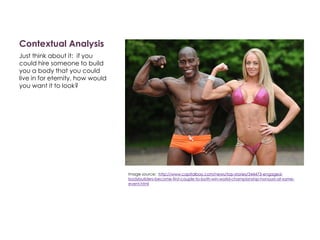
Contextual Analysis
Just think about it: if you
could hire someone to build
you a body that you could
live in for eternity, how would
you want it to look?
Image source: http://www.capitalbay.com/news/top-stories/344473-engaged-
bodybuilders-become-first-couple-to-both-win-world-championship-honours-at-same-
event.html
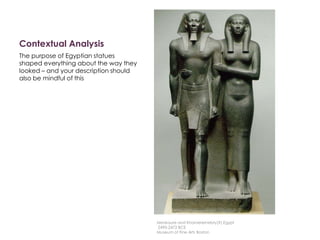
Contextual Analysis
The purpose of Egyptian statues
shaped everything about the way they
looked – and your description should
also be mindful of this
Menkaure and Khamerernebty(?),Egypt
2490-2472 BCE
Museum of Fine Arts Boston
Contextual Analysis
This time, I want to use your textbook’s
description of the Seated Statue of
Khafreon page 38
[You can also find it online]
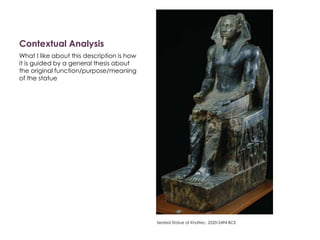
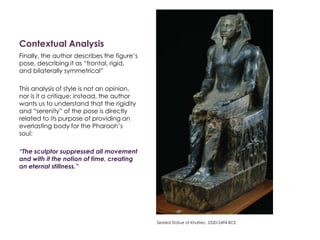
Seated Statue of Khafrec. 2520-2494 BCE
Contextual Analysis
What I like about this description is how
it is guided by a general thesis about
the original function/purpose/meaning
of the statue
Seated Statue of Khafrec. 2520-2494 BCE
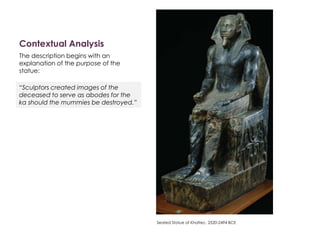
Contextual Analysis
The description begins with an
explanation of the purpose of the
statue:
Seated Statue of Khafrec. 2520-2494 BCE
“Sculptors created images of the
deceased to serve as abodes for the
ka should the mummies be destroyed.”
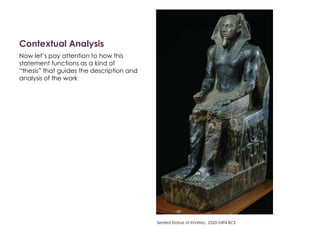
Contextual Analysis
Now let’s pay attention to how this
statement functions as a kind of
“thesis” that guides the description and
analysis of the work
Seated Statue of Khafrec. 2520-2494 BCE
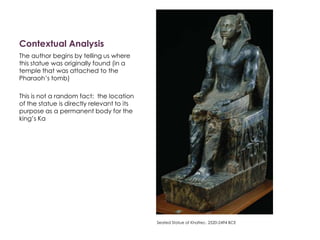
Contextual Analysis
The author begins by telling us where
this statue was originally found (in a
temple that was attached to the
Pharaoh’s tomb)
This is not a random fact: the location
of the statue is directly relevant to its
purpose as a permanent body for the
king’s Ka
Seated Statue of Khafrec. 2520-2494 BCE
Contextual Analysis
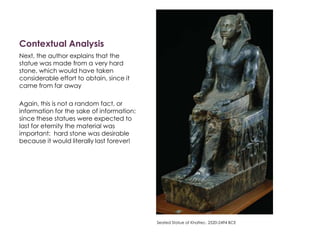
Next, the author explains that the
statue was made from a very hard
stone, which would have taken
considerable effort to obtain, since it
came from far away
Again, this is not a random fact, or
information for the sake of information:
since these statues were expected to
last for eternity the material was
important: hard stone was desirable
because it would literally last forever!
Seated Statue of Khafrec. 2520-2494 BCE
Contextual Analysis
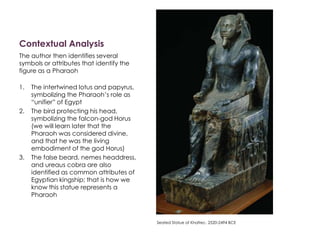
The author then identifies several
symbols or attributes that identify the
figure as a Pharaoh
1. The intertwined lotus and papyrus,
symbolizing the Pharaoh’s role as
“unifier” of Egypt
2. The bird protecting his head,
symbolizing the falcon-god Horus
(we will learn later that the
Pharaoh was considered divine,
and that he was the living
embodiment of the god Horus)
3. The false beard, nemes headdress,
and ureaus cobra are also
identified as common attributes of
Egyptian kingship; that is how we
know this statue represents a
Pharaoh
Seated Statue of Khafrec. 2520-2494 BCE
Contextual Analysis
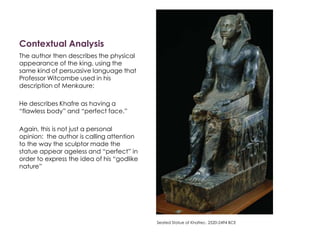
The author then describes the physical
appearance of the king, using the
same kind of persuasive language that
Professor Witcombe used in his
description of Menkaure:
He describes Khafre as having a
“flawless body” and “perfect face.”
Again, this is not just a personal
opinion: the author is calling attention
to the way the sculptor made the
statue appear ageless and “perfect” in
order to express the idea of his “godlike
nature”
Seated Statue of Khafrec. 2520-2494 BCE
Contextual Analysis
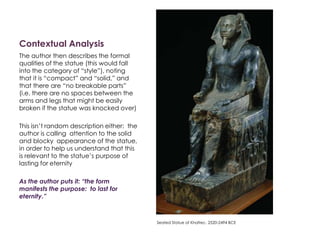
The author then describes the formal
qualities of the statue (this would fall
into the category of “style”), noting
that it is “compact” and “solid,” and
that there are “no breakable parts”
(i.e. there are no spaces between the
arms and legs that might be easily
broken if the statue was knocked over)
This isn’t random description either: the
author is calling attention to the solid
and blocky appearance of the statue,
in order to help us understand that this
is relevant to the statue’s purpose of
lasting for eternity
As the author puts it: “the form
manifests the purpose: to last for
eternity.”
Seated Statue of Khafrec. 2520-2494 BCE
Contextual Analysis
Finally, the author describes the figure’s
pose, describing it as “frontal, rigid,
and bilaterally symmetrical”
This analysis of style is not an opinion,
nor is it a critique; instead, the author
wants us to understand that the rigidity
and “serenity” of the pose is directly
related to its purpose of providing an
everlasting body for the Pharaoh’s
soul:
“The sculptor suppressed all movement
and with it the notion of time, creating
an eternal stillness.”
Seated Statue of Khafrec. 2520-2494 BCE
The Skill of Describing
Describing works of art can sometimes
be challenging, but you will be
practicing the “skill of describing”
throughout the semester
Image source: http://www.hangtogetherblog.com/2013/01/15/reality-based-
cultural-conversations-what-corporations-can-teach-us/words-cant-describe/
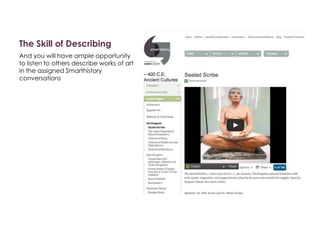
The Skill of Describing
And you will have ample opportunity
to listen to others describe works of art
in the assigned Smarthistory
conversations
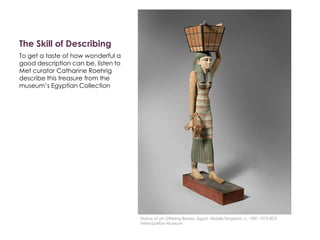
The Skill of Describing
To get a taste of how wonderful a
good description can be, listen to
Met curator Catharine Roehrig
describe this treasure from the
museum’s Egyptian Collection
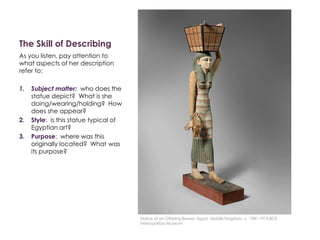
Statue of an Offering Bearer, Egypt, Middle Kingdom, c. 1981-1975 BCE
Metropolitan Museum
The Skill of Describing
As you listen, pay attention to
what aspects of her description
refer to:
1. Subject matter: who does the
statue depict? What is she
doing/wearing/holding? How
does she appear?
2. Style: is this statue typical of
Egyptian art?
3. Purpose: where was this
originally located? What was
its purpose?
Statue of an Offering Bearer, Egypt, Middle Kingdom, c. 1981-1975 BCE
Metropolitan Museum
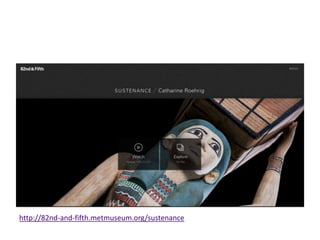
http://82nd-and-fifth.metmuseum.org/sustenance

Skill of Describing

  • 1.
    Art 108 Ancientto Medieval Westchester Community College Fall 2013 Professor Melissa Hall The Skill of Describing Image source: http://smarthistory.tumblr.com/post/36663164164/barberini-faun-c-220-b-c-e-marble-glyptothek
  • 2.
    The Skill ofDescribing One of the most important skills you will learn in this class is how to describe a work of art Visitors at the Metropolitan Museum viewing the Euphronioskrater. Image source: http://www.nytimes.com/2008/01/11/arts/design/11voge.html?pagewanted=all
  • 3.
    The Skill ofDescribing There are four basic components to a visual description Visual Analysis 1. Identification 2. Subject matter description 3. Stylistic analysis 4. Contextual analysis (explanation of meaning/function/purpose
  • 4.
    The Skill ofDescribing These four components will form the building blocks of your Visual Analysis essay Image source: www.thinkandthrive.com
  • 5.
    Identification First, we mustproperly identify the art work we will describe Menkaure and Khamerernebty(?),Egypt 2490-2472 BCE Museum of Fine Arts Boston
  • 6.
    Identification This is theinformation you will find on the museum label, or “object page” on the museum website King Menkaura and Queen Museum of Fine Arts, Boston http://media.mfa.org/audio/ENG_401.mp3
  • 7.
  • 8.
    Identification Just as youare expected to provide the author, title, date and place of publication when writing about books and articles, this information is required when writing about works of art
  • 9.
    Subject Matter Description Now, weare ready to describe the work Menkaure and Khamerernebty(?),Egypt 2490-2472 BCE Museum of Fine Arts Boston
  • 10.
    Subject Matter Description To start,we must explain “who” or “what” is represented Menkaure and Khamerernebty(?),Egypt 2490-2472 BCE Museum of Fine Arts Boston
  • 11.
    Subject Matter Description Now ifI asked you to identify “who or what is represented” in this picture, it would be a no- brainer because George Washington is such a familiar figure Gilbert Stuart, Portrait of George Washington (The Landsdowne Portrait), 1796 Smithsonian Institution, National Portrait Gallery
  • 12.
    Subject Matter Description But toidentify “who or what is represented” in ancient art requires the kind of background knowledge you will be learning in this class Menkaure and Khamerernebty(?),Egypt 2490-2472 BCE
  • 13.
    Subject Matter Description Sally Studentread ahead in her textbook and learned that Menkaure was a Pharaoh of the 4th dynasty in Egypt; he built one of the great pyramids at Giza Menkaure and Khamerernebty(?),Egypt 2490-2472 BCE Museum of Fine Arts Boston
  • 14.
    Subject Matter Description The womanis believed to be his wife, whose name is too difficult to pronounce – so my students nicknamed her “Kim” Menkaure and Khamerernebty(?),Egypt 2490-2472 BCE Museum of Fine Arts Boston
  • 15.
    Subject Matter Description A gooddescription must also have descriptive detail “Descriptive details allow sensory recreations of experiences, objects, or imaginings. In other words, description encourages a more concrete or sensory experience of a subject, one which allows the reader to transport himself or herself into a scene. Writing that lacks description is in danger of being plain or overly general.”
ADefinitionof Descriptive Detail (Colorado State University) Menkaure and Khamerernebty(?),Egypt 2490-2472 BCE Museum of Fine Arts Boston
  • 16.
    Subject Matter Description When describinga work of art, imagine that you are talking to someone on the phone, or that your reader has their eyes closed Image source: http://link2power.org/wordpress/2011/05/can-you-hear-me-now/
  • 17.
    Subject Matter Description Your jobis to bring the image to life so they can “see” it, without looking at a picture Image source: http://megaanswers.com/how-are-we-able-to-sense-light-even-with-the- eyes-closed/
  • 18.
    Subject Matter Description Some thingsto consider in your description: 1. Physical appearance 2. Pose 3. Facial expression and gestures 4. Costume and attributes Menkaure and Khamerernebty(?),Egypt 2490-2472 BCE Museum of Fine Arts Boston
  • 19.
    Subject Matter Description Here isa description written by Professor Chris Witcombe, from Sweetbriar College I chose it because it is a good example of “descriptive writing” Menkaure and Khamerernebty(?),Egypt 2490-2472 BCE Museum of Fine Arts Boston
  • 20.
    Menkaure and Khamerernebty(?),Egypt 2490-2472BCE Museum of Fine Arts Boston “Menkaure is portrayed in the familiar Egyptian pose standing as if at attention with his left leg extended forward, his arms held stiff at his sides, and his fists clenched holding some unidentified cylindrical objects. His stance appears assertive, indicative of his power. He is represented as a mature yet vigorous man, perhaps in his thirties, with slender hips, broad shoulders, and well- developed arms . . . . On his head he wears a nemes, or headdress, the sides of which are pulled back behind his rather large ears, with the lappets falling to either side of his chest. The beard and the headdress are the primary symbols of his pharaonic status. Besides the headdress, the only other article of clothing he wears is a shendjyt kilt which is folded across the front, with one end falling down beneath, and held in place with a belt round his waist . . . .
  • 21.
    Subject Matter Description I thinkyou will agree that a good description helps us see the work more clearly But now I want to analyze the specific features of the statue that Professor Witcombe described Menkaure and Khamerernebty(?),Egypt 2490-2472 BCE Museum of Fine Arts Boston
  • 22.
    Subject Matter Description Here isa description written by Professor Witcombe, from Sweetbriar College “Menkaure is portrayed in the familiar Egyptian pose standing as if at attention with his left leg extended forward, his arms held stiff at his sides, and his fists clenched holding some unidentified cylindrical objects. His stance appears assertive, indicative of his power. He is represented as a mature yet vigorous man, perhaps in his thirties, with slender hips, broad shoulders, and well- developed arms . . . . On his head he wears a nemes, or headdress, the sides of which are pulled back behind his rather large ears, with the lappets falling to either side of his chest. The beard and the headdress are the primary symbols of his pharaonic status. Besides the headdress, the only other article of clothing he wears is a shendjyt kilt which is folded across the front, with one end falling down beneath, and held in place with a belt round his waist . . . . Pose Menkaure and Khamerernebty(?),Egypt 2490-2472 BCE Museum of Fine Arts Boston
  • 23.
    Subject Matter Description Here isa description written by Professor Witcombe, from Sweetbriar College “Menkaure is portrayed in the familiar Egyptian pose standing as if at attention with his left leg extended forward, his arms held stiff at his sides, and his fists clenched holding some unidentified cylindrical objects. His stance appears assertive, indicative of his power. He is represented as a mature yet vigorous man, perhaps in his thirties, with slender hips, broad shoulders, and well- developed arms . . . . On his head he wears a nemes, or headdress, the sides of which are pulled back behind his rather large ears, with the lappets falling to either side of his chest. The beard and the headdress are the primary symbols of his pharaonic status. Besides the headdress, the only other article of clothing he wears is a shendjyt kilt which is folded across the front, with one end falling down beneath, and held in place with a belt round his waist . . . . Pose Physical appearance Menkaure and Khamerernebty(?),Egypt 2490-2472 BCE Museum of Fine Arts Boston
  • 24.
    Subject Matter Description Here isa description written by Professor Witcombe, from Sweetbriar College “Menkaure is portrayed in the familiar Egyptian pose standing as if at attention with his left leg extended forward, his arms held stiff at his sides, and his fists clenched holding some unidentified cylindrical objects. His stance appears assertive, indicative of his power. He is represented as a mature yet vigorous man, perhaps in his thirties, with slender hips, broad shoulders, and well- developed arms . . . . On his head he wears a nemes, or headdress, the sides of which are pulled back behind his rather large ears, with the lappets falling to either side of his chest. The beard and the headdress are the primary symbols of his pharaonic status. Besides the headdress, the only other article of clothing he wears is a shendjyt kilt which is folded across the front, with one end falling down beneath, and held in place with a belt round his waist . . . . Pose Physical appearance Costume/attributes Menkaure and Khamerernebty(?),Egypt 2490-2472 BCE Museum of Fine Arts Boston
  • 25.
    Subject Matter Description A gooddescription must also go beyond the obvious to reveal something deeper about the “personality” of the work: “There is a significant difference between choosing details simply to describe something and selecting details that not only describe, but also reveal . . . . ”
Pursuasive Writing, Colorado State University Menkaure and Khamerernebty(?),Egypt 2490-2472 BCE Museum of Fine Arts Boston
  • 26.
    Subject Matter Description Avoid the“laundry list” description that simply lists details, with no guiding sense of purpose Menkaure and Khamerernebty(?),Egypt 2490-2472 BCE Museum of Fine Arts Boston
  • 27.
    Subject Matter Description Your descriptionshould have a clear idea of what you want to “show” your reader about the work Menkaure and Khamerernebty(?),Egypt 2490-2472 BCE Museum of Fine Arts Boston
  • 28.
    Subject Matter Description In fact,this can be translated into the familiar writing categories of a “thesis” and “supporting detail” Menkaure and Khamerernebty(?),Egypt 2490-2472 BCE Museum of Fine Arts Boston
  • 29.
    Subject Matter Description Professor Witcombe’sdescription actually has a “thesis” He wants to “argue” or “show” that Menkaure is a “majestic” godlike figure Menkaure and Khamerernebty(?),Egypt 2490-2472 BCE How does he do this?
  • 30.
    Subject Matter Description Here isa description written by Professor Witcombe, from Sweetbriar College “Menkaure is portrayed in the familiar Egyptian pose standing as if at attention with his left leg extended forward, his arms held stiff at his sides, and his fists clenched holding some unidentified cylindrical objects. His stance appears assertive, indicative of his power. He is represented as a mature yet vigorous man, perhaps in his thirties, with slender hips, broad shoulders, and well- developed arms . . . . On his head he wears a nemes, or headdress, the sides of which are pulled back behind his rather large ears, with the lappets falling to either side of his chest. The beard and the headdress are the primary symbols of his pharaonic status. Besides the headdress, the only other article of clothing he wears is a shendjyt kilt which is folded across the front, with one end falling down beneath, and held in place with a belt round his waist . . . . He does this by being selective about the details he describes, and by using “persuasive” language Menkaure and Khamerernebty(?),Egypt 2490-2472 BCE Museum of Fine Arts Boston
  • 31.
    Subject Matter Description Here isa description written by Professor Witcombe, from Sweetbriar College “Menkaure is portrayed in the familiar Egyptian pose standing as if at attention with his left leg extended forward, his arms held stiff at his sides, and his fists clenched holding some unidentified cylindrical objects. His stance appears assertive, indicative of his power. He is represented as a mature yet vigorous man, perhaps in his thirties, with slender hips, broad shoulders, and well- developed arms . . . . On his head he wears a nemes, or headdress, the sides of which are pulled back behind his rather large ears, with the lappets falling to either side of his chest. The beard and the headdress are the primary symbols of his pharaonic status. Besides the headdress, the only other article of clothing he wears is a shendjyt kilt which is folded across the front, with one end falling down beneath, and held in place with a belt round his waist . . . . He describes the pose as “assertive;” and the king as “mature,” “vigorous” “slender” and physically fit . . . . Menkaure and Khamerernebty(?),Egypt 2490-2472 BCE Museum of Fine Arts Boston
  • 32.
    Subject Matter Description Here isa description written by Professor Witcombe, from Sweetbriar College “Menkaure is portrayed in the familiar Egyptian pose standing as if at attention with his left leg extended forward, his arms held stiff at his sides, and his fists clenched holding some unidentified cylindrical objects. His stance appears assertive, indicative of his power. He is represented as a mature yet vigorous man, perhaps in his thirties, with slender hips, broad shoulders, and well- developed arms . . . . On his head he wears a nemes, or headdress, the sides of which are pulled back behind his rather large ears, with the lappets falling to either side of his chest. The beard and the headdress are the primary symbols of his pharaonic status. Besides the headdress, the only other article of clothing he wears is a shendjyt kilt which is folded across the front, with one end falling down beneath, and held in place with a belt round his waist . . . . Notice that the description is “showing,” rather than “telling” – he doesn’t just “say” that Menkaure is majestic and godlike, he shows us through his description Menkaure and Khamerernebty(?),Egypt 2490-2472 BCE Museum of Fine Arts Boston
  • 33.
    Showing versus Telling Thereader will have no problem imagining the statue (even if they don’t have a picture!), and will reach the same conclusion as the author: this is truly a majestic representation of the Pharaoh! Wow . . . It sounds like Menkaure is totally awesome!
  • 34.
    Subject Matter Description Describing worksof “narrative art” can be even more complicated, because it is necessary to “read the story out loud,” much like a comic strip Stele of Naramsin
  • 35.
    Subject Matter Description Your “AnnotatedImage Assignments” will help you practice this skill
  • 36.
    Style Style refers tothe visual characteristics of a work of art Stela of Mentuwoser, 1944 CE. Metropolitan Museum
  • 37.
    Style Since this isonly an introductory presentation, I will save further discussion of this until later, when you have had a chance to learn more about it Stela of Mentuwoser, 1944 CE. Metropolitan Museum
  • 38.
    Style Your “Annotated Image Assignments”will also help you become comfortable with analyzing style
  • 39.
    Contextual Analysis In additionto describing the work of art, we must also explain its original function and meaning Menkaure and Khamerernebty(?),Egypt 2490-2472 BCE Museum of Fine Arts Boston
  • 40.
    Contextual Analysis Some questionsto consider: 1. Where was it originally located? 2. Who was it for, and who would have seen it? 3. What was it’s “purpose,” or what “message” was it supposed to communicate? Menkaure and Khamerernebty(?),Egypt 2490-2472 BCE Museum of Fine Arts Boston
  • 41.
    Contextual Analysis As wewill learn, statues of the Pharoah were made to be placed in tombs, and their purpose was to provide a substitute body for the Pharaoh’s soul (or “Ka”) to live in for eternity Menkaure and Khamerernebty(?),Egypt 2490-2472 BCE Museum of Fine Arts Boston
  • 42.
    Contextual Analysis Just thinkabout it: if you could hire someone to build you a body that you could live in for eternity, how would you want it to look? Image source: http://www.capitalbay.com/news/top-stories/344473-engaged- bodybuilders-become-first-couple-to-both-win-world-championship-honours-at-same- event.html
  • 43.
    Contextual Analysis The purposeof Egyptian statues shaped everything about the way they looked – and your description should also be mindful of this Menkaure and Khamerernebty(?),Egypt 2490-2472 BCE Museum of Fine Arts Boston
  • 44.
    Contextual Analysis This time,I want to use your textbook’s description of the Seated Statue of Khafreon page 38 [You can also find it online] Seated Statue of Khafrec. 2520-2494 BCE
  • 45.
    Contextual Analysis What Ilike about this description is how it is guided by a general thesis about the original function/purpose/meaning of the statue Seated Statue of Khafrec. 2520-2494 BCE
  • 46.
    Contextual Analysis The descriptionbegins with an explanation of the purpose of the statue: Seated Statue of Khafrec. 2520-2494 BCE “Sculptors created images of the deceased to serve as abodes for the ka should the mummies be destroyed.”
  • 47.
    Contextual Analysis Now let’spay attention to how this statement functions as a kind of “thesis” that guides the description and analysis of the work Seated Statue of Khafrec. 2520-2494 BCE
  • 48.
    Contextual Analysis The authorbegins by telling us where this statue was originally found (in a temple that was attached to the Pharaoh’s tomb) This is not a random fact: the location of the statue is directly relevant to its purpose as a permanent body for the king’s Ka Seated Statue of Khafrec. 2520-2494 BCE
  • 49.
    Contextual Analysis Next, theauthor explains that the statue was made from a very hard stone, which would have taken considerable effort to obtain, since it came from far away Again, this is not a random fact, or information for the sake of information: since these statues were expected to last for eternity the material was important: hard stone was desirable because it would literally last forever! Seated Statue of Khafrec. 2520-2494 BCE
  • 50.
    Contextual Analysis The authorthen identifies several symbols or attributes that identify the figure as a Pharaoh 1. The intertwined lotus and papyrus, symbolizing the Pharaoh’s role as “unifier” of Egypt 2. The bird protecting his head, symbolizing the falcon-god Horus (we will learn later that the Pharaoh was considered divine, and that he was the living embodiment of the god Horus) 3. The false beard, nemes headdress, and ureaus cobra are also identified as common attributes of Egyptian kingship; that is how we know this statue represents a Pharaoh Seated Statue of Khafrec. 2520-2494 BCE
  • 51.
    Contextual Analysis The authorthen describes the physical appearance of the king, using the same kind of persuasive language that Professor Witcombe used in his description of Menkaure: He describes Khafre as having a “flawless body” and “perfect face.” Again, this is not just a personal opinion: the author is calling attention to the way the sculptor made the statue appear ageless and “perfect” in order to express the idea of his “godlike nature” Seated Statue of Khafrec. 2520-2494 BCE
  • 52.
    Contextual Analysis The authorthen describes the formal qualities of the statue (this would fall into the category of “style”), noting that it is “compact” and “solid,” and that there are “no breakable parts” (i.e. there are no spaces between the arms and legs that might be easily broken if the statue was knocked over) This isn’t random description either: the author is calling attention to the solid and blocky appearance of the statue, in order to help us understand that this is relevant to the statue’s purpose of lasting for eternity As the author puts it: “the form manifests the purpose: to last for eternity.” Seated Statue of Khafrec. 2520-2494 BCE
  • 53.
    Contextual Analysis Finally, theauthor describes the figure’s pose, describing it as “frontal, rigid, and bilaterally symmetrical” This analysis of style is not an opinion, nor is it a critique; instead, the author wants us to understand that the rigidity and “serenity” of the pose is directly related to its purpose of providing an everlasting body for the Pharaoh’s soul: “The sculptor suppressed all movement and with it the notion of time, creating an eternal stillness.” Seated Statue of Khafrec. 2520-2494 BCE
  • 54.
    The Skill ofDescribing Describing works of art can sometimes be challenging, but you will be practicing the “skill of describing” throughout the semester Image source: http://www.hangtogetherblog.com/2013/01/15/reality-based- cultural-conversations-what-corporations-can-teach-us/words-cant-describe/
  • 55.
    The Skill ofDescribing And you will have ample opportunity to listen to others describe works of art in the assigned Smarthistory conversations
  • 56.
    The Skill ofDescribing To get a taste of how wonderful a good description can be, listen to Met curator Catharine Roehrig describe this treasure from the museum’s Egyptian Collection Statue of an Offering Bearer, Egypt, Middle Kingdom, c. 1981-1975 BCE Metropolitan Museum
  • 57.
    The Skill ofDescribing As you listen, pay attention to what aspects of her description refer to: 1. Subject matter: who does the statue depict? What is she doing/wearing/holding? How does she appear? 2. Style: is this statue typical of Egyptian art? 3. Purpose: where was this originally located? What was its purpose? Statue of an Offering Bearer, Egypt, Middle Kingdom, c. 1981-1975 BCE Metropolitan Museum
  • 58.