Visual Analysis
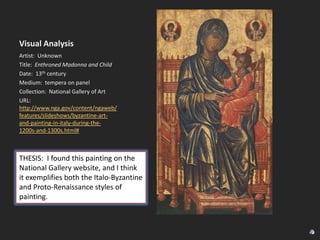
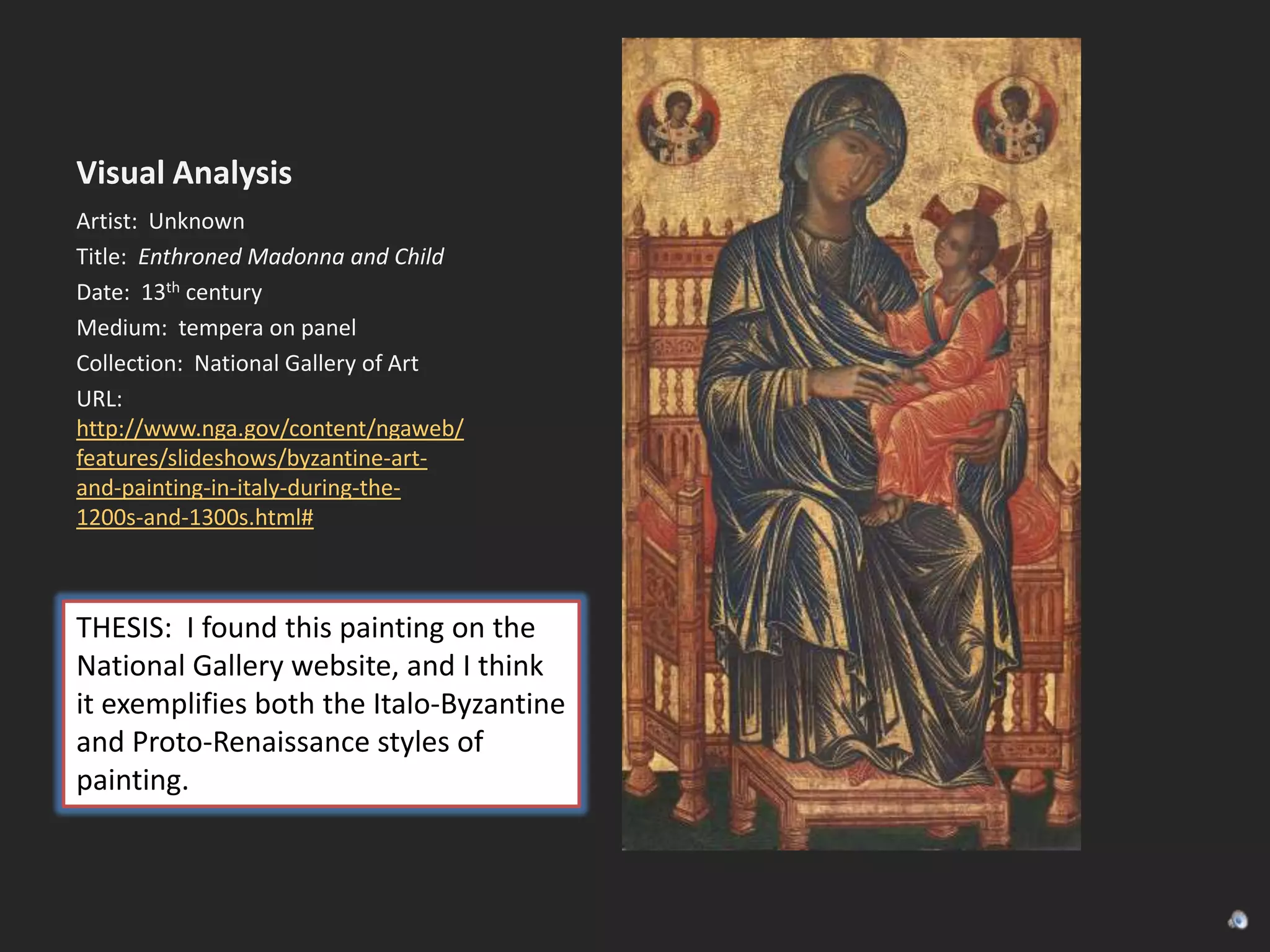
Artist: Unknown
Title: Enthroned Madonna and Child
Date: 13th century
Medium: tempera on panel
Collection: National Gallery of Art
URL:
http://www.nga.gov/content/ngaweb/
features/slideshows/byzantine-artand-painting-in-italy-during-the1200s-and-1300s.html#

THESIS: I found this painting on the
National Gallery website, and I think
it exemplifies both the Italo-Byzantine
and Proto-Renaissance styles of
painting.
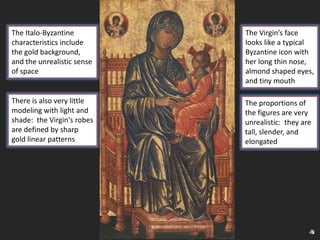
The Italo-Byzantine
characteristics include
the gold background,
and the unrealistic sense
of space

The Virgin’s face
looks like a typical
Byzantine icon with
her long thin nose,
almond shaped eyes,
and tiny mouth

There is also very little
modeling with light and
shade: the Virgin's robes
are defined by sharp
gold linear patterns

The proportions of
the figures are very
unrealistic: they are
tall, slender, and
elongated
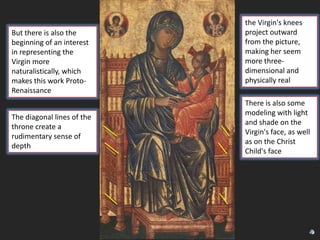
But there is also the
beginning of an interest
in representing the
Virgin more
naturalistically, which
makes this work ProtoRenaissance
The diagonal lines of the
throne create a
rudimentary sense of
depth

the Virgin's knees
project outward
from the picture,
making her seem
more threedimensional and
physically real
There is also some
modeling with light
and shade on the
Virgin's face, as well
as on the Christ
Child's face
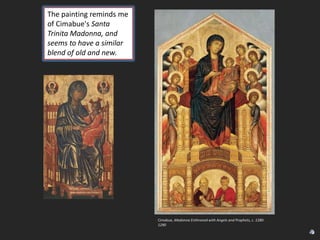
The painting reminds me
of Cimabue's Santa
Trinita Madonna, and
seems to have a similar
blend of old and new.

Cimabue, Madonna Enthroned with Angels and Prophets, c. 12801290

Sample visual analysis

  • 1.
    Visual Analysis Artist: Unknown Title:Enthroned Madonna and Child Date: 13th century Medium: tempera on panel Collection: National Gallery of Art URL: http://www.nga.gov/content/ngaweb/ features/slideshows/byzantine-artand-painting-in-italy-during-the1200s-and-1300s.html# THESIS: I found this painting on the National Gallery website, and I think it exemplifies both the Italo-Byzantine and Proto-Renaissance styles of painting.
  • 2.
    The Italo-Byzantine characteristics include thegold background, and the unrealistic sense of space The Virgin’s face looks like a typical Byzantine icon with her long thin nose, almond shaped eyes, and tiny mouth There is also very little modeling with light and shade: the Virgin's robes are defined by sharp gold linear patterns The proportions of the figures are very unrealistic: they are tall, slender, and elongated
  • 3.
    But there isalso the beginning of an interest in representing the Virgin more naturalistically, which makes this work ProtoRenaissance The diagonal lines of the throne create a rudimentary sense of depth the Virgin's knees project outward from the picture, making her seem more threedimensional and physically real There is also some modeling with light and shade on the Virgin's face, as well as on the Christ Child's face
  • 4.
    The painting remindsme of Cimabue's Santa Trinita Madonna, and seems to have a similar blend of old and new. Cimabue, Madonna Enthroned with Angels and Prophets, c. 12801290