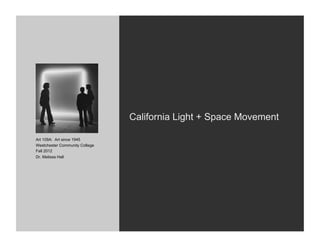
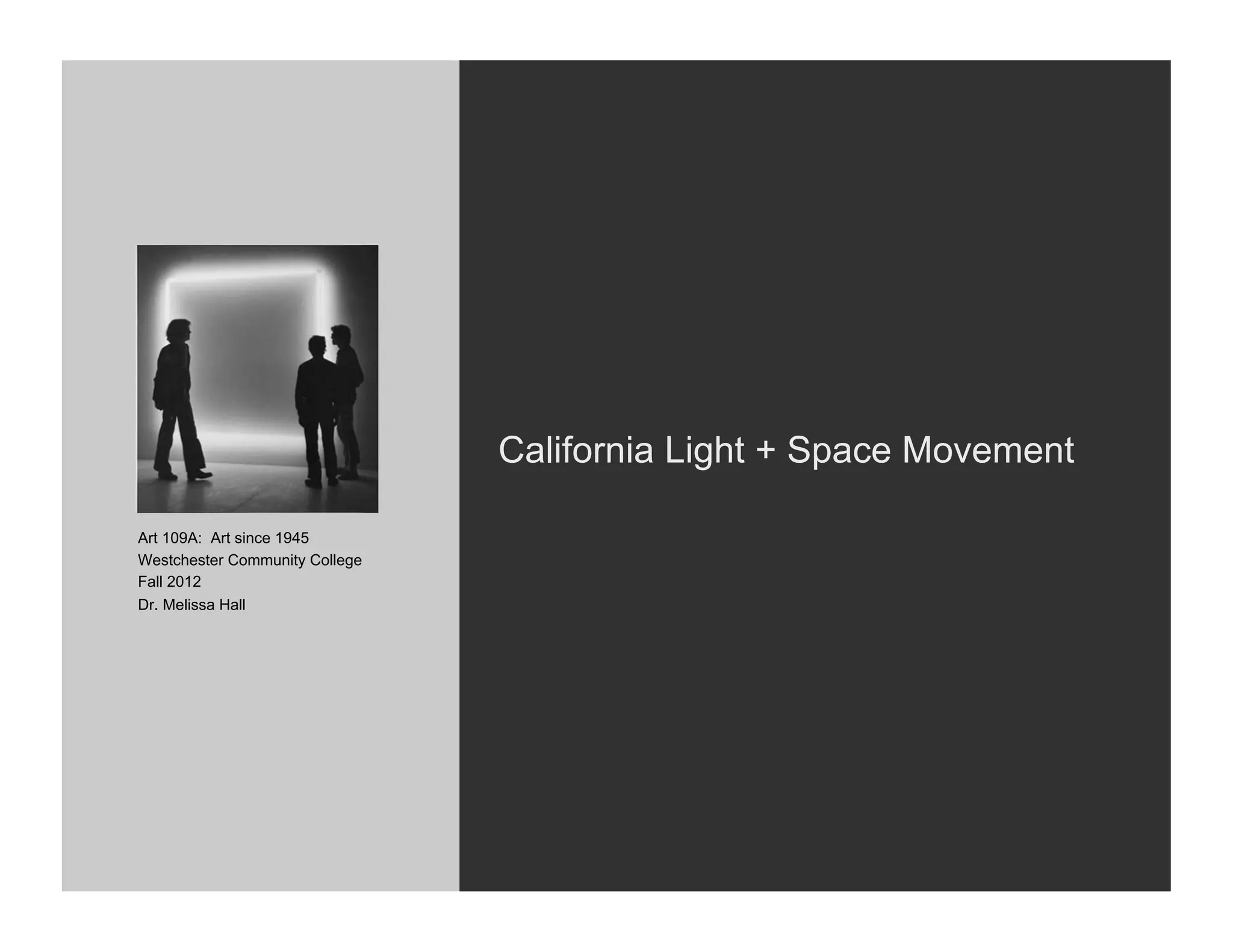
California Light + Space Movement

Art 109A: Art since 1945
Westchester Community College
Fall 2012
Dr. Melissa Hall
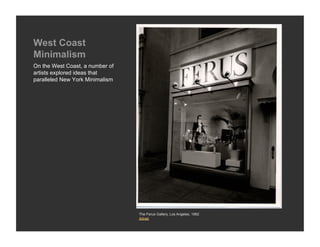
West Coast
Minimalism
On the West Coast, a number of
artists explored ideas that
paralleled New York Minimalism


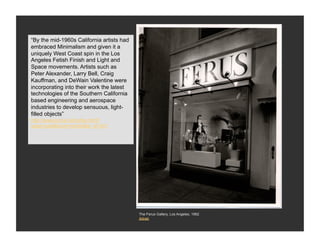
                                 The Ferus Gallery, Los Angeles, 1962
                                 Artnet
“By the mid-1960s California artists had
West Coast
embraced Minimalism and given it a
Minimalism
uniquely West Coast spin in the Los
Angeles Fetish Finish and Light and
Space movements. Artists such as
Peter Alexander, Larry Bell, Craig
Kauffman, and DeWain Valentine were
incorporating into their work the latest
technologies of the Southern California
based engineering and aerospace
industries to develop sensuous, light-
filled objects”
http://www.ocma.net/index.html?
page=past&show=exhibit&e_id=401


                                           The Ferus Gallery, Los Angeles, 1962
                                           Artnet
West Coast
Minimalism
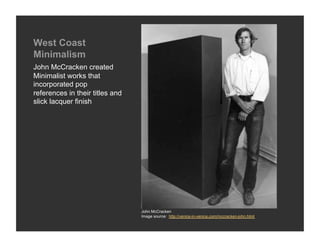
John McCracken created
Minimalist works that
incorporated pop
references in their titles and
slick lacquer finish


                                 John McCracken
                                 Image source: http://venice-in-venice.com/mccracken-john.html
West Coast
Minimalism
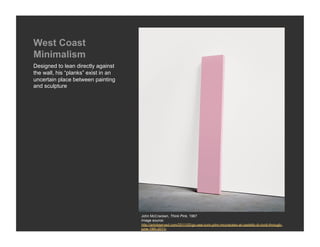
Designed to lean directly against
the wall, his “planks” exist in an
uncertain place between painting
and sculpture


                                     John McCracken, Think Pink, 1967
                                     Image source:
                                     http://artobserved.com/2011/02/go-see-turin-john-mccracken-at-castello-di-rivoli-through-
                                     june-19th-2011/
West Coast
  Minimalism
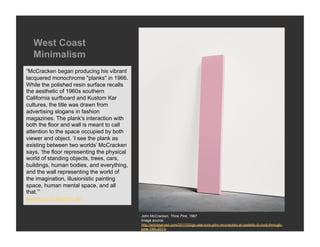
“McCracken began producing his vibrant
lacquered monochrome "planks" in 1966.
While the polished resin surface recalls
the aesthetic of 1960s southern
California surfboard and Kustom Kar
cultures, the title was drawn from
advertising slogans in fashion
magazines. The plank's interaction with
both the floor and wall is meant to call
attention to the space occupied by both
viewer and object. ‘I see the plank as
existing between two worlds’ McCracken
says, ‘the floor representing the physical
world of standing objects, trees, cars,
buildings, human bodies, and everything,
and the wall representing the world of
the imagination, illusionistic painting
space, human mental space, and all
that.’”
Museum of Modern Art


                                             John McCracken, Think Pink, 1967
                                             Image source:
                                             http://artobserved.com/2011/02/go-see-turin-john-mccracken-at-castello-di-rivoli-through-
                                             june-19th-2011/
West Coast
Minimalism
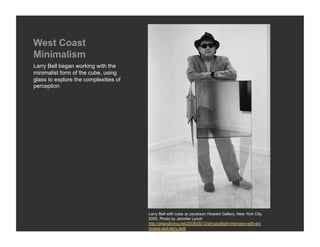
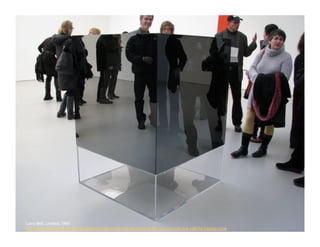
Larry Bell began working with the
minimalist form of the cube, using
glass to explore the complexities of
perception


                                       Larry Bell with cube at Jacobson Howard Gallery, New York City,
                                       2005. Photo by Jennifer Lynch
                                       http://artandliving.net/2008/05/13/art-spotlight-interview-with-ed-
                                       moses-and-larry-bell/
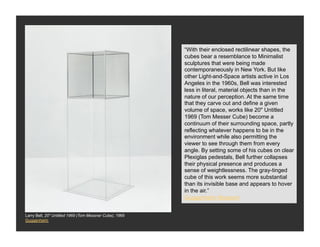
“With their enclosed rectilinear shapes, the
                                                         cubes bear a resemblance to Minimalist
                                                         sculptures that were being made
                                                         contemporaneously in New York. But like
                                                         other Light-and-Space artists active in Los
                                                         Angeles in the 1960s, Bell was interested
                                                         less in literal, material objects than in the
                                                         nature of our perception. At the same time
                                                         that they carve out and define a given
                                                         volume of space, works like 20" Untitled
                                                         1969 (Tom Messer Cube) become a
                                                         continuum of their surrounding space, partly
                                                         reflecting whatever happens to be in the
                                                         environment while also permitting the
                                                         viewer to see through them from every
                                                         angle. By setting some of his cubes on clear
                                                         Plexiglas pedestals, Bell further collapses
                                                         their physical presence and produces a
                                                         sense of weightlessness. The gray-tinged
                                                         cube of this work seems more substantial
                                                         than its invisible base and appears to hover
                                                         in the air.”
                                                         Guggenheim Museum


Larry Bell, 20" Untitled 1969 (Tom Messner Cube), 1969
Guggenheim
Larry Bell, Untitled, 1969
http://www.quotestemple.com/Quotes/larry-bell-quote-hes-not-going-to-win-but-my-vote-is-a-vote-for-having-more
California Light
and Space
Movement
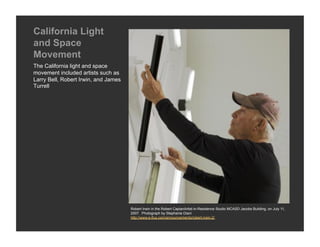
The California light and space
movement included artists such as
Larry Bell, Robert Irwin, and James
Turrell


                                      Robert Irwin in the Robert CaplanArtist-in-Residence Studio MCASD Jacobs Building, on July 11,
                                      2007. Photograph by Stephanie Diani
                                      http://www.e-flux.com/announcements/robert-irwin-2/
California Light
and Space
Movement
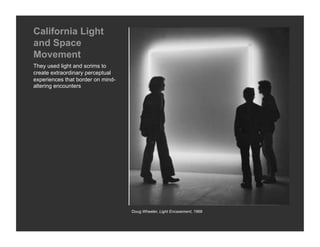
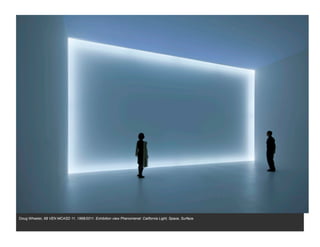
They used light and scrims to
create extraordinary perceptual
experiences that border on mind-
altering encounters


                                   Doug Wheeler, Light Encasement, 1968
Doug Wheeler, 68 VEN MCASD 11, 1968/2011. Exhibition view Phenomenal: California Light, Space, Surface.
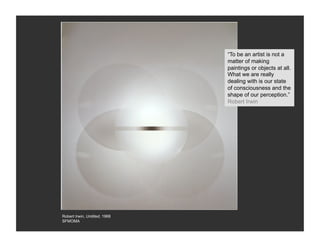
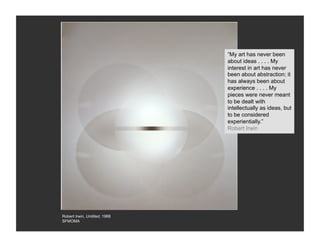
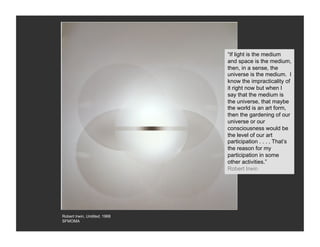
“This untitled work is a
                                                                                              convex, spray-painted disk
                                                                                              held a foot or so out from
                                                                                              the wall by a central post. Its
                                                                                              subtle, tactile surface
                                                                                              modulates delicately from
                                                                                              center to edge, and it is
                                                                                              softly lit from four angles,
                                                                                              creating a cloverleaf pattern
                                                                                              of shadow. The white center
                                                                                              of the disk can seem to lie
                                                                                              level with the white wall, so
                                                                                              that the eye spends time
                                                                                              trying to understand what it
                                                                                              sees—what is nearer and
                                                                                              what is farther, what is solid
                                                                                              and what is immaterial light,
                                                                                              or even light's absence. For
                                                                                              Irwin, the result is ‘this
                                                                                              indeterminate physicality
                                                                                              with different levels of
                                                                                              weight and density, each on
                                                                                              a different physical plane. It
                                                                                              [is] very beautiful and quite
                                                                                              confusing, everything
                                                                                              starting and reversing.’”
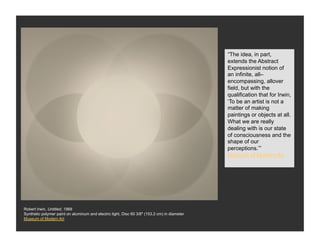
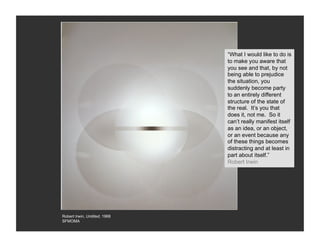
Robert Irwin, Untitled, 1968
                                                                                              Museum of Modern Art
Synthetic polymer paint on aluminum and electric light, Disc 60 3/8" (153.2 cm) in diameter
Museum of Modern Art
“The idea, in part,
                                                                                              extends the Abstract
                                                                                              Expressionist notion of
                                                                                              an infinite, all–
                                                                                              encompassing, allover
                                                                                              field, but with the
                                                                                              qualification that for Irwin,
                                                                                              ‘To be an artist is not a
                                                                                              matter of making
                                                                                              paintings or objects at all.
                                                                                              What we are really
                                                                                              dealing with is our state
                                                                                              of consciousness and the
                                                                                              shape of our
                                                                                              perceptions.’”
                                                                                              Museum of Modern Art


Robert Irwin, Untitled, 1968
Synthetic polymer paint on aluminum and electric light, Disc 60 3/8" (153.2 cm) in diameter
Museum of Modern Art
“To be an artist is not a
                               matter of making
                               paintings or objects at all.
                               What we are really
                               dealing with is our state
                               of consciousness and the
                               shape of our perception.”
                               Robert Irwin


Robert Irwin, Untitled, 1968
SFMOMA
“My art has never been
                               about ideas . . . . My
                               interest in art has never
                               been about abstraction; it
                               has always been about
                               experience . . . . My
                               pieces were never meant
                               to be dealt with
                               intellectually as ideas, but
                               to be considered
                               experientially.”
                               Robert Irwin


Robert Irwin, Untitled, 1968
SFMOMA
“What I would like to do is
                               to make you aware that
                               you see and that, by not
                               being able to prejudice
                               the situation, you
                               suddenly become party
                               to an entirely different
                               structure of the state of
                               the real. It’s you that
                               does it, not me. So it
                               can’t really manifest itself
                               as an idea, or an object,
                               or an event because any
                               of these things becomes
                               distracting and at least in
                               part about itself.”
                               Robert Irwin


Robert Irwin, Untitled, 1968
SFMOMA
“If light is the medium
                               and space is the medium,
                               then, in a sense, the
                               universe is the medium. I
                               know the impracticality of
                               it right now but when I
                               say that the medium is
                               the universe, that maybe
                               the world is an art form,
                               then the gardening of our
                               universe or our
                               consciousness would be
                               the level of our art
                               participation . . . . That’s
                               the reason for my
                               participation in some
                               other activities.”
                               Robert Irwin


Robert Irwin, Untitled, 1968
SFMOMA
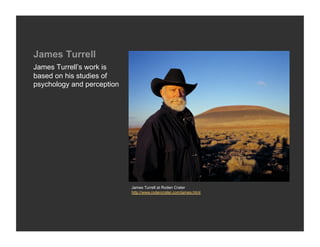
James Turrell
James Turrell’s work is
based on his studies of
psychology and perception


                            James Turrell at Roden Crater
                            http://www.rodencrater.com/james.html
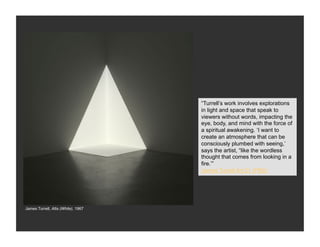
“Turrell’s work involves explorations
                                    in light and space that speak to
                                    viewers without words, impacting the
                                    eye, body, and mind with the force of
                                    a spiritual awakening. ‘I want to
                                    create an atmosphere that can be
                                    consciously plumbed with seeing,’
                                    says the artist, “like the wordless
                                    thought that comes from looking in a
                                    fire.’”
                                    James Turrell Art:21 (PBS)


James Turrell, Alta (White), 1967
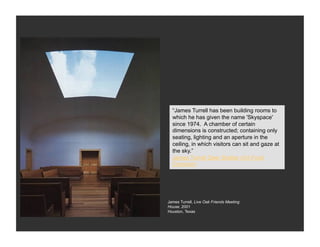
“James Turrell has been building rooms to
  which he has given the name 'Skyspace'
  since 1974. A chamber of certain
  dimensions is constructed; containing only
  seating, lighting and an aperture in the
  ceiling, in which visitors can sit and gaze at
  the sky.”
  James Turrell Deer Shelter (Art Fund
  Comsion)


James Turrell, Live Oak Friends Meeting
House, 2001
Houston, Texas
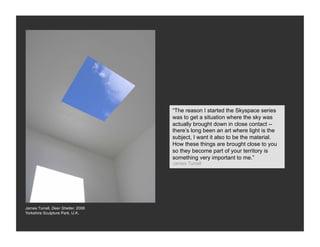
“The reason I started the Skyspace series
                                    was to get a situation where the sky was
                                    actually brought down in close contact --
                                    there’s long been an art where light is the
                                    subject, I want it also to be the material.
                                    How these things are brought close to you
                                    so they become part of your territory is
                                    something very important to me.”
                                    James Turrell


James Turrell, Deer Shelter, 2006
Yorkshire Sculpture Park, U.K.
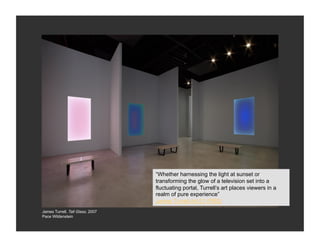
“Whether harnessing the light at sunset or
                                  transforming the glow of a television set into a
                                  fluctuating portal, Turrell’s art places viewers in a
                                  realm of pure experience”
                                  James Turrell Art:21 (PBS)
James Turrell, Tall Glass, 2007
Pace Wildenstein
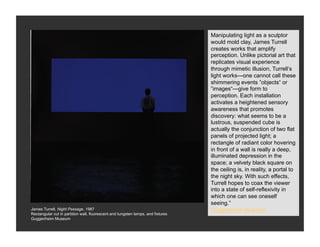
Manipulating light as a sculptor
                                                                                  would mold clay, James Turrell
                                                                                  creates works that amplify
                                                                                  perception. Unlike pictorial art that
                                                                                  replicates visual experience
                                                                                  through mimetic illusion, Turrell’s
                                                                                  light works—one cannot call these
                                                                                  shimmering events ”objects“ or
                                                                                  ”images“—give form to
                                                                                  perception. Each installation
                                                                                  activates a heightened sensory
                                                                                  awareness that promotes
                                                                                  discovery: what seems to be a
                                                                                  lustrous, suspended cube is
                                                                                  actually the conjunction of two flat
                                                                                  panels of projected light; a
                                                                                  rectangle of radiant color hovering
                                                                                  in front of a wall is really a deep,
                                                                                  illuminated depression in the
                                                                                  space; a velvety black square on
                                                                                  the ceiling is, in reality, a portal to
                                                                                  the night sky. With such effects,
                                                                                  Turrell hopes to coax the viewer
                                                                                  into a state of self-reflexivity in
                                                                                  which one can see oneself
                                                                                  seeing.”
James Turrell, Night Passage, 1987                                                Guggenheim Museum
Rectangular cut in partition wall, fluorescent and tungsten lamps, and fixtures
Guggenheim Museum
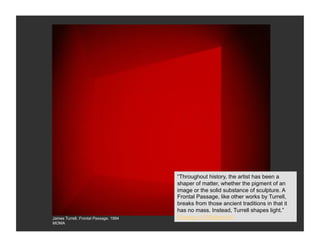
“Throughout history, the artist has been a
                                       shaper of matter, whether the pigment of an
                                       image or the solid substance of sculpture. A
                                       Frontal Passage, like other works by Turrell,
                                       breaks from those ancient traditions in that it
                                       has no mass. Instead, Turrell shapes light.”
James Turrell, Frontal Passage, 1994   Museum of Modern Art
MOMA
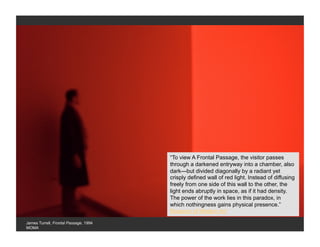
“To view A Frontal Passage, the visitor passes
                                       through a darkened entryway into a chamber, also
                                       dark—but divided diagonally by a radiant yet
                                       crisply defined wall of red light. Instead of diffusing
                                       freely from one side of this wall to the other, the
                                       light ends abruptly in space, as if it had density.
                                       The power of the work lies in this paradox, in
                                       which nothingness gains physical presence.”
                                       Museum of Modern Art

James Turrell, Frontal Passage, 1994
MOMA
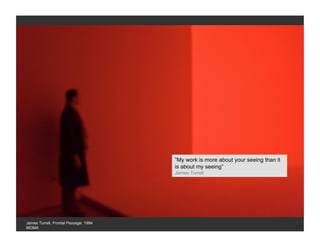
”My work is more about your seeing than it
                                       is about my seeing”
                                       James Turrell


James Turrell, Frontal Passage, 1994
MOMA
California Light
and Space
Movement
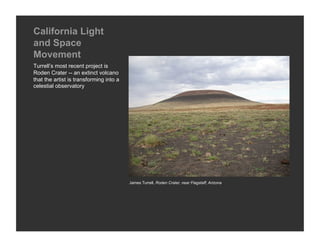
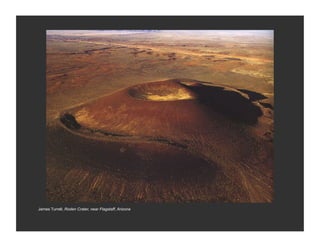
Turrell’s most recent project is
Roden Crater -- an extinct volcano
that the artist is transforming into a
celestial observatory


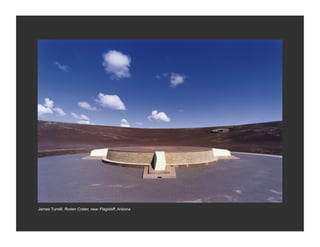
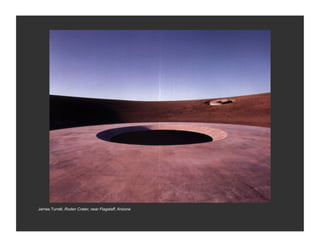
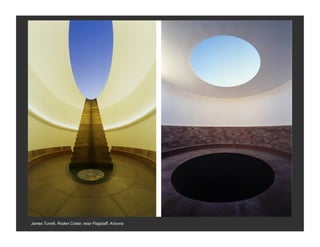
                                         James Turrell, Roden Crater, near Flagstaff, Arizona
James Turrell, Roden Crater, near Flagstaff, Arizona

6.2 minimalism california

  • 1.
    California Light +Space Movement Art 109A: Art since 1945 Westchester Community College Fall 2012 Dr. Melissa Hall
  • 2.
    West Coast Minimalism On theWest Coast, a number of artists explored ideas that paralleled New York Minimalism The Ferus Gallery, Los Angeles, 1962 Artnet
  • 3.
    “By the mid-1960sCalifornia artists had West Coast embraced Minimalism and given it a Minimalism uniquely West Coast spin in the Los Angeles Fetish Finish and Light and Space movements. Artists such as Peter Alexander, Larry Bell, Craig Kauffman, and DeWain Valentine were incorporating into their work the latest technologies of the Southern California based engineering and aerospace industries to develop sensuous, light- filled objects” http://www.ocma.net/index.html? page=past&show=exhibit&e_id=401 The Ferus Gallery, Los Angeles, 1962 Artnet
  • 4.
    West Coast Minimalism John McCrackencreated Minimalist works that incorporated pop references in their titles and slick lacquer finish John McCracken Image source: http://venice-in-venice.com/mccracken-john.html
  • 5.
    West Coast Minimalism Designed tolean directly against the wall, his “planks” exist in an uncertain place between painting and sculpture John McCracken, Think Pink, 1967 Image source: http://artobserved.com/2011/02/go-see-turin-john-mccracken-at-castello-di-rivoli-through- june-19th-2011/
  • 6.
    West Coast Minimalism “McCracken began producing his vibrant lacquered monochrome "planks" in 1966. While the polished resin surface recalls the aesthetic of 1960s southern California surfboard and Kustom Kar cultures, the title was drawn from advertising slogans in fashion magazines. The plank's interaction with both the floor and wall is meant to call attention to the space occupied by both viewer and object. ‘I see the plank as existing between two worlds’ McCracken says, ‘the floor representing the physical world of standing objects, trees, cars, buildings, human bodies, and everything, and the wall representing the world of the imagination, illusionistic painting space, human mental space, and all that.’” Museum of Modern Art John McCracken, Think Pink, 1967 Image source: http://artobserved.com/2011/02/go-see-turin-john-mccracken-at-castello-di-rivoli-through- june-19th-2011/
  • 7.
    West Coast Minimalism Larry Bellbegan working with the minimalist form of the cube, using glass to explore the complexities of perception Larry Bell with cube at Jacobson Howard Gallery, New York City, 2005. Photo by Jennifer Lynch http://artandliving.net/2008/05/13/art-spotlight-interview-with-ed- moses-and-larry-bell/
  • 8.
    “With their enclosedrectilinear shapes, the cubes bear a resemblance to Minimalist sculptures that were being made contemporaneously in New York. But like other Light-and-Space artists active in Los Angeles in the 1960s, Bell was interested less in literal, material objects than in the nature of our perception. At the same time that they carve out and define a given volume of space, works like 20" Untitled 1969 (Tom Messer Cube) become a continuum of their surrounding space, partly reflecting whatever happens to be in the environment while also permitting the viewer to see through them from every angle. By setting some of his cubes on clear Plexiglas pedestals, Bell further collapses their physical presence and produces a sense of weightlessness. The gray-tinged cube of this work seems more substantial than its invisible base and appears to hover in the air.” Guggenheim Museum Larry Bell, 20" Untitled 1969 (Tom Messner Cube), 1969 Guggenheim
  • 9.
    Larry Bell, Untitled,1969 http://www.quotestemple.com/Quotes/larry-bell-quote-hes-not-going-to-win-but-my-vote-is-a-vote-for-having-more
  • 10.
    California Light and Space Movement TheCalifornia light and space movement included artists such as Larry Bell, Robert Irwin, and James Turrell Robert Irwin in the Robert CaplanArtist-in-Residence Studio MCASD Jacobs Building, on July 11, 2007. Photograph by Stephanie Diani http://www.e-flux.com/announcements/robert-irwin-2/
  • 11.
    California Light and Space Movement Theyused light and scrims to create extraordinary perceptual experiences that border on mind- altering encounters Doug Wheeler, Light Encasement, 1968
  • 12.
    Doug Wheeler, 68VEN MCASD 11, 1968/2011. Exhibition view Phenomenal: California Light, Space, Surface.
  • 13.
    “This untitled workis a convex, spray-painted disk held a foot or so out from the wall by a central post. Its subtle, tactile surface modulates delicately from center to edge, and it is softly lit from four angles, creating a cloverleaf pattern of shadow. The white center of the disk can seem to lie level with the white wall, so that the eye spends time trying to understand what it sees—what is nearer and what is farther, what is solid and what is immaterial light, or even light's absence. For Irwin, the result is ‘this indeterminate physicality with different levels of weight and density, each on a different physical plane. It [is] very beautiful and quite confusing, everything starting and reversing.’” Robert Irwin, Untitled, 1968 Museum of Modern Art Synthetic polymer paint on aluminum and electric light, Disc 60 3/8" (153.2 cm) in diameter Museum of Modern Art
  • 14.
    “The idea, inpart, extends the Abstract Expressionist notion of an infinite, all– encompassing, allover field, but with the qualification that for Irwin, ‘To be an artist is not a matter of making paintings or objects at all. What we are really dealing with is our state of consciousness and the shape of our perceptions.’” Museum of Modern Art Robert Irwin, Untitled, 1968 Synthetic polymer paint on aluminum and electric light, Disc 60 3/8" (153.2 cm) in diameter Museum of Modern Art
  • 15.
    “To be anartist is not a matter of making paintings or objects at all. What we are really dealing with is our state of consciousness and the shape of our perception.” Robert Irwin Robert Irwin, Untitled, 1968 SFMOMA
  • 16.
    “My art hasnever been about ideas . . . . My interest in art has never been about abstraction; it has always been about experience . . . . My pieces were never meant to be dealt with intellectually as ideas, but to be considered experientially.” Robert Irwin Robert Irwin, Untitled, 1968 SFMOMA
  • 17.
    “What I wouldlike to do is to make you aware that you see and that, by not being able to prejudice the situation, you suddenly become party to an entirely different structure of the state of the real. It’s you that does it, not me. So it can’t really manifest itself as an idea, or an object, or an event because any of these things becomes distracting and at least in part about itself.” Robert Irwin Robert Irwin, Untitled, 1968 SFMOMA
  • 18.
    “If light isthe medium and space is the medium, then, in a sense, the universe is the medium. I know the impracticality of it right now but when I say that the medium is the universe, that maybe the world is an art form, then the gardening of our universe or our consciousness would be the level of our art participation . . . . That’s the reason for my participation in some other activities.” Robert Irwin Robert Irwin, Untitled, 1968 SFMOMA
  • 19.
    James Turrell James Turrell’swork is based on his studies of psychology and perception James Turrell at Roden Crater http://www.rodencrater.com/james.html
  • 20.
    “Turrell’s work involvesexplorations in light and space that speak to viewers without words, impacting the eye, body, and mind with the force of a spiritual awakening. ‘I want to create an atmosphere that can be consciously plumbed with seeing,’ says the artist, “like the wordless thought that comes from looking in a fire.’” James Turrell Art:21 (PBS) James Turrell, Alta (White), 1967
  • 21.
    “James Turrell hasbeen building rooms to which he has given the name 'Skyspace' since 1974. A chamber of certain dimensions is constructed; containing only seating, lighting and an aperture in the ceiling, in which visitors can sit and gaze at the sky.” James Turrell Deer Shelter (Art Fund Comsion) James Turrell, Live Oak Friends Meeting House, 2001 Houston, Texas
  • 22.
    “The reason Istarted the Skyspace series was to get a situation where the sky was actually brought down in close contact -- there’s long been an art where light is the subject, I want it also to be the material. How these things are brought close to you so they become part of your territory is something very important to me.” James Turrell James Turrell, Deer Shelter, 2006 Yorkshire Sculpture Park, U.K.
  • 23.
    “Whether harnessing thelight at sunset or transforming the glow of a television set into a fluctuating portal, Turrell’s art places viewers in a realm of pure experience” James Turrell Art:21 (PBS) James Turrell, Tall Glass, 2007 Pace Wildenstein
  • 24.
    Manipulating light asa sculptor would mold clay, James Turrell creates works that amplify perception. Unlike pictorial art that replicates visual experience through mimetic illusion, Turrell’s light works—one cannot call these shimmering events ”objects“ or ”images“—give form to perception. Each installation activates a heightened sensory awareness that promotes discovery: what seems to be a lustrous, suspended cube is actually the conjunction of two flat panels of projected light; a rectangle of radiant color hovering in front of a wall is really a deep, illuminated depression in the space; a velvety black square on the ceiling is, in reality, a portal to the night sky. With such effects, Turrell hopes to coax the viewer into a state of self-reflexivity in which one can see oneself seeing.” James Turrell, Night Passage, 1987 Guggenheim Museum Rectangular cut in partition wall, fluorescent and tungsten lamps, and fixtures Guggenheim Museum
  • 25.
    “Throughout history, theartist has been a shaper of matter, whether the pigment of an image or the solid substance of sculpture. A Frontal Passage, like other works by Turrell, breaks from those ancient traditions in that it has no mass. Instead, Turrell shapes light.” James Turrell, Frontal Passage, 1994 Museum of Modern Art MOMA
  • 26.
    “To view AFrontal Passage, the visitor passes through a darkened entryway into a chamber, also dark—but divided diagonally by a radiant yet crisply defined wall of red light. Instead of diffusing freely from one side of this wall to the other, the light ends abruptly in space, as if it had density. The power of the work lies in this paradox, in which nothingness gains physical presence.” Museum of Modern Art James Turrell, Frontal Passage, 1994 MOMA
  • 27.
    ”My work ismore about your seeing than it is about my seeing” James Turrell James Turrell, Frontal Passage, 1994 MOMA
  • 28.
    California Light and Space Movement Turrell’smost recent project is Roden Crater -- an extinct volcano that the artist is transforming into a celestial observatory James Turrell, Roden Crater, near Flagstaff, Arizona
  • 29.
    James Turrell, RodenCrater, near Flagstaff, Arizona
  • 30.
    James Turrell, RodenCrater, near Flagstaff, Arizona
  • 31.
    James Turrell, RodenCrater, near Flagstaff, Arizona
  • 32.
    James Turrell, RodenCrater, near Flagstaff, Arizona