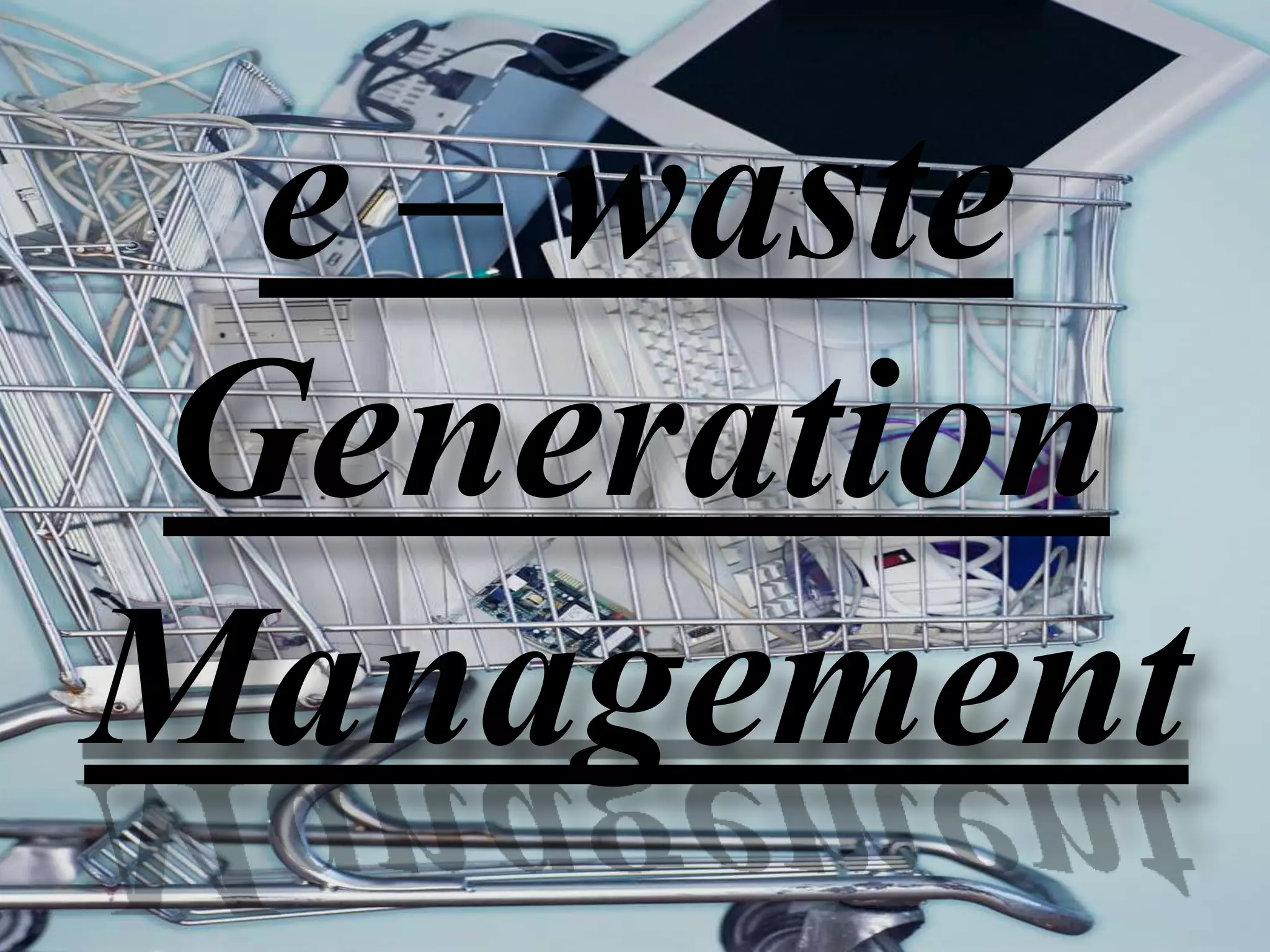
e – waste
Generation
Management
Abstract
“E – waste “ is popular informal name for
electronic products nearing the end of
their useful life. E – waste are considered
dangerous as certain components of some
electronic products such as discarded
media and battery equipments if
improperly disposed can leach lead and
other substances into soil and
groundwater. Many of these products can
be reused or recycled in an environmentally
sound manner so that they are less
harmful to the ecosystem.
Introduction
Technology is changing and people change their
electronic products like mobile phones, and
other electronic gadgets , second hand
electronic equipment are dumped. WHERE? I
don’t know ... But its all is E – WASTE ...
Recyclable electronic waste is sometimes
further categorized as a “commodity” while e
– waste which cannot be reused is
distinguished as “waste”. Both types of e waste have raised concern considering that
many components of such equipment are
considered toxic and are not biodegradable.
The Issue

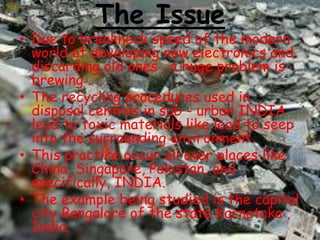
• Due to breakneck speed of the modern
world at developing new electronics and
discarding old ones , a huge problem is
brewing .
• The recycling procedures used in
disposal centres in sub - urban INDIA
lead to toxic materials like lead to seep
into the surrounding environment.
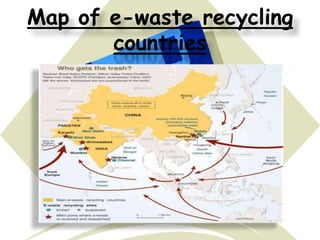
• This practice occur all over places like
China, Singapore, Pakistan, and
specifically, INDIA.
• The example being studied is the capital
city Bangalore of the state Karnataka ,
India.
Case in point:
BANGALORE, India

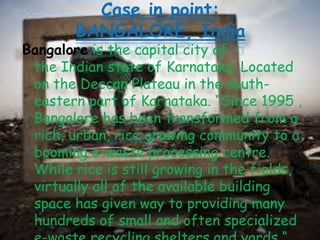
Bangalore is the capital city of
the Indian state of Karnataka. Located
on the Deccan Plateau in the southeastern part of Karnataka. “Since 1995 ,
Bangalore has been transformed from a
rich, urban, rice growing community to a
booming e-waste processing centre.
While rice is still growing in the fields,
virtually all of the available building
space has given way to providing many
hundreds of small and often specialized
Map of e-waste recycling
countries
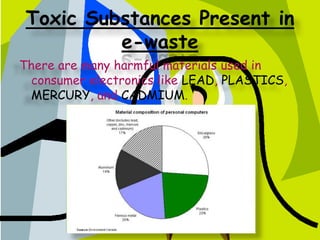
Toxic Substances Present in
e-waste
There are many harmful materials used in
consumer electronics like LEAD, PLASTICS,
MERCURY, and CADMIUM.
Effects of Toxins: LEAD

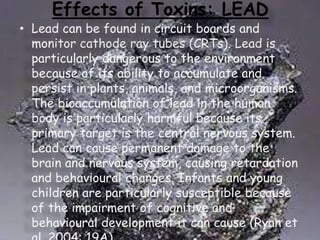
• Lead can be found in circuit boards and
monitor cathode ray tubes (CRTs). Lead is
particularly dangerous to the environment
because of its ability to accumulate and
persist in plants, animals, and microorganisms.
The bioaccumulation of lead in the human
body is particularly harmful because its
primary target is the central nervous system.
Lead can cause permanent damage to the
brain and nervous system, causing retardation
and behavioural changes. Infants and young
children are particularly susceptible because
of the impairment of cognitive and
behavioural development it can cause (Ryan et
Effects of Toxins: Cadmium
• Cadmium can be found in SMD (surface mount
device) chip resistors, infrared detectors and
semiconductors (Puckett et al. 2002: 11). Like
lead, cadmium is particularly toxic to humans
because it accumulates in the human body and
poses an environmental danger due to both
acute and chronic toxicity (Puckett el al.
2002: 11). Renal damage is the most common
effect of cadmium toxicity. Cadmium that
enters the system through the
gastrointestinal tract resides in human
kidneys with half – life of 10 – 20 years
(Nordberg et al. 1985).
Effects of Toxins: Mercury
• Mercury is the most prevalent toxic metal
found in e-waste. It is in circuit boards,
switches, medical equipment, lamps, mobile
phones, and batteries. Mercury transforms
into methyl mercury in water, where it can
accumulate in living organisms, typically via
fish, concentrating in large fish and humans at
the top of the food chain (Puckett et al.
2002: 11). Mercury is readily absorbed by the
human body, ultimately inhibiting enzymatic
activity and leading to cell damage (Boyer et
al. 1959).
Effects of Toxins: Plastics
• The abundant component of e-waste is
plastics. Plastics comprise almost twenty –
three percent of a typical desktop computer
(Microelectronics 1995). They are used for
insulation, cables and housing for all
electronic devices; the variety of products
available for recovery complicates the de –
manufacturing process. Due to the complex
recovery process, large amounts of plastic e –
waste are disposed of through landfills,
incinerators and open burning, allowing toxic
substances to leach into the environment.
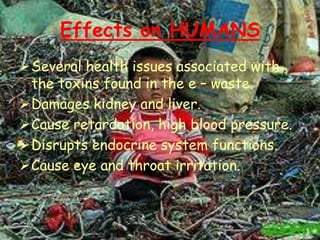
Effects on HUMANS
Several health issues associated with
the toxins found in the e – waste.
Damages kidney and liver.
Cause retardation, high blood pressure.
Disrupts endocrine system functions.
Cause eye and throat irritation.
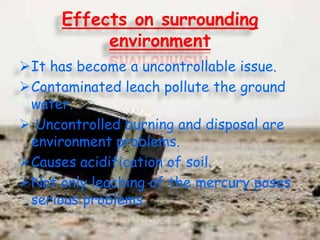
Effects on surrounding
environment
It has become a uncontrollable issue.
Contaminated leach pollute the ground
water.
 Uncontrolled burning and disposal are
environment problems.
Causes acidification of soil.
Not only leaching of the mercury poses
serious problems.
Combating e – waste
Though e – waste is a persisting issue,
efforts are being made around the
world to combat e – waste dumping in
countries like INDIA.
Management of e – waste
Due to advancement in techniques the
old instruments are outdated.
This necessitates implemental
management measures.
India as a developing country needs
simpler, low cost technology for proper
management of e – waste.
In industries management of e – waste
should begin at the point of generation.
Management Options
Considering the severity of the
problem, it is imperative that
certain management options must
be adopted to handle the bulk ewastes.
Following are some of the
management options suggested for
the government, industries and the
public.
Responsibilities of the
Government
Government should set up
regulatory agencies.
Government should provide an
adequate system of laws and
controls.
Government must encourage
research into the development and
production of less hazardous
equipments.
Responsibility and Role of
Industries
Generators of waste should take
responsibility to determine the
output characteristics of wastes.
All involved person should be
properly qualified and trained in
handling e – waste in industries.
Companies should adopt waste
minimization techniques.
Responsibility of the
Citizen

 Reuse
 Donating used electronics to schools, non –
profit organizations, and lower – income
families.
 e – wastes should never be disposed with
garbage and other household wastes.
 These wastes should be collected at a
separate site and they should be sent for
various processes like Reuse, Recycling,
and Donating.
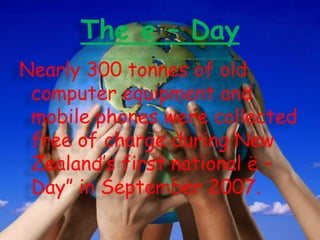
The e – Day
Nearly 300 tonnes of old
computer equipment and
mobile phones were collected
free of charge during New
Zealand’s first national ë –
Day” in September 2007.
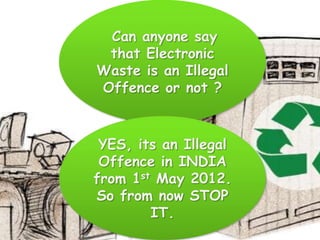
Can anyone say
that Electronic
Waste is an Illegal
Offence or not ?

YES, its an Illegal
Offence in INDIA
from 1st May 2012.
So from now STOP
IT.
Conclusion
Environmentally Safe: The cutting edge of
recycling technology is used to keep waste
by – products to an absolute minimum.
Economical: By using advanced techniques
we can extract greater quantities of base
products of reduced cost.
Convenient: Computer waste can be
collected on regular basis depending on
quantities which can either be deposited or
recycled again.
Words of the Geniuses
 Newton’s Words: Ï am like a child
playing on the shore with pebbles
and shells while whole ocean lies
before me”.
 Swami Vivekananda: Ëducation is
the manifestation of perfection
already in the man”.
Our Globe should be
protected !!!
THANK YOU!!!
•Efforts By:
Ms. Bhavna Arora
And
th A
Niharika Class 8

E – waste management

  • 1.
  • 2.
    Abstract “E – waste“ is popular informal name for electronic products nearing the end of their useful life. E – waste are considered dangerous as certain components of some electronic products such as discarded media and battery equipments if improperly disposed can leach lead and other substances into soil and groundwater. Many of these products can be reused or recycled in an environmentally sound manner so that they are less harmful to the ecosystem.
  • 3.
    Introduction Technology is changingand people change their electronic products like mobile phones, and other electronic gadgets , second hand electronic equipment are dumped. WHERE? I don’t know ... But its all is E – WASTE ... Recyclable electronic waste is sometimes further categorized as a “commodity” while e – waste which cannot be reused is distinguished as “waste”. Both types of e waste have raised concern considering that many components of such equipment are considered toxic and are not biodegradable.
  • 4.
    The Issue • Dueto breakneck speed of the modern world at developing new electronics and discarding old ones , a huge problem is brewing . • The recycling procedures used in disposal centres in sub - urban INDIA lead to toxic materials like lead to seep into the surrounding environment. • This practice occur all over places like China, Singapore, Pakistan, and specifically, INDIA. • The example being studied is the capital city Bangalore of the state Karnataka , India.
  • 5.
    Case in point: BANGALORE,India Bangalore is the capital city of the Indian state of Karnataka. Located on the Deccan Plateau in the southeastern part of Karnataka. “Since 1995 , Bangalore has been transformed from a rich, urban, rice growing community to a booming e-waste processing centre. While rice is still growing in the fields, virtually all of the available building space has given way to providing many hundreds of small and often specialized
  • 6.
    Map of e-wasterecycling countries
  • 7.
    Toxic Substances Presentin e-waste There are many harmful materials used in consumer electronics like LEAD, PLASTICS, MERCURY, and CADMIUM.
  • 8.
    Effects of Toxins:LEAD • Lead can be found in circuit boards and monitor cathode ray tubes (CRTs). Lead is particularly dangerous to the environment because of its ability to accumulate and persist in plants, animals, and microorganisms. The bioaccumulation of lead in the human body is particularly harmful because its primary target is the central nervous system. Lead can cause permanent damage to the brain and nervous system, causing retardation and behavioural changes. Infants and young children are particularly susceptible because of the impairment of cognitive and behavioural development it can cause (Ryan et
  • 9.
    Effects of Toxins:Cadmium • Cadmium can be found in SMD (surface mount device) chip resistors, infrared detectors and semiconductors (Puckett et al. 2002: 11). Like lead, cadmium is particularly toxic to humans because it accumulates in the human body and poses an environmental danger due to both acute and chronic toxicity (Puckett el al. 2002: 11). Renal damage is the most common effect of cadmium toxicity. Cadmium that enters the system through the gastrointestinal tract resides in human kidneys with half – life of 10 – 20 years (Nordberg et al. 1985).
  • 10.
    Effects of Toxins:Mercury • Mercury is the most prevalent toxic metal found in e-waste. It is in circuit boards, switches, medical equipment, lamps, mobile phones, and batteries. Mercury transforms into methyl mercury in water, where it can accumulate in living organisms, typically via fish, concentrating in large fish and humans at the top of the food chain (Puckett et al. 2002: 11). Mercury is readily absorbed by the human body, ultimately inhibiting enzymatic activity and leading to cell damage (Boyer et al. 1959).
  • 11.
    Effects of Toxins:Plastics • The abundant component of e-waste is plastics. Plastics comprise almost twenty – three percent of a typical desktop computer (Microelectronics 1995). They are used for insulation, cables and housing for all electronic devices; the variety of products available for recovery complicates the de – manufacturing process. Due to the complex recovery process, large amounts of plastic e – waste are disposed of through landfills, incinerators and open burning, allowing toxic substances to leach into the environment.
  • 12.
    Effects on HUMANS Severalhealth issues associated with the toxins found in the e – waste. Damages kidney and liver. Cause retardation, high blood pressure. Disrupts endocrine system functions. Cause eye and throat irritation.
  • 13.
    Effects on surrounding environment Ithas become a uncontrollable issue. Contaminated leach pollute the ground water.  Uncontrolled burning and disposal are environment problems. Causes acidification of soil. Not only leaching of the mercury poses serious problems.
  • 14.
    Combating e –waste Though e – waste is a persisting issue, efforts are being made around the world to combat e – waste dumping in countries like INDIA.
  • 15.
    Management of e– waste Due to advancement in techniques the old instruments are outdated. This necessitates implemental management measures. India as a developing country needs simpler, low cost technology for proper management of e – waste. In industries management of e – waste should begin at the point of generation.
  • 16.
    Management Options Considering theseverity of the problem, it is imperative that certain management options must be adopted to handle the bulk ewastes. Following are some of the management options suggested for the government, industries and the public.
  • 17.
    Responsibilities of the Government Governmentshould set up regulatory agencies. Government should provide an adequate system of laws and controls. Government must encourage research into the development and production of less hazardous equipments.
  • 18.
    Responsibility and Roleof Industries Generators of waste should take responsibility to determine the output characteristics of wastes. All involved person should be properly qualified and trained in handling e – waste in industries. Companies should adopt waste minimization techniques.
  • 19.
    Responsibility of the Citizen Reuse  Donating used electronics to schools, non – profit organizations, and lower – income families.  e – wastes should never be disposed with garbage and other household wastes.  These wastes should be collected at a separate site and they should be sent for various processes like Reuse, Recycling, and Donating.
  • 20.
    The e –Day Nearly 300 tonnes of old computer equipment and mobile phones were collected free of charge during New Zealand’s first national ë – Day” in September 2007.
  • 21.
    Can anyone say thatElectronic Waste is an Illegal Offence or not ? YES, its an Illegal Offence in INDIA from 1st May 2012. So from now STOP IT.
  • 22.
    Conclusion Environmentally Safe: Thecutting edge of recycling technology is used to keep waste by – products to an absolute minimum. Economical: By using advanced techniques we can extract greater quantities of base products of reduced cost. Convenient: Computer waste can be collected on regular basis depending on quantities which can either be deposited or recycled again.
  • 23.
    Words of theGeniuses  Newton’s Words: Ï am like a child playing on the shore with pebbles and shells while whole ocean lies before me”.  Swami Vivekananda: Ëducation is the manifestation of perfection already in the man”.
  • 24.
    Our Globe shouldbe protected !!!
  • 25.
    THANK YOU!!! •Efforts By: Ms.Bhavna Arora And th A Niharika Class 8