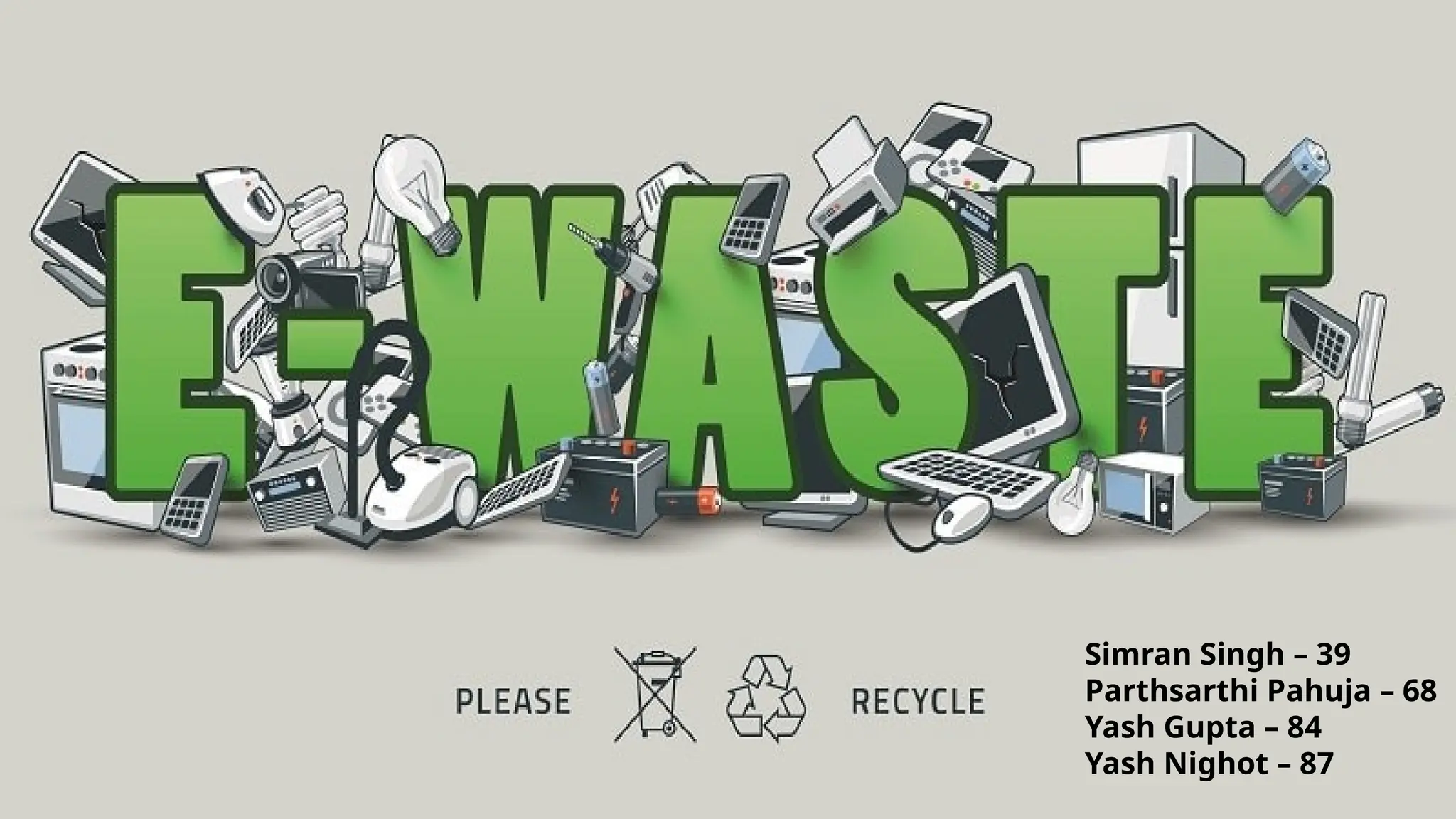
Simran Singh – 39
Parthsarthi Pahuja – 68
Yash Gupta – 84
Yash Nighot – 87
OUTLINE
• What is E-waste?
• Current Scenario
• Causes
• Legislation
• Toxic Substance in E-waste
• Types of E-waste
• Environmental impact of E-waste
• Case Study
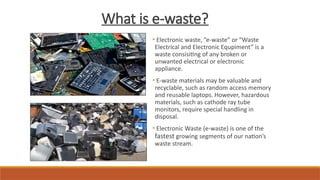
• Electronic waste, ”e-waste” or ”Waste
Electrical and Electronic Equpiment” is a
waste consisiting of any broken or
unwanted electrical or electronic
appliance.
• E-waste materials may be valuable and
recyclable, such as random access memory
and reusable laptops. However, hazardous
materials, such as cathode ray tube
monitors, require special handling in
disposal.
• Electronic Waste (e-waste) is one of the
fastest growing segments of our nation’s
waste stream.
What is e-waste?
Current Scenario in India
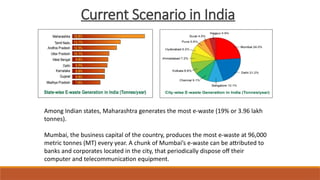
Among Indian states, Maharashtra generates the most e-waste (19% or 3.96 lakh
tonnes).
Mumbai, the business capital of the country, produces the most e-waste at 96,000
metric tonnes (MT) every year. A chunk of Mumbai’s e-waste can be attributed to
banks and corporates located in the city, that periodically dispose off their
computer and telecommunication equipment.
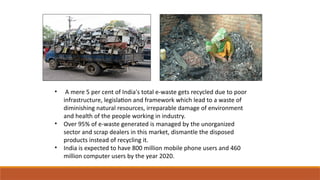
• A mere 5 per cent of India's total e-waste gets recycled due to poor
infrastructure, legislation and framework which lead to a waste of
diminishing natural resources, irreparable damage of environment
and health of the people working in industry.
• Over 95% of e-waste generated is managed by the unorganized
sector and scrap dealers in this market, dismantle the disposed
products instead of recycling it.
• India is expected to have 800 million mobile phone users and 460
million computer users by the year 2020.
E-waste : A Global Challenge
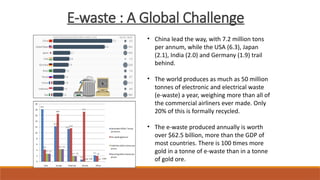
• China lead the way, with 7.2 million tons
per annum, while the USA (6.3), Japan
(2.1), India (2.0) and Germany (1.9) trail
behind.
• The world produces as much as 50 million
tonnes of electronic and electrical waste
(e-waste) a year, weighing more than all of
the commercial airliners ever made. Only
20% of this is formally recycled.
• The e-waste produced annually is worth
over $62.5 billion, more than the GDP of
most countries. There is 100 times more
gold in a tonne of e-waste than in a tonne
of gold ore.
Causes
Development :
As of now, It is estimated that there are over a billion personal computers
in the world. In developed countries these have an average life span of only 2
years. In the United States alone there are over 300 million obsolete computers.
Technology :
In this modern era technology is growing at lightning fast speed. This
technology results in the coming of newer products and appliances. The major
contributors are MNC's( Multinational corporations).
Population :
Population has triggered the above points even more. With increasing
population the amount of e waste increases because the old computers bought
would be thrown with the introduction of better technology devices.
Legislation
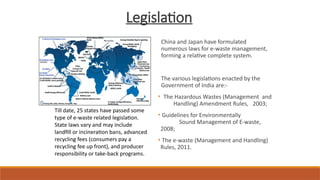
China and Japan have formulated
numerous laws for e-waste management,
forming a relative complete system.
The various legislations enacted by the
Government of India are:-
• The Hazardous Wastes (Management and
Handling) Amendment Rules, 2003;
• Guidelines for Environmentally
Sound Management of E-waste,
2008;
• The e-waste (Management and Handling)
Rules, 2011.
Till date, 25 states have passed some
type of e-waste related legislation.
State laws vary and may include
landfill or incineration bans, advanced
recycling fees (consumers pay a
recycling fee up front), and producer
responsibility or take-back programs.
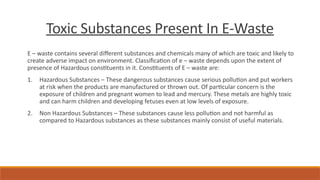
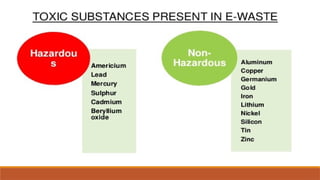
Toxic Substances Present In E-Waste
E – waste contains several different substances and chemicals many of which are toxic and likely to
create adverse impact on environment. Classification of e – waste depends upon the extent of
presence of Hazardous constituents in it. Constituents of E – waste are:
1. Hazardous Substances – These dangerous substances cause serious pollution and put workers
at risk when the products are manufactured or thrown out. Of particular concern is the
exposure of children and pregnant women to lead and mercury. These metals are highly toxic
and can harm children and developing fetuses even at low levels of exposure.
2. Non Hazardous Substances – These substances cause less pollution and not harmful as
compared to Hazardous substances as these substances mainly consist of useful materials.
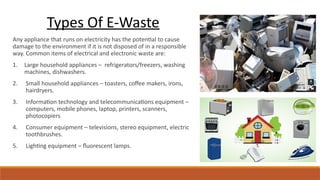
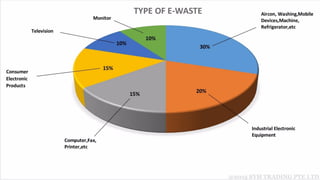
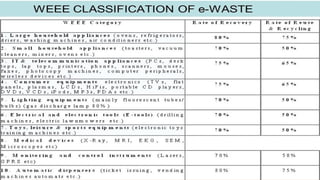
Any appliance that runs on electricity has the potential to cause
damage to the environment if it is not disposed of in a responsible
way. Common items of electrical and electronic waste are:
1. Large household appliances – refrigerators/freezers, washing
machines, dishwashers.
2. Small household appliances – toasters, coffee makers, irons,
hairdryers.
3. Information technology and telecommunications equipment –
computers, mobile phones, laptop, printers, scanners,
photocopiers
4. Consumer equipment – televisions, stereo equipment, electric
toothbrushes.
5. Lighting equipment – fluorescent lamps.
Types Of E-Waste
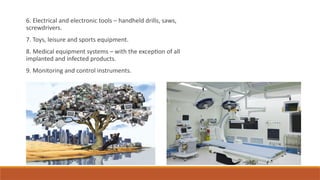
6. Electrical and electronic tools – handheld drills, saws,
screwdrivers.
7. Toys, leisure and sports equipment.
8. Medical equipment systems – with the exception of all
implanted and infected products.
9. Monitoring and control instruments.
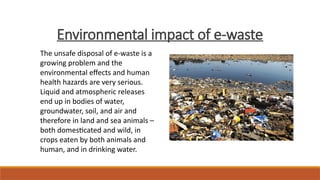
Environmental impact of e-waste
The unsafe disposal of e-waste is a
growing problem and the
environmental effects and human
health hazards are very serious.
Liquid and atmospheric releases
end up in bodies of water,
groundwater, soil, and air and
therefore in land and sea animals –
both domesticated and wild, in
crops eaten by both animals and
human, and in drinking water.
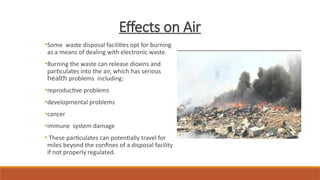
Effects on Air
•Some waste disposal facilities opt for burning
as a means of dealing with electronic waste.
•Burning the waste can release dioxins and
particulates into the air, which has serious
health problems including:
•reproductive problems
•developmental problems
•cancer
•immune system damage
• These particulates can potentially travel for
miles beyond the confines of a disposal facility
if not properly regulated.
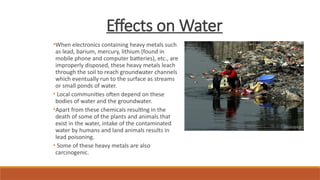
Effects on Water
•When electronics containing heavy metals such
as lead, barium, mercury, lithium (found in
mobile phone and computer batteries), etc., are
improperly disposed, these heavy metals leach
through the soil to reach groundwater channels
which eventually run to the surface as streams
or small ponds of water.
• Local communities often depend on these
bodies of water and the groundwater.
•Apart from these chemicals resulting in the
death of some of the plants and animals that
exist in the water, intake of the contaminated
water by humans and land animals results in
lead poisoning.
• Some of these heavy metals are also
carcinogenic.
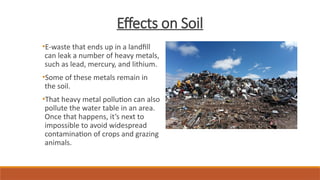
Effects on Soil
•E-waste that ends up in a landfill
can leak a number of heavy metals,
such as lead, mercury, and lithium.
•Some of these metals remain in
the soil.
•That heavy metal pollution can also
pollute the water table in an area.
Once that happens, it’s next to
impossible to avoid widespread
contamination of crops and grazing
animals.
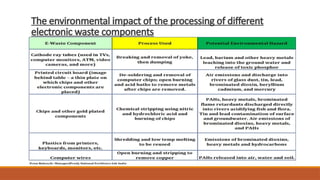
The environmental impact of the processing of different
electronic waste components
Areas affected by e-waste
 One study done on the impact of hazardous e-waste in India has estimated that over 30,000
computers have become decommissioned each year in Bangalore alone. The high disposal of
computers has cultivated more than 1,000 tons of plastics, 300 tons of lead, 0.23 tons of
mercury, 43 tons of nickel, and 350 tons of copper in Bangalore.
 In Bangladesh, at a shipyard in Chittagong, contamination plagued the nearby soil from
chemicals that are commonly found in electronic waste. Soil samples contained compounds
such as “lead, mercury, cadmium, arsenic, antimony trioxide, polybrominated flame retardants,
selenium, chromium, and cobalt”.
In Delhi, discarded gadgets are resulting in massive piles of e-waste, which is contaminating the
soil and groundwater. The average copper concentration in top soils of e-waste sites was 30
times more than the permitted limit, whereas that of cadmium was 16 times more than the
permitted limit.
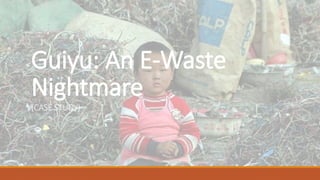
Guiyu: An E-Waste
Nightmare
(CASE STUDY)
ABOUT
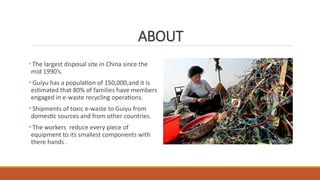
• The largest disposal site in China since the
mid 1990’s.
• Guiyu has a population of 150,000,and it is
estimated that 80% of families have members
engaged in e-waste recycling operations.
• Shipments of toxic e-waste to Guiyu from
domestic sources and from other countries.
• The workers reduce every piece of
equipment to its smallest components with
there hands .
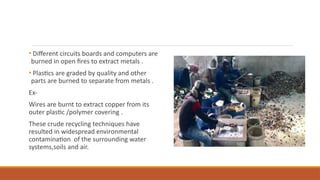
• Different circuits boards and computers are
burned in open fires to extract metals .
• Plastics are graded by quality and other
parts are burned to separate from metals .
Ex-
Wires are burnt to extract copper from its
outer plastic /polymer covering .
These crude recycling techniques have
resulted in widespread environmental
contamination of the surrounding water
systems,soils and air.
Environmental and Health Costs
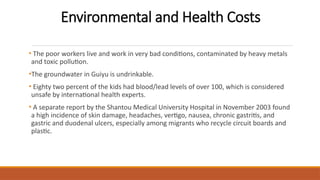
• The poor workers live and work in very bad conditions, contaminated by heavy metals
and toxic pollution.
•The groundwater in Guiyu is undrinkable.
• Eighty two percent of the kids had blood/lead levels of over 100, which is considered
unsafe by international health experts.
• A separate report by the Shantou Medical University Hospital in November 2003 found
a high incidence of skin damage, headaches, vertigo, nausea, chronic gastritis, and
gastric and duodenal ulcers, especially among migrants who recycle circuit boards and
plastic.
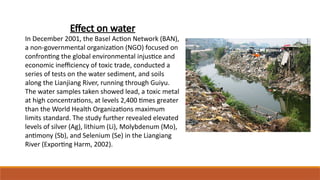
Effect on water
In December 2001, the Basel Action Network (BAN),
a non-governmental organization (NGO) focused on
confronting the global environmental injustice and
economic inefficiency of toxic trade, conducted a
series of tests on the water sediment, and soils
along the Lianjiang River, running through Guiyu.
The water samples taken showed lead, a toxic metal
at high concentrations, at levels 2,400 times greater
than the World Health Organizations maximum
limits standard. The study further revealed elevated
levels of silver (Ag), lithium (Li), Molybdenum (Mo),
antimony (Sb), and Selenium (Se) in the Liangiang
River (Exporting Harm, 2002).
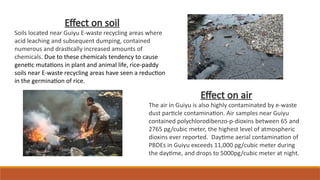
Effect on soil
Soils located near Guiyu E-waste recycling areas where
acid leaching and subsequent dumping, contained
numerous and drastically increased amounts of
chemicals. Due to these chemicals tendency to cause
genetic mutations in plant and animal life, rice-paddy
soils near E-waste recycling areas have seen a reduction
in the germination of rice.
Effect on air
The air in Guiyu is also highly contaminated by e-waste
dust particle contamination. Air samples near Guiyu
contained polychlorodibenzo-p-dioxins between 65 and
2765 pg/cubic meter, the highest level of atmospheric
dioxins ever reported. Daytime aerial contamination of
PBDEs in Guiyu exceeds 11,000 pg/cubic meter during
the daytime, and drops to 5000pg/cubic meter at night.
 Think twice before buying whether you
really need a new device and return your
old equipment to the manufacturer if
possible.
REFERENCES
• https://en.wikipedia.org/wiki/Electronic_waste
• https://www.downtoearth.org.in/blog/waste/e-waste-day-82-of-india-s-e-waste
-is-personal-devices-61880
• https://www.quora.com/What-are-E-waste-causes-and-effects
• https://www.thebalancesmb.com/e-waste-and-the-importance-of-electronics-re
cycling-2877783
• https://www.greenpeace.org/eastasia/campaigns/toxics/problems/e-waste/guiy
u/
• http://ewasteproject.blogspot.com/2009/12/guiyus-problem-soil-water-compos
ition.html
QUESTIONS?????

E-waste-presentation.pptx aaaaaaaaaaaaaaa

  • 1.
    Simran Singh –39 Parthsarthi Pahuja – 68 Yash Gupta – 84 Yash Nighot – 87
  • 2.
    OUTLINE • What isE-waste? • Current Scenario • Causes • Legislation • Toxic Substance in E-waste • Types of E-waste • Environmental impact of E-waste • Case Study
  • 3.
    • Electronic waste,”e-waste” or ”Waste Electrical and Electronic Equpiment” is a waste consisiting of any broken or unwanted electrical or electronic appliance. • E-waste materials may be valuable and recyclable, such as random access memory and reusable laptops. However, hazardous materials, such as cathode ray tube monitors, require special handling in disposal. • Electronic Waste (e-waste) is one of the fastest growing segments of our nation’s waste stream. What is e-waste?
  • 4.
    Current Scenario inIndia Among Indian states, Maharashtra generates the most e-waste (19% or 3.96 lakh tonnes). Mumbai, the business capital of the country, produces the most e-waste at 96,000 metric tonnes (MT) every year. A chunk of Mumbai’s e-waste can be attributed to banks and corporates located in the city, that periodically dispose off their computer and telecommunication equipment.
  • 5.
    • A mere5 per cent of India's total e-waste gets recycled due to poor infrastructure, legislation and framework which lead to a waste of diminishing natural resources, irreparable damage of environment and health of the people working in industry. • Over 95% of e-waste generated is managed by the unorganized sector and scrap dealers in this market, dismantle the disposed products instead of recycling it. • India is expected to have 800 million mobile phone users and 460 million computer users by the year 2020.
  • 6.
    E-waste : AGlobal Challenge • China lead the way, with 7.2 million tons per annum, while the USA (6.3), Japan (2.1), India (2.0) and Germany (1.9) trail behind. • The world produces as much as 50 million tonnes of electronic and electrical waste (e-waste) a year, weighing more than all of the commercial airliners ever made. Only 20% of this is formally recycled. • The e-waste produced annually is worth over $62.5 billion, more than the GDP of most countries. There is 100 times more gold in a tonne of e-waste than in a tonne of gold ore.
  • 7.
    Causes Development : As ofnow, It is estimated that there are over a billion personal computers in the world. In developed countries these have an average life span of only 2 years. In the United States alone there are over 300 million obsolete computers. Technology : In this modern era technology is growing at lightning fast speed. This technology results in the coming of newer products and appliances. The major contributors are MNC's( Multinational corporations). Population : Population has triggered the above points even more. With increasing population the amount of e waste increases because the old computers bought would be thrown with the introduction of better technology devices.
  • 8.
    Legislation China and Japanhave formulated numerous laws for e-waste management, forming a relative complete system. The various legislations enacted by the Government of India are:- • The Hazardous Wastes (Management and Handling) Amendment Rules, 2003; • Guidelines for Environmentally Sound Management of E-waste, 2008; • The e-waste (Management and Handling) Rules, 2011. Till date, 25 states have passed some type of e-waste related legislation. State laws vary and may include landfill or incineration bans, advanced recycling fees (consumers pay a recycling fee up front), and producer responsibility or take-back programs.
  • 10.
    Toxic Substances PresentIn E-Waste E – waste contains several different substances and chemicals many of which are toxic and likely to create adverse impact on environment. Classification of e – waste depends upon the extent of presence of Hazardous constituents in it. Constituents of E – waste are: 1. Hazardous Substances – These dangerous substances cause serious pollution and put workers at risk when the products are manufactured or thrown out. Of particular concern is the exposure of children and pregnant women to lead and mercury. These metals are highly toxic and can harm children and developing fetuses even at low levels of exposure. 2. Non Hazardous Substances – These substances cause less pollution and not harmful as compared to Hazardous substances as these substances mainly consist of useful materials.
  • 12.
    Any appliance thatruns on electricity has the potential to cause damage to the environment if it is not disposed of in a responsible way. Common items of electrical and electronic waste are: 1. Large household appliances – refrigerators/freezers, washing machines, dishwashers. 2. Small household appliances – toasters, coffee makers, irons, hairdryers. 3. Information technology and telecommunications equipment – computers, mobile phones, laptop, printers, scanners, photocopiers 4. Consumer equipment – televisions, stereo equipment, electric toothbrushes. 5. Lighting equipment – fluorescent lamps. Types Of E-Waste
  • 13.
    6. Electrical andelectronic tools – handheld drills, saws, screwdrivers. 7. Toys, leisure and sports equipment. 8. Medical equipment systems – with the exception of all implanted and infected products. 9. Monitoring and control instruments.
  • 16.
    Environmental impact ofe-waste The unsafe disposal of e-waste is a growing problem and the environmental effects and human health hazards are very serious. Liquid and atmospheric releases end up in bodies of water, groundwater, soil, and air and therefore in land and sea animals – both domesticated and wild, in crops eaten by both animals and human, and in drinking water.
  • 17.
    Effects on Air •Somewaste disposal facilities opt for burning as a means of dealing with electronic waste. •Burning the waste can release dioxins and particulates into the air, which has serious health problems including: •reproductive problems •developmental problems •cancer •immune system damage • These particulates can potentially travel for miles beyond the confines of a disposal facility if not properly regulated.
  • 18.
    Effects on Water •Whenelectronics containing heavy metals such as lead, barium, mercury, lithium (found in mobile phone and computer batteries), etc., are improperly disposed, these heavy metals leach through the soil to reach groundwater channels which eventually run to the surface as streams or small ponds of water. • Local communities often depend on these bodies of water and the groundwater. •Apart from these chemicals resulting in the death of some of the plants and animals that exist in the water, intake of the contaminated water by humans and land animals results in lead poisoning. • Some of these heavy metals are also carcinogenic.
  • 19.
    Effects on Soil •E-wastethat ends up in a landfill can leak a number of heavy metals, such as lead, mercury, and lithium. •Some of these metals remain in the soil. •That heavy metal pollution can also pollute the water table in an area. Once that happens, it’s next to impossible to avoid widespread contamination of crops and grazing animals.
  • 20.
    The environmental impactof the processing of different electronic waste components
  • 21.
    Areas affected bye-waste  One study done on the impact of hazardous e-waste in India has estimated that over 30,000 computers have become decommissioned each year in Bangalore alone. The high disposal of computers has cultivated more than 1,000 tons of plastics, 300 tons of lead, 0.23 tons of mercury, 43 tons of nickel, and 350 tons of copper in Bangalore.  In Bangladesh, at a shipyard in Chittagong, contamination plagued the nearby soil from chemicals that are commonly found in electronic waste. Soil samples contained compounds such as “lead, mercury, cadmium, arsenic, antimony trioxide, polybrominated flame retardants, selenium, chromium, and cobalt”. In Delhi, discarded gadgets are resulting in massive piles of e-waste, which is contaminating the soil and groundwater. The average copper concentration in top soils of e-waste sites was 30 times more than the permitted limit, whereas that of cadmium was 16 times more than the permitted limit.
  • 22.
  • 23.
    ABOUT • The largestdisposal site in China since the mid 1990’s. • Guiyu has a population of 150,000,and it is estimated that 80% of families have members engaged in e-waste recycling operations. • Shipments of toxic e-waste to Guiyu from domestic sources and from other countries. • The workers reduce every piece of equipment to its smallest components with there hands .
  • 24.
    • Different circuitsboards and computers are burned in open fires to extract metals . • Plastics are graded by quality and other parts are burned to separate from metals . Ex- Wires are burnt to extract copper from its outer plastic /polymer covering . These crude recycling techniques have resulted in widespread environmental contamination of the surrounding water systems,soils and air.
  • 25.
    Environmental and HealthCosts • The poor workers live and work in very bad conditions, contaminated by heavy metals and toxic pollution. •The groundwater in Guiyu is undrinkable. • Eighty two percent of the kids had blood/lead levels of over 100, which is considered unsafe by international health experts. • A separate report by the Shantou Medical University Hospital in November 2003 found a high incidence of skin damage, headaches, vertigo, nausea, chronic gastritis, and gastric and duodenal ulcers, especially among migrants who recycle circuit boards and plastic.
  • 26.
    Effect on water InDecember 2001, the Basel Action Network (BAN), a non-governmental organization (NGO) focused on confronting the global environmental injustice and economic inefficiency of toxic trade, conducted a series of tests on the water sediment, and soils along the Lianjiang River, running through Guiyu. The water samples taken showed lead, a toxic metal at high concentrations, at levels 2,400 times greater than the World Health Organizations maximum limits standard. The study further revealed elevated levels of silver (Ag), lithium (Li), Molybdenum (Mo), antimony (Sb), and Selenium (Se) in the Liangiang River (Exporting Harm, 2002).
  • 27.
    Effect on soil Soilslocated near Guiyu E-waste recycling areas where acid leaching and subsequent dumping, contained numerous and drastically increased amounts of chemicals. Due to these chemicals tendency to cause genetic mutations in plant and animal life, rice-paddy soils near E-waste recycling areas have seen a reduction in the germination of rice. Effect on air The air in Guiyu is also highly contaminated by e-waste dust particle contamination. Air samples near Guiyu contained polychlorodibenzo-p-dioxins between 65 and 2765 pg/cubic meter, the highest level of atmospheric dioxins ever reported. Daytime aerial contamination of PBDEs in Guiyu exceeds 11,000 pg/cubic meter during the daytime, and drops to 5000pg/cubic meter at night.
  • 28.
     Think twicebefore buying whether you really need a new device and return your old equipment to the manufacturer if possible.
  • 29.
    REFERENCES • https://en.wikipedia.org/wiki/Electronic_waste • https://www.downtoearth.org.in/blog/waste/e-waste-day-82-of-india-s-e-waste -is-personal-devices-61880 •https://www.quora.com/What-are-E-waste-causes-and-effects • https://www.thebalancesmb.com/e-waste-and-the-importance-of-electronics-re cycling-2877783 • https://www.greenpeace.org/eastasia/campaigns/toxics/problems/e-waste/guiy u/ • http://ewasteproject.blogspot.com/2009/12/guiyus-problem-soil-water-compos ition.html
  • 31.