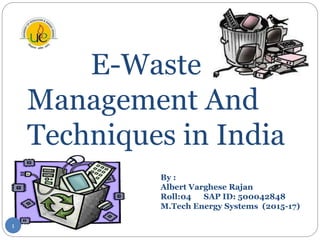
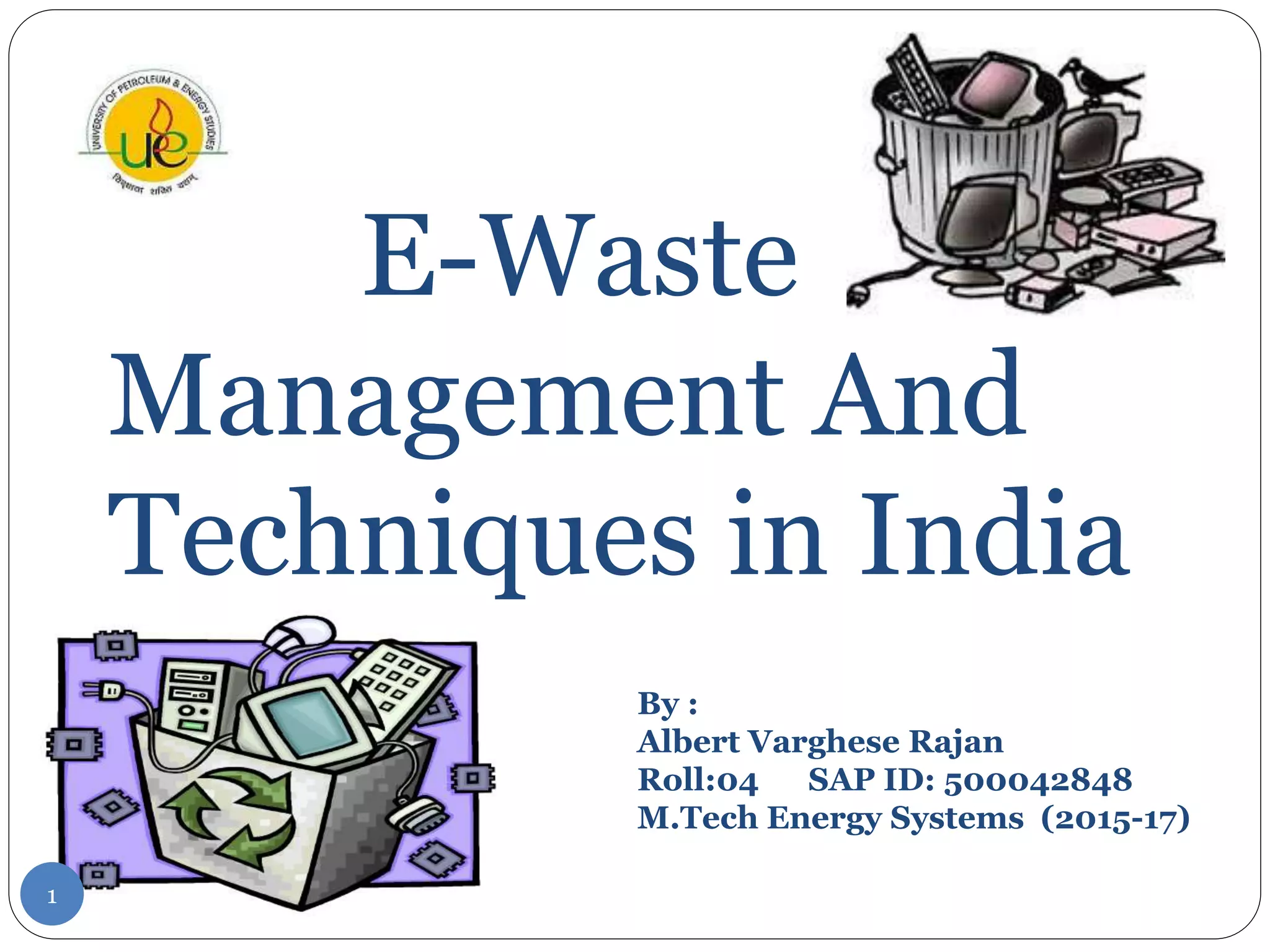
E-Waste
Management And
Techniques in India
By :
Albert Varghese Rajan
Roll:04 SAP ID: 500042848
M.Tech Energy Systems (2015-17)
1
Introduction
2
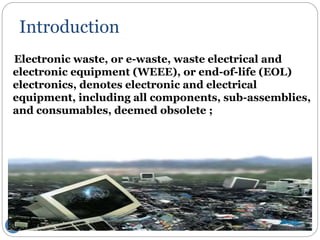
Electronic waste, or e-waste, waste electrical and
electronic equipment (WEEE), or end-of-life (EOL)
electronics, denotes electronic and electrical
equipment, including all components, sub-assemblies,
and consumables, deemed obsolete ;
Factors affecting E-Waste
 Collection and state-of-the-art treatment of e-
waste is limited, and most nations are still without
such e-waste management systems
 Large portion of e-waste is not being collected
,treated in environmentally-sound manner.
 E-waste, or waste electrical and electronic
equipment, is an emerging and fast-growing
waste •–”‡ƒchallenge to waste management in both
developed and developing countries
3
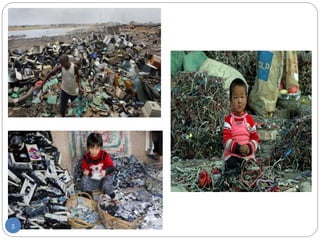
oTechniques are often used to extract materials
and components. These “backyard” techniques
pose dangers.
oSubstandard recycling in developing countries
has led to environmental catastrophes in places
like Guiyu, China and Agbogbloshie,
Ghana
4
5
6
7
E-Waste in India
 350000 Tonnes of E waste generated Each Year in
India and imports another 50000 Tonnes
 More than 90% of the E-Waste generated in the
country end up in the unorganised market for
recycling and disposal
 TIC group in Noida have a capacity of processing 500
Tonnes of E-Waste
 Attero recycling Unit in Roorkee have a capacity of
600 Tonnes
8
9
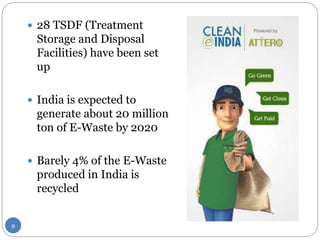
 28 TSDF (Treatment
Storage and Disposal
Facilities) have been set
up
 India is expected to
generate about 20 million
ton of E-Waste by 2020
 Barely 4% of the E-Waste
produced in India is
recycled
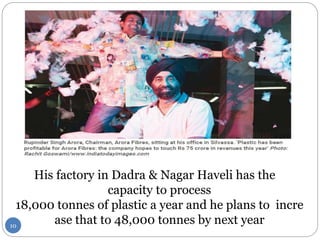
His factory in Dadra & Nagar Haveli has the
capacity to process
18,000 tonnes of plastic a year and he plans to incre
ase that to 48,000 tonnes by next year10
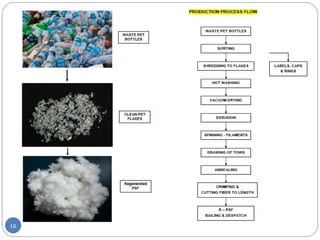
FABRIC FROM PLASTIC
 Arora Fibres recycles discarded plastic bottles into pol
yester
 PET (polyethylene terephthalate) bottles used to make
polyester yarn
 The polyester fibre has huge market in many indus
tries like automobiles also used as packaging material
 "By recycling 10 billion PET bottles, one million
square yards of landfill space and ,eliminate
0.25 million tonnes of CO₂
released into the atmosphere.
11
12
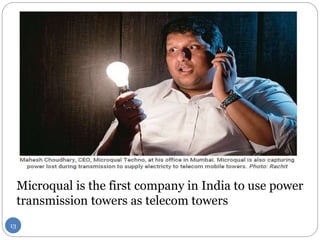
Microqual is the first company in India to use power
transmission towers as telecom towers
13
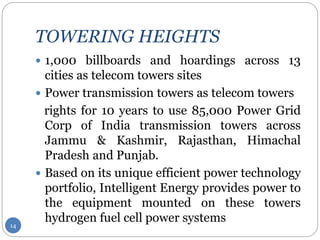
TOWERING HEIGHTS
 1,000 billboards and hoardings across 13
cities as telecom towers sites
 Power transmission towers as telecom towers
rights for 10 years to use 85,000 Power Grid
Corp of India transmission towers across
Jammu & Kashmir, Rajasthan, Himachal
Pradesh and Punjab.
 Based on its unique efficient power technology
portfolio, Intelligent Energy provides power to
the equipment mounted on these towers
hydrogen fuel cell power systems14
 Intelligent Energy, which makes hydrogen fuel
cells, will set up modules to generate power on
all Microqual towers and maintain
 Intelligent Energy has deployed about 100
MW of fuel cells
 The Indian telecom industry uses more than
200 crore litres of diesel every year to run
power generators at their network base station
 Some 150,000 or so of these towers are off-
grid, and many more must rely on their own
power during blackouts that can last hours at
a time. That makes for expensive power
15
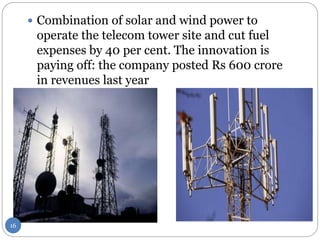
 Combination of solar and wind power to
operate the telecom tower site and cut fuel
expenses by 40 per cent. The innovation is
paying off: the company posted Rs 600 crore
in revenues last year
16
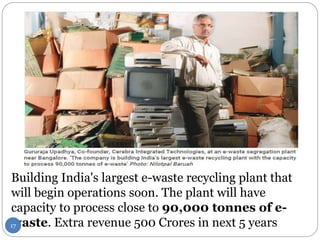
Building India's largest e-waste recycling plant that
will begin operations soon. The plant will have
capacity to process close to 90,000 tonnes of e-
waste. Extra revenue 500 Crores in next 5 years17
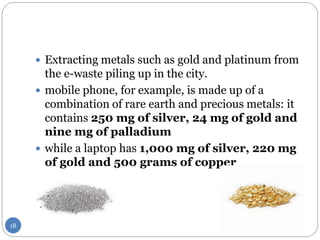
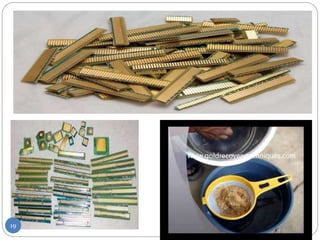
 Extracting metals such as gold and platinum from
the e-waste piling up in the city.
 mobile phone, for example, is made up of a
combination of rare earth and precious metals: it
contains 250 mg of silver, 24 mg of gold and
nine mg of palladium
 while a laptop has 1,000 mg of silver, 220 mg
of gold and 500 grams of copper
18
19
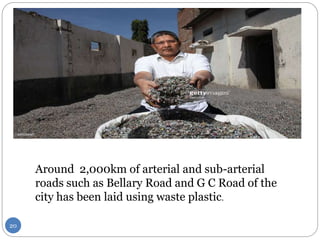
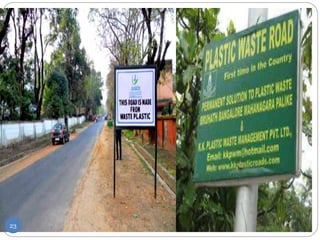
Around 2,000km of arterial and sub-arterial
roads such as Bellary Road and G C Road of the
city has been laid using waste plastic.
20
PLASTIC ROADS
 Eight parts plastic are mixed with 100 parts
bitumen to create a hard-wearing road surface.
 Nearly 7% more costlier than bitumen road, it
helps the civic body cut on cost of waste
management and reduces emissions.
 Roads made did not develop cracks and provided
a smooth riding surface displaying much better
durability even two years after construction.
 40 tones of compound can be generated from
100-120 tones of waste plastic bag
21
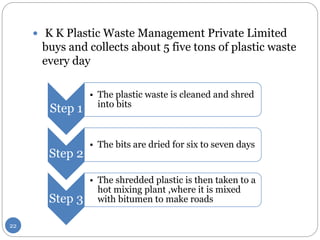
 K K Plastic Waste Management Private Limited
buys and collects about 5 five tons of plastic waste
every day
Step 1
• The plastic waste is cleaned and shred
into bits
Step 2
• The bits are dried for six to seven days
Step 3
• The shredded plastic is then taken to a
hot mixing plant ,where it is mixed
with bitumen to make roads
22
23
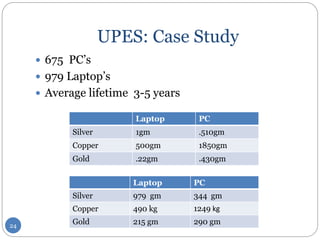
UPES: Case Study
 675 PC’s
 979 Laptop’s
 Average lifetime 3-5 years
Laptop PC
Silver 1gm .510gm
Copper 500gm 1850gm
Gold .22gm .430gm
Laptop PC
Silver 979 gm 344 gm
Copper 490 kg 1249 kg
Gold 215 gm 290 gm24
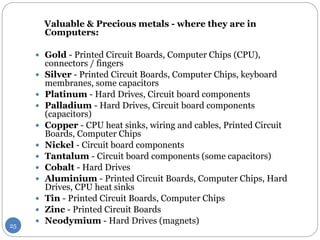
Valuable & Precious metals - where they are in
Computers:
 Gold - Printed Circuit Boards, Computer Chips (CPU),
connectors / fingers
 Silver - Printed Circuit Boards, Computer Chips, keyboard
membranes, some capacitors
 Platinum - Hard Drives, Circuit board components
 Palladium - Hard Drives, Circuit board components
(capacitors)
 Copper - CPU heat sinks, wiring and cables, Printed Circuit
Boards, Computer Chips
 Nickel - Circuit board components
 Tantalum - Circuit board components (some capacitors)
 Cobalt - Hard Drives
 Aluminium - Printed Circuit Boards, Computer Chips, Hard
Drives, CPU heat sinks
 Tin - Printed Circuit Boards, Computer Chips
 Zinc - Printed Circuit Boards
 Neodymium - Hard Drives (magnets)25
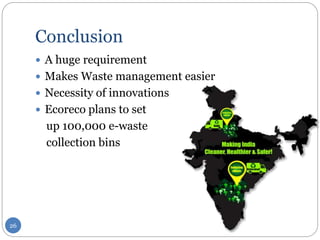
Conclusion
 A huge requirement
 Makes Waste management easier
 Necessity of innovations
 Ecoreco plans to set
up 100,000 e-waste
collection bins
26
References
Global E-Waste Monitor – UNU-IAS (United
Nations University - Institute for Advanced
Study of Sustainability)
Business Today – Article by Mahesh Nayak
Handbook On Procedures For E-Waste
Recyclers- for Indo-German Environment
Programme by Dr. Lakshmi Raghupathy
27
Thank You
28

E Waste Management

  • 1.
    E-Waste Management And Techniques inIndia By : Albert Varghese Rajan Roll:04 SAP ID: 500042848 M.Tech Energy Systems (2015-17) 1
  • 2.
    Introduction 2 Electronic waste, ore-waste, waste electrical and electronic equipment (WEEE), or end-of-life (EOL) electronics, denotes electronic and electrical equipment, including all components, sub-assemblies, and consumables, deemed obsolete ;
  • 3.
    Factors affecting E-Waste Collection and state-of-the-art treatment of e- waste is limited, and most nations are still without such e-waste management systems  Large portion of e-waste is not being collected ,treated in environmentally-sound manner.  E-waste, or waste electrical and electronic equipment, is an emerging and fast-growing waste •–”‡ƒchallenge to waste management in both developed and developing countries 3
  • 4.
    oTechniques are oftenused to extract materials and components. These “backyard” techniques pose dangers. oSubstandard recycling in developing countries has led to environmental catastrophes in places like Guiyu, China and Agbogbloshie, Ghana 4
  • 5.
  • 6.
  • 7.
  • 8.
    E-Waste in India 350000 Tonnes of E waste generated Each Year in India and imports another 50000 Tonnes  More than 90% of the E-Waste generated in the country end up in the unorganised market for recycling and disposal  TIC group in Noida have a capacity of processing 500 Tonnes of E-Waste  Attero recycling Unit in Roorkee have a capacity of 600 Tonnes 8
  • 9.
    9  28 TSDF(Treatment Storage and Disposal Facilities) have been set up  India is expected to generate about 20 million ton of E-Waste by 2020  Barely 4% of the E-Waste produced in India is recycled
  • 10.
    His factory inDadra & Nagar Haveli has the capacity to process 18,000 tonnes of plastic a year and he plans to incre ase that to 48,000 tonnes by next year10
  • 11.
    FABRIC FROM PLASTIC Arora Fibres recycles discarded plastic bottles into pol yester  PET (polyethylene terephthalate) bottles used to make polyester yarn  The polyester fibre has huge market in many indus tries like automobiles also used as packaging material  "By recycling 10 billion PET bottles, one million square yards of landfill space and ,eliminate 0.25 million tonnes of CO₂ released into the atmosphere. 11
  • 12.
  • 13.
    Microqual is thefirst company in India to use power transmission towers as telecom towers 13
  • 14.
    TOWERING HEIGHTS  1,000billboards and hoardings across 13 cities as telecom towers sites  Power transmission towers as telecom towers rights for 10 years to use 85,000 Power Grid Corp of India transmission towers across Jammu & Kashmir, Rajasthan, Himachal Pradesh and Punjab.  Based on its unique efficient power technology portfolio, Intelligent Energy provides power to the equipment mounted on these towers hydrogen fuel cell power systems14
  • 15.
     Intelligent Energy,which makes hydrogen fuel cells, will set up modules to generate power on all Microqual towers and maintain  Intelligent Energy has deployed about 100 MW of fuel cells  The Indian telecom industry uses more than 200 crore litres of diesel every year to run power generators at their network base station  Some 150,000 or so of these towers are off- grid, and many more must rely on their own power during blackouts that can last hours at a time. That makes for expensive power 15
  • 16.
     Combination ofsolar and wind power to operate the telecom tower site and cut fuel expenses by 40 per cent. The innovation is paying off: the company posted Rs 600 crore in revenues last year 16
  • 17.
    Building India's largeste-waste recycling plant that will begin operations soon. The plant will have capacity to process close to 90,000 tonnes of e- waste. Extra revenue 500 Crores in next 5 years17
  • 18.
     Extracting metalssuch as gold and platinum from the e-waste piling up in the city.  mobile phone, for example, is made up of a combination of rare earth and precious metals: it contains 250 mg of silver, 24 mg of gold and nine mg of palladium  while a laptop has 1,000 mg of silver, 220 mg of gold and 500 grams of copper 18
  • 19.
  • 20.
    Around 2,000km ofarterial and sub-arterial roads such as Bellary Road and G C Road of the city has been laid using waste plastic. 20
  • 21.
    PLASTIC ROADS  Eightparts plastic are mixed with 100 parts bitumen to create a hard-wearing road surface.  Nearly 7% more costlier than bitumen road, it helps the civic body cut on cost of waste management and reduces emissions.  Roads made did not develop cracks and provided a smooth riding surface displaying much better durability even two years after construction.  40 tones of compound can be generated from 100-120 tones of waste plastic bag 21
  • 22.
     K KPlastic Waste Management Private Limited buys and collects about 5 five tons of plastic waste every day Step 1 • The plastic waste is cleaned and shred into bits Step 2 • The bits are dried for six to seven days Step 3 • The shredded plastic is then taken to a hot mixing plant ,where it is mixed with bitumen to make roads 22
  • 23.
  • 24.
    UPES: Case Study 675 PC’s  979 Laptop’s  Average lifetime 3-5 years Laptop PC Silver 1gm .510gm Copper 500gm 1850gm Gold .22gm .430gm Laptop PC Silver 979 gm 344 gm Copper 490 kg 1249 kg Gold 215 gm 290 gm24
  • 25.
    Valuable & Preciousmetals - where they are in Computers:  Gold - Printed Circuit Boards, Computer Chips (CPU), connectors / fingers  Silver - Printed Circuit Boards, Computer Chips, keyboard membranes, some capacitors  Platinum - Hard Drives, Circuit board components  Palladium - Hard Drives, Circuit board components (capacitors)  Copper - CPU heat sinks, wiring and cables, Printed Circuit Boards, Computer Chips  Nickel - Circuit board components  Tantalum - Circuit board components (some capacitors)  Cobalt - Hard Drives  Aluminium - Printed Circuit Boards, Computer Chips, Hard Drives, CPU heat sinks  Tin - Printed Circuit Boards, Computer Chips  Zinc - Printed Circuit Boards  Neodymium - Hard Drives (magnets)25
  • 26.
    Conclusion  A hugerequirement  Makes Waste management easier  Necessity of innovations  Ecoreco plans to set up 100,000 e-waste collection bins 26
  • 27.
    References Global E-Waste Monitor– UNU-IAS (United Nations University - Institute for Advanced Study of Sustainability) Business Today – Article by Mahesh Nayak Handbook On Procedures For E-Waste Recyclers- for Indo-German Environment Programme by Dr. Lakshmi Raghupathy 27
  • 28.