Index1. Introduction
2. What is E – Waste
3. Sources of E-waste
4. Challenges
5. Impact
6. E–Waste Management
7. Conclusion
INTRODUCTION
INTRODUCTION
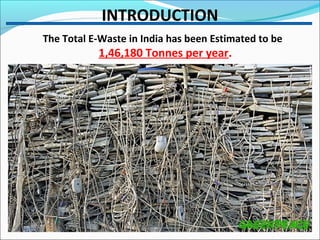
The Total E-Waste in India has been Estimated to be
1,46,180 Tonnes per year.
INTRODUCTION
Over 2 million old PCs
Ready for Disposal in India
INTRODUCTION
Mumbai at present tops the list
Mumbai - 11, 017 tonnes
Delhi - 9,730 tonnes
Bangalore - 4,648 tonnes
Chennai - 4,132 tonnes
Kolkata - 4,025 tonnes
Ahmedabad - 3,287 tonnes
Hyderabad - 2,833 tonnes
Pune - 2,584 tonnes
Surat - 1,836 tonnes
E-WASTE PILING UP
The Current Scenario in India.
WHAT IS E–WASTE ?
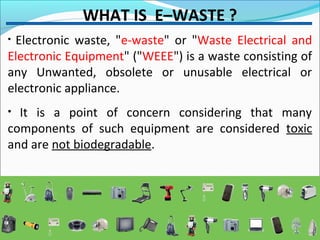
• Electronic waste, "e-waste" or "Waste Electrical and
Electronic Equipment" ("WEEE") is a waste consisting of
any Unwanted, obsolete or unusable electrical or
electronic appliance.
• It is a point of concern considering that many
components of such equipment are considered toxic
and are not biodegradable.
SOURCES OF E-WASTE
• IT & Telecom Equipments
• Large Household
Appliances
• Small Household
Appliances
• Consumer & Lighting
Equipments
• Electrical & Electronic
Tools
• Toys, Leisure & Sports
Equipment
• Medical Devices
• Monitoring & Control
Instruments
CHALLENGES
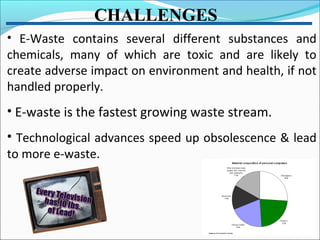
• E-Waste contains several different substances and
chemicals, many of which are toxic and are likely to
create adverse impact on environment and health, if not
handled properly.
• E-waste is the fastest growing waste stream.
• Technological advances speed up obsolescence & lead
to more e-waste.
IMPACT
Effects On Human Health
Damage to central and peripheral nervous systems,
blood systems and kidney damage.
Affects brain development of children.
Chronic damage to the brain.
Respiratory and skin disorders due to bioaccumulation
in fishes.
Asthmatic bronchitis.
Reproductive and developmental problems.
Lung Cancer.
Damage to heart, liver and spleen.
IMPACT
Effects On Environment
 Pollution of Ground-Water.
 Acidification of soil.
 Air Pollution.
 E-Waste accounts for 40 percent of the lead and
75 percent of the heavy metals found in landfills.
EWASTE – MANAGEMENT
E-waste management should begin at the point of
generation. This can be done by:
 Waste minimization techniques by sustainable product
design.
 Regulatory Compliance and Follow Agreed Standards.
Independent Third Party Certification.
EWASTE – MANAGEMENT
Step 1: Use 3R technique to minimize the E-waste.
 Step 2 Identify the E-waste category item.
Step 3: Identify the E-waste composition or
determine it.
Step 4: Identify possible hazardous content in E-
waste.
Step 5: Identify, whether the E-waste component is
hazardous or the entire E-waste item is hazardous.
EWASTE – MANAGEMENT
•Disassembly/dismantling :
Disassembly is the systematic removal of components, parts, a group of
parts or a subassembly from a product which is in E-Waste
•Upgrading :
It includes comminuting and separation of materials using mechanical /
physical and/or metallurgical processing. Methods to recover materials include
incineration and refining.
•Materials Recovery :
The material are recovered by recycling facilities. The plastic, glass,
metals can be recovered by sorting them before mixing with other waste.
EWASTE – MANAGEMENT
Recycling of E-WasteRecycling of E-Waste
Advantages of Recycling E-Waste :Advantages of Recycling E-Waste :
•Asset recovery
•Reduction of need for landfills
•Reduction of junks and clutters
•Resale and Reuse
•Creation of jobs
EWASTE – MANAGEMENT
EWASTE – MANAGEMENT
Wi
Implement Proper E-Waste DisposalImplement Proper E-Waste DisposalImplement Proper E-Waste DisposalImplement Proper E-Waste Disposal
EWASTE – MANAGEMENT
One man’s ‘junk’ is other man’s
‘Treasure’ !
(Anon)
Today’s Leisure
Will Become Tomorrow’s Junk

E-Waste

  • 2.
    Index1. Introduction 2. Whatis E – Waste 3. Sources of E-waste 4. Challenges 5. Impact 6. E–Waste Management 7. Conclusion
  • 3.
  • 4.
    INTRODUCTION The Total E-Wastein India has been Estimated to be 1,46,180 Tonnes per year.
  • 5.
    INTRODUCTION Over 2 millionold PCs Ready for Disposal in India
  • 6.
    INTRODUCTION Mumbai at presenttops the list Mumbai - 11, 017 tonnes Delhi - 9,730 tonnes Bangalore - 4,648 tonnes Chennai - 4,132 tonnes Kolkata - 4,025 tonnes Ahmedabad - 3,287 tonnes Hyderabad - 2,833 tonnes Pune - 2,584 tonnes Surat - 1,836 tonnes E-WASTE PILING UP The Current Scenario in India.
  • 7.
    WHAT IS E–WASTE? • Electronic waste, "e-waste" or "Waste Electrical and Electronic Equipment" ("WEEE") is a waste consisting of any Unwanted, obsolete or unusable electrical or electronic appliance. • It is a point of concern considering that many components of such equipment are considered toxic and are not biodegradable.
  • 8.
    SOURCES OF E-WASTE •IT & Telecom Equipments • Large Household Appliances • Small Household Appliances • Consumer & Lighting Equipments • Electrical & Electronic Tools • Toys, Leisure & Sports Equipment • Medical Devices • Monitoring & Control Instruments
  • 9.
    CHALLENGES • E-Waste containsseveral different substances and chemicals, many of which are toxic and are likely to create adverse impact on environment and health, if not handled properly. • E-waste is the fastest growing waste stream. • Technological advances speed up obsolescence & lead to more e-waste.
  • 10.
    IMPACT Effects On HumanHealth Damage to central and peripheral nervous systems, blood systems and kidney damage. Affects brain development of children. Chronic damage to the brain. Respiratory and skin disorders due to bioaccumulation in fishes. Asthmatic bronchitis. Reproductive and developmental problems. Lung Cancer. Damage to heart, liver and spleen.
  • 11.
    IMPACT Effects On Environment Pollution of Ground-Water.  Acidification of soil.  Air Pollution.  E-Waste accounts for 40 percent of the lead and 75 percent of the heavy metals found in landfills.
  • 12.
    EWASTE – MANAGEMENT E-wastemanagement should begin at the point of generation. This can be done by:  Waste minimization techniques by sustainable product design.  Regulatory Compliance and Follow Agreed Standards. Independent Third Party Certification.
  • 13.
    EWASTE – MANAGEMENT Step1: Use 3R technique to minimize the E-waste.  Step 2 Identify the E-waste category item. Step 3: Identify the E-waste composition or determine it. Step 4: Identify possible hazardous content in E- waste. Step 5: Identify, whether the E-waste component is hazardous or the entire E-waste item is hazardous.
  • 14.
  • 15.
    •Disassembly/dismantling : Disassembly isthe systematic removal of components, parts, a group of parts or a subassembly from a product which is in E-Waste •Upgrading : It includes comminuting and separation of materials using mechanical / physical and/or metallurgical processing. Methods to recover materials include incineration and refining. •Materials Recovery : The material are recovered by recycling facilities. The plastic, glass, metals can be recovered by sorting them before mixing with other waste. EWASTE – MANAGEMENT Recycling of E-WasteRecycling of E-Waste
  • 16.
    Advantages of RecyclingE-Waste :Advantages of Recycling E-Waste : •Asset recovery •Reduction of need for landfills •Reduction of junks and clutters •Resale and Reuse •Creation of jobs EWASTE – MANAGEMENT
  • 17.
  • 18.
    Implement Proper E-WasteDisposalImplement Proper E-Waste DisposalImplement Proper E-Waste DisposalImplement Proper E-Waste Disposal EWASTE – MANAGEMENT One man’s ‘junk’ is other man’s ‘Treasure’ ! (Anon)
  • 21.