Powerpoint Templates
Page 1
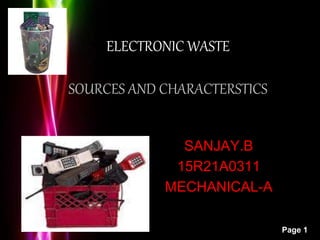
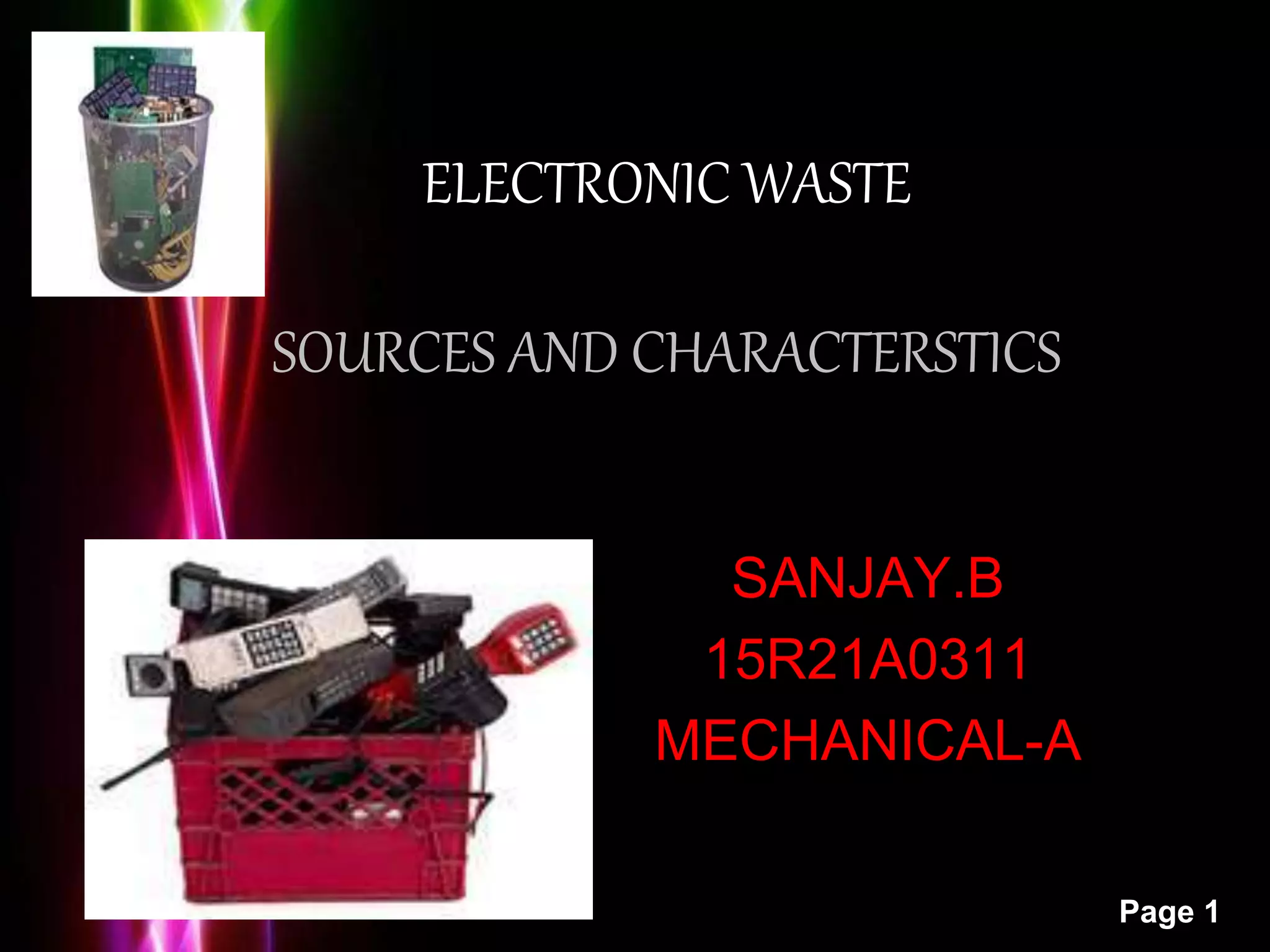
ELECTRONIC WASTE
SOURCES AND CHARACTERSTICS
SANJAY.B
15R21A0311
MECHANICAL-A
Powerpoint Templates
Page 2
PRESENTATION OUTLINE
Introduction
E-Waste
Impacts of e-waste
Indian E-waste scenario
Conclusion
Powerpoint Templates
Page 3
INTRODUCTION
Electronics industry is the world's largest and fastest
growing manufacturing industry.
In developing countries, on an average it equals to 1% of
total solid waste and is expected to grow to 2% by 2010
(UNEP, 2009)
Powerpoint Templates
Page 4
E-Waste
Electronic waste commonly known as E-waste or Waste
Electrical and Electronic Equipment (WEEE), or end-of-life
electronic are the electronic appliances such as computers,
laptops, TVs, DVD players, mobile phones, MP3 players etc.
including their assembly, sub-assembly, components and
consumables, which have been disposed of or unwanted by
their original users(Bhuie et al.,2004).
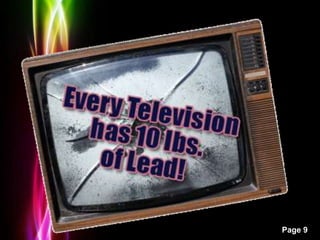
• Lead is a toxic substances which may cause lead poisoning
and can be especially harmful young children.
Powerpoint Templates
Page 5
Powerpoint Templates
Page 6
Powerpoint Templates
Page 7
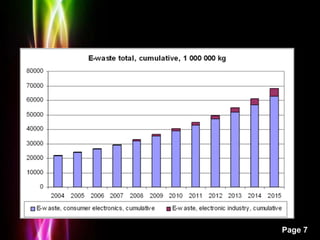
E-waste accumulation in China
Powerpoint Templates
Page 8
Valuable Materials
Gold, silver, copper, platinum etc. are valuable
substances which turn recycling of e-waste into a
lucrative business opportunity.
Powerpoint Templates
Page 9
Powerpoint Templates
Page 10
Impacts Of E-waste
 Electronic wastes can cause widespread environmental
damage due to the use of toxic materials
Toxic Materials releases highly toxic dioxins and furans when
burned
Land filling of e wastes can lead to the leaching of lead into
the ground water.
If the CRT is crushed and burned, it emits toxic fumes into the
air (Ramachandra and Saira, 2004)
The cadmium from one mobile phone battery is enough to
pollute 600 m3 of water (Trick, 2002).
Powerpoint Templates
Page 11
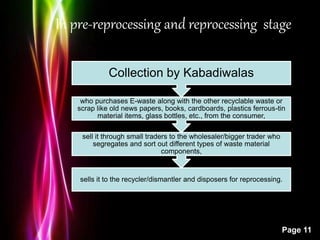
In pre-reprocessing and reprocessing stage
sells it to the recycler/dismantler and disposers for reprocessing.
sell it through small traders to the wholesaler/bigger trader who
segregates and sort out different types of waste material
components,
who purchases E-waste along with the other recyclable waste or
scrap like old news papers, books, cardboards, plastics ferrous-tin
material items, glass bottles, etc., from the consumer,
Collection by Kabadiwalas
Powerpoint Templates
Page 12
Problems with e-waste
Problems associated with the e-waste management-
its ever increasing quantum
its scientific and environment friendly disposal
Management and disposal of e-waste has become a
serious problem among states nationwide.
The problem of electronic waste (e-waste) is growing at
an unsustainable rate.
Powerpoint Templates
Page 13
Conclusion
It is important that we create a national framework for the
environmentally sound management of e-waste including
wide public awareness and education
Conduct detailed inventories of e-waste
Initiate pilot schemes on collection and sorting of e-
wastes , including take back schemes and schemes for
repair refurbishment and recycling
Powerpoint Templates
Page 14
THANK
YOU

Ewaste and management

  • 1.
    Powerpoint Templates Page 1 ELECTRONICWASTE SOURCES AND CHARACTERSTICS SANJAY.B 15R21A0311 MECHANICAL-A
  • 2.
    Powerpoint Templates Page 2 PRESENTATIONOUTLINE Introduction E-Waste Impacts of e-waste Indian E-waste scenario Conclusion
  • 3.
    Powerpoint Templates Page 3 INTRODUCTION Electronicsindustry is the world's largest and fastest growing manufacturing industry. In developing countries, on an average it equals to 1% of total solid waste and is expected to grow to 2% by 2010 (UNEP, 2009)
  • 4.
    Powerpoint Templates Page 4 E-Waste Electronicwaste commonly known as E-waste or Waste Electrical and Electronic Equipment (WEEE), or end-of-life electronic are the electronic appliances such as computers, laptops, TVs, DVD players, mobile phones, MP3 players etc. including their assembly, sub-assembly, components and consumables, which have been disposed of or unwanted by their original users(Bhuie et al.,2004). • Lead is a toxic substances which may cause lead poisoning and can be especially harmful young children.
  • 5.
  • 6.
  • 7.
  • 8.
    Powerpoint Templates Page 8 ValuableMaterials Gold, silver, copper, platinum etc. are valuable substances which turn recycling of e-waste into a lucrative business opportunity.
  • 9.
  • 10.
    Powerpoint Templates Page 10 ImpactsOf E-waste  Electronic wastes can cause widespread environmental damage due to the use of toxic materials Toxic Materials releases highly toxic dioxins and furans when burned Land filling of e wastes can lead to the leaching of lead into the ground water. If the CRT is crushed and burned, it emits toxic fumes into the air (Ramachandra and Saira, 2004) The cadmium from one mobile phone battery is enough to pollute 600 m3 of water (Trick, 2002).
  • 11.
    Powerpoint Templates Page 11 Inpre-reprocessing and reprocessing stage sells it to the recycler/dismantler and disposers for reprocessing. sell it through small traders to the wholesaler/bigger trader who segregates and sort out different types of waste material components, who purchases E-waste along with the other recyclable waste or scrap like old news papers, books, cardboards, plastics ferrous-tin material items, glass bottles, etc., from the consumer, Collection by Kabadiwalas
  • 12.
    Powerpoint Templates Page 12 Problemswith e-waste Problems associated with the e-waste management- its ever increasing quantum its scientific and environment friendly disposal Management and disposal of e-waste has become a serious problem among states nationwide. The problem of electronic waste (e-waste) is growing at an unsustainable rate.
  • 13.
    Powerpoint Templates Page 13 Conclusion Itis important that we create a national framework for the environmentally sound management of e-waste including wide public awareness and education Conduct detailed inventories of e-waste Initiate pilot schemes on collection and sorting of e- wastes , including take back schemes and schemes for repair refurbishment and recycling
  • 14.