7th Annual Conference University College Cork 2008 Blended Learning:  Dr Liam Boyle, LIT
7th Annual Conference University College Cork 2008 Blended Learning:  What? Dr Liam Boyle, LIT 7th Annual Conference University College Cork 2008
7th Annual Conference University College Cork 2008 Blended Learning:  What? Why?  Dr Liam Boyle, LIT 7th Annual Conference University College Cork 2008
7th Annual Conference University College Cork 2008 Blended Learning:  What? Why? How? Dr Liam Boyle, LIT 7th Annual Conference University College Cork 2008
What is Blended Learning? Combining online learning
What is Blended Learning? Combining online learning with more traditional forms of learning
What is Blended Learning? Combining online learning use of virtual learning environment online resources online communications  with more traditional forms of learning
What is Blended Learning? Combining online learning use of virtual learning environment online resources online communications  with more traditional forms of learning lecture tutorial practical sessions
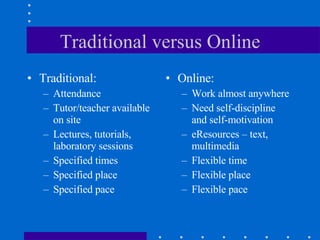
Traditional versus Online Traditional:
Traditional versus Online Traditional: Attendance Tutor/teacher available on site  Lectures, tutorials, laboratory sessions Specified times Specified place Specified pace
Traditional versus Online Traditional: Attendance Tutor/teacher available on site  Lectures, tutorials, laboratory sessions Specified times Specified place Specified pace Online:
Traditional versus Online Traditional: Attendance  Tutor/teacher available on site  Lectures, tutorials, laboratory sessions Specified times Specified place Specified pace Online: Work almost anywhere Need self-discipline and self-motivation eResources – text, multimedia Flexible time Flexible place  Flexible pace
Blended Learning Not “either/or” but “both/and” Use mixed modes, according to circumstances and goals
Blended Learning Not “either/or” but “both/and” Use mixed modes, according to circumstances and goals Use attendance more effectively
Blended Learning Not “either/or” but “both/and” Use mixed modes, according to circumstances and goals Use attendance more effectively, e.g. Online briefing in advance
Blended Learning Not “either/or” but “both/and” Use mixed modes, according to circumstances and goals Use attendance more effectively, e.g. Online briefing in advance  Online debriefing afterwards
Blended Learning Not “either/or” but “both/and” Use mixed modes, according to circumstances and goals Use attendance more effectively, e.g. Online briefing in advance  Online debriefing afterwards Attendance for practical sessions
Blended Learning Not “either/or” but “both/and” Use mixed modes, according to circumstances and goals Use attendance more effectively, e.g. Online briefing in advance  Online debriefing afterwards Attendance for practical sessions Reduced requirement for attendance
What is driving change?
What is driving change? Demography
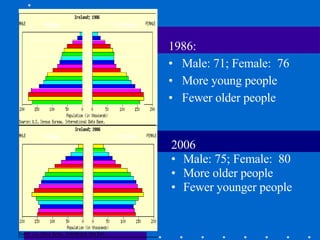
2006 Male: 75; Female:  80 More older people  Fewer younger people 1986: Male: 71; Female:  76 More young people  Fewer older people Female Female Male Male 80 60 40 20 0 0 20 40 60 80
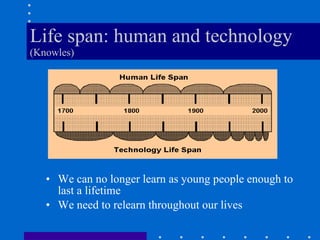
Life span: human and technology  (Knowles) We can no longer learn as young people enough to last a lifetime  We need to relearn throughout our lives
What is driving change? Demography
What is driving change? Demography Economics
Tomorrow’s Skills (  ) Education profile of existing workers, rather than any inflow, will be a major determinant of the future shape of the Irish labour force.  Without significant upskilling of existing workers, no major shift in the education distribution of the working age population can be expected by 2020.  Expert Group on Future Skills Needs
Work-based learning “ Third level institutions which want to grow can do so by reorienting their offering towards those in the workforce in need of upskilling”  ( Tomorrows Skills: Towards a National Skills Strategy ) “ A big challenge for the Institutes now is to ensure that we help those at work who want to continue their education” ( Marian Coy, IOTI President )
Economic case New Technology:  Need for skilled (competent) workers Periodic reskilling and upskilling Educated workforce: Attractive to inward investment Hedge against flight of capital
What is driving change? Demography Economics
What is driving change? Demography Economics Learning theory
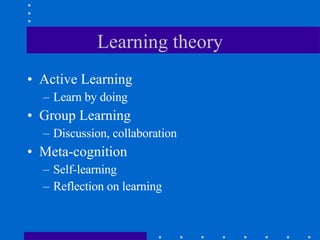
Learning theory Active Learning Learn by doing
Learning theory Active Learning Learn by doing Group Learning Discussion, collaboration
Learning theory Active Learning Learn by doing Group Learning Discussion, collaboration Meta-cognition Self-learning Reflection on learning
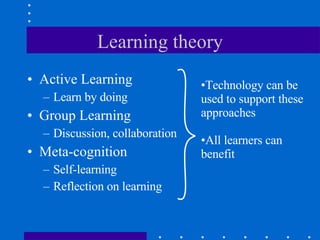
Learning theory Active Learning Learn by doing Group Learning Discussion, collaboration Meta-cognition Self-learning Reflection on learning Technology can be used to support these approaches All learners can benefit
What sort of blend?
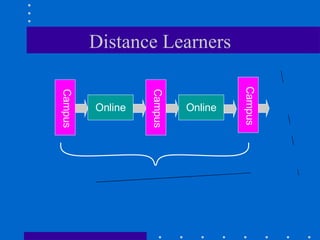
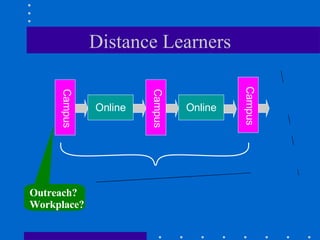
Distance Learners Online Online Campus Campus Campus Assessment Assessment
Distance Learners Online Online Campus Campus Campus Assessment Assessment Outreach? Workplace?
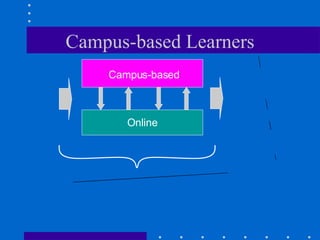
Campus-based Learners Online Campus-based Assessment Assessment
What sort of technology?
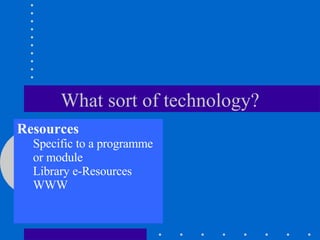
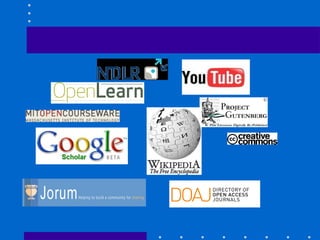
What sort of technology? Resources Specific to a programme or module Library e-Resources WWW
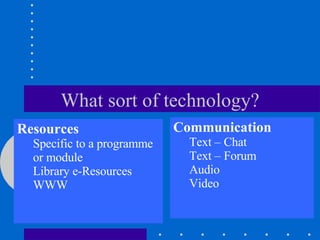
What sort of technology? Resources Specific to a programme or module Library e-Resources WWW Communication Text – Chat Text – Forum Audio Video
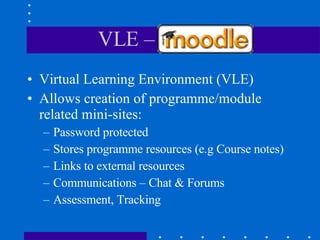
VLE – Moodle Virtual Learning Environment (VLE) Allows creation of programme/module related mini-sites: Password protected Stores programme resources (e.g Course notes) Links to external resources Communications – Chat & Forums Assessment, Tracking
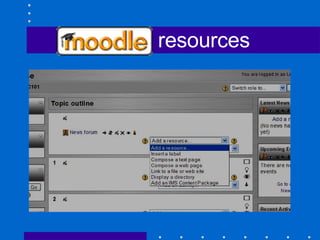
Moodle resources
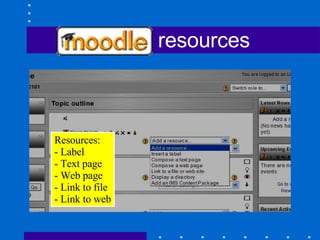
Moodle resources Resources: - Label - Text page - Web page - Link to file - Link to web
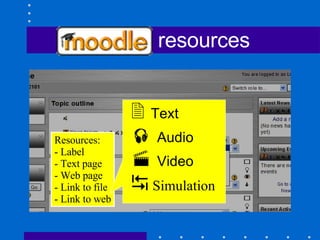
Moodle resources Resources: - Label - Text page - Web page - Link to file - Link to web    Text    Audio    Video    Simulation
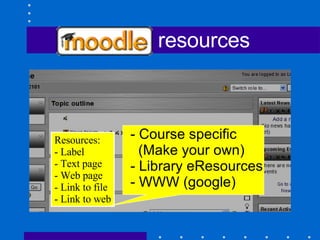
Moodle resources Resources: - Label - Text page - Web page - Link to file - Link to web - Course specific (Make your own) - Library eResources - WWW (google)
 
Moodle activities
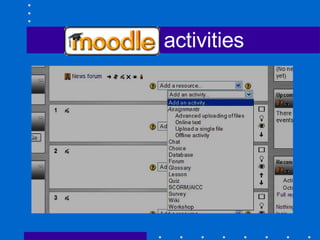
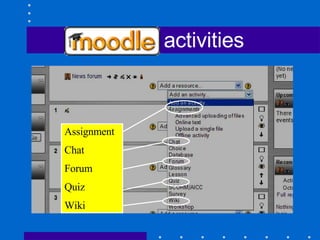
Moodle activities Assignment Chat Forum Quiz Wiki
Interactive use of Moodle Interact with the material Set tasks/activities to explore, reflect on and apply ideas from lectures or readings Interact with fellow students Get learners to discuss, share and collaborate with fellow students - collaborative construction of knowledge Interact with teacher Forum for learners to pose questions which may be responded to by tutor
Value of Communication Community Building/Social dialogue Especially important at start Get to know one another  Bond / Build trust and respect  Pedagogic communication Express ideas Build ideas Test ideas
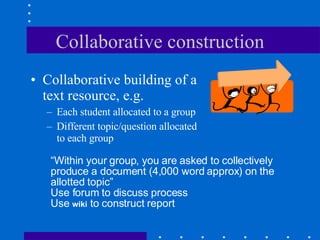
Collaborative construction Collaborative building of a text resource, e.g. Each student allocated to a group Different topic/question allocated to each group “ Within your group, you are asked to collectively produce a document (4,000 word approx) on the allotted topic” Use forum to discuss process Use  wiki  to construct report
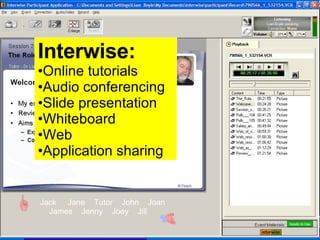
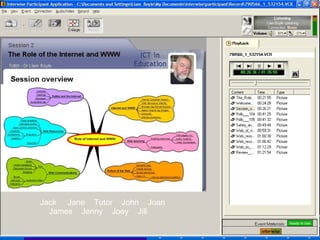
Jack  Jane  Tutor  John  Joan James  Jenny  Joey  Jill Interwise: Online tutorials Audio conferencing Slide presentation Whiteboard Web Application sharing
Jack  Jane  Tutor  John  Joan James  Jenny  Joey  Jill
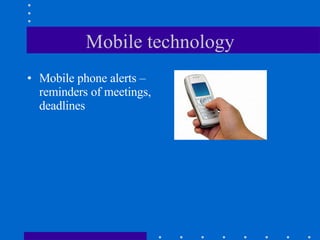
Mobile technology Mobile phone alerts – reminders of meetings, deadlines
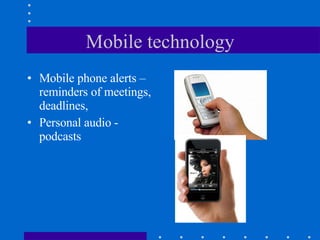
Mobile technology Mobile phone alerts – reminders of meetings, deadlines, Personal audio - podcasts
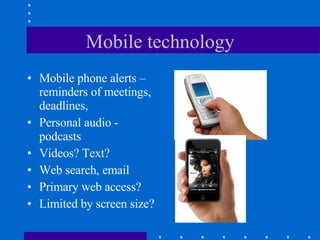
Mobile technology Mobile phone alerts – reminders of meetings, deadlines, Personal audio - podcasts  Videos? Text? Web search, email Primary web access? Limited by screen size?
Issues with online learning Learners expect all information to be online: What of information which is not?  Credibility of web sources Plagiarism and authenticity of student assignments Digital divide – some left behind? What is missing? – taste, smell, touch (EM Forster (1909)  The Machine Stops )
Thank you

Blended Learning

  • 1.
    7th Annual ConferenceUniversity College Cork 2008 Blended Learning: Dr Liam Boyle, LIT
  • 2.
    7th Annual ConferenceUniversity College Cork 2008 Blended Learning: What? Dr Liam Boyle, LIT 7th Annual Conference University College Cork 2008
  • 3.
    7th Annual ConferenceUniversity College Cork 2008 Blended Learning: What? Why? Dr Liam Boyle, LIT 7th Annual Conference University College Cork 2008
  • 4.
    7th Annual ConferenceUniversity College Cork 2008 Blended Learning: What? Why? How? Dr Liam Boyle, LIT 7th Annual Conference University College Cork 2008
  • 5.
    What is BlendedLearning? Combining online learning
  • 6.
    What is BlendedLearning? Combining online learning with more traditional forms of learning
  • 7.
    What is BlendedLearning? Combining online learning use of virtual learning environment online resources online communications with more traditional forms of learning
  • 8.
    What is BlendedLearning? Combining online learning use of virtual learning environment online resources online communications with more traditional forms of learning lecture tutorial practical sessions
  • 9.
  • 10.
    Traditional versus OnlineTraditional: Attendance Tutor/teacher available on site Lectures, tutorials, laboratory sessions Specified times Specified place Specified pace
  • 11.
    Traditional versus OnlineTraditional: Attendance Tutor/teacher available on site Lectures, tutorials, laboratory sessions Specified times Specified place Specified pace Online:
  • 12.
    Traditional versus OnlineTraditional: Attendance Tutor/teacher available on site Lectures, tutorials, laboratory sessions Specified times Specified place Specified pace Online: Work almost anywhere Need self-discipline and self-motivation eResources – text, multimedia Flexible time Flexible place Flexible pace
  • 13.
    Blended Learning Not“either/or” but “both/and” Use mixed modes, according to circumstances and goals
  • 14.
    Blended Learning Not“either/or” but “both/and” Use mixed modes, according to circumstances and goals Use attendance more effectively
  • 15.
    Blended Learning Not“either/or” but “both/and” Use mixed modes, according to circumstances and goals Use attendance more effectively, e.g. Online briefing in advance
  • 16.
    Blended Learning Not“either/or” but “both/and” Use mixed modes, according to circumstances and goals Use attendance more effectively, e.g. Online briefing in advance Online debriefing afterwards
  • 17.
    Blended Learning Not“either/or” but “both/and” Use mixed modes, according to circumstances and goals Use attendance more effectively, e.g. Online briefing in advance Online debriefing afterwards Attendance for practical sessions
  • 18.
    Blended Learning Not“either/or” but “both/and” Use mixed modes, according to circumstances and goals Use attendance more effectively, e.g. Online briefing in advance Online debriefing afterwards Attendance for practical sessions Reduced requirement for attendance
  • 19.
  • 20.
    What is drivingchange? Demography
  • 21.
    2006 Male: 75;Female: 80 More older people Fewer younger people 1986: Male: 71; Female: 76 More young people Fewer older people Female Female Male Male 80 60 40 20 0 0 20 40 60 80
  • 22.
    Life span: humanand technology (Knowles) We can no longer learn as young people enough to last a lifetime We need to relearn throughout our lives
  • 23.
    What is drivingchange? Demography
  • 24.
    What is drivingchange? Demography Economics
  • 25.
    Tomorrow’s Skills ( ) Education profile of existing workers, rather than any inflow, will be a major determinant of the future shape of the Irish labour force. Without significant upskilling of existing workers, no major shift in the education distribution of the working age population can be expected by 2020. Expert Group on Future Skills Needs
  • 26.
    Work-based learning “Third level institutions which want to grow can do so by reorienting their offering towards those in the workforce in need of upskilling” ( Tomorrows Skills: Towards a National Skills Strategy ) “ A big challenge for the Institutes now is to ensure that we help those at work who want to continue their education” ( Marian Coy, IOTI President )
  • 27.
    Economic case NewTechnology: Need for skilled (competent) workers Periodic reskilling and upskilling Educated workforce: Attractive to inward investment Hedge against flight of capital
  • 28.
    What is drivingchange? Demography Economics
  • 29.
    What is drivingchange? Demography Economics Learning theory
  • 30.
    Learning theory ActiveLearning Learn by doing
  • 31.
    Learning theory ActiveLearning Learn by doing Group Learning Discussion, collaboration
  • 32.
    Learning theory ActiveLearning Learn by doing Group Learning Discussion, collaboration Meta-cognition Self-learning Reflection on learning
  • 33.
    Learning theory ActiveLearning Learn by doing Group Learning Discussion, collaboration Meta-cognition Self-learning Reflection on learning Technology can be used to support these approaches All learners can benefit
  • 34.
  • 35.
    Distance Learners OnlineOnline Campus Campus Campus Assessment Assessment
  • 36.
    Distance Learners OnlineOnline Campus Campus Campus Assessment Assessment Outreach? Workplace?
  • 37.
    Campus-based Learners OnlineCampus-based Assessment Assessment
  • 38.
    What sort oftechnology?
  • 39.
    What sort oftechnology? Resources Specific to a programme or module Library e-Resources WWW
  • 40.
    What sort oftechnology? Resources Specific to a programme or module Library e-Resources WWW Communication Text – Chat Text – Forum Audio Video
  • 41.
    VLE – MoodleVirtual Learning Environment (VLE) Allows creation of programme/module related mini-sites: Password protected Stores programme resources (e.g Course notes) Links to external resources Communications – Chat & Forums Assessment, Tracking
  • 42.
  • 43.
    Moodle resources Resources:- Label - Text page - Web page - Link to file - Link to web
  • 44.
    Moodle resources Resources:- Label - Text page - Web page - Link to file - Link to web  Text  Audio  Video  Simulation
  • 45.
    Moodle resources Resources:- Label - Text page - Web page - Link to file - Link to web - Course specific (Make your own) - Library eResources - WWW (google)
  • 46.
  • 47.
  • 48.
    Moodle activities AssignmentChat Forum Quiz Wiki
  • 49.
    Interactive use ofMoodle Interact with the material Set tasks/activities to explore, reflect on and apply ideas from lectures or readings Interact with fellow students Get learners to discuss, share and collaborate with fellow students - collaborative construction of knowledge Interact with teacher Forum for learners to pose questions which may be responded to by tutor
  • 50.
    Value of CommunicationCommunity Building/Social dialogue Especially important at start Get to know one another Bond / Build trust and respect Pedagogic communication Express ideas Build ideas Test ideas
  • 51.
    Collaborative construction Collaborativebuilding of a text resource, e.g. Each student allocated to a group Different topic/question allocated to each group “ Within your group, you are asked to collectively produce a document (4,000 word approx) on the allotted topic” Use forum to discuss process Use wiki to construct report
  • 52.
    Jack Jane Tutor John Joan James Jenny Joey Jill Interwise: Online tutorials Audio conferencing Slide presentation Whiteboard Web Application sharing
  • 53.
    Jack Jane Tutor John Joan James Jenny Joey Jill
  • 54.
    Mobile technology Mobilephone alerts – reminders of meetings, deadlines
  • 55.
    Mobile technology Mobilephone alerts – reminders of meetings, deadlines, Personal audio - podcasts
  • 56.
    Mobile technology Mobilephone alerts – reminders of meetings, deadlines, Personal audio - podcasts Videos? Text? Web search, email Primary web access? Limited by screen size?
  • 57.
    Issues with onlinelearning Learners expect all information to be online: What of information which is not? Credibility of web sources Plagiarism and authenticity of student assignments Digital divide – some left behind? What is missing? – taste, smell, touch (EM Forster (1909) The Machine Stops )
  • 58.