Multiband RF Transceiver System
Chapter 3 Basic Concept of
Communication Systems
Department of Electronic Engineering
National Taipei University of Technology
Outline
• Wireless Standards
• Multiple Access Method
• FDMA
OFDMA
TDMA
CDMA (DS-CDMA, FH-CDMA)
• Duplexing
FDD
TDD
• Signal Quality: Probability of error, BER, and SNR
Department of Electronic Engineering, NTUT2/32
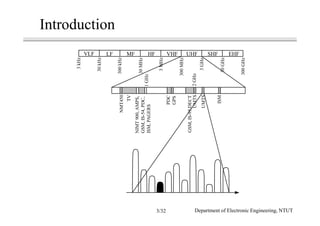
Introduction
VLF LF MF HF VHF UHF SHF EHF
3kHz
30kHz
300kHz
3MHz
30MHz
300MHz
3GHz
30GHz
300GHz
1GHz
2GHz
NIMT900,AMPS,
GSM,IS-54,PDC,
ISM,PAGERS
NMT450
TV
PDC
GPS
GSM,IS-95,DECT
UMTS
UMTS
ISM
Department of Electronic Engineering, NTUT3/32
Typical Transceiver
• Transmitter (TX)
• Receiver (RX)
DATA IN
CODING INTER-
LEAVING
MODU-
LATION
PULSE
SHAPING
FILTER
UP-
CONVERSION
POWER
AMPLIFIER
DUPLEX
FILTER
DATA OUT
DUPLEX
FILTER
LOW NOISE
AMPLIFIER
DOWN-
CONVERSION
CHANNEL
SELECTION
FILTER
DEMODU-
LATION
DEINTER-
LEAVING
DECODING
Department of Electronic Engineering, NTUT4/32
Wireless Systems (I)
• The wireless systems vary from broadcast and television
transmission to cellular telephones and wireless local area
networks (WLAN).
The coverage area or in cellular systems the cell size has reduced when personal
messaging and rising data rates have been adopted.
• The capacity must be shared to small units with various
methods.
For example, in the Third Generation Partnership Project (3GPP), the system uses
direct sequence spread spectrum multiple access. Often, the system is called
Universal Mobile Telecommunications System (UMTS), which has been actually
the name for the European proposal.
Department of Electronic Engineering, NTUT5/32
Wireless Systems (II)
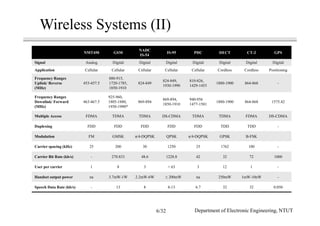
NMT450 GSM
NADC
IS-54
IS-95 PDC DECT CT-2 GPS
Signal Analog Digital Digital Digital Digital Digital Digital Digital
Application Cellular Cellular Cellular Cellular Cellular Cordless Cordless Positioning
Frequency Ranges
Uplink/ Reverse
(MHz)
453-457.5
880-915,
1720-1785,
1850-1910
824-849
824-849,
1930-1990
810-826,
1429-1453
1880-1900 864-868 -
Frequency Ranges
Downlink/ Forward
(MHz)
463-467.5
925-960,
1805-1880,
1930-1990(6
869-894
869-894,
1850-1910
940-956
1477-1501
1880-1900 864-868 1575.42
Multiple Access FDMA TDMA TDMA DS-CDMA TDMA TDMA FDMA DS-CDMA
Duplexing FDD FDD FDD FDD FDD TDD TDD -
Modulation FM GMSK π/4-DQPSK QPSK π/4-DQPSK GPSK B-FSK
Carrier spacing (kHz) 25 200 30 1250 25 1762 100 -
Carrier Bit Rate (kb/s) - 270.833 48.6 1228.8 42 32 72 1000
User per carrier 1 8 3 < 63 3 12 1 -
Handset output power na 3.7mW-1W 2.2mW-6W ≤ 200mW na 250mW 1mW-10nW -
Speech Data Rate (kb/s) - 13 8 8-13 6.7 32 32 0.050
Department of Electronic Engineering, NTUT6/32
Wireless Systems (III)
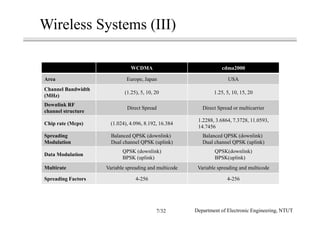
WCDMA cdma2000
Area Europe, Japan USA
Channel Bandwidth
(MHz)
(1.25), 5, 10, 20 1.25, 5, 10, 15, 20
Downlink RF
channel structure
Direct Spread Direct Spread or multicarrier
Chip rate (Mcps) (1.024), 4.096, 8.192, 16.384
1.2288, 3.6864, 7.3728, 11.0593,
14.7456
Spreading
Modulation
Balanced QPSK (downlink)
Dual channel QPSK (uplink)
Balanced QPSK (downlink)
Dual channel QPSK (uplink)
Data Modulation
QPSK (downlink)
BPSK (uplink)
QPSK(downlink)
BPSK(uplink)
Multirate Variable spreading and multicode Variable spreading and multicode
Spreading Factors 4-256 4-256
Department of Electronic Engineering, NTUT7/32
Multiple Access Methods
• The Multiple Access Method:
Defines how the information in a single traffic channel is organized with respect to
the other transmitted channels at the same band or elsewhere.
• The multiple access gives a frame for the radio design, and it
has a strong influence on the choice of the radio architecture
and on the specification of the analog receiver.
• The multiple access can be done in the frequency, time or code
domain.
Department of Electronic Engineering, NTUT8/32
Frequency Division Multiple Access (FDMA)
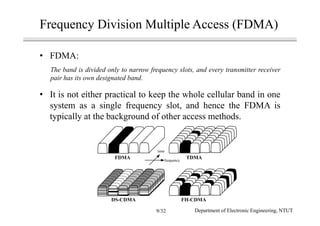
• FDMA:
The band is divided only to narrow frequency slots, and every transmitter receiver
pair has its own designated band.
• It is not either practical to keep the whole cellular band in one
system as a single frequency slot, and hence the FDMA is
typically at the background of other access methods.
FDMA TDMA
DS-CDMA FH-CDMA
time
frequency
Department of Electronic Engineering, NTUT9/32
Orthogonal Frequency-Division Multiple Access
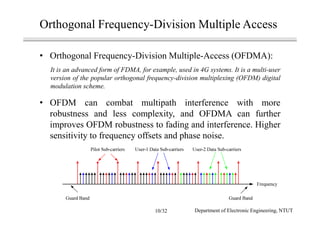
• Orthogonal Frequency-Division Multiple-Access (OFDMA):
It is an advanced form of FDMA, for example, used in 4G systems. It is a multi-user
version of the popular orthogonal frequency-division multiplexing (OFDM) digital
modulation scheme.
• OFDM can combat multipath interference with more
robustness and less complexity, and OFDMA can further
improves OFDM robustness to fading and interference. Higher
sensitivity to frequency offsets and phase noise.
Department of Electronic Engineering, NTUT10/32
Time Division Multiple Access (TDMA)
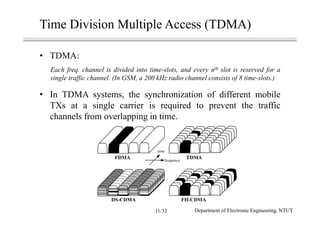
• TDMA:
Each freq. channel is divided into time-slots, and every nth slot is reserved for a
single traffic channel. (In GSM, a 200 kHz radio channel consists of 8 time-slots.)
• In TDMA systems, the synchronization of different mobile
TXs at a single carrier is required to prevent the traffic
channels from overlapping in time.
FDMA TDMA
DS-CDMA FH-CDMA
time
frequency
Department of Electronic Engineering, NTUT11/32
Code Division Multiple Access (CDMA)
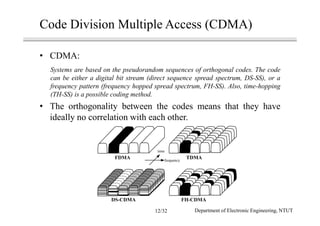
• CDMA:
Systems are based on the pseudorandom sequences of orthogonal codes. The code
can be either a digital bit stream (direct sequence spread spectrum, DS-SS), or a
frequency pattern (frequency hopped spread spectrum, FH-SS). Also, time-hopping
(TH-SS) is a possible coding method.
• The orthogonality between the codes means that they have
ideally no correlation with each other.
FDMA TDMA
DS-CDMA FH-CDMA
time
frequency
Department of Electronic Engineering, NTUT12/32
Direct Sequence CDMA (DS-CDMA)
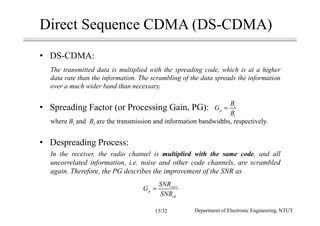
• DS-CDMA:
The transmitted data is multiplied with the spreading code, which is at a higher
data rate than the information. The scrambling of the data spreads the information
over a much wider band than necessary.
• Spreading Factor (or Processing Gain, PG):
where Bt and Bi are the transmission and information bandwidths, respectively.
• Despreading Process:
In the receiver, the radio channel is multiplied with the same code, and all
uncorrelated information, i.e. noise and other code channels, are scrambled
again. Therefore, the PG describes the improvement of the SNR as
t
p
i
B
G
B
=
corr
p
ch
SNR
G
SNR
=
Department of Electronic Engineering, NTUT13/32
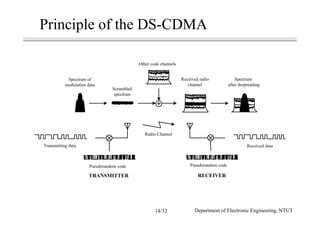
Principle of the DS-CDMA
Spectrum of
modulation data
Scrambled
spectrum
Other code channels
Received radio
channel
Spectrum
after despreading
Transmitting data
Pseudorandom code
Received data
Radio Channel
TRANSMITTER RECEIVER
Pseudorandom code
Department of Electronic Engineering, NTUT14/32
Bit and Chip
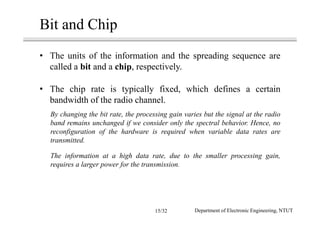
• The units of the information and the spreading sequence are
called a bit and a chip, respectively.
• The chip rate is typically fixed, which defines a certain
bandwidth of the radio channel.
By changing the bit rate, the processing gain varies but the signal at the radio
band remains unchanged if we consider only the spectral behavior. Hence, no
reconfiguration of the hardware is required when variable data rates are
transmitted.
The information at a high data rate, due to the smaller processing gain,
requires a larger power for the transmission.
Department of Electronic Engineering, NTUT15/32
Frequency Hopping CDMA (FH-CDMA)
• FH-CDMA:
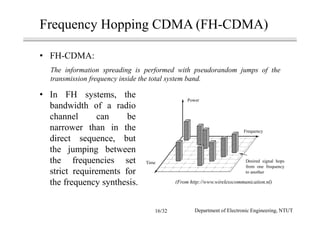
The information spreading is performed with pseudorandom jumps of the
transmission frequency inside the total system band.
(From http://www.wirelesscommunication.nl)
• In FH systems, the
bandwidth of a radio
channel can be
narrower than in the
direct sequence, but
the jumping between
the frequencies set
strict requirements for
the frequency synthesis.
Department of Electronic Engineering, NTUT16/32
Power
Frequency
Time Desired signal hops
from one frequency
to another
Duplexing
• In all two-way communications with only one antenna, the
transmitter and receiver must be isolated from each other.
Otherwise, the Tx output power would saturate the Rx.
Frequency division duplexing (FDD):
The transmission and reception are accomplished at different frequencies with
a duplex filter (typically used in cellular systems).
Time division duplexing (TDD):
The transmission and reception are at the same band but they do not overlap in
time with a switch (DECT in an example).
• In GSM, both FDD and TDD are used simultaneously.
However, a duplex-filter is typically used in mobile terminals
instead of a switch, due to the better immunity against signals
from other mobiles.
Department of Electronic Engineering, NTUT17/32
Digital Modulation
• Reasons: Capacity, Accuracy, Noise, and Distortion
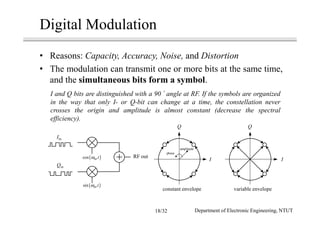
• The modulation can transmit one or more bits at the same time,
and the simultaneous bits form a symbol.
I and Q bits are distinguished with a 90 angle at RF. If the symbols are organized
in the way that only I- or Q-bit can change at a time, the constellation never
crosses the origin and amplitude is almost constant (decrease the spectral
efficiency).
Iin
RF out
Qin
( )cos RFtω
( )sin RFtω
constant envelope variable envelope
amplitude
phase
Q
I
Q
I
Department of Electronic Engineering, NTUT18/32
Binary Phase Shift Keying (BPSK)
• BPSK:
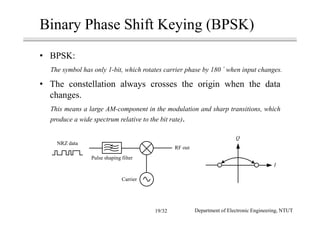
The symbol has only 1-bit, which rotates carrier phase by 180 when input changes.
• The constellation always crosses the origin when the data
changes.
This means a large AM-component in the modulation and sharp transitions, which
produce a wide spectrum relative to the bit rate).
NRZ data
Pulse shaping filter
Carrier
RF out
Q
I
Department of Electronic Engineering, NTUT19/32
Binary Phase Shift Keying (BPSK)
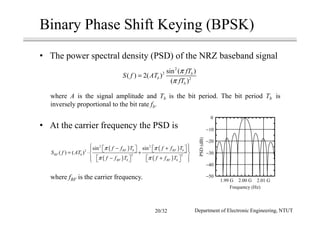
• The power spectral density (PSD) of the NRZ baseband signal
where A is the signal amplitude and Tb is the bit period. The bit period Tb is
inversely proportional to the bit rate fb.
• At the carrier frequency the PSD is
where fRF is the carrier frequency.
2
2
2
sin ( )
( ) 2( )
( )
b
b
b
fT
S f AT
fT
π
π
=
( )
( )
( )
( )
2 2
2
2 2
sin sin
( ) ( )
RF b RF b
RF b
RF b RF b
f f T f f T
S f AT
f f T f f T
π π
π π
 − +       = ⋅ + 
− +        
Department of Electronic Engineering, NTUT20/32
0
−10
−20
−30
−40
−50
1.99 G 2.00 G 2.01 G
Frequency (Hz)
PSD(dB)
Quadrature Phase Shift Keying (QPSK)
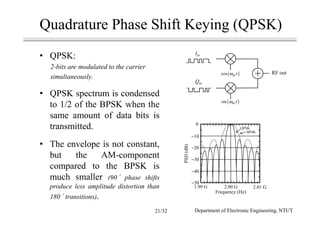
• QPSK:
2-bits are modulated to the carrier
simultaneously.
• QPSK spectrum is condensed
to 1/2 of the BPSK when the
same amount of data bits is
transmitted.
• The envelope is not constant,
but the AM-component
compared to the BPSK is
much smaller (90 phase shifts
produce less amplitude distortion than
180 transitions).
Iin
RF out
Qin
( )cos RFtω
( )sin RFtω
Department of Electronic Engineering, NTUT21/32
0
−10
−20
−30
−40
−50
1.99 G 2.00 G 2.01 G
Frequency (Hz)
PSD(dB)
QPSK
BPSK
Probability of an Error
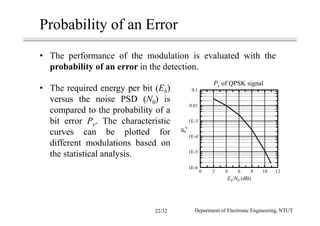
• The performance of the modulation is evaluated with the
probability of an error in the detection.
Department of Electronic Engineering, NTUT22/32
0.1
0.01
1E-3
1E-4
1E-5
1E-6
0 2 4 6 8 10 12
Eb/N0 (dB)
Pe
Pe of QPSK signal
• The required energy per bit (Eb)
versus the noise PSD (N0) is
compared to the probability of a
bit error Pe. The characteristic
curves can be plotted for
different modulations based on
the statistical analysis.
Bit Error Rate (BER)
• In wireless applications, the required BER for speech
transmission is typically, i.e. 10−−−−3, one error in one thousand
transmitted bits. In that case, the Eb/N0 must be about 6.7 dB
for the QPSK.
• The required BER for the data transmission is in the order of
10−−−−6666 in wireless connections.
• The BER is actually defined after decoding of the transmission.
The channel coding has effect on the required Eb/N0.
For example, in WCDMA systems, different coding methods are used for
speech and data transmissions.
Department of Electronic Engineering, NTUT23/32
Signal-to-Noise Ratio (SNR)
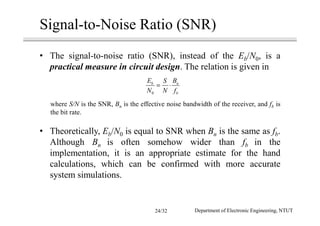
• The signal-to-noise ratio (SNR), instead of the Eb/N0, is a
practical measure in circuit design. The relation is given in
where S/N is the SNR, Bn is the effective noise bandwidth of the receiver, and fb is
the bit rate.
• Theoretically, Eb/N0 is equal to SNR when Bn is the same as fb.
Although Bn is often somehow wider than fb in the
implementation, it is an appropriate estimate for the hand
calculations, which can be confirmed with more accurate
system simulations.
0
b n
b
E BS
N N f
= ⋅
Department of Electronic Engineering, NTUT24/32
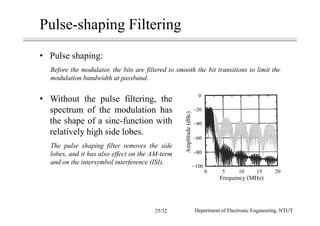
Pulse-shaping Filtering
• Pulse shaping:
Before the modulator, the bits are filtered to smooth the bit transitions to limit the
modulation bandwidth at passband.
• Without the pulse filtering, the
spectrum of the modulation has
the shape of a sinc-function with
relatively high side lobes.
The pulse shaping filter removes the side
lobes, and it has also effect on the AM-term
and on the intersymbol interference (ISI).
0
−20
−40
−60
−80
Amplitude(dBc)
−100
0 5 10 2015
Frequency (MHz)
Department of Electronic Engineering, NTUT25/32
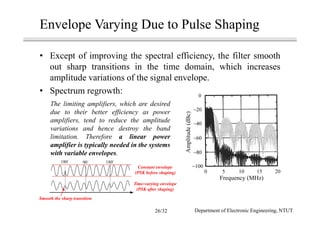
Envelope Varying Due to Pulse Shaping
• Except of improving the spectral efficiency, the filter smooth
out sharp transitions in the time domain, which increases
amplitude variations of the signal envelope.
• Spectrum regrowth:
The limiting amplifiers, which are desired
due to their better efficiency as power
amplifiers, tend to reduce the amplitude
variations and hence destroy the band
limitation. Therefore a linear power
amplifier is typically needed in the systems
with variable envelopes.
0
−20
−40
−60
−80
Amplitude(dBc)
−100
0 5 10 2015
Frequency (MHz)
Constant envelope
(PSK before shaping)
180 18090
Time-varying envelope
(PSK after shaping)
Smooth the sharp transition
Department of Electronic Engineering, NTUT26/32
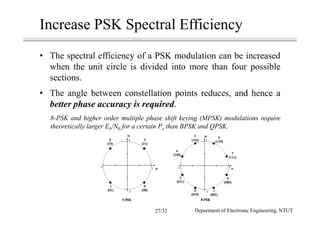
Increase PSK Spectral Efficiency
• The spectral efficiency of a PSK modulation can be increased
when the unit circle is divided into more than four possible
sections.
• The angle between constellation points reduces, and hence a
better phase accuracy is required.
8-PSK and higher order multiple phase shift keying (MPSK) modulations require
theoretically larger Eb/N0 for a certain Pe than BPSK and QPSK.
Department of Electronic Engineering, NTUT27/32
Frequency Shift Keying (FSK)
• Instead of abrupt changes between fixed phase angles, the bits
can be coded as linear phase shifts.
The linear change in the phase means a constant frequency. The methods based
on that principle are called digital frequency modulations.
• In FSK, the phase shift is smooth and the amplitude does not
change (constant envelope modulation).
FSK is the digital counterpart of the analog FM. The difference is that the input of
the modulator is binary data instead of analog information.
Department of Electronic Engineering, NTUT28/32
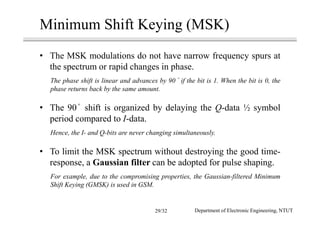
Minimum Shift Keying (MSK)
• The MSK modulations do not have narrow frequency spurs at
the spectrum or rapid changes in phase.
The phase shift is linear and advances by 90 if the bit is 1. When the bit is 0, the
phase returns back by the same amount.
• The 90 shift is organized by delaying the Q-data ½ symbol
period compared to I-data.
Hence, the I- and Q-bits are never changing simultaneously.
• To limit the MSK spectrum without destroying the good time-
response, a Gaussian filter can be adopted for pulse shaping.
For example, due to the compromising properties, the Gaussian-filtered Minimum
Shift Keying (GMSK) is used in GSM.
Department of Electronic Engineering, NTUT29/32
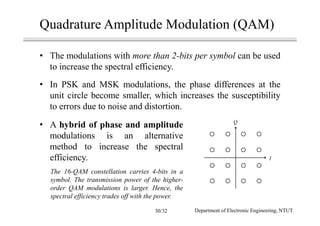
Quadrature Amplitude Modulation (QAM)
• The modulations with more than 2-bits per symbol can be used
to increase the spectral efficiency.
• In PSK and MSK modulations, the phase differences at the
unit circle become smaller, which increases the susceptibility
to errors due to noise and distortion.
• A hybrid of phase and amplitude
modulations is an alternative
method to increase the spectral
efficiency.
The 16-QAM constellation carries 4-bits in a
symbol. The transmission power of the higher-
order QAM modulations is larger. Hence, the
spectral efficiency trades off with the power.
Q
I
Department of Electronic Engineering, NTUT30/32
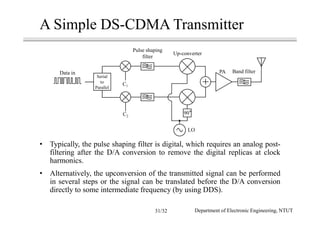
• Typically, the pulse shaping filter is digital, which requires an analog post-
filtering after the D/A conversion to remove the digital replicas at clock
harmonics.
• Alternatively, the upconversion of the transmitted signal can be performed
in several steps or the signal can be translated before the D/A conversion
directly to some intermediate frequency (by using DDS).
A Simple DS-CDMA Transmitter
Data in
Pulse shaping
filter
Serial
to
Parallel
C2
Up-converter
PA Band filter
90
LO
C1
Department of Electronic Engineering, NTUT31/32
Summary
• In this chapter, some basics on communication systems were
introduced, including multiple access, duplexing, digital
modulation, bit error rate, and signal-to-noise ratio, .etc.
• The multiple access defines how the information in a single
traffic channel is organized with respect to the other
transmitted channels at the same band or elsewhere.
• In all two-way communications with only one antenna, the
transmitter and receiver need to be isolated from each other
with time- or frequency-division duplexing.
• The required BER defines the minimum Eb/N0, and hence the
minimum SNR.
• The spectral efficiency can be increased by using the M-PSK
or QAM modulation.
Department of Electronic Engineering, NTUT32/32

Multiband Transceivers - [Chapter 3] Basic Concept of Comm. Systems

  • 1.
    Multiband RF TransceiverSystem Chapter 3 Basic Concept of Communication Systems Department of Electronic Engineering National Taipei University of Technology
  • 2.
    Outline • Wireless Standards •Multiple Access Method • FDMA OFDMA TDMA CDMA (DS-CDMA, FH-CDMA) • Duplexing FDD TDD • Signal Quality: Probability of error, BER, and SNR Department of Electronic Engineering, NTUT2/32
  • 3.
    Introduction VLF LF MFHF VHF UHF SHF EHF 3kHz 30kHz 300kHz 3MHz 30MHz 300MHz 3GHz 30GHz 300GHz 1GHz 2GHz NIMT900,AMPS, GSM,IS-54,PDC, ISM,PAGERS NMT450 TV PDC GPS GSM,IS-95,DECT UMTS UMTS ISM Department of Electronic Engineering, NTUT3/32
  • 4.
    Typical Transceiver • Transmitter(TX) • Receiver (RX) DATA IN CODING INTER- LEAVING MODU- LATION PULSE SHAPING FILTER UP- CONVERSION POWER AMPLIFIER DUPLEX FILTER DATA OUT DUPLEX FILTER LOW NOISE AMPLIFIER DOWN- CONVERSION CHANNEL SELECTION FILTER DEMODU- LATION DEINTER- LEAVING DECODING Department of Electronic Engineering, NTUT4/32
  • 5.
    Wireless Systems (I) •The wireless systems vary from broadcast and television transmission to cellular telephones and wireless local area networks (WLAN). The coverage area or in cellular systems the cell size has reduced when personal messaging and rising data rates have been adopted. • The capacity must be shared to small units with various methods. For example, in the Third Generation Partnership Project (3GPP), the system uses direct sequence spread spectrum multiple access. Often, the system is called Universal Mobile Telecommunications System (UMTS), which has been actually the name for the European proposal. Department of Electronic Engineering, NTUT5/32
  • 6.
    Wireless Systems (II) NMT450GSM NADC IS-54 IS-95 PDC DECT CT-2 GPS Signal Analog Digital Digital Digital Digital Digital Digital Digital Application Cellular Cellular Cellular Cellular Cellular Cordless Cordless Positioning Frequency Ranges Uplink/ Reverse (MHz) 453-457.5 880-915, 1720-1785, 1850-1910 824-849 824-849, 1930-1990 810-826, 1429-1453 1880-1900 864-868 - Frequency Ranges Downlink/ Forward (MHz) 463-467.5 925-960, 1805-1880, 1930-1990(6 869-894 869-894, 1850-1910 940-956 1477-1501 1880-1900 864-868 1575.42 Multiple Access FDMA TDMA TDMA DS-CDMA TDMA TDMA FDMA DS-CDMA Duplexing FDD FDD FDD FDD FDD TDD TDD - Modulation FM GMSK π/4-DQPSK QPSK π/4-DQPSK GPSK B-FSK Carrier spacing (kHz) 25 200 30 1250 25 1762 100 - Carrier Bit Rate (kb/s) - 270.833 48.6 1228.8 42 32 72 1000 User per carrier 1 8 3 < 63 3 12 1 - Handset output power na 3.7mW-1W 2.2mW-6W ≤ 200mW na 250mW 1mW-10nW - Speech Data Rate (kb/s) - 13 8 8-13 6.7 32 32 0.050 Department of Electronic Engineering, NTUT6/32
  • 7.
    Wireless Systems (III) WCDMAcdma2000 Area Europe, Japan USA Channel Bandwidth (MHz) (1.25), 5, 10, 20 1.25, 5, 10, 15, 20 Downlink RF channel structure Direct Spread Direct Spread or multicarrier Chip rate (Mcps) (1.024), 4.096, 8.192, 16.384 1.2288, 3.6864, 7.3728, 11.0593, 14.7456 Spreading Modulation Balanced QPSK (downlink) Dual channel QPSK (uplink) Balanced QPSK (downlink) Dual channel QPSK (uplink) Data Modulation QPSK (downlink) BPSK (uplink) QPSK(downlink) BPSK(uplink) Multirate Variable spreading and multicode Variable spreading and multicode Spreading Factors 4-256 4-256 Department of Electronic Engineering, NTUT7/32
  • 8.
    Multiple Access Methods •The Multiple Access Method: Defines how the information in a single traffic channel is organized with respect to the other transmitted channels at the same band or elsewhere. • The multiple access gives a frame for the radio design, and it has a strong influence on the choice of the radio architecture and on the specification of the analog receiver. • The multiple access can be done in the frequency, time or code domain. Department of Electronic Engineering, NTUT8/32
  • 9.
    Frequency Division MultipleAccess (FDMA) • FDMA: The band is divided only to narrow frequency slots, and every transmitter receiver pair has its own designated band. • It is not either practical to keep the whole cellular band in one system as a single frequency slot, and hence the FDMA is typically at the background of other access methods. FDMA TDMA DS-CDMA FH-CDMA time frequency Department of Electronic Engineering, NTUT9/32
  • 10.
    Orthogonal Frequency-Division MultipleAccess • Orthogonal Frequency-Division Multiple-Access (OFDMA): It is an advanced form of FDMA, for example, used in 4G systems. It is a multi-user version of the popular orthogonal frequency-division multiplexing (OFDM) digital modulation scheme. • OFDM can combat multipath interference with more robustness and less complexity, and OFDMA can further improves OFDM robustness to fading and interference. Higher sensitivity to frequency offsets and phase noise. Department of Electronic Engineering, NTUT10/32
  • 11.
    Time Division MultipleAccess (TDMA) • TDMA: Each freq. channel is divided into time-slots, and every nth slot is reserved for a single traffic channel. (In GSM, a 200 kHz radio channel consists of 8 time-slots.) • In TDMA systems, the synchronization of different mobile TXs at a single carrier is required to prevent the traffic channels from overlapping in time. FDMA TDMA DS-CDMA FH-CDMA time frequency Department of Electronic Engineering, NTUT11/32
  • 12.
    Code Division MultipleAccess (CDMA) • CDMA: Systems are based on the pseudorandom sequences of orthogonal codes. The code can be either a digital bit stream (direct sequence spread spectrum, DS-SS), or a frequency pattern (frequency hopped spread spectrum, FH-SS). Also, time-hopping (TH-SS) is a possible coding method. • The orthogonality between the codes means that they have ideally no correlation with each other. FDMA TDMA DS-CDMA FH-CDMA time frequency Department of Electronic Engineering, NTUT12/32
  • 13.
    Direct Sequence CDMA(DS-CDMA) • DS-CDMA: The transmitted data is multiplied with the spreading code, which is at a higher data rate than the information. The scrambling of the data spreads the information over a much wider band than necessary. • Spreading Factor (or Processing Gain, PG): where Bt and Bi are the transmission and information bandwidths, respectively. • Despreading Process: In the receiver, the radio channel is multiplied with the same code, and all uncorrelated information, i.e. noise and other code channels, are scrambled again. Therefore, the PG describes the improvement of the SNR as t p i B G B = corr p ch SNR G SNR = Department of Electronic Engineering, NTUT13/32
  • 14.
    Principle of theDS-CDMA Spectrum of modulation data Scrambled spectrum Other code channels Received radio channel Spectrum after despreading Transmitting data Pseudorandom code Received data Radio Channel TRANSMITTER RECEIVER Pseudorandom code Department of Electronic Engineering, NTUT14/32
  • 15.
    Bit and Chip •The units of the information and the spreading sequence are called a bit and a chip, respectively. • The chip rate is typically fixed, which defines a certain bandwidth of the radio channel. By changing the bit rate, the processing gain varies but the signal at the radio band remains unchanged if we consider only the spectral behavior. Hence, no reconfiguration of the hardware is required when variable data rates are transmitted. The information at a high data rate, due to the smaller processing gain, requires a larger power for the transmission. Department of Electronic Engineering, NTUT15/32
  • 16.
    Frequency Hopping CDMA(FH-CDMA) • FH-CDMA: The information spreading is performed with pseudorandom jumps of the transmission frequency inside the total system band. (From http://www.wirelesscommunication.nl) • In FH systems, the bandwidth of a radio channel can be narrower than in the direct sequence, but the jumping between the frequencies set strict requirements for the frequency synthesis. Department of Electronic Engineering, NTUT16/32 Power Frequency Time Desired signal hops from one frequency to another
  • 17.
    Duplexing • In alltwo-way communications with only one antenna, the transmitter and receiver must be isolated from each other. Otherwise, the Tx output power would saturate the Rx. Frequency division duplexing (FDD): The transmission and reception are accomplished at different frequencies with a duplex filter (typically used in cellular systems). Time division duplexing (TDD): The transmission and reception are at the same band but they do not overlap in time with a switch (DECT in an example). • In GSM, both FDD and TDD are used simultaneously. However, a duplex-filter is typically used in mobile terminals instead of a switch, due to the better immunity against signals from other mobiles. Department of Electronic Engineering, NTUT17/32
  • 18.
    Digital Modulation • Reasons:Capacity, Accuracy, Noise, and Distortion • The modulation can transmit one or more bits at the same time, and the simultaneous bits form a symbol. I and Q bits are distinguished with a 90 angle at RF. If the symbols are organized in the way that only I- or Q-bit can change at a time, the constellation never crosses the origin and amplitude is almost constant (decrease the spectral efficiency). Iin RF out Qin ( )cos RFtω ( )sin RFtω constant envelope variable envelope amplitude phase Q I Q I Department of Electronic Engineering, NTUT18/32
  • 19.
    Binary Phase ShiftKeying (BPSK) • BPSK: The symbol has only 1-bit, which rotates carrier phase by 180 when input changes. • The constellation always crosses the origin when the data changes. This means a large AM-component in the modulation and sharp transitions, which produce a wide spectrum relative to the bit rate). NRZ data Pulse shaping filter Carrier RF out Q I Department of Electronic Engineering, NTUT19/32
  • 20.
    Binary Phase ShiftKeying (BPSK) • The power spectral density (PSD) of the NRZ baseband signal where A is the signal amplitude and Tb is the bit period. The bit period Tb is inversely proportional to the bit rate fb. • At the carrier frequency the PSD is where fRF is the carrier frequency. 2 2 2 sin ( ) ( ) 2( ) ( ) b b b fT S f AT fT π π = ( ) ( ) ( ) ( ) 2 2 2 2 2 sin sin ( ) ( ) RF b RF b RF b RF b RF b f f T f f T S f AT f f T f f T π π π π  − +       = ⋅ +  − +         Department of Electronic Engineering, NTUT20/32 0 −10 −20 −30 −40 −50 1.99 G 2.00 G 2.01 G Frequency (Hz) PSD(dB)
  • 21.
    Quadrature Phase ShiftKeying (QPSK) • QPSK: 2-bits are modulated to the carrier simultaneously. • QPSK spectrum is condensed to 1/2 of the BPSK when the same amount of data bits is transmitted. • The envelope is not constant, but the AM-component compared to the BPSK is much smaller (90 phase shifts produce less amplitude distortion than 180 transitions). Iin RF out Qin ( )cos RFtω ( )sin RFtω Department of Electronic Engineering, NTUT21/32 0 −10 −20 −30 −40 −50 1.99 G 2.00 G 2.01 G Frequency (Hz) PSD(dB) QPSK BPSK
  • 22.
    Probability of anError • The performance of the modulation is evaluated with the probability of an error in the detection. Department of Electronic Engineering, NTUT22/32 0.1 0.01 1E-3 1E-4 1E-5 1E-6 0 2 4 6 8 10 12 Eb/N0 (dB) Pe Pe of QPSK signal • The required energy per bit (Eb) versus the noise PSD (N0) is compared to the probability of a bit error Pe. The characteristic curves can be plotted for different modulations based on the statistical analysis.
  • 23.
    Bit Error Rate(BER) • In wireless applications, the required BER for speech transmission is typically, i.e. 10−−−−3, one error in one thousand transmitted bits. In that case, the Eb/N0 must be about 6.7 dB for the QPSK. • The required BER for the data transmission is in the order of 10−−−−6666 in wireless connections. • The BER is actually defined after decoding of the transmission. The channel coding has effect on the required Eb/N0. For example, in WCDMA systems, different coding methods are used for speech and data transmissions. Department of Electronic Engineering, NTUT23/32
  • 24.
    Signal-to-Noise Ratio (SNR) •The signal-to-noise ratio (SNR), instead of the Eb/N0, is a practical measure in circuit design. The relation is given in where S/N is the SNR, Bn is the effective noise bandwidth of the receiver, and fb is the bit rate. • Theoretically, Eb/N0 is equal to SNR when Bn is the same as fb. Although Bn is often somehow wider than fb in the implementation, it is an appropriate estimate for the hand calculations, which can be confirmed with more accurate system simulations. 0 b n b E BS N N f = ⋅ Department of Electronic Engineering, NTUT24/32
  • 25.
    Pulse-shaping Filtering • Pulseshaping: Before the modulator, the bits are filtered to smooth the bit transitions to limit the modulation bandwidth at passband. • Without the pulse filtering, the spectrum of the modulation has the shape of a sinc-function with relatively high side lobes. The pulse shaping filter removes the side lobes, and it has also effect on the AM-term and on the intersymbol interference (ISI). 0 −20 −40 −60 −80 Amplitude(dBc) −100 0 5 10 2015 Frequency (MHz) Department of Electronic Engineering, NTUT25/32
  • 26.
    Envelope Varying Dueto Pulse Shaping • Except of improving the spectral efficiency, the filter smooth out sharp transitions in the time domain, which increases amplitude variations of the signal envelope. • Spectrum regrowth: The limiting amplifiers, which are desired due to their better efficiency as power amplifiers, tend to reduce the amplitude variations and hence destroy the band limitation. Therefore a linear power amplifier is typically needed in the systems with variable envelopes. 0 −20 −40 −60 −80 Amplitude(dBc) −100 0 5 10 2015 Frequency (MHz) Constant envelope (PSK before shaping) 180 18090 Time-varying envelope (PSK after shaping) Smooth the sharp transition Department of Electronic Engineering, NTUT26/32
  • 27.
    Increase PSK SpectralEfficiency • The spectral efficiency of a PSK modulation can be increased when the unit circle is divided into more than four possible sections. • The angle between constellation points reduces, and hence a better phase accuracy is required. 8-PSK and higher order multiple phase shift keying (MPSK) modulations require theoretically larger Eb/N0 for a certain Pe than BPSK and QPSK. Department of Electronic Engineering, NTUT27/32
  • 28.
    Frequency Shift Keying(FSK) • Instead of abrupt changes between fixed phase angles, the bits can be coded as linear phase shifts. The linear change in the phase means a constant frequency. The methods based on that principle are called digital frequency modulations. • In FSK, the phase shift is smooth and the amplitude does not change (constant envelope modulation). FSK is the digital counterpart of the analog FM. The difference is that the input of the modulator is binary data instead of analog information. Department of Electronic Engineering, NTUT28/32
  • 29.
    Minimum Shift Keying(MSK) • The MSK modulations do not have narrow frequency spurs at the spectrum or rapid changes in phase. The phase shift is linear and advances by 90 if the bit is 1. When the bit is 0, the phase returns back by the same amount. • The 90 shift is organized by delaying the Q-data ½ symbol period compared to I-data. Hence, the I- and Q-bits are never changing simultaneously. • To limit the MSK spectrum without destroying the good time- response, a Gaussian filter can be adopted for pulse shaping. For example, due to the compromising properties, the Gaussian-filtered Minimum Shift Keying (GMSK) is used in GSM. Department of Electronic Engineering, NTUT29/32
  • 30.
    Quadrature Amplitude Modulation(QAM) • The modulations with more than 2-bits per symbol can be used to increase the spectral efficiency. • In PSK and MSK modulations, the phase differences at the unit circle become smaller, which increases the susceptibility to errors due to noise and distortion. • A hybrid of phase and amplitude modulations is an alternative method to increase the spectral efficiency. The 16-QAM constellation carries 4-bits in a symbol. The transmission power of the higher- order QAM modulations is larger. Hence, the spectral efficiency trades off with the power. Q I Department of Electronic Engineering, NTUT30/32
  • 31.
    • Typically, thepulse shaping filter is digital, which requires an analog post- filtering after the D/A conversion to remove the digital replicas at clock harmonics. • Alternatively, the upconversion of the transmitted signal can be performed in several steps or the signal can be translated before the D/A conversion directly to some intermediate frequency (by using DDS). A Simple DS-CDMA Transmitter Data in Pulse shaping filter Serial to Parallel C2 Up-converter PA Band filter 90 LO C1 Department of Electronic Engineering, NTUT31/32
  • 32.
    Summary • In thischapter, some basics on communication systems were introduced, including multiple access, duplexing, digital modulation, bit error rate, and signal-to-noise ratio, .etc. • The multiple access defines how the information in a single traffic channel is organized with respect to the other transmitted channels at the same band or elsewhere. • In all two-way communications with only one antenna, the transmitter and receiver need to be isolated from each other with time- or frequency-division duplexing. • The required BER defines the minimum Eb/N0, and hence the minimum SNR. • The spectral efficiency can be increased by using the M-PSK or QAM modulation. Department of Electronic Engineering, NTUT32/32