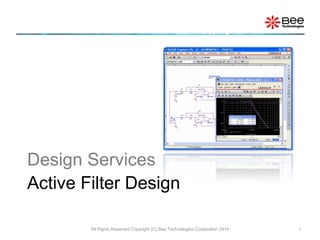
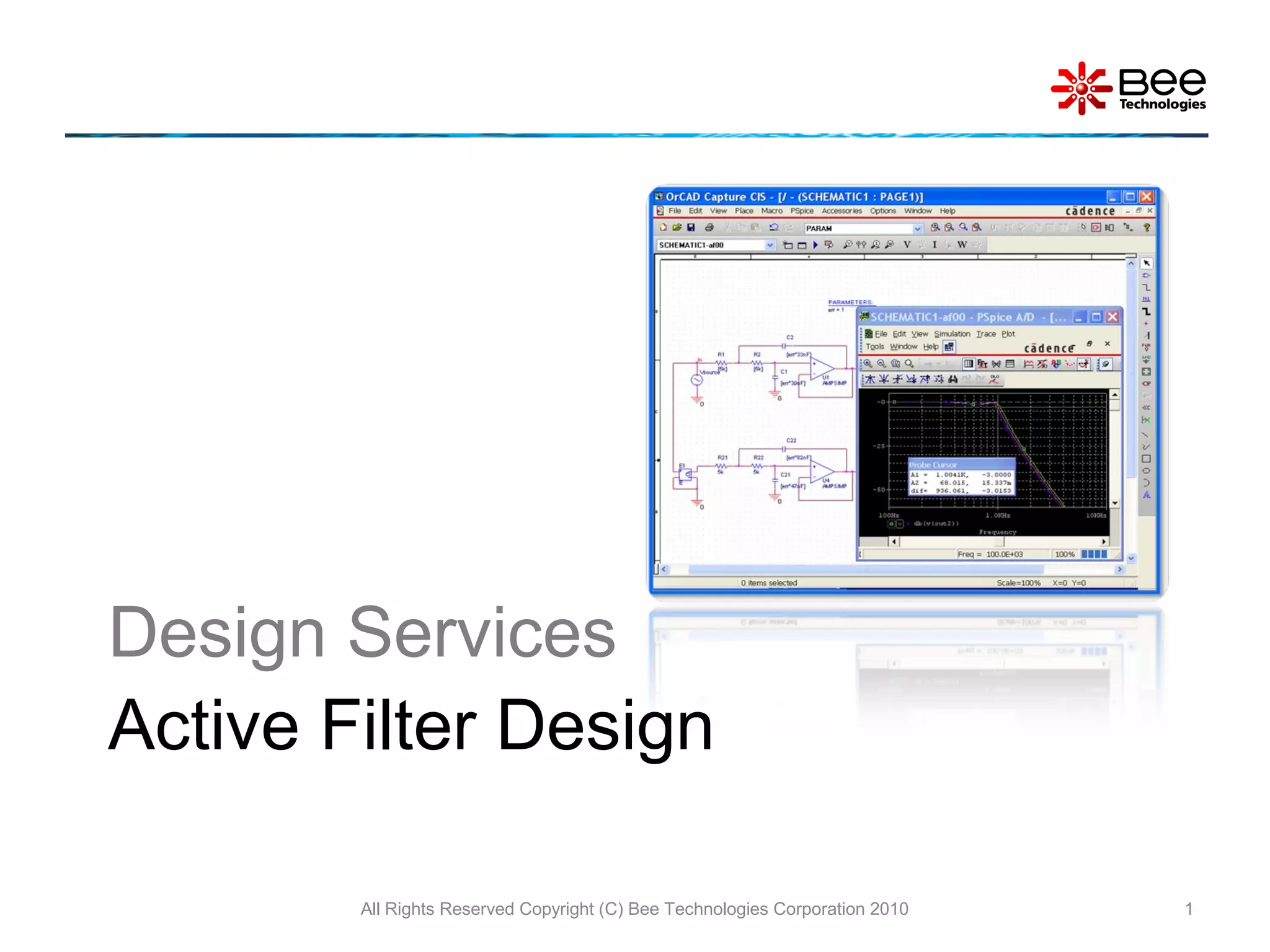
Active Filter Design
All Rights Reserved Copyright (C) Bee Technologies Corporation 2010 1
Design Services
Contents
Slide
#
1. Filter Design
Category..............................................................................
2. Active Filter Design Flow-Chart.............................................................
3. Passive Low Pass Filter
Design...............................................................
3.1
Specifications : ..................................................................................
3.2
Calculation : ......................................................................................
.
3.3
Verification : ......................................................................................
.
3.4
Optimization : ....................................................................................
3.5 Elements
test : ...................................................................................
3
4
5
5
6
7
8-9
10-11
12
2All Rights Reserved Copyright (C) Bee Technologies Corporation 2009
1.Filter Design Category
Available Filter Types
• Low Pass Filter
• High Pass Filter
• Band Pass Filter
• Band Reject Filter
Approximation
• Butterworth
- No ripple
- Smooth roll-off (rate of 20dB/decade for every pole)
• Chebyshev
- Pass-band ripple specification would be required.
- Steeper roll-of
Topology
• Passive
- High frequency range (> 1 MHz)
- Source and load impedance specifications would be required
• Active
- Low frequency range (1 Hz to 1 MHz)
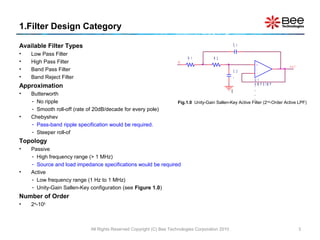
- Unity-Gain Sallen-Key configuration (see Figure 1.0)
Number of Order
• 2nd
-10th
All Rights Reserved Copyright (C) Bee Technologies Corporation 2010 3
R 1 R 2
C 2
0
C 1
in
+
-
U 1
A M P S I M P
o u t
Fig.1.0 Unity-Gain Sallen-Key Active Filter (2nd
-Order Active LPF)
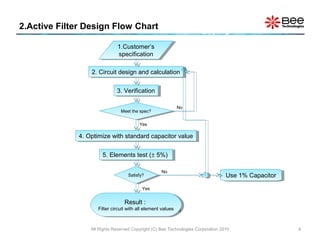
2.Active Filter Design Flow Chart
All Rights Reserved Copyright (C) Bee Technologies Corporation 2010 4
2. Circuit design and calculation2. Circuit design and calculation
3. Verification3. Verification
4. Optimize with standard capacitor value4. Optimize with standard capacitor value
5. Elements test (± 5%)5. Elements test (± 5%)
Meet the spec?Meet the spec?
No
Yes
Satisfy?Satisfy?
Yes
YESYES
Result :
Filter circuit with all element values
Result :
Filter circuit with all element values
Use 1% CapacitorUse 1% Capacitor
1.Customer’s
specification
1.Customer’s
specification
No
Fr equenc y
100Hz 1. 0KHz 10KHz
db( v ( out ) )
- 40
- 30
- 20
- 10
0
3.Active Low Pass Filter Design (1/5)
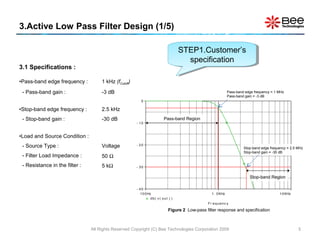
3.1 Specifications :
All Rights Reserved Copyright (C) Bee Technologies Corporation 2009 5
Figure 2 Low-pass filter response and specification
Pass-band Region
Stop-band Region
Pass-band edge frequency = 1 MHz
Pass-band gain = -3 dB
Stop-band edge frequency = 2.5 MHz
Stop-band gain = -30 dB
•Pass-band edge frequency : 1 kHz (fCutoff)
- Pass-band gain : -3 dB
•Stop-band edge frequency : 2.5 kHz
- Stop-band gain : -30 dB
•Load and Source Condition :
- Source Type : Voltage
- Filter Load Impedance : 50 Ω
- Resistance in the filter : 5 kΩ
STEP1.Customer’s
specification
STEP1.Customer’s
specification
R 1
5 k
R 2
5 k
R 5
5 0
0
C 1
2 9 . 4 2 n F
0
C 2
3 4 . 4 4 n F
R 3
5 k
R 4
5 k
C 3
1 2 . 1 8 n F
0
C 4
8 3 . 1 7 n F
+
-
U 2
A M P S I M P
o u tV s o u r c e
0
in
+
-
U 1
A M P S I M P
3. Active Low Pass Filter Design (2/5)
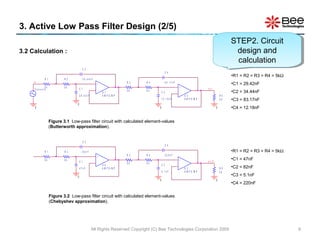
3.2 Calculation :
All Rights Reserved Copyright (C) Bee Technologies Corporation 2009 6
Figure 3.1 Low-pass filter circuit with calculated element-values
(Butterworth approximation).
Figure 3.2 Low-pass filter circuit with calculated element-values
(Chebyshev approximation).
•R1 = R2 = R3 = R4 = 5kΩ
•C1 = 29.42nF
•C2 = 34.44nF
•C3 = 83.17nF
•C4 = 12.18nF
STEP2. Circuit
design and
calculation
STEP2. Circuit
design and
calculation
•R1 = R2 = R3 = R4 = 5kΩ
•C1 = 47nF
•C2 = 82nF
•C3 = 5.1nF
•C4 = 220nF
R 1
5 k
R 2
5 k
R 5
5 0
0
C 1
4 7 n F
0
C 2
8 2 n F
R 3
5 k
R 4
5 k
0
C 3
5 . 1 n F
C 4
2 2 0 n F
+
-
U 3
A M P S I M P
o u t 2
+
-
U 4
A M P S I M P
Fr equenc y
100Hz 1. 0KHz 10KHz
db( v ( out ) ) db ( v ( out 2) )
- 60
- 40
- 20
- 0
3. Active Low Pass Filter Design (3/5)
All Rights Reserved Copyright (C) Bee Technologies Corporation 2009 7
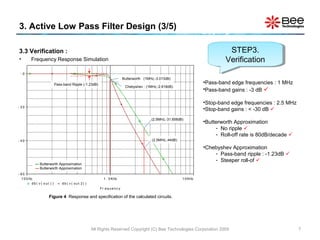
Figure 4 Response and specification of the calculated circuits.
Butterworth (1MHz,-3.013dB)
Chebyshev : (1MHz,-2.818dB)
(2.5MHz,-44dB)
(2.5MHz,-31.858dB)
3.3 Verification :
• Frequency Response Simulation
Pass-band Ripple (-1.23dB) •Pass-band edge frequencies : 1 MHz
•Pass-band gains : -3 dB 
•Stop-band edge frequencies : 2.5 MHz
•Stop-band gains : < -30 dB 
•Butterworth Approximation
- No ripple 
- Roll-off rate is 80dB/decade 
•Chebyshev Approximation
- Pass-band ripple : -1.23dB 
- Steeper roll-of 
— Butterworth Approximation
STEP3.
Verification
STEP3.
Verification
3.4 Optimization :
- Use standard capacitor values (E-24 Capacitor Values)
- Optimize inductor values
R 1
5 k
R 2
5 k
R 5
5 0
0
C 1
3 0 n F
0
C 2
3 3 n F
R 3
5 k
R 4
5 k
C 3
1 2 n F
0
C 4
8 2 n F
+
-
U 2
A M P S I M P
o u tV s o u r c e
0
in
+
-
U 1
A M P S I M P
3.Passive Low Pass Filter Design (4/5)
All Rights Reserved Copyright (C) Bee Technologies Corporation 2009 8
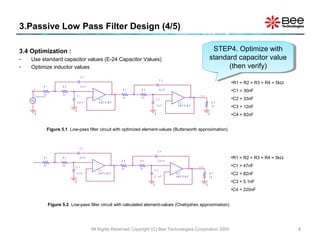
Figure 5.1 Low-pass filter circuit with optimized element-values (Butterworth approximation).
Figure 5.2 Low-pass filter circuit with calculated element-values (Chebyshev approximation).
STEP4. Optimize with
standard capacitor value
(then verify)
STEP4. Optimize with
standard capacitor value
(then verify)
•R1 = R2 = R3 = R4 = 5kΩ
•C1 = 47nF
•C2 = 82nF
•C3 = 5.1nF
•C4 = 220nF
R 1
5 k
R 2
5 k
R 5
5 0
0
C 1
4 7 n F
0
C 2
8 2 n F
R 3
5 k
R 4
5 k
0
C 3
5 . 1 n F
C 4
2 2 0 n F
+
-
U 3
A M P S I M P
o u t 2
+
-
U 4
A M P S I M P
•R1 = R2 = R3 = R4 = 5kΩ
•C1 = 30nF
•C2 = 33nF
•C3 = 12nF
•C4 = 82nF
Fr equenc y
100Hz 1. 0KHz 10KHz
db( v ( out ) ) db ( v ( out 2) )
- 60
- 40
- 20
- 0
3.Passive Low Pass Filter Design (4/5)
All Rights Reserved Copyright (C) Bee Technologies Corporation 2009 9
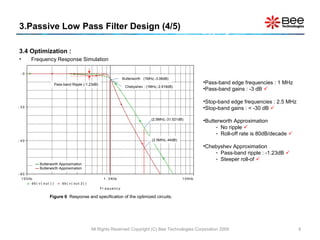
Figure 6 Response and specification of the optimized circuits.
3.4 Optimization :
• Frequency Response Simulation
•Pass-band edge frequencies : 1 MHz
•Pass-band gains : -3 dB 
•Stop-band edge frequencies : 2.5 MHz
•Stop-band gains : < -30 dB 
•Butterworth Approximation
- No ripple 
- Roll-off rate is 80dB/decade 
•Chebyshev Approximation
- Pass-band ripple : -1.23dB 
- Steeper roll-of 
Butterworth (1MHz,-3.06dB)
Chebyshev : (1MHz,-2.818dB)
(2.5MHz,-44dB)
(2.5MHz,-31.521dB)
Pass-band Ripple (-1.23dB)
— Butterworth Approximation
3.5 Elements test :
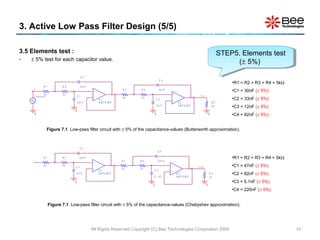
- ± 5% test for each capacitor value.
R 1
5 k
R 2
5 k
R 5
5 0
0
C 1
4 7 n F
0
C 2
8 2 n F
R 3
5 k
R 4
5 k
0
C 3
5 . 1 n F
C 4
2 2 0 n F
+
-
U 3
A M P S I M P
o u t 2
+
-
U 4
A M P S I M P
R 1
5 k
R 2
5 k
R 5
5 0
0
C 1
3 0 n F
0
C 2
3 3 n F
R 3
5 k
R 4
5 k
C 3
1 2 n F
0
C 4
8 2 n F
+
-
U 2
A M P S I M P
o u tV s o u r c e
0
in
+
-
U 1
A M P S I M P
3. Active Low Pass Filter Design (5/5)
All Rights Reserved Copyright (C) Bee Technologies Corporation 2009 10
Figure 7.1 Low-pass filter circuit with ± 5% of the capacitance-values (Butterworth approximation).
Figure 7.1 Low-pass filter circuit with ± 5% of the capacitance-values (Chebyshev approximation).
STEP5. Elements test
(± 5%)
STEP5. Elements test
(± 5%)
•R1 = R2 = R3 = R4 = 5kΩ
•C1 = 47nF (± 5%)
•C2 = 82nF (± 5%)
•C3 = 5.1nF (± 5%)
•C4 = 220nF (± 5%)
•R1 = R2 = R3 = R4 = 5kΩ
•C1 = 30nF (± 5%)
•C2 = 33nF (± 5%)
•C3 = 12nF (± 5%)
•C4 = 82nF (± 5%)
Fr eque nc y
1 00Hz 1. 0KHz 1 0KHz
db( v ( o ut 2 ) )
- 6 0
- 4 0
- 2 0
- 0
Fr eq ue nc y
1 00 Hz 1. 0KHz 10 KHz
db ( v ( ou t ) )
- 60
- 40
- 20
- 0
3.Passive Low Pass Filter Design (5/5)
All Rights Reserved Copyright (C) Bee Technologies Corporation 2009 11
Figure 8 Response and specification when the element values are error with ±5%.
3.5 Elements test :
• Frequency Response Simulation, compare to -5% and +5% of all element values.
Butterworth
— +5%
— standard values
— -5%
Pass-band gain (-3 dB)
Cutoff frequency : 0.9486M, 1M, 1.0485M
Chebyshev
— +5%
— standard values
— -5%
Cutoff frequency : 0.9564M, 1M, 1.0567M
Pass-band gain (-3 dB)
R 1
5 k
R 2
5 k
R 5
5 0
0
C 1
4 7 n F
0
C 2
8 2 n F
R 3
5 k
R 4
5 k
0
C 3
5 . 1 n F
C 4
2 2 0 n F
+
-
U 3
A M P S I M P
o u t 2
+
-
U 4
A M P S I M P
R 1
5 k
R 2
5 k
R 5
5 0
0
C 1
3 0 n F
0
C 2
3 3 n F
R 3
5 k
R 4
5 k
C 3
1 2 n F
0
C 4
8 2 n F
+
-
U 2
A M P S I M P
o u tV s o u r c e
0
in
+
-
U 1
A M P S I M P
•R1 = R2 = R3 = R4 = 5kΩ
•C1 = 47nF (± 5%)
•C2 = 82nF (± 5%)
•C3 = 5.1nF (± 5%)
•C4 = 220nF (± 5%)
•R1 = R2 = R3 = R4 = 5kΩ
•C1 = 30nF (± 5%)
•C2 = 33nF (± 5%)
•C3 = 12nF (± 5%)
•C4 = 82nF (± 5%)
3.Passive Low Pass Filter Design
3.6 Result :
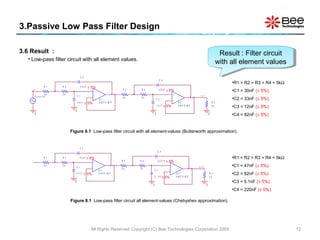
• Low-pass filter circuit with all element values.
All Rights Reserved Copyright (C) Bee Technologies Corporation 2009 12
Figure 8.1 Low-pass filter circuit with all element-values (Butterworth approximation).
Figure 8.1 Low-pass filter circuit all element-values (Chebyshev approximation).
± 5%
± 5%
± 5%
± 5%
± 5%
± 5%
± 5%
Result : Filter circuit
with all element values
Result : Filter circuit
with all element values
± 5%

Active Filter Design Using PSpice

  • 1.
    Active Filter Design AllRights Reserved Copyright (C) Bee Technologies Corporation 2010 1 Design Services
  • 2.
    Contents Slide # 1. Filter Design Category.............................................................................. 2.Active Filter Design Flow-Chart............................................................. 3. Passive Low Pass Filter Design............................................................... 3.1 Specifications : .................................................................................. 3.2 Calculation : ...................................................................................... . 3.3 Verification : ...................................................................................... . 3.4 Optimization : .................................................................................... 3.5 Elements test : ................................................................................... 3 4 5 5 6 7 8-9 10-11 12 2All Rights Reserved Copyright (C) Bee Technologies Corporation 2009
  • 3.
    1.Filter Design Category AvailableFilter Types • Low Pass Filter • High Pass Filter • Band Pass Filter • Band Reject Filter Approximation • Butterworth - No ripple - Smooth roll-off (rate of 20dB/decade for every pole) • Chebyshev - Pass-band ripple specification would be required. - Steeper roll-of Topology • Passive - High frequency range (> 1 MHz) - Source and load impedance specifications would be required • Active - Low frequency range (1 Hz to 1 MHz) - Unity-Gain Sallen-Key configuration (see Figure 1.0) Number of Order • 2nd -10th All Rights Reserved Copyright (C) Bee Technologies Corporation 2010 3 R 1 R 2 C 2 0 C 1 in + - U 1 A M P S I M P o u t Fig.1.0 Unity-Gain Sallen-Key Active Filter (2nd -Order Active LPF)
  • 4.
    2.Active Filter DesignFlow Chart All Rights Reserved Copyright (C) Bee Technologies Corporation 2010 4 2. Circuit design and calculation2. Circuit design and calculation 3. Verification3. Verification 4. Optimize with standard capacitor value4. Optimize with standard capacitor value 5. Elements test (± 5%)5. Elements test (± 5%) Meet the spec?Meet the spec? No Yes Satisfy?Satisfy? Yes YESYES Result : Filter circuit with all element values Result : Filter circuit with all element values Use 1% CapacitorUse 1% Capacitor 1.Customer’s specification 1.Customer’s specification No
  • 5.
    Fr equenc y 100Hz1. 0KHz 10KHz db( v ( out ) ) - 40 - 30 - 20 - 10 0 3.Active Low Pass Filter Design (1/5) 3.1 Specifications : All Rights Reserved Copyright (C) Bee Technologies Corporation 2009 5 Figure 2 Low-pass filter response and specification Pass-band Region Stop-band Region Pass-band edge frequency = 1 MHz Pass-band gain = -3 dB Stop-band edge frequency = 2.5 MHz Stop-band gain = -30 dB •Pass-band edge frequency : 1 kHz (fCutoff) - Pass-band gain : -3 dB •Stop-band edge frequency : 2.5 kHz - Stop-band gain : -30 dB •Load and Source Condition : - Source Type : Voltage - Filter Load Impedance : 50 Ω - Resistance in the filter : 5 kΩ STEP1.Customer’s specification STEP1.Customer’s specification
  • 6.
    R 1 5 k R2 5 k R 5 5 0 0 C 1 2 9 . 4 2 n F 0 C 2 3 4 . 4 4 n F R 3 5 k R 4 5 k C 3 1 2 . 1 8 n F 0 C 4 8 3 . 1 7 n F + - U 2 A M P S I M P o u tV s o u r c e 0 in + - U 1 A M P S I M P 3. Active Low Pass Filter Design (2/5) 3.2 Calculation : All Rights Reserved Copyright (C) Bee Technologies Corporation 2009 6 Figure 3.1 Low-pass filter circuit with calculated element-values (Butterworth approximation). Figure 3.2 Low-pass filter circuit with calculated element-values (Chebyshev approximation). •R1 = R2 = R3 = R4 = 5kΩ •C1 = 29.42nF •C2 = 34.44nF •C3 = 83.17nF •C4 = 12.18nF STEP2. Circuit design and calculation STEP2. Circuit design and calculation •R1 = R2 = R3 = R4 = 5kΩ •C1 = 47nF •C2 = 82nF •C3 = 5.1nF •C4 = 220nF R 1 5 k R 2 5 k R 5 5 0 0 C 1 4 7 n F 0 C 2 8 2 n F R 3 5 k R 4 5 k 0 C 3 5 . 1 n F C 4 2 2 0 n F + - U 3 A M P S I M P o u t 2 + - U 4 A M P S I M P
  • 7.
    Fr equenc y 100Hz1. 0KHz 10KHz db( v ( out ) ) db ( v ( out 2) ) - 60 - 40 - 20 - 0 3. Active Low Pass Filter Design (3/5) All Rights Reserved Copyright (C) Bee Technologies Corporation 2009 7 Figure 4 Response and specification of the calculated circuits. Butterworth (1MHz,-3.013dB) Chebyshev : (1MHz,-2.818dB) (2.5MHz,-44dB) (2.5MHz,-31.858dB) 3.3 Verification : • Frequency Response Simulation Pass-band Ripple (-1.23dB) •Pass-band edge frequencies : 1 MHz •Pass-band gains : -3 dB  •Stop-band edge frequencies : 2.5 MHz •Stop-band gains : < -30 dB  •Butterworth Approximation - No ripple  - Roll-off rate is 80dB/decade  •Chebyshev Approximation - Pass-band ripple : -1.23dB  - Steeper roll-of  — Butterworth Approximation — Butterworth Approximation STEP3. Verification STEP3. Verification
  • 8.
    3.4 Optimization : -Use standard capacitor values (E-24 Capacitor Values) - Optimize inductor values R 1 5 k R 2 5 k R 5 5 0 0 C 1 3 0 n F 0 C 2 3 3 n F R 3 5 k R 4 5 k C 3 1 2 n F 0 C 4 8 2 n F + - U 2 A M P S I M P o u tV s o u r c e 0 in + - U 1 A M P S I M P 3.Passive Low Pass Filter Design (4/5) All Rights Reserved Copyright (C) Bee Technologies Corporation 2009 8 Figure 5.1 Low-pass filter circuit with optimized element-values (Butterworth approximation). Figure 5.2 Low-pass filter circuit with calculated element-values (Chebyshev approximation). STEP4. Optimize with standard capacitor value (then verify) STEP4. Optimize with standard capacitor value (then verify) •R1 = R2 = R3 = R4 = 5kΩ •C1 = 47nF •C2 = 82nF •C3 = 5.1nF •C4 = 220nF R 1 5 k R 2 5 k R 5 5 0 0 C 1 4 7 n F 0 C 2 8 2 n F R 3 5 k R 4 5 k 0 C 3 5 . 1 n F C 4 2 2 0 n F + - U 3 A M P S I M P o u t 2 + - U 4 A M P S I M P •R1 = R2 = R3 = R4 = 5kΩ •C1 = 30nF •C2 = 33nF •C3 = 12nF •C4 = 82nF
  • 9.
    Fr equenc y 100Hz1. 0KHz 10KHz db( v ( out ) ) db ( v ( out 2) ) - 60 - 40 - 20 - 0 3.Passive Low Pass Filter Design (4/5) All Rights Reserved Copyright (C) Bee Technologies Corporation 2009 9 Figure 6 Response and specification of the optimized circuits. 3.4 Optimization : • Frequency Response Simulation •Pass-band edge frequencies : 1 MHz •Pass-band gains : -3 dB  •Stop-band edge frequencies : 2.5 MHz •Stop-band gains : < -30 dB  •Butterworth Approximation - No ripple  - Roll-off rate is 80dB/decade  •Chebyshev Approximation - Pass-band ripple : -1.23dB  - Steeper roll-of  Butterworth (1MHz,-3.06dB) Chebyshev : (1MHz,-2.818dB) (2.5MHz,-44dB) (2.5MHz,-31.521dB) Pass-band Ripple (-1.23dB) — Butterworth Approximation — Butterworth Approximation
  • 10.
    3.5 Elements test: - ± 5% test for each capacitor value. R 1 5 k R 2 5 k R 5 5 0 0 C 1 4 7 n F 0 C 2 8 2 n F R 3 5 k R 4 5 k 0 C 3 5 . 1 n F C 4 2 2 0 n F + - U 3 A M P S I M P o u t 2 + - U 4 A M P S I M P R 1 5 k R 2 5 k R 5 5 0 0 C 1 3 0 n F 0 C 2 3 3 n F R 3 5 k R 4 5 k C 3 1 2 n F 0 C 4 8 2 n F + - U 2 A M P S I M P o u tV s o u r c e 0 in + - U 1 A M P S I M P 3. Active Low Pass Filter Design (5/5) All Rights Reserved Copyright (C) Bee Technologies Corporation 2009 10 Figure 7.1 Low-pass filter circuit with ± 5% of the capacitance-values (Butterworth approximation). Figure 7.1 Low-pass filter circuit with ± 5% of the capacitance-values (Chebyshev approximation). STEP5. Elements test (± 5%) STEP5. Elements test (± 5%) •R1 = R2 = R3 = R4 = 5kΩ •C1 = 47nF (± 5%) •C2 = 82nF (± 5%) •C3 = 5.1nF (± 5%) •C4 = 220nF (± 5%) •R1 = R2 = R3 = R4 = 5kΩ •C1 = 30nF (± 5%) •C2 = 33nF (± 5%) •C3 = 12nF (± 5%) •C4 = 82nF (± 5%)
  • 11.
    Fr eque ncy 1 00Hz 1. 0KHz 1 0KHz db( v ( o ut 2 ) ) - 6 0 - 4 0 - 2 0 - 0 Fr eq ue nc y 1 00 Hz 1. 0KHz 10 KHz db ( v ( ou t ) ) - 60 - 40 - 20 - 0 3.Passive Low Pass Filter Design (5/5) All Rights Reserved Copyright (C) Bee Technologies Corporation 2009 11 Figure 8 Response and specification when the element values are error with ±5%. 3.5 Elements test : • Frequency Response Simulation, compare to -5% and +5% of all element values. Butterworth — +5% — standard values — -5% Pass-band gain (-3 dB) Cutoff frequency : 0.9486M, 1M, 1.0485M Chebyshev — +5% — standard values — -5% Cutoff frequency : 0.9564M, 1M, 1.0567M Pass-band gain (-3 dB)
  • 12.
    R 1 5 k R2 5 k R 5 5 0 0 C 1 4 7 n F 0 C 2 8 2 n F R 3 5 k R 4 5 k 0 C 3 5 . 1 n F C 4 2 2 0 n F + - U 3 A M P S I M P o u t 2 + - U 4 A M P S I M P R 1 5 k R 2 5 k R 5 5 0 0 C 1 3 0 n F 0 C 2 3 3 n F R 3 5 k R 4 5 k C 3 1 2 n F 0 C 4 8 2 n F + - U 2 A M P S I M P o u tV s o u r c e 0 in + - U 1 A M P S I M P •R1 = R2 = R3 = R4 = 5kΩ •C1 = 47nF (± 5%) •C2 = 82nF (± 5%) •C3 = 5.1nF (± 5%) •C4 = 220nF (± 5%) •R1 = R2 = R3 = R4 = 5kΩ •C1 = 30nF (± 5%) •C2 = 33nF (± 5%) •C3 = 12nF (± 5%) •C4 = 82nF (± 5%) 3.Passive Low Pass Filter Design 3.6 Result : • Low-pass filter circuit with all element values. All Rights Reserved Copyright (C) Bee Technologies Corporation 2009 12 Figure 8.1 Low-pass filter circuit with all element-values (Butterworth approximation). Figure 8.1 Low-pass filter circuit all element-values (Chebyshev approximation). ± 5% ± 5% ± 5% ± 5% ± 5% ± 5% ± 5% Result : Filter circuit with all element values Result : Filter circuit with all element values ± 5%