1
E225C – Lecture 16
OFDM Introduction
EE225CEE225C
Introduction to OFDM
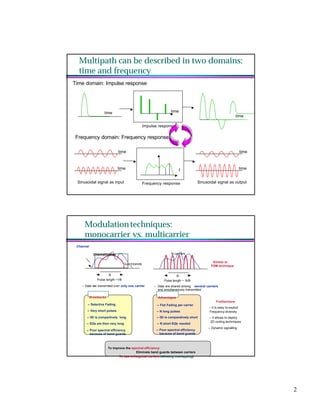
l Basic idea
» Using a large number of parallel narrow-band sub-
carriers instead of a single wide-band carrier to
transport information
l Advantages
» Very easy and efficient in dealing with multi-path
» Robust again narrow-band interference
l Disadvantages
» Sensitive to frequency offset and phase noise
» Peak-to-average problem reduces the power
efficiency of RF amplifier at the transmitter
l Adopted for various standards
– DSL, 802.11a, DAB, DVB
2
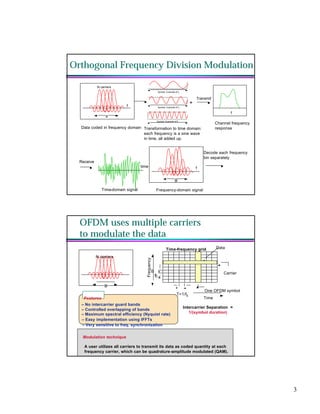
Multipath can be described in two domains:
time and frequency
time
time
Sinusoidal signal as input
time
time
Sinusoidal signal as output
f
Frequency response
Time domain: Impulse response
Frequency domain: Frequency response
time
Impulse response
time
time
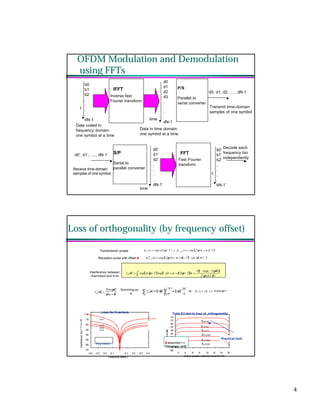
Modulationtechniques:
monocarrier vs. multicarrier
To improve the spectral efficiency:
To use orthogonal carriers (allowing overlapping)
Eliminate band guards between carriers
– Selective Fading
– Very short pulses
– ISI is compartively long
– EQs are then very long
– Poor spectral efficiency
because of band guards
Drawbacks
– It is easy to exploit
Frequency diversity
– Flat Fading per carrier
– N long pulses
– ISI is comparatively short
– N short EQs needed
– Poor spectral efficiency
because of band guards
Advantages
Furthermore
– It allows to deploy
2D coding techniques
– Dynamic signalling
N carriers
B
Pulse length ~ N/B
Similar to
FDM technique
– Data are shared among several carriers
and simultaneously transmitted
B
Pulse length ~1/B
– Data are transmited over only one carrier
Channel
Guard bands
Channelization
3
Orthogonal Frequency Division Modulation
Data coded in frequency domain
N carriers
B
Transformation to time domain:
each frequency is a sine wave
in time, all added up.
f
Transmit
Symbol: 8 periods of f0
Symbol: 4 periods of f0
Symbol: 2 periods of f0
+
Receive
time
B
Decode each frequency
bin separately
Channel frequency
response
f
f
Time-domain signal Frequency-domain signal
OFDM uses multiple carriers
to modulate the data
N carriers
B
Modulation technique
A user utilizes all carriers to transmit its data as coded quantity at each
frequency carrier, which can be quadrature-amplitude modulated (QAM).
Intercarrier Separation =
1/(symbol duration)
– No intercarrier guard bands
– Controlled overlapping of bands
– Maximum spectral efficiency (Nyquist rate)
– Very sensitive to freq. synchronization
– Easy implementation using IFFTs
Features
Data
Carrier
T=1/f0
Time
f0
B
Frequency
One OFDM symbol
Time-frequency grid
4
OFDM Modulation and Demodulation
using FFTs
b0
b1
b2
.
.
.
.
bN-1
Data coded in
frequency domain:
one symbol at a time
IFFT
Inverse fast
Fourier transform
Data in time domain:
one symbol at a time
d0
d1
d2
d3
.
.
.
.
dN-1
time
f
P/S
Parallel to
serial converter
Transmit time-domain
samples of one symbol
d0, d1, d2, …., dN-1
Receive time-domain
samples of one symbol
d0’, d1’, …., dN-1’ S/P
Serial to
parallel converter
d0’
d1’
d2’
.
.
.
.
dN-1’
time
FFT
Fast Fourier
transform
b0’
b1’
b2’
.
.
.
.
bN-1’
f
Decode each
frequency bin
independently
Loss of orthogonality (by frequency offset)
ψ k
(t) = exp( jk2πt / T ) y ψ k +m
(t) = exp j2π (k + m )t / T( )
ψ k+m
δ
(t) = exp j2π (k + m + δ) / T( ) con δ ≤ 1/ 2
Transmission pulses
Reception pulse with offset δ
2 4 6 8 10 12 14 16
-60
-55
-50
-45
-40
-35
-30
-25
-20
-15
-10
Total ICI due to loss of orthogonality
Carrier position within the band (N=16)
ICIindB
δ=0.05
δ=0.02
δ=0.01
δ=0.005
δ=0.002
δ=0.001
Practical limit
δ assumed r.v.
Gaussian σ=δ
0
-0.4 -0.3 -0.2 -0.1 0.1 0.2 0.3 0.4
Frequency offset: ∂
Interference:Im(?)/TendB
Loss for 8 carriers
m=1
m=3
m=5
m=7
-70
-60
-50
-40
-30
-20
-10
0
Im
(δ ) = exp jk2πt /T( )exp − j(k + m + δ )2πt / T( )dt
0
T
∫ =
T 1 − exp(− j2πδ )( )
j2π(m + δ)
Im(δ) =
T sinπδ
π m + δ
Im
2
(δ)
m
∑ ≈ Tδ( )2 1
m2
m=1
N −1
∑ ≈ Tδ( )2 23
14
for N >> 1 (N > 5 Is enough )
Interference between
channelsk and k+m
Summing up
∀ m
Asymetric
5
Loss of orthogonality (time)
Xi = c0 ψk (t)ψl
*
(t − τ )dt
−T /2
− T /2+ τ
∫ + c1 ψ k (t)ψl
*
(t − τ )dt
−T / 2+τ
T / 2
∫Let us assume
a misadjustmentτ
2 consecutive
symbols
0 0.01 0.02 0.03 0.04 0.05 0.06 0.07 0.08
10
15
20
25
30
35
40
45
Typical deviation for the relative misadjustment
ICIindB
N=8
N=64
ICI due to loss of orthogonaliy
τ assumed an Uniform r.v.
Max. practical limit
Doubling N means 3 dB more ICI
E
Xi
2
T
2





= 4
τ
T




2
1
2
+ 0
1
2
= 2
τ
T




2 ICI ≈ 20log 2
τ
T




, τ << T
Per carrier
In average, the interfering
power in any carrier is
Xi
T
≈
2mπ
τ
T
mπ
= 2
τ
T
Or approximately,
when τ<<T
independent
on m
0 0.1 0.2 0.3 0.4 0.5 0.6 0.7 0.8 0.9 1
-50
-45
-40
-35
-30
-25
-20
-15
-10
-5
0
Relative misadjustment τ
InterferenceendB
Loss for 16 carriers
m=1
m=5
m=10
Then Xi =
2T
senmπ
τ
T
mπ
, c0
≠ c1
0, c0
= c1





Zone of interest
if m=k-l
Including a “cyclic prefix”
CP
Passingthechannelh(n)
Ψi(t)
Ψj (t)
h(n)=(1)
– n
/n n=0,…,23
Ψj(t)
Ψi(t)
≠Ψi(t)
To combat the time dispersion: including ‘special’ time guards in the symbol transitions
CP
T
Tc
τ
copy
Furthemore it converts Linear conv. = Cyclic conv.
(Method: overlap-save)
CP functions:
– It acomodates the decaying transient of the previous symbol
– It avoids the initial transient reachs the current symbol
Including the Cyclic Prefix
Symbol: 8 periods of fi
Symbol: 4 periods of fi
Initial transient
remains within
the CP
Final transient
remains within
the CP
The inclusion of a CP
maintains the orthogonality
Passingthechannelh(n)
Initial transient Decaying transient
Channel:
Symbol: 8 periods of fi
Symbol: 4 periods of fi
Without the Cyclic Prefix
Loss of orthogonality
6
Cyclic Prefix
Tg T
τmax
Tx
Multi-path components
TSampling start
802.11a System Specification
l Sampling (chip) rate: 20MHz
l Chip duration: 50ns
l Number of FFT points: 64
l FFT symbol period: 3.2µs
l Cyclic prefix period: 16 chips or 0.8µs
» Typical maximum indoor delay spread < 400ns
» OFDM frame length: 80 chips or 4µs
» FFT symbol length / OFDM frame length = 4/5
l Modulation scheme
» QPSK: 2bits/sample
» 16QAM: 4bits/sample
» 64QAM: 6bits/sample
l Coding: rate ½ convolutional code with constraint length 7
GI2 T1 GI OFDM Symbol GI OFDM SymbolT2t1t2 t3 t4 t5 t6 t7 t8 t9t10
Short training sequence:
AGC and frequency offset
Long training sequence:
Channel estimation
7
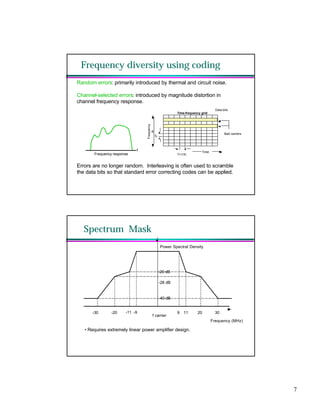
Frequency diversity using coding
Random errors: primarily introduced by thermal and circuit noise.
Channel-selected errors: introduced by magnitude distortion in
channel frequency response.
Data bits
Bad carriers
T=1/f0
Time
f0
B
Frequency
Time-frequency grid
Frequency response
Errors are no longer random. Interleaving is often used to scramble
the data bits so that standard error correcting codes can be applied.
f
Spectrum Mask
Frequency (MHz)
f carrier
Power Spectral Density
9 11 20 30-9-11-20-30
-20 dB
-28 dB
-40 dB
• Requires extremely linear power amplifier design.
8
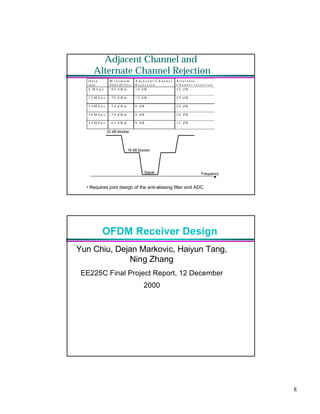
Adjacent Channel and
Alternate Channel Rejection
• Requires joint design of the anti-aliasing filter and ADC.
D a t e
r a t e
M i n i m u m
S e n s i b i l i t y
A d j a c e n t C h a n n e l
R e j e c t i o n
A l t e r n a t e
C h a n n e l r e j e c t i o n
6 M b p s - 8 2 d B m 1 6 d B 3 2 d B
1 2 M b p s - 7 9 d B m 1 3 d B 2 9 d B
2 4 M b p s - 7 4 d B m 8 d B 2 4 d B
3 6 M b p s - 7 0 d B m 4 d B 2 0 d B
5 4 M b p s - 6 5 d B m 0 d B 1 5 d B
16 dB blocker
32 dB blocker
Signal Frequency
OFDM Receiver Design
Yun Chiu, Dejan Markovic, Haiyun Tang,
Ning Zhang
EE225C Final Project Report, 12 December
2000
9
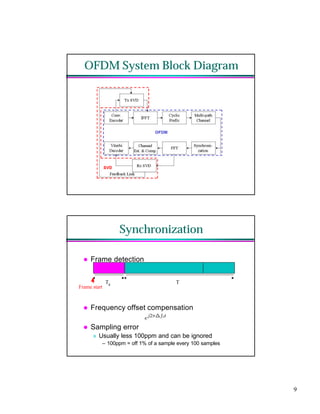
OFDM System Block Diagram
Synchronization
l Frame detection
l Frequency offset compensation
l Sampling error
» Usually less 100ppm and can be ignored
– 100ppm = off 1% of a sample every 100 samples
Tg T
Frame start
10
System Pilot Structure
IEEE 802.11a OFDM Txer
Short Preamble Gen.
Long Preamble Gen.
OFDM Data Path
Signal Data Data21 4 73 5 986 T1GI2 GIGI GI10
Signal Detection, AGC,
Diversity Selection
10 x 0.8 = 8 uS
T2
2 x 0.8 + 2 x 3.2 = 8 uS
Channel & Fine Freq.
Offset Estimation
Coarse Freq. Offset
Est.,TimingSync.
0.8 + 3.2 = 8 uS 0.8 + 3.2 = 8 uS 0.8 + 3.2 = 8 uS
Rate, Length Data Data
11
Short & Long Preambles
f
-24
1+j
-20
-16
-12
-1-j
f
-1
-16
-26
+1
-24
-12
Short Preamble
Long Preamble
Period = 16 Chips
Period = 64 Chips
Correlation of Short Preamble
Correlation
Coarse Timing
Fine Timing
Auto-
Correlation
12
Synchronization
16Td
* Σ
Td
Td
Td
...
* * *
...
Td
Td
Td
Td
...
Td
From AGC
* Σ
Td
Td
Td
...
* * *
...
Short Preamble (LUT)
...
Td
From AGC
Moving Auto-
Corr. Unit
Moving SP
Corr. Unit
Impairments: Multi-Path Channel
t
T
0 2T
t
0
t
0
T
2T
3T
4T
Tc
T
c
Ch. Impulse
Response
t
0
t
0
T
2T
3T
4T
T
c
t
5T
T
2T
3T
4T
t
0
T
2T
3T
4T
5T
t
t
0
T
2T
3T
4T
5T
Auto-Correlation w/
Multi-Path Channel
Response.
13
Impairments: Frequency Offset
t
0
T
2T
3T
4 T
t
0
T
2T
3T
4 T
t
t
0
T
2T
3T
4 T
Fine Frequency Offset Est.
Complex
Multiplier
Sync. Signal
Accumulator
14
Coarse-Fine Joint Estimation &
Decision Alignment Error Correction
0
π
0
π
0
π
0
π
1
23
76
4
85
π
−π
0
π A
D
B
C
Vin
Folding Signal
π
0
0 π 0 πFolding ADC
Coarse Fine ±100ppm ∆fc
@ 5.8GHz
Average over
16 chips
Average over
64 chips
Frequency Offset Compensation
Joint Coarse-
Fine Est.
Offset Corr.
Decision
Alignment
Channel
15
Performance Summary
± 5π = ± 100ppm @ 5.8 GHzFreq. Offset Est. Range
1% (@ 15dB SNR)Freq. Offset Est. Accuracy
12.7 nsCritical path delay
397,080 µm2Silicon area
3.4 mW @ 20 MHzTotal power consumption
≤ 8 chips (CP = 16
chips)
Sync. Frame Start Accuracy
20 MHzSampling clock freq.
BPSK up to 64-QAMModulation Scheme
4 µsOFDM symbol freq.
48 data +4 pilotNumber of sub-carriers
MetricsParameters

ofdm

  • 1.
    1 E225C – Lecture16 OFDM Introduction EE225CEE225C Introduction to OFDM l Basic idea » Using a large number of parallel narrow-band sub- carriers instead of a single wide-band carrier to transport information l Advantages » Very easy and efficient in dealing with multi-path » Robust again narrow-band interference l Disadvantages » Sensitive to frequency offset and phase noise » Peak-to-average problem reduces the power efficiency of RF amplifier at the transmitter l Adopted for various standards – DSL, 802.11a, DAB, DVB
  • 2.
    2 Multipath can bedescribed in two domains: time and frequency time time Sinusoidal signal as input time time Sinusoidal signal as output f Frequency response Time domain: Impulse response Frequency domain: Frequency response time Impulse response time time Modulationtechniques: monocarrier vs. multicarrier To improve the spectral efficiency: To use orthogonal carriers (allowing overlapping) Eliminate band guards between carriers – Selective Fading – Very short pulses – ISI is compartively long – EQs are then very long – Poor spectral efficiency because of band guards Drawbacks – It is easy to exploit Frequency diversity – Flat Fading per carrier – N long pulses – ISI is comparatively short – N short EQs needed – Poor spectral efficiency because of band guards Advantages Furthermore – It allows to deploy 2D coding techniques – Dynamic signalling N carriers B Pulse length ~ N/B Similar to FDM technique – Data are shared among several carriers and simultaneously transmitted B Pulse length ~1/B – Data are transmited over only one carrier Channel Guard bands Channelization
  • 3.
    3 Orthogonal Frequency DivisionModulation Data coded in frequency domain N carriers B Transformation to time domain: each frequency is a sine wave in time, all added up. f Transmit Symbol: 8 periods of f0 Symbol: 4 periods of f0 Symbol: 2 periods of f0 + Receive time B Decode each frequency bin separately Channel frequency response f f Time-domain signal Frequency-domain signal OFDM uses multiple carriers to modulate the data N carriers B Modulation technique A user utilizes all carriers to transmit its data as coded quantity at each frequency carrier, which can be quadrature-amplitude modulated (QAM). Intercarrier Separation = 1/(symbol duration) – No intercarrier guard bands – Controlled overlapping of bands – Maximum spectral efficiency (Nyquist rate) – Very sensitive to freq. synchronization – Easy implementation using IFFTs Features Data Carrier T=1/f0 Time f0 B Frequency One OFDM symbol Time-frequency grid
  • 4.
    4 OFDM Modulation andDemodulation using FFTs b0 b1 b2 . . . . bN-1 Data coded in frequency domain: one symbol at a time IFFT Inverse fast Fourier transform Data in time domain: one symbol at a time d0 d1 d2 d3 . . . . dN-1 time f P/S Parallel to serial converter Transmit time-domain samples of one symbol d0, d1, d2, …., dN-1 Receive time-domain samples of one symbol d0’, d1’, …., dN-1’ S/P Serial to parallel converter d0’ d1’ d2’ . . . . dN-1’ time FFT Fast Fourier transform b0’ b1’ b2’ . . . . bN-1’ f Decode each frequency bin independently Loss of orthogonality (by frequency offset) ψ k (t) = exp( jk2πt / T ) y ψ k +m (t) = exp j2π (k + m )t / T( ) ψ k+m δ (t) = exp j2π (k + m + δ) / T( ) con δ ≤ 1/ 2 Transmission pulses Reception pulse with offset δ 2 4 6 8 10 12 14 16 -60 -55 -50 -45 -40 -35 -30 -25 -20 -15 -10 Total ICI due to loss of orthogonality Carrier position within the band (N=16) ICIindB δ=0.05 δ=0.02 δ=0.01 δ=0.005 δ=0.002 δ=0.001 Practical limit δ assumed r.v. Gaussian σ=δ 0 -0.4 -0.3 -0.2 -0.1 0.1 0.2 0.3 0.4 Frequency offset: ∂ Interference:Im(?)/TendB Loss for 8 carriers m=1 m=3 m=5 m=7 -70 -60 -50 -40 -30 -20 -10 0 Im (δ ) = exp jk2πt /T( )exp − j(k + m + δ )2πt / T( )dt 0 T ∫ = T 1 − exp(− j2πδ )( ) j2π(m + δ) Im(δ) = T sinπδ π m + δ Im 2 (δ) m ∑ ≈ Tδ( )2 1 m2 m=1 N −1 ∑ ≈ Tδ( )2 23 14 for N >> 1 (N > 5 Is enough ) Interference between channelsk and k+m Summing up ∀ m Asymetric
  • 5.
    5 Loss of orthogonality(time) Xi = c0 ψk (t)ψl * (t − τ )dt −T /2 − T /2+ τ ∫ + c1 ψ k (t)ψl * (t − τ )dt −T / 2+τ T / 2 ∫Let us assume a misadjustmentτ 2 consecutive symbols 0 0.01 0.02 0.03 0.04 0.05 0.06 0.07 0.08 10 15 20 25 30 35 40 45 Typical deviation for the relative misadjustment ICIindB N=8 N=64 ICI due to loss of orthogonaliy τ assumed an Uniform r.v. Max. practical limit Doubling N means 3 dB more ICI E Xi 2 T 2      = 4 τ T     2 1 2 + 0 1 2 = 2 τ T     2 ICI ≈ 20log 2 τ T     , τ << T Per carrier In average, the interfering power in any carrier is Xi T ≈ 2mπ τ T mπ = 2 τ T Or approximately, when τ<<T independent on m 0 0.1 0.2 0.3 0.4 0.5 0.6 0.7 0.8 0.9 1 -50 -45 -40 -35 -30 -25 -20 -15 -10 -5 0 Relative misadjustment τ InterferenceendB Loss for 16 carriers m=1 m=5 m=10 Then Xi = 2T senmπ τ T mπ , c0 ≠ c1 0, c0 = c1      Zone of interest if m=k-l Including a “cyclic prefix” CP Passingthechannelh(n) Ψi(t) Ψj (t) h(n)=(1) – n /n n=0,…,23 Ψj(t) Ψi(t) ≠Ψi(t) To combat the time dispersion: including ‘special’ time guards in the symbol transitions CP T Tc τ copy Furthemore it converts Linear conv. = Cyclic conv. (Method: overlap-save) CP functions: – It acomodates the decaying transient of the previous symbol – It avoids the initial transient reachs the current symbol Including the Cyclic Prefix Symbol: 8 periods of fi Symbol: 4 periods of fi Initial transient remains within the CP Final transient remains within the CP The inclusion of a CP maintains the orthogonality Passingthechannelh(n) Initial transient Decaying transient Channel: Symbol: 8 periods of fi Symbol: 4 periods of fi Without the Cyclic Prefix Loss of orthogonality
  • 6.
    6 Cyclic Prefix Tg T τmax Tx Multi-pathcomponents TSampling start 802.11a System Specification l Sampling (chip) rate: 20MHz l Chip duration: 50ns l Number of FFT points: 64 l FFT symbol period: 3.2µs l Cyclic prefix period: 16 chips or 0.8µs » Typical maximum indoor delay spread < 400ns » OFDM frame length: 80 chips or 4µs » FFT symbol length / OFDM frame length = 4/5 l Modulation scheme » QPSK: 2bits/sample » 16QAM: 4bits/sample » 64QAM: 6bits/sample l Coding: rate ½ convolutional code with constraint length 7 GI2 T1 GI OFDM Symbol GI OFDM SymbolT2t1t2 t3 t4 t5 t6 t7 t8 t9t10 Short training sequence: AGC and frequency offset Long training sequence: Channel estimation
  • 7.
    7 Frequency diversity usingcoding Random errors: primarily introduced by thermal and circuit noise. Channel-selected errors: introduced by magnitude distortion in channel frequency response. Data bits Bad carriers T=1/f0 Time f0 B Frequency Time-frequency grid Frequency response Errors are no longer random. Interleaving is often used to scramble the data bits so that standard error correcting codes can be applied. f Spectrum Mask Frequency (MHz) f carrier Power Spectral Density 9 11 20 30-9-11-20-30 -20 dB -28 dB -40 dB • Requires extremely linear power amplifier design.
  • 8.
    8 Adjacent Channel and AlternateChannel Rejection • Requires joint design of the anti-aliasing filter and ADC. D a t e r a t e M i n i m u m S e n s i b i l i t y A d j a c e n t C h a n n e l R e j e c t i o n A l t e r n a t e C h a n n e l r e j e c t i o n 6 M b p s - 8 2 d B m 1 6 d B 3 2 d B 1 2 M b p s - 7 9 d B m 1 3 d B 2 9 d B 2 4 M b p s - 7 4 d B m 8 d B 2 4 d B 3 6 M b p s - 7 0 d B m 4 d B 2 0 d B 5 4 M b p s - 6 5 d B m 0 d B 1 5 d B 16 dB blocker 32 dB blocker Signal Frequency OFDM Receiver Design Yun Chiu, Dejan Markovic, Haiyun Tang, Ning Zhang EE225C Final Project Report, 12 December 2000
  • 9.
    9 OFDM System BlockDiagram Synchronization l Frame detection l Frequency offset compensation l Sampling error » Usually less 100ppm and can be ignored – 100ppm = off 1% of a sample every 100 samples Tg T Frame start
  • 10.
    10 System Pilot Structure IEEE802.11a OFDM Txer Short Preamble Gen. Long Preamble Gen. OFDM Data Path Signal Data Data21 4 73 5 986 T1GI2 GIGI GI10 Signal Detection, AGC, Diversity Selection 10 x 0.8 = 8 uS T2 2 x 0.8 + 2 x 3.2 = 8 uS Channel & Fine Freq. Offset Estimation Coarse Freq. Offset Est.,TimingSync. 0.8 + 3.2 = 8 uS 0.8 + 3.2 = 8 uS 0.8 + 3.2 = 8 uS Rate, Length Data Data
  • 11.
    11 Short & LongPreambles f -24 1+j -20 -16 -12 -1-j f -1 -16 -26 +1 -24 -12 Short Preamble Long Preamble Period = 16 Chips Period = 64 Chips Correlation of Short Preamble Correlation Coarse Timing Fine Timing Auto- Correlation
  • 12.
    12 Synchronization 16Td * Σ Td Td Td ... * ** ... Td Td Td Td ... Td From AGC * Σ Td Td Td ... * * * ... Short Preamble (LUT) ... Td From AGC Moving Auto- Corr. Unit Moving SP Corr. Unit Impairments: Multi-Path Channel t T 0 2T t 0 t 0 T 2T 3T 4T Tc T c Ch. Impulse Response t 0 t 0 T 2T 3T 4T T c t 5T T 2T 3T 4T t 0 T 2T 3T 4T 5T t t 0 T 2T 3T 4T 5T Auto-Correlation w/ Multi-Path Channel Response.
  • 13.
    13 Impairments: Frequency Offset t 0 T 2T 3T 4T t 0 T 2T 3T 4 T t t 0 T 2T 3T 4 T Fine Frequency Offset Est. Complex Multiplier Sync. Signal Accumulator
  • 14.
    14 Coarse-Fine Joint Estimation& Decision Alignment Error Correction 0 π 0 π 0 π 0 π 1 23 76 4 85 π −π 0 π A D B C Vin Folding Signal π 0 0 π 0 πFolding ADC Coarse Fine ±100ppm ∆fc @ 5.8GHz Average over 16 chips Average over 64 chips Frequency Offset Compensation Joint Coarse- Fine Est. Offset Corr. Decision Alignment Channel
  • 15.
    15 Performance Summary ± 5π= ± 100ppm @ 5.8 GHzFreq. Offset Est. Range 1% (@ 15dB SNR)Freq. Offset Est. Accuracy 12.7 nsCritical path delay 397,080 µm2Silicon area 3.4 mW @ 20 MHzTotal power consumption ≤ 8 chips (CP = 16 chips) Sync. Frame Start Accuracy 20 MHzSampling clock freq. BPSK up to 64-QAMModulation Scheme 4 µsOFDM symbol freq. 48 data +4 pilotNumber of sub-carriers MetricsParameters