MBA admission in India 
By: 
Admission.edhole.com
Binary numbers and arithmetic 
Admission.edhole.com
addition 
Admission.edhole.com
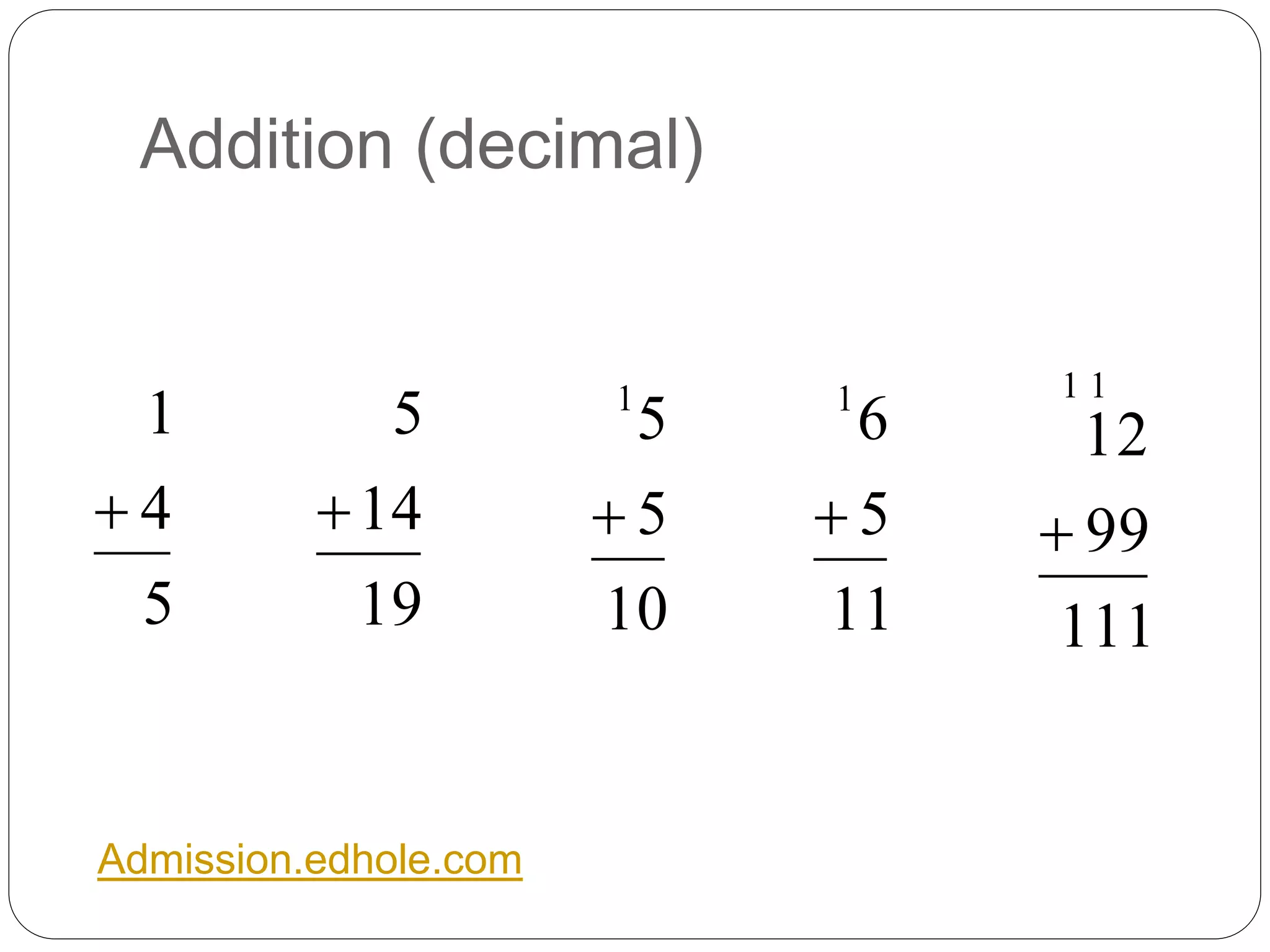
Addition (decimal) 
1 
 
4 
5 
5 
14 
19 
 
5 1 
 
5 
10 
6 1 
 
5 
11 
1 1 
12 
99 
 
111 
Admission.edhole.com
Addition (binary) 
0 
 
0 
0 
1 
 
0 
1 
0 
 
1 
1 
1 
1 
1 
10 
Admission.edhole.com
Addition (binary) 
1 1 1 1 
01101 
01011 
11000 
 
Admission.edhole.com
Addition (binary) 
0 
 
0 
1 
 
0 
So ca0n we count in 1 
binary? 
0 
 
1 
1 
1 
1 
1 
10 
Admission.edhole.com
Counting in binary (4 bits) 
0 
0000 
1 
0001 
2 
… 
3 
4 
5 
6 
7 
8 
9 
10 
11 
12 
13 
14 
15 
Admission.edhole.com
multiplication 
Admission.edhole.com
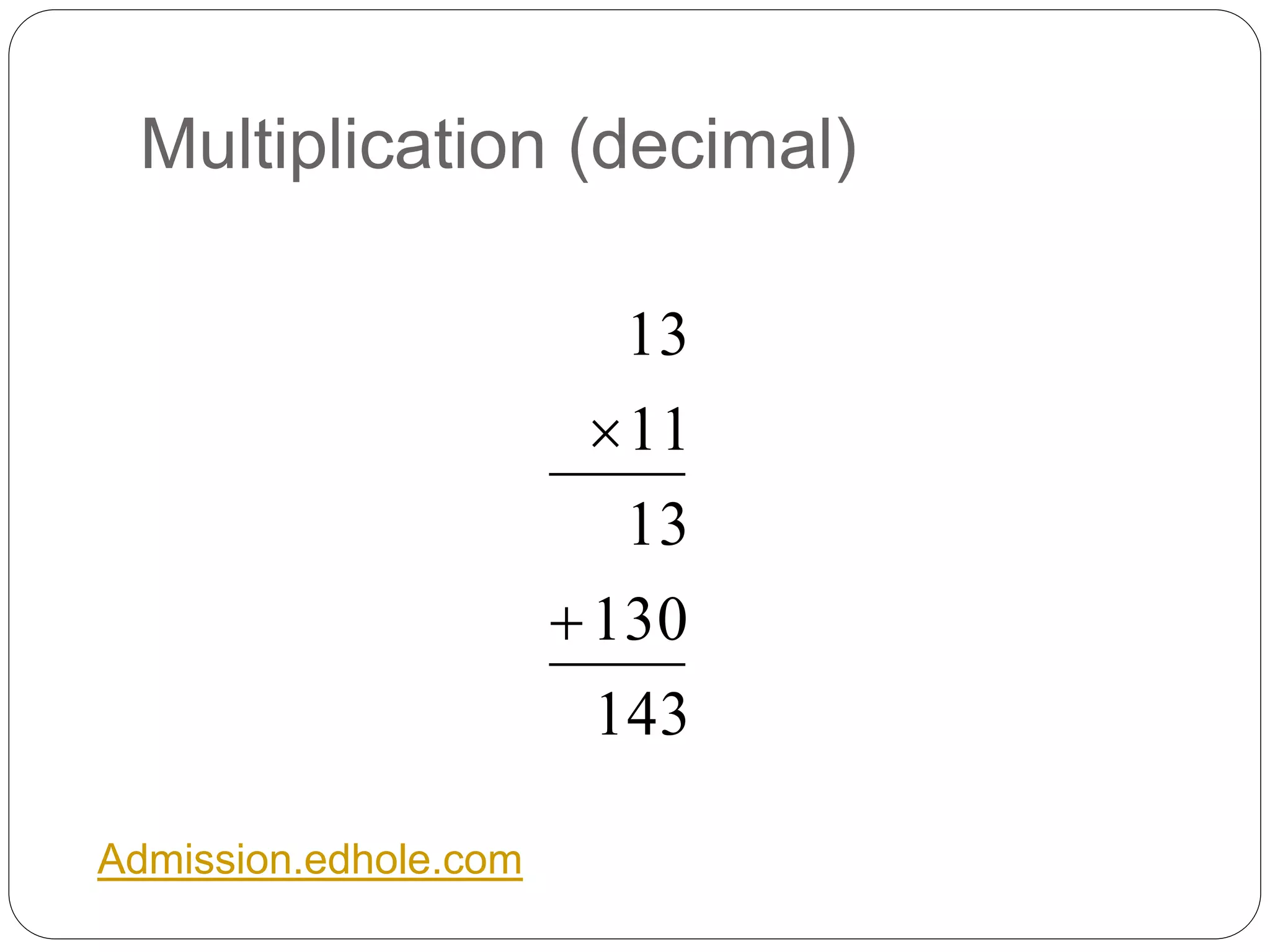
Multiplication (decimal) 
13 
11 
13 
130 
143 
 
 
Admission.edhole.com
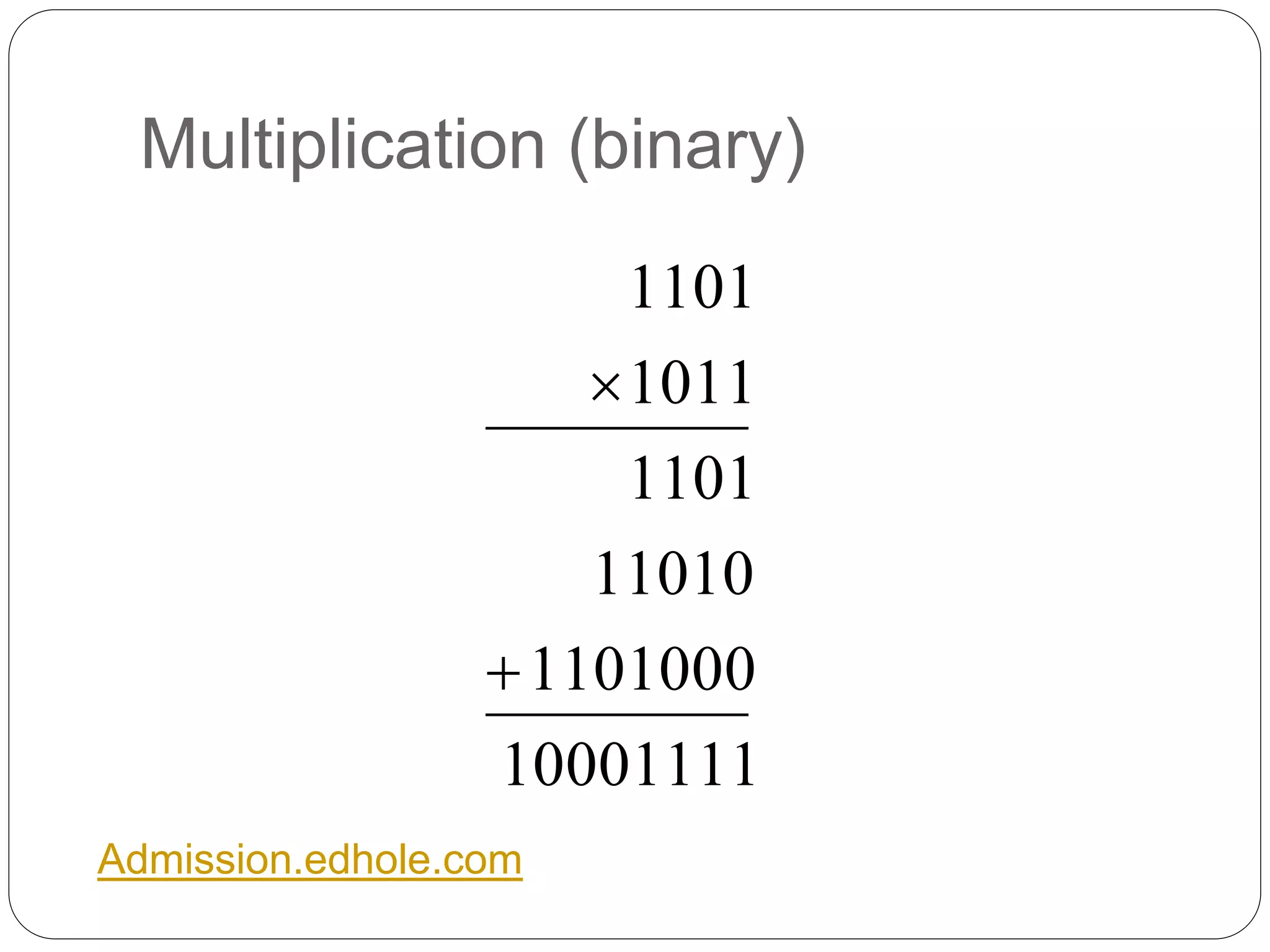
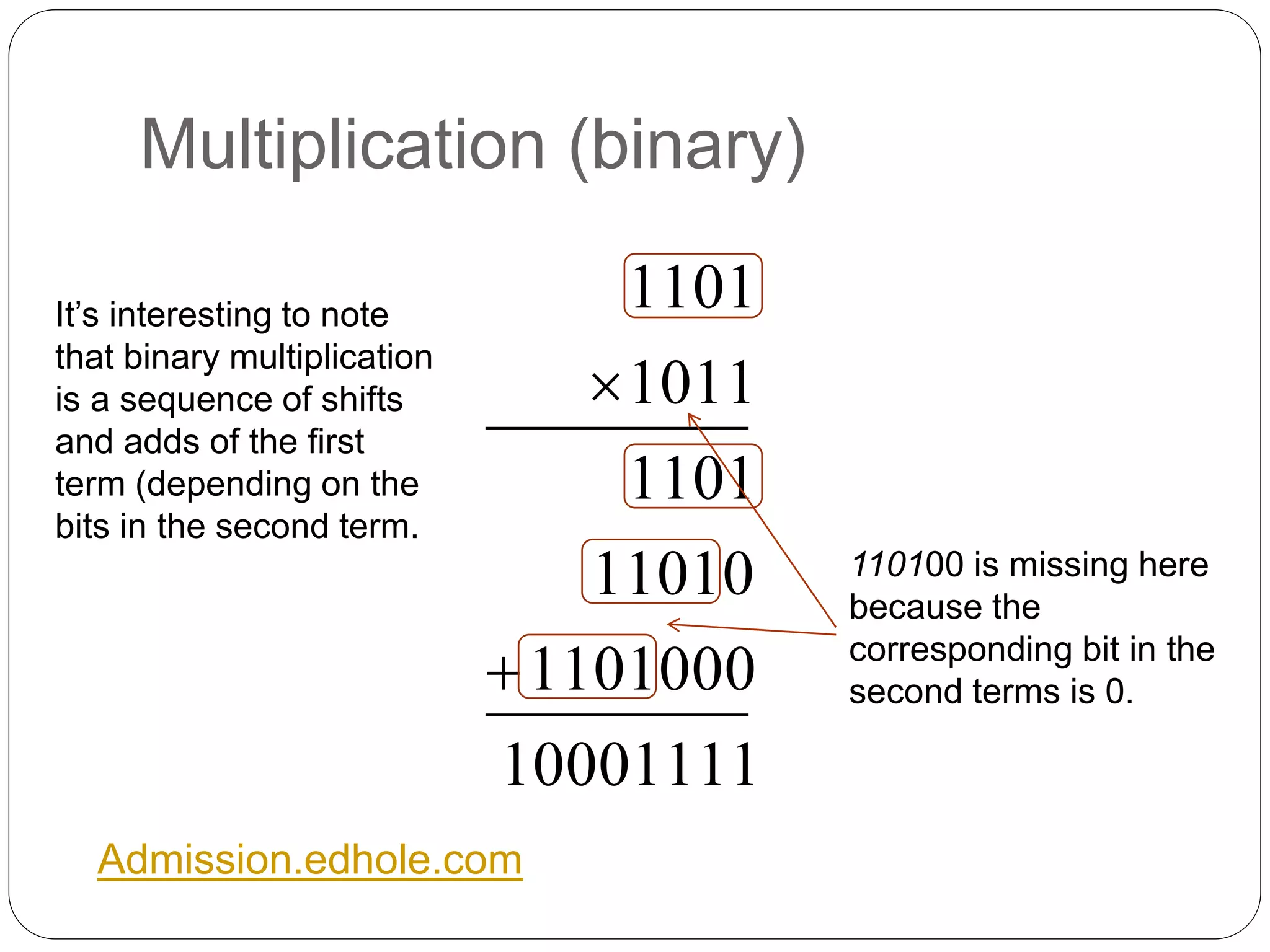
Multiplication (binary) 
1101 
1011 
1101 
 
11010 
1101000 
 
10001111 
Admission.edhole.com
Multiplication (binary) 
1101 
1011 
1101 
 
11010 
1101000 
 
10001111 
It’s interesting to note 
that binary multiplication 
is a sequence of shifts 
and adds of the first 
term (depending on the 
bits in the second term. 
110100 is missing here 
because the 
corresponding bit in the 
second terms is 0. 
Admission.edhole.com
Representing signed (positive 
and negative) numbers
Representing numbers (ints) 
 Fixed, finite number of bits. 
bits bytes C/C++ Intel Sun 
8 1 char [s]byte byte 
16 2 short [s]word half 
32 4 int or long [s]dword word 
64 8 long long [s]qword xword
Representing numbers (ints) 
 Fixed, finite number of bits. 
bits Intel signed unsigned 
8 [s]byte -27..+27-1 0..+28-1 
16 [s]word -215..+215-1 0..+216-1 
32 [s]dword -231..+231-1 0..+232-1 
64 [s]qword -263..+263-1 0..+264-1 
In general, for k bits, the unsigned range is [0..+2k-1] and 
the signed range is [-2k-1..+2k-1-1].
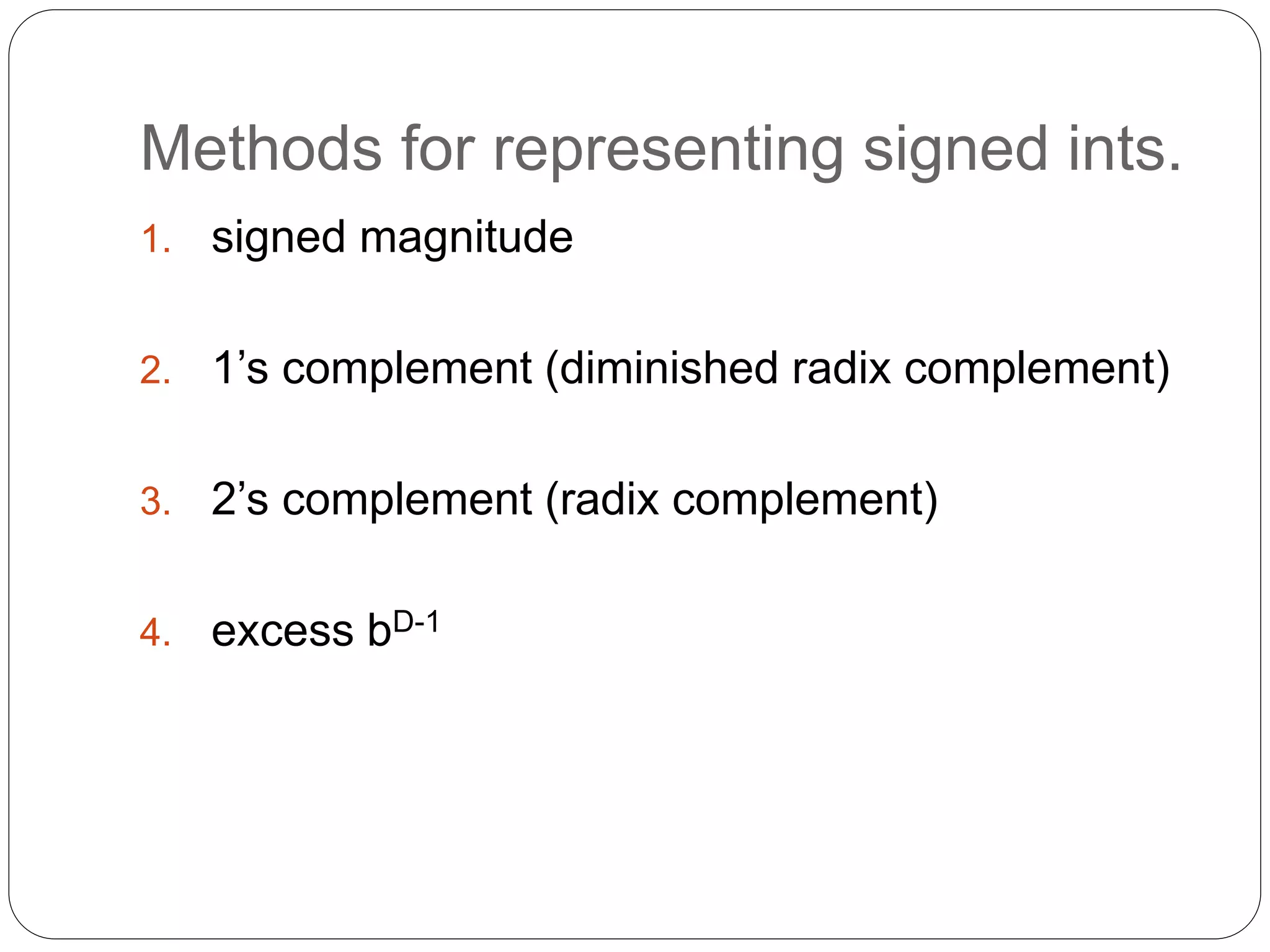
Methods for representing signed ints. 
1. signed magnitude 
2. 1’s complement (diminished radix complement) 
3. 2’s complement (radix complement) 
4. excess bD-1
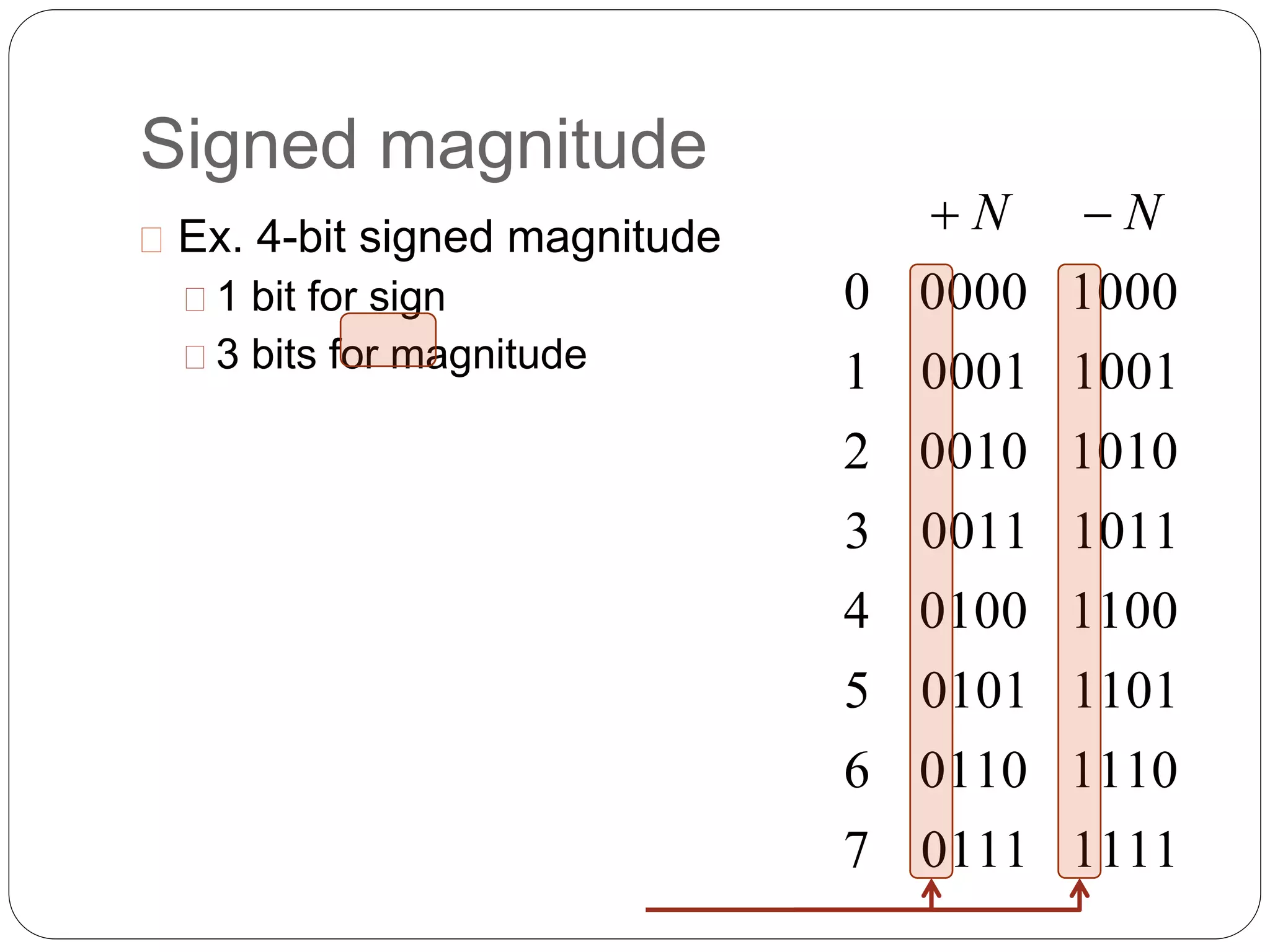
Signed magnitude 
 Ex. 4-bit signed magnitude 
 1 bit for sign 
 3 bits for magnitude 
 N  N 
0 0000 1000 
1 0001 1001 
2 0010 1010 
3 0011 1011 
4 0100 1100 
5 0101 1101 
6 0110 1110 
7 0111 1111
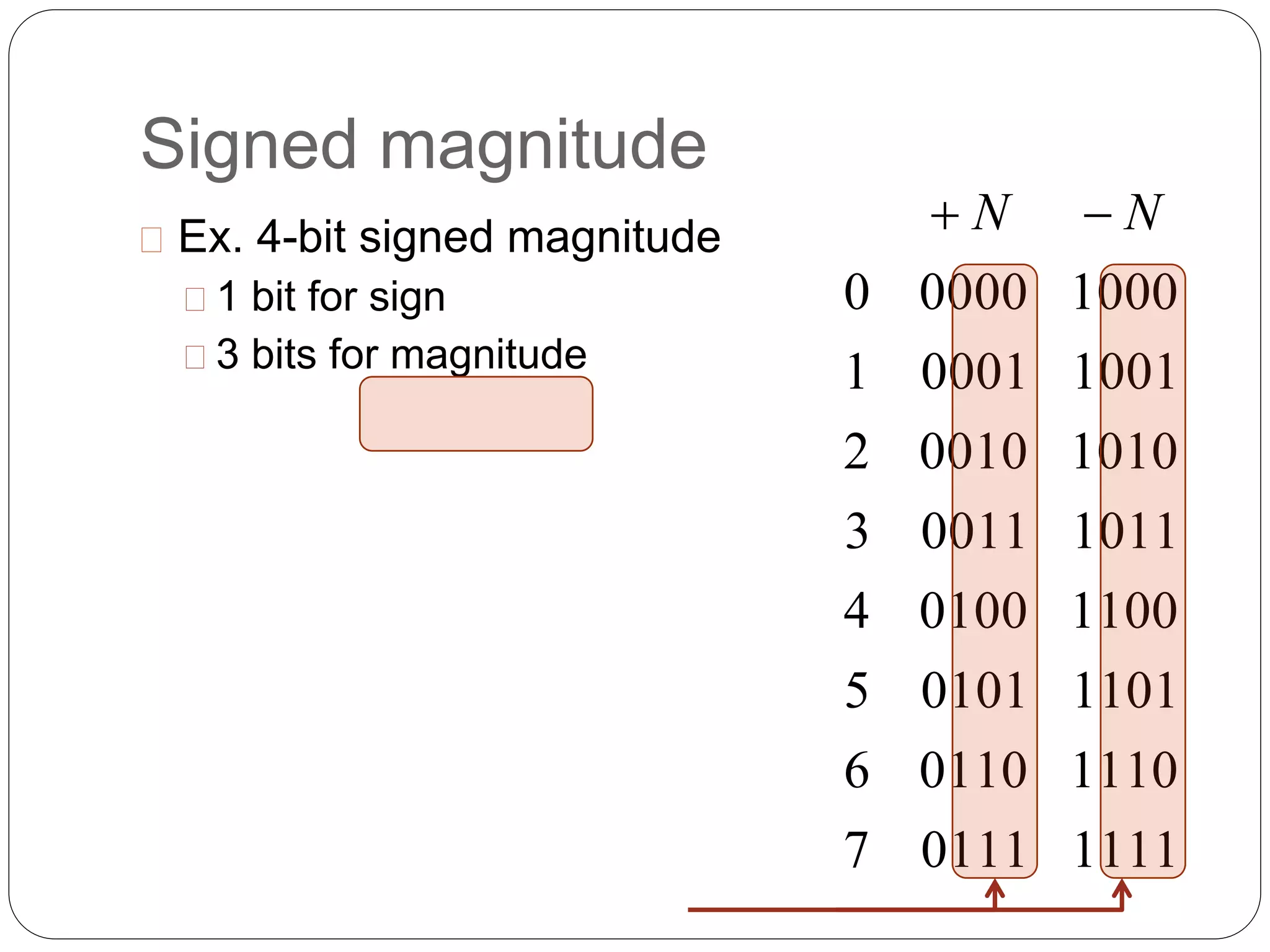
Signed magnitude 
 Ex. 4-bit signed magnitude 
 1 bit for sign 
 3 bits for magnitude 
 N  N 
0 0000 1000 
1 0001 1001 
2 0010 1010 
3 0011 1011 
4 0100 1100 
5 0101 1101 
6 0110 1110 
7 0111 1111
1’s complement 
(diminished radix complement) 
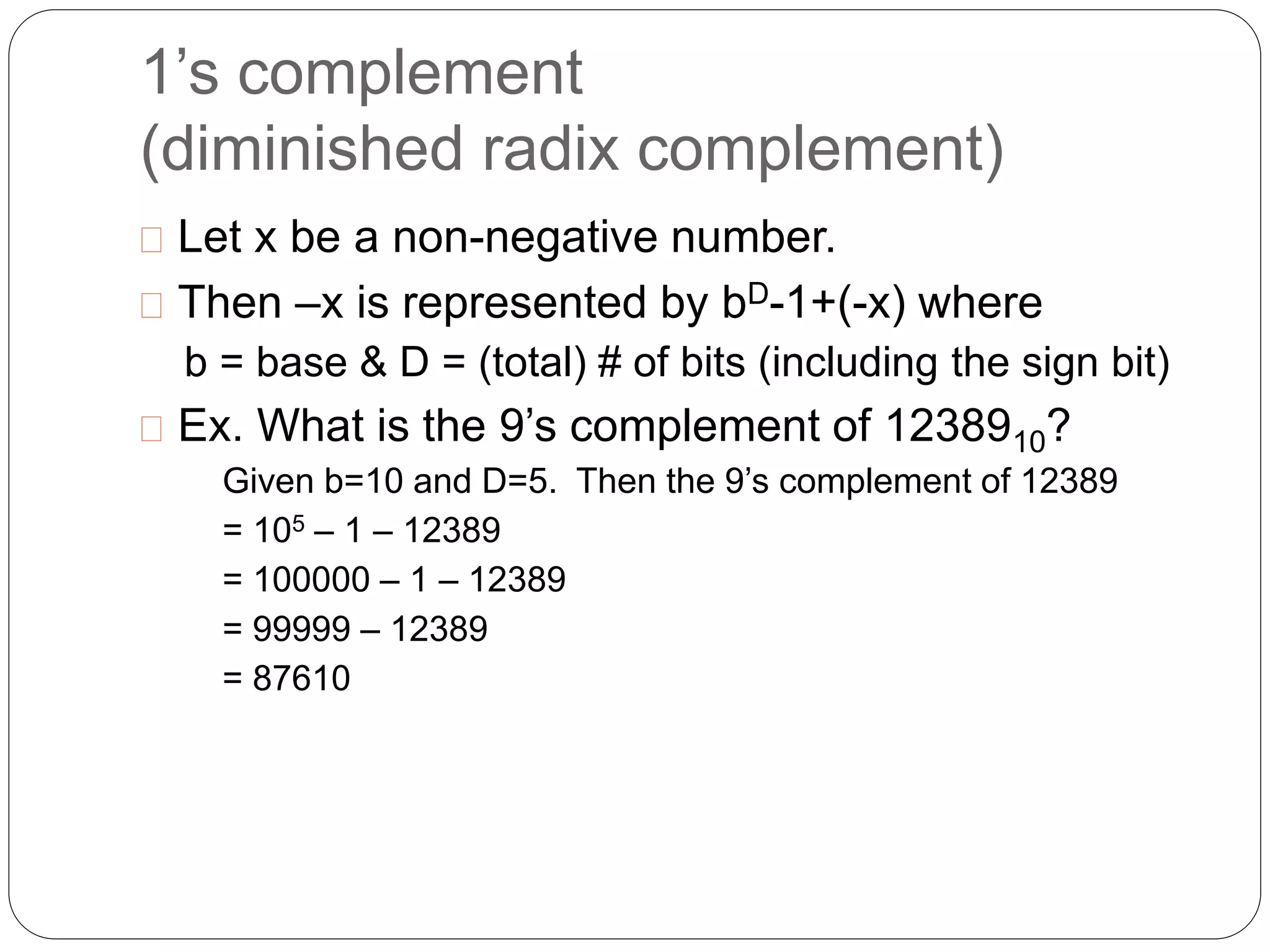
 Let x be a non-negative number. 
 Then –x is represented by bD-1+(-x) where 
b = base 
D = (total) # of bits (including the sign bit) 
 Ex. Let b=2 and D=4. 
Then -1 is represented by 24-1-1 = 1410 or 11102.
1’s complement 
(diminished radix complement) 
 Let x be a non-negative number. 
 Then –x is represented by bD-1+(-x) where 
b = base & D = (total) # of bits (including the sign bit) 
 Ex. What is the 9’s complement of 1238910? 
Given b=10 and D=5. Then the 9’s complement of 12389 
= 105 – 1 – 12389 
= 100000 – 1 – 12389 
= 99999 – 12389 
= 87610
1’s complement 
(diminished radix complement) 
 Let x be a non-negative number. 
 Then –x is represented by bD-1+(-x) 
where 
b = base 
D = (total) # of bits (including the sign 
bit) 
 Shortcut for base 2? 
 All combinations used, but 2 zeros! 
 N  N 
0 0000 1111 
1 0001 1110 
2 0010 1101 
3 0011 1100 
4 0100 1011 
5 0101 1010 
6 0110 1001 
7 0111 1000
2’s complement 
(radix complement) 
 Let x be a non-negative number. 
 Then –x is represented by bD+(-x). 
 Ex. Let b=2 and D=4. Then -1 is represented by 24- 
1 = 15 or 11112. 
 Ex. Let b=2 and D=4. Then -5 is represented by 24 
– 5 = 11 or 10112. 
 Ex. Let b=10 and D=5. Then the 10’s complement 
of 12389 = 105 – 12389 = 100000 – 12389 = 87611.
2’s complement 
(radix complement) 
 Let x be a non-negative number. 
 Then –x is represented by bD+(-x). 
 Ex. Let b=2 and D=4. Then -1 is 
represented by 24-1 = 15 or 11112. 
 Ex. Let b=2 and D=4. Then -5 is 
represented by 24 – 5 = 11 or 10112. 
 Shortcut for base 2? 
 N  N 
0 0000 0000 
1 0001 1111 
2 0010 1110 
3 0011 1101 
4 0100 1100 
5 0101 1011 
6 0110 1010 
7 0111 1001
2’s complement 
(radix complement) 
 Shortcut for base 2? 
 Yes! Flip the bits and add 1. 
 N  N 
0 0000 0000 
1 0001 1111 
2 0010 1110 
3 0011 1101 
4 0100 1100 
5 0101 1011 
6 0110 1010 
7 0111 1001
2’s complement 
(radix complement) 
 Are all combinations of 4 bits used? 
 No. (Now we only have one zero.) 
 1000 is missing! 
 What is 1000? 
 Is it positive or negative? 
 Does -8 + 1 = -7 work in 2’s complement? 
 N  N 
0 0000 0000 
1 0001 1111 
2 0010 1110 
3 0011 1101 
4 0100 1100 
5 0101 1011 
6 0110 1010 
7 0111 1001
excess bD-1 (biased 
representation) 
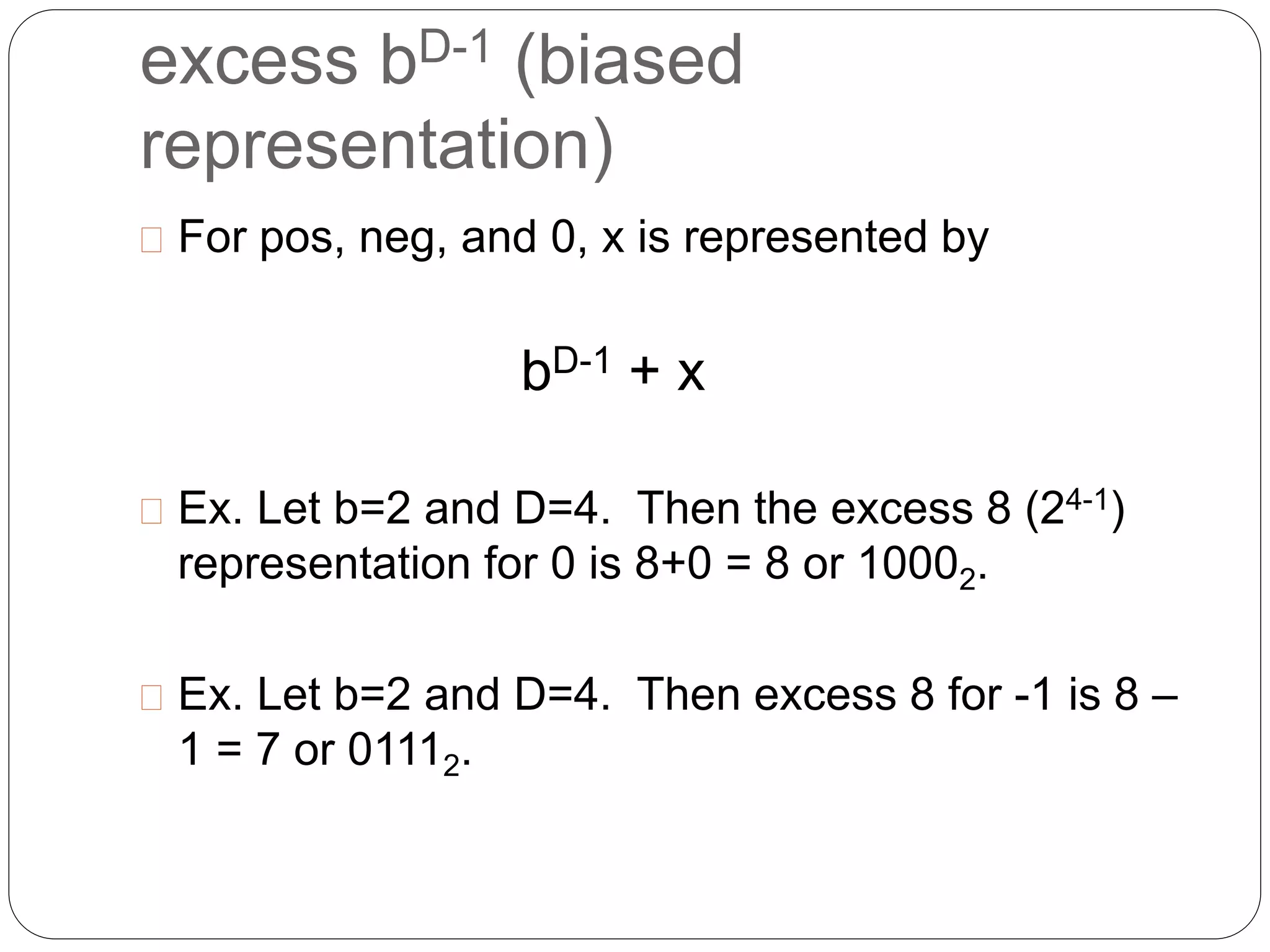
 For pos, neg, and 0, x is represented by 
bD-1 + x 
 Ex. Let b=2 and D=4. Then the excess 8 (24-1) 
representation for 0 is 8+0 = 8 or 10002. 
 Ex. Let b=2 and D=4. Then excess 8 for -1 is 8 – 
1 = 7 or 01112.
excess bD-1 
 For pos, neg, and 0, x is represented 
by 
bD-1 + x. 
 Ex. Let b=2 and D=4. Then the 
excess 8 (24-1) representation for 0 is 
8+0 = 8 or 10002. 
 Ex. Let b=2 and D=4. Then excess 
8 for -1 is 8 – 1 = 7 or 01112. 
 N  N 
0 1000 1000 
1 1001 0111 
2 1010 0110 
3 1011 0101 
4 1100 0100 
5 1101 0011 
6 1110 0010 
7 1111 0001
2’s complement vs. excess bD-1 
 In 2’s, positives start with 0; in 
excess, positives start with 1. 
 Both have one zero (positive). 
 Remaining bits are the same. 
 N  N 
0 1000 1000 
1 1001 0111 
2 1010 0110 
3 1011 0101 
4 1100 0100 
5 1101 0011 
6 1110 0010 
7 1111 0001
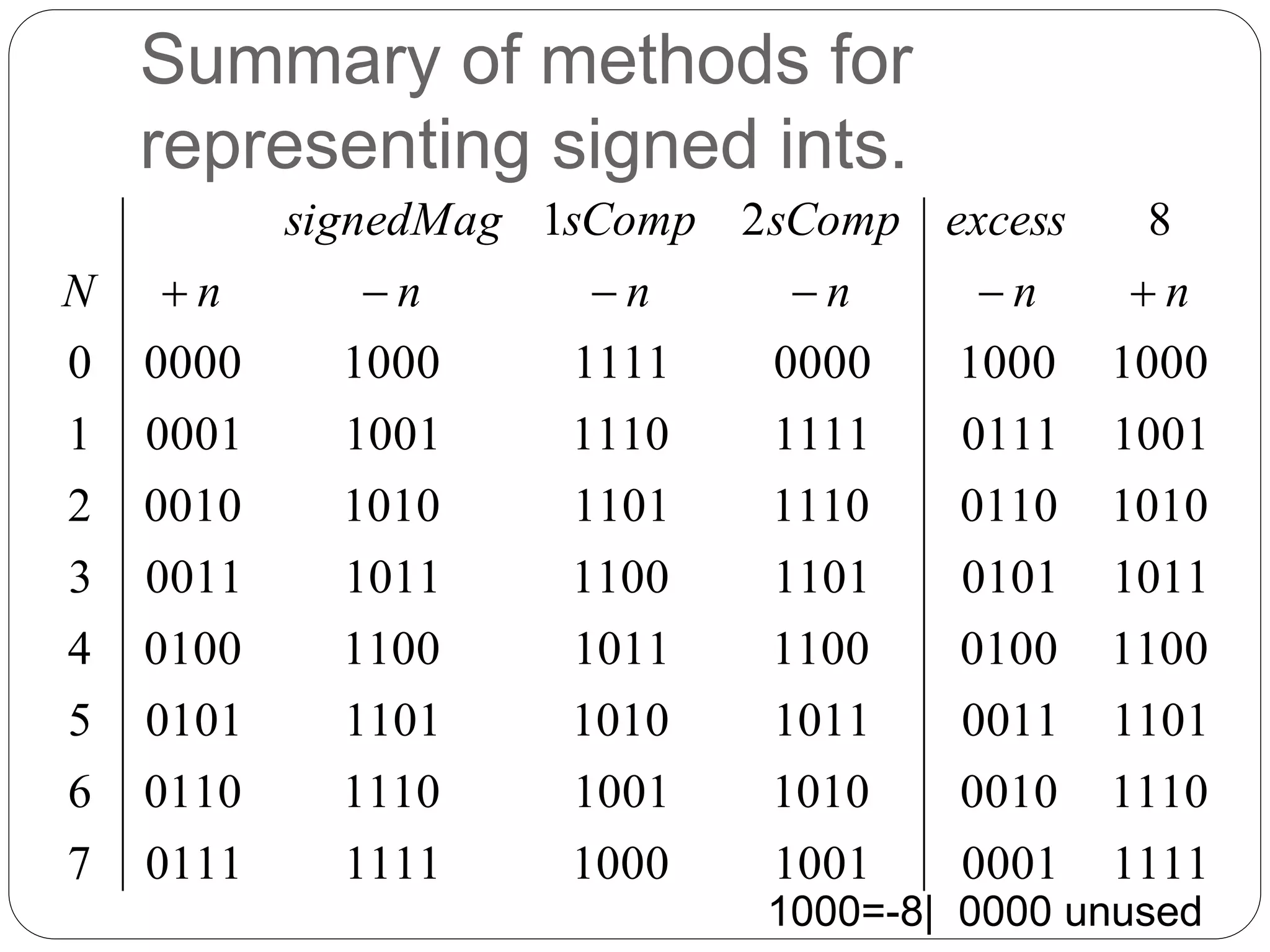
Summary of methods for 
representing signed ints. 
signedMag sComp sComp excess 
1 2 8 
N  n  n  n  n  n  
n 
0 0000 1000 1111 0000 1000 1000 
1 0001 1001 1110 1111 0111 1001 
2 0010 1010 1101 1110 0110 1010 
3 0011 1011 1100 1101 0101 1011 
4 0100 1100 1011 1100 0100 1100 
5 0101 1101 1010 1011 0011 1101 
6 0110 1110 1001 1010 0010 1110 
7 0111 1111 1000 1001 0001 1111 
1000=-8| 0000 unused
Binary arithmetic 
Signed magnitude 
1’s complement 
2’s complement 
Excess K (biased)
Binary Arithmetic 
Signed magnitude
Addition w/ signed magnitude 
algorithm 
 For A - B, change the sign of B and perform addition of 
A + (-B) (as in the next step) 
 For A + B: 
 if (Asign==Bsign) then { R = |A| + |B|; Rsign = Asign; } 
 else if (|A|>|B|) then { R = |A| - |B|; Rsign = Asign; } 
 else if (|A|==|B|) then { R = 0; Rsign = 0; } 
 else { R = |B| - |A|; Rsign = Bsign; } 
 Complicated?
Binary Arithmetic 
2’s complement
Representing numbers (ints) 
using 2’s complement 
 Fixed, finite number of bits. 
bits Intel signed 
8 sbyte -27..+27-1 
16 sword -215..+215-1 
32 sdword -231..+231-1 
64 sqword -263..+263-1 
In general, for k bits, the signed range is [-2k-1..+2k-1-1]. 
So where does the extra negative value come from?
Representing numbers (ints) 
 Fixed, finite number of bits. 
bits Intel signed 
8 sbyte -27..+27-1 
16 sword -215..+215-1 
32 sdword -231..+231-1 
64 sqword -263..+263-1 
In general, for k bits, the signed range 
is 
[-2k-1..+2k-1-1]. 
So where does the extra negative value 
come from? 
 n  n 
0 0000 0000 
1 0001 1111 
2 0010 1110 
3 0011 1101 
4 0100 1100 
5 0101 1011 
6 0110 1010 
7 0111 1001 
8 1000
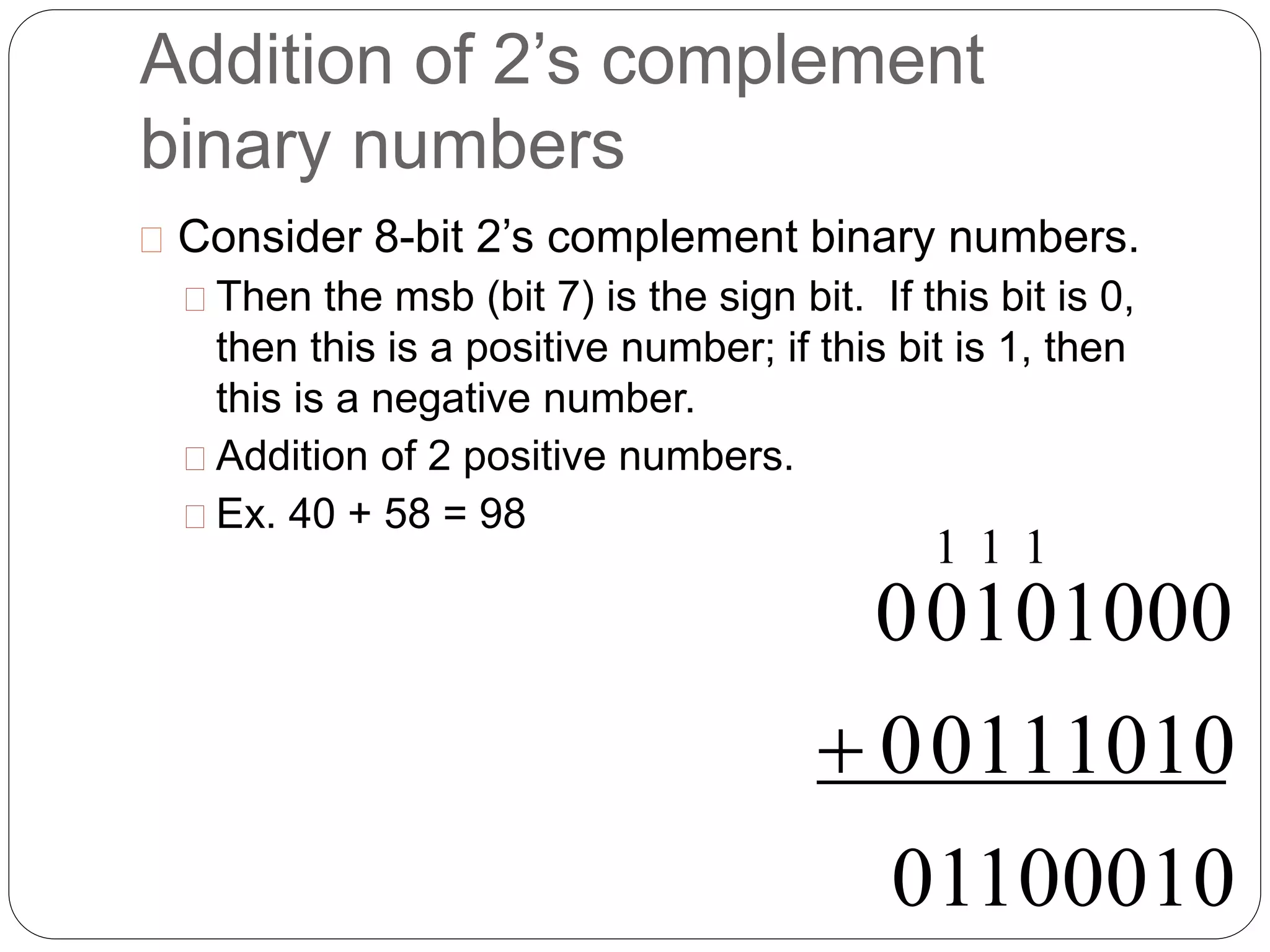
Addition of 2’s complement 
binary numbers 
 Consider 8-bit 2’s complement binary numbers. 
 Then the msb (bit 7) is the sign bit. If this bit is 0, 
then this is a positive number; if this bit is 1, then 
this is a negative number. 
 Addition of 2 positive numbers. 
 Ex. 40 + 58 = 98 
1 1 1 
00101000 
00111010 
01100010 

Addition of 2’s complement 
binary numbers 
 Consider 8-bit 2’s complement 
binary numbers. 
 Addition of a negative to a 
positive. 
 What are the values of these 2 
terms? 
 -88 and 122 
 -88 + 122 = 34 
1 1 1 1 
10101000 
01111010 
 
1 00100010
So how can we perform subtraction?
Addition of 2’s complement 
binary numbers 
 Consider 8-bit 2’s complement binary numbers. 
 Subtraction is nothing but addition of the 2’s 
complement. 
 Ex. 58 – 40 = 58 + (-40) = 18 
1 1 1 1 
00111010 
11011000 
 
1 00010010 
discard carry
Carry vs. overflow
Addition of 2’s complement 
binary numbers 
 Carry vs. overflow when adding A + B 
 If A and B are of opposite sign, then overflow cannot 
occur. 
 If A and B are of the same sign but the result is of 
the opposite sign, then overflow has occurred (and 
the answer is therefore incorrect). 
 Overflow occurs iff the carry into the sign bit differs from the 
carry out of the sign bit.
Addition of 2’s complement 
binary numbers 
class test { 
public static void main ( String 
args[] ) 
{ 
byte A = 127; 
byte B = 127; 
byte result = (byte)(A + B); 
System.out.println( "A + B = " 
+ result ); 
} 
} 
#include <stdio.h> 
int main ( int argc, char* argv[] ) 
{ 
char A = 127; 
char B = 127; 
char result = (char)(A + B); 
printf( "A + B = %d n", result ); 
return 0; 
} Result = -2 in both 
Java (left) and C++ 
(right). Why?
Addition of 2’s complement 
binary numbers 
class test { 
public static void main ( String 
args[] ) 
{ 
byte A = 127; 
byte B = 127; 
byte result = (byte)(A + B); 
System.out.println( "A + B = " 
+ result ); 
} 
} 
Result = -2 in both Java and 
C++. 
Why? 
What’s 127 as a 2’s 
complement binary number? 
01111111 
 
01111111 
11111110 
What is 111111102? 
Flip the bits: 00000001. 
Then add 1: 00000010.
Binary Arithmetic 
1’s complement
Addition with 1’s complement 
 Note: 1’s complement has two 0’s! 
 1’s complement addition is tricky 
(end-around-carry). 
 N  N 
0 0000 1111 
1 0001 1110 
2 0010 1101 
3 0011 1100 
4 0100 1011 
5 0101 1010 
6 0110 1001 
7 0111 1000
8-bit 1’s complement addition 
 Ex. Let X = A816 and Y = 8616. 
 Calculate Y - X using 1’s complement.
8-bit 1’s complement addition 
 Ex. Let X = A816 and Y = 8616. 
 Calculate Y - X using 1’s complement. 
Y = 1000 01102 = -12110 
X = 1010 10002 = -8710 
~X = 0101 01112 
(Note: C=0 out of msb.) 
1000 0110 
 
0101 0111 
1101 1101 
Y - X = -121 + 87 = -34 (base 10)
8-bit 1’s complement addition 
 Ex. Let X = A816 and Y = 8616. 
 Calculate X - Y using 1’s complement.
8-bit 1’s complement addition 
 Ex. Let X = A816 and Y = 8616. 
 Calculate X - Y using 1’s complement. 
X = 1010 10002 = -8710 
Y = 1000 01102 = -12110 
~Y = 0111 10012 
(Note: C=1 out of msb.) 
1010 1000 
0111 1001 
 
1 0010 0001 
1 
 
end around 
carry 
0010 0010 
X - Y = -87 + 121 = 34 (base 10)
Binary Arithmetic 
Excess K (biased)
Binary arithmetic and Excess K 
(biased) 
Method: Simply add and then flip the sign bit. 
-1 0111 
+5 1101 
-- ---- 
+4 0100 -> flip sign -> 1100 
+1 1001 
-5 0011 
-- ---- 
-4 1100 -> flip sign -> 0100 
+1 1001 
+5 1101 
-- ---- 
+6 0110 -> flip sign -> 1110 
-1 0111 
-5 0011 
-- ---- 
-6 1010 -> toggle sign -> 0010 
 N  N 
0 1000 1000 
1 1001 0111 
2 1010 0110 
3 1011 0101 
4 1100 0100 
5 1101 0011 
6 1110 0010 
7 1111 0001 
(Not used for integer arithmetic but employed 
in IEEE 754 floating point standard.)

Mba admission in india

  • 1.
    MBA admission inIndia By: Admission.edhole.com
  • 2.
    Binary numbers andarithmetic Admission.edhole.com
  • 3.
  • 4.
    Addition (decimal) 1  4 5 5 14 19  5 1  5 10 6 1  5 11 1 1 12 99  111 Admission.edhole.com
  • 5.
    Addition (binary) 0  0 0 1  0 1 0  1 1 1 1 1 10 Admission.edhole.com
  • 6.
    Addition (binary) 11 1 1 01101 01011 11000  Admission.edhole.com
  • 7.
    Addition (binary) 0  0 1  0 So ca0n we count in 1 binary? 0  1 1 1 1 1 10 Admission.edhole.com
  • 8.
    Counting in binary(4 bits) 0 0000 1 0001 2 … 3 4 5 6 7 8 9 10 11 12 13 14 15 Admission.edhole.com
  • 9.
  • 10.
    Multiplication (decimal) 13 11 13 130 143   Admission.edhole.com
  • 11.
    Multiplication (binary) 1101 1011 1101  11010 1101000  10001111 Admission.edhole.com
  • 12.
    Multiplication (binary) 1101 1011 1101  11010 1101000  10001111 It’s interesting to note that binary multiplication is a sequence of shifts and adds of the first term (depending on the bits in the second term. 110100 is missing here because the corresponding bit in the second terms is 0. Admission.edhole.com
  • 13.
    Representing signed (positive and negative) numbers
  • 14.
    Representing numbers (ints)  Fixed, finite number of bits. bits bytes C/C++ Intel Sun 8 1 char [s]byte byte 16 2 short [s]word half 32 4 int or long [s]dword word 64 8 long long [s]qword xword
  • 15.
    Representing numbers (ints)  Fixed, finite number of bits. bits Intel signed unsigned 8 [s]byte -27..+27-1 0..+28-1 16 [s]word -215..+215-1 0..+216-1 32 [s]dword -231..+231-1 0..+232-1 64 [s]qword -263..+263-1 0..+264-1 In general, for k bits, the unsigned range is [0..+2k-1] and the signed range is [-2k-1..+2k-1-1].
  • 16.
    Methods for representingsigned ints. 1. signed magnitude 2. 1’s complement (diminished radix complement) 3. 2’s complement (radix complement) 4. excess bD-1
  • 17.
    Signed magnitude Ex. 4-bit signed magnitude  1 bit for sign  3 bits for magnitude  N  N 0 0000 1000 1 0001 1001 2 0010 1010 3 0011 1011 4 0100 1100 5 0101 1101 6 0110 1110 7 0111 1111
  • 18.
    Signed magnitude Ex. 4-bit signed magnitude  1 bit for sign  3 bits for magnitude  N  N 0 0000 1000 1 0001 1001 2 0010 1010 3 0011 1011 4 0100 1100 5 0101 1101 6 0110 1110 7 0111 1111
  • 19.
    1’s complement (diminishedradix complement)  Let x be a non-negative number.  Then –x is represented by bD-1+(-x) where b = base D = (total) # of bits (including the sign bit)  Ex. Let b=2 and D=4. Then -1 is represented by 24-1-1 = 1410 or 11102.
  • 20.
    1’s complement (diminishedradix complement)  Let x be a non-negative number.  Then –x is represented by bD-1+(-x) where b = base & D = (total) # of bits (including the sign bit)  Ex. What is the 9’s complement of 1238910? Given b=10 and D=5. Then the 9’s complement of 12389 = 105 – 1 – 12389 = 100000 – 1 – 12389 = 99999 – 12389 = 87610
  • 21.
    1’s complement (diminishedradix complement)  Let x be a non-negative number.  Then –x is represented by bD-1+(-x) where b = base D = (total) # of bits (including the sign bit)  Shortcut for base 2?  All combinations used, but 2 zeros!  N  N 0 0000 1111 1 0001 1110 2 0010 1101 3 0011 1100 4 0100 1011 5 0101 1010 6 0110 1001 7 0111 1000
  • 22.
    2’s complement (radixcomplement)  Let x be a non-negative number.  Then –x is represented by bD+(-x).  Ex. Let b=2 and D=4. Then -1 is represented by 24- 1 = 15 or 11112.  Ex. Let b=2 and D=4. Then -5 is represented by 24 – 5 = 11 or 10112.  Ex. Let b=10 and D=5. Then the 10’s complement of 12389 = 105 – 12389 = 100000 – 12389 = 87611.
  • 23.
    2’s complement (radixcomplement)  Let x be a non-negative number.  Then –x is represented by bD+(-x).  Ex. Let b=2 and D=4. Then -1 is represented by 24-1 = 15 or 11112.  Ex. Let b=2 and D=4. Then -5 is represented by 24 – 5 = 11 or 10112.  Shortcut for base 2?  N  N 0 0000 0000 1 0001 1111 2 0010 1110 3 0011 1101 4 0100 1100 5 0101 1011 6 0110 1010 7 0111 1001
  • 24.
    2’s complement (radixcomplement)  Shortcut for base 2?  Yes! Flip the bits and add 1.  N  N 0 0000 0000 1 0001 1111 2 0010 1110 3 0011 1101 4 0100 1100 5 0101 1011 6 0110 1010 7 0111 1001
  • 25.
    2’s complement (radixcomplement)  Are all combinations of 4 bits used?  No. (Now we only have one zero.)  1000 is missing!  What is 1000?  Is it positive or negative?  Does -8 + 1 = -7 work in 2’s complement?  N  N 0 0000 0000 1 0001 1111 2 0010 1110 3 0011 1101 4 0100 1100 5 0101 1011 6 0110 1010 7 0111 1001
  • 26.
    excess bD-1 (biased representation)  For pos, neg, and 0, x is represented by bD-1 + x  Ex. Let b=2 and D=4. Then the excess 8 (24-1) representation for 0 is 8+0 = 8 or 10002.  Ex. Let b=2 and D=4. Then excess 8 for -1 is 8 – 1 = 7 or 01112.
  • 27.
    excess bD-1 For pos, neg, and 0, x is represented by bD-1 + x.  Ex. Let b=2 and D=4. Then the excess 8 (24-1) representation for 0 is 8+0 = 8 or 10002.  Ex. Let b=2 and D=4. Then excess 8 for -1 is 8 – 1 = 7 or 01112.  N  N 0 1000 1000 1 1001 0111 2 1010 0110 3 1011 0101 4 1100 0100 5 1101 0011 6 1110 0010 7 1111 0001
  • 28.
    2’s complement vs.excess bD-1  In 2’s, positives start with 0; in excess, positives start with 1.  Both have one zero (positive).  Remaining bits are the same.  N  N 0 1000 1000 1 1001 0111 2 1010 0110 3 1011 0101 4 1100 0100 5 1101 0011 6 1110 0010 7 1111 0001
  • 29.
    Summary of methodsfor representing signed ints. signedMag sComp sComp excess 1 2 8 N  n  n  n  n  n  n 0 0000 1000 1111 0000 1000 1000 1 0001 1001 1110 1111 0111 1001 2 0010 1010 1101 1110 0110 1010 3 0011 1011 1100 1101 0101 1011 4 0100 1100 1011 1100 0100 1100 5 0101 1101 1010 1011 0011 1101 6 0110 1110 1001 1010 0010 1110 7 0111 1111 1000 1001 0001 1111 1000=-8| 0000 unused
  • 30.
    Binary arithmetic Signedmagnitude 1’s complement 2’s complement Excess K (biased)
  • 31.
  • 32.
    Addition w/ signedmagnitude algorithm  For A - B, change the sign of B and perform addition of A + (-B) (as in the next step)  For A + B:  if (Asign==Bsign) then { R = |A| + |B|; Rsign = Asign; }  else if (|A|>|B|) then { R = |A| - |B|; Rsign = Asign; }  else if (|A|==|B|) then { R = 0; Rsign = 0; }  else { R = |B| - |A|; Rsign = Bsign; }  Complicated?
  • 33.
  • 34.
    Representing numbers (ints) using 2’s complement  Fixed, finite number of bits. bits Intel signed 8 sbyte -27..+27-1 16 sword -215..+215-1 32 sdword -231..+231-1 64 sqword -263..+263-1 In general, for k bits, the signed range is [-2k-1..+2k-1-1]. So where does the extra negative value come from?
  • 35.
    Representing numbers (ints)  Fixed, finite number of bits. bits Intel signed 8 sbyte -27..+27-1 16 sword -215..+215-1 32 sdword -231..+231-1 64 sqword -263..+263-1 In general, for k bits, the signed range is [-2k-1..+2k-1-1]. So where does the extra negative value come from?  n  n 0 0000 0000 1 0001 1111 2 0010 1110 3 0011 1101 4 0100 1100 5 0101 1011 6 0110 1010 7 0111 1001 8 1000
  • 36.
    Addition of 2’scomplement binary numbers  Consider 8-bit 2’s complement binary numbers.  Then the msb (bit 7) is the sign bit. If this bit is 0, then this is a positive number; if this bit is 1, then this is a negative number.  Addition of 2 positive numbers.  Ex. 40 + 58 = 98 1 1 1 00101000 00111010 01100010 
  • 37.
    Addition of 2’scomplement binary numbers  Consider 8-bit 2’s complement binary numbers.  Addition of a negative to a positive.  What are the values of these 2 terms?  -88 and 122  -88 + 122 = 34 1 1 1 1 10101000 01111010  1 00100010
  • 38.
    So how canwe perform subtraction?
  • 39.
    Addition of 2’scomplement binary numbers  Consider 8-bit 2’s complement binary numbers.  Subtraction is nothing but addition of the 2’s complement.  Ex. 58 – 40 = 58 + (-40) = 18 1 1 1 1 00111010 11011000  1 00010010 discard carry
  • 40.
  • 41.
    Addition of 2’scomplement binary numbers  Carry vs. overflow when adding A + B  If A and B are of opposite sign, then overflow cannot occur.  If A and B are of the same sign but the result is of the opposite sign, then overflow has occurred (and the answer is therefore incorrect).  Overflow occurs iff the carry into the sign bit differs from the carry out of the sign bit.
  • 42.
    Addition of 2’scomplement binary numbers class test { public static void main ( String args[] ) { byte A = 127; byte B = 127; byte result = (byte)(A + B); System.out.println( "A + B = " + result ); } } #include <stdio.h> int main ( int argc, char* argv[] ) { char A = 127; char B = 127; char result = (char)(A + B); printf( "A + B = %d n", result ); return 0; } Result = -2 in both Java (left) and C++ (right). Why?
  • 43.
    Addition of 2’scomplement binary numbers class test { public static void main ( String args[] ) { byte A = 127; byte B = 127; byte result = (byte)(A + B); System.out.println( "A + B = " + result ); } } Result = -2 in both Java and C++. Why? What’s 127 as a 2’s complement binary number? 01111111  01111111 11111110 What is 111111102? Flip the bits: 00000001. Then add 1: 00000010.
  • 44.
  • 45.
    Addition with 1’scomplement  Note: 1’s complement has two 0’s!  1’s complement addition is tricky (end-around-carry).  N  N 0 0000 1111 1 0001 1110 2 0010 1101 3 0011 1100 4 0100 1011 5 0101 1010 6 0110 1001 7 0111 1000
  • 46.
    8-bit 1’s complementaddition  Ex. Let X = A816 and Y = 8616.  Calculate Y - X using 1’s complement.
  • 47.
    8-bit 1’s complementaddition  Ex. Let X = A816 and Y = 8616.  Calculate Y - X using 1’s complement. Y = 1000 01102 = -12110 X = 1010 10002 = -8710 ~X = 0101 01112 (Note: C=0 out of msb.) 1000 0110  0101 0111 1101 1101 Y - X = -121 + 87 = -34 (base 10)
  • 48.
    8-bit 1’s complementaddition  Ex. Let X = A816 and Y = 8616.  Calculate X - Y using 1’s complement.
  • 49.
    8-bit 1’s complementaddition  Ex. Let X = A816 and Y = 8616.  Calculate X - Y using 1’s complement. X = 1010 10002 = -8710 Y = 1000 01102 = -12110 ~Y = 0111 10012 (Note: C=1 out of msb.) 1010 1000 0111 1001  1 0010 0001 1  end around carry 0010 0010 X - Y = -87 + 121 = 34 (base 10)
  • 50.
  • 51.
    Binary arithmetic andExcess K (biased) Method: Simply add and then flip the sign bit. -1 0111 +5 1101 -- ---- +4 0100 -> flip sign -> 1100 +1 1001 -5 0011 -- ---- -4 1100 -> flip sign -> 0100 +1 1001 +5 1101 -- ---- +6 0110 -> flip sign -> 1110 -1 0111 -5 0011 -- ---- -6 1010 -> toggle sign -> 0010  N  N 0 1000 1000 1 1001 0111 2 1010 0110 3 1011 0101 4 1100 0100 5 1101 0011 6 1110 0010 7 1111 0001 (Not used for integer arithmetic but employed in IEEE 754 floating point standard.)