© 2005 Xilinx, Inc. All Rights Reserved
Basic FPGA
Architecture
Basic FPGA Architecture 2 - 3 © 2005 Xilinx, Inc. All Rights Reserved
For Academic Use Only
Objectives
After completing this module, you will be able to:
• Identify the basic architectural resources of the Virtex™-II FPGA
• List the differences between the Virtex-II, Virtex-II Pro, Spartan™-3, and
Spartan-3E devices
• List the new and enhanced features of the new Virtex-4 device family
Basic FPGA Architecture 2 - 4 © 2005 Xilinx, Inc. All Rights Reserved
For Academic Use Only
Outline
• Overview
• Slice Resources
• I/O Resources
• Memory and Clocking
• Spartan-3, Spartan-3E, and
Virtex-II Pro Features
• Virtex-4 Features
• Summary
• Appendix
Basic FPGA Architecture 2 - 5 © 2005 Xilinx, Inc. All Rights Reserved
For Academic Use Only
Overview
• All Xilinx FPGAs contain the same basic resources
– Slices (grouped into CLBs)
• Contain combinatorial logic and register resources
– IOBs
• Interface between the FPGA and the outside world
– Programmable interconnect
– Other resources
• Memory
• Multipliers
• Global clock buffers
• Boundary scan logic
Basic FPGA Architecture 2 - 7 © 2005 Xilinx, Inc. All Rights Reserved
For Academic Use Only
Outline
• Overview
• Slice Resources
• I/O Resources
• Memory and Clocking
• Spartan-3, Spartan-3E, and
Virtex-II Pro Features
• Virtex-4 Features
• Summary
• Appendix
Basic FPGA Architecture 2 - 8 © 2005 Xilinx, Inc. All Rights Reserved
For Academic Use Only
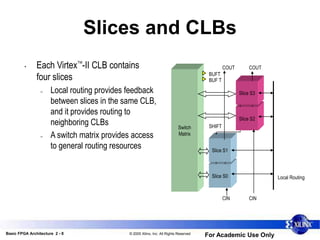
Slices and CLBs
• Each Virtex-II CLB contains
four slices
– Local routing provides feedback
between slices in the same CLB,
and it provides routing to
neighboring CLBs
– A switch matrix provides access
to general routing resources
CIN
Switch
Matrix
BUFT
BUF T
COUT
COUT
Slice S0
Slice S1
Local Routing
Slice S2
Slice S3
CIN
SHIFT
Basic FPGA Architecture 2 - 9 © 2005 Xilinx, Inc. All Rights Reserved
For Academic Use Only
Slice 0
LUT Carry
LUT Carry D Q
CE
PRE
CLR
D
Q
CE
PRE
CLR
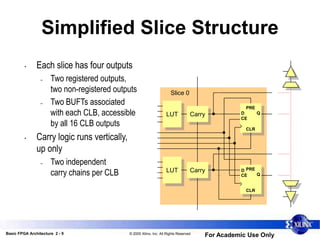
Simplified Slice Structure
• Each slice has four outputs
– Two registered outputs,
two non-registered outputs
– Two BUFTs associated
with each CLB, accessible
by all 16 CLB outputs
• Carry logic runs vertically,
up only
– Two independent
carry chains per CLB
Basic FPGA Architecture 2 - 10 © 2005 Xilinx, Inc. All Rights Reserved
For Academic Use Only
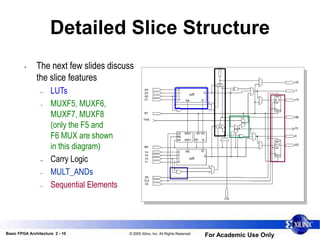
Detailed Slice Structure
• The next few slides discuss
the slice features
– LUTs
– MUXF5, MUXF6,
MUXF7, MUXF8
(only the F5 and
F6 MUX are shown
in this diagram)
– Carry Logic
– MULT_ANDs
– Sequential Elements
Basic FPGA Architecture 2 - 11 © 2005 Xilinx, Inc. All Rights Reserved
For Academic Use Only
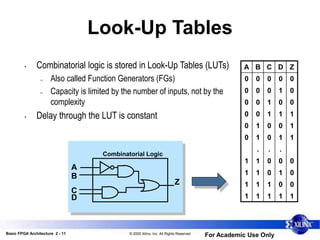
Combinatorial Logic
A
B
C
D
Z
Look-Up Tables
• Combinatorial logic is stored in Look-Up Tables (LUTs)
– Also called Function Generators (FGs)
– Capacity is limited by the number of inputs, not by the
complexity
• Delay through the LUT is constant
A B C D Z
0 0 0 0 0
0 0 0 1 0
0 0 1 0 0
0 0 1 1 1
0 1 0 0 1
0 1 0 1 1
. . .
1 1 0 0 0
1 1 0 1 0
1 1 1 0 0
1 1 1 1 1
Basic FPGA Architecture 2 - 12 © 2005 Xilinx, Inc. All Rights Reserved
For Academic Use Only
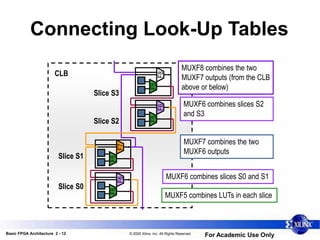
Connecting Look-Up Tables
F5
F8
F5
F6
CLB
Slice S3
Slice S2
Slice S0
Slice S1
F5
F7
F5
F6
MUXF8 combines the two
MUXF7 outputs (from the CLB
above or below)
MUXF6 combines slices S2
and S3
MUXF7 combines the two
MUXF6 outputs
MUXF6 combines slices S0 and S1
MUXF5 combines LUTs in each slice
Basic FPGA Architecture 2 - 13 © 2005 Xilinx, Inc. All Rights Reserved
For Academic Use Only
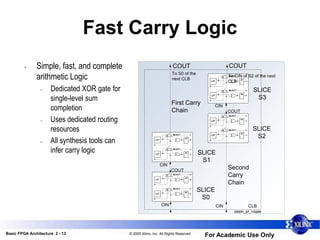
Fast Carry Logic
• Simple, fast, and complete
arithmetic Logic
– Dedicated XOR gate for
single-level sum
completion
– Uses dedicated routing
resources
– All synthesis tools can
infer carry logic
COUT COUT
SLICE
S0
SLICE
S1
Second
Carry
Chain
To S0 of the
next CLB
To CIN of S2 of the next
CLB
First Carry
Chain
SLICE
S3
SLICE
S2
COUT
COUT
CIN
CIN
CIN CIN CLB
Basic FPGA Architecture 2 - 14 © 2005 Xilinx, Inc. All Rights Reserved
For Academic Use Only
CO
DI CI
S
LUT
CY_MUX
CY_XOR
MULT_AND
A
B
A x B
LUT
LUT
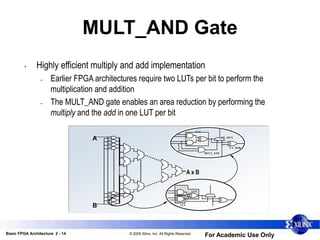
MULT_AND Gate
• Highly efficient multiply and add implementation
– Earlier FPGA architectures require two LUTs per bit to perform the
multiplication and addition
– The MULT_AND gate enables an area reduction by performing the
multiply and the add in one LUT per bit
Basic FPGA Architecture 2 - 15 © 2005 Xilinx, Inc. All Rights Reserved
For Academic Use Only
D
CE
PRE
CLR
Q
FDCPE
D
CE
S
R
Q
FDRSE
D
CE
PRE
CLR
Q
LDCPE
G
_1
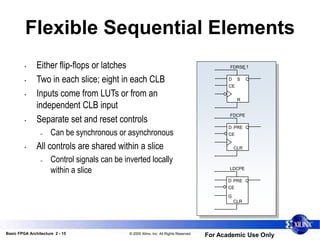
Flexible Sequential Elements
• Either flip-flops or latches
• Two in each slice; eight in each CLB
• Inputs come from LUTs or from an
independent CLB input
• Separate set and reset controls
– Can be synchronous or asynchronous
• All controls are shared within a slice
– Control signals can be inverted locally
within a slice
Basic FPGA Architecture 2 - 16 © 2005 Xilinx, Inc. All Rights Reserved
For Academic Use Only
Shift Register LUT
(SRL16CE)
• Dynamically addressable serial
shift registers
– Maximum delay of 16 clock cycles
per LUT (128 per CLB)
– Cascadable to other LUTs or CLBs
for longer shift registers
• Dedicated connection from Q15
to D input of the next SRL16CE
– Shift register length can
be changed
asynchronously
by toggling address A
LUT
D Q
CE
D Q
CE
D Q
CE
D Q
CE
LUT
D
CE
CLK
A[3:0]
Q
Q15 (cascade out)
Basic FPGA Architecture 2 - 17 © 2005 Xilinx, Inc. All Rights Reserved
For Academic Use Only
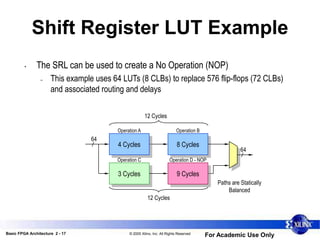
Shift Register LUT Example
• The SRL can be used to create a No Operation (NOP)
– This example uses 64 LUTs (8 CLBs) to replace 576 flip-flops (72 CLBs)
and associated routing and delays
12 Cycles
64
Operation A
4 Cycles 8 Cycles
Operation B
3 Cycles
Operation C
64
12 Cycles
Paths are Statically
Balanced
9 Cycles
Operation D - NOP
Basic FPGA Architecture 2 - 18 © 2005 Xilinx, Inc. All Rights Reserved
For Academic Use Only
Outline
• Overview
• Slice Resources
• I/O Resources
• Memory and Clocking
• Spartan-3, Spartan-3E, and
Virtex-II Pro Features
• Virtex-4 Features
• Summary
• Appendix
Basic FPGA Architecture 2 - 19 © 2005 Xilinx, Inc. All Rights Reserved
For Academic Use Only
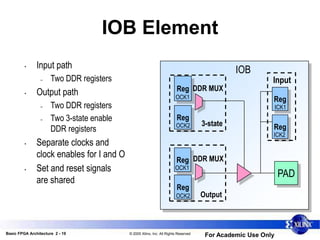
IOB Element
• Input path
– Two DDR registers
• Output path
– Two DDR registers
– Two 3-state enable
DDR registers
• Separate clocks and
clock enables for I and O
• Set and reset signals
are shared
Reg
Reg
DDR MUX
3-state
OCK1
OCK2
Reg
Reg
DDR MUX
Output
OCK1
OCK2
PAD
Reg
Reg
Input
ICK1
ICK2
IOB
Basic FPGA Architecture 2 - 20 © 2005 Xilinx, Inc. All Rights Reserved
For Academic Use Only
SelectIO Standard
• Allows direct connections to external signals of varied voltages and
thresholds
– Optimizes the speed/noise tradeoff
– Saves having to place interface components onto your board
• Differential signaling standards
– LVDS, BLVDS, ULVDS
– LDT
– LVPECL
• Single-ended I/O standards
– LVTTL, LVCMOS (3.3V, 2.5V, 1.8V, and 1.5V)
– PCI-X at 133 MHz, PCI (3.3V at 33 MHz and 66 MHz)
– GTL, GTLP
– and more!
Basic FPGA Architecture 2 - 21 © 2005 Xilinx, Inc. All Rights Reserved
For Academic Use Only
Digital Controlled
Impedance (DCI)
• DCI provides
– Output drivers that match the impedance of the traces
– On-chip termination for receivers and transmitters
• DCI advantages
– Improves signal integrity by eliminating stub reflections
– Reduces board routing complexity and component count by eliminating
external resistors
– Eliminates the effects of temperature, voltage, and process variations by
using an internal feedback circuit
Basic FPGA Architecture 2 - 22 © 2005 Xilinx, Inc. All Rights Reserved
For Academic Use Only
Outline
• Overview
• Slice Resources
• I/O Resources
• Memory and Clocking
• Spartan-3, Spartan-3E, and
Virtex-II Pro Features
• Virtex-4 Features
• Summary
• Appendix
Basic FPGA Architecture 2 - 23 © 2005 Xilinx, Inc. All Rights Reserved
For Academic Use Only
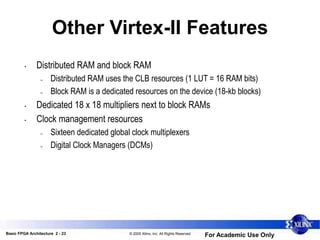
Other Virtex-II Features
• Distributed RAM and block RAM
– Distributed RAM uses the CLB resources (1 LUT = 16 RAM bits)
– Block RAM is a dedicated resources on the device (18-kb blocks)
• Dedicated 18 x 18 multipliers next to block RAMs
• Clock management resources
– Sixteen dedicated global clock multiplexers
– Digital Clock Managers (DCMs)
Basic FPGA Architecture 2 - 24 © 2005 Xilinx, Inc. All Rights Reserved
For Academic Use Only
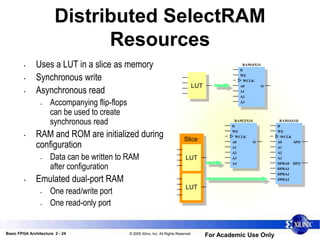
Distributed SelectRAM
Resources
• Uses a LUT in a slice as memory
• Synchronous write
• Asynchronous read
– Accompanying flip-flops
can be used to create
synchronous read
• RAM and ROM are initialized during
configuration
– Data can be written to RAM
after configuration
• Emulated dual-port RAM
– One read/write port
– One read-only port
RAM16X1S
O
D
WE
WCLK
A0
A1
A2
A3
LUT
RAM32X1S
O
D
WE
WCLK
A0
A1
A2
A3
A4
RAM16X1D
SPO
D
WE
WCLK
A0
A1
A2
A3
DPRA0 DPO
DPRA1
DPRA2
DPRA3
Slice
LUT
LUT
Basic FPGA Architecture 2 - 25 © 2005 Xilinx, Inc. All Rights Reserved
For Academic Use Only
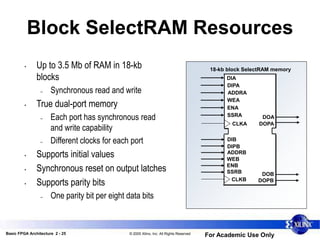
Block SelectRAM Resources
• Up to 3.5 Mb of RAM in 18-kb
blocks
– Synchronous read and write
• True dual-port memory
– Each port has synchronous read
and write capability
– Different clocks for each port
• Supports initial values
• Synchronous reset on output latches
• Supports parity bits
– One parity bit per eight data bits
DIA
DIPA
ADDRA
WEA
ENA
SSRA
CLKA
DIB
DIPB
WEB
ADDRB
ENB
SSRB
DOA
CLKB
DOPA
DOPB
DOB
18-kb block SelectRAM memory
Basic FPGA Architecture 2 - 26 © 2005 Xilinx, Inc. All Rights Reserved
For Academic Use Only
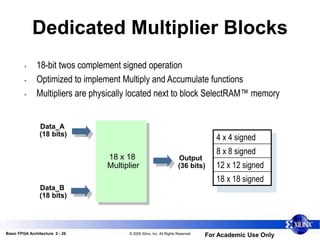
Dedicated Multiplier Blocks
• 18-bit twos complement signed operation
• Optimized to implement Multiply and Accumulate functions
• Multipliers are physically located next to block SelectRAM™ memory
18 x 18
Multiplier
Output
(36 bits)
Data_A
(18 bits)
Data_B
(18 bits)
4 x 4 signed
8 x 8 signed
12 x 12 signed
18 x 18 signed
Basic FPGA Architecture 2 - 27 © 2005 Xilinx, Inc. All Rights Reserved
For Academic Use Only
Global Clock Routing
Resources
• Sixteen dedicated global clock multiplexers
– Eight on the top-center of the die, eight on the bottom-center
– Driven by a clock input pad, a DCM, or local routing
• Global clock multiplexers provide the following:
– Traditional clock buffer (BUFG) function
– Global clock enable capability (BUFGCE)
– Glitch-free switching between clock signals (BUFGMUX)
• Up to eight clock nets can be used in each clock region of the device
– Each device contains four or more clock regions
Basic FPGA Architecture 2 - 28 © 2005 Xilinx, Inc. All Rights Reserved
For Academic Use Only
Digital Clock Manager (DCM)
• Up to twelve DCMs per device
– Located on the top and bottom edges of the die
– Driven by clock input pads
• DCMs provide the following:
– Delay-Locked Loop (DLL)
– Digital Frequency Synthesizer (DFS)
– Digital Phase Shifter (DPS)
• Up to four outputs of each DCM can drive onto global clock buffers
– All DCM outputs can drive general routing
Basic FPGA Architecture 2 - 29 © 2005 Xilinx, Inc. All Rights Reserved
For Academic Use Only
Outline
• Overview
• Slice Resources
• I/O Resources
• Memory and Clocking
• Spartan-3, Spartan-3E,
and Virtex-II Pro Features
• Virtex-4 Features
• Summary
• Appendix
Basic FPGA Architecture 2 - 30 © 2005 Xilinx, Inc. All Rights Reserved
For Academic Use Only
Spartan-3 versus Virtex-II
• Lower cost
• Smaller process = lower core
voltage
– .09 micron versus .15 micron
– Vccint = 1.2V versus 1.5V
• Different I/O standard support
– New standards: 1.2V LVCMOS,
1.8V HSTL, and SSTL
– Default is LVCMOS, versus
LVTTL
• More I/O pins per package
• Only one-half of the slices
support RAM or SRL16s
(SLICEM)
• Fewer block RAMs and multiplier
blocks
– Same size and functionality
• Eight global clock multiplexers
• Two or four DCM blocks
• No internal 3-state buffers
– 3-state buffers are in the I/O
Basic FPGA Architecture 2 - 31 © 2005 Xilinx, Inc. All Rights Reserved
For Academic Use Only
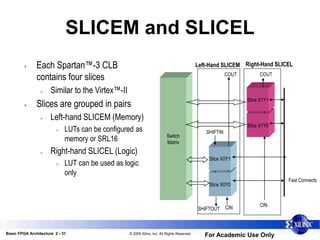
SLICEM and SLICEL
• Each Spartan™-3 CLB
contains four slices
– Similar to the Virtex™-II
• Slices are grouped in pairs
– Left-hand SLICEM (Memory)
• LUTs can be configured as
memory or SRL16
– Right-hand SLICEL (Logic)
• LUT can be used as logic
only
CIN
Switch
Matrix
COUT
COUT
Slice X0Y0
Slice X0Y1
Fast Connects
Slice X1Y0
Slice X1Y1
CIN
SHIFTIN
Left-Hand SLICEM Right-Hand SLICEL
SHIFTOUT
Basic FPGA Architecture 2 - 32 © 2005 Xilinx, Inc. All Rights Reserved
For Academic Use Only
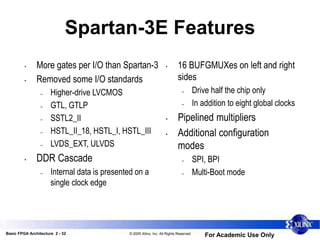
Spartan-3E Features
• More gates per I/O than Spartan-3
• Removed some I/O standards
– Higher-drive LVCMOS
– GTL, GTLP
– SSTL2_II
– HSTL_II_18, HSTL_I, HSTL_III
– LVDS_EXT, ULVDS
• DDR Cascade
– Internal data is presented on a
single clock edge
• 16 BUFGMUXes on left and right
sides
– Drive half the chip only
– In addition to eight global clocks
• Pipelined multipliers
• Additional configuration
modes
– SPI, BPI
– Multi-Boot mode
Basic FPGA Architecture 2 - 33 © 2005 Xilinx, Inc. All Rights Reserved
For Academic Use Only
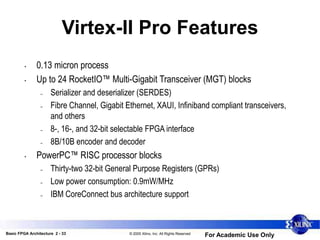
Virtex-II Pro Features
• 0.13 micron process
• Up to 24 RocketIO™ Multi-Gigabit Transceiver (MGT) blocks
– Serializer and deserializer (SERDES)
– Fibre Channel, Gigabit Ethernet, XAUI, Infiniband compliant transceivers,
and others
– 8-, 16-, and 32-bit selectable FPGA interface
– 8B/10B encoder and decoder
• PowerPC™ RISC processor blocks
– Thirty-two 32-bit General Purpose Registers (GPRs)
– Low power consumption: 0.9mW/MHz
– IBM CoreConnect bus architecture support
Basic FPGA Architecture 2 - 34 © 2005 Xilinx, Inc. All Rights Reserved
For Academic Use Only
Outline
• Overview
• Slice Resources
• I/O Resources
• Memory and Clocking
• Spartan-3, Spartan-3E, and
Virtex-II Pro Features
• Virtex-4 Features
• Summary
• Appendix
Basic FPGA Architecture 2 - 35 © 2005 Xilinx, Inc. All Rights Reserved
For Academic Use Only
Virtex-4 Features
• New features
– Dedicated DSP blocks
– Phase-matched clock dividers (PMCD)
– SERDES built into the Virtex™-4 SelectIO™ standard
– Dynamic reconfiguration port (DRP)
• Enhanced features
– Block RAM can be configured as a FIFO
– Advanced clocking networks, including regional clock buffers and source-
synchronous support
– 11.1 Gbps RocketIO™ Multi-Gigabit Transceiver (MGT) blocks
– Enhanced PowerPC™ processor blocks
Basic FPGA Architecture 2 - 36 © 2005 Xilinx, Inc. All Rights Reserved
For Academic Use Only
Outline
• Overview
• Slice Resources
• I/O Resources
• Memory and Clocking
• Spartan-3, Spartan-3E, and
Virtex-II Pro Features
• Virtex-4 Features
• Summary
• Appendix
Basic FPGA Architecture 2 - 37 © 2005 Xilinx, Inc. All Rights Reserved
For Academic Use Only
Review Questions
• List the primary slice features
• List the three ways a LUT can be configured
Basic FPGA Architecture 2 - 38 © 2005 Xilinx, Inc. All Rights Reserved
For Academic Use Only
Answers
• List the primary slice features
– Look-up tables and function generators (two per slice, eight per CLB)
– Registers (two per slice, eight per CLB)
– Dedicated multiplexers (MUXF5, MUXF6, MUXF7, MUXF8)
– Carry logic
– MULT_AND gate
• List the three ways a LUT can be configured
– Combinatorial logic
– Shift register (SRL16CE)
– Distributed memory
Basic FPGA Architecture 2 - 39 © 2005 Xilinx, Inc. All Rights Reserved
For Academic Use Only
Summary
• Slices contain LUTs, registers, and carry logic
– LUTs are connected with dedicated multiplexers and carry logic
– LUTs can be configured as shift registers or memory
• IOBs contain DDR registers
• SelectIO™ standards and DCI enable direct connection to multiple I/O
standards while reducing component count
• Virtex™-II memory resources include the following:
– Distributed SelectRAM™ resources and distributed SelectROM (uses CLB
LUTs)
– 18-kb block SelectRAM resources
Basic FPGA Architecture 2 - 40 © 2005 Xilinx, Inc. All Rights Reserved
For Academic Use Only
Summary
• The Virtex™-II devices contain dedicated 18x18 multipliers next to each
block SelectRAM™ resource
• Digital clock managers provide the following:
– Delay-Locked Loop (DLL)
– Digital Frequency Synthesizer (DFS)
– Digital Phase Shifter (DPS)
Basic FPGA Architecture 2 - 41 © 2005 Xilinx, Inc. All Rights Reserved
For Academic Use Only
Where Can I Learn More?
• User Guides
– www.xilinx.com  Documentation  User Guides
• Application Notes
– www.xilinx.com  Documentation  Application Notes
• Education resources
– Designing with the Virtex-4 Family course
– Spartan-3E Architecture free Recorded e-Learning

Basic FPGA Architecture, Virtex CLB IO blocks

  • 1.
    © 2005 Xilinx,Inc. All Rights Reserved Basic FPGA Architecture
  • 2.
    Basic FPGA Architecture2 - 3 © 2005 Xilinx, Inc. All Rights Reserved For Academic Use Only Objectives After completing this module, you will be able to: • Identify the basic architectural resources of the Virtex™-II FPGA • List the differences between the Virtex-II, Virtex-II Pro, Spartan™-3, and Spartan-3E devices • List the new and enhanced features of the new Virtex-4 device family
  • 3.
    Basic FPGA Architecture2 - 4 © 2005 Xilinx, Inc. All Rights Reserved For Academic Use Only Outline • Overview • Slice Resources • I/O Resources • Memory and Clocking • Spartan-3, Spartan-3E, and Virtex-II Pro Features • Virtex-4 Features • Summary • Appendix
  • 4.
    Basic FPGA Architecture2 - 5 © 2005 Xilinx, Inc. All Rights Reserved For Academic Use Only Overview • All Xilinx FPGAs contain the same basic resources – Slices (grouped into CLBs) • Contain combinatorial logic and register resources – IOBs • Interface between the FPGA and the outside world – Programmable interconnect – Other resources • Memory • Multipliers • Global clock buffers • Boundary scan logic
  • 5.
    Basic FPGA Architecture2 - 7 © 2005 Xilinx, Inc. All Rights Reserved For Academic Use Only Outline • Overview • Slice Resources • I/O Resources • Memory and Clocking • Spartan-3, Spartan-3E, and Virtex-II Pro Features • Virtex-4 Features • Summary • Appendix
  • 6.
    Basic FPGA Architecture2 - 8 © 2005 Xilinx, Inc. All Rights Reserved For Academic Use Only Slices and CLBs • Each Virtex-II CLB contains four slices – Local routing provides feedback between slices in the same CLB, and it provides routing to neighboring CLBs – A switch matrix provides access to general routing resources CIN Switch Matrix BUFT BUF T COUT COUT Slice S0 Slice S1 Local Routing Slice S2 Slice S3 CIN SHIFT
  • 7.
    Basic FPGA Architecture2 - 9 © 2005 Xilinx, Inc. All Rights Reserved For Academic Use Only Slice 0 LUT Carry LUT Carry D Q CE PRE CLR D Q CE PRE CLR Simplified Slice Structure • Each slice has four outputs – Two registered outputs, two non-registered outputs – Two BUFTs associated with each CLB, accessible by all 16 CLB outputs • Carry logic runs vertically, up only – Two independent carry chains per CLB
  • 8.
    Basic FPGA Architecture2 - 10 © 2005 Xilinx, Inc. All Rights Reserved For Academic Use Only Detailed Slice Structure • The next few slides discuss the slice features – LUTs – MUXF5, MUXF6, MUXF7, MUXF8 (only the F5 and F6 MUX are shown in this diagram) – Carry Logic – MULT_ANDs – Sequential Elements
  • 9.
    Basic FPGA Architecture2 - 11 © 2005 Xilinx, Inc. All Rights Reserved For Academic Use Only Combinatorial Logic A B C D Z Look-Up Tables • Combinatorial logic is stored in Look-Up Tables (LUTs) – Also called Function Generators (FGs) – Capacity is limited by the number of inputs, not by the complexity • Delay through the LUT is constant A B C D Z 0 0 0 0 0 0 0 0 1 0 0 0 1 0 0 0 0 1 1 1 0 1 0 0 1 0 1 0 1 1 . . . 1 1 0 0 0 1 1 0 1 0 1 1 1 0 0 1 1 1 1 1
  • 10.
    Basic FPGA Architecture2 - 12 © 2005 Xilinx, Inc. All Rights Reserved For Academic Use Only Connecting Look-Up Tables F5 F8 F5 F6 CLB Slice S3 Slice S2 Slice S0 Slice S1 F5 F7 F5 F6 MUXF8 combines the two MUXF7 outputs (from the CLB above or below) MUXF6 combines slices S2 and S3 MUXF7 combines the two MUXF6 outputs MUXF6 combines slices S0 and S1 MUXF5 combines LUTs in each slice
  • 11.
    Basic FPGA Architecture2 - 13 © 2005 Xilinx, Inc. All Rights Reserved For Academic Use Only Fast Carry Logic • Simple, fast, and complete arithmetic Logic – Dedicated XOR gate for single-level sum completion – Uses dedicated routing resources – All synthesis tools can infer carry logic COUT COUT SLICE S0 SLICE S1 Second Carry Chain To S0 of the next CLB To CIN of S2 of the next CLB First Carry Chain SLICE S3 SLICE S2 COUT COUT CIN CIN CIN CIN CLB
  • 12.
    Basic FPGA Architecture2 - 14 © 2005 Xilinx, Inc. All Rights Reserved For Academic Use Only CO DI CI S LUT CY_MUX CY_XOR MULT_AND A B A x B LUT LUT MULT_AND Gate • Highly efficient multiply and add implementation – Earlier FPGA architectures require two LUTs per bit to perform the multiplication and addition – The MULT_AND gate enables an area reduction by performing the multiply and the add in one LUT per bit
  • 13.
    Basic FPGA Architecture2 - 15 © 2005 Xilinx, Inc. All Rights Reserved For Academic Use Only D CE PRE CLR Q FDCPE D CE S R Q FDRSE D CE PRE CLR Q LDCPE G _1 Flexible Sequential Elements • Either flip-flops or latches • Two in each slice; eight in each CLB • Inputs come from LUTs or from an independent CLB input • Separate set and reset controls – Can be synchronous or asynchronous • All controls are shared within a slice – Control signals can be inverted locally within a slice
  • 14.
    Basic FPGA Architecture2 - 16 © 2005 Xilinx, Inc. All Rights Reserved For Academic Use Only Shift Register LUT (SRL16CE) • Dynamically addressable serial shift registers – Maximum delay of 16 clock cycles per LUT (128 per CLB) – Cascadable to other LUTs or CLBs for longer shift registers • Dedicated connection from Q15 to D input of the next SRL16CE – Shift register length can be changed asynchronously by toggling address A LUT D Q CE D Q CE D Q CE D Q CE LUT D CE CLK A[3:0] Q Q15 (cascade out)
  • 15.
    Basic FPGA Architecture2 - 17 © 2005 Xilinx, Inc. All Rights Reserved For Academic Use Only Shift Register LUT Example • The SRL can be used to create a No Operation (NOP) – This example uses 64 LUTs (8 CLBs) to replace 576 flip-flops (72 CLBs) and associated routing and delays 12 Cycles 64 Operation A 4 Cycles 8 Cycles Operation B 3 Cycles Operation C 64 12 Cycles Paths are Statically Balanced 9 Cycles Operation D - NOP
  • 16.
    Basic FPGA Architecture2 - 18 © 2005 Xilinx, Inc. All Rights Reserved For Academic Use Only Outline • Overview • Slice Resources • I/O Resources • Memory and Clocking • Spartan-3, Spartan-3E, and Virtex-II Pro Features • Virtex-4 Features • Summary • Appendix
  • 17.
    Basic FPGA Architecture2 - 19 © 2005 Xilinx, Inc. All Rights Reserved For Academic Use Only IOB Element • Input path – Two DDR registers • Output path – Two DDR registers – Two 3-state enable DDR registers • Separate clocks and clock enables for I and O • Set and reset signals are shared Reg Reg DDR MUX 3-state OCK1 OCK2 Reg Reg DDR MUX Output OCK1 OCK2 PAD Reg Reg Input ICK1 ICK2 IOB
  • 18.
    Basic FPGA Architecture2 - 20 © 2005 Xilinx, Inc. All Rights Reserved For Academic Use Only SelectIO Standard • Allows direct connections to external signals of varied voltages and thresholds – Optimizes the speed/noise tradeoff – Saves having to place interface components onto your board • Differential signaling standards – LVDS, BLVDS, ULVDS – LDT – LVPECL • Single-ended I/O standards – LVTTL, LVCMOS (3.3V, 2.5V, 1.8V, and 1.5V) – PCI-X at 133 MHz, PCI (3.3V at 33 MHz and 66 MHz) – GTL, GTLP – and more!
  • 19.
    Basic FPGA Architecture2 - 21 © 2005 Xilinx, Inc. All Rights Reserved For Academic Use Only Digital Controlled Impedance (DCI) • DCI provides – Output drivers that match the impedance of the traces – On-chip termination for receivers and transmitters • DCI advantages – Improves signal integrity by eliminating stub reflections – Reduces board routing complexity and component count by eliminating external resistors – Eliminates the effects of temperature, voltage, and process variations by using an internal feedback circuit
  • 20.
    Basic FPGA Architecture2 - 22 © 2005 Xilinx, Inc. All Rights Reserved For Academic Use Only Outline • Overview • Slice Resources • I/O Resources • Memory and Clocking • Spartan-3, Spartan-3E, and Virtex-II Pro Features • Virtex-4 Features • Summary • Appendix
  • 21.
    Basic FPGA Architecture2 - 23 © 2005 Xilinx, Inc. All Rights Reserved For Academic Use Only Other Virtex-II Features • Distributed RAM and block RAM – Distributed RAM uses the CLB resources (1 LUT = 16 RAM bits) – Block RAM is a dedicated resources on the device (18-kb blocks) • Dedicated 18 x 18 multipliers next to block RAMs • Clock management resources – Sixteen dedicated global clock multiplexers – Digital Clock Managers (DCMs)
  • 22.
    Basic FPGA Architecture2 - 24 © 2005 Xilinx, Inc. All Rights Reserved For Academic Use Only Distributed SelectRAM Resources • Uses a LUT in a slice as memory • Synchronous write • Asynchronous read – Accompanying flip-flops can be used to create synchronous read • RAM and ROM are initialized during configuration – Data can be written to RAM after configuration • Emulated dual-port RAM – One read/write port – One read-only port RAM16X1S O D WE WCLK A0 A1 A2 A3 LUT RAM32X1S O D WE WCLK A0 A1 A2 A3 A4 RAM16X1D SPO D WE WCLK A0 A1 A2 A3 DPRA0 DPO DPRA1 DPRA2 DPRA3 Slice LUT LUT
  • 23.
    Basic FPGA Architecture2 - 25 © 2005 Xilinx, Inc. All Rights Reserved For Academic Use Only Block SelectRAM Resources • Up to 3.5 Mb of RAM in 18-kb blocks – Synchronous read and write • True dual-port memory – Each port has synchronous read and write capability – Different clocks for each port • Supports initial values • Synchronous reset on output latches • Supports parity bits – One parity bit per eight data bits DIA DIPA ADDRA WEA ENA SSRA CLKA DIB DIPB WEB ADDRB ENB SSRB DOA CLKB DOPA DOPB DOB 18-kb block SelectRAM memory
  • 24.
    Basic FPGA Architecture2 - 26 © 2005 Xilinx, Inc. All Rights Reserved For Academic Use Only Dedicated Multiplier Blocks • 18-bit twos complement signed operation • Optimized to implement Multiply and Accumulate functions • Multipliers are physically located next to block SelectRAM™ memory 18 x 18 Multiplier Output (36 bits) Data_A (18 bits) Data_B (18 bits) 4 x 4 signed 8 x 8 signed 12 x 12 signed 18 x 18 signed
  • 25.
    Basic FPGA Architecture2 - 27 © 2005 Xilinx, Inc. All Rights Reserved For Academic Use Only Global Clock Routing Resources • Sixteen dedicated global clock multiplexers – Eight on the top-center of the die, eight on the bottom-center – Driven by a clock input pad, a DCM, or local routing • Global clock multiplexers provide the following: – Traditional clock buffer (BUFG) function – Global clock enable capability (BUFGCE) – Glitch-free switching between clock signals (BUFGMUX) • Up to eight clock nets can be used in each clock region of the device – Each device contains four or more clock regions
  • 26.
    Basic FPGA Architecture2 - 28 © 2005 Xilinx, Inc. All Rights Reserved For Academic Use Only Digital Clock Manager (DCM) • Up to twelve DCMs per device – Located on the top and bottom edges of the die – Driven by clock input pads • DCMs provide the following: – Delay-Locked Loop (DLL) – Digital Frequency Synthesizer (DFS) – Digital Phase Shifter (DPS) • Up to four outputs of each DCM can drive onto global clock buffers – All DCM outputs can drive general routing
  • 27.
    Basic FPGA Architecture2 - 29 © 2005 Xilinx, Inc. All Rights Reserved For Academic Use Only Outline • Overview • Slice Resources • I/O Resources • Memory and Clocking • Spartan-3, Spartan-3E, and Virtex-II Pro Features • Virtex-4 Features • Summary • Appendix
  • 28.
    Basic FPGA Architecture2 - 30 © 2005 Xilinx, Inc. All Rights Reserved For Academic Use Only Spartan-3 versus Virtex-II • Lower cost • Smaller process = lower core voltage – .09 micron versus .15 micron – Vccint = 1.2V versus 1.5V • Different I/O standard support – New standards: 1.2V LVCMOS, 1.8V HSTL, and SSTL – Default is LVCMOS, versus LVTTL • More I/O pins per package • Only one-half of the slices support RAM or SRL16s (SLICEM) • Fewer block RAMs and multiplier blocks – Same size and functionality • Eight global clock multiplexers • Two or four DCM blocks • No internal 3-state buffers – 3-state buffers are in the I/O
  • 29.
    Basic FPGA Architecture2 - 31 © 2005 Xilinx, Inc. All Rights Reserved For Academic Use Only SLICEM and SLICEL • Each Spartan™-3 CLB contains four slices – Similar to the Virtex™-II • Slices are grouped in pairs – Left-hand SLICEM (Memory) • LUTs can be configured as memory or SRL16 – Right-hand SLICEL (Logic) • LUT can be used as logic only CIN Switch Matrix COUT COUT Slice X0Y0 Slice X0Y1 Fast Connects Slice X1Y0 Slice X1Y1 CIN SHIFTIN Left-Hand SLICEM Right-Hand SLICEL SHIFTOUT
  • 30.
    Basic FPGA Architecture2 - 32 © 2005 Xilinx, Inc. All Rights Reserved For Academic Use Only Spartan-3E Features • More gates per I/O than Spartan-3 • Removed some I/O standards – Higher-drive LVCMOS – GTL, GTLP – SSTL2_II – HSTL_II_18, HSTL_I, HSTL_III – LVDS_EXT, ULVDS • DDR Cascade – Internal data is presented on a single clock edge • 16 BUFGMUXes on left and right sides – Drive half the chip only – In addition to eight global clocks • Pipelined multipliers • Additional configuration modes – SPI, BPI – Multi-Boot mode
  • 31.
    Basic FPGA Architecture2 - 33 © 2005 Xilinx, Inc. All Rights Reserved For Academic Use Only Virtex-II Pro Features • 0.13 micron process • Up to 24 RocketIO™ Multi-Gigabit Transceiver (MGT) blocks – Serializer and deserializer (SERDES) – Fibre Channel, Gigabit Ethernet, XAUI, Infiniband compliant transceivers, and others – 8-, 16-, and 32-bit selectable FPGA interface – 8B/10B encoder and decoder • PowerPC™ RISC processor blocks – Thirty-two 32-bit General Purpose Registers (GPRs) – Low power consumption: 0.9mW/MHz – IBM CoreConnect bus architecture support
  • 32.
    Basic FPGA Architecture2 - 34 © 2005 Xilinx, Inc. All Rights Reserved For Academic Use Only Outline • Overview • Slice Resources • I/O Resources • Memory and Clocking • Spartan-3, Spartan-3E, and Virtex-II Pro Features • Virtex-4 Features • Summary • Appendix
  • 33.
    Basic FPGA Architecture2 - 35 © 2005 Xilinx, Inc. All Rights Reserved For Academic Use Only Virtex-4 Features • New features – Dedicated DSP blocks – Phase-matched clock dividers (PMCD) – SERDES built into the Virtex™-4 SelectIO™ standard – Dynamic reconfiguration port (DRP) • Enhanced features – Block RAM can be configured as a FIFO – Advanced clocking networks, including regional clock buffers and source- synchronous support – 11.1 Gbps RocketIO™ Multi-Gigabit Transceiver (MGT) blocks – Enhanced PowerPC™ processor blocks
  • 34.
    Basic FPGA Architecture2 - 36 © 2005 Xilinx, Inc. All Rights Reserved For Academic Use Only Outline • Overview • Slice Resources • I/O Resources • Memory and Clocking • Spartan-3, Spartan-3E, and Virtex-II Pro Features • Virtex-4 Features • Summary • Appendix
  • 35.
    Basic FPGA Architecture2 - 37 © 2005 Xilinx, Inc. All Rights Reserved For Academic Use Only Review Questions • List the primary slice features • List the three ways a LUT can be configured
  • 36.
    Basic FPGA Architecture2 - 38 © 2005 Xilinx, Inc. All Rights Reserved For Academic Use Only Answers • List the primary slice features – Look-up tables and function generators (two per slice, eight per CLB) – Registers (two per slice, eight per CLB) – Dedicated multiplexers (MUXF5, MUXF6, MUXF7, MUXF8) – Carry logic – MULT_AND gate • List the three ways a LUT can be configured – Combinatorial logic – Shift register (SRL16CE) – Distributed memory
  • 37.
    Basic FPGA Architecture2 - 39 © 2005 Xilinx, Inc. All Rights Reserved For Academic Use Only Summary • Slices contain LUTs, registers, and carry logic – LUTs are connected with dedicated multiplexers and carry logic – LUTs can be configured as shift registers or memory • IOBs contain DDR registers • SelectIO™ standards and DCI enable direct connection to multiple I/O standards while reducing component count • Virtex™-II memory resources include the following: – Distributed SelectRAM™ resources and distributed SelectROM (uses CLB LUTs) – 18-kb block SelectRAM resources
  • 38.
    Basic FPGA Architecture2 - 40 © 2005 Xilinx, Inc. All Rights Reserved For Academic Use Only Summary • The Virtex™-II devices contain dedicated 18x18 multipliers next to each block SelectRAM™ resource • Digital clock managers provide the following: – Delay-Locked Loop (DLL) – Digital Frequency Synthesizer (DFS) – Digital Phase Shifter (DPS)
  • 39.
    Basic FPGA Architecture2 - 41 © 2005 Xilinx, Inc. All Rights Reserved For Academic Use Only Where Can I Learn More? • User Guides – www.xilinx.com  Documentation  User Guides • Application Notes – www.xilinx.com  Documentation  Application Notes • Education resources – Designing with the Virtex-4 Family course – Spartan-3E Architecture free Recorded e-Learning